
Wooden shipping crates are framed wooden containers on skids that protect heavy or fragile cargo in transit; a wooden box is a lighter, fully closed package without the load frame. Choose a crate when the load is heavy, lifted by forklift or stacked at sea. Minh Thanh Plywood supplies the plywood that sheathes them.
What are wooden shipping crates?
A wooden shipping crate is a framed wooden container, usually built on skids, that protects heavy or fragile cargo during handling and transport. Its frame carries the load and the forklift; sheathing panels or slats close the sides. Machinery, engines, moulds, electrical cabinets and stone are shipped in wooden crates because a frame keeps them safe when the package is lifted, stacked and lashed.
Wooden crates are made by packaging firms and in-house packing shops, often around the cargo itself. Minh Thanh does not build crates; we supply packing plywood and LVL to the firms that do.
Wooden crate vs wooden box: what is the difference?
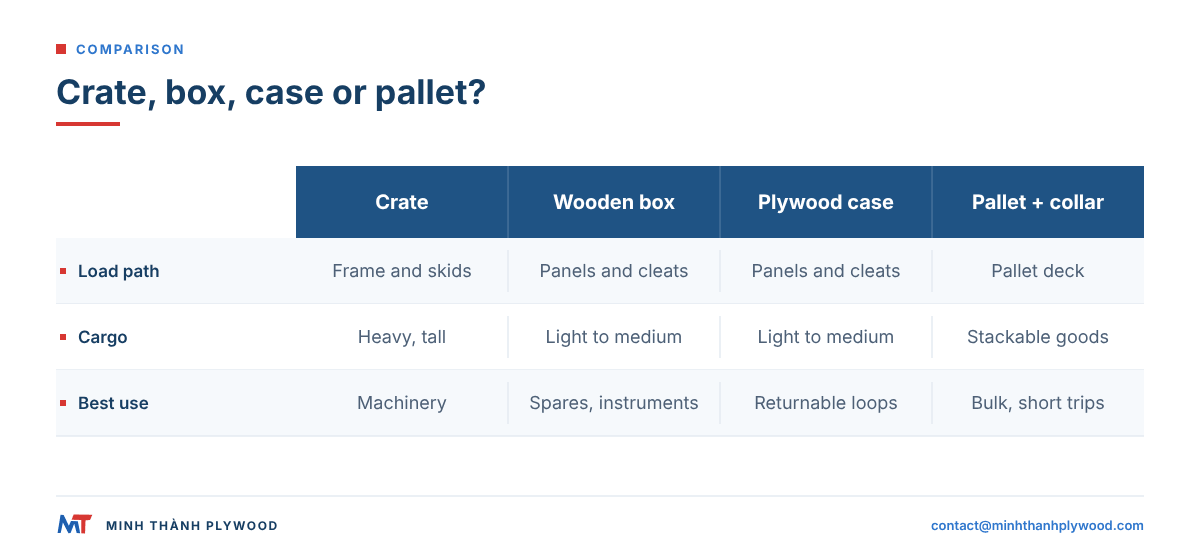
The difference between a wooden crate and a wooden box is the frame. A crate has a load-bearing frame of skids, frame members and diagonal braces, with panels or slats fixed to it; a wooden box is a closed package whose panels carry the load themselves.
| Metric | Wooden crate | Wooden box | Plywood case | Pallet with collar |
|---|---|---|---|---|
| Load path | Frame and skids | Panels and cleats | Panels and cleats | Pallet deck |
| Sides | Sheathed or open slats | Fully closed | Fully closed | Removable collars |
| Usual cargo weight | Heavy, from hundreds of kilograms to many tonnes | Light to medium | Light to medium | Light to medium |
| Forklift entry | Under the skids | Only with a base | Only with a base | Under the pallet |
| Stacking at sea | With top joists | Limited | Limited | Limited |
| Ventilation | Possible with open slats | None | None | Some |
| Build cost | Highest | Medium | Medium | Lowest |
| Best use | Machinery, long and heavy parts | Spares, instruments | Returnable or collapsible loops | Bulk goods, short trips |
Verdict by use: choose a crate for anything heavy, tall or with a high centre of gravity; a box or plywood case for parts and instruments under a few hundred kilograms; a collared pallet for stackable goods that need little protection. For box types in detail, see plywood boxes.
Which types of wood crates are there?
Wooden crates come in four main types, set by how closed they are and how they are built:
- Open (slatted or skeleton) crate: a frame with spaced boards, light and ventilated, for sturdy cargo that only needs a frame.
- Closed (sheathed) crate: the frame covered by plywood or boards, for cargo that must stay clean and dry.
- Sea or export crate: a closed crate with a moisture barrier bag, desiccant and a sloped or reinforced lid for long sea voyages.
- Collapsible or bolted crate: panels screwed or bolted to the frame, opened and reused in closed loops.
ASTM D6039 is the American standard for open and covered wood crates, and many machinery buyers write their own crate specification on top of it.
Standard wooden crate sizes and costs in the UK
UK buyers meet three kinds of crate: flat-pack stock crates in thin plywood, used heavy-duty crates, and custom export crates built around the cargo.
BiGDUG lists 12 stock sizes from 250 × 250 × 250 mm to 1200 × 790 × 760 mm, with 4 or 5 mm plywood depending on the model, a 250 mm cube weighing 1.5 kg, rated to carry up to 100 kg uniformly distributed (UDL), delivered flat-packed in 3 parts with delivery in 2 to 3 working days (BiGDUG). Reuseabox sells used heavy-duty crates of 1060 × 1060 × 1140 mm in 6 mm plywood at a listed range of £9.62 to £62.83 each (Reuseabox).
| Crate kind | Size | Plywood | Load | Price signal |
|---|---|---|---|---|
| Flat-pack stock crate | 250 × 250 × 250 mm up to 1200 × 790 × 760 mm | 4 mm | Up to 100 kg UDL | Priced per crate; free delivery on larger orders |
| Used heavy-duty crate | 1060 × 1060 × 1140 mm | 6 mm | Not stated by the seller | £9.62 to £62.83 each |
| Custom air-freight or export crate | Built to the cargo | 9–18 mm | By crate design and frame | Quoted per job, above stock crates |
Alban, a UK case maker, says its air-freight plywood cases use 9 to 18 mm plywood (Alban Cases). The load rating belongs to the crate design (frame, skids and sheathing together), not to the sheet alone; a thin 4 mm skin carries its stock rating only inside its own frame, and heavier cargo moves to the framed designs in this guide.
UK crate makers prove their ISPM 15 compliance with a registration. Producers of treated wood packaging in the UK belong to the UK Wood Packaging Material Marking Programme, are assessed every six months and register with the Forestry Commission, and their mark carries a producer number (GOV.UK, wood packaging material). Alban, for instance, quotes Forestry Commission number FC0624. Plywood sheathing and LVL are exempt materials. For a mixed-material crate, the authorized mark certifies the assembled unit and may be placed on its plywood face for visibility.
What are the parts of a wooden shipping crate?
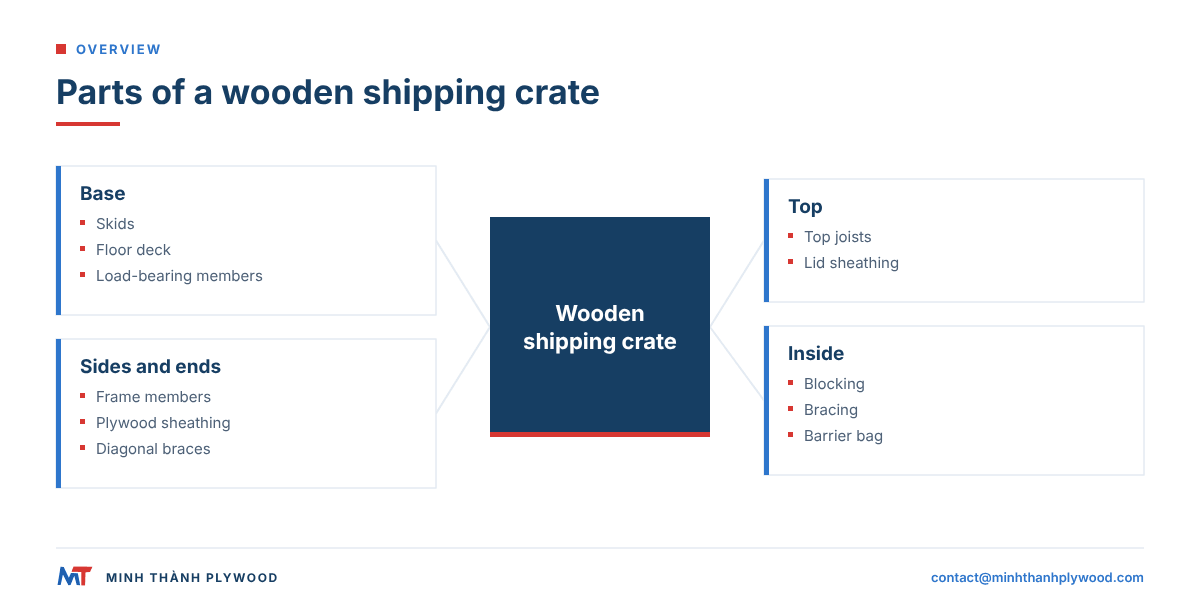
The parts of a wooden shipping crate are the skids, the base, the frame, the sheathing, the braces, the top and the blocking. Each has one job.
- Skids: the runners under the crate that carry the whole load and leave room for forklift tines.
- Floor or base: boards or a plywood deck fixed to the skids, with load-bearing floor members under heavy points.
- Frame members: the edge members of each side and end panel.
- Sheathing: plywood or boards that close the sides, ends and top.
- Diagonal braces: members across the side frames that stop the crate racking.
- Top joists and lid: carry stacking loads and keep the lid from sagging.
- End panels: often removable, for loading and unloading.
- Blocking and bracing: internal members that stop the cargo sliding or tipping.
Which wood is best for wooden crates?
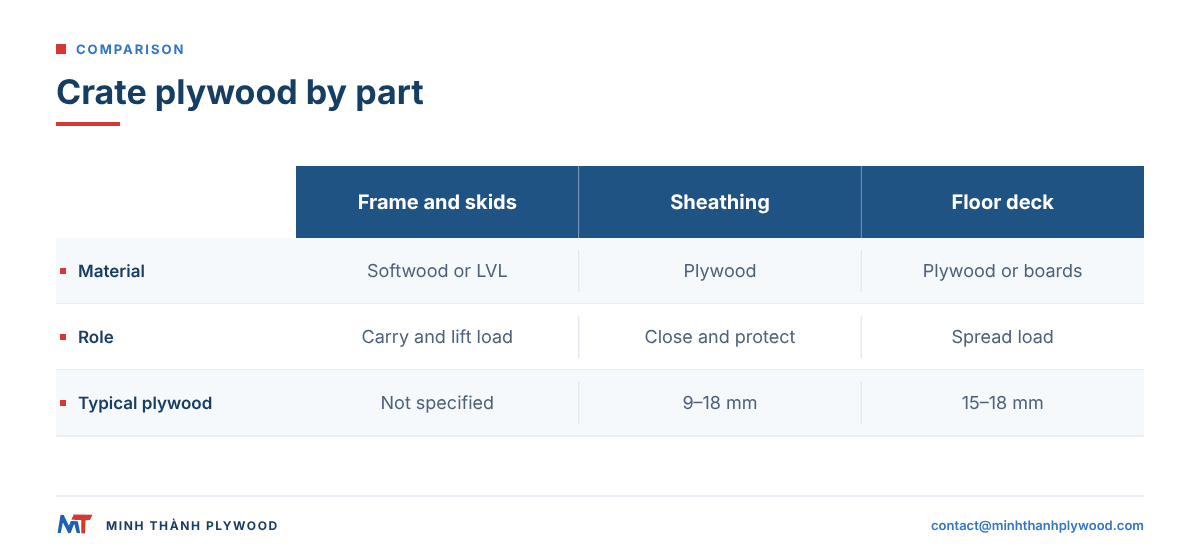
The best wood for wooden crates is a combination: heat-treated softwood or LVL for the load-carrying frame, and plywood for the sheathing. No single material does every part well.
| Crate part | Best material | Why |
|---|---|---|
| Skids | Heat-treated pine or spruce, or LVL | Straight, strong in bending, easy to notch for forklifts |
| Frame members and braces | Sawn softwood or LVL | Holds nails and bolts along the length |
| Sheathing | Plywood, 9–18 mm | Resists splitting and punctures, no ISPM 15 treatment |
| Floor deck | Plywood 15–18 mm or boards | Spreads the load over the skids |
| Blocking | Sawn softwood, LVL or plywood | Cut to fit the cargo |
LVL is worth a look for skids and frames: its veneers run in one direction, so it is straight and uniform without the knots and splits of sawn timber, and as processed wood it is exempt from ISPM 15. Minh Thanh produces LVL alongside plywood.
Plywood or OSB for crate sheathing?
Plywood is the better crate sheathing where the crate travels by sea, is reused or takes nails close to the edges; OSB is the cheaper choice for short, dry, one-way trips.
- Nail holding near edges: plywood’s cross-laid veneers hold nails closer to the panel edge without splitting.
- Weight: plywood is lighter for the same stiffness.
- Humidity: plywood with melamine-fortified glue keeps more of its strength in humid holds; OSB edges swell.
- Puncture resistance: plywood resists forklift tines and corners better.
For crate makers, plywood thickness follows the panel span between frame members: 9 to 12 mm for most sides, 15 to 18 mm for floors and large unsupported panels.
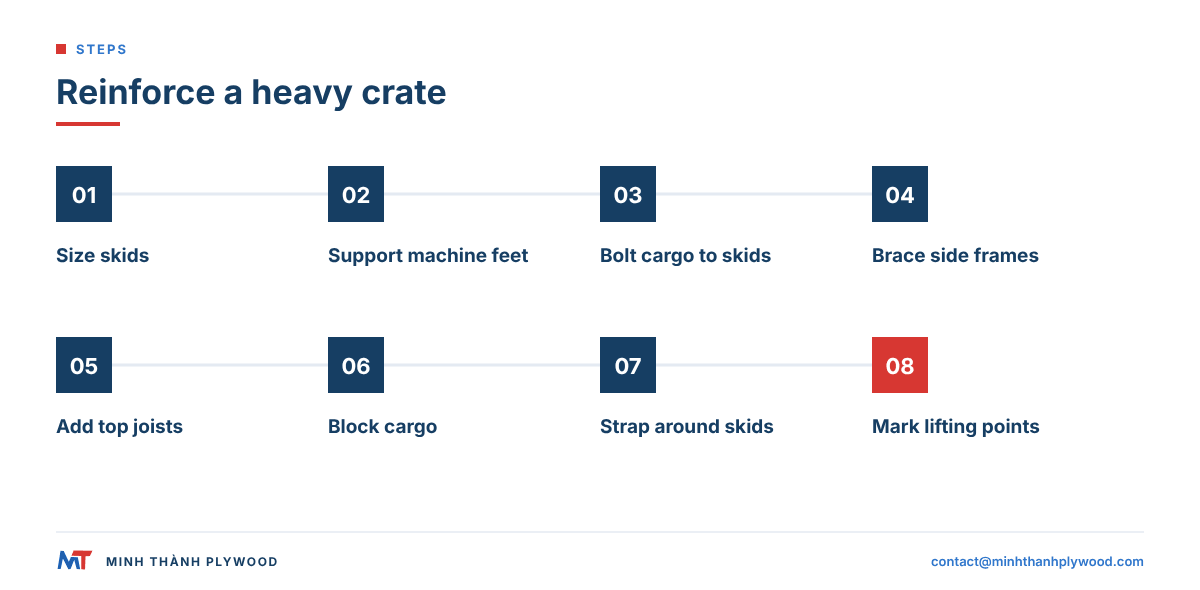
How do you reinforce wooden crates for heavy loads?
Wooden crates for heavy loads are reinforced at the base first, then at the sides and top. The rules a packing engineer applies:
- Size the skids for the load and space them under the cargo’s support points, not just at the crate edges.
- Add load-bearing floor members directly under concentrated loads, such as machine feet.
- Bolt the cargo to the skids through its own fixing points, with a timber or plywood pad to spread the load.
- Brace the side panels diagonally, so the crate cannot rack when lifted at one end.
- Add top joists where crates will be stacked or lashed from the top.
- Block and brace the cargo inside in all three directions.
- Strap the crate with steel or polyester bands around the skids.
- Mark the centre of gravity, the lifting points and the weight on two sides.
Heavy crates fail most often at the skids and the joints between base and sides, not in the sheathing. That is why the frame is sized first and the sheathing last.
ISPM 15 and wooden crates
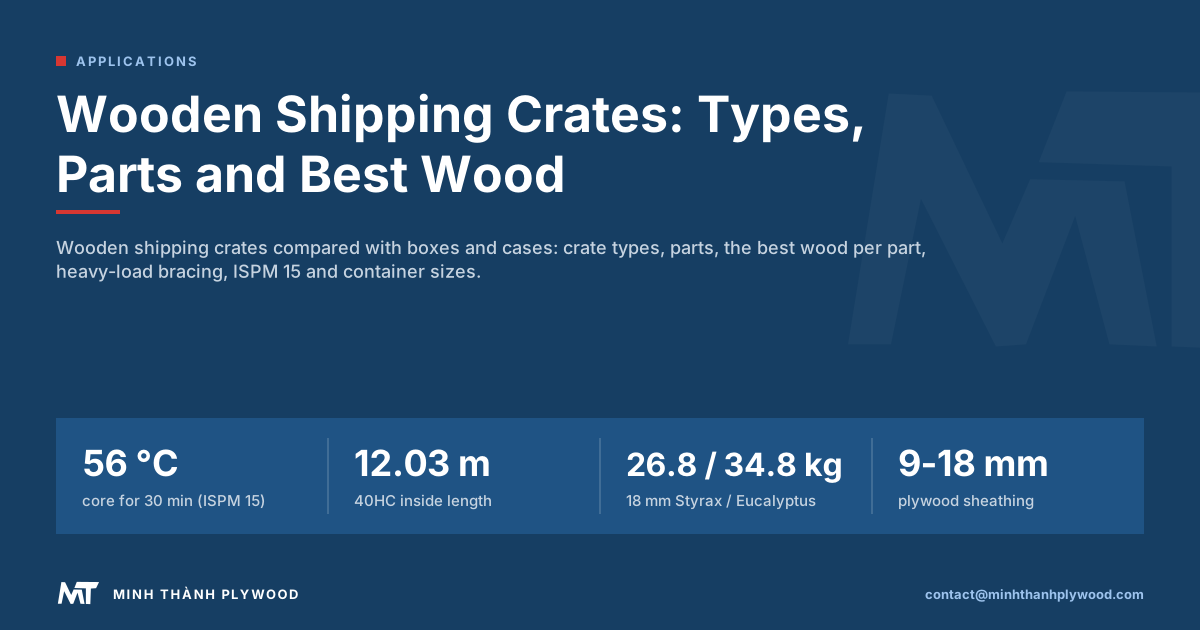
Where destination rules require it, solid-wood crate components must meet ISPM 15. Packaging made entirely from wood 6 mm thick or less is exempt. The wood is debarked, heat-treated to a core temperature of at least 56 °C for 30 continuous minutes (or treated by another approved method), and stamped with the IPPC mark, the country code, the producer number and the treatment code.
Processed wood is outside the standard. Plywood, LVL and particle board have been made with glue, heat and pressure, so crate sheathing and LVL skids need no treatment or mark. On a mixed-material crate, the mark identifies the completed unit and may appear on a processed-wood component.
For the European Union, the packaging regulation (EU) 2025/40 has applied since 12 August 2026 and limits lead, cadmium, mercury and hexavalent chromium in packaging to 100 mg/kg in total. Minh Thanh’s own export packing was tested by SGS in September 2026 under that regulation: none of the four were detected in its cardboard, plywood and pallet blocks, strapping band or wrapping film.
How do you plan crate size against the container?
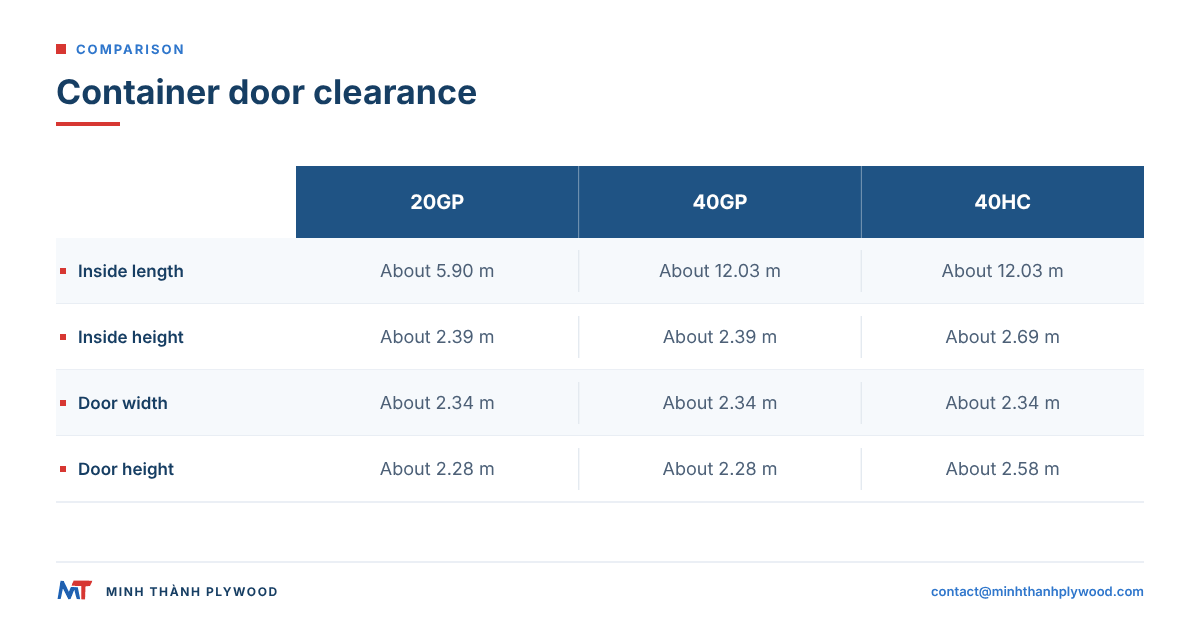
Plan crate size from the container’s door opening and inside dimensions, minus clearance for loading and lashing. A crate that fits the inside but not the door does not ship.
| Container | Inside length | Inside width | Inside height | Door width | Door height |
|---|---|---|---|---|---|
| 20GP | About 5.90 m | About 2.35 m | About 2.39 m | About 2.34 m | About 2.28 m |
| 40GP | About 12.03 m | About 2.35 m | About 2.39 m | About 2.34 m | About 2.28 m |
| 40HC | About 12.03 m | About 2.35 m | About 2.69 m | About 2.34 m | About 2.58 m |
Figures vary slightly by carrier; check the booking. Leave about 50 to 100 mm on width and height for handling, plan the forklift approach from the door, and remember that the payload, not the volume, often limits heavy crates first.
How do you protect a sea crate from moisture?
A sea crate is protected from moisture by a sealed barrier bag around the cargo, desiccant inside it, and sheathing that does not soften in a humid hold. Containers sweat when they move between climates, and water drips from the roof onto the crate.
- Barrier foil bag, sealed around the cargo, with desiccant sized for the voyage.
- VCI film or emitters for bare steel parts.
- Sheathing bonded with melamine-fortified glue, with edges painted.
- A lid that sheds water: sloped, or covered with a waterproof sheet.
- Dry wood: panels at 8–12 % moisture content and timber dried to the agreed moisture limit. Verify moisture separately from ISPM 15 heat treatment.
When is a crate the better choice than a box or a pallet?
A crate is the better choice when any one of these is true: the cargo is heavy, it has a high centre of gravity, it must be lifted by forklift from any side, it will be stacked or lashed at sea, or it is too long for a box. In every other case a plywood box or a pallet with collars costs less.
The decision in one line: frame needed, choose a crate; panels can carry it, choose a box; it stacks and needs little protection, choose a pallet. For pallets, see wooden pallets and pallet boards.
How much does crate sheathing plywood weigh?
An 18 mm plywood sheet of 1220 × 2440 mm weighs about 26.8 kg on a Styrax core, 31.1 kg on Acacia and 34.8 kg on Eucalyptus, at reference densities of 500, 580 and 650 kg/m³. Sheet weight is volume times density, so the core species decides the weight of a sheathed crate as much as the thickness does.
For export crates, a lighter core means a lighter package for the same panel: air and courier freight and manual handling both benefit. A denser eucalyptus core holds nails and screws harder and suits floors and heavily handled panels.
Which plywood should crate makers order?
Crate makers should order packing plywood by thickness, size, glue and core, with the tolerance their nail guns and frames need. The lines to put on the order:
- Thickness: 9, 12, 15 or 18 mm, with packing tolerance ±0.5–1.0 mm.
- Size: 1220 × 2440 or 1250 × 2500 mm, or cut to size; Minh Thanh cuts one panel into 4, 6 or 8 pieces.
- Glue: melamine-fortified for sea crates, or as the crate specification requires.
- Core: Eucalyptus for hard-wearing floors, Acacia or Styrax for lighter sides.
- Packing: packs about 1,000 mm high, labelled by specification.
The specifications and stock sizes are on the packing plywood page, and the panel choices in detail are in plywood for crates and pallets.
What to send for crate plywood
Send the crate use, thickness by part, size, glue, core and quantity. A complete line reads: “Crate sheathing, packing plywood, 12 and 18 mm, 1220 × 2440 mm, melamine-fortified glue, Eucalyptus core, ±0.5 mm, export packs, mixed in 1 × 40HC.”
Minimum order is one 40HC with mixed specifications by agreement, production 15–45 days after the 30% deposit, FOB Hai Phong, CFR or CIF, and free samples. Send your line to [email protected] and we reply within hours.
Buyer questions, answered
What is the difference between a wooden crate and a wooden box?
A crate has a load-bearing frame of skids, frame members and braces, with sheathing or slats fixed to it; a box is a closed package whose panels carry the load themselves. Crates suit heavy machinery, boxes suit lighter goods.
What wood is best for wooden crates?
Heat-treated pine or spruce for skids and frames, or LVL; plywood of 9 to 18 mm for the sheathing. Plywood resists splitting and punctures and needs no ISPM 15 treatment.
What are the parts of a wooden shipping crate?
Skids, the base or floor, frame members, sheathing, diagonal braces, top joists and lid, end panels, and the internal blocking and bracing that hold the cargo.
Do wooden shipping crates need ISPM 15?
Where destination rules require ISPM 15, regulated solid-wood parts need an approved treatment and the assembled crate needs the mark. Plywood, LVL and packaging made entirely from wood no more than 6 mm thick are exempt.
Is plywood or OSB better for crate sheathing?
Plywood holds nails closer to edges, is lighter for the same stiffness and keeps more strength when wet; OSB is cheaper per sheet. Sea crates and reused crates are usually sheathed in plywood.
How do you reinforce a wooden crate for heavy loads?
Size the skids for the weight, add load-bearing floor members under the cargo's support points, brace the sides diagonally, add top joists for stacking and bolt the cargo to the skids.
What size wooden crate fits in a 40-foot container?
Inside, a 40-foot high-cube container is about 12.03 m long, 2.35 m wide and 2.69 m high, with a door opening about 2.34 m wide and 2.58 m high. Leave clearance for forklift tines and lashing.
How much does an 18 mm plywood sheet for crate sheathing weigh?
A 1220 × 2440 × 18 mm sheet weighs about 26.8 kg on a Styrax core and about 34.8 kg on a Eucalyptus core, at reference densities of 500 and 650 kg/m³.
Are wooden crates reusable?
Crates built with screws or bolted panels can be opened and reused; nailed one-way export crates are usually broken down after delivery.
What standard covers wooden shipping crates?
ASTM D6039 covers open and covered wood crates, and ASTM D6251 covers wood-cleated panelboard boxes; many buyers also write their own packaging specification.