
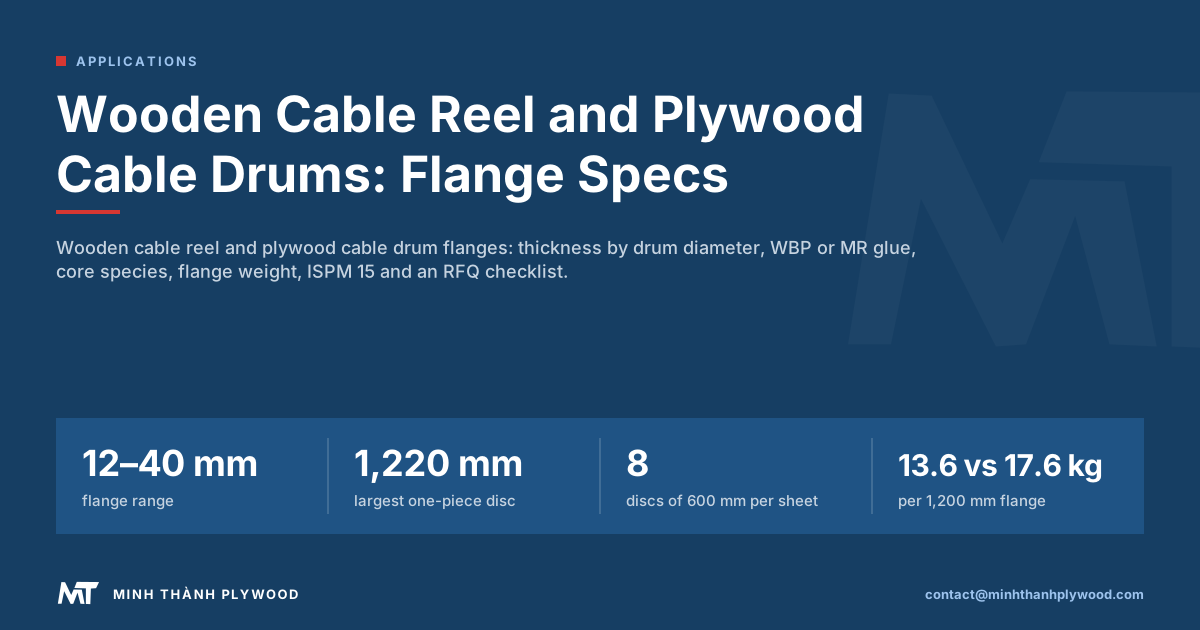
A wooden cable reel is two round flanges joined by a barrel and tie bolts; plywood cable drums cut those flanges from cross-laminated sheet, so they do not split along the grain, stay flat in a damp yard and ship without ISPM 15 treatment. Specify flange thickness by drum diameter and load, a WBP bond for outdoor storage, and a dense core. Minh Thanh Plywood supplies the sheet.
Standard wooden cable reel sizes in inches and millimetres
A wooden cable reel is ordered by flange diameter in inches: 24, 30, 36, 42, 48, 60 or 72 in. It is named flange × traverse × drum, such as 48 × 30 × 24 in. Traverse (the width between flanges) runs about 10 to 60 in, drum (barrel) diameter 8 to 48 in, and the arbor hole 1 to 4 in.
The drum diameter is set by the cable’s minimum bend radius; the arbor hole is most often 1.5, 2 or 3 in. A 48 in flange with a 30 in traverse weighs roughly 120–160 lb empty in wood; a comparable steel reel weighs 300–500 lb.
| Flange (in) | Flange (mm) | Plywood flange thickness we suggest | Typical arbor hole |
|---|---|---|---|
| 24 | 610 | 18–21 mm | 1.5–2 in |
| 30 | 762 | 18–21 mm | 2–3 in |
| 36 | 914 | 21–24 mm | 3 in |
| 42 | 1,067 | 24–30 mm | 3 in |
| 48 | 1,219 | 24–30 mm | 3–4 in |
| 60 | 1,524 | Two-layer segmented flange | 3–4 in |
| 72 | 1,829 | Two-layer segmented flange, up to 40 mm total | 4 in or larger |
Flange thickness is our starting guide, one step up for heavy power cable; the cable maker’s reel standard and design load decide the final figure. Used reels are listed by the same three numbers, so a buyer can match a flange sheet to a reel size directly. Prices of used reels vary by size, condition and state, so quote on the new flange sheet and ask the reel maker for the reel price.
What is a wooden cable reel made of?
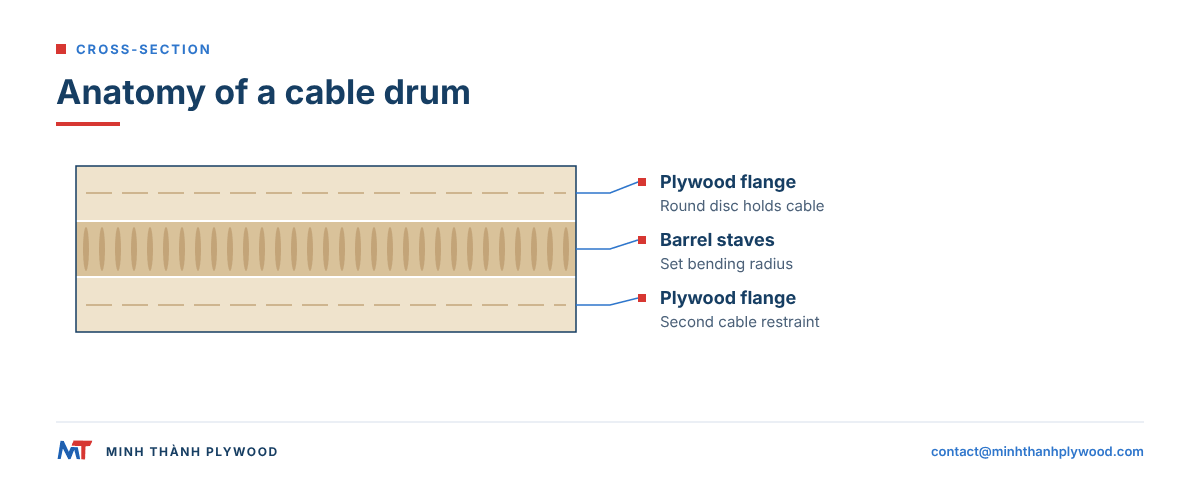
A wooden cable reel is two round flanges, a barrel that the cable winds on, and tie bolts that pull the flanges onto the barrel. Plywood cable drums use plywood for the flanges and often for the barrel staves, with steel plates at the arbor hole.
The parts and what each does:
| Part | Material in plywood drums | Job |
|---|---|---|
| Flanges | Plywood discs, 12–40 mm | Keep the cable on the barrel, take the rolling load |
| Barrel (drum core) | Plywood or timber staves, or a tube | Carries the wound cable, sets the minimum bending radius |
| Arbor hole | Hole through each flange centre | Takes the spindle on the payoff stand |
| Arbor plate | Steel plate bolted over the hole | Stops the spindle wearing the plywood |
| Tie bolts | Steel through-rods with nuts and washers | Clamp both flanges to the barrel |
| Lagging or battens | Timber or plywood strips | Protect the outer cable layer in transport |
The flange carries the most load and decides the price, so it is where the plywood specification matters. A drum rolled across a yard rests its full weight on the two flange rims.
What plywood is used for cable drum flanges?
Cable drum flanges use hardwood-core plywood of 12 to 40 mm with a water-resistant bond, utility faces and a dense, gap-free core. Drum-flange makers publish 12–30 mm and 12–40 mm as their ranges; the drum’s diameter and cable weight decide where in that range a flange sits.
The specification in five lines:
- Thickness: set by diameter and load (see the thickness table below).
- Bond: phenolic (WBP) for drums stored outdoors; melamine-fortified (MR) for covered, short-cycle use.
- Core: Eucalyptus or Acacia for bolt grip, Styrax where weight matters more.
- Faces: utility C/D faces; appearance does not matter, flatness and soundness do.
- Core quality: no open gaps or overlaps at the rim, where the drum rolls.
Minh Thanh’s exterior panels use utility C/D face and back appearance with melamine-fortified or phenolic (WBP) glue, the combination drum makers order. Our exterior plywood page lists the build.
Why are plywood flanges better than solid wood?
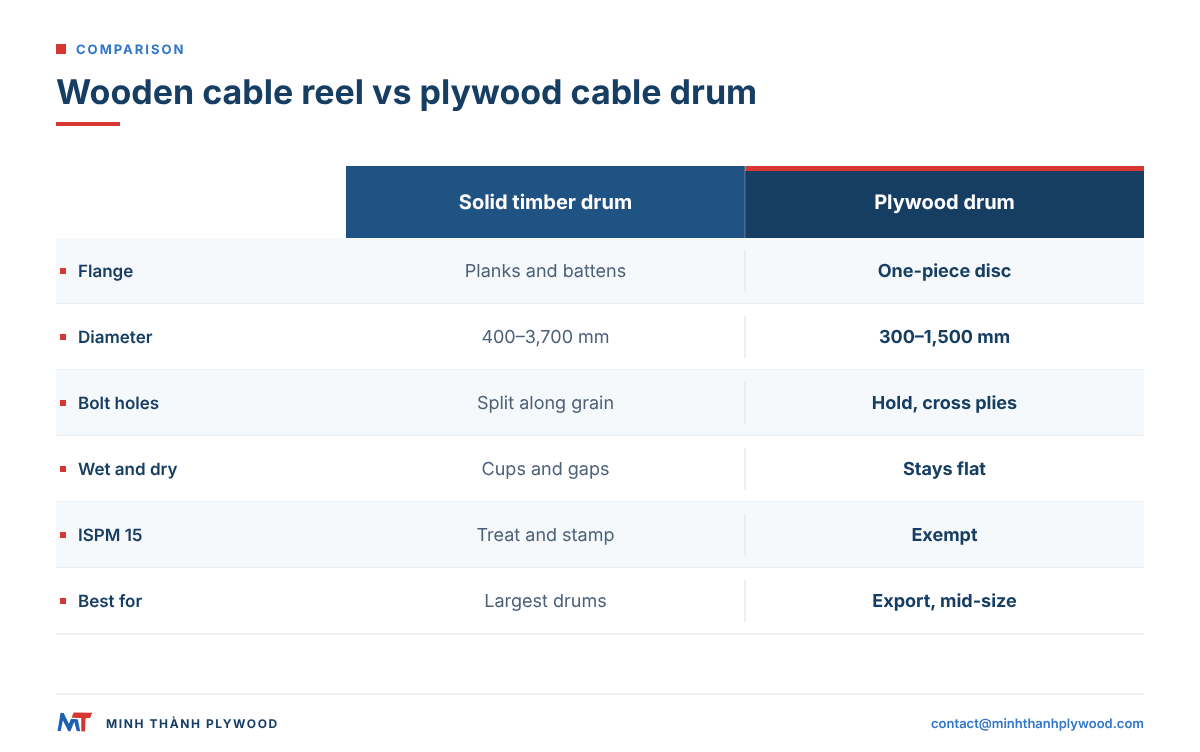
Plywood flanges win because the cross-laminated veneers carry load in both directions: a flange cannot split along the grain at the arbor hole or a bolt hole, and it stays flat as it wets and dries. A solid-wood flange is a set of boards held by battens and nails, and each joint is a weak line.
Four advantages a drum maker measures:
- No splitting. Alternate veneers cross the grain, so a bolt hole near the rim holds.
- One-piece discs. A round flange of up to 1,220 mm comes from one sheet, with no board joints or cleats.
- Flatness. A balanced plywood panel moves far less with moisture than a solid board across the grain, so the flange stays square to the barrel.
- No ISPM 15 treatment for the plywood parts, which saves heat treatment and stamping.
Solid timber still wins on very large drums, where flanges are assembled from heavy planks, and on cost in regions with cheap sawn timber. Wood packaging producers in Northern Europe offer timber drums from 400 to 3,700 mm diameter and plywood drums from 300 to 1,500 mm, and that split matches the practice: plywood for small and mid-size drums, timber for the largest.
Wooden cable drum vs plywood cable drum: which should you choose?
Choose a plywood cable drum for drums up to about 1,500 mm, export shipments and cable that must arrive undamaged; choose a solid wooden cable drum for the largest power-cable drums and for domestic loops where timber is cheap and heat treatment is not needed.
| Metric | Solid wooden cable drum | Plywood cable drum |
|---|---|---|
| Flange build | Planks joined with battens and nails | One-piece cross-laminated disc |
| Typical diameter range | 400–3,700 mm | 300–1,500 mm |
| Splitting at bolt holes | Common along the grain | Resisted by cross plies |
| Flatness through wet and dry | Boards cup and gap | Stays flat |
| ISPM 15 treatment for export | Required, with stamp | Not required for plywood parts |
| Weight for the same stiffness | Higher | Lower |
| Repair | Replace single planks | Replace the whole flange |
| Best for | Very large drums, domestic return loops | Small and mid-size drums, export, wire and data cable |
Verdict by use: plywood for export and for drums a cable plant wants to look clean and run true on a payoff stand; solid timber for the heaviest power cable on the largest drums.
What thickness should a plywood flange be?
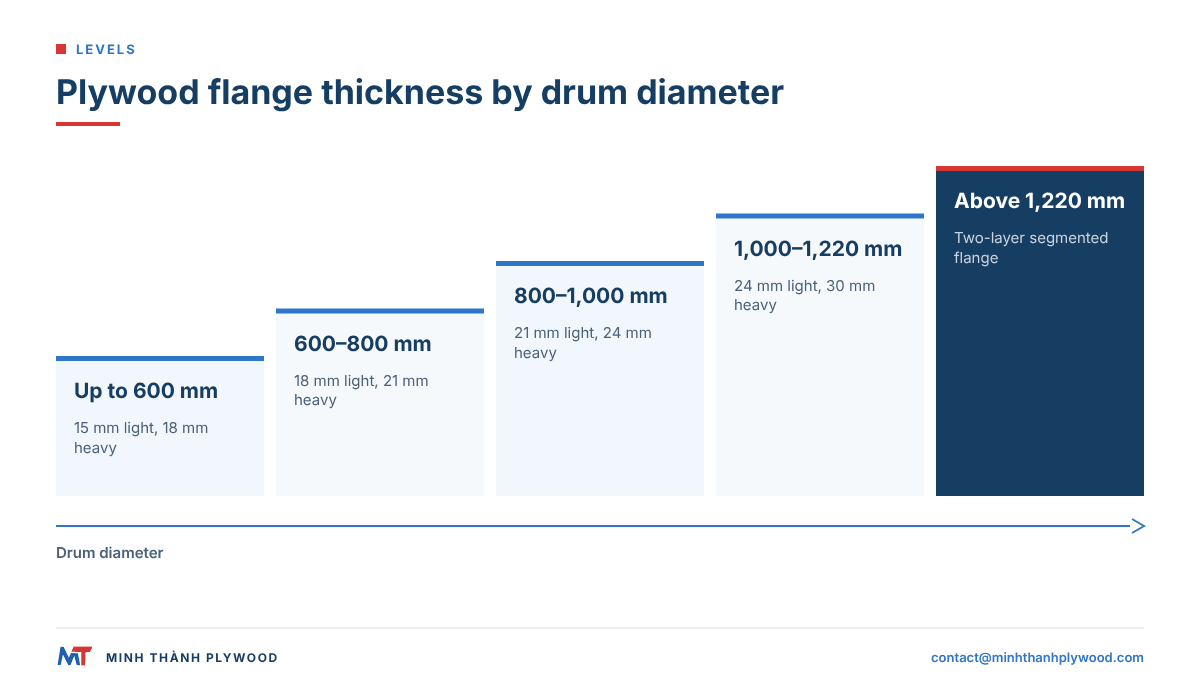
Flange thickness rises with diameter and cable weight: about 15–18 mm up to 600 mm diameter, 18–21 mm up to 800 mm, 21–24 mm up to 1,000 mm and 24–30 mm up to 1,220 mm. Heavy power cable moves a drum one step up the table.
| Flange diameter | Light cable (data, control, wire) | Heavy cable (power, armoured) |
|---|---|---|
| Up to 600 mm | 15 mm | 18 mm |
| 600–800 mm | 18 mm | 21 mm |
| 800–1,000 mm | 21 mm | 24 mm |
| 1,000–1,220 mm | 24 mm | 30 mm |
| Above 1,220 mm | Two-layer segmented flange | Two-layer segmented flange, up to 40 mm total |
This is a starting guide built from the 12–40 mm ranges drum-flange makers publish; the drum’s design load and the payoff stand decide the final figure. Three checks confirm it on a prototype:
- Rim flatness after a full wind: the flange must not dish outwards under the cable.
- Bolt-hole crushing after the tie bolts are torqued: washers must not sink into the face.
- Roll test across a yard: the rim must not delaminate at the outer veneer.
Which glue: WBP phenolic or melamine for cable drums?
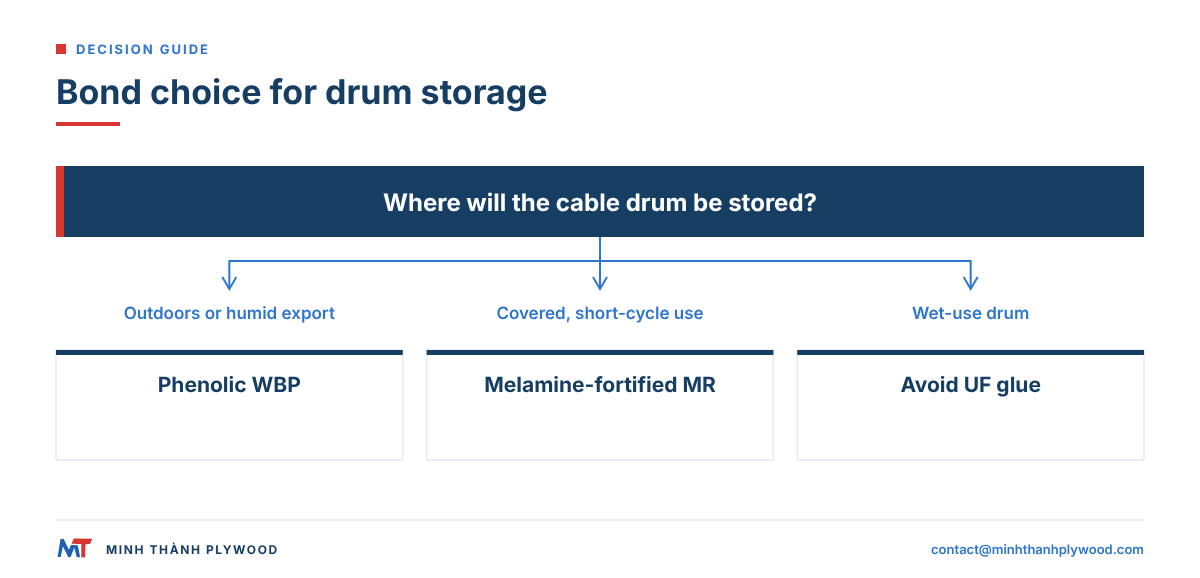
Use phenolic (WBP) glue for any drum stored outdoors or shipped in humid holds; use melamine-fortified (MR) glue only for drums kept under cover and used for short cycles. Glue choice decides whether a drum survives a wet winter in a cable yard.
| Bond | Where it fits | What happens when wet |
|---|---|---|
| Phenolic (WBP) | Outdoor yards, export, returnable drums | Holds through repeated wetting and drying |
| Melamine-fortified (MR) | Covered storage, one-way domestic drums | Tolerates humidity and short wetting |
| Urea-formaldehyde (UF) | Not for drums | Delaminates at the rim when wet |
Bond and emission class are two separate lines on an order. For the bond class, BS EN 314-2:1993 sets the bonding-quality requirements for plywood. A drum flange rarely needs a furniture emission class, but a cable plant shipping to buyers with packaging rules may ask for one; write it as its own line.
Which core species makes the best flange?
A dense core makes the strongest flange: Eucalyptus at about 650 kg/m³ and Acacia at 580 kg/m³ grip bolts and resist rim crushing best, while Styrax at 500 kg/m³ gives the lightest drum. Pick by what fails first on your drums, the bolt holes or the freight bill.
Flange weight follows area × thickness × density. Computed for full discs:
| Flange | Styrax core, 500 kg/m³ | Acacia core, 580 kg/m³ | Eucalyptus core, 650 kg/m³ |
|---|---|---|---|
| 800 mm × 18 mm | 4.5 kg | 5.2 kg | 5.9 kg |
| 1,000 mm × 21 mm | 8.2 kg | 9.6 kg | 10.7 kg |
| 1,200 mm × 24 mm | 13.6 kg | 15.7 kg | 17.6 kg |
The arbor hole and bolt holes take a little off these figures. On a two-flange drum the difference between Styrax and Eucalyptus at 1,200 mm is 8 kg per drum, which adds up over a container of empty drums or a season of return freight.
How large can a one-piece plywood flange be?
A one-piece plywood flange can be as wide as the sheet’s short side: 1,220 mm from a 1220 × 2440 mm sheet and 1,250 mm from a 1250 × 2500 mm sheet. Above that, flanges are built from segments.
How drum makers build flanges larger than the sheet:
- Two layers of segments, each layer cut as halves or quarters of the disc.
- Joints staggered, so the joint line of one layer crosses solid plywood in the other.
- Glued and bolted, with the tie bolts passing through both layers.
- Total thickness usually split evenly, for example two layers of 18 or 20 mm.
A segmented flange is heavier and slower to make than a one-piece disc, which is why most plywood cable drums stay at or below the sheet width. Custom sheet sizes such as 1220 × 2500 mm help where a drum maker needs a little more length for nesting.
How many flanges does one sheet give?
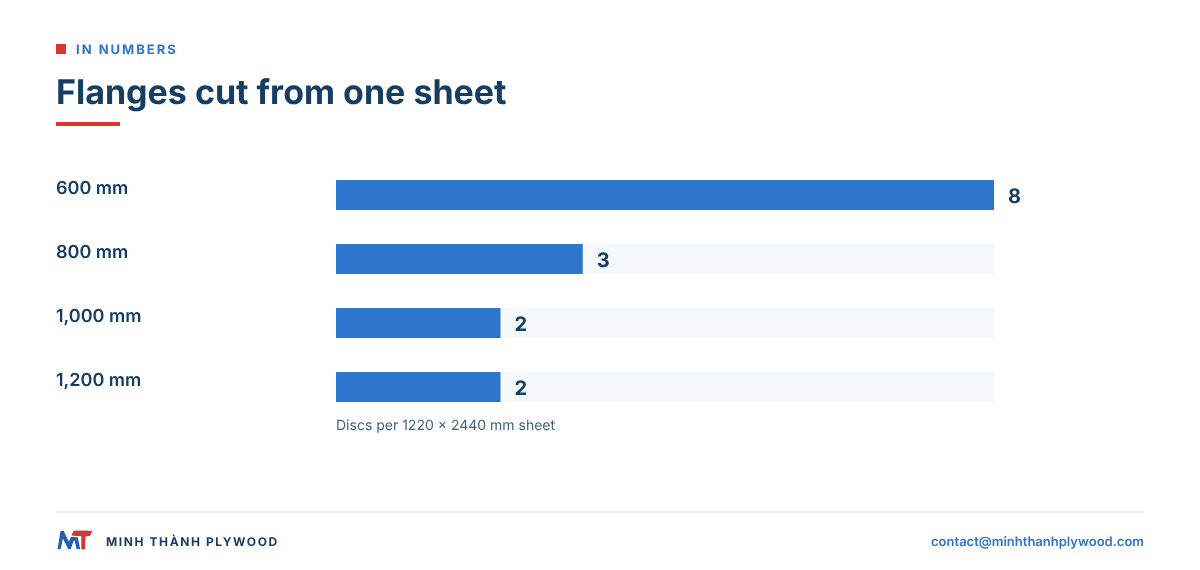
A 1220 × 2440 mm sheet gives eight discs of 600 mm, three discs of 800 mm, or two discs from 1,000 to 1,220 mm. Order sheet sizes that match your most common diameters, since the offcut is waste you pay for.
| Flange diameter | Discs per 1220 × 2440 mm sheet | Layout |
|---|---|---|
| 600 mm | 8 | 2 across, 4 along |
| 800 mm | 3 | 1 across, 3 along |
| 1,000 mm | 2 | 1 across, 2 along |
| 1,200 mm | 2 | 1 across, 2 along |
Offcuts between large discs are still useful: small hub discs, reinforcing rings around the arbor hole and spacer blocks come from them. Cutting is done on a CNC router or a circle-cutting saw at the drum plant; the sheet only has to arrive flat, to thickness and with a sound core at every point a disc might fall.
What must the flange hold at the arbor hole and bolts?
The flange must hold the spindle and the tie bolts without crushing: a steel arbor plate spreads the spindle load, and large washers spread the bolt clamp. Without them, the plywood face crushes and the drum wobbles on the payoff stand.
What drum makers add to the plywood:
- Arbor plate: a steel plate bolted over the arbor hole on both flanges.
- Drive hole: a second, smaller hole for the payoff stand’s drive pin, also plated on heavy drums.
- Wide washers or a steel ring under the tie-bolt nuts.
- A centred arbor hole, so the drum runs true and the cable pays off evenly.
A dense, gap-free core helps most here. A core gap under a bolt hole lets the washer sink; stitched core layers and calibrated thickness keep the clamping load even across the flange.
Are plywood cable drums reusable?
Yes: a plywood cable drum with a WBP bond, steel arbor plates and sound bolt holes can be returned, inspected and rewound for several trips. Many cable plants run return loops for their mid-size drums and treat small drums as one-way packaging.
What decides whether a returned drum goes back into service:
- Bond: no delamination at the rim or around holes.
- Bolt holes: no crushing or elongation; tie bolts retensioned.
- Arbor plate: firmly fixed, hole not worn oval.
- Flange flatness: no dishing or warp.
- Barrel: no broken staves or protruding nails that could damage cable.
An MR-bonded drum that stood outdoors for a season usually fails the first check. Specifying WBP from the start is cheaper than scrapping drums early.
New, used and returnable reels: how a plywood flange survives return trips
US reel makers run take-back systems. Carris Reels, a large US reel maker, operates return depots and recycling centres where used reels are graded on a three-point scale from excellent condition to scrap, then repaired, repainted and bolt-tightened before reuse; reels with broken flanges or torn arbor holes are rejected. Its returnable nailed-wood reels are sold for roughly 5 to 10 uses.
The flange decides that grade. A WBP plywood flange keeps its bond after rain and yard storage, and the cross-laminated face resists the torn arbor hole that sends a solid-wood reel to scrap. A steel arbor plate over the hole and washers under the tie bolts raise the number of trips further. Cable plants running deposit loops or buying reconditioned spools therefore specify WBP glue and a dense core on the flange sheet from the start.
Wooden, plywood, plastic or steel cable reels: which to choose?
| Reel type | Weight | Reuse | Best fit |
|---|---|---|---|
| Solid wood (nailed) | Light | One-way or a few trips | Low-cost, short-haul cable |
| Plywood flanges | Light | Several trips with WBP bond | Export cable, return loops |
| Plastic | Light to medium | Many trips; recycled polymers common | Small and medium cable, closed loops |
| Steel | Heavy, 300–500 lb at 48 in | Very many trips | Heavy power and submarine cable, in-house loops |
Plywood sits between wood and steel: it costs less to ship than steel, lasts longer than nailed solid wood, and is cut from a sheet to the exact flange diameter. Export cable usually travels on wood or plywood because the reel is not collected afterwards.
Do plywood drums need ISPM 15 for export?
The plywood parts do not: ISPM 15 exempts wood packaging made wholly of processed wood such as plywood, because the glue-press process removes the pest risk. Solid-wood parts on the same drum, such as staves, battens or blocks, still need heat treatment and the ISPM 15 stamp.
The standard is published by the International Plant Protection Convention (IPPC); its scope excludes processed wood material such as plywood, particleboard, oriented strand board and veneer. For a drum maker shipping abroad, an all-plywood drum, with plywood flanges and plywood staves, removes the stamping step and the risk of a rejected consignment. UK government guidance says the rules “do not apply to processed, non solid WPM like plywood” (GOV.UK, wood packaging material). Our guide to plywood for crates and pallets covers the same exemption for other packaging.
What moisture, tolerance and storage does a flange sheet need?
Flange sheets should arrive at 8–12 % moisture content, within ±0.5 mm in thickness for commercial panels or ±0.5–1.0 mm for packing grades, and be stored flat and covered until cutting. Dry, even sheets cut flat discs; wet or uneven sheets cut flanges that dish.
Why each figure matters for a drum:
- Moisture 8–12 %: the flange will not shrink away from the tie bolts after assembly.
- Thickness tolerance: bolt lengths, arbor plates and barrel recesses are set to the nominal thickness.
- Length and width ±2 mm: nesting layouts on the CNC use the full sheet.
- Flat storage: a sheet stored on uneven bearers takes a set that becomes a dished flange.
Minh Thanh holds these figures at dispatch: 8–12 % moisture, ±0.5 mm on commercial panels, ±0.5–1.0 mm on packing panels, ±2 mm on length and width.
RFQ checklist for cable drum makers
A drum maker’s request for quotation should state seven lines: use, thickness, bond, core, faces, size and packing with quantity. With those, a mill quotes the right sheet the first time.
- Use: cable drum flanges, drum diameters and cable type (for example 800–1,200 mm, power cable).
- Thickness: for example 21 mm and 24 mm, with the tolerance you need.
- Bond: phenolic (WBP), or melamine-fortified (MR) for covered storage.
- Core: Eucalyptus, Acacia or Styrax; no open gaps.
- Faces: utility C/D, sanded or unsanded.
- Sheet size: 1220 × 2440 mm, 1250 × 2500 mm or a custom length such as 1220 × 2500 mm.
- Packing and quantity: sheets per pack, number of thicknesses in one container, destination port.
Add whether the drums ship abroad, so the mill and you agree which parts stay all-plywood for the ISPM 15 exemption. The packing plywood guide has the matching checklist for crate and pallet panels.
What Minh Thanh supplies to drum makers
Minh Thanh Plywood supplies the sheet: plywood from 3 to 40 mm, utility C/D faces, melamine-fortified or phenolic (WBP) bonds to your specification, Styrax, Eucalyptus or Acacia cores, in 1220 × 2440 mm, 1250 × 2500 mm and custom sizes. Your plant cuts the flanges.
What a full container looks like:
- 18 mm on a Styrax core: 990 sheets in 18 packs, 26.8 kg per sheet.
- 18 mm on an Acacia core: 880 sheets in 16 packs, 31.1 kg per sheet.
- 18 mm on a Eucalyptus core: 795 sheets in 15 packs, 34.8 kg per sheet.
Mixed thicknesses fit in one 40HC by agreement. Terms: MOQ one 40HC, production 15–45 days after the 30% deposit, balance against the scanned B/L or L/C at sight, FOB Hai Phong, CFR or CIF, free samples. Commercial plywood starts from US$250/m³ (October 2026).
Send your flange thicknesses, bond and drum sizes to contact@minhthanhplywood.com, or WhatsApp Lisa on +84 988 586 601; we reply within hours. See packing plywood from Minh Thanh for the packing grades and the wood packaging guide for crates, pallets and boxes.
Buyer questions, answered
What plywood is used for cable drum flanges?
Hardwood-core plywood of 12 to 40 mm with a water-resistant bond: WBP phenolic for drums stored outdoors, melamine-fortified (MR) glue for short indoor cycles. Utility C/D faces are normal; a dense Eucalyptus or Acacia core gives the best bolt grip.
Why are plywood flanges preferred over solid wood?
Cross-laminated veneers stop a flange from splitting along the grain at the arbor hole and bolt holes, keep it flat through wet and dry cycles, and let one sheet give a full round disc. Plywood is also exempt from ISPM 15 treatment.
What thickness is commonly used for plywood cable drum flanges?
Drum-flange makers publish 12 to 40 mm. As a starting guide: 15 to 18 mm up to 600 mm diameter, 18 to 21 mm up to 800 mm, 21 to 24 mm up to 1,000 mm and 24 to 30 mm up to 1,220 mm.
Are plywood cable drums reusable?
Yes. A plywood drum with a WBP bond, a steel arbor plate and intact tie bolts can be returned, inspected and rewound for several trips. Drums stored wet with an MR bond, or with crushed bolt holes, are scrapped.
Do plywood cable drums need ISPM 15 treatment?
The plywood flanges do not: ISPM 15 exempts packaging made wholly of processed wood such as plywood. Solid-wood staves, battens or blocks on the same drum still need heat treatment and the stamp.
How large can a one-piece plywood flange be?
A one-piece flange is limited by the sheet's short side: 1,220 mm from a 1220 × 2440 mm sheet, 1,250 mm from a 1250 × 2500 mm sheet. Larger flanges are built from two layers of segments glued and bolted with staggered joints.
How much does a plywood cable drum flange weigh?
Weight is disc area × thickness × density. A 1,200 mm flange of 24 mm weighs about 13.6 kg on a 500 kg/m³ Styrax core and 17.6 kg on a 650 kg/m³ Eucalyptus core.
What is the difference between a cable drum and a cable reel?
None in practice. Drum is the usual term in Europe and the cable industry, reel or spool in North America; all three describe flanges joined by a barrel, carrying wound cable or wire.
Which glue is best for wooden cable drums stored outdoors?
Phenolic (WBP) glue. It survives rain, sun and months of yard storage without delaminating, where a melamine-fortified bond is suited to covered storage and short cycles.
How many flanges can be cut from one plywood sheet?
From a 1220 × 2440 mm sheet: eight discs of 600 mm, three of 800 mm, or two of 1,000 to 1,220 mm. Nest small hub discs and reinforcing rings in the offcuts.