
Plywood shipping crates use packing-grade plywood: utility faces, a core chosen for weight, and a glue matched to the trip. Packaging made wholly of processed wood such as plywood falls outside ISPM 15; plywood also holds nails near the edge and arrives dry. This guide from Minh Thanh Plywood, written for crate builders, sets out the grade, thickness and core for each crate part, the weight and container numbers, and the order line a crate maker sends.
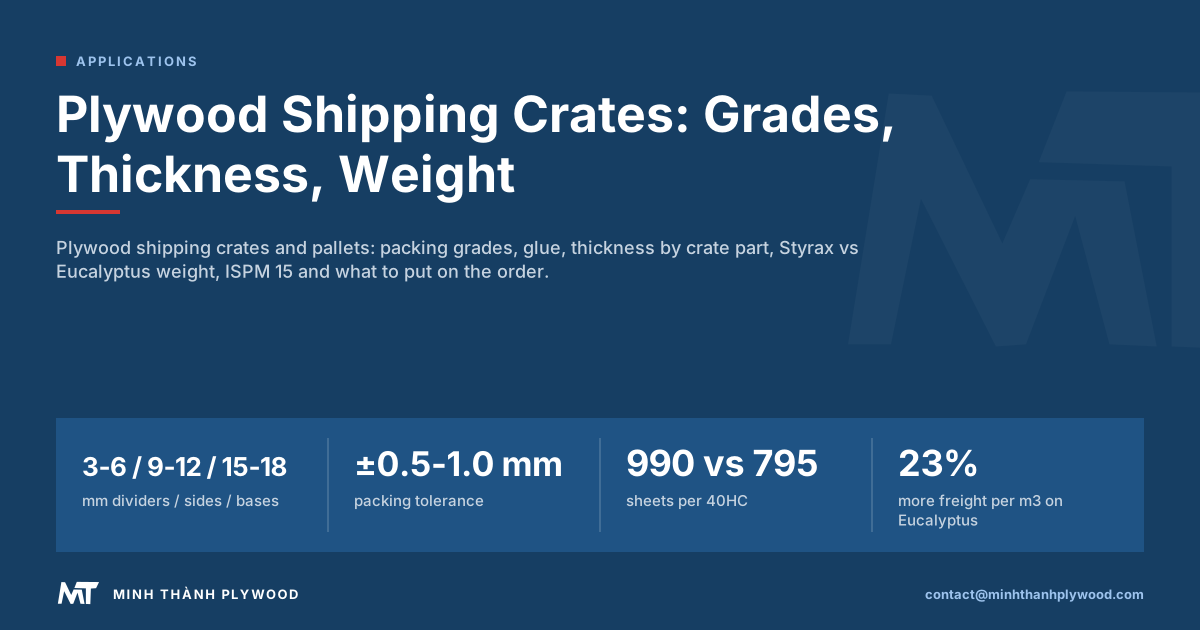
Plywood shipping crates: the short answer
Plywood shipping crates are crates sheathed, floored and lidded with packing-grade plywood on a timber, LVL or plywood frame. Crate makers choose plywood for four reasons: a crate made wholly of plywood falls outside ISPM 15, large panels mean fewer joints, cross-laid veneers hold fasteners near the edge, and the panel arrives dry.
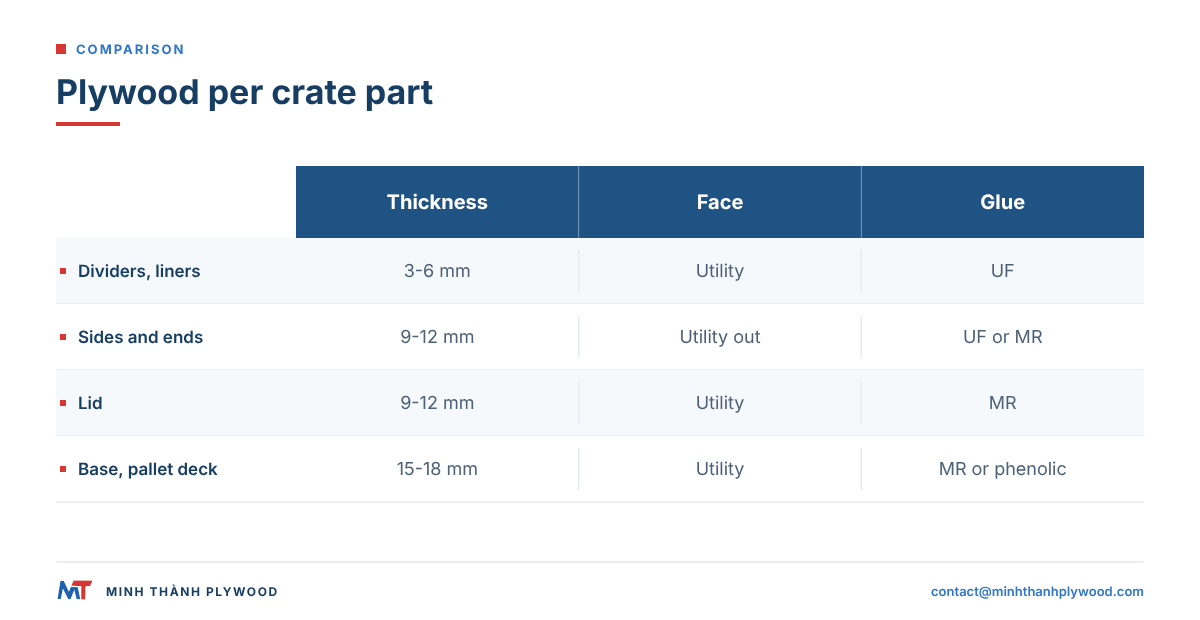
The plywood for crates and pallets is specified part by part, not as one product:
| Crate part | Thickness | Face grade | Glue |
|---|---|---|---|
| Dividers, liners, supported skins | 3–6 mm | Utility, both sides | UF for dry service |
| Sides and ends (sheathing) | 9–12 mm | Utility outside, sound inside | UF or melamine-fortified |
| Lid | 9–12 mm | Utility, sound face up if stacked | Melamine-fortified for rain |
| Base and pallet deck | 15–18 mm | Utility, solid core | Melamine-fortified or phenolic |
| Printed or reusable boxes | 9–18 mm | Cleaner face for print | By route and reuse |
The frame spacing and the weight of the goods set the final thickness. A crate design is proven by testing the assembled crate with the proposed panel before volume orders.
What sizes do plywood shipping crates come in, and what panels do they take?
The crate sizes that US shops sell most are 48 × 48 × 48 in, 48 × 40 × 42 in, 72 × 48 × 48 in and 96 × 48 × 48 in, and each one is cut from 1220 × 2440 mm sheets (48 × 96 in) with little waste. The table gives the outside size, the load and price a finished crate carries on the market, and the plywood a builder needs for the same size.
| Outside size (L × W × H, in) | Published load rating and price of a finished crate | Plywood for one crate (1220 × 2440 mm sheets) |
|---|---|---|
| 48 × 40 × 42 | Uline S-9922: 3,000 lb capacity, US$270 each | 3 sheets of 12 mm + 1 sheet of 18 mm for the base |
| 48 × 48 × 48 | Uline S-11303: 3,000 lb capacity, US$321 each | 3 sheets of 12 mm + 1 sheet of 18 mm |
| 72 × 48 × 48 | Uline S-14460: 3,500 lb capacity, US$424 each | 4 sheets of 12 mm + 1 sheet of 18 mm |
| 96 × 48 × 48 | Container Exchanger lists new and used crates at this size | 4 sheets of 12 mm + 1 sheet of 18 mm: two sides, one sheet of ends, one lid |
| 96 × 48 × 54 | SharkCrate: 17,000 lb stacking strength, inside 94.5 × 46.5 × 48 in | 6 sheets of 12 mm + 1 sheet of 18 mm; the 54 in sides need a joined strip |
Ratings and prices come from Uline, Container Exchanger and SharkCrate (checked on 21 October 2026); Uline prices are for one crate. Inch sizes convert at 25.4 mm to the inch (NIST). Sheet counts are planning numbers from panel area: sides, ends and lid in 12 mm, base in 18 mm, with saw allowance and before frame battens. The offcut of the base sheet often covers the next crate. A crate builder’s own load rating comes from testing the assembled crate, not from the panel alone.
Two lines sell the crate on the dock. A crate built wholly of plywood and LVL or chip-block skids ships ISPM 15 exempt, with no heat-treatment mark to check. And a 4-way block pallet base lets a forklift or pallet truck lift it from any side. For one order across these sizes, the cut list goes to us as a part list and the panels arrive bundled per part.
Why do packers use plywood instead of solid wood for export crates?
Packers switch from sawn boards to plywood because plywood removes the most common reasons a crate is stopped, damaged or refused. A plywood crate sits outside ISPM 15, so it needs no heat-treatment stamp. It stays dry and stable, one sheet covers a whole side, and it takes nails, labels and stencils cleanly.
- Outside ISPM 15. The international standard for wood packaging, ISPM 15 of the IPPC, exempts packaging made wholly of processed wood such as plywood (checked 20 October 2026). No heat-treatment, no stamp, no risk of a missing mark at the border.
- Dry and stable. Packing plywood leaves the mill at 8–12% moisture. Fresh sawn boards are often much wetter, shrink in transit and can breed mould on the goods.
- Fewer joints. One 1220 × 2440 mm sheet covers a crate side that needs several boards and battens.
- Holds fasteners. Cross-laid veneers resist splitting, so nails and staples can go close to the edge.
- Clean, even faces. Plywood takes stencils, labels and printed marks.
Crate skids and heavy runners can be sawn timber or processed LVL. The sawn-timber parts need the treatment and marking described in the ISPM 15 section; processed LVL is exempt.
What does packing grade plywood mean?
Packing grade plywood is plywood with faces chosen for a job, not for looks: repaired knots, colour variation, patches and small splits are accepted wherever they do not weaken the part. The core and the bond are still specified, because they carry the load and decide how the panel behaves when wet.
Face grades on packing plywood follow the same face/back pairs as other panels, fixed by the approved sample:
- Pine-faced: A/A, A/B and B/B, with B/C for utility parts.
- Poplar-faced: A/A, A/B and B/B, also ordered by the Chinese codes B/BB, BB/CC and CP.
- Utility or C/D faces for exterior-type packing panels.
For hidden crate parts, the lowest grade the sample allows is the right one. For printed boxes, display crates and returnable cases, a B face or better pays for itself. Our guide on how to choose packing plywood covers the core and grade choice in more detail.
Which plywood thickness for which crate part?
Plywood thickness for crates follows the part and the support spacing. The frame carries the load; the panel spans between the frame members.
| Part | Typical thickness | Why |
|---|---|---|
| Interior dividers and liners | 3–6 mm | Separate and protect; no structural load |
| Skins on closely spaced frames | 6 mm | Cover and keep out dust and rain |
| Sides and ends, light to medium goods | 9 mm | Spans between battens, takes stencils |
| Sides and ends, heavier goods | 12 mm | Stiffer between frame members |
| Lid | 9–12 mm | Rain and stacking loads |
| Base deck on skids | 15–18 mm | Point loads from the goods and forklift |
| Pallet deck | 15–18 mm | Spans between blocks or runners |
Packing panels carry a thickness tolerance of ±0.5–1.0 mm; length and width are held to ±2 mm. That matters to automated nailing lines, which are set for one thickness.
Glue and emission: UF, MR or phenolic, E2 or E1?
Glue and emission class are two separate lines on a packing plywood order. The glue decides how the panel survives water; the emission class decides how much formaldehyde it may release.
| Glue | Service | Typical crate use |
|---|---|---|
| UF (urea-formaldehyde) | Dry, covered | Inner parts, crates that travel and are stored indoors |
| MR / melamine-fortified | Humid air, short wetting | Sea freight in humid routes, outdoor storage under cover |
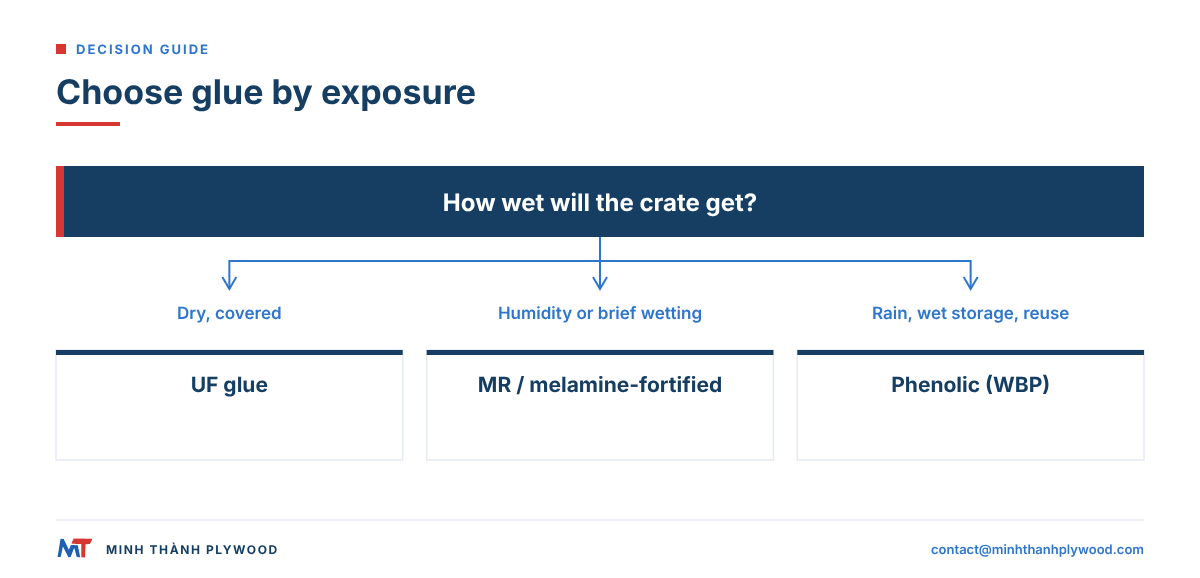
| Phenolic (WBP) | Rain, wet storage, reuse | Crates stored outdoors, returnable cases |
E2 panels are common for export packing where the destination has no emission rule for packaging. Specify E1 or a lower class when the crate is stored indoors, when your customer asks for it, or when the goods are sensitive to odour. State both lines on the order, for example “melamine-fortified glue, E1”.
Styrax vs Eucalyptus core: weight and container numbers
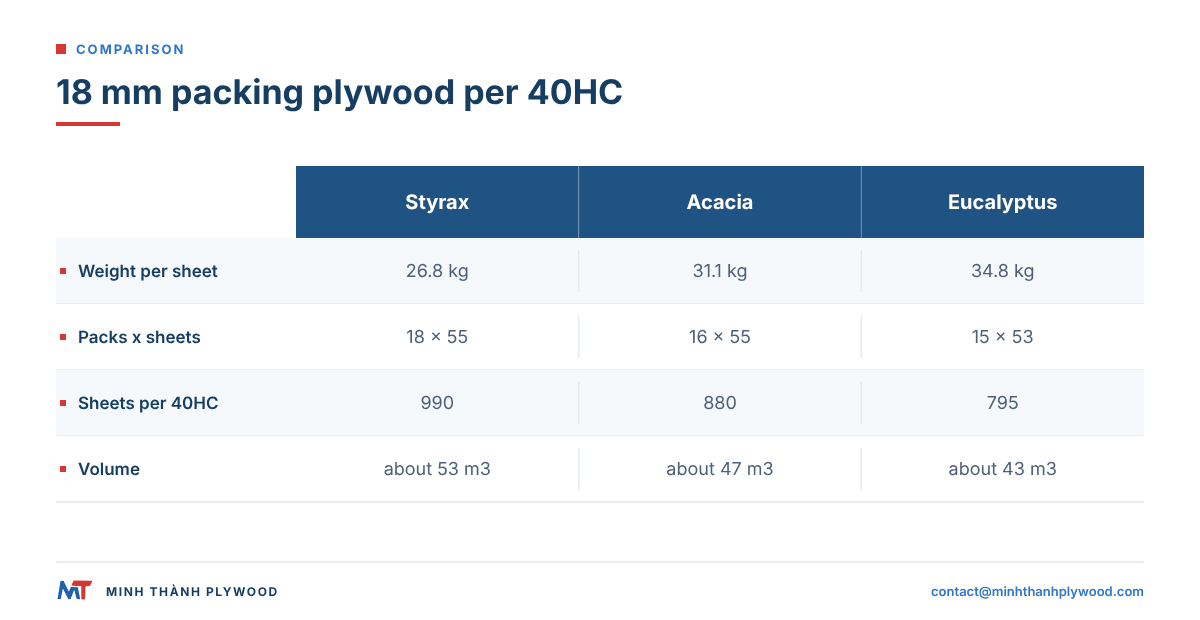
The core species sets the weight of every crate part and the number of sheets in a container. Styrax is light, at about 500 kg/m³; Eucalyptus is dense, at 650–750 kg/m³.
| 18 mm, 1220 × 2440 mm | Styrax core | Acacia core | Eucalyptus core |
|---|---|---|---|
| Reference density | 500 kg/m³ | 580 kg/m³ | 650 kg/m³ |
| Weight per sheet | 26.8 kg | 31.1 kg | 34.8 kg |
| Sheets per pack | 55 | 55 | 53 |
| Packs per 40HC | 18 | 16 | 15 |
| Volume per 40HC | about 53 m³ | about 47 m³ | about 43 m³ |
| Sheets per 40HC | 990 | 880 | 795 |
Packs are about 1,000 mm high, so a pack holds 1,000 ÷ thickness sheets, rounded down, and then the count is capped by weight. The plan uses a 28,000 kg payload unless the booking is lower. A dense core reaches the weight limit before the container is full.
Lighter crates also cost less to ship onward with the goods. A crate maker using Styrax-core panels saves about 8 kg on every full sheet of 18 mm compared with Eucalyptus.
What is the plywood shipping cost per CBM from Vietnam?
Plywood shipping cost per CBM is the container freight divided by the cubic metres loaded. The freight per box is set by the carrier and route; the cubic metres depend on the core.
With the same 40HC freight, 18 mm plywood costs:
- Styrax core: freight ÷ 53 m³.
- Eucalyptus core: freight ÷ 43 m³, about 23% more per cubic metre.
Add the landed costs on top: destination port charges, duty, customs clearance and inland haulage. A quote on FOB Hai Phong leaves the sea freight with you; CFR and CIF include it. Typical days at sea from Hai Phong are 30–40 to Northern Europe and 25–35 to the Mediterranean, by carrier and route.
For packing plywood, where the panel’s strength needs are modest, a lighter core often wins twice: more cubic metres per container and lighter crates.
How is a plywood crate built?
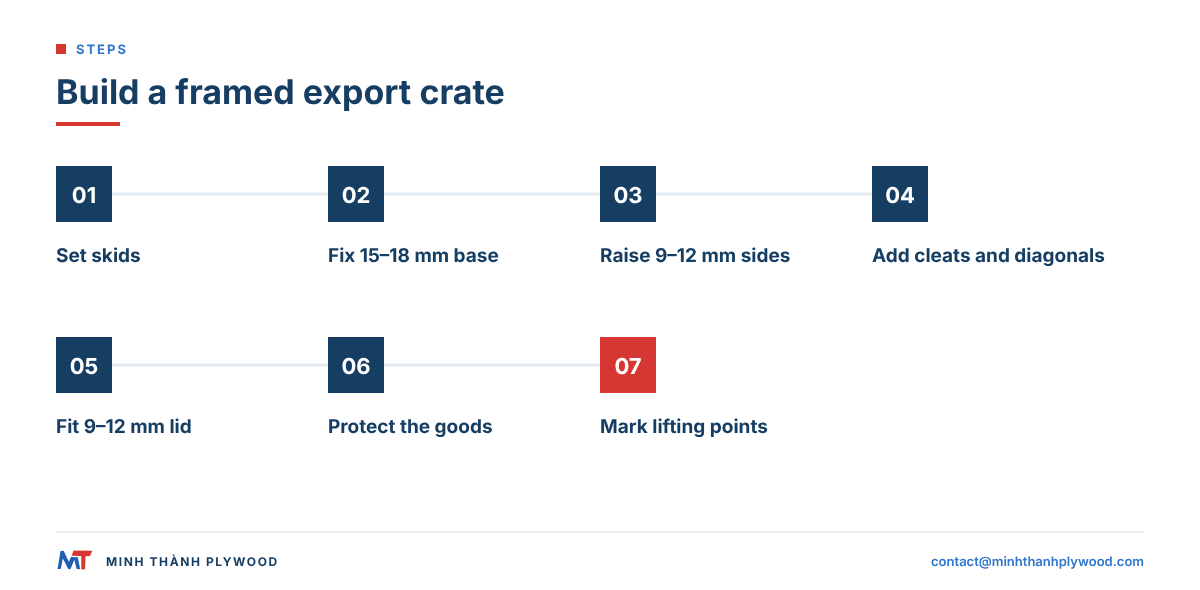
A plywood crate is built in a fixed order, from the base up. A typical framed export crate for machinery:
- Skids. Two or more runners of sawn timber or LVL carry the load and leave room for forklift tines.
- Base deck. 15–18 mm plywood nailed or screwed to the skids; the goods are bolted through it to the skids.
- Side and end panels. 9–12 mm plywood on a frame of battens, assembled flat, then raised.
- Cleats and diagonals. Battens on the panel joints and diagonals on large sides stop the crate racking.
- Lid. 9–12 mm plywood on lid joists, sloped or felted where rain stands.
- Protection. Barrier film, desiccant and corner blocks inside, as the goods need.
- Marking. Centre of gravity, lifting points, handling symbols and the shipping mark.
Wood-cleated plywood boxes follow ASTM D6251, the US standard for wood-cleated panelboard shipping boxes. Our article on wooden shipping crates compares crate types and parts in detail.
Plywood pallets and pallet decks
Plywood pallet decks replace several deck boards with one sheet, so small cartons and bags cannot drop through the gaps and the load is spread evenly. The deck is usually 15–18 mm plywood on blocks or runners.
| Pallet part | Material options | Notes |
|---|---|---|
| Top deck | 15–18 mm plywood | Full surface, takes point loads |
| Blocks (feet) | Chip blocks, LVL blocks or solid timber | Chip and LVL blocks fall outside ISPM 15 |
| Runners | LVL or solid timber | LVL runners stay straight and resist splitting |
| Bottom boards | Plywood strips or timber | Plywood strips for one-way export pallets |
A pallet made wholly of plywood, chip blocks and LVL is processed wood throughout, so it travels without an ISPM 15 stamp. Our guide to packing LVL for pallet runners and blocks covers those parts, and the comparison of plywood pallets vs solid wood pallets weighs deck, weight and cost.
ISPM 15: what plywood avoids and what still needs a stamp
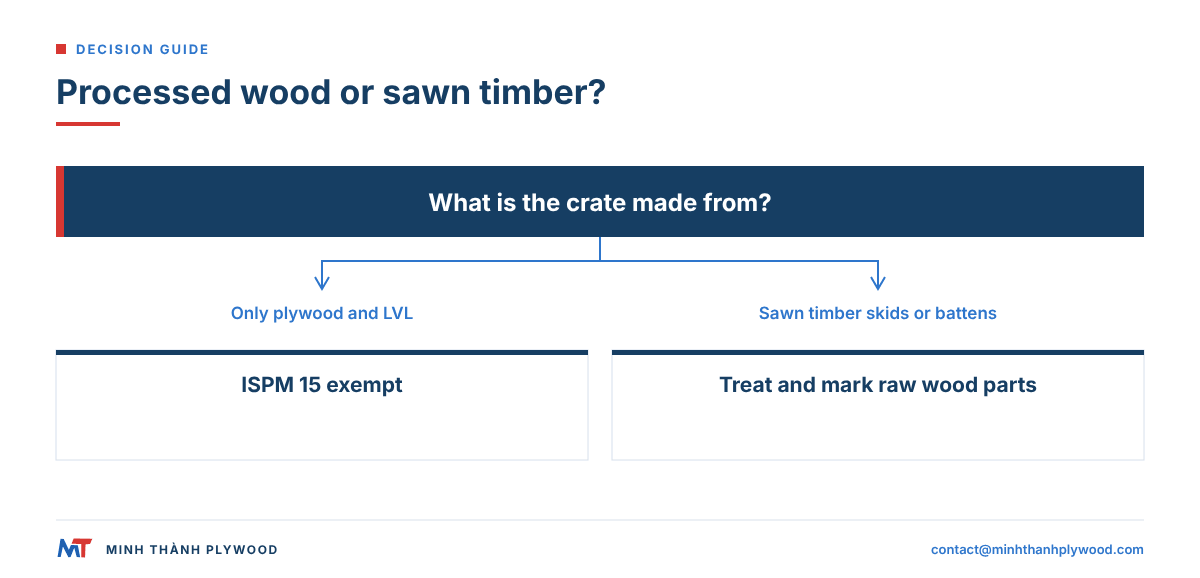
ISPM 15 regulates wood packaging made of raw wood, and plywood is not raw wood. The standard exempts packaging made wholly of processed wood produced with glue, heat or pressure, such as plywood, OSB, LVL and particleboard. Raw wood 6 mm thick or less is also exempt, as the GOV.UK guidance on wood packaging material lists.
When a plywood crate has sawn timber skids, battens or blocks, those solid parts need an approved ISPM 15 treatment, and the completed crate must carry the IPPC mark. The mark may be placed on a plywood panel of that composite unit; the plywood itself needs no treatment.
Cost note. A crate maker that builds the whole crate from plywood and LVL removes the heat-treatment step, the stamping and the risk of a refused or re-treated consignment. The panels may cost more per cubic metre than sawn boards; the saving is in the process and the risk.
Cut-to-size crate panels and mixed containers
Crate makers often order panels cut to their part list instead of full sheets. Minh Thanh Plywood cuts one panel into 4, 6 or 8 pieces, with the saw allowance included in the plan.
Send for each part: finished length and width, thickness, quantity, grain direction and a part reference. Matching left and right parts, notches or holes go on the drawing as a separate line.
A 40HC can carry mixed thicknesses and grades by agreement, usually one or two specifications per container and more by agreement. Each item travels in its own marked bundle, and the packing list repeats your part references so receiving is a count, not a search.
How to check packing plywood on arrival
Check packing plywood on arrival in this order, before the panels go to the saw:
- Packs and marks. Count packs, read the marks against the packing list, photograph any damaged wrapping.
- Thickness. Measure several sheets with a caliper at the corners and mid-edges; packing panels are held to ±0.5–1.0 mm.
- Size and squareness. Length and width within ±2 mm; check the diagonals.
- Faces. Compare both faces with the approved sample, not with a furniture grade.
- Core and bond. Look at the edges for gaps and open glue lines.
- Moisture. A meter reading of 8–12% is the dispatch range.
Store the panels flat, under cover, on even bearers and off the floor. Different thicknesses need clear labels, so the nailing line takes the right panel for each part.
What to write on a packing plywood order
A crate maker’s order lists the part, then the panel. These lines make two quotes comparable:
| Line | Example |
|---|---|
| Use | Export crate sides and lids, sea freight, outdoor storage under cover |
| Core | Styrax (light) or Eucalyptus (dense) |
| Glue and emission | Melamine-fortified, E1 |
| Faces | Packing grade, B/C, to the approved sample |
| Thickness and tolerance | 12 mm, ±0.5–1.0 mm |
| Size | 1220 × 2440 mm, or cut list attached |
| Moisture | 8–12% at dispatch |
| Packing | Packs with marks per part, strapped, covered |
| Quantity and term | 1 × 40HC, CIF destination port |
The core and glue lines move the price more than any other. A quote that names neither is not comparable with one that does.
Packing plywood from Minh Thanh Plywood
Minh Thanh Plywood, a manufacturer in Phu Tho, Vietnam, makes packing plywood for crates, pallet decks and protective panels, alongside our furniture and film-faced ranges. Cores are white Styrax or Eucalyptus as standard, with Acacia and pine on order; plantation timber for the cores grows around the factory.
| Line | What we supply |
|---|---|
| Thickness | 3–40 mm |
| Sizes | 1220 × 2440 mm, 1250 × 2500 mm, custom sizes and cut-to-size |
| Glue | UF for dry service; melamine-fortified or phenolic (WBP) to specification |
| Tolerance | Packing ±0.5–1.0 mm; length and width ±2 mm |
| Moisture | 8–12% at dispatch |
| Our export packaging | Cardboard, plywood and pallet blocks, strapping and film tested by SGS under Regulation (EU) 2025/40 (September 2026): lead, cadmium, mercury and hexavalent chromium not detected |
| Terms | MOQ one 40HC, mixed by agreement; production 15–45 days after deposit; FOB Hai Phong, CFR or CIF |
Every shipment is photographed and filmed before loading, and the photos and video go to the buyer. Free samples let you nail-test a panel on your own line.
Send this line for a quote: “Packing plywood for [crate part], [Styrax/Eucalyptus] core, [UF/MR/phenolic] glue, [E2/E1], [grade] faces to sample, [thickness] mm ±0.5–1.0 mm, [size or cut list], [quantity] × 40HC, [FOB/CIF port].”
Buyer questions, answered
Why use plywood instead of solid wood for export crates?
Plywood is processed wood, so a crate made wholly of it falls outside ISPM 15 and needs no heat-treatment stamp. It also comes in large flat panels with fewer joints, holds nails close to the edge without splitting, and arrives dry, which keeps mould off the goods.
What thickness of plywood is used for shipping crates?
Thin 3–6 mm panels for dividers and supported skins, 9–12 mm for sides, ends and lids, and 15–18 mm for bases and pallet decks. The frame spacing and the weight of the goods set the final thickness.
Does a plywood crate need ISPM 15 treatment?
No, not for the plywood. ISPM 15 exempts packaging made wholly of processed wood such as plywood. Solid timber skids, battens or blocks in the same crate need an approved ISPM 15 treatment, and the completed crate must carry the mark.
What grade of plywood is best for crates?
A packing grade with utility faces: repaired knots, colour variation and small splits are fine on hidden parts. Choose cleaner faces only where the crate is printed, reused or shown to the end customer.
Which plywood glue is right for export packaging?
UF glue for dry, covered trips; melamine-fortified (MR) glue for humid routes and storage; phenolic WBP glue where the crate stands in rain or is reused outdoors.
What is the typical plywood shipping cost per CBM from Vietnam?
Divide the container freight by the cubic metres it carries. A 40HC of 18 mm plywood carries about 53 m³ on a Styrax core and about 43 m³ on Eucalyptus, so the same freight costs about 23% more per cubic metre on Eucalyptus.
How does core density affect plywood shipping cost per container?
A dense core reaches the container's weight limit before its volume. At 18 mm, 990 Styrax-core sheets fit a 40HC against 795 Eucalyptus-core sheets, because each sheet weighs 26.8 kg against 34.8 kg.
Is E2 plywood acceptable for packing crates?
E2 panels are widely used for export packing where the destination has no emission rule for packaging. Specify E1 or better when the crate is stored indoors, when your customer asks, or when the goods are sensitive to odour.
Can I order plywood cut to crate sizes?
Yes. Send the finished size, thickness and quantity of each part, with grain direction. Minh Thanh Plywood cuts one panel into 4, 6 or 8 pieces with the saw allowance included in the plan.
How heavy is an 18 mm plywood crate panel?
A full 1220 × 2440 × 18 mm sheet weighs about 26.8 kg on a Styrax core and about 34.8 kg on Eucalyptus. A crate side cut from it weighs in proportion to its area.
Plywood crates or plywood boxes: what is the difference?
A crate has a timber or LVL frame with plywood sheathing nailed or screwed on; a box relies on the plywood panels and cleats for its strength. Boxes suit lighter goods; framed crates suit heavy machinery.