
Packing plywood specifications come down to seven lines: core species, thickness by load, glue, moisture, tolerance, size and packing. For export crates, a Styrax core at 9–15 mm with MR glue, 8–12 % moisture and ±0.5–1.0 mm tolerance covers most loads; heavy bases go to 18 mm or a denser core. Minh Thanh Plywood makes packing plywood in Vietnam and ships it by the container.
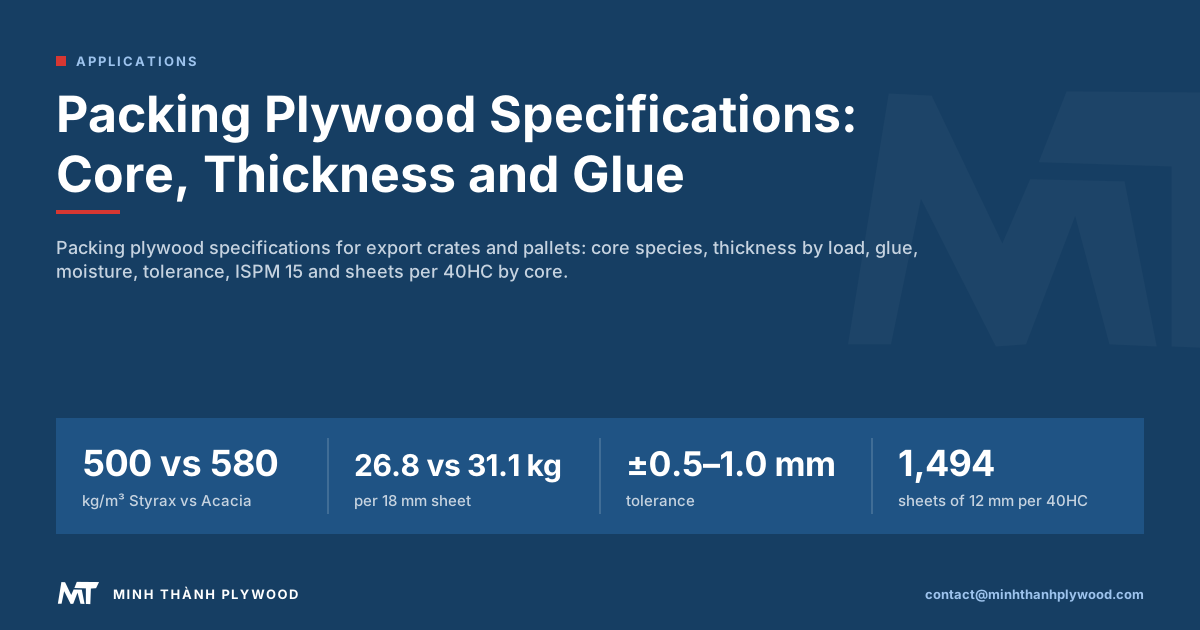
Packing plywood specifications at a glance
Packing plywood specifications cover seven parameters: face grade, core species, thickness, glue, moisture content, tolerance and sheet size. The table gives the values export crate and pallet makers order most, and the range Minh Thanh produces.
| Parameter | Common for export packaging | Range we make |
|---|---|---|
| Face and back | Utility C/D | Utility to better faces on order |
| Core | Styrax | Styrax, Eucalyptus; Acacia and Pine on order |
| Thickness | 9, 12, 15, 18 mm | 3–40 mm |
| Glue | MR (melamine-fortified) | UF, MR or phenolic (WBP) to specification |
| Moisture at dispatch | 8–12 % | 8–12 % |
| Thickness tolerance | ±0.5–1.0 mm | ±0.5–1.0 mm (commercial ±0.5 mm) |
| Length and width tolerance | ±2 mm | ±2 mm |
| Sheet size | 1220 × 2440 mm | 1220 × 2440, 1250 × 2500 mm and custom sizes |
| ISPM 15 | Not required for plywood | Not required for plywood |
Each line is explained below with the choice it decides. The order checklist at the end puts them into the words a mill quotes from.
Packing-grade thicknesses, sizes and price
Packing plywood is often sold by actual thickness, which runs under the nominal figure because the sheet is pressed for strength per cost. Buyers quote 7 mm (4 plies), 8 mm (5 plies), 11 mm (7 plies), 14 mm (9 plies) and 17 mm (11 plies), against the nominal 9, 12, 15 and 18 mm of commercial panels. Thin 4 mm and 5 mm sheets exist for box sides and dividers.
| Actual thickness | Plies | Nominal equivalent | Typical part |
|---|---|---|---|
| 4–5 mm | 3 | 5–6 mm | Box sides, dividers |
| 7 mm | 4 | 9 mm | Light crate panels |
| 8 mm | 5 | 9 mm | Crate sides and lids |
| 11 mm | 7 | 12 mm | Export crate sides, light bases |
| 14 mm | 9 | 15 mm | Heavy sides, medium bases |
| 17 mm | 11 | 18 mm | Bases, pallet decks |
These are market figures; Minh Thanh builds its own 3–5 mm panels as 5-ply and confirms the ply count of 6 mm and thicker packing panels with the order.
Sizes are 1220 × 2440 mm and 1250 × 2500 mm; smaller sheets such as 910 × 1820 mm, which suit hand-built crates and one-person handling, are cut to size on order. Faces can be utility C/D, or a red okoume or bintangor face where the crate is seen. Glue classes run from UF to MR and phenolic; emission is E1 or E2 for ordinary packing, with E0 on order.
For price, Minh Thanh quotes commercial-grade plywood from US$250/m³ FOB Hai Phong (October 2026), and the figure moves with thickness, face, glue and quantity. Public packing-grade listings from Vietnamese mills show US$207–260/m³ FOB, so compare quotes on the same thickness, ply count and glue, not on the cubic-metre figure alone.
For UK buyers: plywood imported into Great Britain falls under the UK Timber Regulation, so the importer keeps due-diligence papers for five years. Minh Thanh supplies species, origin and legal-harvest documents with each shipment, and FSC certification on request, which shortens that file.
What is packing plywood?
Packing plywood is plywood made for crates, boxes, pallets and dunnage: utility faces, a sound core, a water-resistant bond and the thickness the load needs. It is built for strength per cost, not appearance, and it ships without ISPM 15 treatment.
How it differs from other grades:
| Grade | Faces | Core | Typical use |
|---|---|---|---|
| Packing plywood | Utility, knots and patches allowed | Sound, small gaps tolerated | Crates, boxes, pallets, drums |
| Commercial plywood | Better, sanded | Tighter core | Furniture backs, hidden parts, general building |
| Furniture plywood | Selected, sanded, often polished | Stitched, pressed twice | Visible furniture and interiors |
A crate plant pays for strength, fastener holding and dimensional accuracy. Paying for a furniture face on a crate side buys nothing the crate needs; buying too weak a core costs a damaged shipment. The wood packaging guide shows where plywood sits beside timber, LVL and boxes.
Face grade: what C/D means on packing plywood
Packing plywood faces are utility grades: C/D means a C face with sound knots, small splits and patches, and a D back with open knots and defects allowed. The face only has to hold nails and carry print where needed.
What each part of the code tells the crate maker:
- C face: knots and patches, no large holes; good enough to print a shipping mark.
- D back: open defects allowed; hidden inside the crate.
- BB/CC and lower codes: the same ladder named by the codes many Asian mills and buyers use.
- Better face on one side: order it when the crate is a retail display or carries the customer’s brand.
Two face defects matter for packaging: an open split at the edge, where a nail can pull through, and an overlap that makes a sheet thick in one spot. A mill grading for packing removes these, even on a utility face.
Packing plywood core: Styrax, Acacia, Eucalyptus or mixed
The packing plywood core decides weight, fastener holding and the number of sheets in a container. Styrax at about 500 kg/m³ is the light standard; Acacia at about 580 kg/m³ and Eucalyptus at about 650 kg/m³ are denser and stronger at the fastener.
| Core | Reference density | Character | Best packaging use |
|---|---|---|---|
| Styrax (white) | 500 kg/m³ | Light, even, easy to nail | Crate sides and lids, boxes, one-way packaging |
| Acacia | 580 kg/m³ | Denser, good screw and nail holding | Crate bases, reusable crates, machinery packing |
| Eucalyptus | 650 kg/m³ | Densest, stiff, hard | Heavy bases, pallet decks, skids |
| Mixed hardwood | Varies with mix | Cheapest, least even | Dunnage and fillers |
Mixed cores cost less, but density and fastener holding change from sheet to sheet, which a crate line feels at the nail gun. A single declared species keeps every sheet the same. Minh Thanh makes Styrax and Eucalyptus cores as standard and Acacia and Pine on order.
Acacia vs Styrax packing plywood: which one?
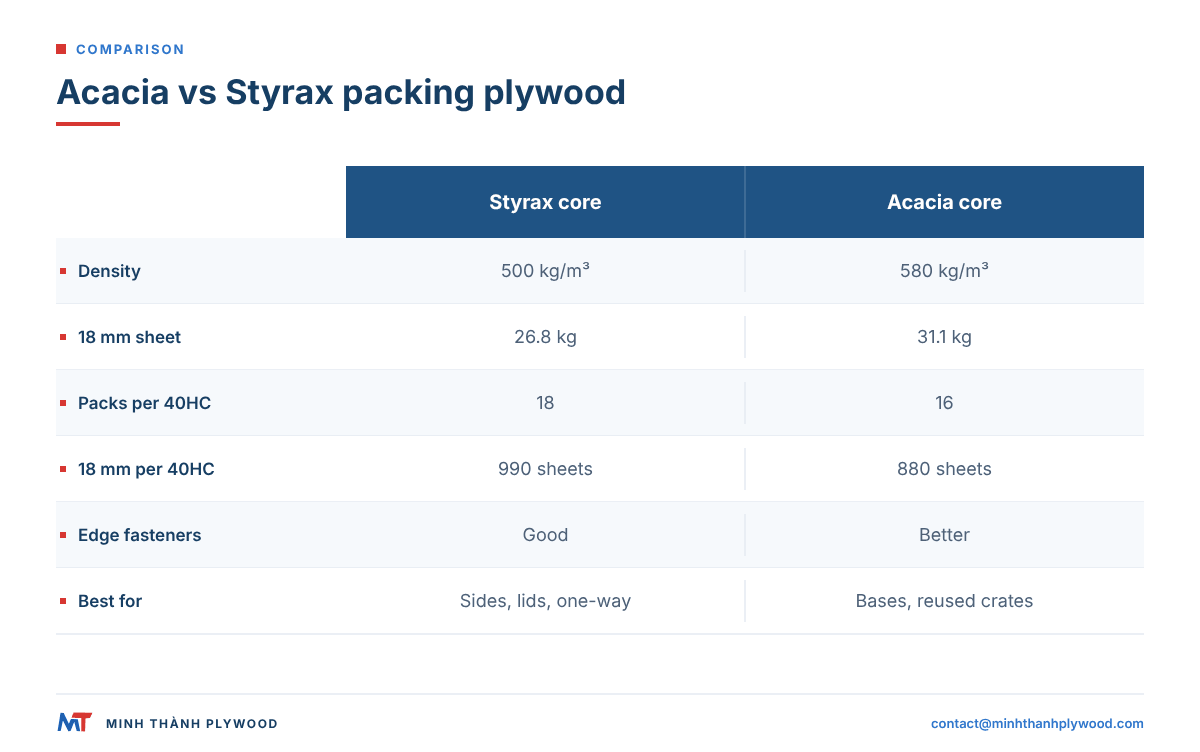
Choose Styrax packing plywood when freight and handling weight matter and fasteners are in the face; choose Acacia when screws and nails close to edges carry heavy loads or crates are reused. At 18 mm, a Styrax sheet weighs 26.8 kg and an Acacia sheet 31.1 kg.
| Metric | Styrax core | Acacia core |
|---|---|---|
| Reference density | 500 kg/m³ | 580 kg/m³ |
| 18 mm sheet, 1220 × 2440 mm | 26.8 kg | 31.1 kg |
| 12 mm sheet, 1220 × 2440 mm | 17.9 kg | 20.7 kg |
| Packs in a 40HC | 18 | 16 |
| 18 mm sheets per 40HC | 990 | 880 |
| Nail and screw holding at edges | Good | Better |
| Stiffness | Good | Higher |
| Best for | Sides, lids, boxes, one-way crates | Bases, reused crates, heavy machinery |
Verdict: most export crates use Styrax for the whole crate, or Styrax sides with an Acacia or Eucalyptus base. The extra 4.3 kg per 18 mm sheet is worth it where the base carries a machine; it is wasted weight on a lid.
Which core and packing plywood thickness suit export crates?
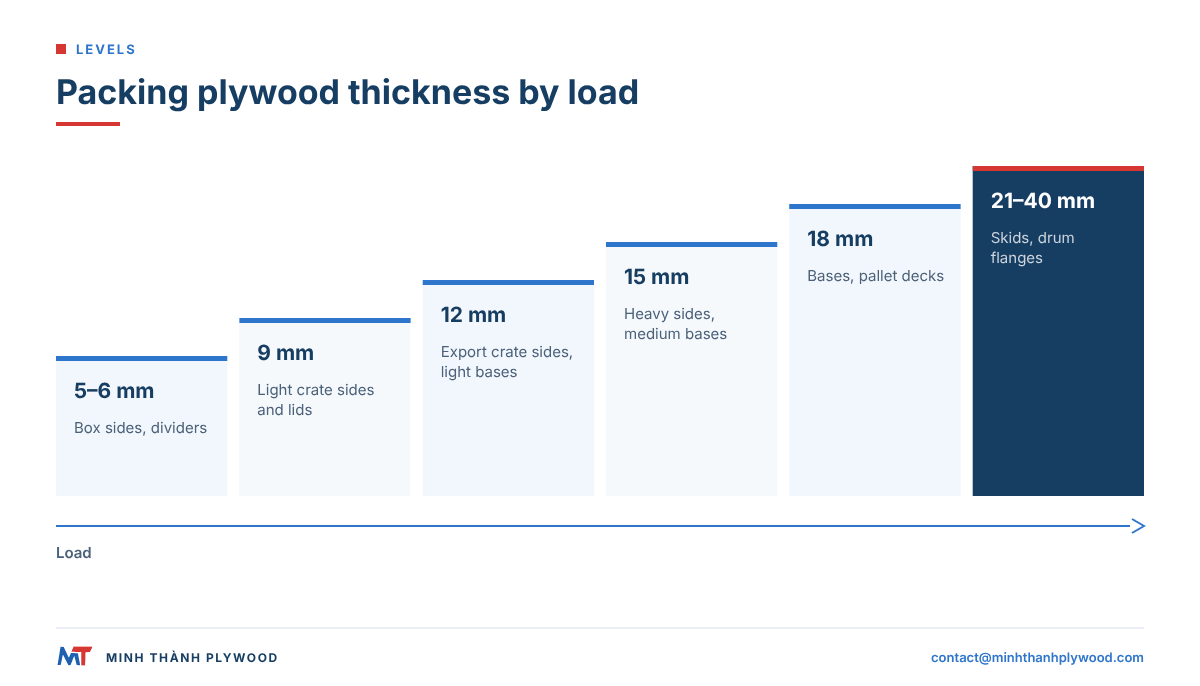
Packing plywood thickness follows the part and the load: 5–6 mm for box sides and dividers, 9 mm for light crate panels, 12 mm for general export crate sides, 15 mm for heavy crate sides and light bases, 18 mm for bases and pallet decks carrying machinery.
| Thickness | Crate or pallet part | Load class |
|---|---|---|
| 5–6 mm | Box sides, dividers, lids of light cartons | Light parts, retail boxes |
| 9 mm | Crate sides and lids with timber frame | Light to medium goods |
| 12 mm | Export crate sides, lids, light bases | Medium goods, the most ordered |
| 15 mm | Heavy crate sides, medium bases | Heavy goods, stacked crates |
| 18 mm | Crate bases, pallet top decks, skid decks | Machinery and heavy loads |
| 21–40 mm | Heavy skids, cable drum flanges, bearing pads | Very heavy or concentrated loads |
Three rules move a part up a size:
- Span: a panel spanning further between frame members needs more thickness or a frame member added.
- Stacking: crates stacked in the container or warehouse load the lid and sides of the crates below.
- Fasteners near edges: a thin panel splits where nails run close to its edge; thicker or denser cores hold.
Over-specifying is the more common error. A crate built in 18 mm where 12 mm carries the load weighs half as much again and costs more freight on every trip. Cable drum flanges are the main use above 18 mm; see plywood cable drums.
How many plies does packing plywood have?
Packing plywood usually has an odd number of plies, more as it gets thicker (some thin packing listings, such as 7 mm in 4 plies, pair two core veneers laid in the same direction): three to five plies for thin panels, seven to nine for 12–15 mm, nine to thirteen for 18 mm, depending on veneer thickness. More, thinner plies give a flatter, stronger panel; fewer, thicker plies give a cheaper one.
| Thickness | Typical plies | What to check |
|---|---|---|
| 3–6 mm | 3 or 5 | No overlaps, even thickness |
| 9 mm | 5 or 7 | Core gaps at the edge |
| 12 mm | 7 or 9 | Flatness across the sheet |
| 15 mm | 9 or 11 | Glue line soundness |
| 18 mm | 11 or 13 | Count plies against the quote |
A buyer checks ply count at the edge of a sample sheet. Fewer plies than quoted usually means thicker, rougher core veneers and more gaps, which shows up as nails that miss solid wood. Our furniture panels at 18 mm run 11–13 plies; packing panels use the same core lines with utility faces.
Glue and emission: MR, WBP or UF for packaging?
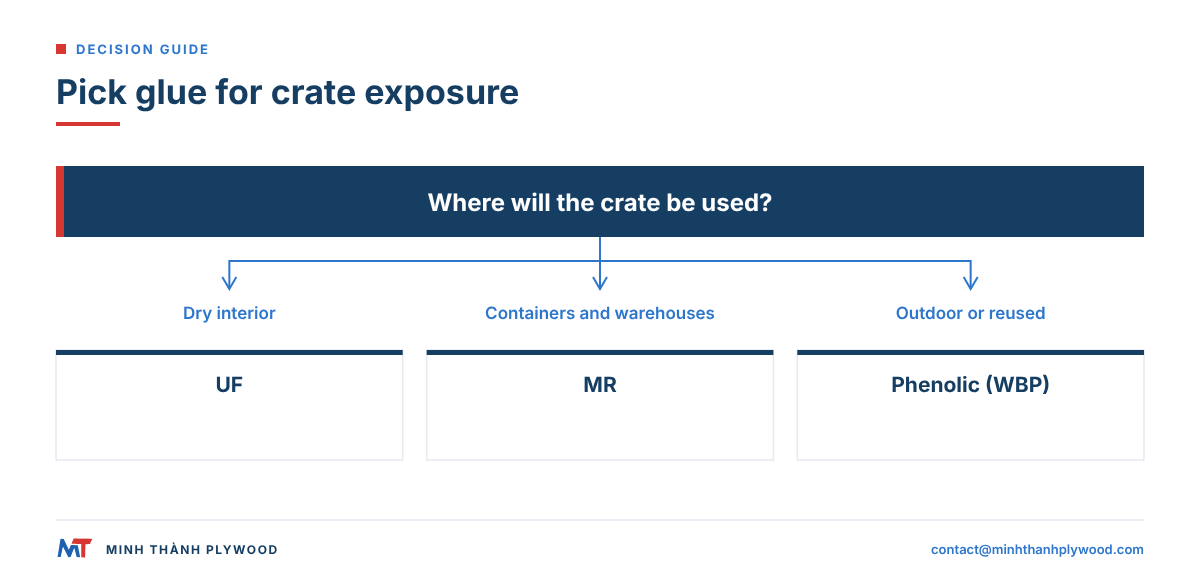
Use MR (melamine-fortified) glue for crates that stay dry in containers and warehouses, phenolic (WBP) glue for crates stored outdoors, reused or shipped through very humid routes, and plain UF glue only for dry, interior packaging. The bond decides whether a crate survives rain on a quay.
| Bond | Resistance | Packaging use | Cost |
|---|---|---|---|
| UF (urea-formaldehyde) | Dry interior only | Retail boxes, indoor dividers | Lowest |
| MR (melamine-fortified) | Humidity, short wetting | Export crates, most pallets | Middle |
| Phenolic (WBP) | Repeated wetting, outdoor storage | Reusable crates, drums, outdoor yards | Highest |
Emission class is a separate line from the bond. Packaging rarely carries a furniture emission requirement, but some importers set one for crates that travel with consumer goods. When yours does, write the emission class and test method as their own line; Minh Thanh makes UF glue at E0 emission for its furniture panels and can match a packaging order to the same class.
What moisture content should packing plywood have?
Packing plywood should leave the mill at 8–12 % moisture content. Dry panels limit mould and condensation inside a sealed container, keep nails tight as the crate dries, and stop panels shrinking away from the frame.
Why moisture matters more for export packaging than for most uses:
- Container rain: a sealed box crossing climate zones condenses moisture from wet wood onto the cargo.
- Mould: wet packaging on a 30–40 day voyage to Northern Europe can grow mould on the crate and the goods.
- Fastener loosening: wet panels shrink after assembly, and nails and staples lose their grip.
- Weight: water is freight you pay for.
Minh Thanh dries veneers and finished panels to 8–12 % before dispatch. A crate plant can check incoming sheets with a pin meter on the edge and the centre of a few sheets per pack.
Thickness tolerance: why ±0.5–1.0 mm matters
Packing plywood is held to ±0.5–1.0 mm on thickness and ±2 mm on length and width. Tight thickness keeps nail-gun depth, frame rebates and panel stacks consistent; accurate length and width keep cut lists and automatic crate lines running.
What tolerance changes on a crate line:
- Nail depth: a sheet 1 mm thin leaves heads proud; 1 mm thick sinks them.
- Rebates and grooves: frame rebates are cut for nominal thickness.
- Stack height: forty sheets each 0.5 mm over adds 20 mm to a pack.
- Cut lists: saw settings assume ±2 mm sheets.
Where a line needs more, order commercial tolerance, ±0.5 mm. Furniture-grade sanded panels are held to ±0.2–0.3 mm, which packing rarely needs.
Panel sizes and cut-to-size yield
Packing plywood comes in 1220 × 2440 mm and 1250 × 2500 mm sheets, plus custom sizes such as 1220 × 2500 mm and 1220 × 2280 mm, and can be cut at the mill into 4, 6 or 8 pieces. Matching sheet size to the crate’s panel sizes cuts waste.
How to choose:
- 1220 × 2440 mm: the common size for crates built to inch-based or Asian dimensions.
- 1250 × 2500 mm: suits crates built to European metric modules.
- Custom lengths: where one crate side needs a little more length than 2440 mm.
- Cut-to-size: sheets cut into 4, 6 or 8 pieces for crate plants that build one size in volume.
Cut-to-size saves cutting time at the crate plant and freight on offcuts. Order it with a drawing of the piece sizes and the tolerance you need on them; see cut-to-size plywood.
Does packing plywood need ISPM 15?
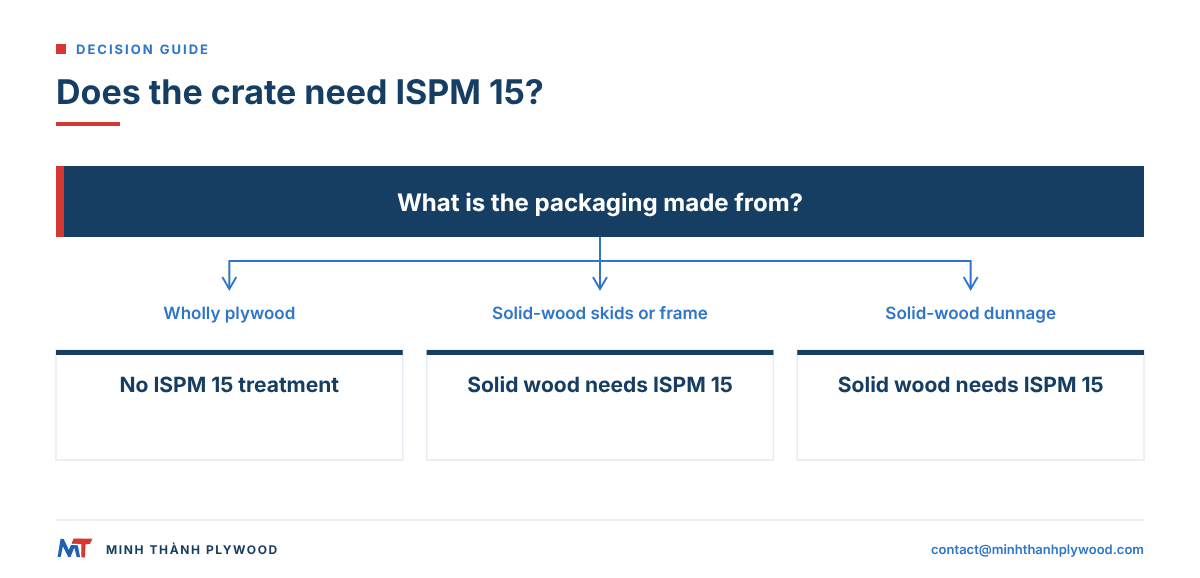
No. ISPM 15, the international standard for wood packaging in trade, exempts packaging made wholly of processed wood such as plywood, because the glue-press process removes the pest risk. Plywood crates, boxes and pallet decks need no heat treatment and no stamp.
What still needs ISPM 15 on a plywood crate:
- Solid-wood skids under the crate.
- Battens, frames and cleats of sawn timber.
- Blocks and bearers of solid wood.
- Dunnage of sawn timber used to brace the load.
The standard is published by the International Plant Protection Convention (IPPC). UK government guidance says the rules do not apply to processed, non solid WPM like plywood. Making the whole crate from plywood, with LVL or plywood skids and blocks, removes the treatment and stamping step entirely; our guide to plywood for crates and pallets shows the builds.
Packing plywood sheets per 40HC by core and thickness
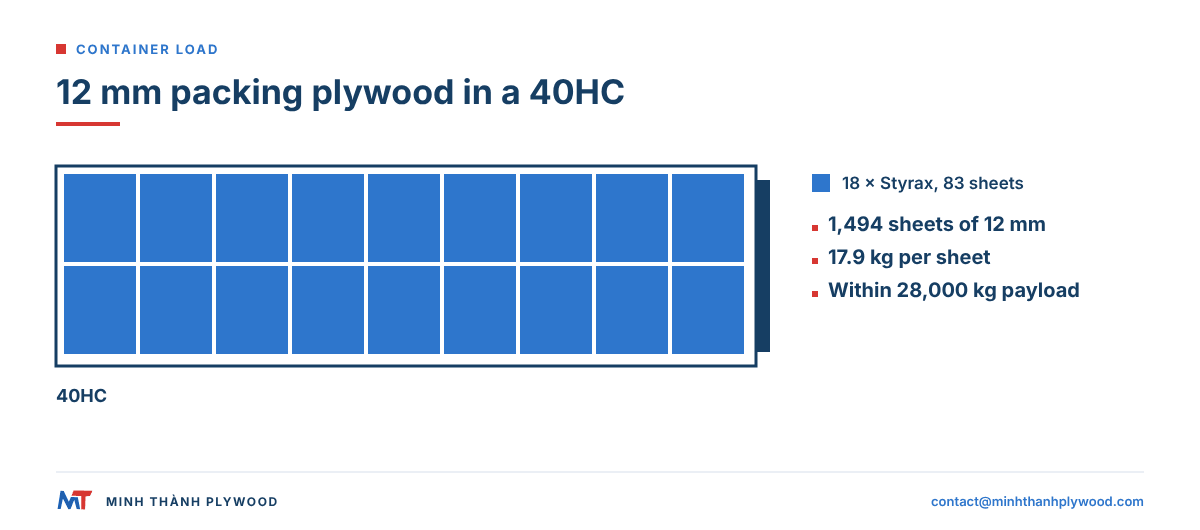
A 40HC of 1220 × 2440 mm packing plywood carries 18 packs on a Styrax core, 16 on Acacia and 15 on Eucalyptus, with packs about one metre high and every plan capped at the 28,000 kg planning payload. The denser the core, the fewer sheets per container.
| Thickness | Styrax core (18 packs) | Acacia core (16 packs) | Eucalyptus core (15 packs) |
|---|---|---|---|
| 9 mm | 1,998 sheets, 13.4 kg each | 1,776 sheets, 15.5 kg each | 1,605 sheets, 17.4 kg each |
| 12 mm | 1,494 sheets, 17.9 kg each | 1,328 sheets, 20.7 kg each | 1,200 sheets, 23.2 kg each |
| 15 mm | 1,188 sheets, 22.3 kg each | 1,056 sheets, 25.9 kg each | 960 sheets, 29.0 kg each |
| 18 mm | 990 sheets, 26.8 kg each | 880 sheets, 31.1 kg each | 795 sheets, 34.8 kg each |
At 12 mm on a Styrax core, that is 18 packs of 83 sheets. The Styrax and Acacia plans are limited by pack height; the Eucalyptus plans are reduced to stay under the payload. If your booking allows less, for example 26,000 kg, the sheet count drops to fit. Check any mix of thicknesses in the packing calculator.
How packing plywood sheets are packed for shipping
Packing plywood sheets for shipping are stacked in packs about one metre high on a base, covered top and sides, strapped, and marked with thickness, size, grade and sheet count. Each shipment is photographed and filmed before loading, and the buyer gets the photos and video.
What a buyer should see on the packs:
- Base: bearers or a plywood base so a forklift can lift the pack.
- Cover: top and side boards or film against dirt and rain on the quay.
- Corner protectors under the straps.
- Straps: steel or PET, at least three across the length.
- Marks: thickness, size, grade, sheets per pack, pack number.
Shipping documents come with every shipment: commercial invoice, packing list, B/L, certificate of origin, with phytosanitary and fumigation certificates where the buyer’s market asks for them and insurance under CIF.
Common specification mistakes on packing plywood orders
The common mistakes are ordering one thickness for every crate part, leaving the core species open, buying UF glue for crates that will be stored outdoors, and accepting a container count that ignores weight. Each one costs money on freight or on damaged goods.
| Mistake | What happens | Fix on the order |
|---|---|---|
| One thickness for all parts | Heavy, costly crates | Thickness per part: sides, lid, base |
| Core species left open | Mixed density, uneven nailing | Name the species |
| UF glue for outdoor storage | Delamination at edges | MR or WBP by storage |
| No moisture figure | Mould, loose nails | 8–12 % at dispatch |
| Sheet count by volume only | Overweight container | Count capped by payload |
| No tolerance line | Proud or sunk nails | ±0.5–1.0 mm, ±2 mm |
| Better face than needed | Paying for looks | Utility faces unless printed |
The cheapest crate panel is the one that matches the part. Splitting an order into two or three thicknesses in one container is normal practice and is agreed with the mill before production.
How to check packing plywood when it arrives
Check an incoming packing plywood container in six steps: pack count and marks, moisture, thickness, length and width, core and glue, and a nailing test. A short check on arrival catches a wrong specification before the panels go into crates.
- Count and marks: packs and sheets against the packing list; thickness, size and grade marked on each pack.
- Moisture: a pin meter on the edge and the centre of three sheets from three packs; the target is 8–12 %.
- Thickness: a caliper at four points on five sheets per thickness, against ±0.5–1.0 mm.
- Length and width: a tape on the same sheets, against ±2 mm, and the diagonals for squareness.
- Core and glue: look along the edges for open gaps, overlaps and delamination; count plies against the quote.
- Nailing test: drive nails near the edge of an offcut, as the crate line does, and check for splitting.
Record the results with photos and the pack numbers. Comparing them with the loading photos and video sent before shipment shows whether anything changed in transit. A buyer who checks the first container closely can sample lightly on repeat orders of the same specification.
What the checks catch early:
| Finding | Likely cause | Effect on crates |
|---|---|---|
| Moisture above 12 % | Wet storage or short drying | Mould, loose nails |
| Thickness out of tolerance | Uneven core veneers | Proud or sunk nails, poor fit |
| Open core gaps at edges | Loose core lay-up | Nails missing solid wood |
| Delamination at edges | Wrong or under-cured glue | Panels separating in rain |
| Wrong ply count | Thicker, cheaper veneers | Lower strength, more gaps |
What to write on a packing plywood order
A complete packing plywood order states eight lines: application, core, thickness by part, glue, moisture, tolerance, size, and packing with quantity and port. With them, a mill quotes the right panel in one reply.
- Application: export crates for machinery, sides and bases; or pallets, boxes, drums.
- Core: Styrax, Acacia or Eucalyptus; no mixed core.
- Thickness by part: for example sides 12 mm, base 18 mm.
- Glue: MR, or WBP for outdoor or reused crates.
- Moisture: 8–12 % at dispatch.
- Tolerance: ±0.5–1.0 mm on thickness, ±2 mm on length and width.
- Size: 1220 × 2440 mm, 1250 × 2500 mm, a custom size, or cut into 4, 6 or 8 pieces.
- Packing and quantity: sheets per pack, number of thicknesses in the container, destination port, payload limit of your booking.
Add the face grade only when it differs from utility C/D, and the emission class only when your customer requires one.
How Minh Thanh supplies packing plywood
Minh Thanh Plywood makes packing plywood at its own mill in Ha Hoa, Phu Tho, Vietnam, from locally grown plantation timber: Styrax and Eucalyptus cores as standard, Acacia and Pine on order, MR or WBP bonds, 3–40 mm, 8–12 % moisture and ±0.5–1.0 mm tolerance. Capacity is 50,000+ m³ per year.
Order terms:
- MOQ: one 40HC, mixed specifications by agreement.
- Production: 15–45 days after the 30% deposit; balance 70% against the scanned B/L, or L/C at sight.
- Delivery: FOB Hai Phong, CFR or CIF; about 30–40 days at sea to Northern Europe and 25–35 days to the Mediterranean, by carrier and route.
- Price: commercial plywood from US$250/m³ (October 2026); the quote depends on core, glue, thickness and quantity.
- Samples: free samples.
Send your eight lines to contact@minhthanhplywood.com or WhatsApp Lisa on +84 988 586 601; we reply within hours. The packing plywood page lists the standard grades, and our guides to wooden shipping crates and plywood pallets cover the crate and pallet builds.
Buyer questions, answered
What are the standard packing plywood specifications?
Utility faces, a Styrax, Acacia or Eucalyptus core, MR or WBP glue, 8–12 % moisture, ±0.5–1.0 mm thickness tolerance, ±2 mm on length and width, in 1220 × 2440 or 1250 × 2500 mm sheets from 3 to 40 mm.
Which core and thickness of packing plywood for export crates?
For most export crates, a Styrax core at 9–12 mm for sides and lids and 15–18 mm for bases. Choose Acacia or Eucalyptus where nails and screws near edges must hold heavy loads, or where the crate is reused.
What is the difference between Acacia and Styrax packing plywood?
Styrax is lighter, at about 500 kg/m³, so it saves freight and fits 18 packs in a 40HC. Acacia, at about 580 kg/m³, is denser and holds fasteners better, but 16 packs fill the same container by weight.
What moisture content should packing plywood have?
8–12 % at dispatch. Drier panels reduce mould risk in a sealed container and keep nailed joints tight after the crate is built.
Does packing plywood need ISPM 15 treatment?
No. ISPM 15 exempts packaging made wholly of processed wood such as plywood, so plywood crates and boxes need no heat treatment or stamp. Solid-wood skids, battens or blocks on the same crate still do.
How many sheets of 12 mm packing plywood fit in a 40HC?
At 1220 × 2440 mm: 1,494 sheets on a Styrax core, 1,328 on Acacia and 1,200 on Eucalyptus, with each plan capped by the 28,000 kg planning payload.
What glue is used in packing plywood?
MR (melamine-fortified) glue for crates kept dry in containers and warehouses; phenolic (WBP) glue for crates stored outdoors or reused. Plain UF glue suits dry interior packaging only.
What face grade is used for packing plywood?
Utility grades: C/D, or the BB/CC and lower codes, with open knots and patches allowed. Appearance matters only where the crate is printed or shows the brand; ask for a better face on one side then.
What thickness of plywood is used for pallets?
Pallet top decks are usually 15–18 mm plywood; light display and export pallets use 12 mm. Bottom boards and blocks are often LVL or solid wood, sized by the pallet's load.
Can packing plywood be cut to size?
Yes. Sheets can be cut into 4, 6 or 8 pieces at the mill, which saves cutting at the crate plant and lowers freight on waste.
What is the thickness tolerance of packing plywood?
±0.5–1.0 mm on thickness and ±2 mm on length and width. Commercial plywood is held to ±0.5 mm when a crate line needs tighter thickness.
How should packing plywood be stored before use?
Flat, on level bearers, covered from rain and sun, in the strapped pack until use. Opened packs should be restacked flat so the top sheets do not bow.