
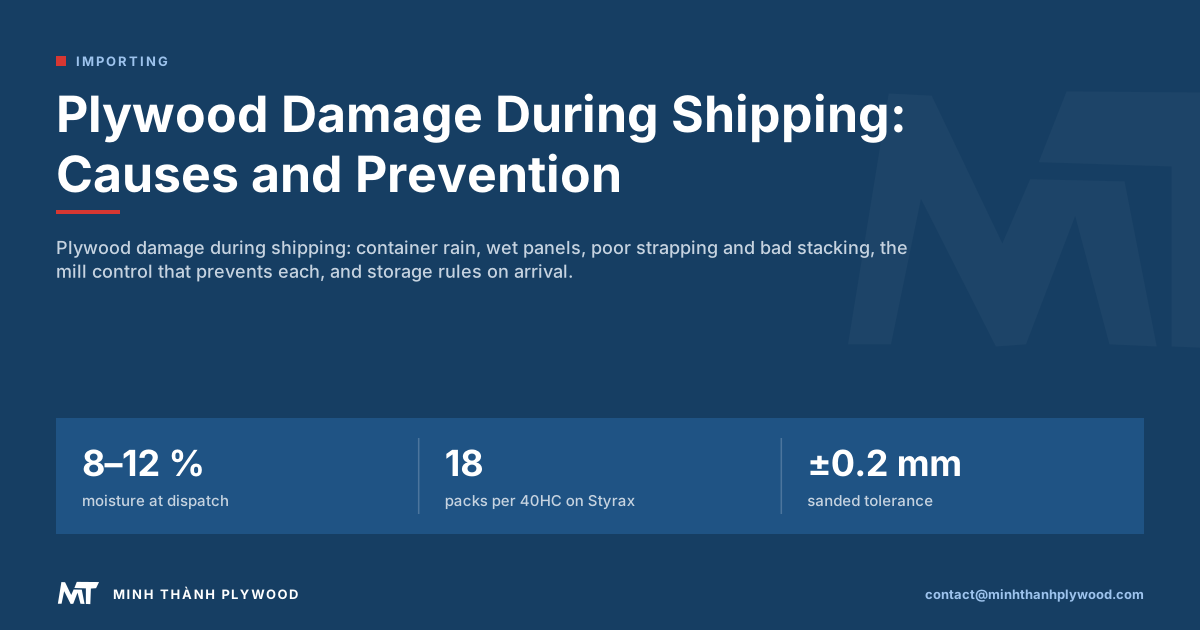
Plywood damage during shipping has four main causes: condensation inside the container, panels packed too wet, loose or over-tight strapping, and packs stacked on an uneven base. Each one is prevented at the mill, before the doors close. Minh Thanh Plywood dries panels to 8–12 % moisture, builds level packs about one metre high and films every container before loading.
What causes plywood damage during shipping?
Plywood damage during shipping comes from four causes, and moisture is behind most of them. Panels absorb or lose water through their faces and edges, and a sea voyage of several weeks moves them through heat, humidity and cold. Damage shows up as warped or bowed sheets, mould spots, water stains, delamination on low-grade bonds, and crushed edges and corners.
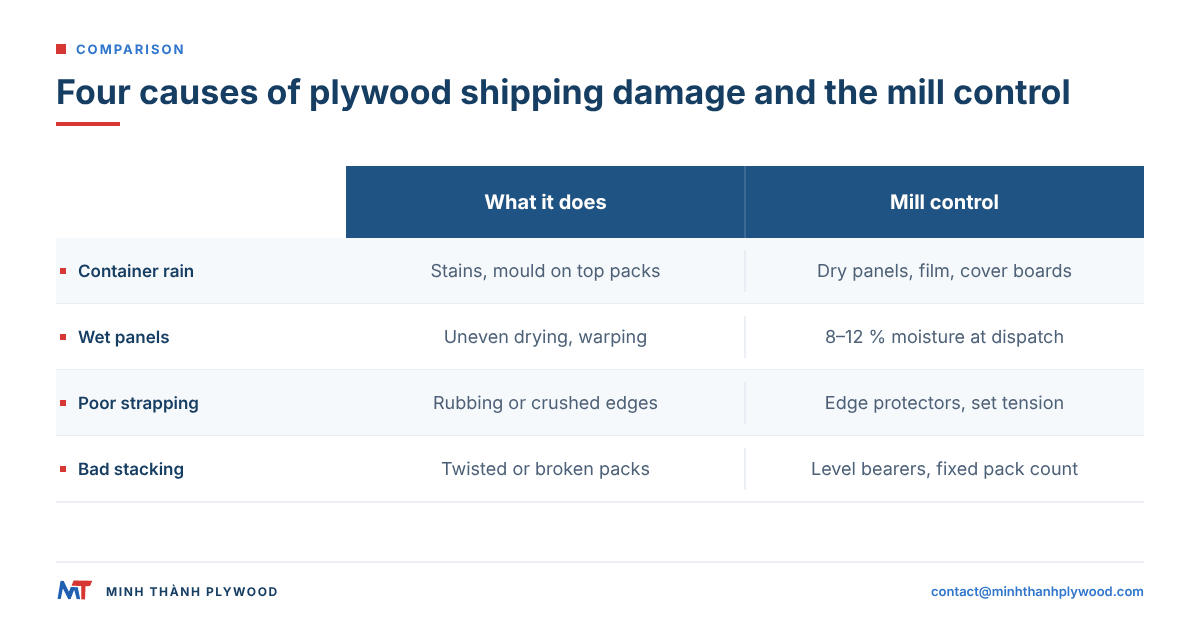
| Cause | What it does to the plywood | Mill control that prevents it |
|---|---|---|
| Container rain (condensation) | Water drips on top packs: stains, mould, swelling of the top sheets | Dry panels, wrapped packs, cover boards, container checked for holes and seal damage |
| Moisture content too high at pressing or packing | Panels dry out at destination unevenly: warping, cupping, checks | Veneers and finished panels dried to 8–12 % before packing |
| Poor strapping | Loose straps let sheets shift and rub; over-tight straps crush edges | Straps over edge protectors, tension set by pack size |
| Bad stacking and bracing | Uneven bases twist packs; overloaded containers break pack feet | Level bearers, packs about one metre high, fixed pack count per container |
The table reads from left to right: name the damage, find the cause, then ask the supplier how that cause is controlled. A supplier who can answer each line has already prevented most claims.
What is container rain and how does it damage plywood?
Container rain is condensation inside a closed shipping container. Air in the box carries water vapour from the cargo, the packaging and the floor. When the steel roof and walls cool at night or in colder waters, the vapour condenses on the steel and drips back onto the top of the load.
For plywood the damage lands on the top packs and the upper sheets: water marks, raised grain, mould spots and swollen edges. Panels that were already damp add their own water to the air, which is why container rain is worst when wet goods share the box.
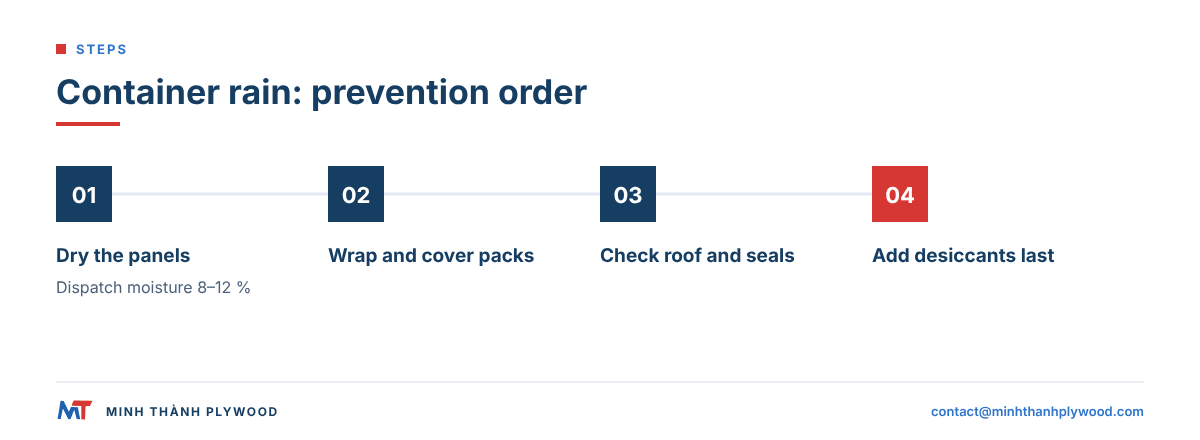
The defence is in the order of what goes in. Dry panels add little vapour. Wrapping film and a cover board keep drips off the faces. A container with an intact roof, floor and door seals keeps outside water out. Desiccant bags or strips can take some of the remaining vapour out of the air; they cannot dry wet panels, so they come last, not first.
Why does plywood arrive warped?
Plywood arrives warped when its two faces change moisture at different rates, or when the pack is forced out of flat during transit. A balanced panel stays flat because each veneer layer is crossed against the next and the build is symmetrical about its centre. Moisture entering one face faster than the other breaks that balance, and the panel bows.
Four conditions cause most warped deliveries:
- panels packed above the dispatch moisture range, which dry unevenly at destination;
- top sheets wetted by condensation while the rest of the pack stays dry;
- packs resting on bearers that are too few, too far apart or uneven, so the sheets sag and set in that shape;
- an unbalanced build, such as different face and back veneer thicknesses, which bows with any change in humidity.
At Minh Thanh, furniture-grade panels are pressed twice: the core board is pressed and calibrated first, then the face and back are pressed on. The calibrated core and the matched faces give a panel that starts flat and stays balanced. Core layers are stitched both horizontally and vertically, so the inner layers close without gaps that would let one side move.
What moisture content should plywood have when it is packed?
Furniture plywood should be packed at 8–12 % moisture content, the normal dispatch range for furniture panels. Minh Thanh dries both the veneers before pressing and the finished panels before packing to that range. The USDA Wood Handbook (2021) is the standard US reference on how wood moisture changes with humidity and service conditions.
Moisture content matters twice. A panel packed wet gives off water inside the container, feeding condensation. The same panel then keeps drying in a heated warehouse or workshop at destination, and drying that happens fast and from one side is what turns a flat sheet into a bowed one.
Ask the supplier how moisture is measured and recorded. A moisture meter reading on sample sheets from each pack, written on the inspection record, is simple evidence. For orders into cold, dry heated workshops, state the target in the purchase order so the panels are packed at the lower end of the range.
How does plywood damage at sea differ from damage in port?
Plywood damage at sea is mostly moisture and movement damage; damage in port is mostly handling damage. At sea the container swings through day and night temperatures, and the ship rolls and pitches, so condensation and shifting are the risks. In port the risk changes to forklifts, open-air storage and rain while the container doors are open.
From Hai Phong, typical days at sea are 15–25 to the Middle East, 25–35 to the Mediterranean, 30–40 to Northern Europe and 35–45 to the US East Coast. Longer routes through hot and cold zones give more cycles of warming and cooling, and more chances for condensation. Packing for a long route therefore needs more care with dryness and wrapping, not a different panel.
Port damage is prevented by how the packs are built: bearers deep enough for forklift tines, edge protectors at the strap points, and cover boards on top. Each pack is a unit that can be lifted without touching the faces.
How should plywood packs be built for export?
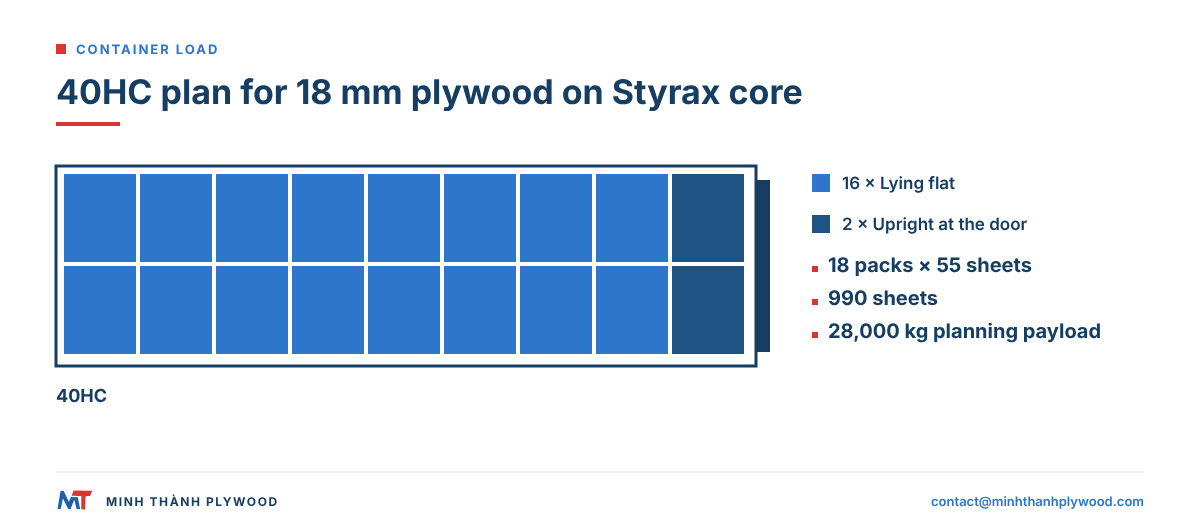
A plywood export pack should be flat, square and closed. Minh Thanh builds packs about one metre high at 1220 × 2440 mm, so sheets per pack follow from the thickness: 55 sheets of 18 mm, for example. The pack rests on level bearers, carries a cover board on top, and is wrapped in film and strapped over cardboard edge protection.
The packaging materials are cardboard, plywood and pallet blocks, strapping band and wrapping film. SGS tested all four in September 2026 for lead, cadmium, mercury and hexavalent chromium and detected none, a pass against the 100 mg/kg limit for packaging in the European Union.
Export pallets with solid wood bearers are made on order. Where solid wood is used, it is heat treated and carries the mark set by ISPM 15, the IPPC wood packaging standard; plywood parts need no mark, as explained in is plywood exempt from ISPM 15. UK government guidance says its wood packaging rules “do not apply to processed, non solid WPM like plywood”.
How should straps be placed on a plywood pack?
Straps on a plywood pack should hold the sheets as one block without biting into the edges. Place them across the width at even spacing, over cardboard or plastic edge protectors, and add straps along the length so the pack cannot rack.
Two strapping faults cause most edge damage. Loose straps let sheets slide against each other at sea, which scuffs sanded faces and opens up the pack. Over-tight straps without protectors crush the top and bottom sheets’ edges, which shows as dents on exactly the panels a buyer opens first. Tension the straps to close the pack, not to compress it.
How many packs should go in a 40HC container?
A 40HC container of 1220 × 2440 mm plywood takes 18 packs on Styrax core, 16 on Acacia core or 15 on Eucalyptus core. On Styrax, the 18 packs are 16 lying flat plus 2 standing upright at the door end. The count stops earlier on heavier cores because the payload limit comes before the space limit.
At 18 mm that gives 990 sheets on Styrax core, 880 on Acacia and 795 on Eucalyptus, against a planning payload of 28,000 kg unless the booking is lower.
Pushing more packs into the box is the classic cause of crushed loads. The bottom packs carry more than their bearers were built for, the feet break, and the packs then lean and twist for the whole voyage. Ask for the pack plan in writing with the quotation, and do not raise the count to cut freight cost.
How should plywood be loaded and braced in the container?
Plywood should be loaded so that no pack can move and no pack rests on less than its full base. The sequence at loading runs like this:
- Inspect the empty container: roof, walls and floor for holes and rust, door seals for gaps, the floor for damp patches and loose nails.
- Load packs level, lying flat on their bearers, tight against each other and the walls.
- Fill gaps with bracing so packs cannot slide; any solid wood bracing is ISPM 15 marked.
- Stand the door-end packs upright where the plan calls for it, braced so they cannot fall when the doors open.
- Photograph and film each stage, the full container and the seal number before the doors close.
Minh Thanh photographs and films every shipment before loading and sends the photos and video to the buyer. That record answers the first question of any claim: what state the goods were in when they left.
Do desiccants prevent all container moisture damage?
No. Desiccants absorb part of the water vapour in a closed container, which lowers the risk of condensation on the roof. They do not dry panels that were packed wet, they do not stop water entering through a damaged roof or door seal, and their capacity is used up on long voyages through humid zones.
Use them as the last layer of protection, after dry panels, wrapped packs and a sound container. If you order them, write the type and the weight per container in the purchase order and ask to see them hung in the loading photos.
How much is enough depends on the voyage, and published planning figures are ranges, not a single rule:
| Source | Calcium chloride per 40ft container |
|---|---|
| Plywood exporter practice (Fomex Group, checked on 21 October 2026) | 2–4 kg, with panels metered at 12% moisture content or below before loading |
| Supplier planning guide, normal conditions (Superdryers, checked on 21 October 2026) | about 2–3 kg |
| Same guide, humid cargo or a long voyage | about 4–6 kg |
On a long voyage to a cold destination, plan on the upper half of those ranges and write the figure into the order. Hang strips high on the side walls from the lashing rings, spread evenly down the box, and never block the doors or vents. Add humidity indicator cards at three positions, at the doors, the middle and the rear, and ask for a photo of each card at loading; the readings support the condition record but do not show when moisture entered. Reversible indicators can lose an earlier humidity indication as they dry.
Pair the desiccant with a record of the panels themselves: a moisture meter reading on sample sheets from each pack, written on the inspection record that ships with the loading photos. A desiccant weight with no moisture reading behind it proves little to an insurer, and a moisture reading with no desiccant proves little about the container.
Does “plywood for shipping” mean crate plywood or shipped plywood?
Both searches exist. Shipped plywood is the panel you buy and move across the sea, which is what this guide covers. Packing plywood is a thin, low-cost grade that factories use to build crates, boxes and pallet decks for other goods, and it is the material behind the all-plywood packs that need no ISPM 15 mark (Is plywood exempt from ISPM 15?). If you build crates, the same rules apply to your crate as to a plywood pack: dry material, level bases, protected edges and no loose solid wood without the mark. Minh Thanh supplies packing plywood for that use as well as furniture panels for export.
What should you check when the container arrives?
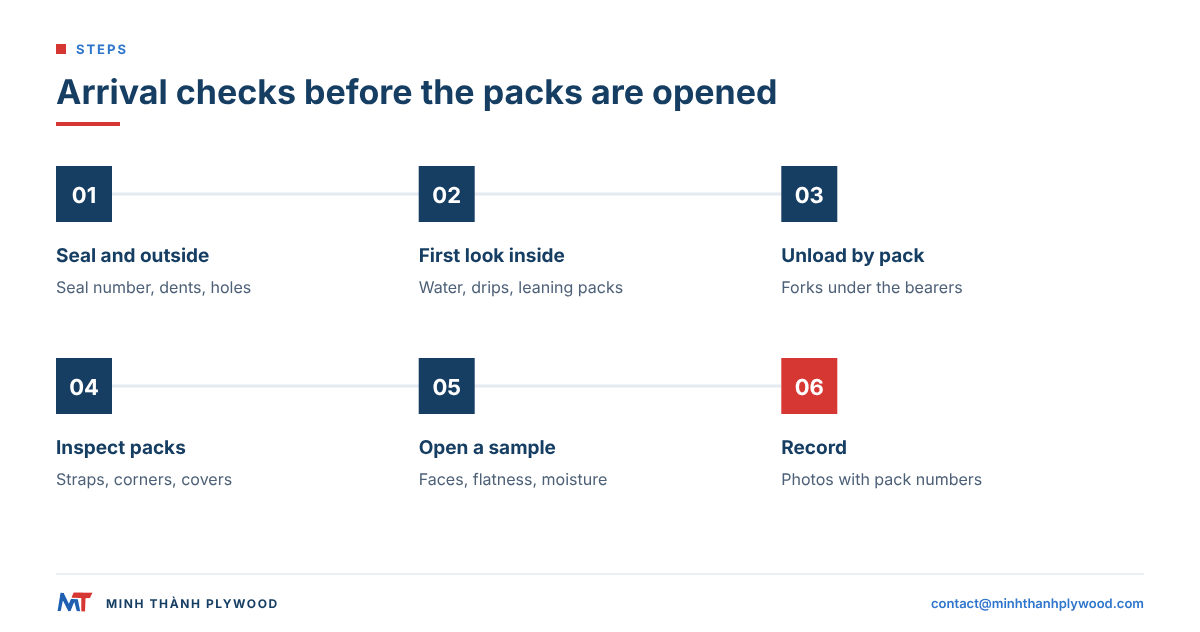
Check the container before it is opened, then the packs before they are opened. Arrival checks in order:
- Seal number against the bill of lading, and the container outside for dents and holes.
- First look inside before unloading: water on the floor, drips on the roof, wet or torn wrapping, leaning packs. Photograph it.
- Unload pack by pack with forks under the bearers, not against the panel edges.
- Inspect each pack for broken straps, crushed corners and wet cover boards before opening.
- Open a sample of packs and check faces, edges and flatness; measure moisture content on a few sheets.
- Record findings with pack numbers, photos and the date, before panels are moved or cut.
Any damage noted on the delivery receipt and photographed on the day is a fact; damage found weeks later after the panels have been used is an argument.
How should you store plywood after delivery without warping?
Store plywood without warping by keeping it flat, supported and closed. Lay packs on level bearers spaced closely enough that the sheets do not sag between them, all bearers in line from the floor up. Keep a cover board on top and leave the wrapping on until the panels are used.
Keep the store dry and steady: indoors, off concrete that sweats, away from open doors, roof leaks and heaters that dry one side of a pack. Never store plywood on its edge for long periods unless it is fully supported against a flat backing, because tall sheets bow under their own weight.
When a pack is opened, take sheets from the top and put the cover board back on what remains. A part-used pack left uncovered dries or wets from the top sheet down, and the top sheet warps first.
Moisture problems with plywood after delivery: what causes them?
Moisture problems after delivery start when panels meet a climate different from the container’s. Plywood from a humid tropical port unloaded into a heated, dry workshop gives off water; plywood unloaded in winter rain and stored under a leaking roof takes it up. Either way the faces move before the core does, and bows, cups and checks follow.
Let the panels acclimatise. Bring closed packs into the room where they will be processed and leave them for a few days, then open them. Measure moisture content and compare it with the room before cutting furniture parts. Panels shipped at 8–12 % and acclimatised slowly stay flat; panels opened straight into hot dry air at the warehouse door often do not.
How do you prevent mould and stains on plywood panels?
Prevent mould and stains on plywood panels by keeping water away from them from press to workshop. Mould needs moisture and time; it does not grow on dry panels in a dry pack.
Ship panels inside the dispatch moisture range, wrap the packs, keep cover boards on top, and load them into a dry, sound container. At destination, unload promptly, keep packs indoors and off wet floors, and do not leave condensation-wet packs closed: open the wrapping and let the panels air in a dry space. Water stains on sanded faces come from drips on unprotected packs, which is what the cover board and film are for.
Is it shipping damage or a tolerance issue?
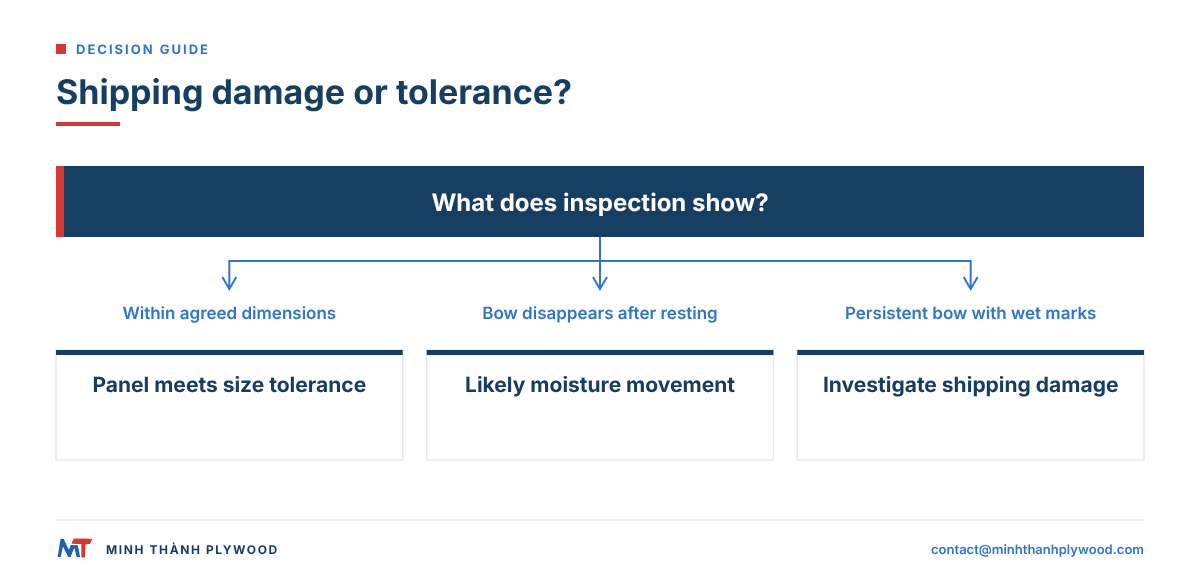
Separate shipping damage from tolerance before raising a claim. Every panel has agreed tolerances: Minh Thanh holds sanded furniture panels to ±0.2–0.3 mm on thickness, down to ±0.2 mm, commercial and film-faced panels to ±0.5 mm, packing plywood to ±0.5–1.0 mm, and length and width to ±2 mm. A panel inside those tolerances is to specification.
Flatness after transit needs the same care. Lay a sheet flat on a level surface for a day before judging it. A slight bow that disappears is moisture movement in transit; a bow that stays, with wet marks or broken straps on the pack, points to shipping damage, and the loading photos show which side of the voyage it happened on.
Who pays when plywood is damaged at sea?
Who pays depends on the Incoterm and the insurance cover, not on who loaded the container. Under FOB Hai Phong and CFR the buyer arranges cargo insurance; under CIF the seller buys it for the buyer. In all three terms the risk passes to the buyer when the goods are on board the vessel at Hai Phong, so a claim for damage at sea goes to the insurer.
An insurer asks for three things: proof of condition at loading, proof of condition at arrival, and proof of the cause. Minh Thanh’s loading photos and video cover the first. The arrival checks cover the second. Moisture readings and photos of water marks, broken straps or a damaged container cover the third.
What should you write in the order to prevent shipping damage?
Write the packing into the purchase order so it is part of the specification, not a hope. A packing line for a furniture plywood order:
“Panels dried to 8–12 % moisture content; packs about one metre high on level bearers, cover board on top, film-wrapped, strapped over edge protectors; 18 packs per 40HC on Styrax core; solid wood bearers ISPM 15 marked; container inspected before loading; photos and video of packs, loading and seal.”
Add the panel specification: application, core, glue and emission class, face and grade, size and thickness, quantity and destination port. Send it to Minh Thanh for a quote on furniture plywood from Vietnam; samples are free and replies come within hours. For freight and container costs on the same order, see shipping plywood from Vietnam, and for the full import route, the guide to importing plywood from Vietnam.
Buyer questions, answered
Why does plywood arrive warped?
Usually because one side of the panel took up or lost moisture faster than the other, or because the pack sat on an uneven base during transit. Panels packed above the dispatch moisture range, condensation in the container and a twisted pack base are the common triggers.
What moisture content should plywood have at shipping?
Furniture plywood is normally dried to 8–12 % moisture content at dispatch. Minh Thanh dries veneers and finished panels to that range before packing.
What is container rain?
Container rain is condensation inside a shipping container. Warm, humid air inside the box meets steel walls and roof that cool at night or in colder waters, water forms on the steel and drips onto the cargo.
Do desiccants prevent all container moisture damage?
No. Desiccant bags or strips absorb some of the moisture in the air of a closed container, but they cannot dry panels that were packed wet, and they do not stop water entering through a damaged door seal or roof.
How should plywood be stored after delivery?
Flat, indoors, off the floor on level bearers spaced closely enough to stop sagging, with a cover board on top and the wrapping kept on until the panels are used. Keep packs away from doors, heaters and wet floors.
How long should plywood acclimatise before use?
Leave the packs closed for a few days in the room where they will be processed, then open them. For furniture work, measure the panel moisture and compare it with the room before cutting.
How do I prevent mould and stains on plywood panels?
Ship the panels dry, keep the container dry and short of standing water, wrap the packs, and unpack and ventilate them promptly on arrival. Mould needs moisture; a dry pack in a dry box does not grow it.
Who pays for plywood damaged at sea?
That depends on the Incoterm and the insurance. Under CIF the seller buys the cargo insurance; under FOB or CFR the buyer arranges it. Photos at loading and on arrival are the evidence any claim needs.
Is a bowed panel a shipping defect or a tolerance issue?
Check against the agreed specification first. Thickness and size have their own tolerances; a panel inside them that is flat after acclimatising is not damaged. A bow that remains after the panel has rested flat points to a moisture or pack problem.
What does Minh Thanh send before a container sails?
Photos and a video of the packs and the loading of every container, together with the commercial invoice and packing list. The buyer sees the condition of the goods before the balance is paid.