
Plywood decking works when the plywood is a covered or waterproofed deck: a walkable roof or balcony under a membrane, a porch under a roof, or the base for tiles. Bare plywood boards left in the rain absorb water through their faces and edges and fail within a few seasons. Minh Thanh Plywood, a Vietnamese plywood manufacturer, explains thickness by joist spacing, waterproofing and which plywood to order.
Can you use plywood for decking?
You can use plywood for decking when the plywood is protected: under a waterproof membrane, under tiles, or under a roof. Plywood decking fails when bare sheets are the walking surface of an open deck, because rain enters the faces, the end grain of every ply and the screw holes.
Where plywood decking works:
- Walkable roof decks and balconies: plywood is the structural deck; a membrane makes it waterproof.
- Covered porches and verandas: a roof keeps the rain off; a coating handles splashes.
- Tiled outdoor floors: plywood under a tile membrane and backer board.
- Decks with a dry space below: a membrane keeps a room, garage or storage area dry.
- Trailer and boat decks: marine or film-faced plywood, sealed and coated.
Where it fails: an open garden deck of bare plywood boards, plywood laid flat with no fall, and any deck where the sheet edges are left unsealed.
Plywood for pontoon and boat decking
Pontoon and boat decks use 3/4 in (18 to 19 mm) CCA-treated marine plywood or marine plywood of 6 to 7 plies, laid across the cross-members and covered with marine carpet or vinyl. US pontoon suppliers sell it by the deck width: the common widths are 8 ft and 8-1/2 ft, cut to the deck length, with a minimum of 4 sheets.
CCA-treated marine plywood should not be coated before installation; put carpet or vinyl over it with marine adhesive and stainless fasteners. Suppliers quote up to 20 years of life and a 6-year warranty on a treated pontoon deck, which is what a buyer compares an imported panel against.
| Deck plywood (3/4 in, 4 x 8 ft) | US retail per sheet | Note |
|---|---|---|
| CDX sheathing, 23/32 in | about US$41 | Lowe’s listing, Douglas fir |
| Ground-contact pressure-treated | about US$53 to US$66 | Home Depot listings, varying by snapshot |
| AB marine, BS 1088-type | about US$135 to US$178 | Lumberyards, 23/32 in |
| CCA-treated marine, pontoon | US$159.99 | Pontoonstuff, 4-sheet minimum |
| Our commercial plywood, 18 mm | about US$13 raw FOB per sheet | US$250/m³ x 0.0536 m³; not a sheet price |
The last row is a raw FOB example for container buyers: 1220 x 2440 x 18 mm is 0.0536 m³, and freight, duty and margin come on top. For a pontoon builder or a deck-supply dealer buying by the container, the gap between that line and a US$135 to US$178 marine sheet is the margin.
Why bare plywood decking fails outdoors
Bare plywood fails outdoors because water enters and leaves the thin face veneer every day, so it swells, shrinks and splits along the grain, then water reaches the core. A waterproof glue keeps the plies together, but it does not stop the wood itself taking up water.
How the damage starts:
- Face checking: sun and rain open fine cracks across the face veneer within months.
- Edge swelling: the end grain of every ply drinks water at the sheet edges.
- Standing water: a flat deck holds puddles, which soak in rather than run off.
- Fastener holes: screws let water into the core and loosen as the wood swells.
- Core voids: gaps in inner plies hold water and rot from inside.
The glue line decides whether the panel holds together when wet; the wood decides how fast it weathers. Our guide is plywood waterproof? explains the difference between a waterproof bond and a waterproof panel.
Deck plywood: exterior, marine and treated compared
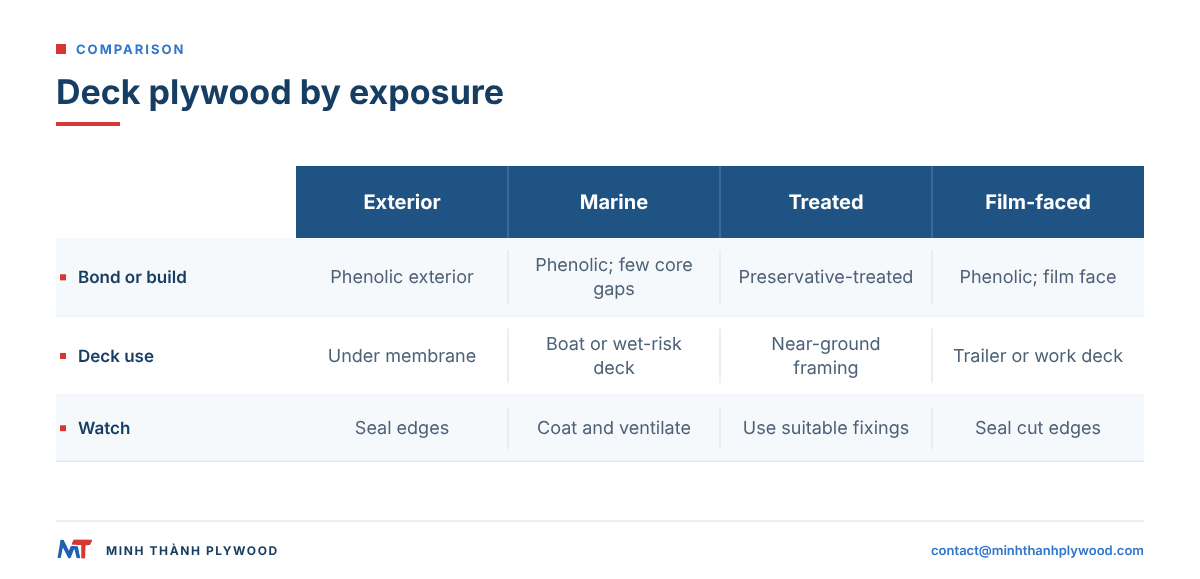
Deck plywood is exterior plywood with a waterproof phenolic (WBP) bond, marine plywood with a void-free core, or pressure-treated plywood; each suits a different exposure. All three need a membrane or coating to be a walking surface.
| Type | Bond | Core | Best deck use | Watch for |
|---|---|---|---|---|
| Exterior plywood (CDX-type, WBP) | Phenolic, waterproof; PS 1 Exterior bond | Some core gaps allowed | Under a membrane on roofs and balconies | Seal edges; lowest face grades check faster |
| Exposure 1 sheathing (APA PS 1) | Waterproof bond for construction delays | Some core gaps allowed | Short exposure before the roof or membrane goes on | Not rated for permanent weather; Exterior bond is |
| Marine plywood | Phenolic, waterproof | Few or no core gaps | Decks that may get wet behind the membrane, boats | Price; still needs a coating |
| Pressure-treated plywood | Exterior | Preservative-treated plies | Framing near the ground, under decks | Treated wood corrodes plain steel fixings |
| Film-faced plywood | Phenolic, waterproof | Hardwood core | Trailer and work decks, anti-slip versions | Film wears; seal cut edges |
In the US, structural plywood is graded under Voluntary Product Standard PS 1-22, the NIST-listed standard behind the Exterior and Exposure 1 bond classes. Interior plywood with UF (urea-formaldehyde) glue does not belong on any deck: the bond breaks down when wet. Our exterior plywood grades guide lists the face grades and checks for outdoor panels.
Marine plywood decking: when it is worth the price
Marine plywood decking is worth its higher price when the deck is likely to get wet inside the build-up: a membrane that is hard to inspect, a boat or pontoon deck, or a balcony over a living space. A marine panel has few or no core gaps, so water that gets in has nowhere to collect.
A marine plywood deck still needs:
- A coating or membrane: marine plywood is not a weathering wood; bare faces check like any plywood.
- Sealed edges: epoxy or primer on every cut edge and hole.
- Ventilation below: framing that can dry out.
Marine plywood is made to standards such as BS 1088, the British standard for marine plywood. For outdoor structural panels, BS EN 636:2012+A1:2015 covers plywood for structural and general-purpose use in dry, humid or exterior conditions. Our marine plywood buying guide explains the grades and what to check on a delivery. For most membrane-covered roof decks, a good exterior plywood with a phenolic bond and a solid face is the cost-effective choice.
Best plywood for outside deck and outdoor decking
The best plywood for an outside deck under a membrane is exterior plywood with a phenolic (WBP) bond, a sound face with no open defects, a tongue-and-groove long edge and a thickness matched to the joist spacing. The membrane, not the plywood, keeps the rain out; the plywood must stay flat and stiff under foot traffic.
What to look for in plywood for an outdoor deck:
- Bond: phenolic (WBP) or an exterior bond rated for permanent outdoor exposure.
- Face: solid face without open knots or splits, so the membrane does not crack over a hole.
- Edges: tongue-and-groove on the long edges, so sheets do not deflect at joints between joists.
- Thickness: set by the joist spacing (next section).
- Moisture content: dry at installation, so the deck does not shrink and crack the membrane.
Our exterior/CDX-type plywood uses utility C/D face and back grades with a water-resistant melamine-fortified or phenolic (WBP) glue. For a deck under a membrane, order the phenolic (WBP) bond.
What thickness plywood for decking?
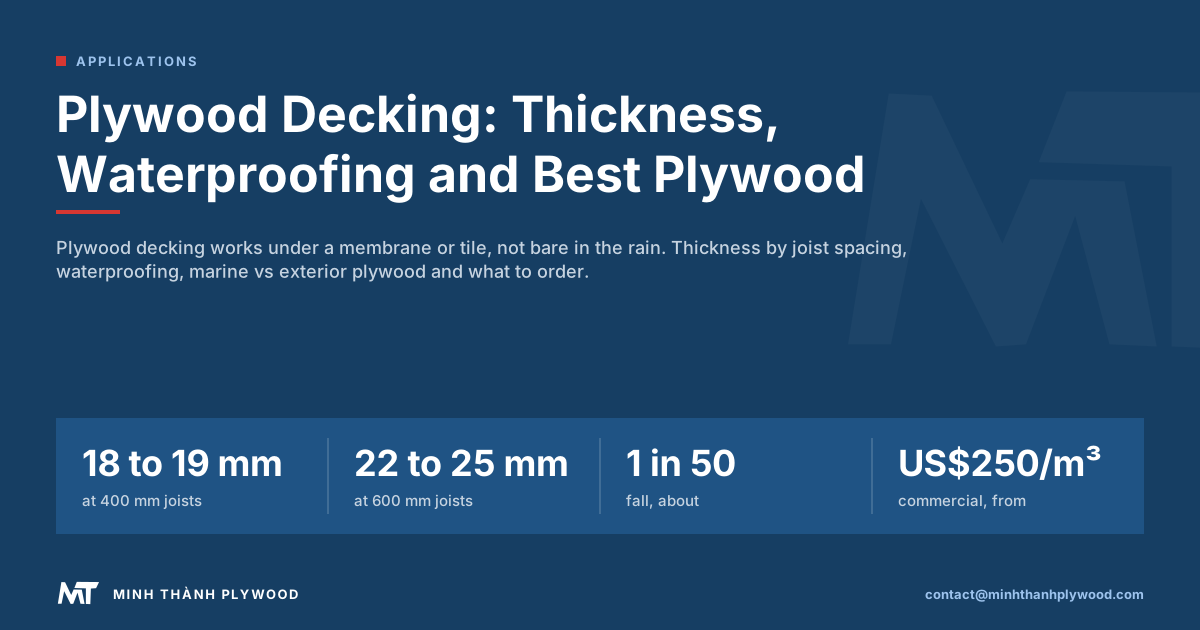
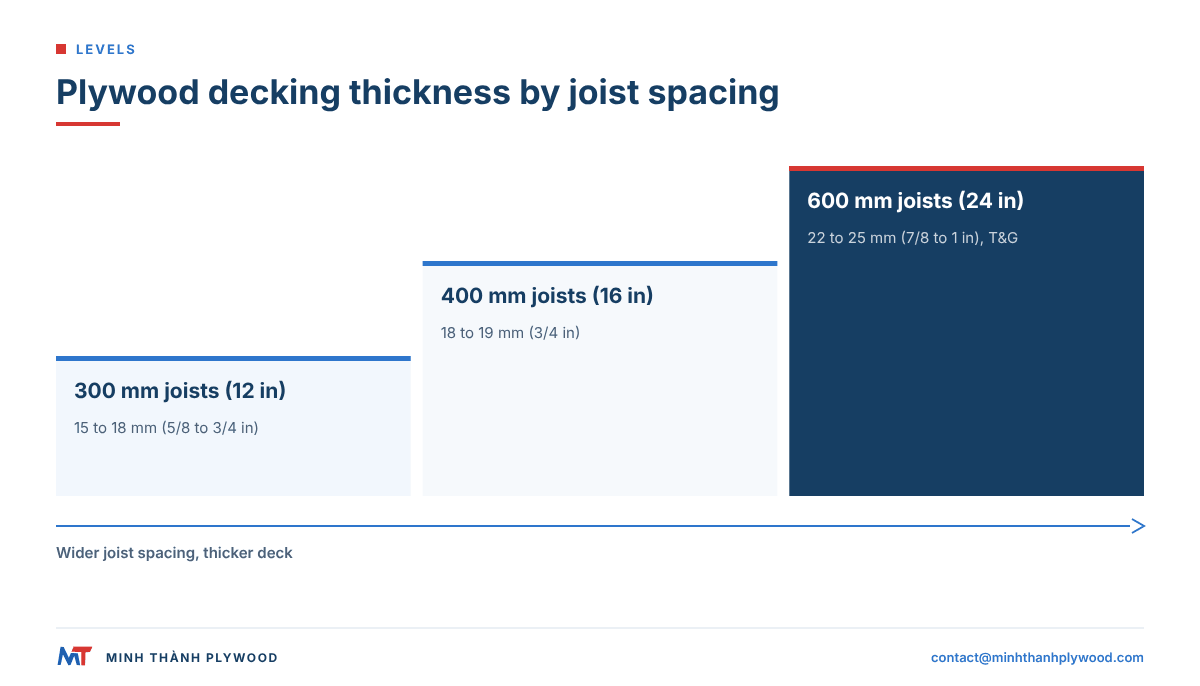
Plywood decking is 18 to 19 mm (3/4 in) thick on joists at 400 mm (16 in) centres and 22 to 25 mm (7/8 to 1 in) on joists at 600 mm (24 in) centres, laid with the face grain across the joists. Walkable membranes often need the stiffer option, because deflection cracks the coating.
| Joist spacing | Minimum for a walkable deck | Stiffer choice | Edge support |
|---|---|---|---|
| 300 mm (12 in) | 15 to 18 mm (5/8 to 3/4 in) | 18 mm | Tongue-and-groove or blocking |
| 400 mm (16 in) | 18 to 19 mm (3/4 in) | 22 mm | Tongue-and-groove or blocking |
| 600 mm (24 in) | 22 to 25 mm (7/8 to 1 in) | 28 mm | Tongue-and-groove required |
Two rules decide the final number. The membrane maker’s system sheet sets a minimum plywood thickness and spacing for its warranty; follow it when it is stricter. The building code or engineer sets the deck’s structural design; a balcony is a structure, not a floor finish.
Our plywood roof sheathing guide gives thickness for roofs that are not walked on, and subfloor plywood covers indoor floors.
Plywood for deck floor: fall, fixing and joints
A plywood deck floor needs a fall towards a drain or gutter, sheets glued and screwed to the joists, and gaps at the joints, so water runs off and the membrane sits on a flat, stiff surface. Getting the substrate right decides whether the membrane lasts.
How to lay a plywood deck floor:
- Build the fall into the framing: taper the joists or fit firrings, so the plywood slopes to the outlet; a common target is about 1 in 50 (1/4 in per foot).
- Lay the sheets with the face grain across the joists and end joints staggered.
- Glue and screw to each joist with exterior construction adhesive and corrosion-resistant screws, closely spaced at edges.
- Leave a small expansion gap at ends and edges, as the plywood maker or membrane maker specifies.
- Sink screw heads flush and fill them, so they do not puncture the membrane.
- Seal all cut edges with primer before the membrane goes on.
Lay the deck only on dry framing and in dry weather. A deck sealed over wet plywood traps the water under the membrane.
How to waterproof a plywood deck
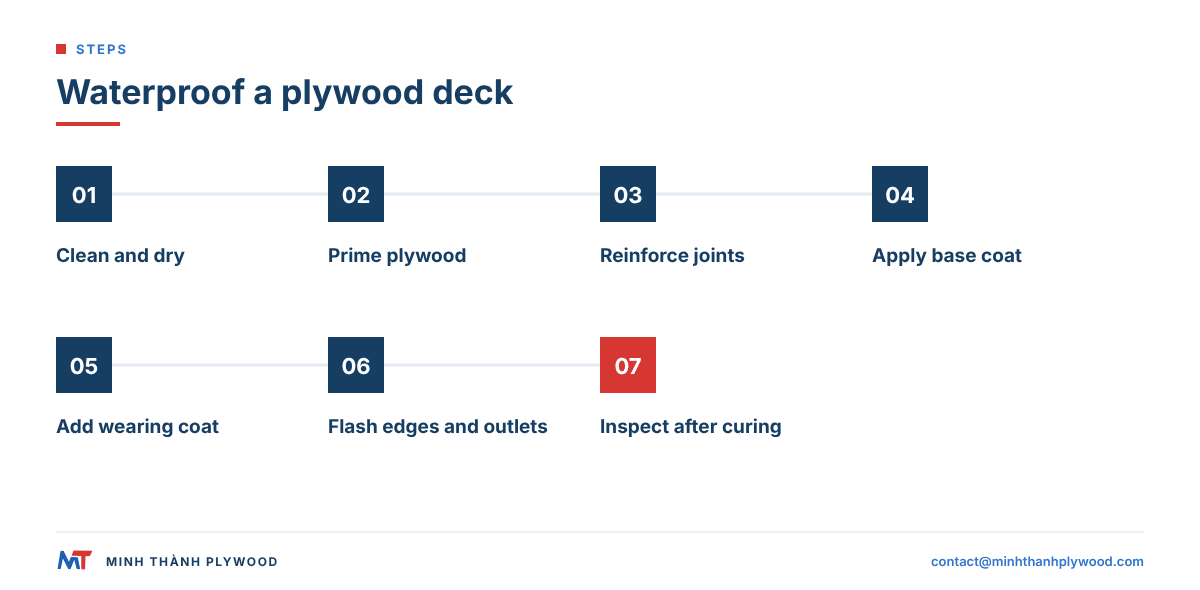
Waterproof a plywood deck by preparing the sheets, reinforcing every joint, and applying a membrane system made for walkable decks, then flashing every edge, upstand and outlet. The membrane is what makes the deck waterproof; coatings sold for wood alone do not.
- Clean and dry the plywood; sand any raised grain or high joints.
- Prime the surface with the membrane maker’s primer.
- Reinforce joints with fabric or tape bedded in the first coat.
- Apply the base coat to the stated thickness.
- Add the wearing coat with anti-slip aggregate for walkways.
- Flash edges and upstands: turn the membrane up walls, into gutters and around outlets.
- Inspect after curing and fix pinholes before use.
The membrane options are compared in the next section. Whichever system you choose, buy primer, fabric and coats from the same maker so the warranty applies.
Best waterproofing for plywood deck: membranes compared
The best waterproofing for a plywood deck that people walk on is a liquid-applied polyurethane or acrylic deck coating with fabric over the joints, or glass-reinforced polyester (GRP, fibreglass). Sheet membranes suit roofs that are rarely walked on, or decks covered by tiles or pedestal pavers.
| Membrane | How it goes on | Walkable | Best for | Repairs |
|---|---|---|---|---|
| Liquid polyurethane coating | Rolled in coats, fabric at joints | Yes, with wearing coat | Balconies, roof terraces | Patch and recoat |
| Acrylic deck coating | Rolled or troweled, often with a base sheet | Yes | Sun decks, walkways | Recoat |
| Glass-reinforced polyester (GRP) | Resin and glass mat laminated on site | Yes | Small roofs, dormers, balconies | Patch with resin |
| EPDM or PVC sheet | Bonded or loose-laid sheet | Only under pavers | Roof decks with pedestal tiles | Patch kit |
| Bituminous torch-on or cold-applied | Sheets in layers | Under tiles or pavers | Large roof decks | Patch |
Named systems follow the same steps. Life Specialty Coatings, for example, sells its LD-2000 moisture-cured urethane system for plywood decks: primer, a base coat, reinforcing at joints and a wearing coat. Ask any maker for the liquid membrane’s ASTM C957 data (the standard for liquid-applied membranes with an integral wearing surface), its ICC-ES evaluation report if it has one, and the coat thickness per layer, because the warranty depends on that thickness being met.
Coloured deck coatings also need recoating as the wearing coat wears through, so plan maintenance into the cost.
Can you put composite decking over plywood?
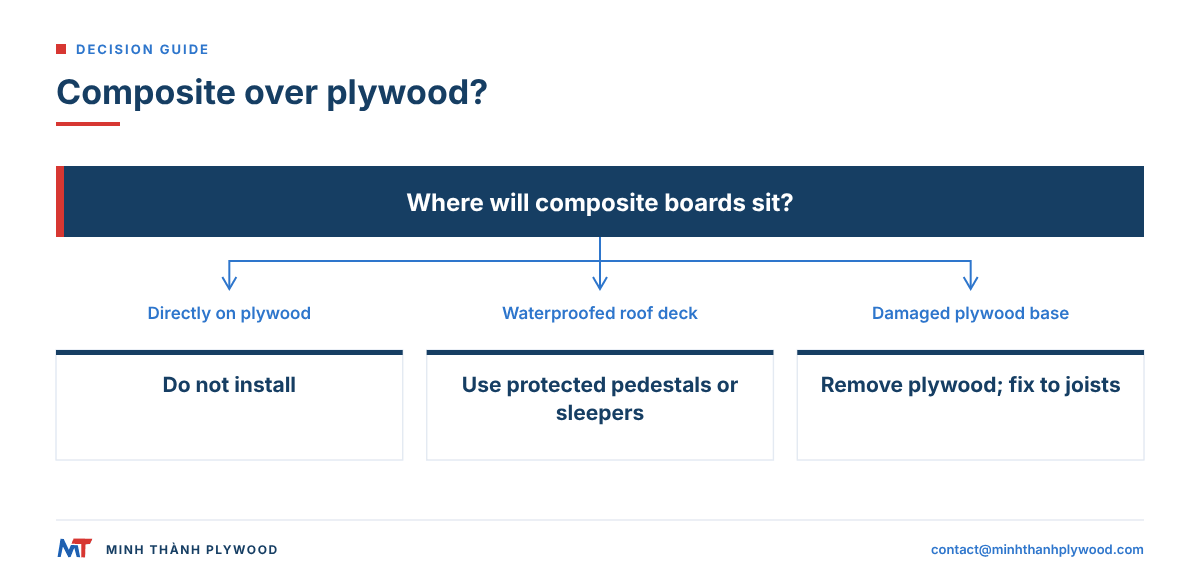
You should not install composite decking directly over plywood, because the boards need open, ventilated joists or sleepers so water can drain and dry. Composite fixed flat on plywood traps water between the two, which rots the plywood and voids most composite warranties.
What to do instead:
- On a waterproofed roof deck: lay composite boards on adjustable pedestals or sleepers placed on the membrane, with protection pads under each support.
- On an existing plywood deck in poor condition: remove the plywood and fit the composite to joists at the spacing its maker specifies.
- For a dry space below: use the plywood and membrane as the roof, then the composite as a floating walking surface above it.
Check the composite maker’s installation guide for joist or sleeper spacing and the minimum gap below the boards.
Plywood balcony flooring and waterproof plywood balcony decks
Plywood balcony flooring is a plywood deck covered by a waterproof balcony membrane or tiles, laid with a fall away from the building and flashed into the wall. A waterproof plywood balcony is only as good as its edges: most leaks start at the door threshold, the wall and the rim.
Balcony details that matter:
- Fall away from the house to a gutter or the front edge.
- Upstand at the wall with the membrane turned up behind the cladding.
- Threshold sealed under the door with a membrane tray.
- Drip edge at the front, so water drops clear of the framing.
- Balustrade posts fixed through sleeves sealed into the membrane, or to the side of the structure.
A balcony carries people over a drop. Its structure, fixings and guarding follow the local building code and an engineer’s design; the plywood is one layer of that design.
Plywood deck coating and maintenance
A plywood deck coating needs a yearly inspection and recoating of the wearing layer when it shows wear, so the membrane underneath never meets foot traffic. Most failures of older plywood decks start at a small crack left unrepaired.
What to check each year:
- Wearing coat: traffic paths and stair landings wear first.
- Joints: a line of cracks over sheet joints means the deck moves; screws may be loose.
- Edges and upstands: sealant gaps at walls and outlets.
- Soft spots: a spongy feel underfoot means wet plywood below; open and replace the sheet.
- Outlets: clear leaves and dirt so water does not pond.
Replacing a wet plywood sheet early is cheap. Waiting until the framing rots under it is not.
What this means for your order
An order of plywood for decking names the bond, the face, the edge profile, the thickness and the quantity, so the panel suits the membrane and the joist spacing. Minh Thanh Plywood makes exterior/CDX-type plywood for outdoor uses such as decks under membranes, stair treads and wall sheathing.
- Use: deck under a membrane, balcony deck, covered porch or tiled floor base.
- Bond: phenolic (WBP) for decks.
- Face and back: utility C/D, matched to the order sample; a sounder face where the membrane is thin.
- Thickness: for example 18 mm for joists at 400 mm, 25 mm for 600 mm.
- Size: 1220 × 2440 mm or 1250 × 2500 mm.
- Tolerance: ±0.5 mm for commercial panels, so sheets sit flush at the joints.
- Quantity: sheets per thickness and the number of 40HC containers, with the destination port.
Commercial plywood is quoted from US$250/m³ (October 2026), and one 40HC is the minimum, mixed thicknesses by agreement. Production takes 15–45 days after deposit. Ask for free samples to test with your membrane system, then send the deck schedule to contact@minhthanhplywood.com for a quote within hours.
Buyer questions, answered
Can I use plywood for decking?
Yes, as a deck under a waterproof membrane, tiles or a roof. Do not use bare plywood as the walking surface of an open deck: rain soaks the faces and edges and the top veneer checks and delaminates.
What thickness plywood for decking?
Use at least 18 to 19 mm (3/4 in) tongue-and-groove exterior plywood on joists at 400 mm (16 in) centres, and 22 to 25 mm (7/8 to 1 in) at 600 mm (24 in) centres. Membrane makers often set their own minimum; follow it.
What is the best plywood for an outside deck?
Exterior plywood with a phenolic (WBP) bond, a solid C-grade or better face and a tongue-and-groove edge, under a membrane. Marine plywood is a step up where the deck stays wet; pressure-treated plywood suits ground-near framing.
How do you waterproof a plywood deck?
Lay the plywood with a fall to the drain, glue and screw it, fill and tape the joints, then apply a deck membrane: a liquid-applied polyurethane or acrylic system, a sheet membrane, or glass-reinforced polyester. Flash every edge and upstand.
Can you put composite decking over plywood?
Not directly on the plywood. Composite boards need ventilated joists or sleepers so water drains and dries; over a waterproofed plywood roof deck, lay the boards on pedestals or sleepers above the membrane as the composite maker specifies.
Is marine plywood good for decking?
Marine plywood has few core gaps and a fully waterproof bond, so it lasts better than ordinary exterior plywood under a membrane that may leak. Bare marine plywood still needs a coating on an open deck.
How long does a plywood deck last?
A plywood deck under a sound membrane can last as long as the membrane, often decades. Bare plywood exposed to rain usually lasts only a few seasons before the face splits and the edges swell.
Can plywood be used for a balcony floor?
Yes, as the deck under a waterproof balcony membrane or tiles, with a fall away from the building and flashed edges. A balcony is a structure: follow the building code and the engineer's design.
What is the best waterproofing for a plywood deck?
For a walkable deck, a liquid-applied polyurethane or acrylic deck coating with a reinforcing fabric over the joints, or glass-reinforced polyester. For a roof that is rarely walked on, a sheet membrane works.
Is plywood decking cheaper than timber decking?
The plywood is cheaper per square metre than hardwood boards, but a walkable membrane adds cost. Choose plywood decking when you need a sealed, dry space underneath, not to save money on an open deck.