
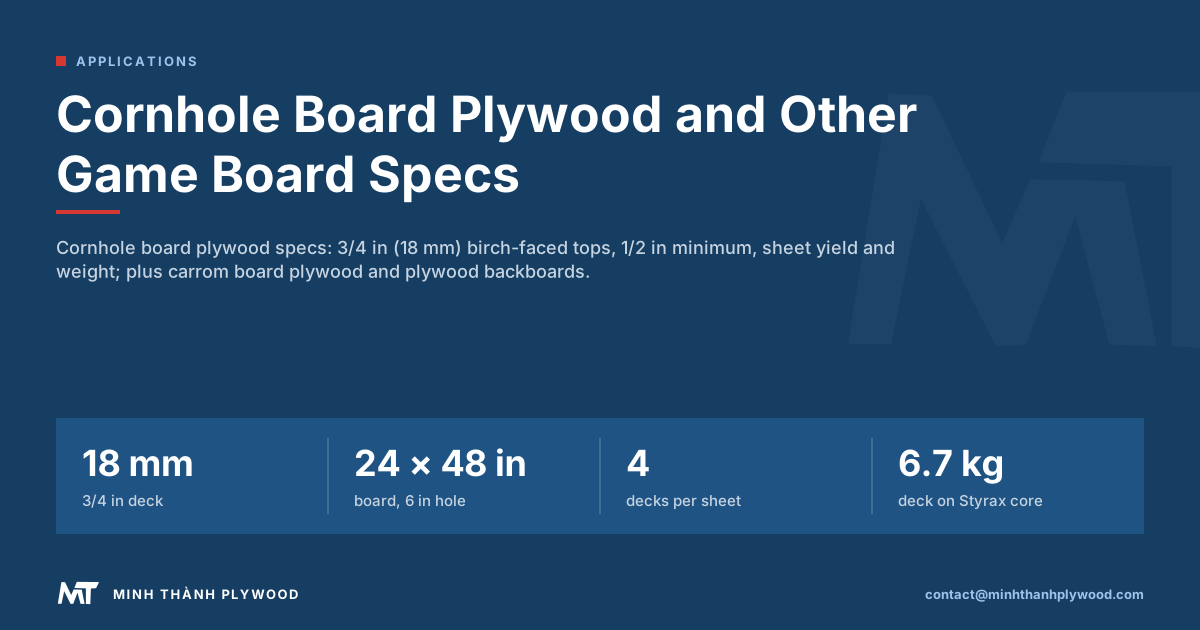
The best cornhole board plywood is 3/4 in (18 mm) birch-faced plywood with a sanded, void-free face, cut to 24 × 48 in. Regulation rules accept 1/2 in tops, but 3/4 in gives the dead, even bounce tournament players expect. Minh Thanh Plywood, a plywood manufacturer in Vietnam, sets out the spec for cornhole, carrom boards and basketball backboards.
What plywood thickness for cornhole boards?
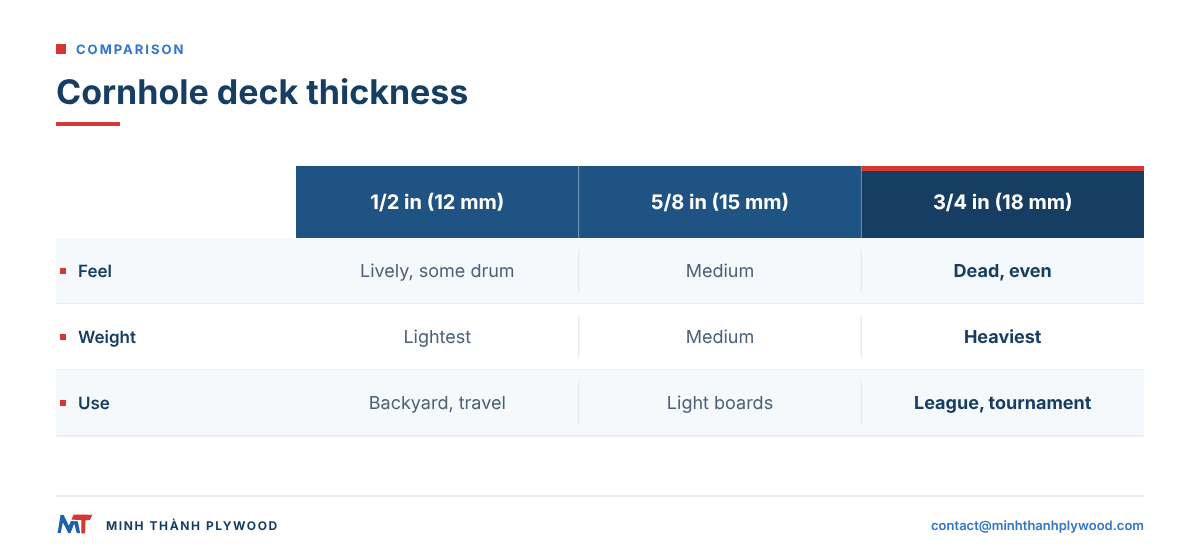
Use 3/4 in (18 mm) plywood for a tournament feel, and 1/2 in (12 mm) if weight and price matter more. Both meet the main rules: the American Cornhole League (ACL rules) sets a 1/2 in minimum with support under it, or 3/4 in without, and a board weight of at least 15 lb.
The older American Cornhole Association and Organization (ACA, ACO) rules ask for boards of at least 25 lb.
| Thickness | Feel | Weight per deck | When to use |
|---|---|---|---|
| 1/2 in (12 mm) | Livelier, some drum | Lightest | Backyard and travel boards, with a centre brace |
| 5/8 in (15 mm) | Medium | Medium | Light boards that still play flat |
| 3/4 in (18 mm) | Dead, even landing | Heaviest | League and tournament boards |
The deck thickness changes how a bag lands. A thin deck flexes and bounces the bag back; a thick, stiff deck absorbs it, so bags land where they hit and slide predictably. That is why league boards are almost all 3/4 in.
Weight is the trade-off. A 3/4 in deck weighs about 1.5 times a 1/2 in deck; with the same frame and legs the finished board is only a few pounds heavier, which still matters which matters for players who carry boards to every match. For reference, Play Cornhole lists its 1/2 in, 9-ply Baltic birch Star board at 28 lb with a solid poplar frame and double centre support.
What type of plywood for cornhole boards?
The best type of plywood for cornhole boards is birch-faced plywood or Baltic birch, sanded on both faces, with a hardwood core free of large voids. The face decides how the paint, decals and clear coat look; the core decides how flat the deck stays and how evenly it plays.
What to look for:
- Face: smooth birch, no patches or open knots in the playing area.
- Core: hardwood veneers with no large gaps; a void under the deck gives a dead spot.
- Flatness: the sheet must lie flat before cutting; a bowed deck plays uneven.
- Sanding: both faces sanded, so paint goes on without extra prep.
- Thickness accuracy: two decks of a set should match; our sanded panels are made to ±0.2–0.3 mm, down to ±0.2 mm.
Cheaper options work for casual boards. Sanded pine or poplar plywood paints well; construction sheathing does not, because its knots and patches show through paint and its core voids play dead.
Cornhole plywood: birch, Baltic birch, poplar or pine?
Cornhole plywood comes in four common types, and the choice is between surface quality, weight and price.
| Type | Face | Core | Weight | Best for |
|---|---|---|---|---|
| Baltic birch | Birch | All-birch plies | Heavy | Premium tournament boards |
| Birch-faced on hardwood core | Birch | Styrax, Eucalyptus or Acacia | Light to medium | Painted and wrapped league boards, volume makers |
| Poplar plywood | Poplar | Poplar or hardwood | Light | Painted backyard boards |
| Pine plywood | Pine | Pine or mixed | Medium | Budget boards, rustic finish |
Birch-faced plywood on a hardwood core gives the birch face for print and paint at a lower weight than all-birch panels. Our birch plywood is birch-faced on a white Styrax or Eucalyptus core, with faces graded D+, D and E and quoted as face/back pairs such as D+/D. For a printed or vinyl-wrapped deck, D/E is enough; for a clear-coated natural wood deck, choose D+ on the face.
Corn hole plywood board dimensions and sheet yield
A regulation corn hole board deck is 24 × 48 in, with a 6 in hole centred 9 in from the top edge, in the standard cornhole rules. The back of the board stands about 12 in high and the front edge 2 1/2 to 4 in off the ground (the ACL narrows the front to 2 1/2 to 3 1/2 in and allows ±1/4 in on the 24 × 48 in size).
| Part | Size | Plywood |
|---|---|---|
| Deck | 24 × 48 in | 1/2 to 3/4 in birch or similar |
| Hole | 6 in diameter, centre 9 in from top | Cut with a jigsaw or router jig |
| Frame | 2 × 4 or 1 × 4 timber, or plywood strips | 3/4 in plywood strips for a light frame |
| Legs | About 11 1/2 in long, folding | Timber or 3/4 in plywood |
| Height | Back 12 in, front 2 1/2 to 4 in | Set by the legs |
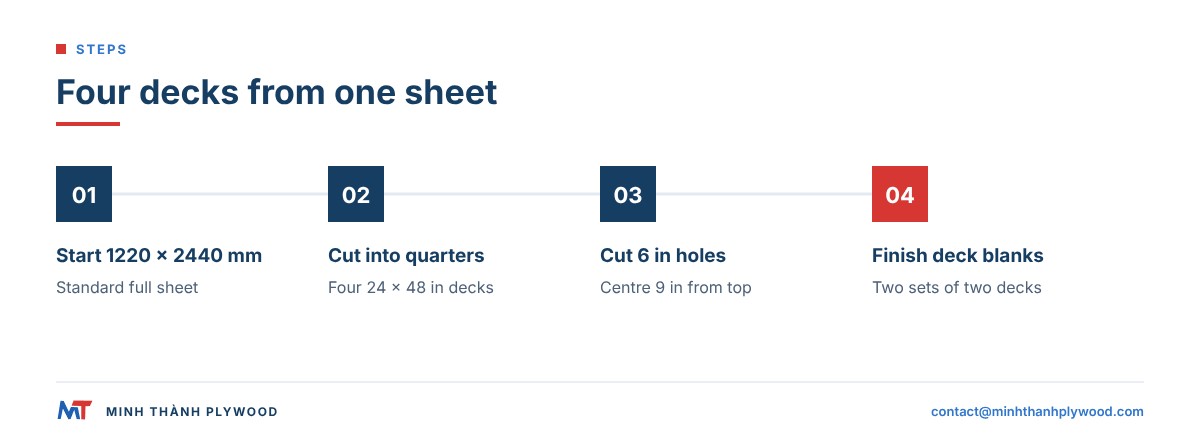
Sheet yield is the reason 4 ft × 8 ft sheets suit cornhole: one sheet cut into quarters gives four 24 × 48 in decks, a full set of two boards plus spares, or two sets with frames cut from a second sheet. A metric 1220 × 2440 mm sheet gives the same four decks with a little trim. Inch sizes convert at exactly 25.4 mm to the inch, the definition on the NIST length page.
At our factory, a panel is cut into 4, 6 or 8 pieces as standard cut-to-size work, so cornhole decks can ship as ready blanks rather than full sheets.
How much does a cornhole deck weigh?
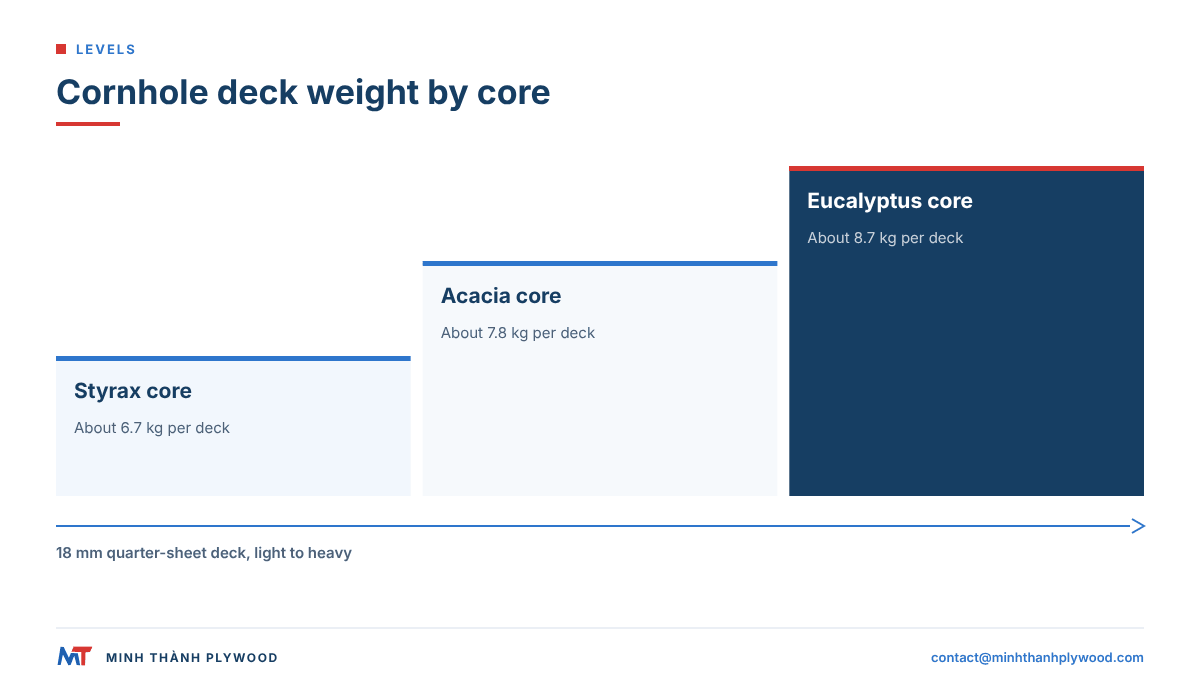
An 18 mm cornhole deck cut from a quarter sheet weighs about 6.7 kg on a white Styrax core and about 8.7 kg on a Eucalyptus core. The core species is the biggest single lever on board weight.
| Core | Density | Full 18 mm sheet, 1220 × 2440 mm | Quarter-sheet deck |
|---|---|---|---|
| Styrax (white core) | 500 kg/m³ | 26.8 kg | about 6.7 kg |
| Acacia | 580 kg/m³ | 31.1 kg | about 7.8 kg |
| Eucalyptus | 650 kg/m³ | 34.8 kg | about 8.7 kg |
In US pounds, the quarter-sheet deck weighs about 15 lb on Styrax, 17 lb on Acacia and 19 lb on Eucalyptus. Add the frame, legs and finish and a finished board comes to roughly 25-30 lb, in line with the 28 lb Baltic birch board above. The frame and legs add 10 lb or more, so the deck is where a lighter core saves weight.
The deck weights are the full-sheet weight divided by four, before the hole is cut. For a brand selling boards that players carry, a Styrax core takes about 2 kg off every deck compared with Eucalyptus at the same thickness.
Cornhole board build: deck, frame and finish
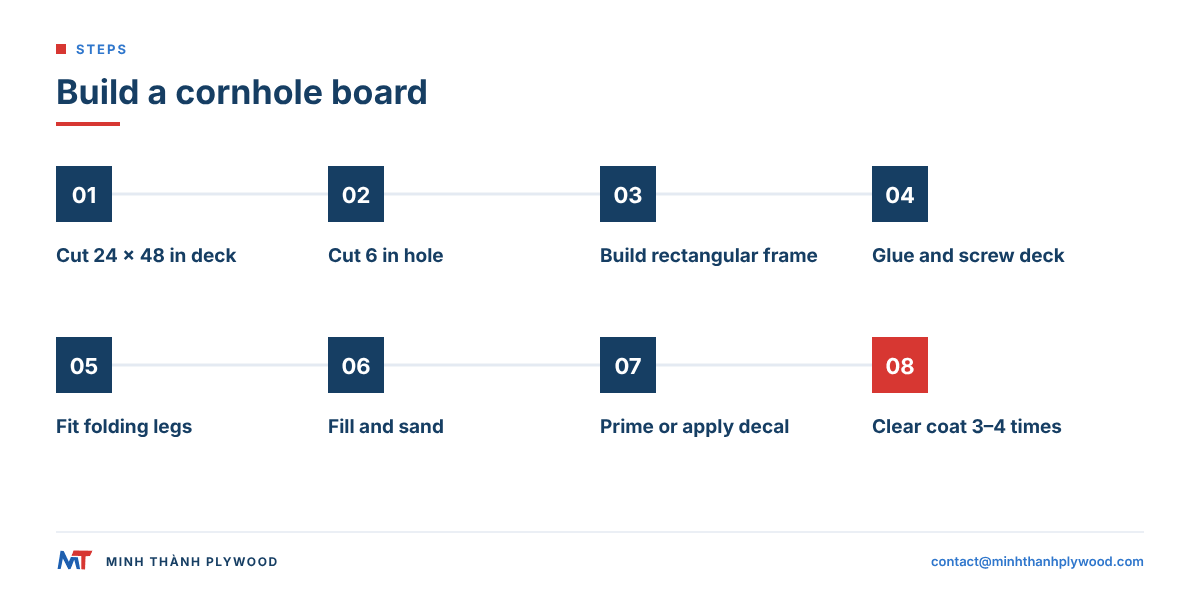
A cornhole board is a plywood deck glued and screwed to a rectangular frame, with folding legs at the back and a sealed finish on top. The steps below are for a 3/4 in deck.
- Cut the deck to 24 × 48 in from a quarter sheet; check the corners are square.
- Mark the hole 9 in from the top edge, centred, and cut it 6 in across; round the edge with sandpaper.
- Build the frame from 2 × 4 or 1 × 4 timber, or plywood strips for a lighter board, screwed at the corners.
- Glue and screw the deck to the frame from the top, countersinking every screw.
- Fit the legs at the back on a carriage bolt so they fold under the board.
- Fill and sand screw holes and edges smooth.
- Prime and paint, or apply a vinyl wrap or decal.
- Clear coat with three or four thin coats of water-based polyurethane or polycrylic, sanding lightly between coats.
On a 1/2 in deck, add a centre brace across the frame under the middle of the deck so the board does not drum.
Finish and slide: sealing a plywood cornhole deck
The finish sets how bags slide, and a sealed deck slides the same in sun and damp. Water-based polyurethane or polycrylic in three or four thin coats is the usual choice, because it stays clear over paint and decals.
- Sand to a fine grit before the first coat; raised grain makes a sticky deck.
- Thin coats dry flat; a thick coat leaves ridges that catch bags.
- Buff the last coat with a fine abrasive pad for a consistent slide.
- Seal the edges and underside too, so damp grass does not swell the deck.
Our birch faces are sanded and polished at the mill, and both faces are made UV-ready, so a board maker can apply a factory UV coat on a production line.
Carrom board plywood: which plywood for carrom boards?
Carrom board plywood is a thin, sanded and polished plywood playing surface, usually 4 to 12 mm thick, glued into a solid timber or plywood frame. The surface must be perfectly flat and smooth so coins and the striker glide evenly.
| Part | Usual spec |
|---|---|
| Playing surface | 29 in (74 cm) square, plywood with a fine hardwood face |
| Surface plywood | 4–6 mm for club boards, 8–12 mm for heavy tournament boards |
| Face | Birch or another close-grained face, sanded and polished |
| Frame | Solid hardwood or plywood strips around the surface |
| Finish | Clear lacquer or polish, then carrom powder in play |
What makes a good carrom board plywood sheet:
- Flatness. A board that bows lets coins drift; a double-pressed panel, core pressed and calibrated first, stays flat.
- Face quality. No patches, knots or joints in the playing area.
- Even thickness, so the surface sits level in the frame.
Thin plywood suits the surface well. Our thin plywood in 3–5 mm is always 5-ply, which gives a thin panel that stays flatter than a 3-ply sheet of the same thickness.
Plywood backboard for basketball
A plywood backboard for basketball is a 3/4 in (18 mm) exterior plywood board with a phenolic (WBP) bond, sealed and painted, bolted to the pole bracket behind the rim. Exterior glue and sealed edges are what make it last outdoors.
- Panel: 18 mm plywood with a WBP bond; interior plywood delaminates after a few wet seasons.
- Size: cut to the rim mount and the space; the regulation shape is a 72 × 42 in rectangle.
- Rim mount: through-bolt the rim with a steel backing plate behind the plywood to spread the load.
- Sealing: prime all faces and every edge, then two coats of exterior paint; mark the target square in contrasting paint.
- Fixing: bolt the backboard to a steel frame or timber bearers, not straight to a fence or wall cladding.
Our exterior plywood is made with phenolic (WBP) or melamine-fortified (MR) glue to the buyer’s specification. For a backboard, WBP is the right bond.
Plywood backboard for other game and display uses
A plywood backboard is also the base for dartboard surrounds, target boards, scoreboards and sports-hall wall panels. The spec follows the use: interior birch or EV plywood for indoor boards, WBP exterior plywood for anything outdoors.
| Use | Plywood | Thickness |
|---|---|---|
| Dartboard surround | Birch or EV face, painted or laminated | 15–18 mm |
| Scoreboards and signs | EV or poplar face, painted | 9–12 mm |
| Outdoor target boards | Exterior, WBP bond, sealed | 18 mm |
| Sports-hall wall panels | Birch or EV face, lacquered | 18 mm |
Cornhole board plywood problems and fixes
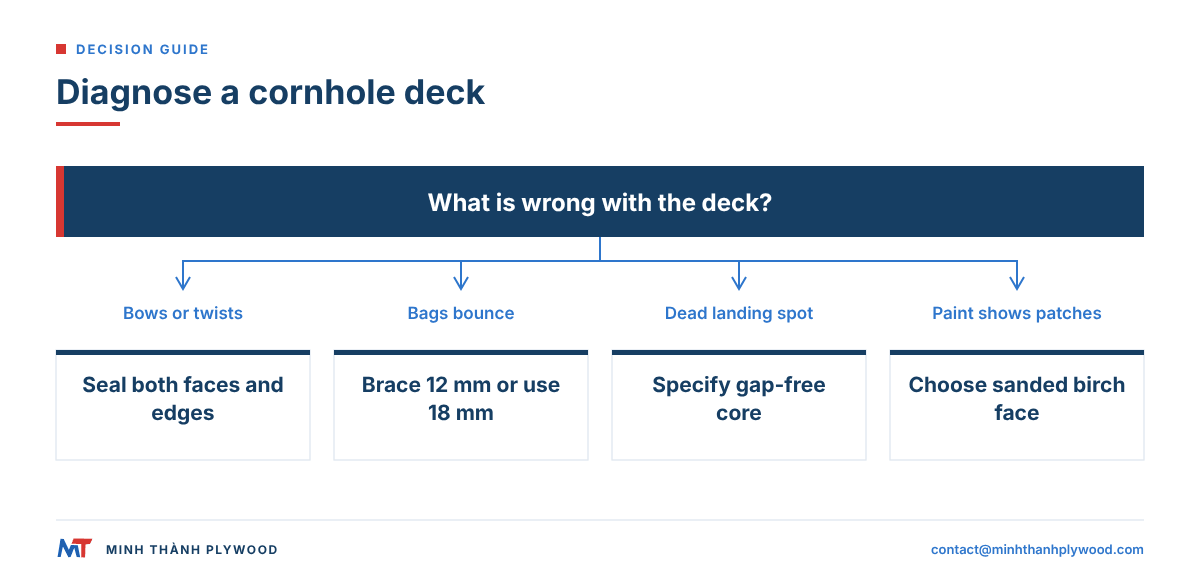
Most cornhole board complaints trace back to the plywood: a deck that bows, a deck that drums, or a dead spot where the bag stops. Each has a cause that can be fixed in the specification or in the build.
| Problem | Cause | Fix |
|---|---|---|
| Deck bows or twists | Sheet not flat, or one face sealed and the other bare | Order flat, double-pressed panels; seal both faces and edges |
| Bags bounce off | 1/2 in deck with no brace | Add a centre brace, or move to 3/4 in |
| Dead spot | Void in the core under the landing zone | Specify a core free of large gaps |
| Paint shows grain or patches | Patched or rough face | Choose a sanded birch face, D/E or better |
| Two boards play differently | Decks from different thickness lots | Order both decks of a set from one lot |
| Edge splits at the hole | Rough jigsaw cut | Cut with a router and template, round the edge |
Warping is the complaint board makers hear most after a season outdoors. A deck sealed only on top takes up damp from the grass through its underside and cups. Sealing all six sides keeps the moisture balanced.
For brands with return rates to manage, flatness is the plywood line to watch. Furniture-grade panels at our factory are pressed twice as standard, core first and calibrated, then the faces, which keeps cut decks flat.
OEM cornhole and game board blanks from Vietnam
Board makers and brands that sell cornhole sets by the hundred can buy plywood decks as cut blanks direct from the mill. At Minh Thanh Plywood:
- Blanks: 24 × 48 in cornhole decks, four per 1220 × 2440 mm sheet; carrom surfaces and backboards cut from full sheets into 4, 6 or 8 pieces.
- Faces: birch graded D+, D or E, or poplar and pine faces graded A/A, A/B or B/B, matched to the approved sample.
- Cores: white Styrax for light boards, Eucalyptus for heavy, stiff decks.
- Glue: UF glue at E0 emission for indoor boards; WBP for outdoor boards.
- Minimum order: one 40HC, mixed specifications by agreement; production 15–45 days after the 30% deposit.
- Price: furniture and interior plywood from US$350/m³ (October 2026), depending on face, core, thickness and quantity.
For decks shipped to the US, the formaldehyde limit for veneer-core hardwood plywood is 0.05 ppm under 40 CFR 770.10. The bond class for outdoor boards is set by EN 314-2, the plywood bonding-quality standard.
A 40HC of 18 mm full sheets in 1220 × 2440 mm carries 990 sheets on Styrax core, which is 3,960 cornhole decks once each sheet is cut into quarters.
What a deck of plywood costs against a retail kit
At US$350/m³, the raw FOB material in one 18 mm deck of 24 × 48 in (0.0134 m³) is about US$4.70, before cutting, hole, packing and freight. This is a raw FOB example from the starting price, not a deck price.
A retail kit sells the same plywood after freight, duty, cutting, sanding and margin: Cornhole Ace sells a DIY set of two boards in 18 mm Baltic birch for US$199.99, with 10% to 20% off from US$500 orders, and Home Depot sells a pre-cut 1/2 in maple top with a 6 in hole under its PureBond label. A brand buying blanks by the container works from the first number, which is why the blank price leaves room for a retail margin.
What to write on a cornhole board plywood order
A cornhole board plywood order should name the board, the panel and the cut, line by line.
- Use: cornhole decks; carrom surfaces; or backboards.
- Thickness: for example 18 mm, sanded, tolerance ±0.2–0.3 mm.
- Size: 24 × 48 in decks cut four per sheet, or full 1220 × 2440 mm sheets.
- Face and grade: birch D+/D for clear coat, D/E for paint or wrap.
- Core: white Styrax or Eucalyptus.
- Glue: UF glue at E0 emission indoors, WBP outdoors.
- Packing and quantity: pieces per pack, number of 40HC containers, destination port.
We send free samples, so the face and deck feel can be tested before a production run. Send the seven lines to [email protected] or through our contact page; we reply within hours.
Buyer questions, answered
What plywood thickness for cornhole boards?
Use 3/4 in (18 mm) plywood for the deck of a tournament-style board. 1/2 in (12 mm) meets regulation rules and saves weight, but needs a centre brace to stop the deck drumming.
What type of plywood is best for cornhole boards?
Birch-faced or Baltic birch plywood with a sanded, defect-free face. Birch takes paint, decals and clear coat evenly, and a hardwood core keeps the deck flat.
Can I use regular plywood for cornhole?
Yes for backyard boards, if the face is sanded and free of patches and the sheet is flat. Construction sheathing with knots and open voids gives a dead spot wherever a bag lands on a void.
How many cornhole tops come from one sheet of plywood?
Four. A 4 × 8 ft or 1220 × 2440 mm sheet cut into quarters gives four 24 × 48 in decks, enough for two boards, a full set.
How heavy is a cornhole board top in 18 mm plywood?
On a white Styrax core, a quarter of an 18 mm 1220 × 2440 mm sheet weighs about 6.7 kg; on Eucalyptus core about 8.7 kg, before the frame and legs.
Which plywood is used for carrom boards?
Carrom boards use a sanded, polished plywood playing surface, often birch or another fine hardwood face, glued to a frame. The face must be flat and smooth so the striker glides evenly.
What plywood should I use for a basketball backboard?
Use 3/4 in (18 mm) exterior plywood with a phenolic (WBP) bond, sealed on all faces and edges and painted. It survives rain and ball impact for years when the edges stay sealed.
Should cornhole boards be sealed?
Yes. Three or four thin coats of water-based polyurethane or polycrylic over the paint give a consistent slide and protect the deck from damp grass and spills.
Can Minh Thanh supply cornhole blanks cut to size?
Yes. We cut panels into 4, 6 or 8 pieces, so 24 × 48 in decks come four to a sheet, with birch or other faces, sanded both sides.