
Plywood pegboard is a plywood sheet drilled on a regular grid for hooks; slatwall is a panel grooved in horizontal T-slots for brackets and shelves. Pegboard is cheaper and flexible for tools and crafts; slatwall carries heavier retail stock and looks cleaner. Minh Thanh Plywood supplies birch, poplar and EV faced panels, calibrated to ±0.2 mm for CNC drilling and grooving.
What is plywood pegboard, or peg board plywood?
Plywood pegboard is a sheet of plywood drilled with holes on a regular grid, so hooks, shelves and holders can be placed and moved without new screws. It does the same job as the brown hardboard pegboard sold in hardware stores, with one difference: it is made of cross-laminated wood veneers instead of pressed fibre.
That construction changes three things a buyer notices after a year of use:
- Holes keep their shape. Hardboard holes wear oval as hooks go in and out; plywood holes stay round because every veneer layer holds the hook.
- The sheet stays flat. Plywood resists sagging between fixings and takes humidity changes in a garage or shop better than hardboard.
- It looks finished. A birch, poplar or EV face can be lacquered or left natural, so peg board plywood works in kitchens, studios and retail walls, not only in the workshop.
Peg board plywood is also called wooden pegboard, birch pegboard or plywood peg wall. The specification is the same: panel, thickness, face, hole size and grid.
Slatwall vs pegboard: which is better?
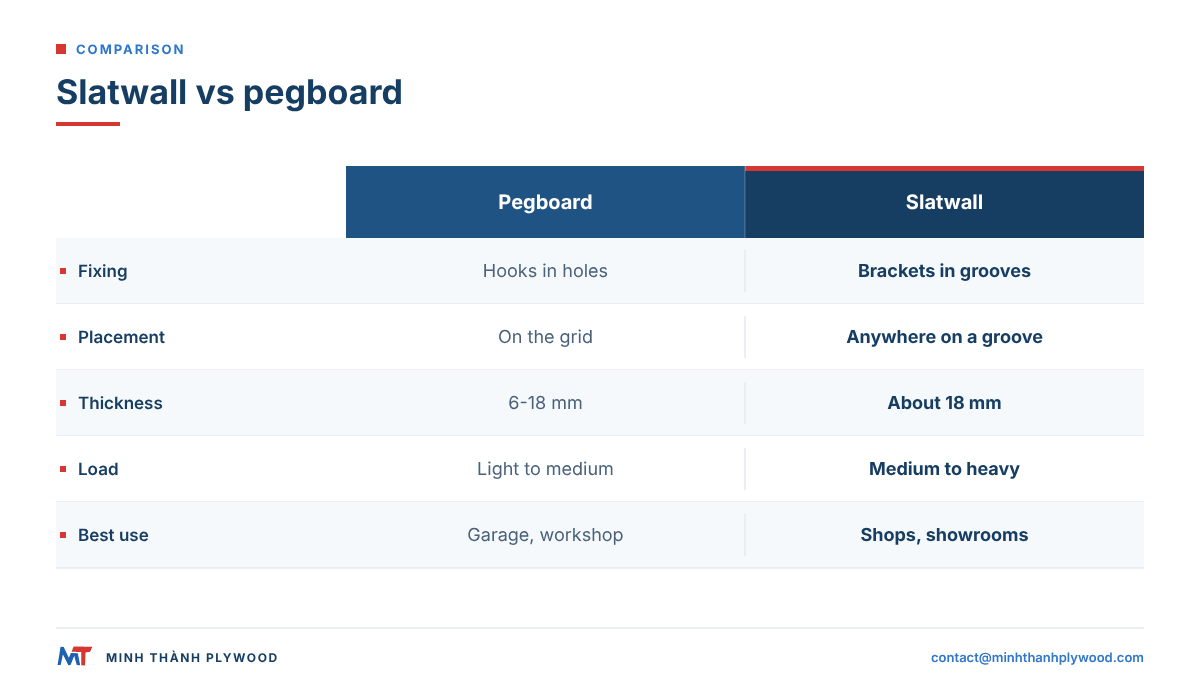
Slatwall is better for retail walls and heavy, changing displays; pegboard is better for tools, crafts and light stock at a lower cost. The two systems hold accessories in different ways: pegboard hooks go into holes on a fixed grid, slatwall brackets slide along continuous horizontal grooves.
| Metric | Plywood pegboard | Slatwall panels |
|---|---|---|
| How accessories fix | Hooks in drilled holes | Brackets slide in T-shaped grooves |
| Placement | On the hole grid only | Anywhere along each groove |
| Typical thickness | 6–18 mm | About 18 mm |
| Load per accessory | Light to medium | Medium to heavy |
| Mounting | Needs about 20 mm spacers behind | Screws flat to the wall |
| Look | Visible holes across the face | Clean horizontal lines |
| Machining | Drilling on a grid | Grooving with a profile cutter |
| Material cost | Lower | Higher, thicker sheet and more machining |
| Best use | Garages, workshops, craft rooms, kitchens | Shops, showrooms, exhibition stands |
The verdict by use: choose pegboard where the owner rearranges tools and the load is light; choose slatwall where stock is heavy, the wall faces customers and displays change each season. Many retail fit-outs use both: slatwall on the main wall, pegboard in the stockroom. Our guide to plywood for shopfitting and displays covers the rest of the shop.
What hole pitch and hole size does pegboard use?
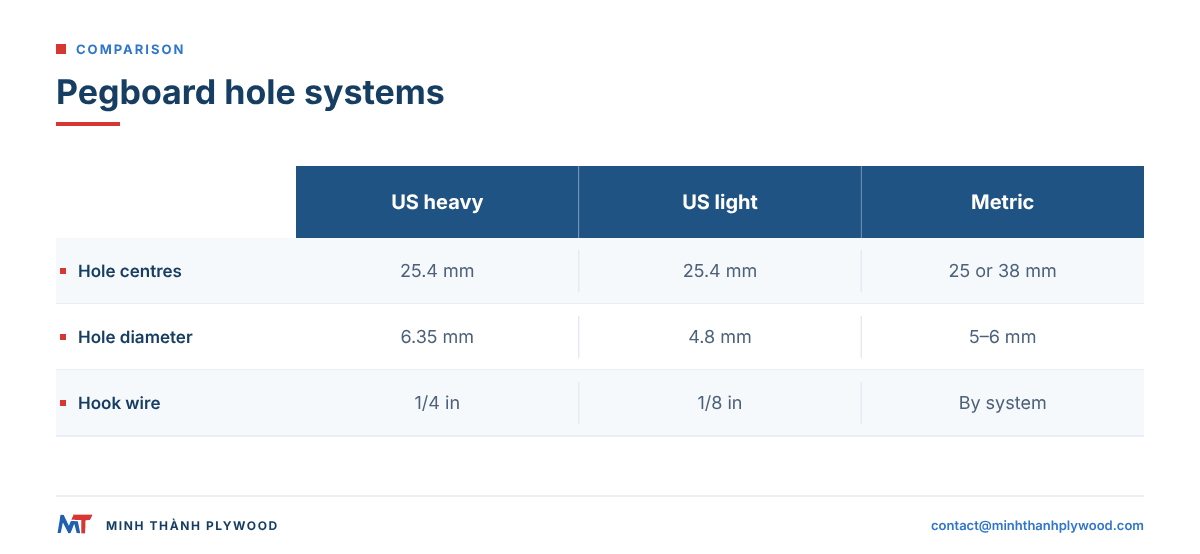
Most pegboard uses a 1-inch (25.4 mm) grid between hole centres. The hole diameter follows the hook wire: 1/4-inch (6.35 mm) holes for 1/4-inch hooks and 3/16-inch (4.8 mm) holes for 1/8-inch hooks.
| System | Hole centres | Hole diameter | Hook wire | Typical board |
|---|---|---|---|---|
| US heavy | 25.4 mm (1 in) | 6.35 mm (1/4 in) | 1/4 in | 6–18 mm |
| US light | 25.4 mm (1 in) | 4.8 mm (3/16 in) | 1/8 in | 3–6 mm |
| Metric | 25 or 38 mm | 5–6 mm | By system | 6–18 mm |
Decide the hook system first, then drill the board to match it. A hook made for a 1/4-inch board may not seat in an 18 mm board, so buyers using thick plywood choose hooks made for thick panels or counterbore the back of each hole.
Keep a border of at least one grid space from every edge, so the outer holes do not break through the veneer. On cut-to-size panels, centre the grid on the panel so the borders match left and right.
Wooden peg pegboard (dowel style): sizes, plan and price
A wooden peg pegboard is an 18 mm birch plywood panel drilled with 18–20 mm holes on a 100–110 mm grid, with softwood or beech pegs 18 mm thick and 120–220 mm long, and shelves 120–200 mm deep that sit on two pegs. It is a different product from hook pegboard: the holes are wide, the pegs are wood, and the panel is the feature. Wrong hole size or grid makes pegs wobble or shelves that do not line up.
| Item | Typical size |
|---|---|
| Panel | 18 mm birch plywood, arris-edged |
| Holes | 18 mm (UK makers) to 20 mm (NZ DIY plan) |
| Grid | 100 mm to 110 mm between centres |
| Pegs | 18 mm dowel, 120 mm to 220 mm long |
| Shelves | 120 mm to 200 mm deep, cut to span two pegs plus overhang |
| Sanding and finish | 240-grit, then oil or PU lacquer at 25% sheen |
A DIY plan from the Resene paint guide shows how the numbers fit together:
- Cut 18 mm plywood to 1200 × 768 mm; the offcut makes the shelves.
- Draw the grid on the back, starting 54 mm from the side and 50 mm from the top, then every 110 mm. That gives 7 × 11 holes.
- Drill 2 mm pilot holes at each crossing, then open them with a 20 mm bit held square to the board, or the pegs sit crooked.
- Cut the dowel into 220 mm pegs and the shelves 200 mm deep.
- Hang the board on a French cleat: a 45-degree-cut 18 × 40 mm batten on the wall, screwed into a stud at about 1980 mm, and the mating batten on the back of the panel.
Ready-made sets are priced at about £140 to £355 (2026) for the 600 or 1200 mm widths from a UK maker, with oil or lacquer finish. Making your own from calibrated sheets costs the plywood and a few hours. A shop or brand that makes many boards CNC-drills them, and the drilling needs sheets of even thickness: our sanded panels hold ±0.2 mm, so every hole sits at the same depth and the same grid on the first board and the five-hundredth. We hold CARB P2 / TSCA Title VI certification for the panels, which matters when the boards go into homes (certificates).
Slatwall groove spacing and panel thickness
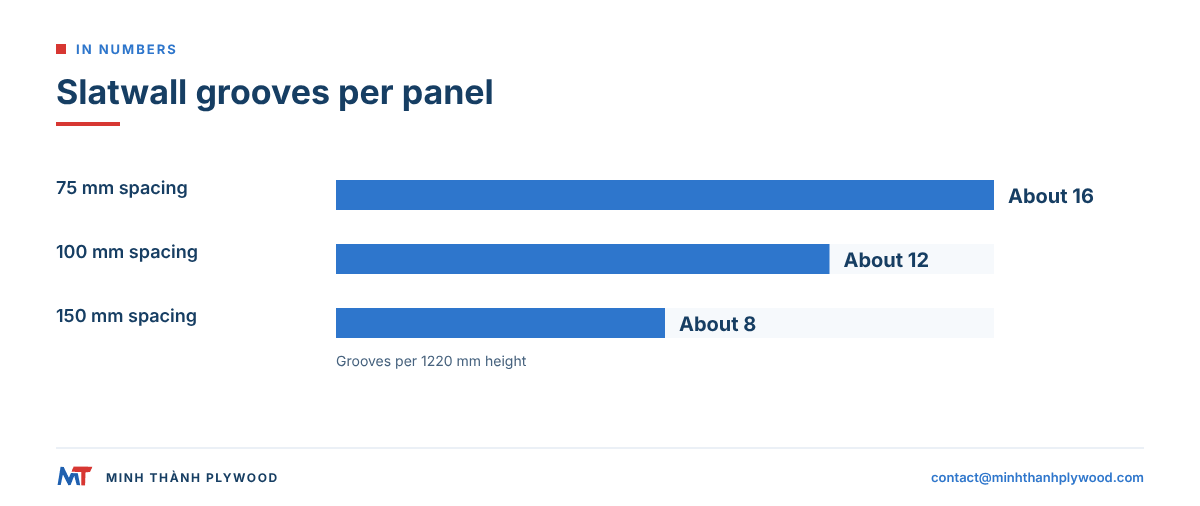
Slatwall panels are usually about 18 mm thick with T-shaped grooves at 75, 100 or 150 mm centres. Closer grooves give more positions for brackets; wider spacing shows more face and suits large shelves.
| Groove spacing | Grooves on a 1220 mm high panel | Use |
|---|---|---|
| 75 mm | About 16 | Small accessories, dense merchandising |
| 100 mm | About 12 | General retail, the most common choice |
| 150 mm | About 8 | Shelving, large items, more visible face |
The groove runs along the 2440 mm length, horizontal on the wall. Each groove has a narrow mouth at the face and a wider slot behind it, so the bracket lip hooks behind the face veneers. In plywood that lip is made of veneer layers; a stitched core with no gaps keeps the lip solid along the whole groove.
For heavy loads, slatwall grooves take aluminium inserts that spread the bracket load over a metal channel. Inserts need a groove cut to the insert profile, so order panels and inserts together.
How much weight can plywood pegboard hold?
Plywood pegboard holds more weight than hardboard pegboard of the same size, because cross-laminated veneers stop the holes wearing oval and the sheet sagging. In practice the hook and the wall fixing set the limit before the plywood does.
Three things decide what a wall of pegboard carries:
- The hook. Each hook is rated by its maker; a 1/4-inch hook in a 1/4-inch hole carries more than a 1/8-inch hook.
- The fixing. Screws into studs or masonry plugs carry the load to the wall; screws into plasterboard alone do not. Fix along every stud and at every edge.
- The panel. Thicker plywood spreads the load over more wood around each hole. A 12 mm or 18 mm panel holds heavy tools that would pull through a thin sheet.
| Panel thickness | Load class | Typical use |
|---|---|---|
| 6–9 mm | Light | Craft rooms, kitchens, small tools |
| 12 mm | Medium | Workshop hand tools, garden tools |
| 18 mm | Heavy | Power tools, free-standing displays, slatwall |
Weight the wall for the heaviest item, not the average. A power tool on one hook bends the sheet around that hole long before a rack of light hand tools does.
Birch vs poplar vs MDF for pegboard and slatwall
Birch-faced plywood gives the hardest face and the crispest hole and groove edges; poplar-faced plywood is lighter and costs less; MDF gives the flattest painted face but is heavier and weaker at the edges.
| Metric | Birch-faced plywood | Poplar-faced plywood | MDF |
|---|---|---|---|
| Face hardness | Hard, resists hook marks | Softer, marks more easily | Smooth, dents on impact |
| Hole and groove edges | Crisp, veneer lips | Clean, softer lips | Clean when new, crumble with wear |
| Weight per sheet | Medium | Light | Heaviest |
| Screw holding at edges | Good | Good | Poor at edges |
| Moisture tolerance | Good with a sealed face | Good with a sealed face | Swells if wet |
| Best finish | Clear lacquer, natural | Paint or laminate | Solid paint |
| Best use | Exposed pegboard, premium slatwall | Painted and light-duty boards | White painted slatwall |
Our furniture panels pair the face with a white Styrax or Eucalyptus core. On Styrax at 500 kg/m³ an 18 mm sheet of 1220 × 2440 mm weighs about 26.8 kg; on Eucalyptus at 650 kg/m³ about 34.8 kg. Styrax keeps a large wall panel light to lift; Eucalyptus is harder for heavy-duty slatwall.
EV (engineered veneer) faces give an even oak or walnut look on every sheet, which matters when a shop runs 30 metres of slatwall that must match. Our birch plywood and poplar plywood pages list grades and thicknesses.
White slatwall panels and other finishes
White slatwall panels are made in three ways: painted MDF, painted plywood, or plywood with a white laminate or overlay. Painted MDF gives the most even white; plywood weighs less per sheet and holds screws better, and it survives knocks at the edges.
For a painted or lacquered finish on plywood, the face decides the result. Our faces are sanded and polished, and both faces are UV-ready, prepared to the standard buyers need to apply their own UV coating. A smooth, closed face takes white paint or lacquer in fewer coats than a rough commercial face.
Finish notes buyers use:
- Clear or natural: birch or EV face, clear lacquer, edges sanded to show the plies.
- Solid white: poplar or birch face, primer and two coats, or a laminate pressed on before grooving.
- Colour-matched to a brand: EV in a fixed colour, or a laminate in the brand colour.
Finish the face before drilling or grooving, then seal the cut surfaces inside the holes and grooves with a light coat.
Which panel for which use?
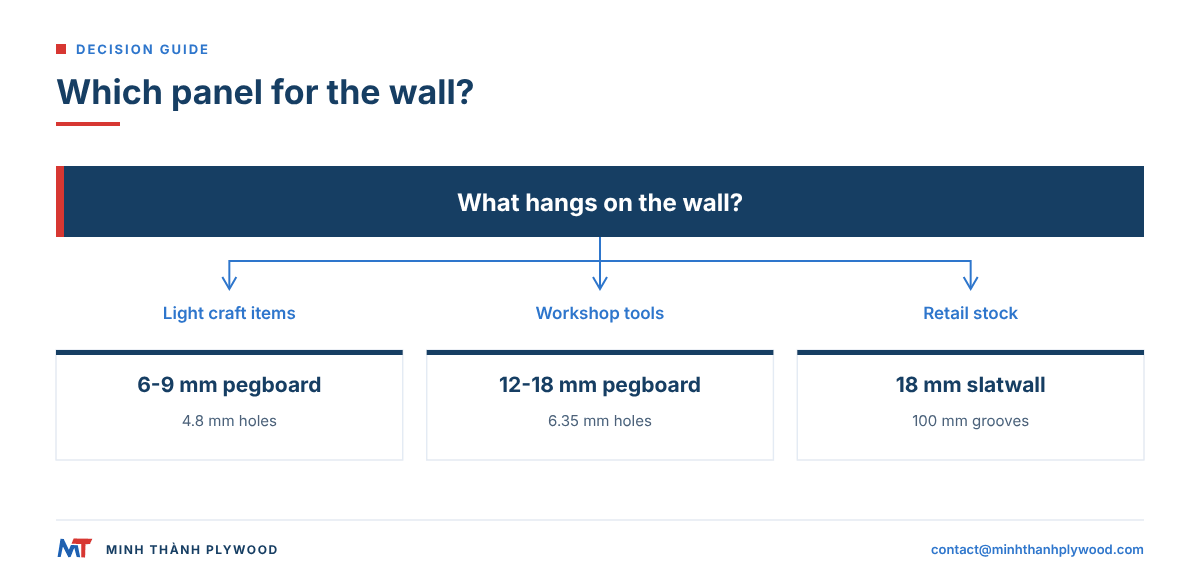
Choose the panel from the heaviest item on the wall, whether customers see it, and whether it will be painted. The table turns the earlier sections into a buying line.
| Use | Panel | Face | Hole or groove |
|---|---|---|---|
| Kitchen or craft pegboard | 6–9 mm plywood | Birch or poplar, clear or painted | 25.4 mm grid, 4.8 mm holes |
| Garage or workshop pegboard | 12–18 mm plywood | Poplar or birch | 25.4 mm grid, 6.35 mm holes |
| Retail slatwall, natural wood | 18 mm plywood | Birch or EV | 100 mm grooves |
| Retail slatwall, white | 18 mm MDF or plywood | Painted or laminated | 75 or 100 mm grooves |
| Exhibition stand walls | 18 mm plywood | Birch or EV | 100 or 150 mm grooves |
A free-standing gondola or display tower uses the same panel on both faces; specify the same face on the back, a face/back pair such as B/BB or D+/D for birch.
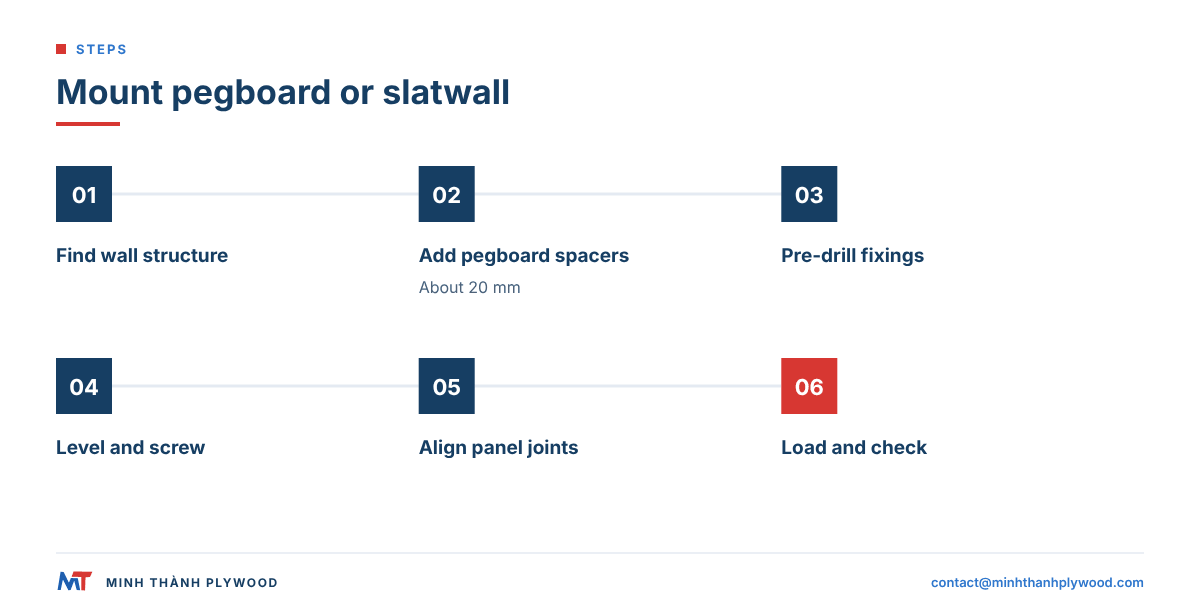
How to mount pegboard and slatwall on a wall
Pegboard needs a gap behind it for the hooks; slatwall screws flat to the wall. Both must reach the studs or masonry, not just the wall board.
- Find the structure. Locate studs or plan masonry plugs at even spacing across the panel width.
- Fit battens for pegboard. Screw battens or spacers about 20 mm thick to the wall at each stud and along the top and bottom edges.
- Pre-drill the panel. Drill fixing holes between the peg holes or in the groove backs, countersunk on the face.
- Level and fix. Set the panel on a level line, fix from the centre outwards, and do not overtighten into the face.
- Join panels. Butt panels on a stud or batten, lining up the hole grid or grooves across the joint.
- Load and check. Hang the heaviest items low and near fixings, then check the panel for movement.
Slatwall panels screw through the groove backs, where the screw heads are hidden by the brackets.
CNC drilling and grooving from cut-to-size panels
Pegboard and slatwall made in volume are drilled and grooved on a CNC router, and the router needs flat, even-thickness sheets. A sheet that varies in thickness gives grooves of uneven depth and holes that break out where the sheet is thin.
Our furniture panels are pressed twice: the core is pressed and calibrated, then face and back are pressed on. Sanded panels reach a thickness tolerance down to ±0.2 mm, with ±2 mm on length and width. Core layers are stitched horizontally and vertically, so a hole or groove does not open into a core gap.
For a production run, we supply panels in standard sizes or cut to size, with one sheet cut into 4, 6 or 8 pieces to fit your CNC bed and your bay widths. Our cut-to-size plywood page shows the formats.
Where plywood pegboard and slatwall are used
Plywood pegboard and slatwall are used wherever items need to hang in view and move often.
- Retail shops: slatwall bays for clothing, shoes, accessories and hardware, with hooks, shelves and bins.
- Showrooms and exhibition stands: birch or EV slatwall walls that can be rebuilt for the next show.
- Garages and workshops: 12–18 mm pegboard for hand and power tools.
- Kitchens and studios: thin birch pegboard for utensils, shelves and plants.
- Warehouses and back rooms: painted pegboard for stock and spares.
Our best plywood for woodworking guide covers the workshop side, and plywood furniture design covers built-in units. All of these sit under our pillar on plywood projects.
What does this mean for your order?
A pegboard or slatwall order from us is a furniture plywood order: face, core, thickness, size and quantity, with the drilling or grooving done on your line.
| Order item | Minh Thanh practice |
|---|---|
| Faces | Birch, poplar, EV or pine; birch quoted as D+/D or D/E pairs |
| Core | White Styrax or Eucalyptus, stitched both ways |
| Thickness | 3–40 mm; ±0.2 mm on sanded panels |
| Sizes | 1220 × 2440 or 1250 × 2500 mm, or cut to size |
| Glue and emission | UF glue at E0 emission; CARB P2 / TSCA Title VI, ICTT mill no. 23024 |
| Surface | Sanded and polished, both faces UV-ready |
| MOQ and lead time | One 40HC, mixed specifications by agreement; 15–45 days after deposit |
| Samples | Free samples |
Panels for indoor walls meet the emission requirements European and US buyers ask for; six ASTM D6007 chamber tests on 9, 15 and 18 mm panels averaged 0.014–0.032 ppm. The TSCA Title VI limit for hardwood plywood is 0.05 ppm under 40 CFR 770.10.
For garages and kitchens, name the service condition and the glue on the order: the bonding-quality requirements are in EN 314-2, and BS EN 636:2012+A1:2015 covers plywood for use in dry, humid or exterior conditions.
To quote panels for pegboard or slatwall, send the face, thickness, size or cutting list, quantity and destination port through the furniture plywood page. We reply within hours.
Buyer questions, answered
Is slatwall or pegboard better?
Slatwall is better for retail walls and heavy, changing displays, because brackets slide anywhere along the grooves and carry more load. Pegboard is better for tools, crafts and light stock, because it costs less and hooks go into any hole on the grid.
How much weight can plywood pegboard hold?
Plywood pegboard holds more than hardboard pegboard of the same size, because the cross-laminated veneers keep the holes from wearing oval and the sheet from sagging. The real limit is usually the hook and the wall fixing: screw 12–18 mm plywood to studs or battens and use hooks rated for the tool.
What is the standard pegboard hole spacing?
The common grid is 1 inch (25.4 mm) between hole centres, with 1/4-inch (6.35 mm) holes for 1/4-inch hooks or 3/16-inch (4.8 mm) holes for 1/8-inch hooks. Many European systems use metric grids of 25 or 38 mm; match the grid to the hooks you will buy.
What thickness should plywood pegboard be?
Use 6–9 mm plywood for light craft and kitchen pegboards, 12 mm for workshop tools and 18 mm for heavy tools or free-standing displays. Thicker sheets need longer hooks or hooks made for thick boards.
Can slatwall be made from plywood?
Yes. Slatwall can be machined from 18 mm plywood with a void-free core, so each groove lip is solid wood veneer. Birch-faced or EV-faced plywood gives a natural wood look; MDF is the usual choice when the panel will be painted solid white.
What size are slatwall panels?
Slatwall panels are most often cut from 1220 × 2440 mm sheets, about 18 mm thick, with the grooves running along the long side. Panels can also be cut to bay widths before grooving.
Is birch or poplar plywood better for pegboard?
Birch-faced plywood is harder, so holes and groove lips keep a crisp edge under repeated hook changes. Poplar-faced plywood is lighter and lower in cost, and suits painted or light-duty pegboards.
Do white slatwall panels have to be MDF?
No. White slatwall panels can be painted or laminated plywood as well as MDF. Plywood weighs less per sheet and holds screws better at the edges, while MDF gives the flattest painted face.
Do I need spacers behind a pegboard?
Yes. Pegboard hooks need a gap behind the sheet to seat, so mount it on battens or spacers of about 20 mm. Slatwall does not need spacers, because the hooks sit in the grooves.