
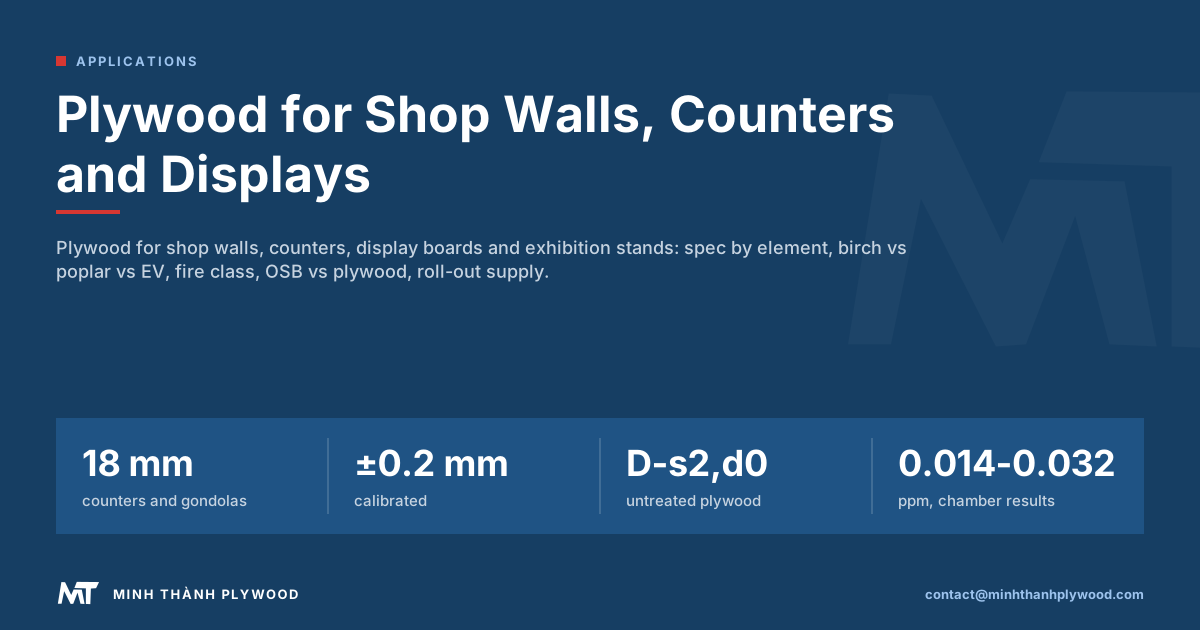
The best plywood for shop walls is a flat, calibrated 12–18 mm panel with a sanded face ready for paint, lacquer or laminate: birch or EV where the wood shows, poplar where it is covered. Counters and gondolas take 18 mm, display boards 9–15 mm. Minh Thanh Plywood supplies these panels to one repeat specification for multi-store roll-outs.
Plywood for workshop and garage walls: thickness, cost and code
For a workshop or garage wall, fix 1/2 in (12 mm) plywood to the studs as the standard, 5/8 in (15 mm) where you want a stiffer wall, and 3/4 in (18 mm) where you want to hang a tool, cabinet or shelf anywhere without finding a stud. A wrong pick dents, pulls out or fails inspection. Retail shopfitting follows from the next section.
| Wall option | Thickness | Typical price per 4 × 8 ft sheet (US, October 2026) | Use |
|---|---|---|---|
| OSB sheathing | 7/16 in | About US$15 | Cheapest hidden lining, paint-grade at best |
| Plywood BCX | Varies | About US$28 | Painted workshop walls, rough face |
| Sanded plywood | 1/2 in (12 mm) | About US$49 | Smooth paint-ready face, light fittings |
| Birch plywood | Varies | From about US$55 | Clear-finished workshop or studio walls |
| Drywall with French cleats | 1/2 in | Varies by store | Smooth wall; hang tools on cleat rails |
Prices come from Home Depot listings and a price round-up, and vary by store. A workshop built inside a 20 ft shipping container with 3/4 in tongue-and-groove sheets is reported at about US$800 of materials.
The price round-up linked above is dated 18 October 2026.
Choices that matter in a workshop:
- Sanded or unsanded. Sanded is worth buying for a painted or lacquered wall; unsanded faces need hours of sanding before paint. Paint it a light tan or off-white rather than pure gloss white, which is harsh on the eyes under shop lights.
- Fixing. Screw into studs at 16–24 in centres. Plywood lets you add a screw anywhere along the sheet, which is why many shop owners prefer it to drywall.
- Outlets. Cut outlet and switch openings with about 3/16 in (5 mm) clearance, as this workshop wall install does, around the box, and check behind the sheet for rails before you start the saw.
- Attached garage. The US residential code (IRC R302.6) asks for at least 1/2 in gypsum board on the garage side of walls shared with the house, and 5/8 in Type X under a habitable room. Plywood alone does not meet that on the house side, so line the shared wall with drywall and use plywood on the other walls. Check your local code before you build.
- Sheet handling. A 4 × 8 ft sheet is heavy overhead; use a panel lift for ceilings.
Plywood for shop walls: which panel for retail?
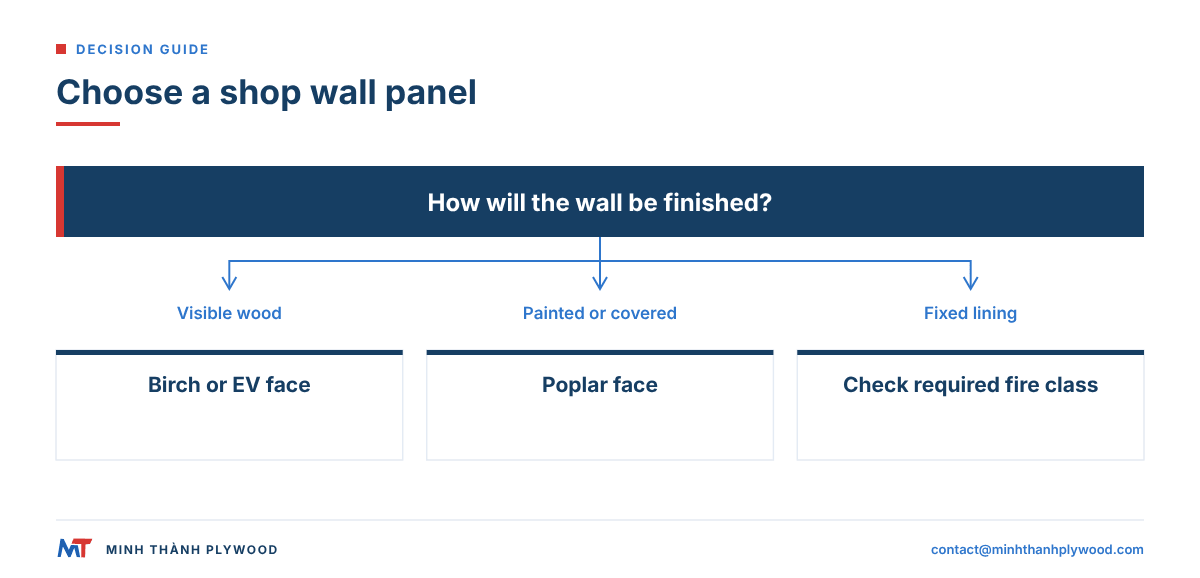
The best plywood for shop walls is a flat 12–18 mm panel with a sanded face that takes paint, lacquer or laminate without extra preparation. Where the wood shows, choose a birch or EV (engineered veneer) face; where the wall will be painted or covered, a poplar face does the job at a lower cost.
A shop wall carries more than its own weight: shelves, slatwall bays, graphics and screens hang from it, and customers lean on it. That asks for four things from the panel:
- Flatness, so light across a long wall shows no waves.
- Screw holding, so fixings close to an edge stay put.
- A clean face, so the finish goes on in few coats.
- A known fire class, so the building inspector signs off the lining.
Plywood for shop walls also has to look the same in every store of a chain. That is a supply question as much as a material one, and it is covered further down this guide.
Plywood shop display and fit-out specification by element
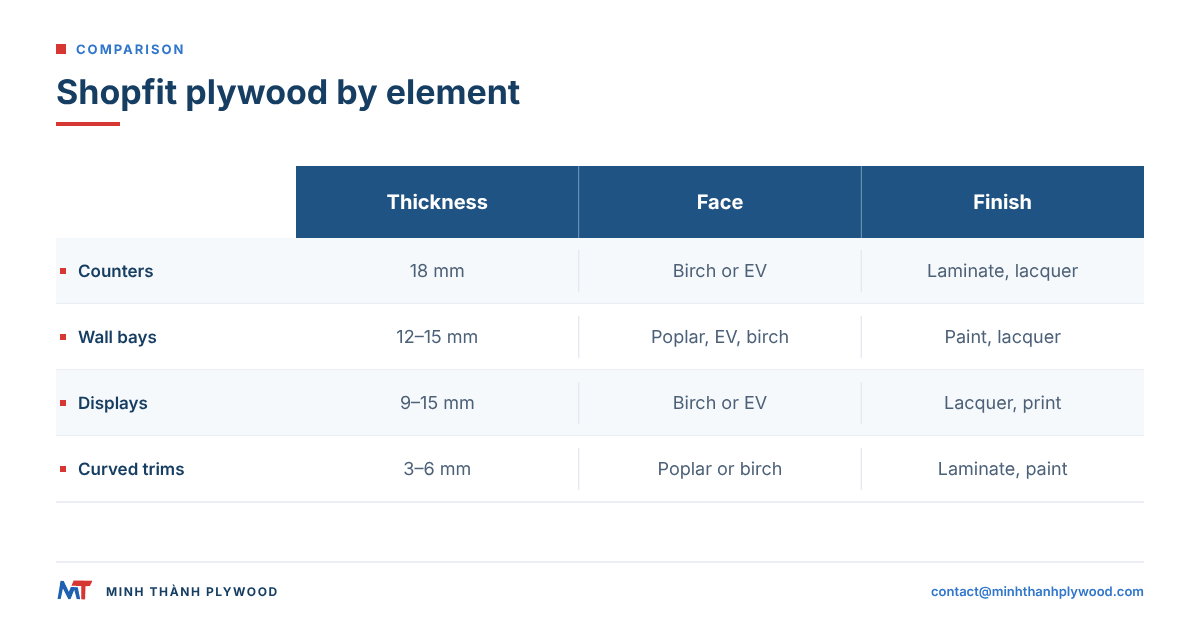
Each element of a shop asks for a different thickness, face and edge. The table is the specification most shopfitters start from.
| Element | Thickness | Face | Flatness need | Edge | Finish |
|---|---|---|---|---|---|
| Counters and cash desks | 18 mm | Birch or EV | High, long fronts | Banded or exposed plies | Laminate, lacquer |
| Gondolas and mid-floor units | 18 mm | Poplar or birch | Medium | Banded | Paint, laminate |
| Wall bays and linings | 12–15 mm | Poplar, EV or birch | High, large areas | Hidden or shadow gap | Paint, lacquer |
| Slatwall and pegboard walls | 18 mm | Birch or EV | High for grooving | Machined grooves | Lacquer, paint |
| Display boards and plinths | 9–15 mm | Birch or EV | Medium | Exposed plies | Lacquer, print |
| Curved fronts and shelves trims | 3–6 mm | Poplar or birch | Bendable | Hidden | Laminate, paint |
| Exhibition stand walls | 12–18 mm | Birch or EV | High, reused | Exposed or capped | Lacquer, wrap |
A face/back pair matters wherever both sides show: a gondola end, a free-standing display, a counter back. Order a pair such as D+/D for birch or A/B for poplar, so the hidden side is still sound. Our pegboard and slatwall guide covers hole grids and groove spacing for the wall bays.
Which plywood for shop counters and display units?
Shop counters and display units take 18 mm plywood with a hard, sanded face and a stitched core that has no gaps. Counters are the most handled furniture in a shop, so the face must resist knocks and the edges must take banding or a polished ply edge.
What separates a good counter panel from a poor one:
- Double pressing. Our furniture panels are pressed twice: the core is pressed and calibrated, then face and back are pressed on. The sheet is flat before it reaches the CNC.
- Calibrated thickness. Sanded panels are calibrated to tight tolerances, so shelves, doors and carcass joints line up across a long run.
- A stitched core. Core layers are stitched horizontally and vertically, so an exposed ply edge on a counter top shows even lines, not a void.
- A face for the finish. Faces are sanded and polished, with both faces UV-ready for the buyer’s own coating.
A laminated counter can use a poplar face under the laminate; an exposed-ply counter needs birch or a dense EV for the look.
Birch vs poplar vs EV for exhibition stands
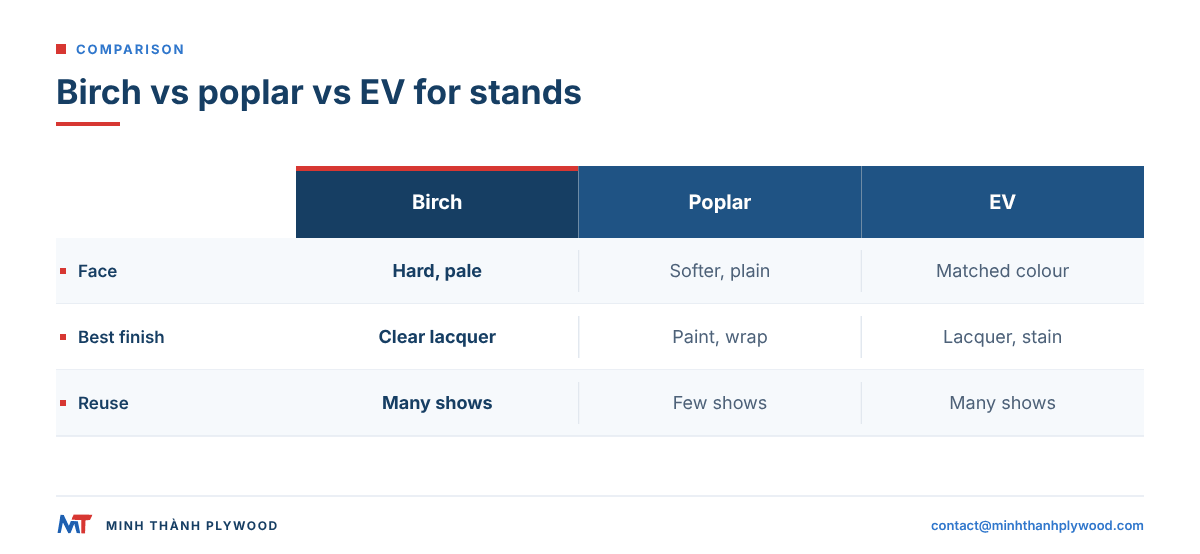
Birch-faced plywood is the best choice for exhibition stands that are rebuilt for many shows; poplar-faced plywood suits painted or wrapped stands for a single event; EV gives a matched wood look across every panel of a large stand.
| Metric | Birch face | Poplar face | EV face |
|---|---|---|---|
| Face hardness | Hard, resists transport knocks | Softer | Medium, by species base |
| Look | Pale, fine grain, clear-finished | Plain, usually painted | Same colour and grain every sheet |
| Weight on Styrax core, 18 mm | About 26.8 kg per sheet | About 26.8 kg per sheet | About 26.8 kg per sheet |
| Best finish | Clear lacquer, exposed plies | Paint, wrap, laminate | Clear lacquer, stain |
| Reuse | Many shows | Few shows | Many shows with care |
| Grades | D+/D, D/E | A/A, A/B, B/B | By pattern and grade |
Weight per sheet follows the core more than the face: on our white Styrax core at 500 kg/m³ an 18 mm sheet of 1220 × 2440 mm weighs about 26.8 kg, light enough for two people to carry onto a stand. A Eucalyptus core at 650 kg/m³ raises that to about 34.8 kg and gives a harder panel for heavy shelving.
Designers who plan modules to the sheet size waste less. A stand built from boxes cut from 1220 × 2440 or 1250 × 2500 mm sheets uses almost the whole sheet and stacks for transport and storage between shows.
What fire rating does plywood need for a retail fit-out?
The required fire class depends on where the panel goes, and the national building code sets it. Untreated plywood is a combustible lining with a known class; escape routes and large public spaces often need a better class, met with a fire-retardant treatment or a certified coating.
In Europe, reaction to fire is classed under EN 13501-1 from A1 to F. Commission Decision 2007/348/EC classes plywood of at least 9 mm and 400 kg/m³, fixed without an air gap to a non-combustible backing, as D-s2,d0 for wall and ceiling linings without further testing (EUR-Lex, Decision 2007/348/EC). We checked the Decision on 20 October 2026. In England, the class each space needs is set out in Approved Document B.
How shopfitters handle it:
- Ask the fire engineer or architect for the class per location: sales floor, escape route, stockroom.
- Use untreated plywood where class D is accepted, such as furniture and small rooms.
- Specify fire-retardant treated or coated panels for linings that need more, with the certificate for that system.
Loose furniture such as counters and gondolas is usually treated separately from fixed wall linings; the project’s fire strategy decides.
Is OSB a better choice for shop walls than plywood?
OSB (oriented strand board) is cheaper and suits hidden backing walls or a deliberate raw, industrial look, but plywood is the better choice for most shop walls. Plywood gives a smooth face for paint, lacquer or laminate, holds screws close to the edge and keeps flatter as humidity changes.
| Metric | Plywood | OSB |
|---|---|---|
| Face | Smooth veneer, sanded | Visible strands, rough |
| Paint and laminate | Takes them directly | Needs filling or a lining |
| Screw holding near edges | Good | Lower, strands can split |
| Flatness over time | Stable, cross-laminated | Edges swell with moisture |
| Cost | Higher | Lower |
| Best use | Visible walls, furniture, displays | Hidden backing, industrial look |
A common shop build uses OSB or commercial plywood as hidden backing for fixings, with a finished plywood or slatwall lining in front.
Flatness, edges and laminate-ready faces
Shop interiors are lit hard, and long panels under spotlights show every wave and ripple. A laminate pressed on an uneven sheet copies the unevenness; a lacquered face shows it too.
Three panel properties prevent that:
- Even thickness. Sanded furniture panels at ±0.2–0.3 mm, down to ±0.2 mm, give a flat base for laminate and lacquer.
- Dry panels. Veneers and finished panels are dried to 8–12 % moisture content at dispatch, so the panel does not move after it is fitted in a heated store.
- Balanced build. Laminate or veneer both faces of any free-standing panel so it stays flat.
For exposed edges, the stitched core and even ply lines give a clean striped edge under clear lacquer. For banded edges, ±2 mm on length and width keeps cut parts square for the edge-bander.
Wood display board and plywood racks for shops
A wood display board is a flat plywood panel that shows products, graphics or samples on a wall, an easel or a stand. Most are 9–15 mm plywood with a sanded birch, poplar or EV face, cut to the size the display needs.
Common plywood shop display formats:
- Wall display boards for hats, bags or samples, often with routed slots or pegs.
- Plinths and risers built from 18 mm sheets as boxes, in nested sizes.
- Plywood racks for shops: shelving units and garment rails built from 18 mm carcasses with exposed ply edges.
- Graphic panels printed directly on a light, smooth face.
- Window displays cut on a CNC to a seasonal theme.
Thin plywood from 3 to 5 mm bends for curved display fronts. Our thin panels are always 5-ply, so they stay stable when cut into narrow strips.
How to build exhibition stands that are reused
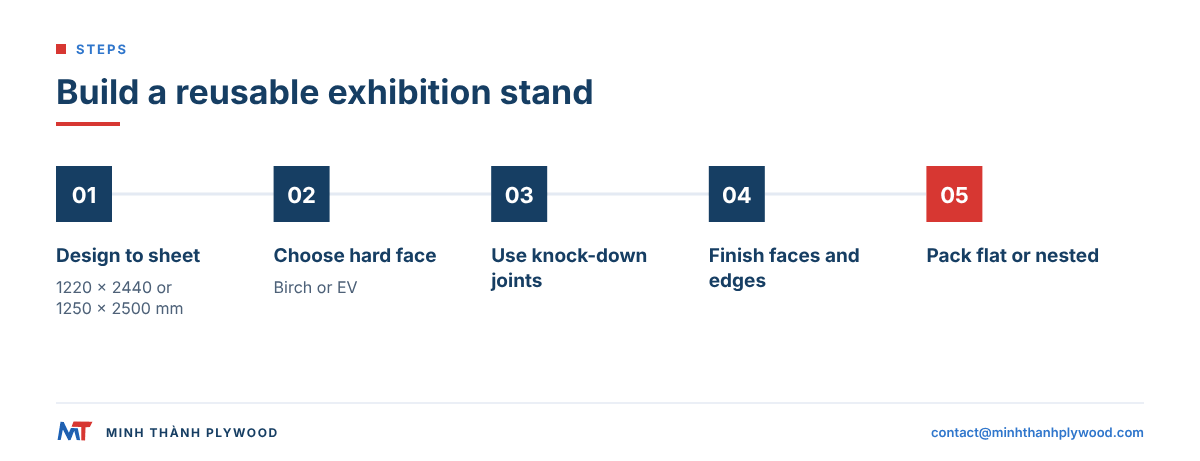
A reusable exhibition stand is built from modules that fit the sheet size and come apart without damage. Built that way, the same plywood serves several shows and the shop fit-out that follows them.
- Design to the sheet. Size modules to 1220 × 2440 or 1250 × 2500 mm so offcuts are small.
- Choose a hard face. Use birch or EV faces that survive packing and transport.
- Join mechanically. Use knock-down fittings, slots or bolts instead of glue so modules come apart.
- Finish all faces. Lacquer both faces and edges so handling marks clean off.
- Pack flat or nested. Plan boxes that stack inside each other for transport and storage.
Panels cut to size before shipping save time on site. We cut one sheet into 4, 6 or 8 pieces and ship cut-to-size panels regularly to Italy and other European markets; see our cut-to-size plywood page.
Roll-out programmes: one specification across many stores
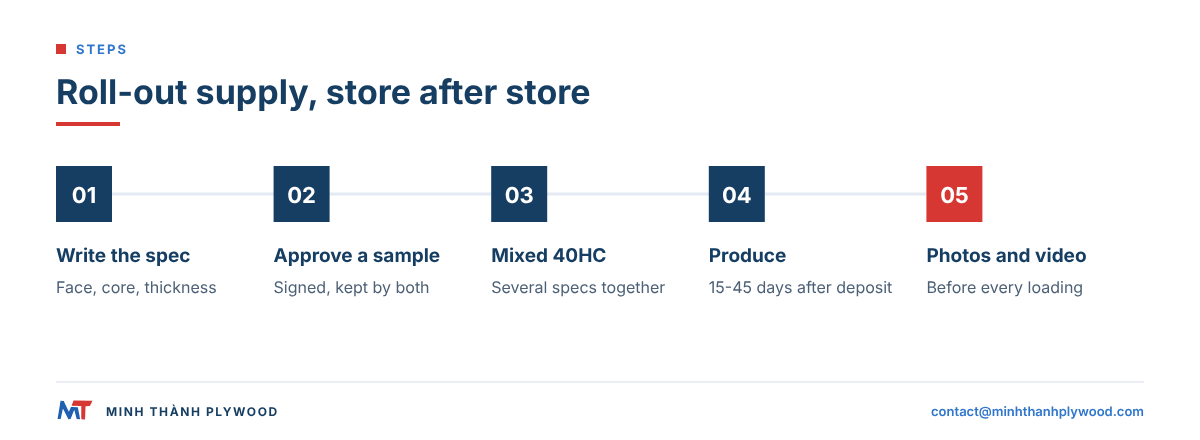
A retail roll-out needs the same panel in the first store and the fiftieth: the same face colour, the same thickness, the same edge. That depends on a written specification and an approved sample more than on the mill’s goodwill.
How a roll-out supply works with us:
- One written specification: face species and grade pair, core, thickness and tolerance, glue and emission class, size or cutting list, packing.
- An approved, signed sample that every repeat order is graded against.
- Mixed loads: one 40HC can carry several specifications by agreement, so counters, walls and shelves for a batch of stores arrive together.
- Production 15–45 days after deposit, so the order is placed to the store-opening calendar.
- Photos and video before loading for every shipment, so the fit-out team knows what is arriving.
EV faces help most here: the colour and grain are engineered, so a counter made in spring matches a wall made in autumn.
Emissions and indoor air in shops
Shops are occupied indoor spaces, and retailers in Europe and the US ask for low-formaldehyde panels in fixtures and linings. Our furniture plywood uses UF glue at E0 emission and is certified CARB P2 / TSCA Title VI under ICTT mill no. 23024.
Six ASTM D6007 chamber tests on 9, 15 and 18 mm panels, between April 2025 and June 2026, averaged 0.014–0.032 ppm against the 0.05 ppm limit for veneer-core hardwood plywood. That limit is listed in the EPA formaldehyde emission standards.
Three were run by Shanghai Hongjun and three by ICTT Vietnam. Third-party testing to the buyer’s method, such as EN 717-1, is arranged through SGS on request.
How to specify plywood for shopfitting
A shopfitting plywood specification fits on one line per panel type. Write it in this order:
- Application: counter, gondola, wall lining, display board or stand.
- Face and grade pair: birch D+/D, poplar A/B or EV pattern and colour.
- Core: white Styrax for light panels, Eucalyptus for harder ones.
- Thickness and tolerance: for example 18 mm, sanded and calibrated.
- Glue and emission: UF glue at E0 emission.
- Size: 1220 × 2440, 1250 × 2500 mm or a cutting list.
- Fire class, if a treated panel is needed, with the system named.
- Packing and quantity, with the destination port.
What does this mean for your order?
For shop interiors we supply furniture plywood to your specification, in sheets or cut to size, with the documents shopfitters need.
| Order item | Minh Thanh practice |
|---|---|
| Faces | Birch, poplar, EV, pine and 10+ face veneers |
| Core | White Styrax or Eucalyptus, stitched both ways |
| Thickness | 3–40 mm; sanded panels down to ±0.2 mm |
| Sizes | 1220 × 2440 and 1250 × 2500 mm, custom sizes, cut-to-size |
| Pressing | Double pressing as standard for furniture panels |
| Emission | UF glue at E0 emission; certificates and test reports |
| MOQ | One 40HC, mixed specifications by agreement |
| Price | Furniture plywood from US$350/m³ (October 2026) |
| Samples | Free samples |
Every shipment is photographed and filmed before loading. Our pillar on plywood projects and the guides to plywood furniture design and best plywood for woodworking cover related builds. To quote plywood for shop walls, counters or displays, send the specification line through the furniture plywood page. We reply within hours.
Buyer questions, answered
Which plywood is best for shop counters and display units?
Use 18 mm plywood with a hard, sanded face: birch or EV where the face stays visible, poplar under laminate or paint. A calibrated, double-pressed panel stays flat on long counter fronts and gives clean edges for banding.
What thickness plywood for workshop walls?
Use 1/2 in (12 mm) as the standard, 5/8 in (15 mm) for a stiffer wall and 3/4 in (18 mm) to hang loads anywhere without finding a stud. Screw into studs at 16–24 in centres. Walls shared with an attached house also need drywall to meet code.
What fire rating does plywood need for a retail fit-out?
The building code sets the class by location. Untreated plywood of at least 9 mm and 400 kg/m³, fixed without an air gap to a non-combustible backing, is classed D-s2,d0 for walls and ceilings in Europe; escape routes and large spaces often need a higher class, met with a fire-retardant treatment or certified coating.
Is birch or poplar plywood better for exhibition stands?
Birch-faced plywood is better for exposed, reusable stand structures, because its hard face survives repeated assembly and transport. Poplar-faced plywood is lighter and lower in cost, and suits painted or wrapped panels used for one show.
Is OSB a better choice for shop walls than plywood?
OSB is a cheaper choice for hidden backing and a raw industrial look, but plywood is better for most shop walls. Plywood has a smooth face for paint or laminate, holds screws closer to the edge and stays flatter under humidity changes.
What thickness of plywood is used for shopfitting?
Shopfitters use 18 mm for counters, gondolas and carcasses, 12–15 mm for wall linings and backs, and 6–9 mm for curved fronts and thin display panels. Exhibition stand walls are usually 12–18 mm.
Can plywood be laminated for shop displays?
Yes. Sanded plywood takes HPL, melamine paper or veneer laminates; the face must be flat and even in thickness so the laminate shows no ripples. Laminate both faces of a free panel to keep it flat.
What is a wood display board?
A wood display board is a flat plywood or timber panel used to show products, graphics or samples, on a wall, an easel or a stand. Plywood display boards are usually 9–15 mm with a sanded birch, poplar or EV face.
How do I keep the same plywood across many store openings?
Write one specification with face, grade pair, core, thickness, tolerance, glue and emission, and size, approve a signed sample, and order by that reference each time. Our repeat orders are graded against the same approved sample.
Does shopfitting plywood need low formaldehyde emission?
Yes. Shops are occupied indoor spaces, so buyers in Europe and the US ask for low-emission panels. Our furniture plywood uses UF glue at E0 emission, with chamber results of 0.014–0.032 ppm.