
Plywood for outdoor furniture works when three choices are right: a phenolic (WBP) bond that survives wetting, edges sealed before assembly, and an exterior finish that is renewed. Marine plywood suits pieces that stand in water; exterior WBP plywood suits most patio and garden furniture. Minh Thanh Plywood, a Vietnamese plywood manufacturer, sets out each choice for furniture makers.
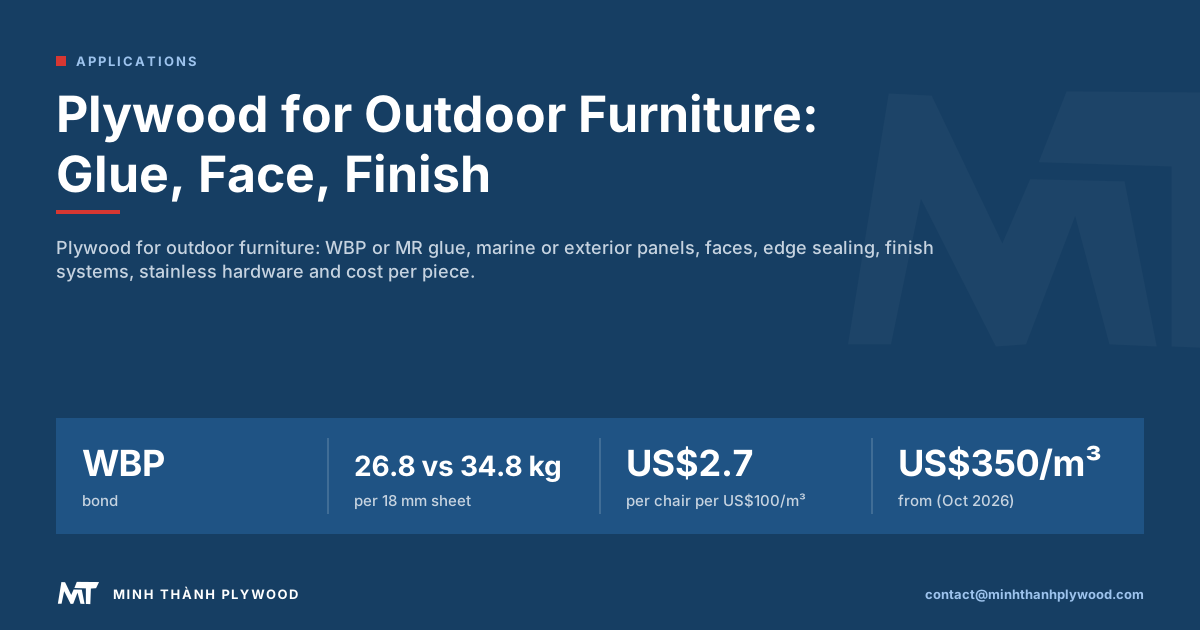
Is plywood good for outdoor furniture?
Plywood is good for outdoor furniture when the bond is phenolic (WBP), every edge is sealed and the finish is exterior grade and renewed. Under those conditions plywood gives large, stable, flat parts that solid wood cannot: wide seats, curved backs, table tops without joints, and CNC-cut shapes.
What decides whether a plywood piece lasts outside:
- The bond: phenolic (WBP) glue survives repeated wetting and drying; urea glue does not.
- The edges: cut edges take up water fast and must be sealed before assembly.
- The face: a dense, even face takes finish well and resists checking.
- The finish: paint, varnish or oil, chosen for the look and the upkeep the buyer accepts.
- The design: drainage, gaps and feet that keep water from standing on or under the piece.
- The hardware: stainless steel fittings that do not rust or stain.
Get these right, and a plywood chair or bench outlives many solid-softwood pieces, because plywood does not split along the grain.
Glue first: WBP, MR or urea?
Choose the glue before anything else: phenolic (WBP) for furniture exposed to rain, melamine-fortified (MR) for covered outdoor areas, and never urea glue outdoors. The glue line, not the wood, is usually what fails first in outdoor plywood.
| Point | UF glue (urea) | MR (melamine-fortified) | WBP (phenolic) |
|---|---|---|---|
| Colour of glue line | Light | Light | Dark brown |
| Resists humidity | Indoors only | Yes | Yes |
| Resists rain and soaking | No | Occasional splashes | Yes, repeated wetting and drying |
| Typical outdoor use | None | Covered verandas, outdoor kitchens under a roof | Garden, patio, pool and boat furniture |
| Visible edge | Pale lines | Pale lines | Dark lines, visible on a clear-finished edge |
The dark glue line of WBP shows on exposed edges. Furniture makers who want pale edges on a clear finish either paint the edges, band them with solid wood, or design the edges out of sight.
For pieces used indoors as well, such as furniture for covered terraces or conservatories, emission matters too. Our mill holds CARB P2 / TSCA Title VI certification (ICTT mill no. 23024). Six ASTM D6007 chamber tests between April 2025 and June 2026 averaged 0.014–0.032 ppm against the 0.05 ppm limit set by CARB Phase 2. The US federal limit for veneer-core hardwood plywood is the same 0.05 ppm under 40 CFR 770.10.
Glue and emission class are two separate specifications. At Minh Thanh, UF glue at E0 emission is our standard for furniture and interior panels, and MR and phenolic (WBP) bonds are made to the customer’s specification. For outdoor furniture, order WBP.
Marine or exterior plywood?
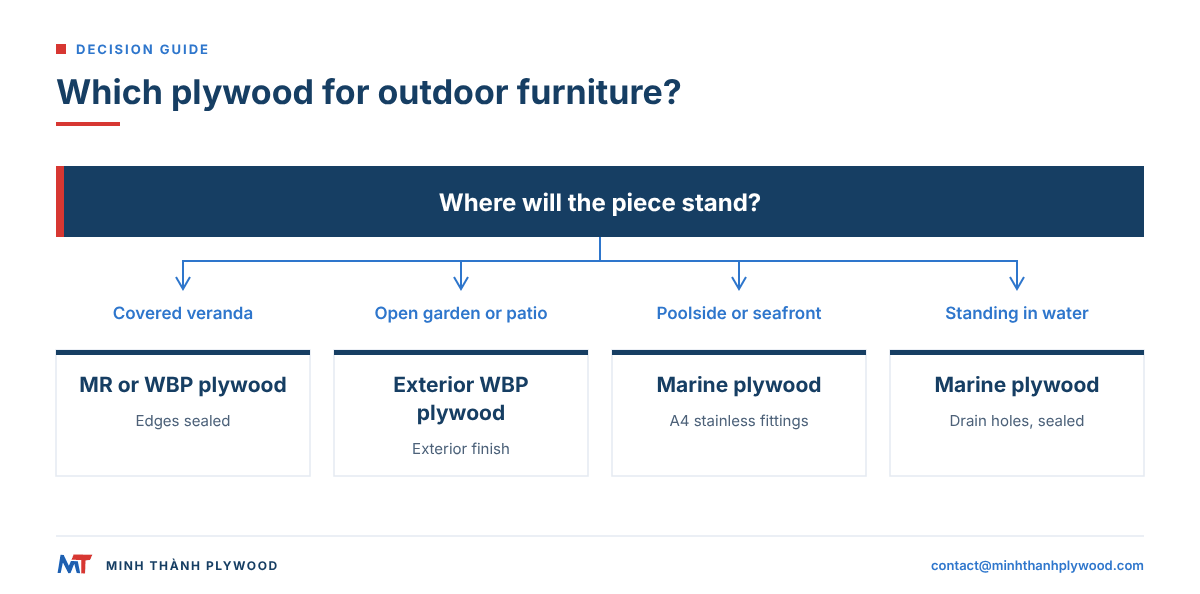
Marine plywood suits furniture that stands in water or by the sea; exterior WBP plywood suits most patio and garden furniture. Both use a phenolic bond; marine plywood adds a stricter build with fewer core gaps and a higher face standard.
| Point | Exterior WBP plywood | Marine plywood |
|---|---|---|
| Bond | Phenolic (WBP) | Phenolic (WBP) |
| Core gaps | Allowed within the grade | Very few, set by the marine standard |
| Face grade | From utility to good furniture faces | High, few defects |
| Typical standard | EN 636-3 class for exterior use | BS 1088 for marine plywood |
| Weight | Depends on core species | Usually hardwood throughout |
| Cost per sheet | Lower | Higher |
| Best for | Patio sets, garden benches, planters, playhouses | Boat furniture, poolside, seafront terraces |
Exterior plywood under EN 636 is graded by use class: EN 636-3 is for exterior conditions. Our marine plywood buying guide explains BS 1088 and when its stricter core is worth paying for.
US buyers read plywood by grade letters and inches, so here is how they map, following Forest Plywood’s exterior guide. The first letter is the face grade, the second the back, and X means an exterior-type glue:
| US name | Face / back | Typical use | Furniture? |
|---|---|---|---|
| CDX | C face, D back, exterior glue | Sheathing, roofs; D knotholes up to 2.5 in | No, rough face; protected 20+ years when covered |
| BCX sanded | B face, C back, exterior glue | Painted outdoor pieces under cover | Yes, with paint |
| ACX | A face, C back, exterior glue | Painted or clear-finished pieces with one good face | Yes |
| CCX ground-contact, pressure-treated | C face, C back, treated | Posts, planters, ground contact | Hidden parts only |
| Marine | High-grade faces, few core gaps | Boat, poolside, seafront | Yes |
Thickness by part, in the sizes US shops stock: 1/2 in (12 mm) for furniture sides and cabinets, 5/8 in (15 mm) for lighter decking and backs, 3/4 in (19 mm) for seats, table tops and heavy pieces. Sheets are 4 × 8 ft (1220 × 2440 mm) and Exposure 1 panels are the common grade in the Home Depot exterior range. Exposure 1 means the bond survives construction-time wetting; for furniture that stays outside, choose an exterior bond and seal every edge, as set out below.
The plywood we make for outdoor furniture has faces graded for furniture and, to your specification, a phenolic (WBP) bond, the same bond as the marine row, or a melamine-fortified bond for covered pieces, so it sits above CDX on face quality.
A common furniture approach is to build the frame and hidden parts in exterior WBP plywood and use marine plywood only for parts that sit in standing water, such as boat seats or planter bases.
Which face for plywood garden furniture?
For plywood garden furniture, choose a face that takes finish evenly and resists checking: okoume and birch for painted or varnished pieces, eucalyptus for harder, denser faces, pine for a softwood look under paint. The face is a thin veneer, often under a millimetre, so the finish protects it.
| Face | Look | Takes paint | Takes clear finish | Notes |
|---|---|---|---|---|
| Okoume | Pink-brown, even | Very well | Well | Light; popular for boat and outdoor pieces |
| Birch | Pale, fine grain | Very well | Very well | Hard face; birch faces at Minh Thanh graded D+, D and E |
| Eucalyptus | Light brown, dense | Well | Well | Harder face; graded A/A, A/B and B/B |
| Pine | Yellow, visible grain | Well | Moderate | Knots show; graded A/A, A/B and B/B |
| Film-faced | Dark brown or black | Not needed | Not needed | Phenolic film face for cabinets and tops |
Face grade matters most on visible parts. A painted piece can use a lower grade with filled knots; a clear-finished table top needs the best face grade and a matched sample. All our faces are matched to the buyer’s approved sample.
Plywood patio furniture: design rules for water
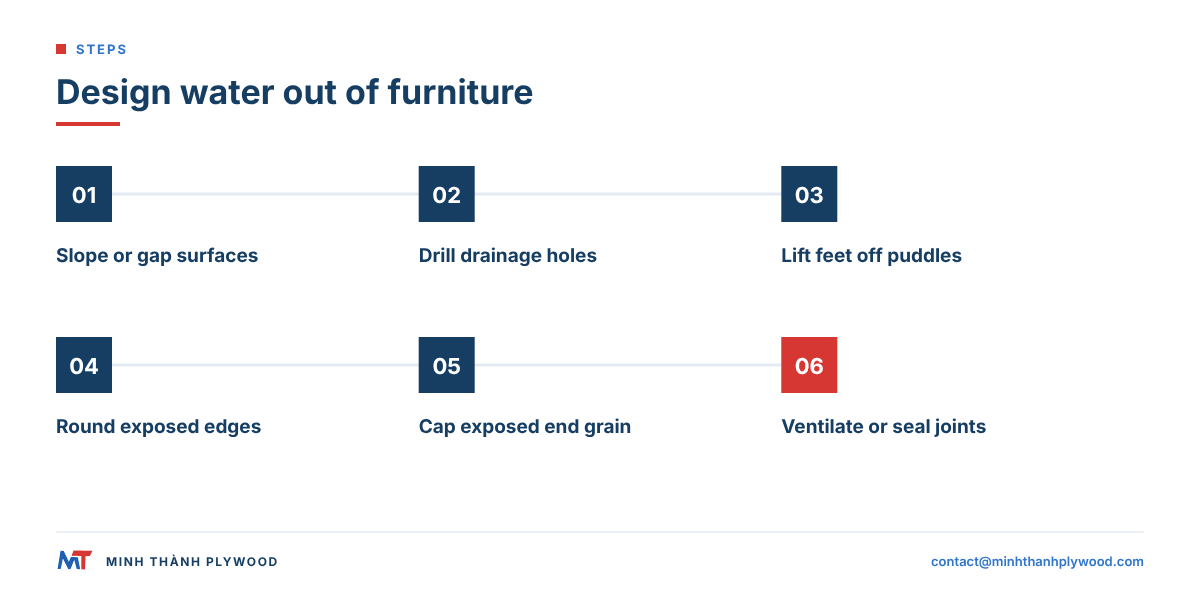
Plywood patio furniture lasts when water runs off and air reaches every part: slope or gap the seats, lift the feet, and avoid joints where water can sit. Design does more for an outdoor piece than any finish.
- Gap or slope flat surfaces. Leave small gaps between seat and table slats, or slope solid tops slightly so rain runs off.
- Drill drain holes in any recess, planter base or box that can collect water.
- Lift the feet. Fit plastic or stainless glides so end grain never stands in a puddle.
- Round the edges. A rounded edge holds finish better than a sharp one, where coatings thin and crack.
- Avoid horizontal end grain. Cap or band exposed end grain on the top edges of backs and legs.
- Ventilate joints. Leave a small gap where two parts meet face to face, or seal and glue the joint completely.
Pieces built to these rules need far less repair. Our guide to repairing plywood covers the fixes when water does get in.
Edge sealing before assembly
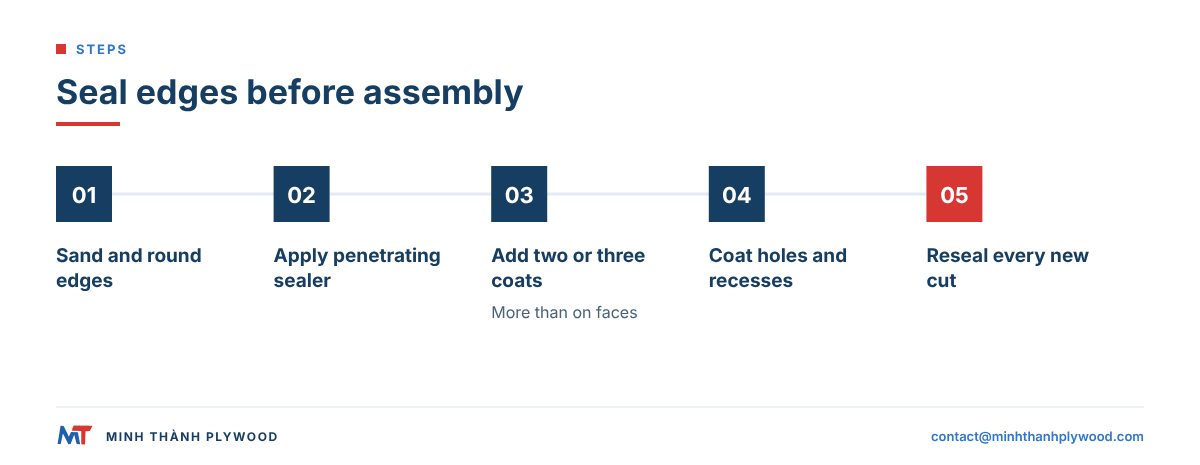
Seal every plywood edge before assembly, because cut edges take up water many times faster than faces and are hard to reach once the piece is built. Edge sealing is the single most effective step for outdoor plywood.
- Sand the edge smooth and round it slightly.
- Apply a penetrating sealer. A thin epoxy sealer or a thinned first coat of the finish soaks into the end grain.
- Build the coat. Apply two or three more coats on the edges than on the faces.
- Seal holes too. Coat screw holes, dowel holes and hinge recesses before fitting hardware.
- Seal after every cut. Any cut or drilling made during assembly gets the same treatment.
Edge banding with solid wood or a PVC or ABS band also protects the edge, provided the band is glued with a water-resistant adhesive and its joints are sealed.
Finish systems for outdoor plywood furniture
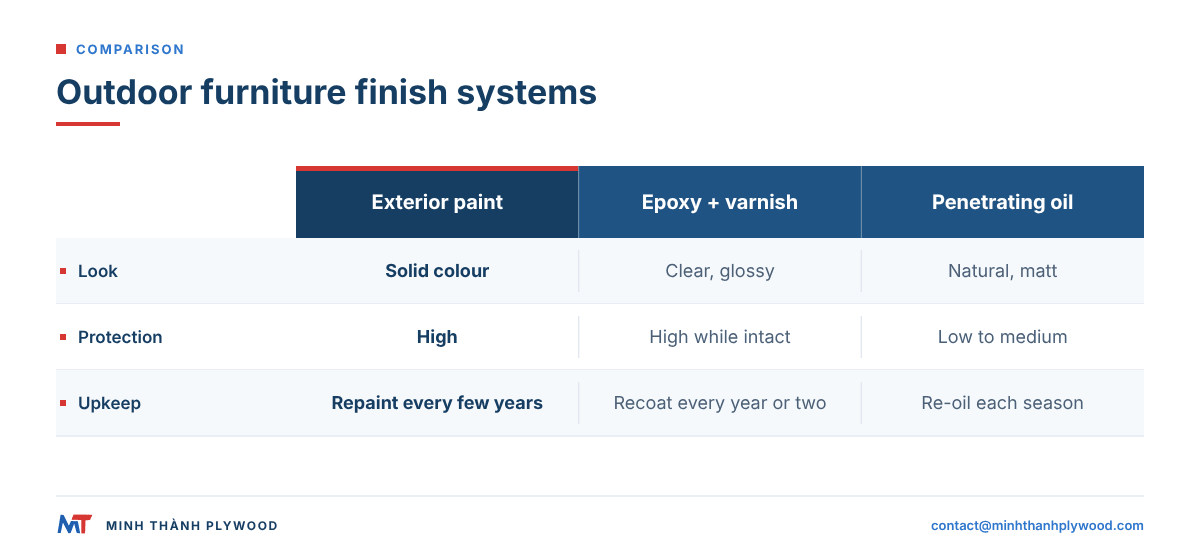
Exterior paint is the longest-lasting finish for outdoor plywood furniture; a sealed and varnished clear finish shows the wood but needs regular recoating; oil is easy to renew but protects least. Choose by the look the buyer wants and the upkeep they will accept.
| Finish system | Look | Protection | Upkeep |
|---|---|---|---|
| Primer + two coats of exterior paint | Solid colour | High | Repaint every few years |
| Epoxy seal coat + UV-resistant marine varnish | Clear, glossy wood | High while intact | Light sand and recoat every year or two |
| Exterior wood stain (film-forming) | Coloured wood grain | Medium | Recoat every two to three years |
| Penetrating oil | Natural, matt | Low to medium | Re-oil each season |
| Two-pack polyurethane, factory applied | Clear or coloured | High | Long life, harder to repair |
Clear finishes need UV protection: sunlight breaks down the wood surface under a clear coat, the coat lifts and water gets in. A marine varnish with UV absorbers, recoated before it cracks, solves that. Our guide on how to finish plywood gives the coating steps.
Our panels have sanded and polished faces, and both faces are UV-ready, prepared to the standard customers need to apply their own coating.
Hardware and fixings for outdoor pieces
Use stainless steel hardware for outdoor plywood furniture: grade A4 (316) near the sea or a pool, A2 (304) inland. Plain steel and zinc-plated screws rust, stain the wood black around the head and loosen as the wood around them softens.
- Screws: stainless, with a pilot hole and a countersink; seal the hole before driving.
- Bolts and threaded inserts: stainless inserts for knock-down furniture that is assembled and taken apart.
- Hinges and stays: stainless or marine-grade fittings for outdoor cabinets and storage benches.
- Glue: polyurethane or epoxy for glued joints; PVA (type D4 water-resistant at most) only for covered pieces.
- Glides and feet: plastic or stainless, so end grain does not touch wet ground.
Do not mix stainless screws with aluminium frames without isolation washers. Two metals in wet contact corrode the weaker one.
Outdoor cabinets: which wood and which plywood?
Outdoor cabinets need exterior or marine plywood with a phenolic (WBP) bond, or a phenolic film-faced panel, with every edge sealed. They stand in the same sun and rain as a bench but hold water inside, so they need drainage and ventilation as well.
What outdoor kitchen and storage cabinets need:
- Carcass: 15 to 18 mm WBP plywood; film-faced panels for the back and base.
- Doors: WBP plywood with a painted or laminated face, or solid timber frames.
- Base: raised on adjustable stainless or plastic feet, never standing on the patio.
- Ventilation: gaps or vents at top and bottom so damp air leaves.
- Drainage: a slightly sloped base with a drain hole.
- Worktop: stone, stainless or a fully sealed film-faced top.
For outdoor cabinets wood choices compared with plywood: teak and other durable hardwoods resist rot on their own but move with humidity; plywood stays flat in wide panels and costs less, provided the bond and edges are right. A covered outdoor kitchen under a roof can use MR-bonded plywood; one open to rain needs WBP.
Plywood, teak, HPL or aluminium?
Plywood is the material of choice for outdoor furniture with wide, flat or curved parts at a moderate cost; teak suits solid-timber pieces that weather without a finish; HPL (high-pressure laminate) and aluminium suit contract furniture that must need almost no upkeep. Each wins in a different place.
| Material | Strengths | Limits | Best for |
|---|---|---|---|
| WBP or marine plywood | Wide stable panels, curves, CNC shapes, light for its stiffness | Needs sealed edges and a renewed finish | Chairs, loungers, benches, cabinets, planters |
| Teak and durable hardwoods | Weather without finish, solid look | Narrow boards, costly, moves with humidity | Classic slatted chairs and tables |
| Pine or other softwood | Low cost, easy to work | Splits and checks, needs treatment | Garden benches, rustic pieces |
| HPL compact panels | Very low upkeep, colour through | Heavy, hard to machine, costly | Contract seating, table tops |
| Aluminium frames | Light, no rot | Gets hot in sun, needs cushions or slats | Frames with plywood or textile seats |
| HDPE (poly) lumber | No painting, resists rot and fading | Heavy, no sharp curves or CNC shapes | Ready-made chairs and tables sold as finished furniture |
Many designs mix them: an aluminium or stainless frame with WBP plywood seats and backs, or a teak frame with a painted plywood table top. The plywood brings the shape and the flat surface; the frame brings the slim profile.
Compared with solid softwood, plywood resists splitting along the grain because its plies cross. That lets a designer use thinner parts and screws close to the edge, which solid boards of the same thickness would not take.
Core and weight of plywood for outdoor furniture: Styrax, Eucalyptus or hardwood?
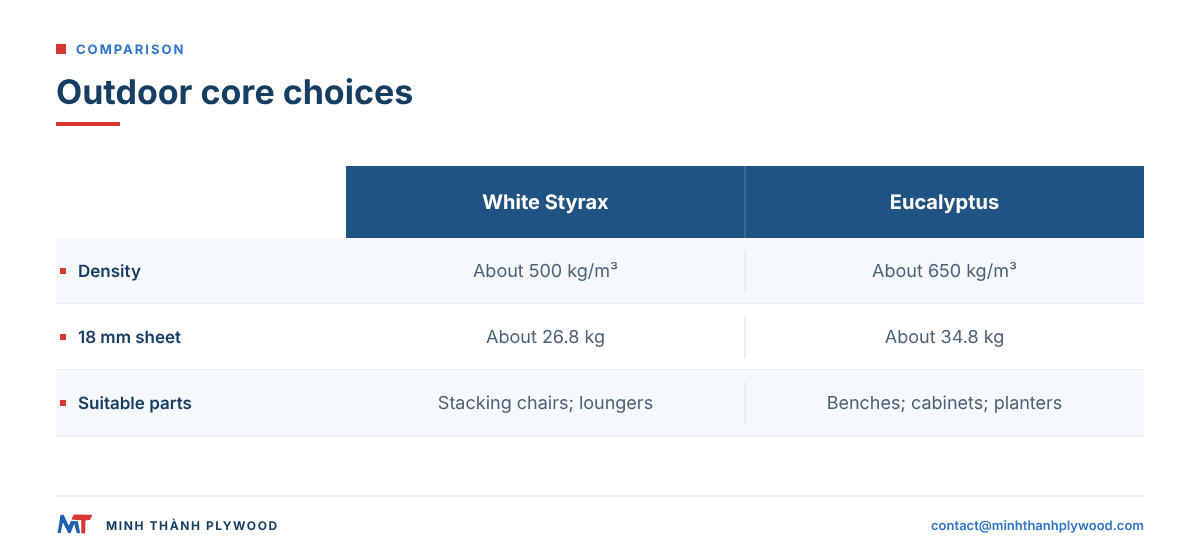
The core sets the weight and the screw holding of outdoor furniture plywood. A white Styrax core keeps chairs and loungers light to move; a Eucalyptus core is denser and holds screws and hinges better.
Our reference densities show the difference. White Styrax core plywood is about 500 kg/m³; Eucalyptus core about 650 kg/m³. A 1220 × 2440 × 18 mm sheet weighs about 26.8 kg on a Styrax core and about 34.8 kg on a Eucalyptus core.
| Piece | Suggested core | Why |
|---|---|---|
| Stacking chairs, loungers | White Styrax | Light to lift and stack |
| Benches and picnic tables | Eucalyptus | Stiffer seat, firm screw holding |
| Outdoor cabinets | Eucalyptus | Hinges and drawer runners hold |
| Planters and boxes | Eucalyptus, WBP | Resists knocks and wet soil |
| Play furniture | White Styrax | Light, safe to move |
Furniture panels at Minh Thanh use white Styrax or Eucalyptus cores as standard; Acacia and Pine cores are made on order. Furniture-grade panels are pressed twice as standard: the core board is pressed and calibrated, then face and back are pressed on, which keeps wide parts flat.
Marine vs exterior cost per piece
The extra cost of marine over exterior plywood is small per piece, because a chair or bench uses only part of a sheet. Work it out per piece, not per sheet, before you decide.
A worked example: an outdoor chair cut from half a sheet of 1220 × 2440 × 18 mm plywood uses about 0.0268 m³ of plywood (a full sheet is about 0.0536 m³). Every US$100/m³ of price difference between two panels adds about US$2.7 to the plywood cost of that chair.
How to compare:
- Nest the parts on a sheet and count the sheets per piece.
- Convert to volume: sheets per piece × 0.0536 m³ for 18 mm sheets.
- Multiply by the price difference per m³ between the panels.
- Compare with labour and finish costs, which are usually larger.
- Decide by exposure: pay for marine where the piece stands in water; use exterior elsewhere.
As an indicative starting price in October 2026, our furniture and interior plywood is from US$350/m³; the final price depends on face, core, glue, thickness, size, quantity and delivery term.
Caring for plywood outdoor furniture
Plywood outdoor furniture lasts longest when the finish is renewed before it cracks, water is not left standing on it, and pieces are covered or stored in winter. Most failures start where finish has worn at an edge or a screw head.
- Each spring: wash with mild detergent, check edges and screw holes, touch up worn finish.
- Each year or two: sand lightly and recoat clear finishes; repaint chipped paint.
- After storms: wipe off standing water and let pieces dry in the air.
- In winter: cover pieces or store them dry, raised off the ground.
- At the first sign of damage: seal a lifted edge or cracked finish before water reaches the core.
Grey weathering, water stains and small dents can all be repaired; see our plywood repair guide.
What to write on an outdoor furniture plywood order
An outdoor furniture plywood order states the exposure, the panel and the finish preparation, one line each. A furniture maker can copy these lines.
- Exposure: covered outdoor area, open garden or poolside and seafront.
- Bond: WBP (phenolic) for open exposure; MR for covered areas.
- Thickness and size: for example 18 mm, 1220 × 2440 mm; our range is 3 to 40 mm, with cut-to-size panels on order.
- Face and grade: okoume, birch, eucalyptus or pine, with the face/back grade matched to an approved sample.
- Core: white Styrax for light pieces, Eucalyptus for benches, cabinets and planters.
- Tolerance and finish preparation: sanded faces, down to ±0.2 mm on furniture panels.
- Packing and quantity: sheets per pack, number of 40HC containers and the destination port.
Our minimum order is one 40HC with mixed specifications by agreement; production takes 15–45 days after deposit. Free samples let you test the face, the bond and your finish before ordering. See our exterior plywood or send your specification to [email protected]; we reply within hours.
Buyer questions, answered
Is plywood good for outdoor furniture?
Yes, if it has a phenolic (WBP) bond, sealed edges and an exterior finish that is maintained. Interior plywood bonded with urea glue delaminates outdoors.
What is the best plywood for outdoor furniture?
Marine plywood for pieces that stand in water or by the sea; exterior WBP plywood with a hardwood face for most garden and patio furniture. Choose a face that takes paint or varnish well, such as okoume, birch or eucalyptus.
Is melamine or phenolic glue better for outdoor furniture plywood?
Phenolic (WBP) glue. Melamine-fortified (MR) glue resists humidity and occasional splashes, which suits covered outdoor kitchens and verandas, but only a phenolic bond holds through repeated soaking and drying.
Do I need marine plywood for garden furniture?
Not usually. Exterior plywood with a WBP bond, sealed edges and a good finish lasts for years on a patio. Marine plywood pays off for boat furniture, poolside pieces and furniture left uncovered by the sea.
How do you waterproof plywood for outdoor use?
Seal every edge and face before assembly with epoxy sealer, primer or several coats of exterior varnish or paint, then keep the finish renewed. Water enters through edges and screw holes first.
What finish is best for outdoor plywood furniture?
Exterior paint lasts longest; an epoxy seal coat under a UV-resistant marine varnish gives a clear wood look with more upkeep; penetrating oils are easy to renew but protect less.
What screws should I use for outdoor plywood furniture?
Stainless steel screws and fittings, grade A4 (316) near the sea and A2 (304) inland. Plain steel and zinc-plated screws rust and stain the wood.
Can you leave plywood furniture outside in winter?
Well-built WBP plywood furniture can stay out, but it lasts longer covered or stored. Lift it off wet ground and do not let water stand on seats and table tops.
Can interior plywood be used outdoors if painted?
Not for long. Paint slows water down but cannot stop it at joints, screw holes and cracks, and a urea glue line fails once water reaches it.
What plywood is used for outdoor cabinets?
Exterior or marine plywood with a WBP bond, or a phenolic film-faced panel, with every edge sealed. Outdoor kitchen cabinets also need raised feet and drainage gaps.