
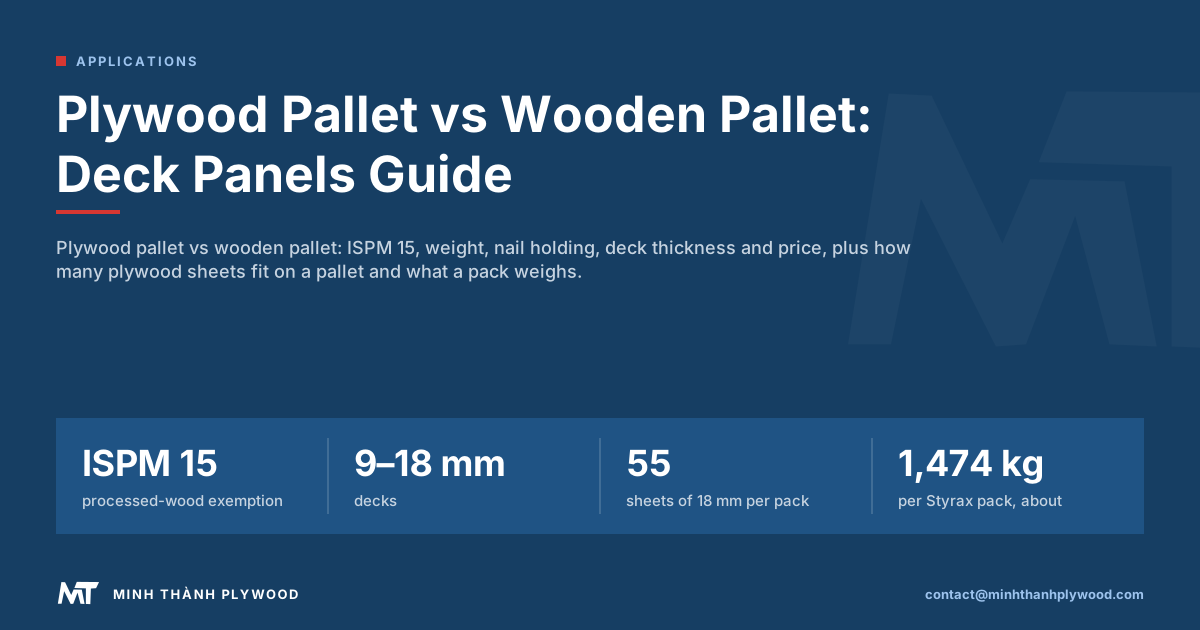
A plywood pallet has a deck of plywood sheet instead of sawn boards, on blocks or runners of pressed wood, LVL or timber. An all-plywood and pressed-wood pallet is exempt from ISPM 15 treatment; a solid timber pallet is not. Minh Thanh Plywood supplies the deck panels pallet makers cut, and this guide compares the pallet types and answers how many sheets sit on a pallet of plywood.
What is a plywood pallet?
A plywood pallet is a pallet whose top deck, and often its bottom deck, is a plywood sheet instead of sawn boards. The deck stands on blocks or runners made of pressed wood (moulded chip blocks), LVL, plywood strips or solid timber. The plywood sheet gives a flat, closed deck that does not split along the grain.
Electronics, machinery, chemical and export goods makers use plywood pallets because the closed deck supports small cartons and the pallet can ship without heat treatment when all its wood is processed. Pallet makers cut the decks from packing plywood, nail or staple them to the blocks and add runners where the pallet needs them.
Do not confuse a plywood pallet with a “pallet of plywood”. The second is a pack of plywood sheets stacked on a pallet for shipping; this guide answers both, starting with the pallet you build and ending with how many sheets sit on a pack.
Plywood pallet price in India: finished pallets and deck cost
Indian sellers list a finished 1200 × 1000 mm plywood pallet at about ₹850 to ₹1,350 per piece, while the deck plywood for the same pallet costs about ₹350 to ₹700 at our raw FOB container price. India sells pallets on IndiaMART, JustDial and TradeIndia, so buyers compare per piece. The table sets the two side by side, at about ₹96 per US$.
| Item | Size and load | Price |
|---|---|---|
| Plywood pallet, Greno Packaging (IndiaMART) | 1200 × 1000 mm, 500 kg | ₹1,350 per piece |
| Plywood pallet, Multan Packing Cases (IndiaMART) | 1016 × 1219 mm, 1000 kg | ₹1,100 per piece |
| Plywood pallet, Perfect Packers (IndiaMART) | size not stated | ₹850 per piece |
| Plywood pallet blocks, Mapac Technology | 1200 × 1000 × 120 mm | ₹900 per piece |
| One 13sqft listing | size and lot not stated | ₹33,925 incl. taxes |
| Our 12 mm deck sheet, raw FOB example | 1220 × 2440 mm, 0.0357 m³ | about US$9 (₹860) |
| Our 18 mm deck sheet, raw FOB example | 1220 × 2440 mm, 0.0536 m³ | about US$13 (₹1,290) |
| One 12 mm deck for a 1200 × 1000 mm pallet | 1.2 m², 0.0144 m³ | about US$3.6 (₹350) |
The deck prices are commercial plywood at US$250/m³ FOB, a raw container price per sheet and not a sheet price for a small lot; freight to an Indian port, duty and GST come on top. The pallet prices are seller listings, not verified quotes.
Common Indian pallet sizes are 1200 × 1000 mm and 1200 × 800 mm; a 12 mm deck suits light cartons and an 18 mm deck suits machinery or bags. Pallet makers in India that buy our cut deck panels by the 40HC build the pallet on their own line, and an all-plywood and pressed-wood pallet skips ISPM 15 treatment for export out of India.
Are plywood pallets better than wooden pallets?
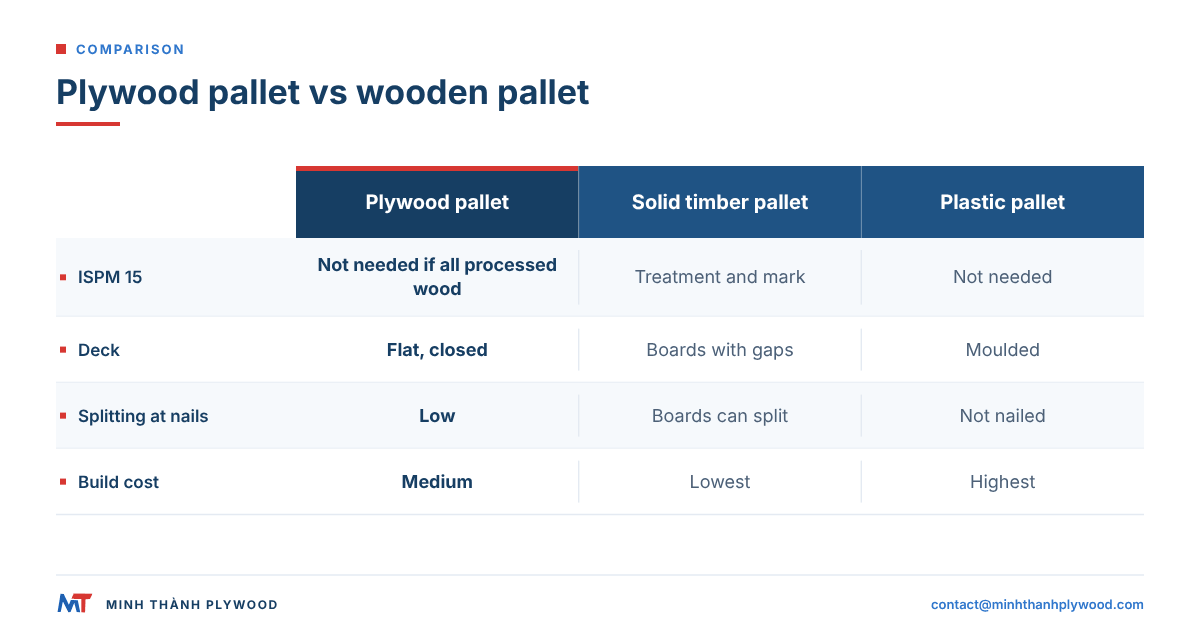
In a plywood pallet vs wooden pallet comparison, a plywood pallet beats a solid timber pallet on export rules, deck flatness and weight for its stiffness; a solid timber pallet beats plywood on build cost and ease of repair. The table compares four pallet types, one metric per row.
| Metric | Plywood-deck pallet, pressed-wood blocks | Solid timber pallet | Presswood (moulded) pallet | Plastic pallet |
|---|---|---|---|---|
| ISPM 15 treatment | Not needed when all wood is processed | Needed: heat treatment or fumigation and mark | Not needed | Not needed |
| Deck surface | Flat, closed, no gaps | Boards with gaps | Moulded, closed | Moulded, open or closed |
| Splitting at nails | Low; crossed plies hold fasteners | Boards can split at ends | Not nailed | Not nailed |
| Weight for stiffness | Light | Heavier for the same stiffness | Light, nestable | Medium |
| Moisture | Depends on glue; edges need care | Absorbs and dries; may grow mould if wet | Sensitive to water | Not affected |
| Repair | Replace a deck sheet | Replace a board, easy | Not repairable | Not repairable |
| Build cost | Medium | Lowest | Medium, high volume only | Highest |
| Best fit | One-way export, cartons, machinery | Domestic reuse and pools | One-way light export | Closed loops and hygiene |
For one-way export shipments, the plywood pallet usually wins. For a domestic pallet pool that is repaired and reused for years, solid timber stays the standard.
Do plywood pallets need ISPM 15 treatment?
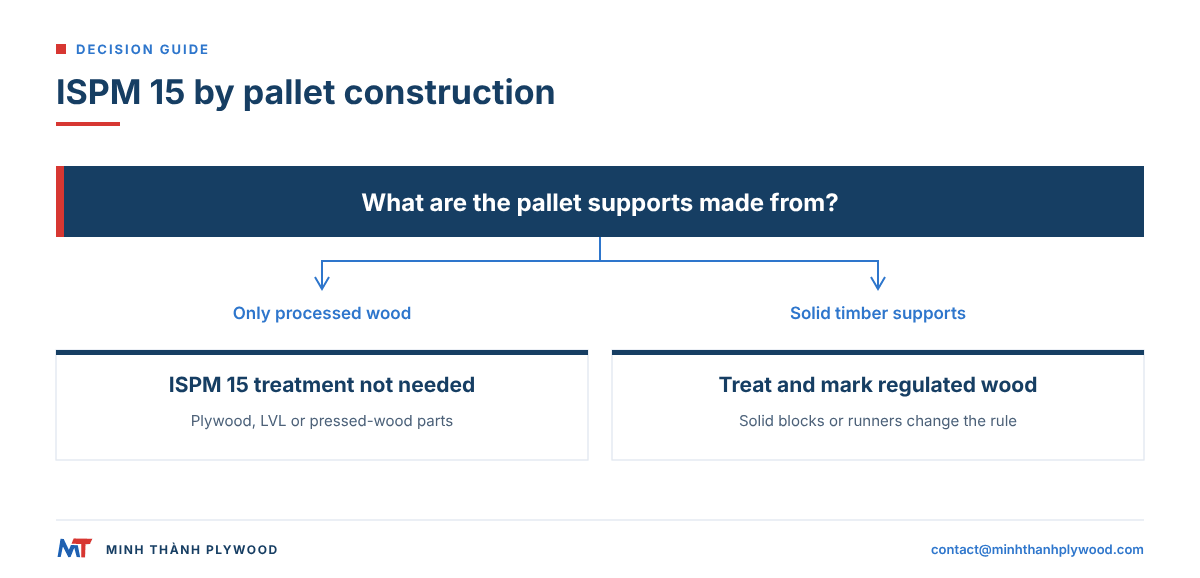
No, a pallet made wholly of plywood and other processed wood does not need ISPM 15 treatment or the mark. ISPM 15, the international standard for wood packaging (read 20 October 2026), exempts “wood packaging material made wholly of processed wood material, such as plywood, particle board, oriented strand board or veneer that has been created using glue, heat or pressure, or a combination thereof.”
The exemption covers the material, not the pallet as a whole. If a plywood-deck pallet stands on solid timber blocks or runners, those solid parts are regulated wood packaging and need treatment and the mark. Pallet makers keep the whole pallet exempt by using pressed-wood blocks, LVL or plywood strips for every part. The UK rules for wood packaging say they “do not apply to processed, non solid WPM like plywood” (GOV.UK).
That is the main reason exporters switch. A pallet with no solid wood needs no heat-treatment chamber, no stamp and no risk of a rejected consignment at the border because a mark is missing or unreadable. Plywood itself is processed wood and outside ISPM 15; our planned guide to plywood for crates and pallets covers the same rule for crates.
Are plywood pallets stronger than wooden pallets?
A plywood deck is stiffer across its width and far less likely to split at fasteners than sawn boards of the same thickness, because its veneers run in crossed directions. Overall pallet strength still depends on the blocks, the runners and the fastening.
Sawn boards are strong along their grain but split easily at the ends, where nails go in. A plywood sheet has grain in both directions, so a nail near the edge holds and the deck spreads a point load over more area. A closed plywood deck also carries cartons and bagged goods that would sag between boards.
The weak points of a plywood pallet are elsewhere: blocks that crush under the forks, staples that pull through a thin deck and edges that take water. A well-designed plywood pallet sizes the deck to the gap between blocks and protects its edges.
Which plywood thickness for pallet decks?
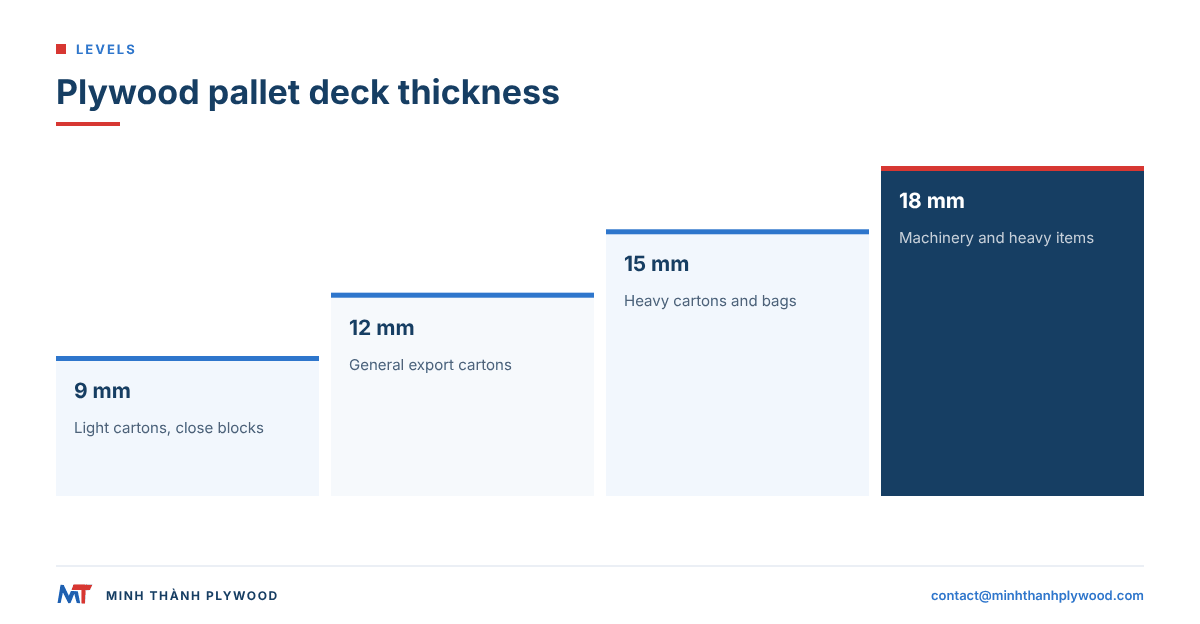
Pallet decks usually use 9–18 mm plywood: 9–12 mm for light loads on closely spaced blocks, 15–18 mm for heavier loads, wider spans and machinery bases. The pallet design and load decide the final thickness; test the assembled pallet before a large order.
| Pallet duty | Deck thickness | Notes |
|---|---|---|
| Light cartons, closely spaced blocks | 9 mm | Lightest deck; staple or nail with care at edges |
| General export cartons | 12 mm | Common one-way export deck |
| Heavy cartons, bags, wider block spacing | 15 mm | Stiffer deck, better fastener holding |
| Machinery and heavy single items | 18 mm | Top and bottom decks often both plywood |
| Bottom deck boards, runners | 15–18 mm strips | Cut from the same sheets |
Our packing plywood runs from 3–40 mm with a packing-grade thickness tolerance of ±0.5–1.0 mm, in 1220 × 2440 mm and 1250 × 2500 mm sheets, or cut into 4, 6 or 8 pieces on order. Our packing plywood page lists the build options.
Which core and glue for pallet plywood?
Choose a Styrax core for light pallets and a Eucalyptus core where fasteners must hold hard; choose UF glue for dry indoor use, melamine-fortified for humid sea freight and phenolic WBP for outdoor or wet reuse.
Core density sets the weight of every pallet you ship. A 1220 × 2440 × 18 mm sheet weighs about 26.8 kg on a Styrax core at about 500 kg/m³, about 31.1 kg on an Acacia core at 580 kg/m³ and about 34.8 kg on a Eucalyptus core at 650 kg/m³. Over a container of pallets, the lighter core saves freight weight; the denser core holds staples and nails more firmly.
Glue sets moisture behaviour. A pallet that sits in a humid hold for a month at sea needs at least melamine-fortified glue; a pallet left in rain or reused in a wet yard needs phenolic WBP. Emission class is a separate line: our furniture panels use UF glue at E0 emission as standard, and packing orders state the bond and emission required.
Plywood top pallets and plywood pallet boxes
A plywood top pallet has one plywood sheet as its top deck over blocks or stringers, with an open or board bottom; a plywood pallet box adds plywood walls and a lid to the same base. Both use the same deck panels.
Plywood top pallets suit cartons, bags and drums that need a closed surface. They weigh less than a fully decked pallet and can be built with plywood or pressed-wood blocks to stay exempt from ISPM 15. Plywood pallet boxes and crates protect machinery, parts and fragile goods, and the walls are often thinner sheets of 9–12 mm on a frame.
Collapsible plywood boxes, with hinged or clipped walls, fold flat for return shipments. Our planned guide to wood packaging covers crates, boxes and cases across the cluster.
How many plywood sheets on a pallet?
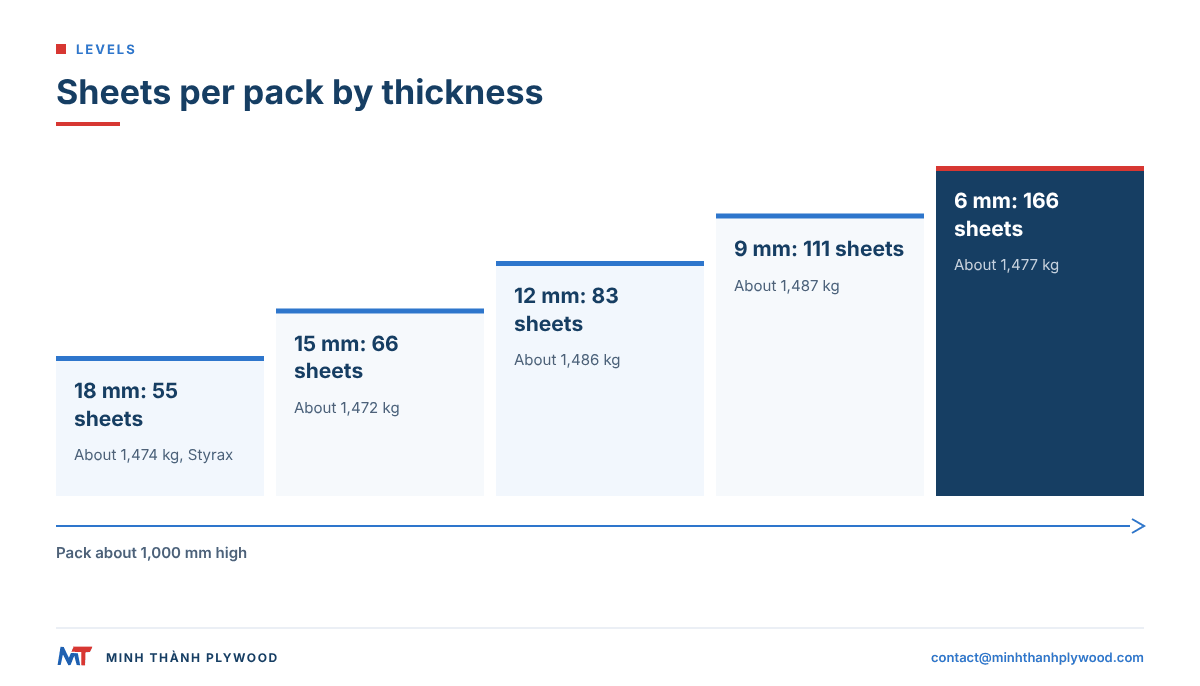
A pallet of plywood holds as many sheets as fit in a pack about 1,000 mm high, capped by weight: 111 sheets of 9 mm, 83 of 12 mm, 66 of 15 mm or 55 of 18 mm in our export packs of 1220 × 2440 mm sheets. Sheets per pack = 1,000 ÷ thickness, rounded down.
| Thickness | Sheets per pack (about 1,000 mm high) | Sheet weight, Styrax core | Plywood weight per pack, Styrax core |
|---|---|---|---|
| 3 mm | 333 sheets | 4.5 kg | about 1,499 kg |
| 6 mm | 166 sheets | 8.9 kg | about 1,477 kg |
| 9 mm | 111 sheets | 13.4 kg | about 1,487 kg |
| 12 mm | 83 sheets | 17.9 kg | about 1,486 kg |
| 15 mm | 66 sheets | 22.3 kg | about 1,472 kg |
| 18 mm | 55 sheets | 26.8 kg | about 1,474 kg |
The pack weight stays close to 1.5 tonnes of plywood whatever the thickness, because the pack height is fixed. Heavier cores reach the container’s payload sooner: on a Eucalyptus core, an 18 mm pack is capped at 53 sheets.
In North America, where sheets are sold in inch sizes, buyers ask how many sheets of 1/2 or 3/4 inch plywood sit on a pallet. The same rule applies: divide the pack height by the sheet thickness, then check the weight.
How much does a pallet of plywood weigh?
A pack of 55 sheets of 18 mm plywood, 1220 × 2440 mm, on a Styrax core weighs about 1,474 kg of plywood (55 × 26.8 kg); on a Eucalyptus core, 53 sheets weigh about 1,844 kg (53 × 34.8 kg). Add the pallet, corner boards and wrapping on top.
Sheet weight is density × volume. An 18 mm sheet of 1220 × 2440 mm has a volume of about 0.0536 m³; at about 500 kg/m³ for Styrax it weighs about 26.8 kg, at 650 kg/m³ for Eucalyptus about 34.8 kg. A forklift and a racking beam rated for the pack weight plus packaging handle either.
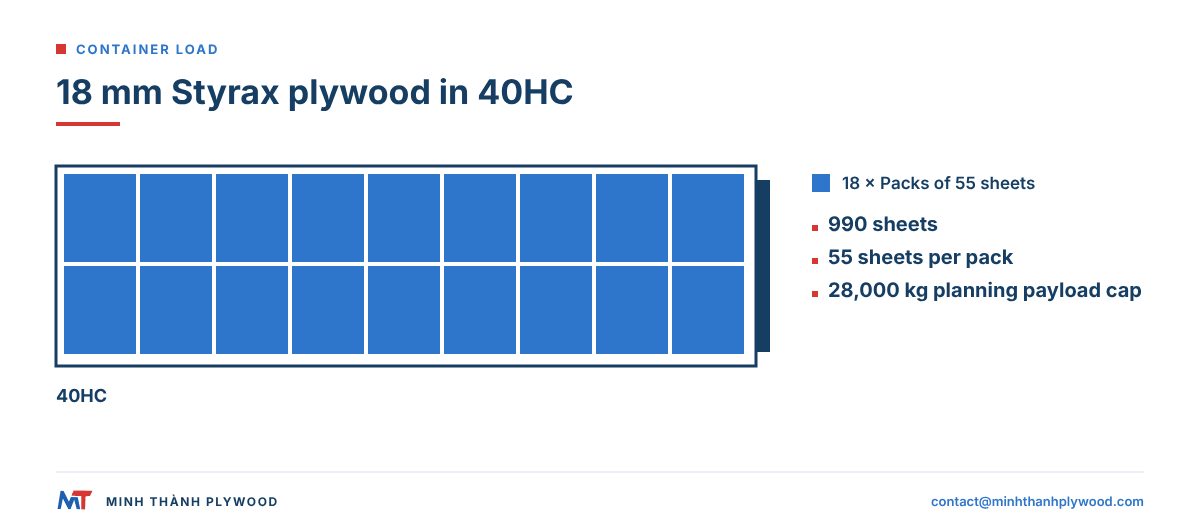
Pack weight also sets container loads. Our 40HC plan for 18 mm sheets carries 990 sheets on a Styrax core (18 packs of 55), 880 on an Acacia core and 795 on a Eucalyptus core, capped by a planning payload of 28,000 kg unless the booking is lower.
Pallet plywood from Vietnam: what buyers order
Pallet makers buying pallet plywood from Vietnam usually order packing plywood on Styrax or Eucalyptus cores, 9–18 mm, with a practical face grade, cut to deck size, in full 40HC loads with mixed thicknesses. The core and glue are chosen for the pallet’s weight and moisture exposure.
Vietnamese mills draw core veneer from plantation timber. Our factory in Ha Hoa, Phu Tho uses locally grown plantation wood for cores, which keeps the panel cost competitive for packing work, and we supply the EUDR compliance dossier (origin records and geolocation files) with orders for Europe.
A first order usually starts with free samples of the deck panel, a test pallet built on the buyer’s line, then one container. Repeat orders keep the approved face/back sample, thickness and cut size fixed.
Plywood pallet packing in Vietnam: how our panels ship
Our plywood ships in packs about 1,000 mm high on pallets with corner protection and strapping, and every shipment is photographed and filmed before loading. Our packaging materials, including plywood and pallet blocks, passed an SGS test in September 2026 under the heavy-metal limit of 100 mg/kg in the EU Packaging and Packaging Waste Regulation, Regulation (EU) 2025/40 (PPWR).
The four packaging materials tested were cardboard, plywood and pallet blocks, strapping band and wrapping film; lead, cadmium, mercury and hexavalent chromium were not detected. The PPWR packaging test page shows the report, and our export packing page shows the full packing routine.
Each pack is labelled with thickness, size and sheet count so a pallet maker can feed the right deck panel to the right line. Mixed thicknesses ride in separately marked packs within one container.
Plywood pallet price: what sets it
The plywood pallet price is set mainly by the deck panel: its thickness, core, glue and face grade, then the blocks, the fasteners and the labour. For the plywood itself, commercial plywood starts from US$250/m³ (indicative, October 2026), with the final price set by face, core, glue, thickness, size, quantity and delivery term.
Compare deck panels on cost per pallet, not price per sheet. A 1220 × 2440 mm sheet cut into two decks of 1220 × 1220 mm, or into deck parts for a 1200 × 1000 mm pallet, gives a different yield; cutting the sheets to size at the mill can save freight on offcuts. Count the saving on heat treatment too: an all-processed-wood pallet skips the treatment chamber and the mark.
Our payment terms are 30% deposit and 70% against the scanned B/L, or an irrevocable L/C at sight; production takes 15–45 days after the deposit, on FOB Hai Phong, CFR or CIF terms.
Plywood pallets for sale: buying the deck panels
We sell the plywood that pallets are built from, not finished pallets: pallet makers and packaging plants buy our packing plywood by the 40HC and build pallets to their own designs. Our minimum order is one 40HC, with mixed thicknesses by agreement.
Common pallet sizes set the deck cut. The EUR pallet is 1200 × 800 mm; the ISO standard sizes include 1200 × 1000 mm and 1100 × 1100 mm. Send the size and deck layout and we plan the cut from 1220 × 2440 mm or 1250 × 2500 mm sheets, or ship full sheets for your own saw.
The factory is built for top-grade furniture and interior plywood with Europe as its main market, and our packing panels come off the same presses and checks. For crate parts and other packaging, see our cut-to-size plywood page.
What to send for a pallet plywood quotation
Send the pallet type, deck size and thickness, core, glue, face grade, quantity per size and destination port, and we reply within hours. A complete line saves a round of questions.
A full line reads: packing plywood for pallet decks, Styrax core, melamine-fortified glue, practical face grade to approved sample, 12 mm ±0.5–1.0 mm, cut to 1200 × 1000 mm, plus 18 mm full sheets 1220 × 2440 mm, one 40HC, CIF German port.
Email contact@minhthanhplywood.com or WhatsApp +84 988 586 601 (Lisa). Free samples go out before a first order. For pallet types and sizes in solid wood, see our planned guide to wooden pallets.
Buyer questions, answered
What is a plywood pallet?
A plywood pallet is a pallet whose top deck, and often its bottom deck, is a plywood sheet instead of sawn boards. It stands on blocks or runners made of pressed wood, LVL, plywood strips or solid timber.
Are plywood pallets better than wooden pallets?
For export, often yes: an all-plywood and pressed-wood pallet needs no ISPM 15 heat treatment, is lighter for its stiffness and gives a flat, closed deck. Solid timber pallets are cheaper to build and easier to repair for domestic reuse.
Do plywood pallets need ISPM 15?
No, if every wooden part is processed wood such as plywood, pressed-wood blocks or veneer made with glue, heat or pressure. If the pallet has solid timber blocks or runners, those parts need ISPM 15 treatment and the mark.
How many sheets of plywood are on a pallet?
It depends on thickness. In our export packs about 1,000 mm high, a pack holds 111 sheets of 9 mm, 83 of 12 mm, 66 of 15 mm or 55 of 18 mm, capped by weight on heavier cores.
How much does a pallet of plywood weigh?
A pack of 55 sheets of 18 mm, 1220 × 2440 mm, on a Styrax core weighs about 1,474 kg of plywood (55 × 26.8 kg), plus the pallet and wrapping. On a heavier Eucalyptus core, 53 sheets weigh about 1,844 kg.
What thickness of plywood is used for pallet decks?
Pallet decks usually use 9–18 mm plywood: 9–12 mm for light, fully supported decks and 15–18 mm for heavier loads and wider spans between blocks. The pallet design and load decide the final thickness.
What is a plywood top pallet?
A plywood top pallet has a single plywood sheet as its top deck over blocks or stringers, with an open or board bottom. The closed top stops small cartons from dropping between boards.
Are plywood pallets more expensive than wooden pallets?
Per pallet, the plywood deck usually costs more than sawn boards, but the export pallet saves heat treatment and marking, weighs less for its stiffness and protects goods better. Compare the cost per shipment, not per pallet.
Does Minh Thanh sell plywood pallets?
We supply packing plywood for pallet decks and crates, cut to size on order, not finished pallets. Pallet makers buy our panels by the 40HC and build pallets to their own designs.
Which core is best for pallet plywood?
A Styrax core is the lighter choice at about 500 kg/m³; Eucalyptus at 650–750 kg/m³ is heavier and holds fasteners firmly. Choose by load, fastening and freight weight.
What glue should pallet plywood have?
UF glue suits pallets kept dry indoors, melamine-fortified glue suits humid sea freight, and phenolic WBP suits pallets left outdoors or reused in wet conditions.