
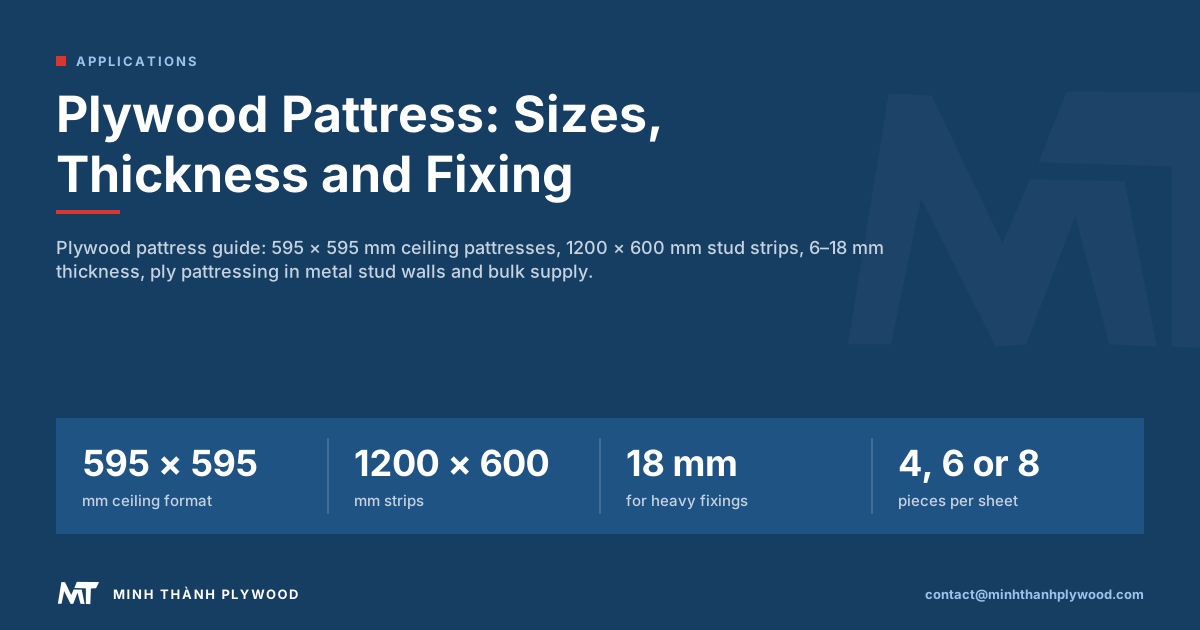
A plywood pattress is a board fixed inside a partition or above a ceiling so a heavy item has something solid to screw into. In metal stud walls it is usually 18 mm plywood between or across the studs; on suspended ceilings it is a 595 × 595 mm sheet of 6–12 mm plywood. Minh Thanh Plywood, a Vietnamese plywood manufacturer, covers sizes, fixing and supply.
What is a plywood pattress?
A plywood pattress is a plywood board built into a stud wall or laid on a ceiling so a heavy fixture has a solid fixing. Plasterboard alone holds light loads; a basin, a wall-hung toilet frame, a TV bracket, a grab rail or a ceiling speaker needs something stronger to screw into. The pattress takes that load and passes it to the studs or the ceiling grid.
The word has two meanings in UK building:
- Drylining pattress: plywood or timber fixed inside a partition before the boards go on. This is what this guide covers.
- Electrical pattress: the back box behind a socket or switch. A plywood pattress is sometimes fitted behind it in a stud wall, which is where the two meanings meet.
A plywood pattress is cheap, invisible once the wall is finished, and very hard to add later without cutting the board out. That is why drylining specifications mark every pattress on the drawings.
Where are plywood pattresses used?
Plywood pattresses go wherever a fixture is heavier than plasterboard fixings can carry, or where it will be pulled, pushed or leaned on. Hospitals, schools, hotels and offices use them in hundreds per floor.
| Fixture | Usual pattress | Placement |
|---|---|---|
| Wash basin, vanity unit | 18 mm plywood | Bay-width, at bracket height |
| Wall-hung WC frame, cistern | 18 mm plywood or the frame maker’s rails | Behind the frame fixings |
| Grab rails, support rails | 18 mm plywood | Full length of the rail |
| TV and monitor brackets | 18 mm plywood | Across two or three studs |
| Wall cabinets, shelving | 12–18 mm plywood | Full width of the cabinet run |
| Radiators, towel rails | 18 mm plywood | At bracket positions |
| Handrails in corridors | 18 mm plywood strip | Continuous, at rail height |
| Ceiling speakers, lights, detectors | 6–12 mm plywood, 595 × 595 mm | On top of the ceiling tile |
Plywood pattress sizes: 595 × 595 mm and 1200 × 600 mm strips
The two standard plywood pattress formats are 595 × 595 mm squares for suspended ceilings and 1200 × 600 mm strips for stud walls. Both are cut from full sheets.
- 595 × 595 mm. Sized to drop into a 600 mm ceiling grid, on top of the tile, so a light fitting or speaker is screwed through the tile into the plywood rather than hanging on the mineral fibre.
- 1200 × 600 mm. A strip that spans a stud bay at 600 mm centres, or runs horizontally behind a row of fixtures. Cut shorter for single brackets.
- Custom lengths. Continuous strips behind a handrail or a long cabinet run, cut to the length of the run.
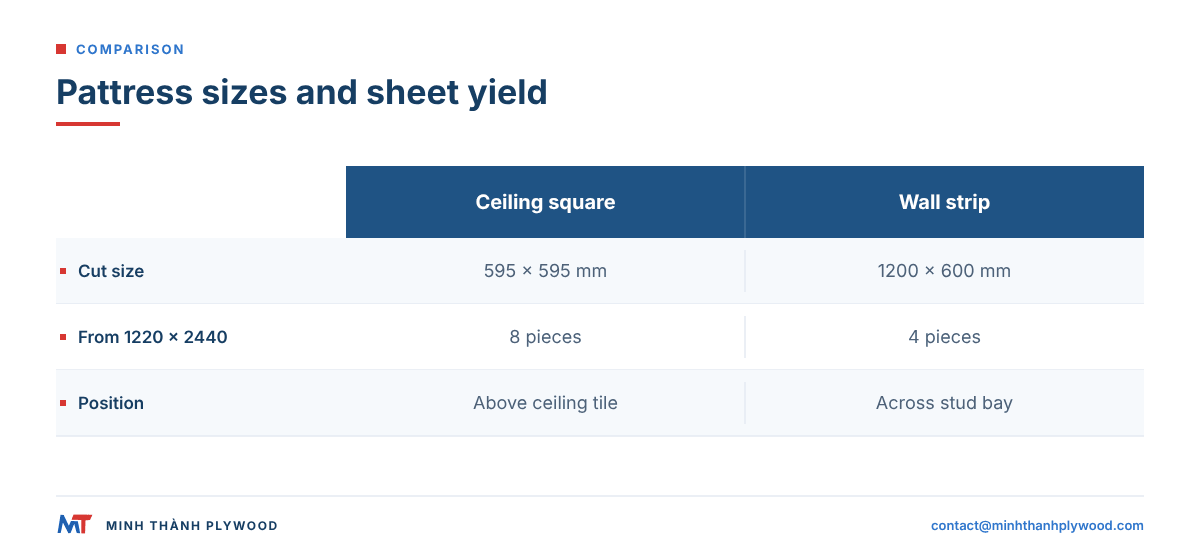
From a 1220 × 2440 mm sheet, eight pieces give 595 × 595 mm squares after trimming, and four pieces give 1200 × 600 mm strips. Cut-to-size supply of one panel into 4, 6 or 8 pieces is standard at our factory, so these formats ship ready to fit.
What thickness ply for a pattress?
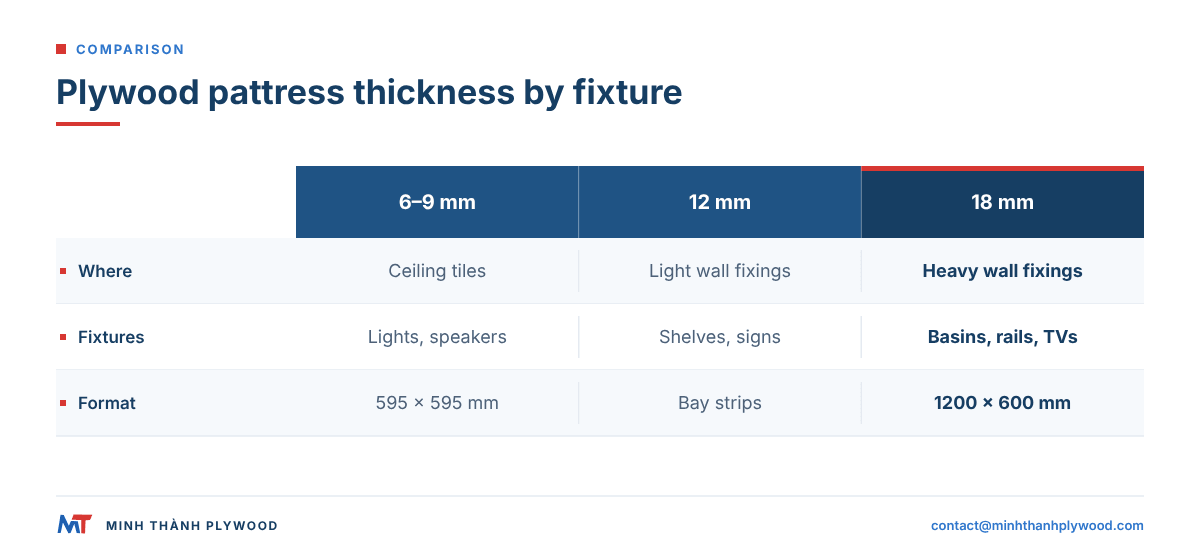
Use 18 mm plywood for wall pattresses that carry heavy or dynamic loads, 12 mm for lighter wall fixtures, and 6–12 mm for ceiling-tile pattresses. Thicker ply gives a screw more thread to grip and spreads the load further.
| Thickness | Typical use | Notes |
|---|---|---|
| 6 mm | Ceiling-tile pattress for light fittings, detectors | Lightest; sits on the tile without bowing it |
| 9 mm | Ceiling pattress for speakers, projectors on brackets | Better screw hold |
| 12 mm | Wall shelves, light cabinets, signage | Bay-width strips |
| 15 mm | Medium fixtures, where the stud depth is tight | Between 12 and 18 mm options |
| 18 mm | Basins, WC frames, grab rails, TVs, radiators | The default wall pattress |
The load a fixing carries comes from the whole system: the screw, the pattress, the studs and how they are fixed together. Use the partition maker’s load data for the tested detail and the fixing maker’s figures for the screw, and choose the pattress thickness that detail names.
Our pattress thicknesses are cut from panels made from 3–40 mm, with commercial thickness tolerance of ±0.5 mm and sanded panels to ±0.2–0.3 mm, so packs of pattresses lie flat and fit channels without packing.
Ply pattressing in metal stud partitions
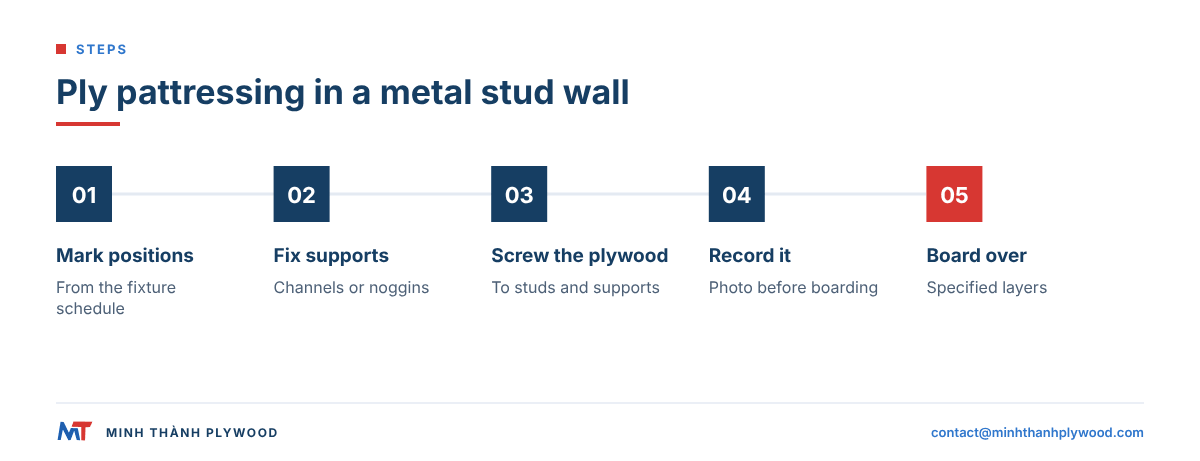
Ply pattressing in a metal stud partition means fixing plywood between or across the studs before the plasterboard goes on, at the positions marked on the drawings. There are three common methods, and the right one depends on the load, the stud gauge and the board thickness.
- Between the studs on channels. Horizontal fixing channels or noggin sections are screwed between the studs, and the plywood is screwed to them so its face sits flush with the stud face.
- Across the stud faces. The plywood is screwed to the face of two or more studs, and the plasterboard goes over it. This adds the ply thickness to the wall, so it suits areas where the whole wall is lined or the board is packed out.
- Notched into the studs. The plywood is set into the stud web so it lies flush. This takes more labour and is used where the wall line cannot move.
The general steps are the same in each case:
- Mark each pattress on the floor track from the fixture schedule.
- Fix supports (channels or noggins) at the top and bottom edges of the pattress.
- Screw the plywood to the supports and studs with self-tapping drywall or wafer-head screws.
- Record the position on a photo or drawing before boarding, so the fixer finds it later.
- Board over with the specified plasterboard layers.
How British Gypsum and other system makers detail pattresses
Drylining system makers such as British Gypsum publish pattress details for their partitions: which plywood thickness, how it is supported, which screws fix it and what load the fixing then carries. These details are part of the tested system, so a site that follows them keeps the partition’s performance.
Points those details usually cover:
- Plywood thickness and grade, most often 18 mm.
- Support method: fixing channel, service support plate or noggin, and its screw spacing.
- Board layers over the pattress and whether they are screwed into it.
- Fire and sound: whether the partition’s rated performance holds with the pattress in place.
Some system makers sell plywood pattresses pre-cut to their stud spacing, which is why drylining distributors stock pattress packs alongside studs and track. Distributors who import plywood in container loads can buy the same formats cut to size at the mill.
Plywood vs timber noggins for pattresses
Plywood is the better pattress material for wide or heavy fixtures; a timber noggin is enough for a single fixing point between two studs. Wooden pattresses in either form do the same job, but plywood spreads the load over a larger area and holds screws closer to its edge.
| Metric | Plywood pattress | Timber noggin |
|---|---|---|
| Fixing area | Full bay or wider | One line between two studs |
| Screws near edges | Holds well, cross-laminated veneers resist splitting | Splits near ends |
| Flatness | Flat, consistent thickness | Can twist and cup |
| Moisture movement | Small in both directions | Shrinks across the grain |
| Speed to fit | One board per bay | Several noggins per fixture |
| Typical cost per fixture | Higher material, lower labour | Lower material, higher labour |
Timber pattresses made from solid softwood are still used in timber-frame houses, where the noggin is nailed between studs. In metal stud partitions, plywood is the norm because it screws cleanly to steel and needs no notching.
Plywood pattress fire and moisture rules
For UK fire-safety coordination, Approved Document B covers fire safety in England.
A plywood pattress inside a fire-rated or acoustic partition must follow the system maker’s detail to keep the rated performance. Plywood is combustible, so its size, position and the board layers over it decide whether the wall still meets its rating.
- Fire-rated walls: use the pattress detail named in the partition maker’s fire data; do not cut away board layers to fit a thicker pattress.
- Acoustic walls: keep the pattress off the opposite face so it does not bridge the two sides.
- Wet areas: in bathrooms, kitchens and plant rooms, use plywood with a phenolic (WBP) bond, sealed on its cut edges.
For wet rooms, the wood panels for bathroom walls guide explains bond classes in detail. Our pattress plywood can be made with melamine-fortified (MR) or phenolic (WBP) glue to the buyer’s specification.
Plywood pattresses on suspended ceilings
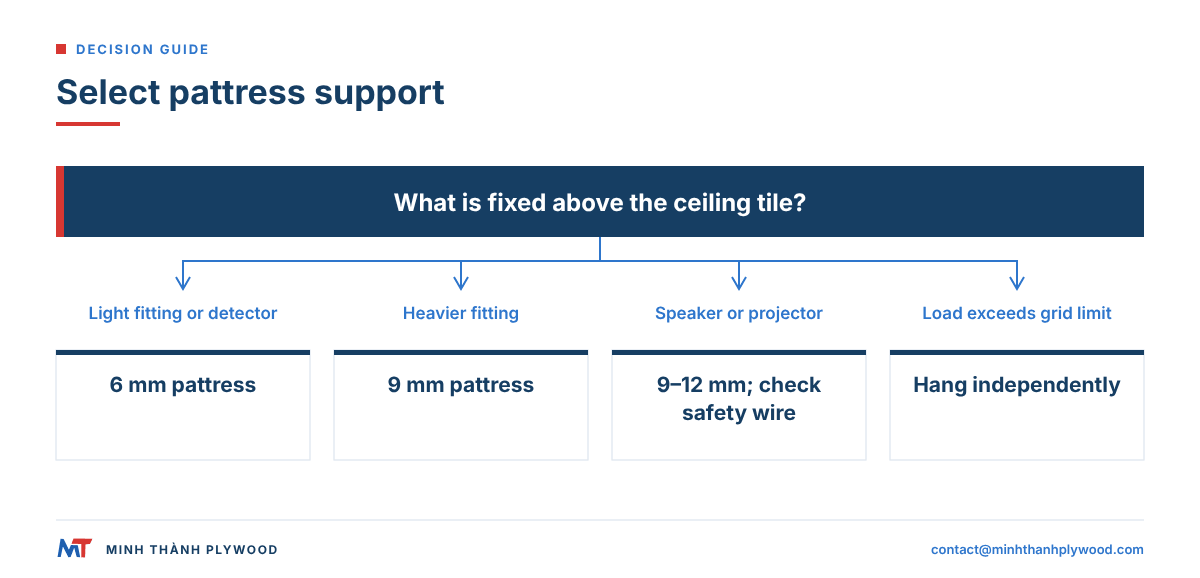
On a suspended ceiling, a plywood pattress sits on top of the ceiling tile inside the grid, so a fitting screwed from below is held by the plywood. The 595 × 595 mm format fits a 600 mm grid; plywood of 6–12 mm keeps the weight on the grid low.
- Grid fit: the 595 × 595 mm pattress suits 600 × 600 mm tiles on both 15 mm and 24 mm T-bar grids, because it sits on top of the tile and not in the grid profile. For 1200 × 600 mm tiles, the matching size is 1195 × 595 mm.
- Light fittings and detectors: 6 mm plywood is enough for most surface-mounted fittings; 9 mm is the next step for heavier ones.
- Speakers and projectors: 9–12 mm plywood, with the fitting’s own safety wire to the soffit where the maker requires it.
- Weight on the grid: check the grid maker’s limit per tile, and hang heavier items independently.
Quantity and price against a retail pack
Count one pattress per fitting and add 10% for waste and breakage. A project with 120 downlights and detectors needs 132 pieces. At retail, a 595 × 595 × 6 mm plywood pattress costs about £6.23 each from Judge Ceilings, with a minimum of 4 (read 21 October 2026). A distributor that buys the same formats cut from 1220 × 2440 mm sheets by the container works from the material price, so the margin on a retail pack of 4 is the gap between the two.
Pattresses also come as blank, round, square and rectangle shapes: Pattresses Direct lists all four. Round holes and shaped blanks are cut from the same sheet to the drawing.
For full plywood ceilings rather than pattresses, see the guide to plywood for ceilings.
Electrical pattress boxes and plywood backing
An electrical pattress box is the back box that holds a socket or switch; in a stud wall it is a dry-lining box clipped to the plasterboard. A plywood pattress behind it gives the box a solid fixing where the socket will be pushed and pulled often, such as in kitchens, hospitals and workshops.
- Socket and switch runs: a 12–18 mm plywood strip between studs at box height.
- Surface-mounted boxes on an uneven wall: a plywood backing board fixed first, then the box screwed to it.
- Data cabinets and consumer units: a full plywood backboard, usually 18 mm.
The same plywood strips can be stocked by electrical wholesalers as backing boards, in the same cut sizes as drylining pattresses.
Which pattress wood to use: the plywood specification
The best plywood for pattresses is a flat, calibrated commercial or EV-faced panel with a hardwood core that holds screws well. Appearance does not matter, because the pattress is hidden; flatness, thickness and screw holding do.
- Core: Eucalyptus or Acacia hardwood cores hold self-tapping screws firmly.
- Faces: utility or EV faces; our EV plywood is a common choice for its consistent face and flatness.
- Bond: UF glue at E0 emission for dry walls; MR or WBP for damp areas.
- Pressing: furniture-grade panels are pressed twice as standard, core first and calibrated, then faces, which keeps cut pieces flat.
- Moisture: dispatched at 8–12 % moisture content, so pieces do not cup after fitting.
- Chain of custody: UK drylining distributors often ask for proof of timber legality. We supply the EUDR compliance dossier (origin records and geolocation files) with orders. If your tender asks for FSC certified material, put it in the enquiry and we confirm the documents we can supply before you quote.
Checking a plywood pattress delivery on site
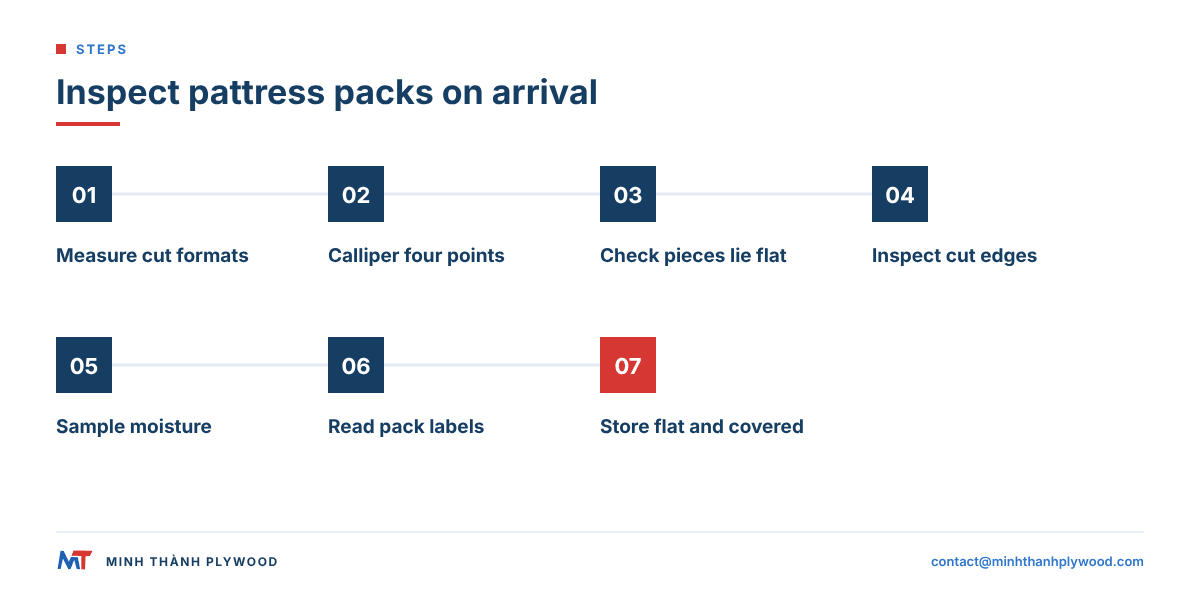
Check a plywood pattress delivery for format, thickness, flatness and moisture before the packs go up to the floors. A pattress that is thin, bowed or wet causes problems only after the board is on, when it is expensive to fix.
| Check | How | Accept when |
|---|---|---|
| Format | Tape across both diagonals of a few pieces | Square pieces match the ordered size and the diagonals are equal |
| Thickness | Calliper at four points per piece | Within the ordered tolerance, for example ±0.5 mm on 18 mm |
| Flatness | Lay a piece on a flat floor | Lies flat with no rocking corner |
| Edges | Look along the cut edges | Clean cuts, no open voids at screw lines |
| Moisture | Pin meter on a sample | Close to the site’s dry indoor conditions |
| Labels | Read the pack label | Format, thickness and bond match the order |
Store the packs flat, off the floor and under cover. Pattresses stored upright against a wall in a damp building bow, and a bowed pattress pushes the plasterboard out.
For distributors, the same checks belong in the incoming inspection when a container arrives. Every shipment from our factory is photographed and filmed before loading, so the pack labels and stacking can be checked against the photos before the container is opened.
Cut-to-size pattress supply in bulk
Drylining distributors buy plywood pattresses cut to size in bulk, packed by format, so each site gets the boards it needs without cutting. Minh Thanh Plywood cuts pattress formats from full sheets and packs them on pallets for container shipment.
- Formats: 595 × 595 mm, 1200 × 600 mm and custom strips; one panel cut into 4, 6 or 8 pieces.
- Thickness: 6, 9, 12, 15 or 18 mm.
- Minimum order: one 40HC, with mixed specifications by agreement.
- Production: 15–45 days after the 30% deposit; balance 70% against the scanned B/L, or an irrevocable L/C at sight.
- Terms: FOB Hai Phong, CFR or CIF; sea time to Northern Europe is typically 30–40 days.
A 40HC of 18 mm full sheets in 1220 × 2440 mm carries 880 sheets on Acacia core or 795 sheets on Eucalyptus core under a 28,000 kg payload. Cut pattresses ship in the same volume, packed by piece size. Every shipment is photographed and filmed before loading.
What to write on a plywood pattress order
A plywood pattress order should give the formats, thickness and packing line by line.
- Use: wall pattresses in metal stud partitions; or ceiling-tile pattresses.
- Format: 595 × 595 mm, 1200 × 600 mm or custom lengths, with quantity per format.
- Thickness: for example 18 mm, tolerance ±0.5 mm.
- Core and face: Eucalyptus or Acacia core; EV or utility faces.
- Bond: UF glue at E0 emission, MR or WBP.
- Packing: pieces per pallet, labels by format, number of 40HC containers and destination port.
We send free samples of the pattress formats before the order. Send the six lines to [email protected] or through our contact page; we reply within hours.
Buyer questions, answered
What is a plywood pattress?
A plywood pattress is a piece of plywood fixed behind plasterboard or above ceiling tiles to give heavy fixtures a solid fixing. It spreads the load of basins, TVs, grab rails, cabinets or ceiling speakers into the studs or grid.
What thickness ply for a pattress?
Use 18 mm plywood for wall pattresses carrying basins, cabinets, TVs or grab rails. Use 6–12 mm for ceiling-tile pattresses under lights and speakers, and 12 mm for light wall fixings such as shelves.
What is plywood pattressing?
Ply pattressing is the drylining trade's term for fitting plywood pattresses in a stud partition before the boards go on. Each pattress is marked on the drawings at the height and position of the fixture.
What size is a plywood pattress?
Ceiling pattresses are usually 595 × 595 mm to sit on a 600 mm grid tile. Wall pattresses are cut to fit the stud bay, commonly 1200 × 600 mm strips or lengths cut to the fixture width.
Is plywood or timber better for a pattress?
Plywood resists splitting, holds screws close to its edges and comes flat and dry in wide sheets. A timber noggin works for a single fixing point between two studs, but a plywood pattress covers a wider area.
Does a plywood pattress affect fire rating?
It can. Fire-rated partitions keep their rating only when the pattress is fitted to the system maker's tested detail, so follow the partition maker's pattress detail and its fire data.
How is a plywood pattress fixed to metal studs?
It is screwed to the stud flanges with self-tapping drywall screws or wafer-head screws, either set between the studs on fixing channels or laid across the stud faces with the board over it.
Can plywood pattresses be bought cut to size?
Yes. Pattress boards are cut from 1220 × 2440 mm sheets; one sheet can be cut into 4, 6 or 8 pieces, so 595 × 595 mm and 1200 × 600 mm formats come from standard sheets with little waste.