
In short, the Vietnam plywood price in October 2026 starts from US$250/m³ for commercial plywood and from US$350/m³ for furniture/interior plywood at Minh Thanh Plywood, FOB Hai Phong. To get a sheet price, multiply the quoted rate by the sheet volume: an 18 mm 1220 × 2440 mm sheet is 0.0536 m³. Face, core, glue, thickness, size, quantity and delivery term set the final quote.
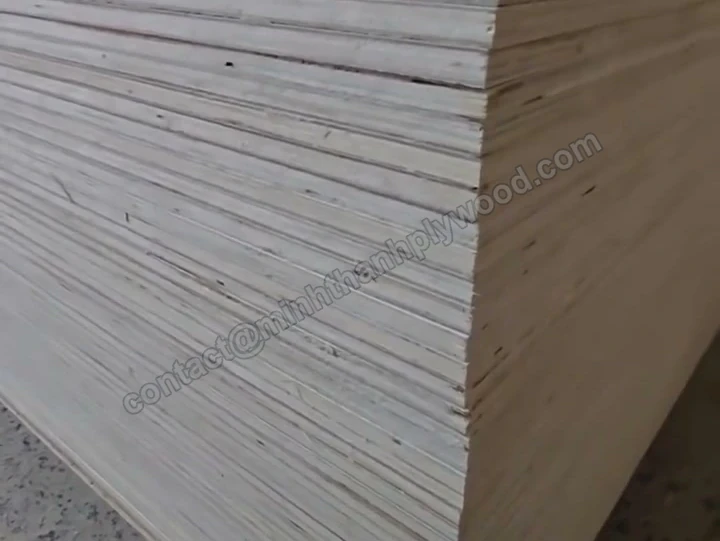
Which Vietnam plywood price is useful for a purchase decision?
The useful price is the executable quotation for the board your workshop will accept. Minh Thanh’s commercial and furniture starting references establish different product tiers; the order quotation fixes the construction and delivery basis. Start with the plywood price guide if your purchasing team needs the general sheet and landed-cost framework.
A national average mixes products that cannot replace each other. Birch-faced furniture panels, utility commercial boards and concrete forming panels contain different veneers and processing. Comparing those prices without their specifications rewards the cheapest description rather than the right board.
A buying file should connect the quotation to a drawing, a physical sample and a receiving checklist. The face acceptance agreed by the furniture maker must be the face acceptance purchased by the importer. That connection makes a revised price intelligible: procurement can see whether the rate changed or the ordered product changed.
Keep the original currency, quotation date and validity alongside the specification. Use a separate column for conversion into your accounting currency. A current exchange-rate calculation should not overwrite the factory’s quoted amount, because accounts payable will need to reconcile the contract with the deposit and balance payment.
What are Minh Thanh’s dated starting prices?
The October 2026 references are commercial plywood from US$250/m³ and furniture/interior plywood from US$350/m³, FOB Hai Phong. They are the floor of each tier; face, core, glue, thickness, size, quantity and delivery term move the final price up from there.
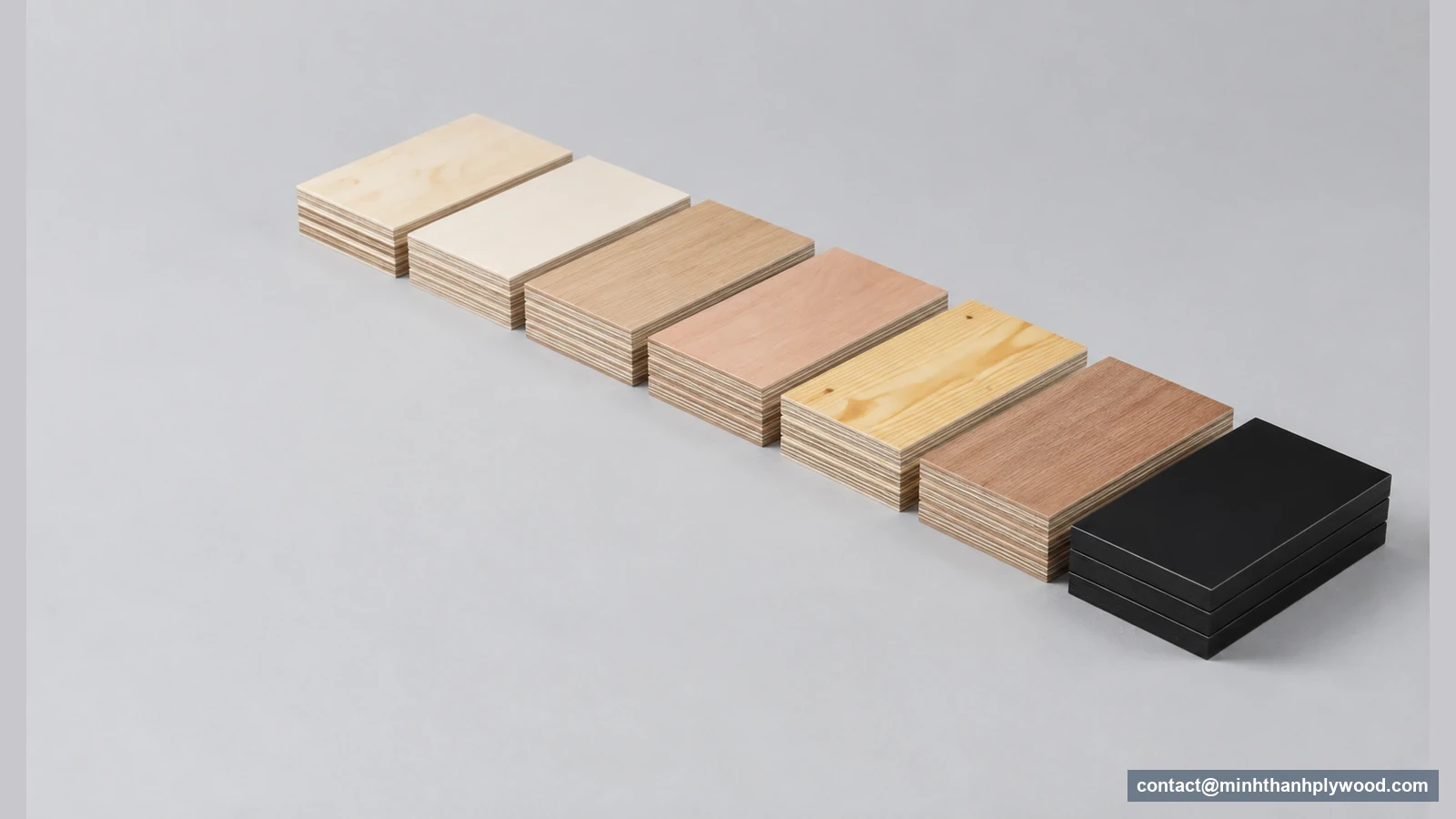
| Product tier | October 2026 reference | Fields that fix the order |
|---|---|---|
| Commercial plywood | From US$250/m³ | Face/back, core, bond, dimensions, appearance and intended use |
| Furniture/interior plywood | From US$350/m³ | Face/back acceptance, stitched core, calibrated thickness, sanding and emissions |
The two rows are different products: furniture panels carry a graded face, stitched core, double pressing and calibrated thickness. A pine face and an engineered veneer face also need their own quotations, even when the dimensions match.
For a repeat order, send the previous specification revision with the new quantities. Ask the quotation to identify any changes to construction or preparation in plain terms. Keep the approved sample reference on the purchase order so receiving staff do not have to reconstruct the product from email descriptions.
Minh Thanh manufactures furniture and interior panels in Ha Hoa, Phu Tho, using locally grown plantation timber for cores. Stitched cores and double pressing belong in the furniture comparison because they affect the board the workshop receives. They are concrete production features, separate from a generic claim that one country always costs less.
Vietnam plywood FOB price ranges by glue and type
Vietnamese commercial plywood trades at about US$250–300/m³ FOB with MR glue, US$260–315/m³ with melamine glue and US$350–400/m³ with phenolic glue, and film-faced plywood at about US$280–450/m³ by film and core, on ranges a Hanoi exporter published on 8 December 2025. Across all types, Vietnamese plywood runs from about US$220 to US$600 per m³ FOB Hai Phong.
| Product and build, 1220 × 2440 mm | FOB range, US$/m³ | Source |
|---|---|---|
| Commercial plywood, MR glue | 250–300 | Kosmex |
| Commercial plywood, melamine glue | 260–315 | Kosmex |
| Commercial plywood, phenolic glue | 350–400 | Kosmex |
| Film-faced, low-density film, hand-jointed core, melamine glue | 280–300 | Kosmex |
| Film-faced, high-density film, composer-jointed core, melamine glue | 350–380 | Kosmex |
| Film-faced, high-density film, composer-jointed core, phenolic glue | 400–450 | Kosmex |
| All Vietnamese plywood types | 220–600 | Fomex |
| Minh Thanh commercial plywood | from 250 | Minh Thanh Plywood, October 2026 |
| Minh Thanh furniture/interior plywood | from 350 | Minh Thanh Plywood, October 2026 |
Read the gaps as the cost of each upgrade. On those published ranges, melamine glue adds about US$10–15/m³ over MR, and phenolic glue about US$35–50/m³. Film-faced panels move with film weight, from about 90 to 180 g/m², and with the core joining: a composer-jointed core with no overlaps or gaps costs more than a hand-laid one and lasts more pours. Minh Thanh’s core layers are stitched horizontally and vertically, so its film-faced and furniture panels are quoted on that build.
Vietnam plywood price per sheet by thickness
At Minh Thanh’s October 2026 starting rates, one 1220 × 2440 mm sheet works out to about US$13.40 at 18 mm for commercial plywood and about US$18.76 for furniture plywood, as raw FOB examples. A per-sheet figure is the rate per m³ times the sheet’s volume; it is never a sheet price until the build is fixed.
| Thickness, 1220 × 2440 mm | Volume per sheet | Commercial, from US$250/m³ (raw FOB example) | Furniture/interior, from US$350/m³ (raw FOB example) | A published Vietnamese list, 1222 × 2440 mm, B/C |
|---|---|---|---|---|
| 9 mm | 0.0268 m³ | about US$6.70 | about US$9.38 | US$5.20–5.50 |
| 12 mm | 0.0357 m³ | about US$8.93 | about US$12.50 | US$6.70–7.00 |
| 15 mm | 0.0447 m³ | about US$11.18 | about US$15.65 | n/a |
| 18 mm | 0.0536 m³ | about US$13.40 | about US$18.76 | US$10.00–10.30 (A/B: US$10.90–11.10) |
The last column is the per-sheet list HG Plywood publishes, valid 60 days (HG Plywood, plywood prices 4x8). Its 18 mm B/C sheet at US$10.00–10.30 works out to about US$186–192/m³ (÷ 0.0537 m³), below the commercial MR range above, which points to a utility or packing build. Before you set a list like that beside a furniture quote, ask for the core species, glue, ply count and thickness tolerance. A sheet that measures 17 mm, or a core with gaps, is cheaper for a reason the price list does not print.
How have Vietnam plywood prices and exports moved?
Vietnamese plywood exports grew from about US$714 million in 2020 to about US$1 billion in 2022, with the United States the largest buyer at 36%, and Vietnam’s wood and wood-product exports reached a record of about US$17.2 billion in 2025, up nearly 6% on 2024. Prices moved in a narrow band over the same period, led by veneer and resin costs.
| Year | Figure | Source |
|---|---|---|
| 2016–2020 | Plywood exports up 2.5 times, to US$714 million in 2020 | Fomex |
| 2022 | HS 4412 exports about US$1 billion; United States 36%, about US$363 million | Trend Economy |
| December 2025 | Veneer prices rising after heavy rain and flooding in raw-material regions; mild price adjustments expected | Kosmex |
| 2025 | All wood and wood products about US$17.2 billion, up nearly 6% | Viet Nam News, January 2026 |
| October 2026 | Minh Thanh starting prices: commercial from US$250/m³, furniture/interior from US$350/m³ | Minh Thanh Plywood |
Two things move a Vietnamese quote in the short run: the veneer log price after the rainy season and the resin price, which follows oil and urea. Freight and currency move the landed price on top. A buyer who books a full 40HC on an approved sample and a written specification sees those changes clearly from one quote to the next.
How do you normalize the face and core before comparing quotes?
Normalize the face/back and complete core construction as separate fields. A birch-faced board identifies its outer veneer; it does not identify the interior plies. Minh Thanh’s standard furniture cores are Styrax or Eucalyptus, so compare them with the named core on the alternative offer.
Record appearance on both sides. A visible cabinet side and a hidden back do not require identical face acceptance. Buying the correct face/back pair lets you protect the visible finish without paying for unused appearance on the reverse. State which side the factory should treat as the finished face.
A cutting trial gives the core description practical meaning. Saw an edge used by the actual component, inspect the exposed plies, then try the intended fastening operation. Keep photographs of the cross-section and any rejected parts with the sample reference. A face-only sample leaves those production questions unanswered.
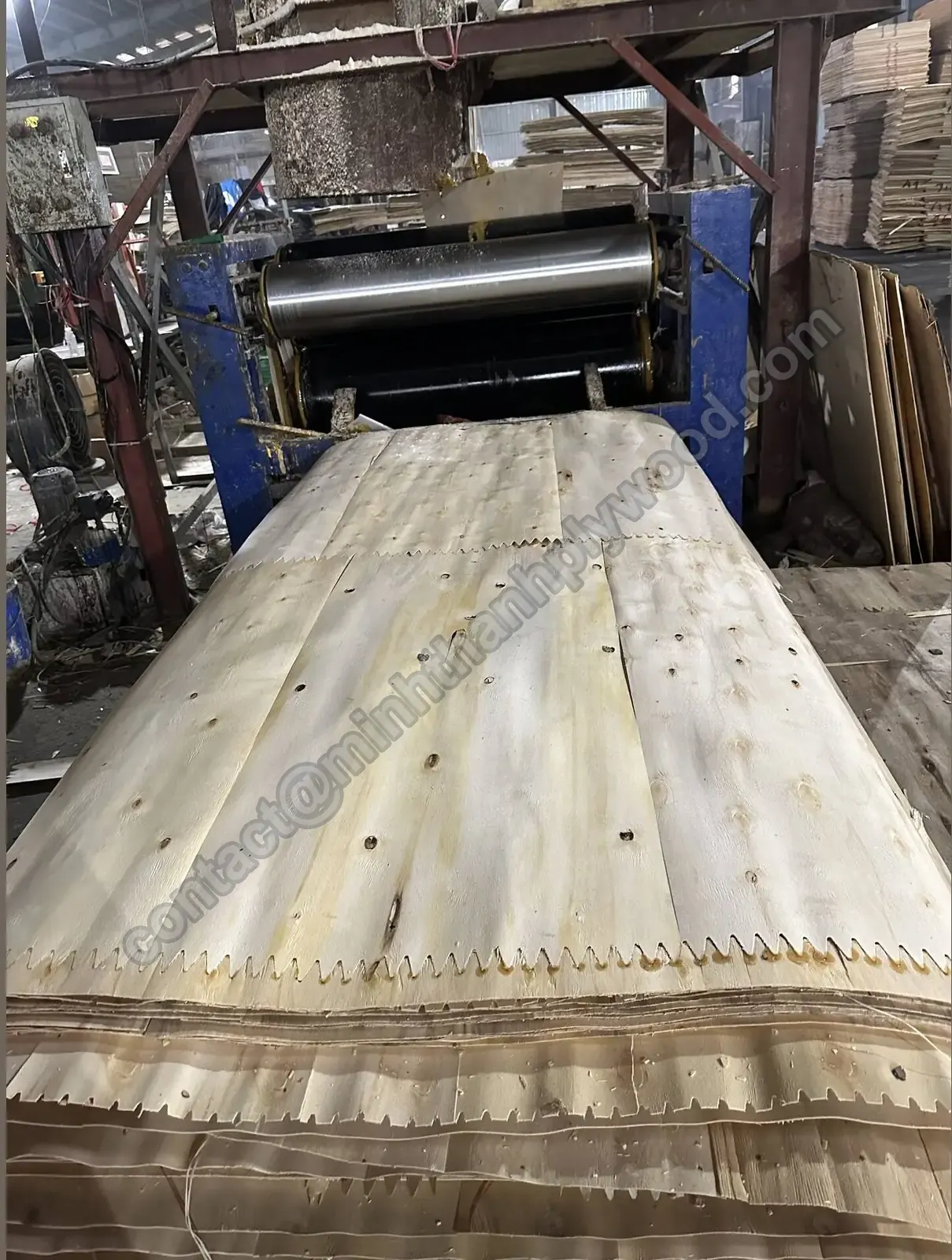
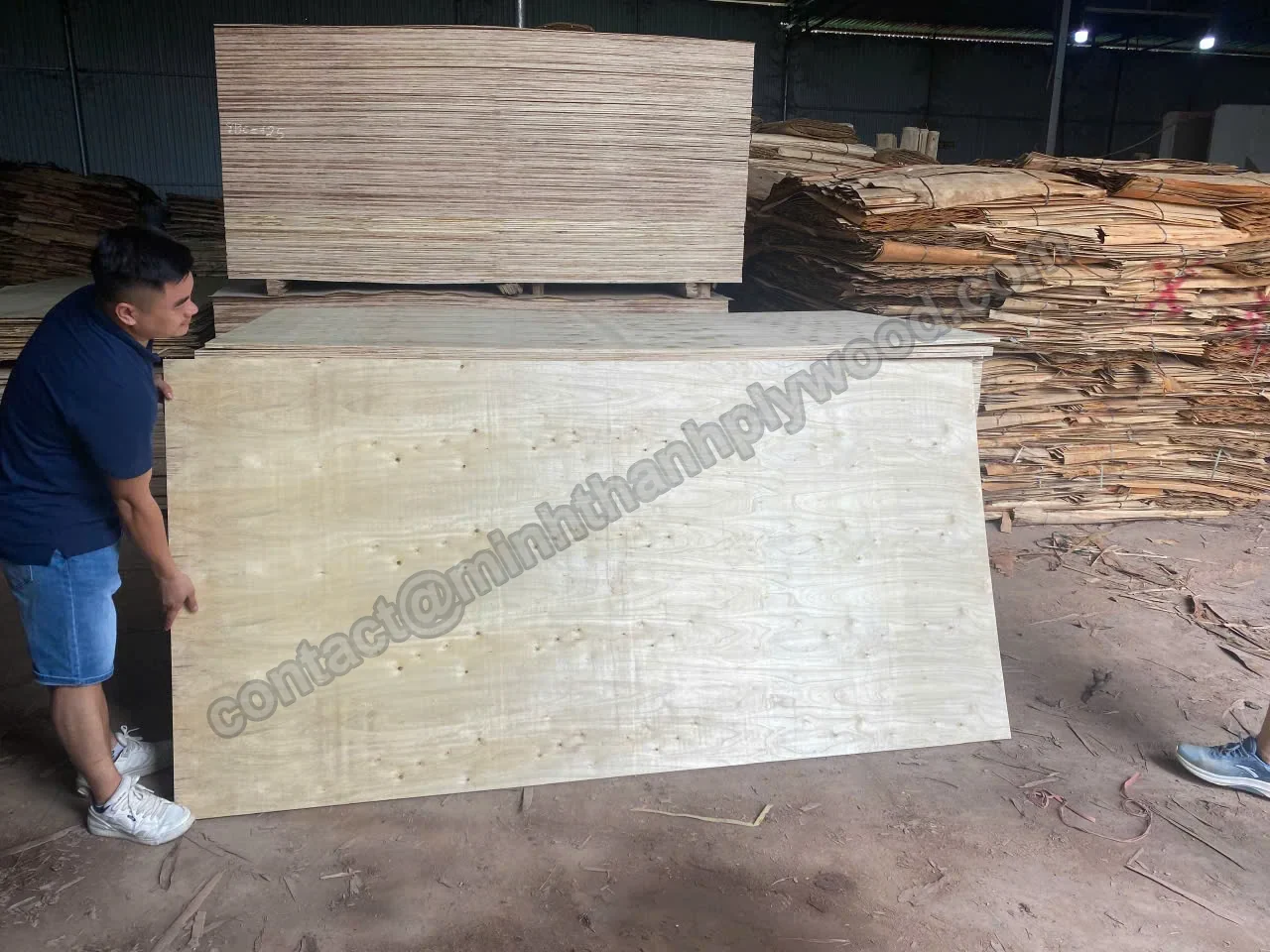
The composer photograph shows core preparation before the decorative face is applied. Core joining affects what the cutter encounters inside the board. Use the furniture plywood specifications to choose a construction, then price it against a panel with the same intended job.
Which manufacturing steps earn their cost in furniture production?
Core calibration, double pressing and final sanding earn their cost when they raise accepted output in your workshop. Minh Thanh presses the furniture core first, calibrates it, then applies face and back in a separate press. That process supports the flat prepared surface buyers need for furniture components.
Write surface preparation as an order requirement. A board described only as sanded leaves the workshop to decide whether another pass is necessary before finishing. A UV-ready face is prepared for the buyer’s own UV coating process; include that coating process in the trial so the surface is evaluated under the finish actually used.
For an EV plywood exporter Vietnam price comparison, include the approved decorative appearance and the finishing route. The veneer description alone leaves colour acceptance, sanding marks and visible repair allowance open. Trial a finished component, not merely an unfinished sheet held under warehouse lighting.
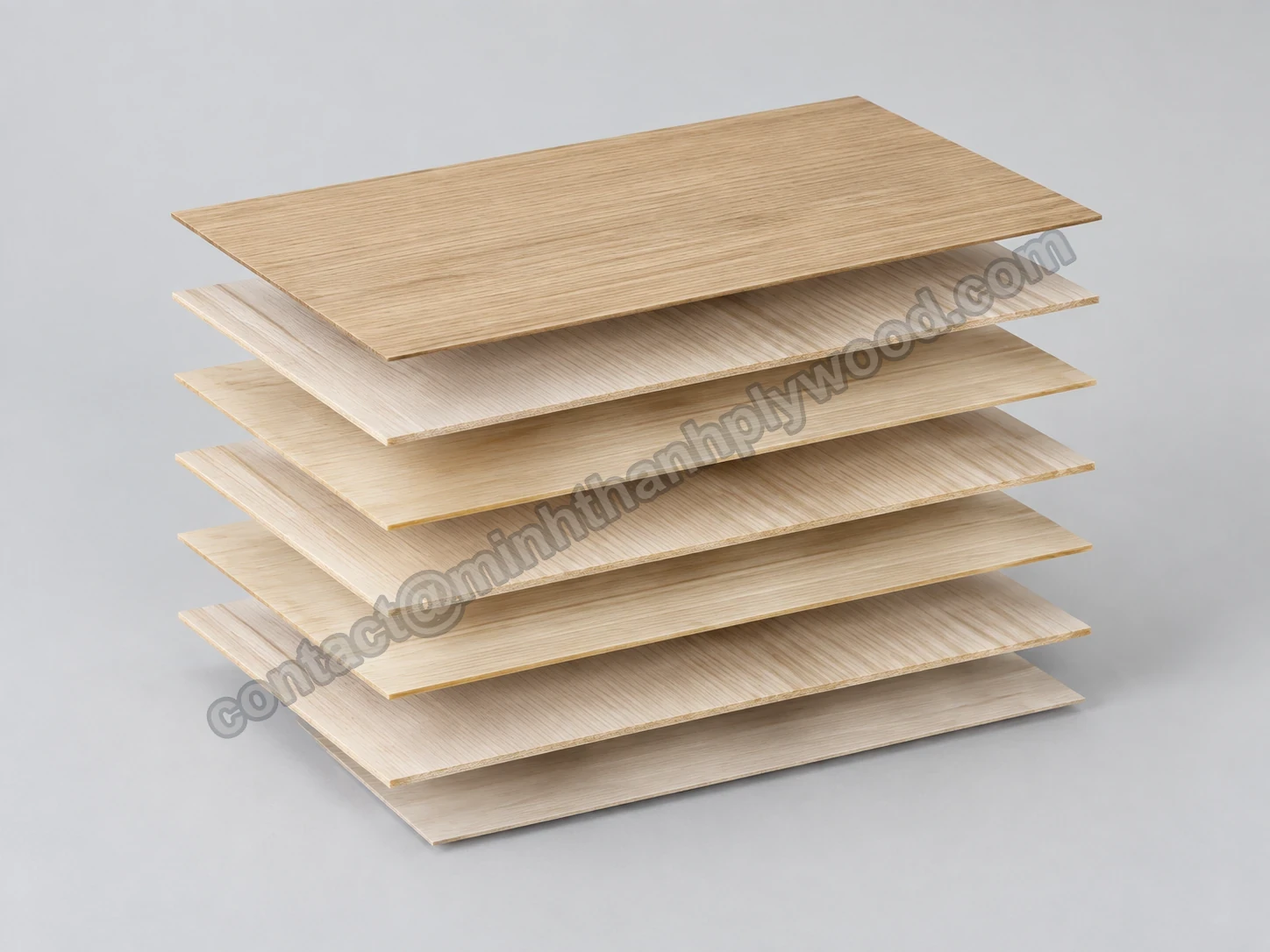
Cost the operations the supplied panel replaces. If the incoming board removes an extra calibration or sanding pass, record that saved work in the component calculation. If the workshop still performs the same operations, keep the claimed saving out of the purchasing budget. The supplier earns the premium through observed output.
How do you turn a plywood price per CBM Vietnam quote into a sheet price?
Multiply the price per m³ by the sheet volume in m³: rate × length × width × thickness, all in metres. CBM and m³ are the same unit. An 18 mm 1220 × 2440 mm sheet holds 0.0536 m³, so its sheet price is your quoted US$/m³ × 0.0536. Apply that formula to the rate on your own quotation; the volumes for common thicknesses are below.
| Thickness, 1220 × 2440 mm | Volume per sheet | Sheets per m³ | 40HC plan, Styrax core |
|---|---|---|---|
| 9 mm | 0.0268 m³ | 37.3 | 1,998 sheets |
| 12 mm | 0.0357 m³ | 28.0 | 1,494 sheets |
| 15 mm | 0.0447 m³ | 22.4 | 1,188 sheets |
| 18 mm | 0.0536 m³ | 18.7 | 990 sheets, about 53 m³ |
The container column comes from our 40HC plan at 28,000 kg payload. A buyer who compares two offers per sheet must also compare them per m³, because a thinner real thickness lowers the sheet price without lowering the rate.
Minh Thanh supplies standard formats including 1220 × 2440 mm and 1250 × 2500 mm. Compare them using your cutting layout as well as panel volume. A larger sheet can reduce a particular offcut while increasing handling work or changing pack dimensions. The cutting plan resolves that tradeoff better than a sheet-price comparison alone.
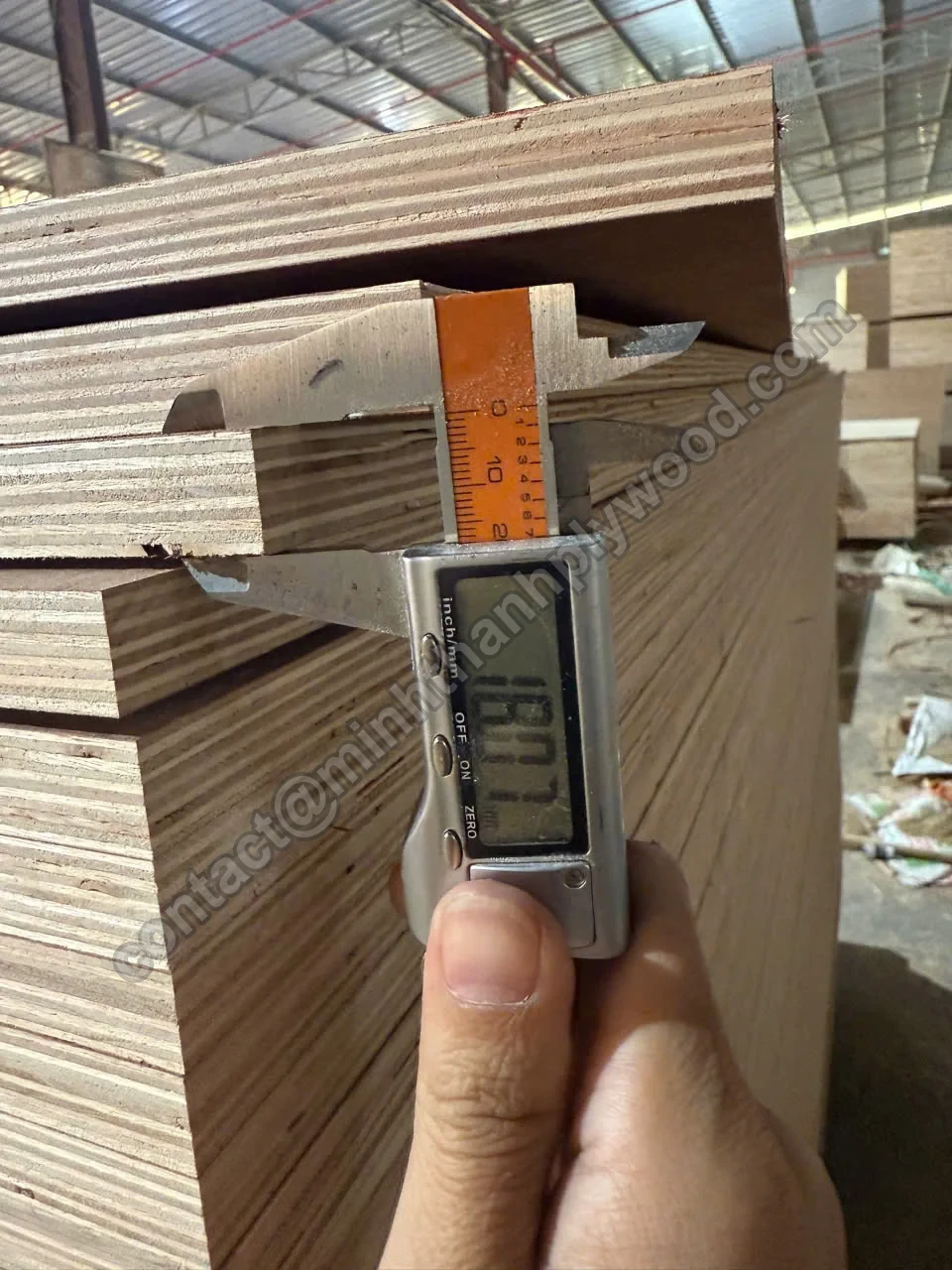
State thickness tolerance separately from nominal thickness. Furniture panels are supplied down to ±0.2 mm tolerance; a groove or hardware system may use that consistency in a way that a utility crate does not. Choose the tolerance needed by the component and carry it into the inspection instruction.
Measure sample thickness at several positions rather than comparing one edge reading. Keep the instrument and measurement method consistent across alternatives. Where the board goes through calibration in your own plant, record both incoming and final dimensions so the material-removal cost remains visible.
What does a CIF plywood price Vietnam quote include compared with FOB?
The delivery term decides which transport costs sit inside the quote. Minh Thanh quotes FOB Hai Phong, CFR or CIF. Typical days at sea from Hai Phong are 25–35 to the Mediterranean, 30–40 to Northern Europe and 20–30 to the US West Coast. Keep the named port on every comparison line and use the same Incoterms edition in the contract.
A CIF plywood price from Vietnam includes the goods, loading at Hai Phong, ocean freight and marine insurance to the named destination port; FOB stops when the goods are on board in Hai Phong. Under FOB, the buyer arranges the main carriage. CFR adds seller-arranged freight to the named destination port; CIF adds seller-arranged freight and insurance. A port-based price still needs the destination clearance, handling and inland delivery plan that gets the panels to the workshop.
The ICC overview of Incoterms 2020, consulted 8 October 2026, explains why cost allocation and delivery risk are separate contract questions. Review both in the purchase file. The point where freight is paid through need not be the point where shipment risk transfers.
For a CIF plywood price Vietnam comparison, obtain the destination charge schedule from the forwarder handling the receipt. Put it beside the named port, currency and shipment period. Ask for the assumptions behind time-based charges, so a lower ocean freight line does not conceal a receiving plan the warehouse cannot execute.
How do you calculate cost per usable component?
Calculate component cost from the delivered sheet cost divided by accepted output, then add the workshop operations. Accepted output means parts that meet the drawing and appearance requirements. Offcuts that remain usable for another planned part can be credited separately.
Begin with the nesting diagram, including grain direction and the finished face. Saw kerf, edge trimming and decorative matching belong in the layout. Counting rectangles on a sheet without those requirements overstates the useful yield, especially on exposed furniture parts.
Run a sample batch through machining and finishing. Record accepted parts, rejected parts, processing time and the reason for rejection. A void exposed by a groove and a sanding defect visible under lacquer represent different costs, so keep them separate rather than recording an unexplained waste total.
Compare alternatives using the same component drawing and inspection standard. The board with the lowest delivered sheet price wins only if its accepted output and processing costs support that result. This is a practical route to reduce cost of importing plywood from Vietnam to the EU without weakening the product specification.
What do emission and origin documents add to a buying file?
Emission evidence and origin records let the buying team evaluate the specified panel alongside its physical sample. Minh Thanh holds CARB P2 / TSCA Title VI certification, ICTT mill no. 23024, and supplies the EUDR compliance dossier with orders. The rules behind them are the CARB composite wood products program, TSCA Title VI and the EU deforestation regulation. The dossier includes origin records and geolocation files.
Keep bond and emission requirement on separate RFQ lines. UF glue at E0 emission identifies a resin and an emission specification; E0 is not the name of an adhesive. A furniture buyer choosing a bond for the working environment still needs the emission evidence required by its procurement programme.
Use quality documentation to identify the relevant proof for the order. Third-party testing to the buyer’s method can be arranged through SGS on request. Assign time for reviewing that evidence before the shipment is needed, alongside sample approval and production planning.
A buyer searching for EUDR compliant plywood Vietnam cost should include document handling in the sourcing plan. Give the review task an owner and a completion point. That planning is more useful than inventing a standard document surcharge or treating a dossier as a separate product certificate.
How should you plan packing and freight allocation?
Allocate freight to the actual shipment plan, including pack protection and cargo mass. The rate per container becomes useful only after the factory has laid out the ordered specifications. Minh Thanh’s MOQ is one 40HC, and mixed specifications are arranged with the factory.
Core selection affects both the board and its transport mass. A heavier construction changes the number of sheets that can be carried under the booked cargo limit. Keep measured panel and packaging weights in the loading calculation, rather than dividing container volume by sheet volume and calling the result a deliverable load.
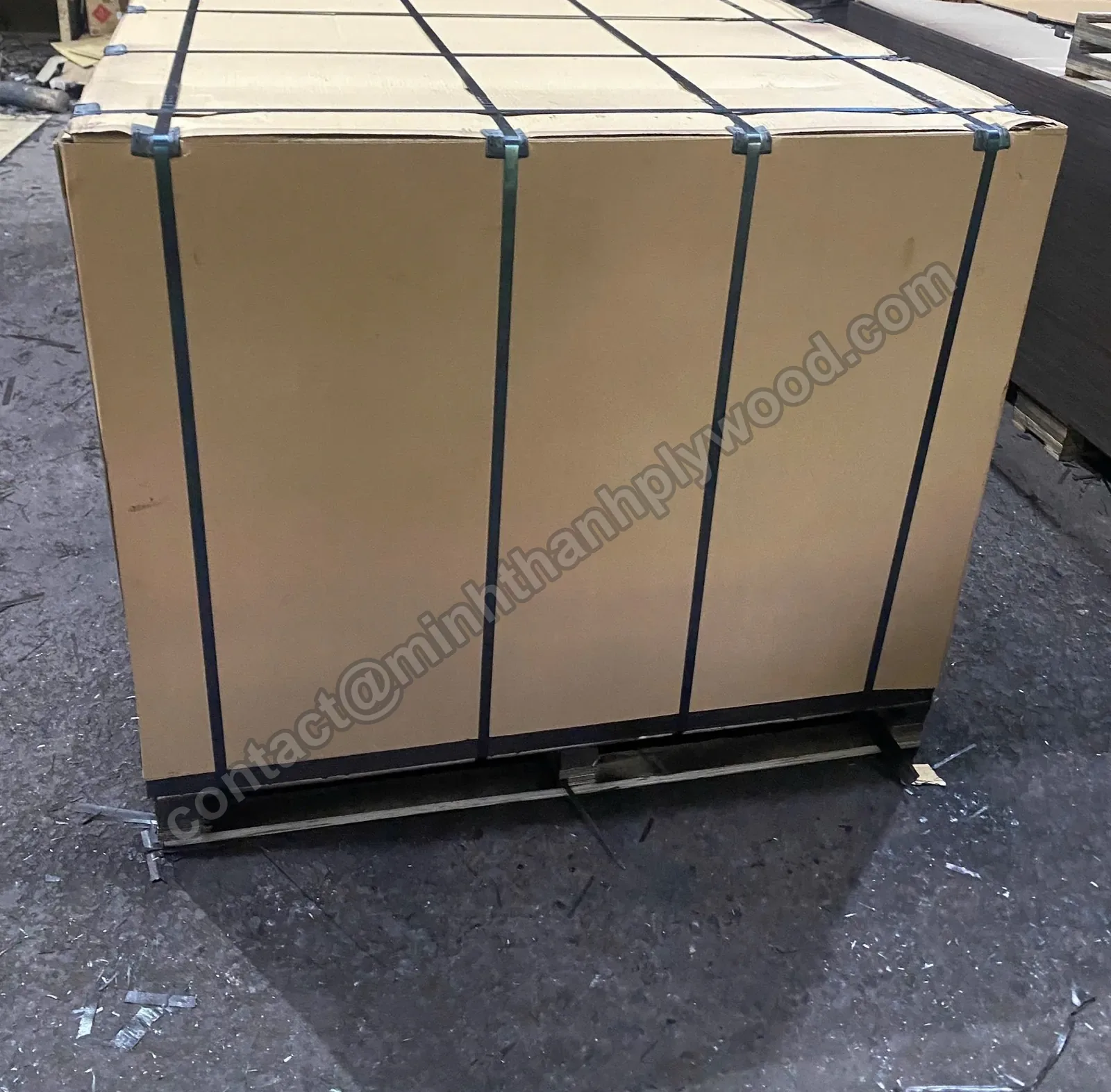
Protect the prepared furniture face during transport and receiving. Pack protection, strap placement and clear specification identification reduce unnecessary opening and handling. Ask the warehouse how it will unload, support and separate the packs before finalizing the packing instruction.
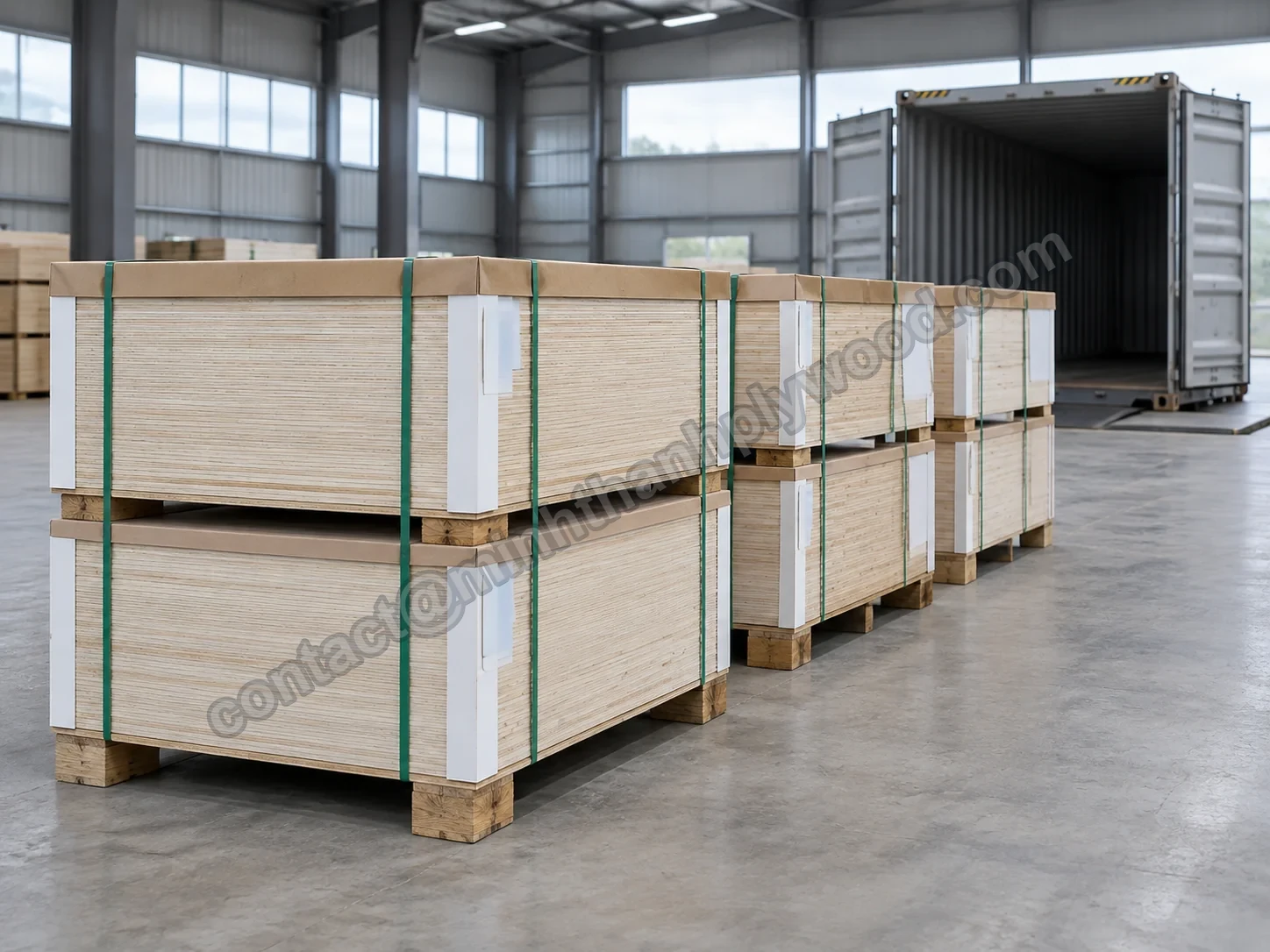
Minh Thanh photographs and films shipments before loading and sends buyers the photos and video. Use those records to connect the packing list with the physical cargo. Receiving staff can then check the arrival against the same pack schedule used at dispatch.
What moves a Vietnam plywood quote up or down?
Seven fields move a Vietnam plywood quote above the from-price. Hold them constant across suppliers and the price comparison becomes real.
| Field | Lower in the quote | Higher in the quote |
|---|---|---|
| Face/back | Utility pair such as C/D or B/C | Matched furniture pair such as birch D+/D or pine A/B |
| Core | Commercial mixed core | White Styrax or Eucalyptus core, stitched and calibrated |
| Bond | Standard UF glue (E1/E2) for dry interior | UF at E0 for furniture, melamine-fortified (MR) for humid rooms, phenolic WBP for exterior and film-faced |
| Thickness and plies | Mid thicknesses such as 12–18 mm | Thin panels (3–6 mm), which use more faces and glue lines per m³ |
| Film-faced | Lighter film, fewer reuses | Heavier film, more pours per panel |
| Preparation | Standard sanded face | UV-ready face, ±0.2 mm calibration, cut-to-size |
| Order and term | Full 40HC of one specification, FOB Hai Phong | Many small lines, CFR or CIF to your port |
The face/back pair and the core decide most of the gap between the commercial and furniture tiers. Eucalyptus is denser than Styrax (650 against 500 kg/m³ reference density), so an Eucalyptus-core 40HC carries 795 sheets of 18 mm against 990 on Styrax, which raises freight per sheet.
Volume works in the buyer’s favour. One 40HC is the MOQ, with mixed specifications by agreement; a container of a single specification packs and presses most efficiently. Repeat orders on an approved sample keep the specification stable, so a new quote compares directly with the last one.
Production runs 15–45 days after the 30% deposit, with the 70% balance against the scanned B/L or an irrevocable L/C at sight.
How do you request a comparable export quotation?
Send a complete product schedule and the receiving destination so Minh Thanh can quote the ordered panel and transport basis. One line per specification makes the response easier to compare with existing supply. Attach the component drawing or nesting plan where it defines appearance or dimensions.
Include application, face/back pair, core, bond and emission requirement, nominal thickness and tolerance, sheet or cut size, surface preparation, sheet quantity and packing. Add the required receiving period, delivery term and destination port. Identify the sample or previous order revision when the new purchase is a repeat.
For a single face, the eucalyptus faced plywood Vietnam price article works through the same method. For the general sheet and landed-cost framework, use the plywood price guide.
Request a quotation or email [email protected] with the schedule. Minh Thanh provides free samples. The quotation can then show the exact product, quantities and delivery basis your purchasing team needs to approve.
Buyer questions, answered
What is the price of plywood in Vietnam?
Minh Thanh's October 2026 references are commercial plywood from US$250/m³ and furniture/interior plywood from US$350/m³. Obtain an order quotation for the actual face/back, core, bond, dimensions and delivery term. The starting references describe product tiers rather than a national average.
How do I compare plywood price per CBM in Vietnam?
CBM means cubic metre, written m³. Compare quotations for the same face/back grade, core construction, bond, thickness tolerance and preparation, using the same delivery point. Convert each rate into sheet cost and then accepted component cost.
Can I get a Vietnam plywood price list for all thicknesses?
At Minh Thanh's October 2026 starting rates, a 1220 × 2440 mm sheet works out to about US$6.70 at 9 mm, US$8.93 at 12 mm and US$13.40 at 18 mm for commercial plywood, and about US$9.38, US$12.50 and US$18.76 for furniture plywood, as raw FOB examples. The order quote fixes the price for your face, core, glue and tolerance.
How much does phenolic or melamine glue add to a Vietnam plywood price?
On ranges a Vietnamese exporter published in December 2025, commercial plywood costs about US$250–300/m³ FOB with MR glue, US$260–315/m³ with melamine glue and US$350–400/m³ with phenolic glue: about US$10–15/m³ more for melamine and US$35–50/m³ more for phenolic.
What is the price of film-faced plywood in Vietnam?
Vietnamese film-faced plywood was quoted at about US$280–300/m³ FOB with low-density film, a hand-jointed core and melamine glue, US$350–380/m³ with high-density film and a composer-jointed core, and US$400–450/m³ with phenolic glue, on ranges published in December 2025.
What does a Vietnam plywood FOB price cover?
A quotation marked FOB Hai Phong prices the agreed goods and seller obligations through delivery on board at that port. Add buyer-arranged main freight, insurance and destination costs to the import budget. Keep the named port and Incoterms edition on the purchase order.
Is a CIF plywood price from Vietnam a warehouse price?
CIF prices include seller-arranged freight and insurance to the named destination port. Import clearance, destination handling and inland delivery still need their own budget lines. Compare the total at the same receiving point as a local delivered offer.
What affects an EV plywood exporter Vietnam price?
An engineered veneer quotation reflects the decorative face, specified core, face/back acceptance, thickness, sanding and order volume. State the finished appearance and coating process in the RFQ. Compare trial components from each construction rather than deciding from veneer names alone.
What is the cost of EUDR compliant plywood from Vietnam?
Minh Thanh supplies the EUDR compliance dossier, including origin records and geolocation files, with orders. Include document preparation and review in your sourcing schedule alongside the panel quote. State the dossier and review requirements in the RFQ so the quotation covers the complete order scope.
Can tighter tolerance reduce furniture manufacturing cost?
Tighter tolerance can reduce adjustments and rejects when grooves, hardware or laminated parts require consistent thickness. Minh Thanh supplies sanded furniture panels down to ±0.2 mm tolerance. Test the ordered tolerance with your actual tooling and compare accepted parts per sheet.
How long does a Vietnamese export plywood order take?
Minh Thanh's production period is 15–45 days after deposit. Ocean transport, clearance and delivery follow production, so the workshop receiving date needs a separate schedule. The MOQ is one 40HC, with mixed specifications by agreement.
What should I send to get a plywood price quote from Vietnam?
Send application, face/back grade, core, bond and emission requirement, dimensions and tolerance, surface preparation, sheet quantities, packing and destination. Minh Thanh quotes FOB Hai Phong, CFR or CIF and provides free samples. Contact [email protected] with the complete specification schedule.