
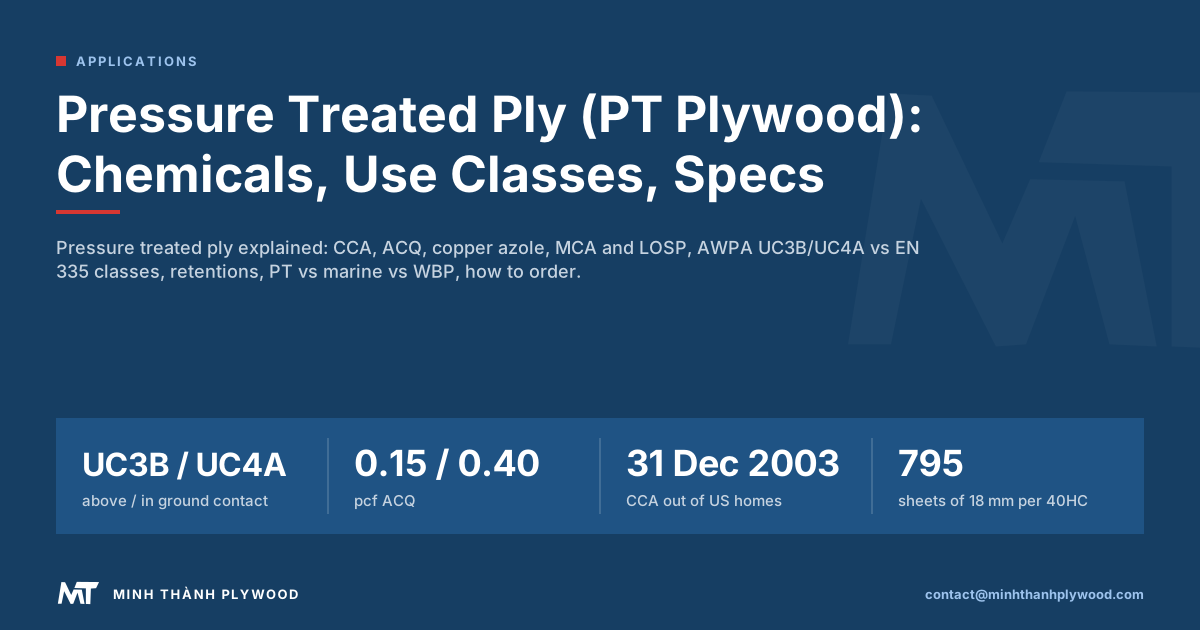
Pressure treated ply is plywood that a treating plant has filled with preservative in a closed cylinder, under vacuum and pressure, so fungi and insects cannot feed on it. The chemical and the retention decide where it may go: above ground or in ground contact. This guide from Minh Thanh Plywood compares the treatments, the use classes and the alternatives, and shows how to order treated plywood by the container.
What is pressure treated ply?
Pressure treated ply is plywood impregnated with a wood preservative inside a sealed steel cylinder, called a retort, using vacuum and pressure, so that the preservative reaches deep into every veneer instead of coating the surface. Builders call it PT plywood, treated ply or pressure treated lumber plywood; it is the sheet version of the treated timber in decks and fence posts.
The treatment protects the wood fibre against decay fungi, termites and wood-boring insects. It does not change the glue line, the grade of the faces or the strength class of the panel. A pressure treated sheet is therefore two specifications in one: the plywood (grade, glue, thickness, size) and the treatment (preservative, retention, use category, standard).
Most plywood is not treated. Standard furniture, commercial, packing, CDX and film-faced panels leave the mill untreated. A panel is pressure treated only when it carries a stamp or end tag from the treating plant that names the preservative, the retention and the use category.
Is plywood pressure treated? CDX, RTD and other common confusions
Plywood is pressure treated only when a treating plant has treated it, and the stamp proves it. Three names are often mistaken for treatment:
- CDX is a grade: C face, D back and an exterior glue line (the X). CDX is not treated, but it is the most common base sheet for treatment because its glue survives the wet process. Our guide to CDX plywood vs ACX and BCX explains the grade letters.
- RTD is shorthand for Rated, as in APA Rated Sheathing, a structural end-use designation. It says nothing about preservative.
- Exterior or WBP plywood has a water-resistant, boil-proof glue line, usually phenolic. The glue keeps the plies together when wet; it does not stop fungi eating the wood.
Green or brown colour is not proof either. Copper-based treatments tint the wood, but stains and paints can imitate the colour, and some treatments leave the wood close to its natural colour. Buy to the stamp, not to appearance.
How is plywood pressure treated?
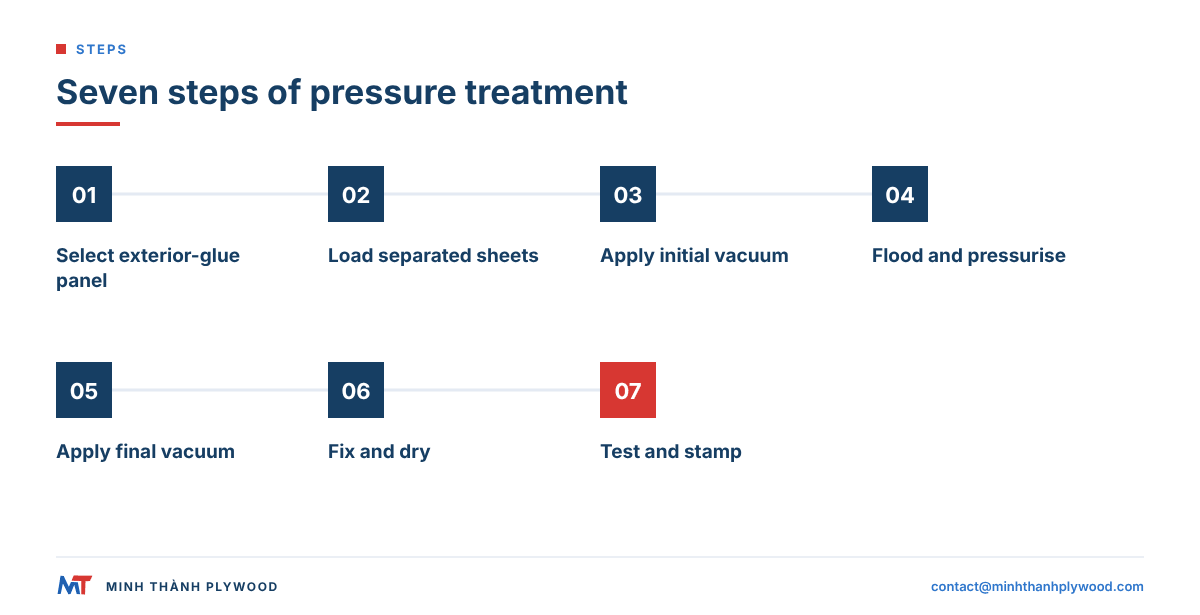
Plywood is pressure treated in a batch process that takes a few hours per charge. The steps are the same for every water-borne preservative:
- Select the base panel. The treater takes exterior-glue plywood, because the water-borne solution and the pressure would break an interior glue line. Species matters: pine and other softwoods take preservative evenly; dense hardwood cores take less.
- Load the retort. Bundles of sheets, separated by stickers so the solution reaches every face, are rolled into the cylinder.
- Initial vacuum. The sealed cylinder is evacuated to draw air out of the wood cells.
- Flood and pressure. The cylinder fills with preservative and pressure drives it into the veneers. Holding time and pressure set the uptake.
- Final vacuum. A short vacuum removes surplus solution so the surface does not drip.
- Fixation and drying. Copper treatments need time to fix in the wood. The sheets leave wet; KDAT stock (kiln dried after treatment) is dried before sale.
- Stamp and test. The treater samples cores of the charge, checks retention and penetration against the standard, and stamps or tags each sheet.
Light organic solvent preservatives (LOSP), used in New Zealand and Australia, follow a gentler cycle. The solvent evaporates, so the sheet stays dry, keeps its size and can be painted straight away.
Which chemicals are used to treat plywood?
Five preservative families account for almost all treated plywood. The table compares them; the retentions are the AWPA U1 values for lumber and plywood in the two common use categories.
| Preservative | Active ingredients | Above ground (UC3B) | Ground contact (UC4A) | Notes |
|---|---|---|---|---|
| CCA (chromated copper arsenate) | Copper, chromium, arsenic | 0.25 pcf (4.0 kg/m³) | 0.40 pcf (6.4 kg/m³) | Withdrawn from US residential use from 31 December 2003; still used for poles, piles and farm and industrial uses |
| ACQ (alkaline copper quaternary) | Copper and a quaternary ammonium compound | 0.15 pcf (2.4 kg/m³) | 0.40 pcf (6.4 kg/m³) | Common general-purpose exterior treatment; greenish-brown colour |
| CA (copper azole) | Copper and azole co-biocides | 0.06 pcf (1.0 kg/m³) | 0.15 pcf (2.4 kg/m³) | Lower copper loading than ACQ for the same use |
| MCA (micronized copper azole) | Copper ground to fine particles, plus azole | Set by its evaluation report | Set by its evaluation report | Branded treatments such as MicroPro; lighter colour, less corrosive |
| LOSP (light organic solvent preservative) | Azoles, permethrin in white spirit | H3 above ground (NZ and Australia) | Not for ground contact | Dry after treatment, no swelling; used for H3.1 and H3.2 plywood |
Borate treatments protect against insects and fungi in dry, covered positions, but borates wash out in rain, so they never go outdoors uncovered. Fire-retardant treatment (FRT) is a separate class for flame spread, not decay.
The US Environmental Protection Agency describes the CCA withdrawal and the remaining permitted uses on its chromated arsenicals page (checked 20 October 2026). In the European Union, arsenic compounds in wood preservation are restricted under REACH Annex XVII, entry 19, and preservatives must be authorised under the Biocidal Products Regulation.
What do AWPA use categories UC3B and UC4A mean?
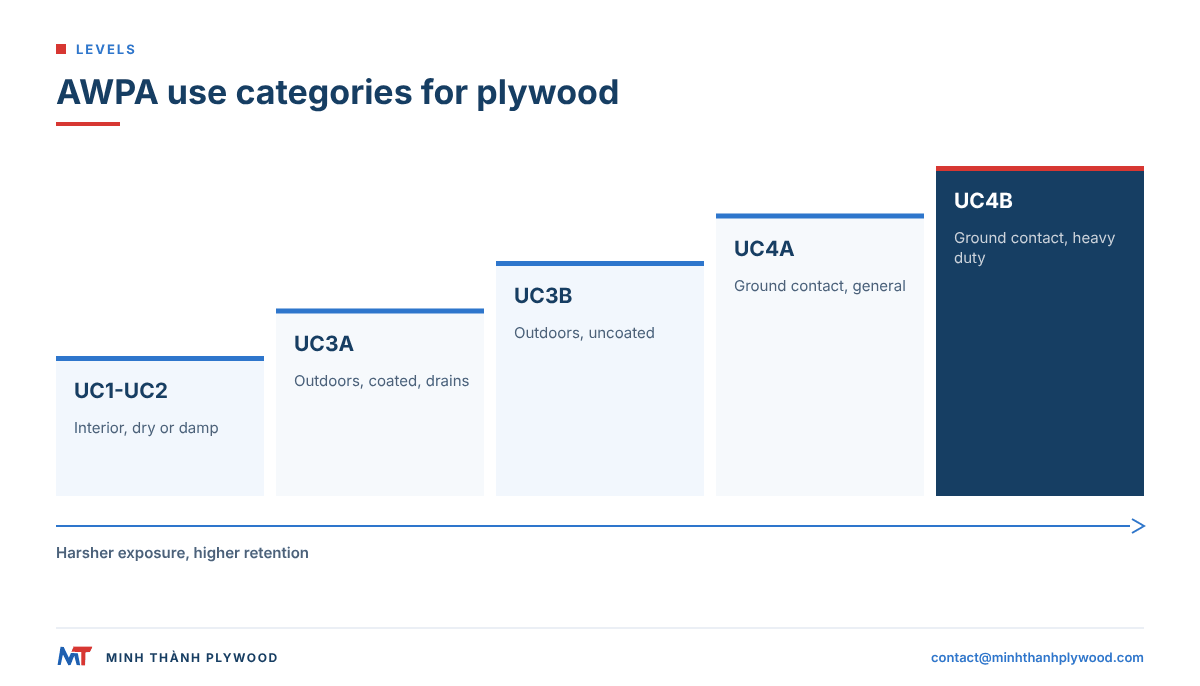
AWPA use categories say where a treated product may go; the higher the number, the harsher the exposure and the higher the retention. The American Wood Protection Association sets them in its standard U1, and treated plywood in the US and Canada is stamped with one of them.
| AWPA category | Exposure | Typical plywood use |
|---|---|---|
| UC1 | Interior, dry | Interior framing, rarely specified for plywood |
| UC2 | Interior, damp | Sill plates, damp interiors |
| UC3A | Exterior, above ground, coated, water drains off | Painted soffits and trim |
| UC3B | Exterior, above ground, uncoated or poor drainage | Fence panels, deck skirting, sheds, sheathing exposed to weather |
| UC4A | Ground contact, general use; also above ground where it is hard to drain or replace | Ground-contact walls, garden beds, decking within reach of soil, utility enclosures |
| UC4B | Ground contact, heavy duty | Permanent wood foundations, critical structural parts |
| UC5 | Marine, salt water | Piling and marine structures (not usual for plywood) |
The rule that prevents most early failures is simple: anything touching soil, buried, wet for long periods or hard to replace is UC4A or higher. A UC3B sheet laid on soil fails years before a UC4A sheet in the same place. In Canada, the CSA O80 series sets the equivalent requirements, and branded micronized copper products are sold to both systems.
EN 335 use classes: how Europe classifies treated plywood
Europe uses five use classes in EN 335 instead of AWPA categories, and the treatment is specified with EN 351-1 penetration and retention against the preservative’s tested critical value (EN 599-1). UK and Irish yards sell treated ply as UC3 or UC4, often under brand names such as Tanalith.
| EN 335 use class | Exposure | Closest AWPA category |
|---|---|---|
| UC1 | Interior, dry | UC1 |
| UC2 | Interior or covered, occasional wetting | UC2 |
| UC3.1 | Exterior, above ground, protected, water does not stay | UC3A |
| UC3.2 | Exterior, above ground, unprotected | UC3B |
| UC4 | Ground or fresh-water contact | UC4A and UC4B |
| UC5 | Salt water | UC5 |
New Zealand and Australia use hazard classes instead: H3 for exterior above ground (H3.1 coated, H3.2 uncoated), H4 for ground contact and H5 for heavy ground contact, under NZS 3640 and AS 1604. Our guide to H3 and H3.2 treated plywood covers LOSP and CCA for those markets.
A treated sheet is legal in a market only when its stamp follows that market’s system. An AWPA UC4A sheet and an EN 335 UC4 sheet are comparable in exposure, but a European inspector reads the EN stamp and a North American inspector reads the AWPA stamp.
What is pressure treated lumber plywood used for?
Pressure treated plywood is used wherever a panel stays outdoors or near the ground and decay is the main risk. Match the use to the category:
- Above ground (UC3B, EN UC3.2, H3.2): fence and gate panels, deck skirting, sheds and outbuildings, roof sheathing over open structures, signboards, agricultural buildings.
- Ground contact (UC4A, EN UC4, H4): retaining walls and garden beds, ground-level wall sheathing on farm buildings, utility boxes, playground parts set into the ground, skirting buried at the bottom.
- Interior where codes ask for treated wood (UC2): sill plates and damp basements.
Where the panel is wet for long periods but not attacked by fungi, such as concrete forms or boat decks, the glue line matters more than the preservative. That is the next comparison.
Pressure treated vs marine vs exterior WBP plywood
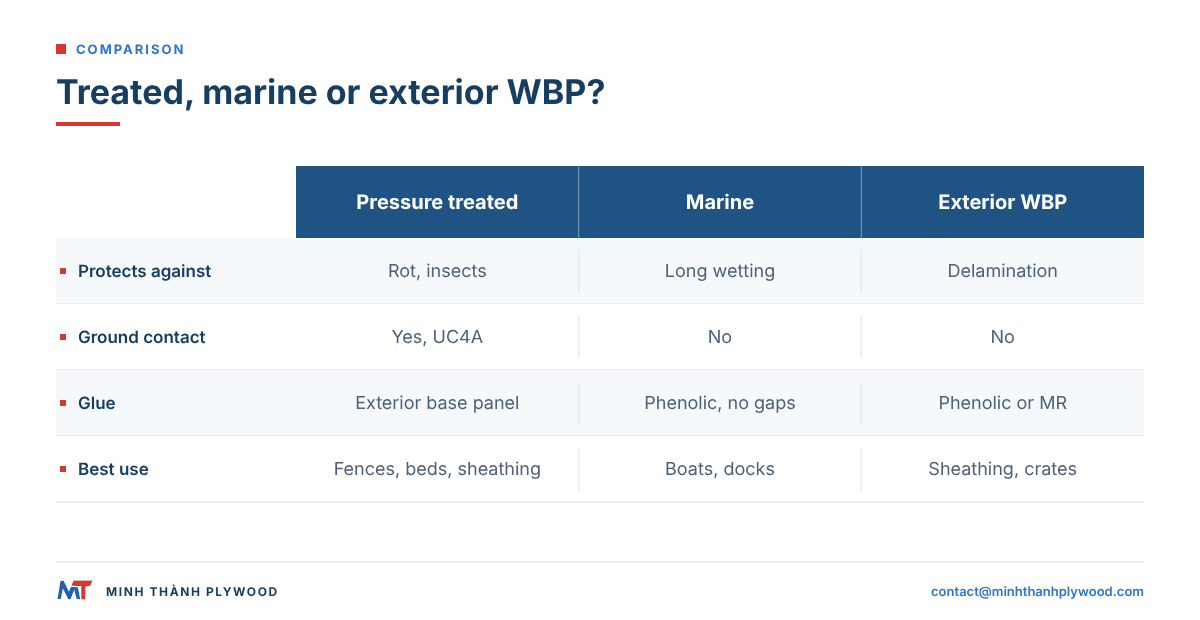
Pressure treated plywood answers decay; marine and exterior WBP plywood answer water. One metric per row:
| Metric | Pressure treated plywood | Marine plywood | Exterior WBP plywood |
|---|---|---|---|
| Protection against | Fungi, termites, insects | Delamination and long wetting | Delamination when wet |
| How | Preservative in the wood | Boil-proof glue, core without gaps, durable faces | Phenolic or melamine-fortified exterior glue |
| Glue line | Exterior glue of the base panel | Phenolic, BS 1088 type | Phenolic (WBP) or MR/melamine-fortified |
| Core | Softwood or mixed, gaps allowed by grade | No gaps, selected veneers | By grade, C/D faces common |
| Ground contact | Yes, at UC4A or higher | No | No |
| Long wetting | Swells and checks without coating | Yes | Short wetting and weather |
| Surface | Rough, wet after treatment, stamp marks | Sanded, high-grade faces | Utility faces, sanded on order |
| Typical uses | Fences, garden beds, ground-level sheathing | Boats, docks above waterline, wet joinery | Sheathing, hoarding, stair treads, crates |
Verdict by use. Ground contact or buried: pressure treated at UC4A. Above ground, rained on, painted: exterior WBP plywood is often enough, treated to UC3B where fungi or termites are a known risk. Wet for weeks or structurally critical in water: marine plywood. The full comparison is in our article on marine vs pressure-treated plywood, and the marine plywood buying guide covers grades and the BS 1088 build.
Sizes and thicknesses of PT plywood
PT plywood is sold in the same sheet sizes as the base panel. Canada and the US sell 4 × 8 ft (1220 × 2440 mm) spruce or pine in 3/8, 1/2, 5/8 and 3/4 inch, in lifts of about 30 sheets. Europe uses 1220 × 2440 mm and 1250 × 2500 mm, with 12 and 18 mm the most common.
Canadian retail prices for one 4 × 8 ft spruce PT sheet, as listed in October 2026:
| Thickness | 4 × 8 ft sheet | Metric size | Retail price per sheet (C$) | Use category and stamp |
|---|---|---|---|---|
| 3/8 in | 1220 × 2440 mm | about 9.5 mm | from 46.79 (Timbertown, western Canada) | UC3B above ground; CSA O80 or AWPA stamp |
| 1/2 in | 1220 × 2440 mm | about 12.7 mm | 71.98 (Home Depot Canada); about 44 lb per sheet | UC3B above ground; UC4A where stamped |
| 5/8 in | 1220 × 2440 mm | about 15.9 mm | 89.32 (Home Depot Canada) | UC3B above ground; UC4A where stamped |
| 3/4 in | 1220 × 2440 mm | about 19 mm | 99.96 (Home Depot Canada) | UC3B above ground; UC4A where stamped |
Prices are from Home Depot Canada and Timbertown, whose range for 3/8 to 3/4 in is C$46.79 to C$88.19 across four Alberta yards (both checked on 21 October 2026). The Home Depot sheet is spruce, square edge, not fire retardant, and sold 30 pieces to a lift (product page). Retail prices move with the region and the week; they show what a distributor competes with.
For a treater or distributor, the cost that matters sits one step earlier: the untreated exterior-glue base panel bought by the container. Your own margin is the retail shelf price above, less the treatment charge, less the base panel landed. Send us the thickness mix and the base panel is quoted CIF to your port.
Thicker panels need deeper penetration to meet the same retention in the analysed zone. For ground contact many treaters prefer the thinner, more open softwood panels and supply thicker panels only on order. Ask the treater which thicknesses they stamp for UC4A before ordering the base panels.
Treated at origin or at destination: how importers specify treatment
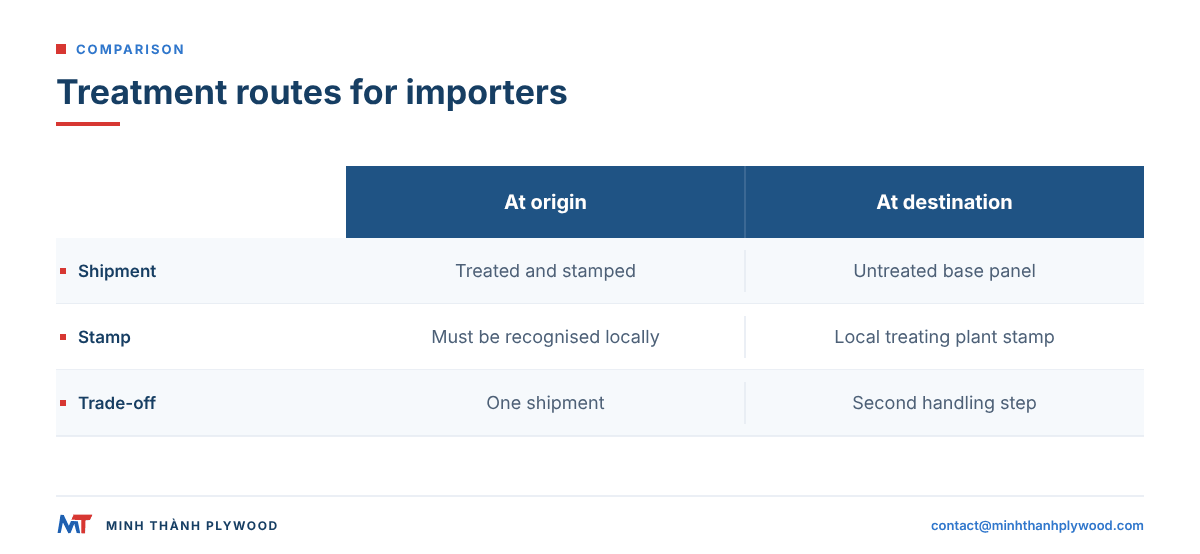
An importer can buy treated plywood in two ways, and the choice is mostly about whose stamp the inspector accepts.
| Route | How it works | Strengths | Watch out for |
|---|---|---|---|
| Treated at origin | The mill sends exterior plywood to a treater in the producing country, which treats and stamps it to the buyer’s standard | One shipment, panels ready to sell | The stamp must be recognised in the destination market; US and Canadian treated wood needs an accredited inspection agency; some preservatives are not authorised in the EU |
| Treated at destination | The importer brings in exterior-glue plywood and a local treating plant treats it | Local stamp, local warranty, any preservative approved locally | A second handling step; the base panel must suit the plant’s process |
For North America, Europe, the UK and Australia, most importers treat at destination. The local stamp is what building inspectors and insurers accept, and the importer can choose the retention for each lot.
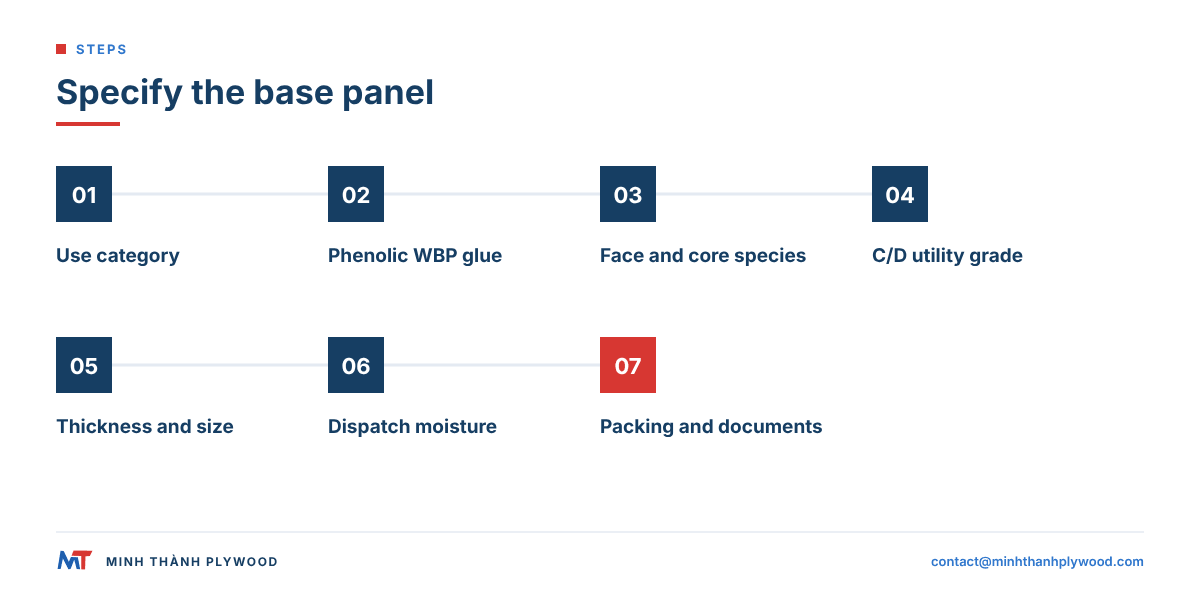
What to write on the order for the base panels:
- Use and use category the panel will be treated to (for example UC4A or EN UC4).
- Glue: phenolic (WBP), so the bond survives the treating cycle.
- Species of faces and core, agreed with the treater.
- Grade: C/D utility faces are normal for treated sheathing and fencing.
- Thickness and size, for example 18 mm, 1220 × 2440 mm.
- Moisture: 8–12% at dispatch, so the plant can treat on arrival.
- Packing and labelling per pack, plus the documents your treater and customs need.
How long does pressure treated plywood last outdoors?
Pressure treated plywood lasts decades outdoors when its use category matches the position and the cut edges are treated. Ground-contact panels in soil and above-ground panels that drain both reach that life; an above-ground panel in soil does not.
Three habits protect the service life:
- Treat every cut. Sawing exposes inner veneer that the preservative may not have reached. Brush an end-cut preservative onto each cut and drilled hole.
- Let water leave. Drainage gaps, a slope on horizontal panels and air behind cladding matter more than any coating.
- Coat the face. A water-repellent or stain reapplied every few years slows surface checking and face splits.
Treated plywood can get rained on; that is what it is for. Standing water against an unsealed edge still shortens its life.
Can you paint, stain and fix treated plywood?
Yes, once the sheet is dry. Water-borne treated plywood leaves the plant wet; a sprinkle test shows when it is ready: if water beads, wait; if it soaks in, paint or stain. KDAT sheets can be finished at once.
Use an exterior primer and paint or a penetrating stain sold for treated wood. LOSP-treated H3 plywood is dry after treatment and is usually primed straight away.
Fix it with hot-dip galvanised or stainless-steel nails, screws and connectors. Copper treatments corrode plain and electro-plated steel faster than untreated wood. Do not use aluminium flashing in contact with copper-treated wood.
Is pressure treated plywood safe?
Modern pressure treated plywood with copper-based treatments contains no arsenic and is used in homes where codes ask for treated wood. Handle it with common sense: wear gloves and a dust mask when sawing, wash hands before eating, collect sawdust, and dispose of offcuts as the local authority directs. Never burn treated wood.
Do not use treated plywood for food-contact surfaces, animal feeding troughs or beehives. For indoor furniture and cabinets, use untreated furniture plywood with a low-emission glue instead; treatment adds nothing there.
Pressure treated plywood suppliers: Canada, Ireland and Asia
Pressure treated plywood is bought from a local yard or treating plant in most markets, because the stamp must follow local rules. Buyers in Canada look for sheets stamped to CSA O80 or an AWPA category with an evaluation report, often micronized copper brands. Buyers in Ireland and the UK ask merchants for UC3 or UC4 treated ply to EN 335 and EN 351-1.
Importers, distributors and treating plants in these markets often source the base panel abroad. Asian mills, including Vietnamese ones, export exterior-glue plywood in 1220 × 2440 mm and imperial thicknesses for treatment at destination. In smaller markets without a treating plant nearby, the buyer can ask the mill to arrange treatment in the producing country to the destination’s standard.
When you compare suppliers, ask for the glue type in writing, the species of every ply, the thickness tolerance and the moisture at dispatch. Those four lines decide how evenly the panel takes treatment.
What Minh Thanh Plywood supplies for treated plywood orders
Minh Thanh Plywood, a manufacturer in Phu Tho, Vietnam, makes exterior and CDX-type plywood with utility C/D faces and phenolic (WBP) or melamine-fortified glue, the bond a treating plant needs. Our exterior plywood is made to the buyer’s specification and the treater’s species list.
| Line | What we supply |
|---|---|
| Glue | Phenolic (WBP) or MR/melamine-fortified, to the customer’s specification |
| Faces | Utility C/D face and back, matched to the order sample |
| Core | Eucalyptus or Styrax as standard; pine cores on order for treaters that ask for softwood |
| Thickness | 3–40 mm, metric or imperial |
| Size | 1220 × 2440 mm, 1250 × 2500 mm or custom |
| Tolerance | Commercial panels ±0.5 mm; length and width ±2 mm |
| Moisture | 8–12% at dispatch |
| Load | 18 mm on Eucalyptus core: 795 sheets per 40HC, 34.8 kg per sheet |
| Terms | MOQ one 40HC with mixed specifications by agreement; production 15–45 days after deposit; FOB Hai Phong, CFR or CIF |
Every shipment is photographed and filmed before loading, and the buyer receives the photos and video. We supply the EUDR compliance dossier (origin records and geolocation files) with orders for Europe. Free samples go out so your treating plant can run a trial charge before you order the container.
Send this line for a quote: “Exterior plywood for pressure treatment to [UC3B/UC4A/EN UC4], phenolic WBP glue, [species] faces and core, C/D grade, [thickness] mm, 1220 × 2440 mm, ±0.5 mm, moisture 8–12%, [quantity] × 40HC, CIF [port].”
Buyer questions, answered
Is CDX plywood pressure treated?
No. CDX is a grade: C and D faces with an exterior glue line. It is not pressure treated unless the sheet carries a treatment stamp naming the preservative, retention and use category. CDX is, however, a common base panel for treatment because its glue survives the process.
Is RTD plywood pressure treated?
No. RTD means Rated (APA Rated Sheathing), not a preservative treatment. An RTD sheet is pressure treated only when a treating plant has treated it and stamped it.
Is pressure-treated plywood waterproof?
No. The preservative stops rot and insects; it does not stop water. Treated plywood still absorbs water, swells and can check, so it needs drainage, sealed edges and a coating where it stays wet.
What is the difference between pressure treated and marine plywood?
Pressure treated plywood is protected by chemistry against decay and insects. Marine plywood is protected by its build: a boil-proof glue line, a core without gaps and durable face veneers. Use treated plywood in ground contact; use marine plywood where the panel is wet for long periods and must not delaminate.
How long does pressure treated plywood last outdoors?
Treated plywood rated for its position lasts decades outdoors: above-ground panels when water drains off, ground-contact panels where they touch soil. Most early failures come from an above-ground panel used in ground contact or from untreated cut edges.
Can you paint or stain pressure treated plywood?
Yes, once it is dry. Water-borne treatments leave the sheet wet, so let it dry until water beads soak in, or buy KDAT (kiln dried after treatment) stock, then use an exterior primer or stain made for treated wood.
What does PT mean on plywood?
PT means pressure treated: the plywood was impregnated with a wood preservative in a pressure cylinder. Look for the stamp or end tag with the preservative, retention, use category and standard, for example AWPA UC4A.
Which fasteners should I use with treated plywood?
Use hot-dip galvanised or stainless-steel fasteners and connectors. Copper-based treatments such as ACQ and copper azole corrode plain steel faster than untreated wood does.
Can I import pressure treated plywood from Vietnam?
Yes, two ways: buy panels treated at origin to your market's standard, or import exterior-glue plywood and have a local treating plant treat it. Most buyers in North America, Europe and Australia treat at destination, because the local stamp and certification are what inspectors accept.
Is pressure treated plywood safe indoors?
Modern copper-based treatments without arsenic are used indoors where codes call for treated wood, such as sill plates. Do not use treated plywood for food-contact surfaces, and never burn offcuts.
What is the difference between treated ply and fire-retardant plywood?
Treated ply carries a preservative against rot and insects. Fire-retardant treated (FRT) plywood carries chemicals that slow flame spread. They are different treatments with different stamps, and one does not replace the other.