
For a modular kitchen, plywood is the better carcass for most cabinets, and PVC or WPC is the better choice only where water stands: the sink base and a wet utility corner. Minh Thanh Plywood makes furniture plywood with MR or WBP bonds for kitchen makers, and this guide compares the two cabinet by cabinet.
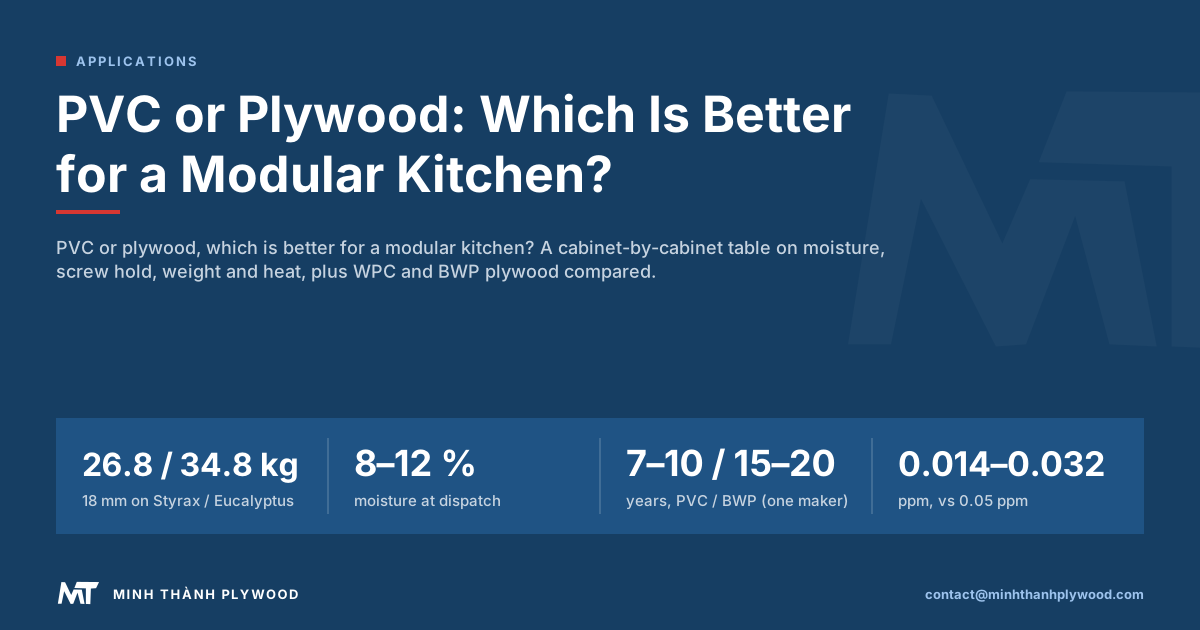
PVC or plywood: the short answer
Plywood is the better material for most of a modular kitchen, and PVC or WPC wins in one place: the cabinet under the sink. The rule is simple: where water stands, use a plastic board or a BWP bonded panel; where weight, hinges and a wood finish matter, use plywood.
- Sink base and wet utility corner: PVC or WPC board, or BWP plywood with sealed edges.
- Wall units, tall units, drawers, corner carousels: plywood.
- Hob and oven zone: plywood with a laminate or veneer face; never bare PVC beside the flame.
- Wardrobes and bedroom furniture: plywood.
The tables below compare the two metric by metric, then cabinet by cabinet.
What PVC board, WPC board and plywood are
PVC board is a foamed polyvinyl chloride sheet: plastic all the way through, with a solid skin and a lighter cellular core. WPC (wood plastic composite) board mixes wood fibre or flour into the plastic, which makes it denser and stiffer than plain PVC foam. Plywood is wood: thin veneers glued in cross layers and pressed into one panel.
The difference matters for a kitchen. A plastic board has no wood fibre to swell, so water does not hurt it, but it has no long fibres either, so it bends and lets screws go under load. Plywood has the cross layers that give it strength and screw hold, and its bond decides how it behaves in water.
“PVC plywood” is a third product: a plywood panel faced with a PVC film or laminate. It is plywood inside, and it behaves like plywood. The plastic plywood guide covers PP, HDPE and other synthetic sheets.
PVC or plywood: which is better, metric by metric?
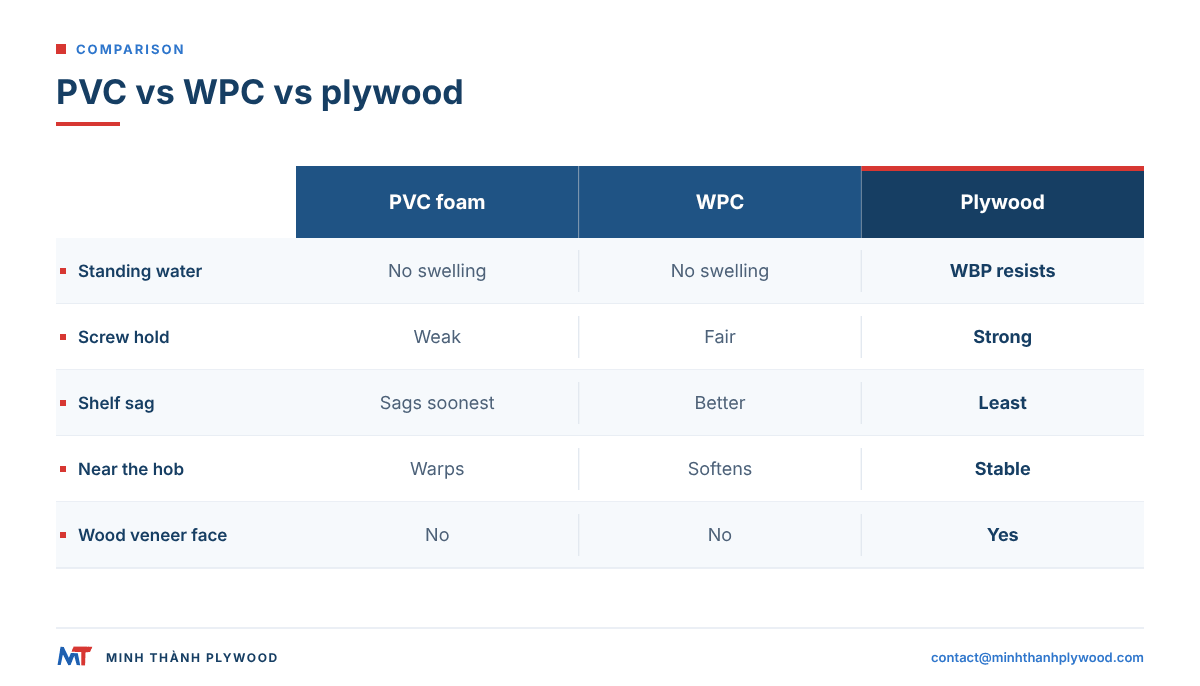
PVC or plywood, which is better depends on the metric: PVC wins on standing water and termites, plywood wins on strength, screw hold, heat and finish. Each row of the table compares one property for cabinet carcass board of the same thickness.
| Metric | PVC foam board | WPC board | Plywood (MR or WBP bond) |
|---|---|---|---|
| Standing water | Does not swell | Does not swell | MR: avoid; WBP: resists boiling-water tests |
| Strength and shelf sag | Lowest; sags on long spans | Better than PVC | Highest; cross layers resist sag |
| Screw and hinge hold | Weak; screws strip with repeat use | Fair | Strong, also in the edge |
| Weight | Varies by density | Heavy | Medium (by core species) |
| Heat near the hob | Softens and warps | Softens at high heat | Stable; face finish decides |
| Termites | Immune | Highly resistant | Treated or tight bond needed |
| Finish options | Foil, gloss film, paint | Laminate, paint | Veneer, laminate, paint, lacquer, UV coat |
| Repair | Replace the part | Replace the part | Sand, refill, re-face |
| Emissions | No formaldehyde glue | No formaldehyde glue | Set by bond and emission class |
The pattern holds in every kitchen: plastic boards solve water; plywood solves everything else.
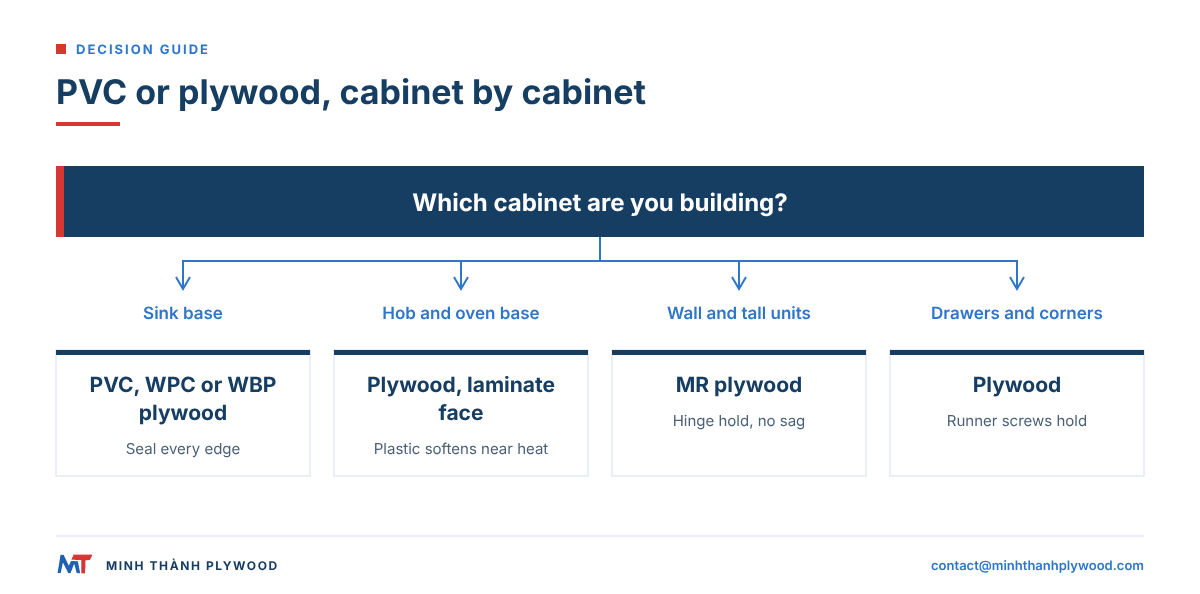
PVC or plywood: which is better for a modular kitchen, by cabinet?
The best answer to “PVC or plywood, which is better for a modular kitchen” is a split by cabinet, not one material for the whole room: PVC or sealed WBP plywood for the sink base, plywood for the drawers, wall units, tall units and hob zone. Use the table below as the bill of materials.
| Cabinet | Main risk | Best carcass | Why |
|---|---|---|---|
| Sink base | Leaks, standing water | PVC or WPC; or WBP plywood with all edges sealed | Plastic does not swell; WBP survives wetting |
| Base units beside the sink | Splash, wet mopping | WBP plywood | Strength plus water resistance |
| Hob and oven base | Heat, heavy pans | Plywood (MR or WBP), laminate face | Plastic softens near heat |
| Drawer boxes | Load, runner screws | Plywood | Runners need screw hold |
| Wall units | Hinge load, crockery | MR plywood | Light core, strong hinge hold |
| Tall units and larder | Long spans, weight | Plywood | Resists sag and racking |
| Corner carousel | Hardware load | Plywood | Hardware screws into the edge |
| Shutters and doors | Look, hinge cups | Plywood with veneer, acrylic or laminate | Hinge cups need a firm face |
A kitchen built this way uses plastic for perhaps one cabinet and plywood for the rest, which is why most kitchen makers keep plywood as the carcass standard.
Moisture: where PVC really wins
PVC wins on moisture because there is nothing in it to absorb water: a leak under the sink that would stain or swell a wood panel leaves a PVC board unchanged. That is a real advantage in coastal and humid cities, and it is the main reason buyers ask the question.
Plywood closes most of the gap with the right bond and finish. A WBP (phenolic) bond holds through boiling-water tests; an MR bond suits dry cabinets. The European plywood specification, BS EN 636, classes panels for dry, humid or exterior conditions. What swells plywood in a kitchen is almost always an open edge: a raw cut edge under the sink drinks water through the end grain.
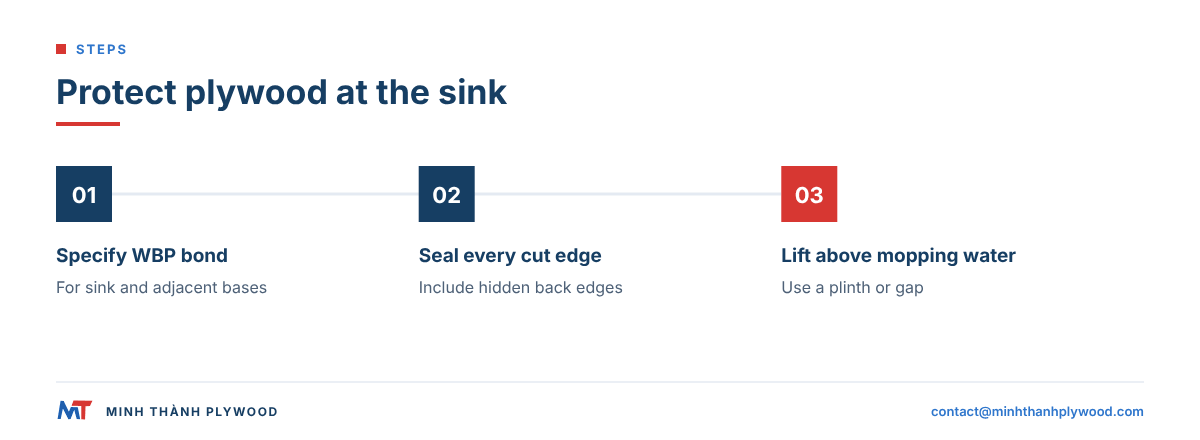
Three rules keep plywood dry in a kitchen:
- Use WBP bonded plywood for the sink base and the units beside it.
- Seal every cut edge with edge band or sealer, including the hidden back edges.
- Leave a gap or a plinth under base units so mopping water does not reach the bottom panel.
Our veneers and finished panels are dried to 8–12 % moisture content at dispatch, the normal range for furniture plywood, so the panel starts stable before it meets the kitchen. The guide to plywood and water explains the bond classes in detail.
Strength, screw hold and shelf sag
Plywood is stronger than PVC board of the same thickness, and the gap shows first in hinges and shelves. Cross-laminated veneers spread the load of a hinge screw over many fibres; a foamed plastic core has no fibre to grip, so a screw that is opened and closed thousands of times slowly works loose.
- Hinges: soft-close hinges on tall doors pull hard on the carcass edge; plywood holds them, PVC often needs inserts or through bolts.
- Drawer runners: full-extension runners carry pans and tins on a few screws; plywood keeps them aligned.
- Shelves: long shelves of PVC sag under crockery sooner than plywood shelves of the same span.
- Racking: a tall unit in plywood stays square when it is moved or loaded unevenly.
For shelf spans and loads, the guide on how much weight plywood can hold gives the method.
Weight: what an 18 mm sheet weighs
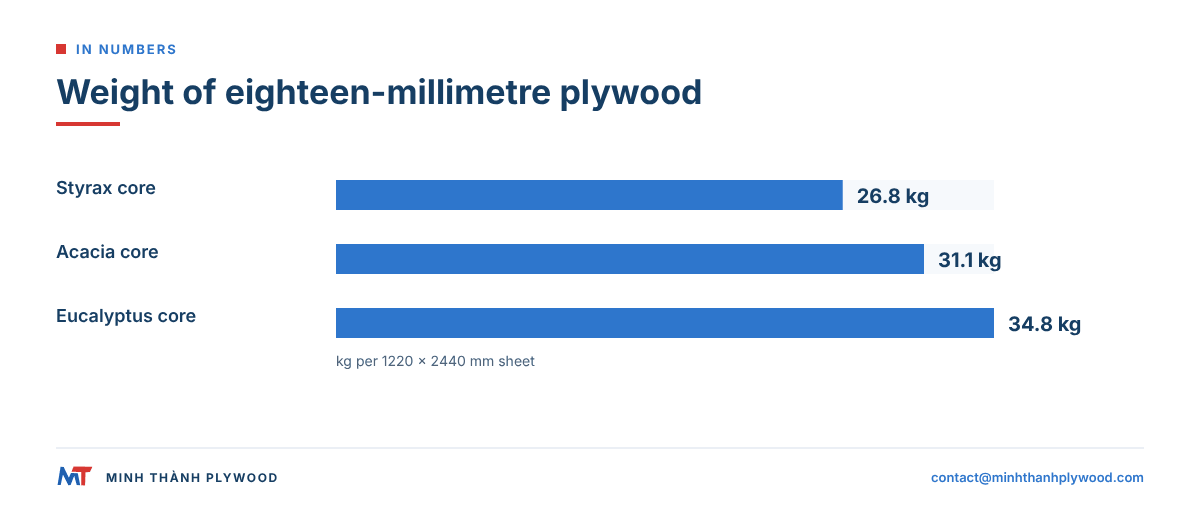
The weight of plywood depends on its core species, so a kitchen maker can choose a light carcass or a dense one. An 18 mm sheet of 1220 × 2440 mm weighs about 26.8 kg on a white Styrax core (about 500 kg/m³) and about 34.8 kg on a Eucalyptus core.
PVC foam board weight depends on its density, so compare the supplier’s sheet weight with the plywood core you specify. WPC is heavier than PVC because of its wood content. For wall units, a light Styrax core plywood gives most of the weight saving that buyers want from PVC without losing the hinge hold.
| Carcass board, 18 mm | Weight per sheet, 1220 × 2440 mm | Use |
|---|---|---|
| Plywood, Styrax core | about 26.8 kg | Wall units, light carcasses |
| Plywood, Acacia core | about 31.1 kg | General carcasses |
| Plywood, Eucalyptus core | about 34.8 kg | Heavy-duty bases, tall units |
Heat, hob and chimney zone
Plywood is the safer carcass beside the hob, because PVC softens with heat. Kitchen makers report PVC cabinets warping when placed near cooking ranges and ovens, and a hot pan set on a PVC edge can mark it. Plywood does not soften; its face finish, laminate or veneer with lacquer, takes the heat.
Keep any carcass material away from direct flame and exhaust ducts, and use a heat-resistant laminate or a metal heat shield on the panel next to a built-in oven.
Termites, fungus and hygiene
PVC and WPC boards are immune or highly resistant to termites because they contain no or little wood. This is a real point in regions where termites attack kitchen joinery. Plywood resists termites when the bond is tight and the panel is treated for the market; sealed faces and edges also keep out the damp that feeds fungus.
For hygiene, a closed surface matters more than the core: a laminate, acrylic or lacquered plywood face cleans as easily as a PVC foil.
Finish: veneer, laminate, acrylic or PVC foil
Plywood accepts every kitchen finish: natural veneer, engineered veneer, laminate, acrylic, high-gloss films, paint and UV lacquer. PVC board is limited to foils, gloss films and paint, and it cannot carry a natural wood veneer face. This is the deciding point for designers who want a real wood kitchen.
Our panels leave the factory with sanded and polished faces, and both faces are UV-ready, so a kitchen maker can apply its own UV coating directly. Faces include engineered veneer (EV), poplar, birch, okoume and pine. Engineered veneer gives matching grain across every door of a run: see EV plywood.
WPC or plywood: which is better?
WPC or plywood, which is better depends on water and load. WPC is a better choice than PVC foam for cabinets because it is denser and holds screws better, and it shares PVC’s resistance to standing water. Plywood stays ahead on strength, screw hold in the edge, weight per strength and finish choice.
- Choose WPC for a sink base, a laundry cabinet or an outdoor kitchen unit that is wet every day.
- Choose BWP or marine plywood for base units that are splashed but not soaked, when you want a wood finish and strong hardware fixing.
- Choose MR plywood for every dry cabinet: wall units, tall units, wardrobes.
On cost, WPC board is usually priced above plain commercial plywood and close to good BWP plywood of the same thickness. Hardware, edge work and the door finish move the cabinet price more than the carcass board does.
PVC plywood vs plywood: a face, not a core
PVC plywood is ordinary plywood with a PVC film, PVC laminate or PVC edge on its face, so it keeps the strength and screw hold of plywood and adds a wipe-clean plastic surface. It is not a plastic board, and it is not waterproof through its core: the bond and the edges still decide how it handles water.
Buyers who see “PVC plywood” on a quote should check three lines:
- Core and bond: species, ply count and MR or WBP bond, as for any plywood.
- Face film: PVC foil, PVC laminate or high-gloss PET; thickness and whether both faces are covered.
- Edges: edge band material and whether the back edges are sealed too.
A kitchen maker can buy plain plywood with sanded, UV-ready faces and apply its own film or laminate, which keeps the choice of colour and gloss in the workshop. The melamine board guide covers the other factory-faced option.
Which furniture is best: PVC or plywood?
For furniture outside the kitchen, plywood is best in almost every room, because wardrobes, beds and desks need strength and screw hold more than water resistance. PVC furniture fits wet rooms and low-cost units that carry little load.
| Room or piece | Best choice | Reason |
|---|---|---|
| Wardrobe | Plywood | Long doors, hanging rails, shelf loads |
| Bathroom vanity | PVC, WPC or WBP plywood with sealed edges | Daily water |
| Bed and storage bed | Plywood | Load and screw joints |
| TV unit, study desk | Plywood | Look and stiffness |
| Laundry and balcony cabinet | PVC or WPC | Wet and outdoor exposure |
| Shoe rack near the door | Either | Light load; choose by finish |
The plywood for kitchen cabinets guide and the comparison of plywood vs MDF cover the other carcass boards.
Lifespan and cost over time
Plywood kitchens last longer, and the longer life often makes them cheaper over time even when PVC costs less on day one. One Chennai kitchen maker quotes an average lifespan of 7–10 years for PVC modular kitchens and 15–20 years for well-sealed BWP plywood kitchens (sahainteriors.com, read 20 October 2026).
The same maker puts the saving of a PVC kitchen at 25–35% against equivalent plywood. Spread over the life of the kitchen, that saving is often smaller than the cost of replacing a PVC kitchen once. Plywood also repairs: a damaged shelf or panel can be refaced or replaced on its own.
In India the comparison runs in rupees per sq ft of finished kitchen, and the day-one gap is relative: a PVC kitchen is quoted 25–35% cheaper than the same layout in plywood, and the figure moves with grade, city, hardware and door finish. Ask each modular kitchen maker for the carcass grade by name (MR, BWR or BWP plywood, or PVC/WPC foam board), because the grade changes the price of the same layout.
For an importer or kitchen maker buying plywood by the container, the factory price replaces the retail rate: plywood starts from US$350/m³ for furniture and interior plywood (October 2026); the final price depends on face, core, glue, thickness, size, quantity and delivery term.
Emissions: what to ask for in kitchen plywood
Kitchen plywood should carry a recognised low-emission certificate, because the carcass sits in a closed room with food. PVC board contains no formaldehyde glue; plywood’s emission depends on its bond and emission class, which are two separate specifications.
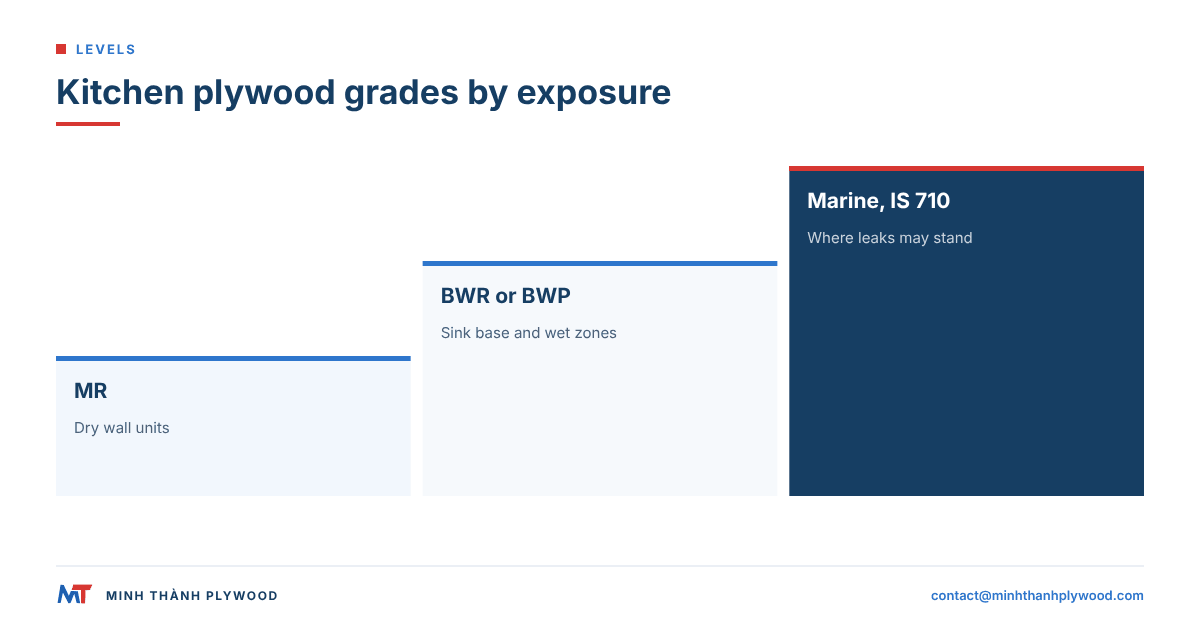
Indian kitchen makers and buyers name the grade by Bureau of Indian Standards number. IS 303 covers commercial plywood in the MR (moisture resistant), BWR (boiling water resistant) and BWP (boiling waterproof) grades, and IS 710 covers marine plywood, the top of the ladder.
Quotations that say “marine” or “BWP” without a standard number are worth a question. The practical ladder for a kitchen: MR for dry wall units, BWR or BWP for the sink base, and marine only where a leak is a standing risk. Termite and borer cover is a separate guarantee, so ask for it in writing with the treatment named.
On any WBP line, ask for the boiling-water bond test report with the order; the bond-quality requirements for plywood are set out in BS EN 314-2. Our furniture panels use UF glue at E0 emission for dry interior parts, and MR or WBP bonds to the customer’s specification for wet zones. Panels are CARB P2 / TSCA Title VI certified (ICTT mill no. 23024), and six third-party ASTM D6007 chamber tests between April 2025 and June 2026 averaged 0.014–0.032 ppm. The US limit for veneer-core hardwood plywood is 0.05 ppm under EPA’s TSCA Title VI requirements (checked on 3 November 2026).
What this means for your kitchen plywood order
A kitchen maker who splits the materials by cabinet orders plywood in two or three lines, not one. Send these lines with your request:
- Application: kitchen carcass, wall units, shutters or wardrobes; which parts face water.
- Core: white Styrax for light wall units, Eucalyptus at 650–750 kg/m³ for heavy bases.
- Glue and emission: UF glue at E0 emission for dry parts; WBP for the sink zone; CARB P2 / TSCA Title VI. For India, say which IS 303 grade (MR, BWR or BWP) or IS 710 marine each part is.
- Face: engineered veneer, poplar, birch or okoume; UV-ready faces for your own coating.
- Size and thickness: 1220 × 2440 mm or 1250 × 2500 mm; thickness 3–40 mm; tolerance down to ±0.2 mm for sanded furniture panels.
- Packing and quantity: from one 40HC, mixed specifications by agreement; destination port.
Production takes 15–45 days after the deposit, FOB Hai Phong, CFR or CIF, with free samples. Every shipment is photographed and filmed before loading. For the wider board choice, start with the guide to types of wood boards or melamine board.
Buyer questions, answered
Which is better, PVC or plywood, for a modular kitchen?
Plywood is better for most of a modular kitchen: wall units, tall units, drawers and every cabinet that carries weight. PVC or WPC is better only for the sink base and other cabinets that stand in water.
Which furniture is best, PVC or plywood?
For wardrobes, beds, desks and living-room units, plywood is best: it holds screws and hinges, carries loads without sagging and takes veneer, laminate or paint. PVC furniture suits wet rooms and low-cost, light-duty units.
Is PVC board as strong as plywood?
No. A PVC foam board of the same thickness is weaker and more flexible than plywood, so shelves sag sooner and screws pull out under load. It wins on water, not on strength.
WPC or marine plywood, which is better?
WPC is better for a cabinet that will be wet every day, because it does not swell. Marine or BWP plywood is better where strength, screw hold and a real wood finish matter and the cabinet is only splashed.
Is WPC cheaper than plywood?
WPC board usually costs more than plain commercial plywood and about the same as, or less than, good BWP plywood of the same thickness. Hardware and edge work change the final cabinet price more than the board.
Can PVC kitchen cabinets be used near the hob?
Keep PVC away from the hob, oven and chimney duct. Kitchen makers report PVC cabinets warping near heat; plywood with a laminate or veneer face is the safer choice beside the cooking zone.
Does plywood swell in a kitchen?
Plywood with a water-resistant bond, sealed edges and a laminate or veneer face does not swell in normal kitchen use. Raw edges left open under a leaking sink are what make any wood panel swell.
What plywood grade should I use for kitchen cabinets?
Use MR bond for dry wall units and tall units, and WBP (phenolic) bond for the sink base and cabinets close to water. For emissions, ask for CARB P2 / TSCA Title VI certified panels.
How long does a PVC kitchen last compared with plywood?
One Chennai kitchen maker quotes an average of 7–10 years for PVC modular kitchens and 15–20 years for well-sealed BWP plywood kitchens. Both figures depend on use and care.
Can I mix PVC and plywood in one kitchen?
Yes, and many makers do: a PVC or WPC sink base, plywood for every other carcass and the shelves, and one door finish across the run so the two materials do not show.