
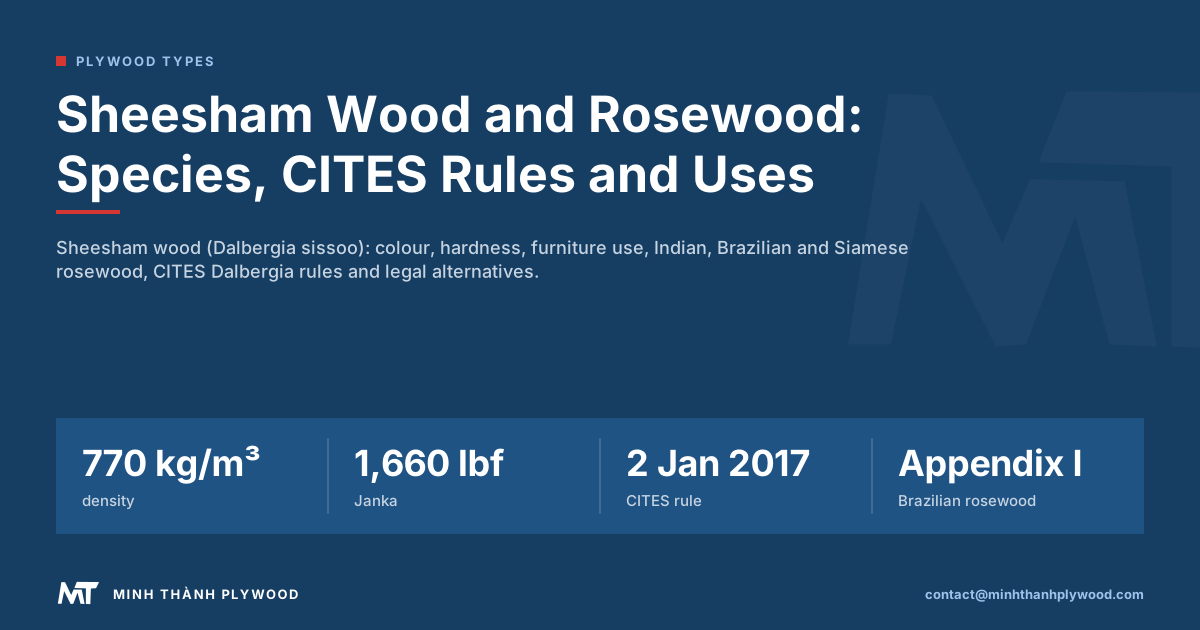
Sheesham wood is the timber of Dalbergia sissoo, a rosewood of northern India and Pakistan known in English as North Indian rosewood or shisham. It is a hard, heavy, golden to deep brown hardwood used for solid furniture. Like every Dalbergia rosewood, it is traded under CITES rules, which is the first thing an importer has to settle. Minh Thanh Plywood makes furniture plywood, and this guide takes a buyer through the species, the permits and the panel route to a rosewood look.
What is sheesham wood?
Sheesham wood is the timber of Dalbergia sissoo, a fast-growing rosewood tree native to the plains and foothills of northern India, Pakistan and Nepal. In English it is called North Indian rosewood, Indian rosewood or shisham. Its heartwood is golden to deep brown, hard and durable, and it is the main wood of solid Indian furniture.
As a tree, Dalbergia sissoo is a fast-growing, hardy, deciduous rosewood, large and often crooked, with long leathery leaves and whitish or pink flowers. It grows across the Indian subcontinent and southern Iran, the IUCN Red List rates it Least Concern, it is the state tree of Punjab, and its timber trade is regulated in India. The CITES Appendix II listing of the whole Dalbergia genus still applies to its shipments (see the CITES section below).
Sheesham grows on farms, canal banks and roadsides as well as in forests, which makes it more plentiful than the classic rosewoods. Rajasthan, and Jodhpur above all, is the centre of sheesham furniture making for export.
What a buyer sees in the wood:
- Heartwood: golden brown to deep reddish brown, with darker streaks.
- Sapwood: pale cream to light brown, sharply set off from the heartwood.
- Grain: interlocked, medium to coarse texture, with a natural lustre.
- Smell: a mild spicy scent when cut.
Is sheesham wood good?
Sheesham wood is good for indoor furniture: it is hard, heavy, strong and its heartwood resists termites and decay. It carves cleanly and takes a polish well. Its limits are movement in dry rooms if it is not dried properly, and the need for a finish outdoors.
| Property | Sheesham (Dalbergia sissoo) | What it means |
|---|---|---|
| Density (dried) | about 770 kg/m³ | Heavy, solid-feeling furniture |
| Janka hardness | 1,660 lbf (7,380 N) | Resists dents better than teak or oak |
| Durability | Durable heartwood | Good against termites indoors |
| Workability | Good; blunts tools moderately | Carves and turns well |
| Finishing | Takes oil, wax and lacquer well | Deepens to a warm brown |
| Stability | Moderate | Needs correct drying |
Values for density and hardness are averages from The Wood Database, read October 2026.
What is rosewood wood, and which species count?
Rosewood wood is the dark, dense, scented timber of Dalbergia species, the true rosewoods; the trade name is also used for a few other genera, such as narra (Pterocarpus indicus). True rosewoods share a heavy, oily heartwood with dark streaks and a sweet smell when cut.
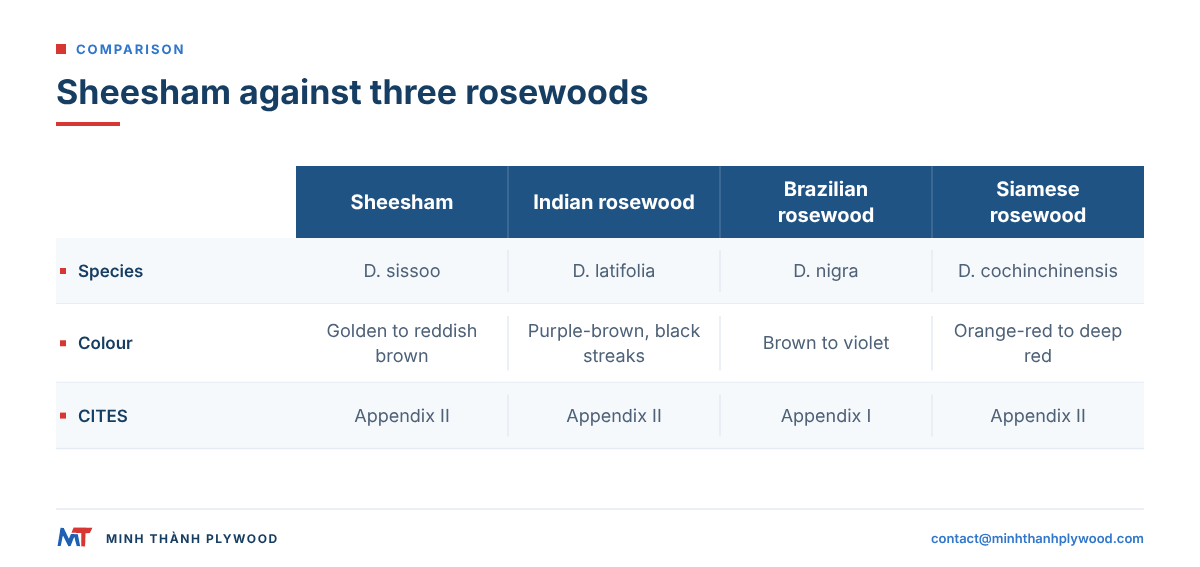
| Rosewood | Botanical name | Main origin | Colour | CITES |
|---|---|---|---|---|
| Sheesham (North Indian rosewood) | Dalbergia sissoo | India, Pakistan, Nepal | Golden to reddish brown | Appendix II |
| Indian (East Indian) rosewood | Dalbergia latifolia | Southern India, Java | Purple-brown, black streaks | Appendix II |
| Brazilian rosewood | Dalbergia nigra | Atlantic forest of Brazil | Brown to violet, black streaks | Appendix I |
| Siamese rosewood | Dalbergia cochinchinensis | Thailand, Laos, Cambodia, Vietnam | Orange-red to deep red | Appendix II |
| Madagascar rosewoods | Dalbergia spp. | Madagascar | Red to purple-brown | Appendix II, exports stopped |
| Narra (Philippine rosewood) | Pterocarpus indicus | Philippines, Southeast Asia | Golden to red-brown | Not listed |
What colour is rosewood?
Rosewood is a dark wood: chocolate to purple-brown with near-black streaks in Indian rosewood, brown to violet in Brazilian rosewood, and orange-red to deep red in Siamese rosewood. Sheesham is the lightest of the group, golden to reddish brown.
Rosewood darkens with light and age, and oil finishes deepen it further. Two boards of the same species can differ a lot, so colour should be fixed by an approved sample, not by the species name.
How do sheesham and Indian rosewood compare?
Sheesham (D. sissoo) is lighter in colour, softer and cheaper than Indian rosewood (D. latifolia). Both are sold as “Indian rosewood”, so the botanical name on the invoice is the only reliable way to know which one you are buying.
| Property | Sheesham (D. sissoo) | Indian rosewood (D. latifolia) |
|---|---|---|
| Colour | Golden to reddish brown | Purple-brown to near-black |
| Density (dried) | about 770 kg/m³ | about 830 kg/m³ |
| Janka hardness | 1,660 lbf | 2,440 lbf |
| Typical use | Solid furniture | Guitars, veneer, fine furniture |
| Supply | Farms and plantations | Restricted, mostly plantations in Java and India |
| Price | Lower | Higher |
Indian rosewood values from The Wood Database, read October 2026.
How do CITES rules apply to rosewood and sheesham?
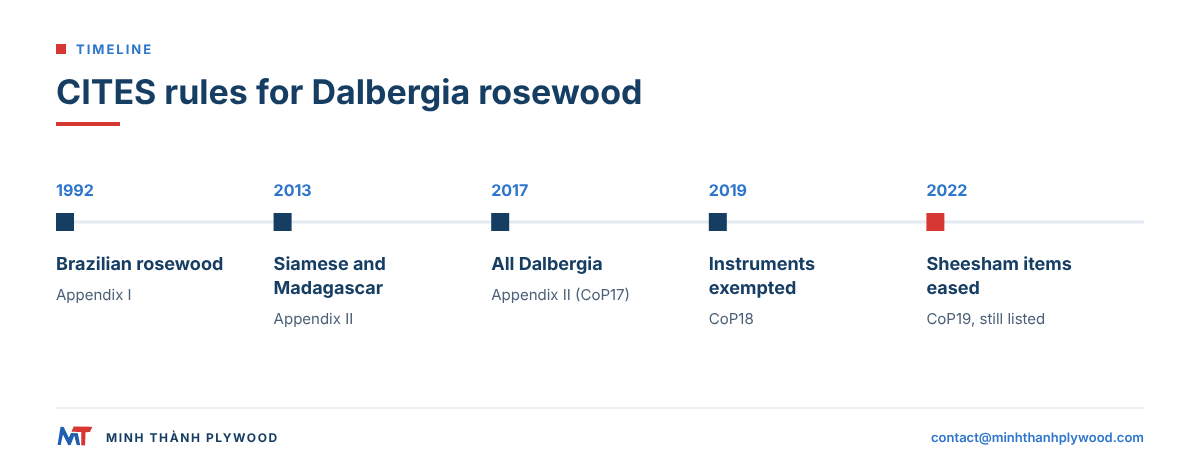
All Dalbergia rosewoods, sheesham included, are listed in CITES Appendix II, so commercial export and import need CITES permits; Brazilian rosewood is in Appendix I, which stops commercial trade in newly cut wood. The genus-wide listing took effect on 2 January 2017.
| Date | CITES decision | Effect on buyers |
|---|---|---|
| 1992 | Brazilian rosewood (D. nigra) to Appendix I | No commercial trade in new wood |
| June 2013 | Siamese rosewood and Madagascar Dalbergia to Appendix II | Permits for logs, sawn wood and veneer |
| 2 January 2017 | All Dalbergia to Appendix II (CoP17) | Permits for nearly all rosewood products |
| November 2019 | Finished musical instruments exempted (CoP18) | Guitars and parts move without permits |
| November 2022 | Sheesham kept listed; finished sheesham items from India eased (CoP19) | Easier furniture and handicraft exports |
In the EU, CITES is applied through the wildlife trade regulation, Council Regulation (EC) No 338/97 (read October 2026), and an import permit may be needed on top of the exporting country’s permit. In the US, a permit is required to import or export a CITES-listed species (U.S. Fish and Wildlife Service, CITES). The Lacey Act also asks importers to declare the species and harvest country of plant products (APHIS, Lacey Act). The CITES species database gives the current listing and annotation for each species.
What is sheesham wood used for?
Sheesham wood is used for solid furniture above all: beds, dining tables, sideboards, chairs, cabinets and carved chests. It is also used for flooring, doors and window frames, turned items, musical instruments and handicrafts.
| Use | Why sheesham works | What to ask for |
|---|---|---|
| Beds and dining tables | Hard, heavy, strong joints | Kiln-dried heartwood, moisture to destination |
| Carved cabinets and chests | Carves cleanly, holds detail | Heartwood faces, sapwood only inside |
| Chairs | Strength in thin sections | Straight grain on legs and rails |
| Flooring | High hardness | Kiln-dried, tongue and groove |
| Handicrafts and turnings | Figure and lustre | Grade and colour sample |
Most sheesham furniture for export is finished in a natural, honey, walnut or dark stain. The stain hides colour differences between boards, so ask for an unstained sample if the natural colour matters.
How do you choose sheesham furniture or timber, step by step?
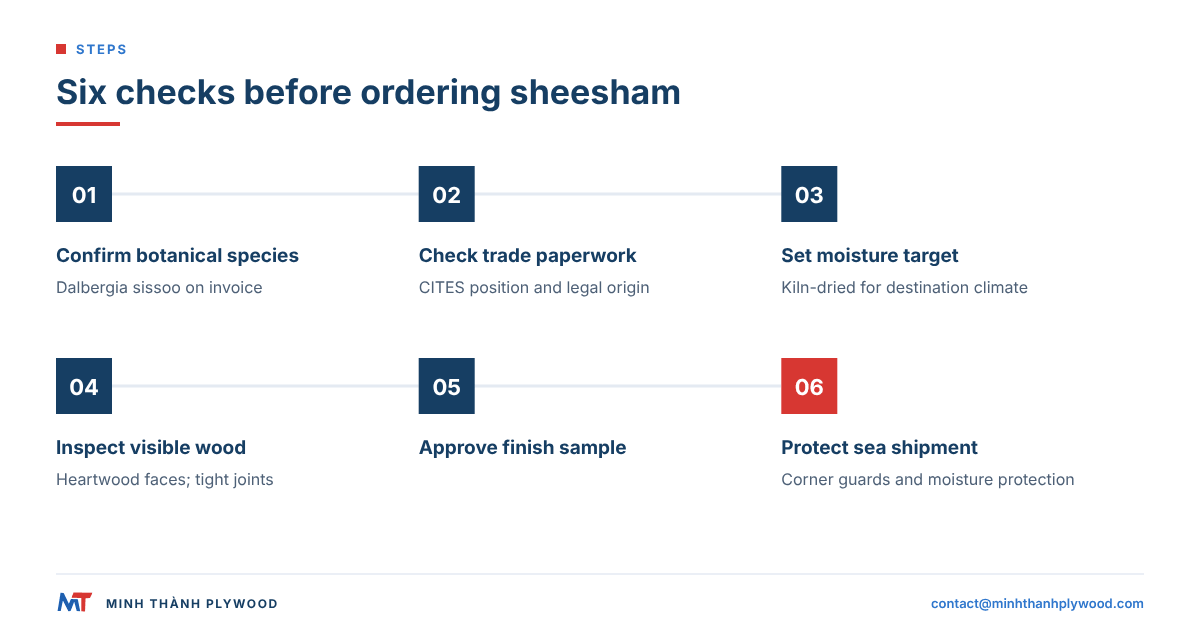
Choose sheesham in the buyer’s order of risk: legality first, then drying, then wood quality, then finish. A cheap table that cracks in a heated room, or a container held at customs, costs more than any price saving.
- Confirm the species. Dalbergia sissoo on the invoice, not “Indian rosewood” or “sheesham-look”.
- Confirm the paperwork. The CITES position for your product and destination, the exporter’s legal origin documents, and for the US the Lacey Act declaration data.
- Fix the moisture content. Kiln-dried, to the climate of the room it will sit in; a dry European winter room is far drier than Jodhpur in the monsoon.
- Check the wood. Heartwood on all visible faces, no open cracks, tight joints, sapwood only on hidden parts.
- Fix the finish and colour. A finish sample, stain or natural, approved before production.
- Plan packing. Corner guards and moisture protection for the sea voyage.
What are the legal alternatives to rosewood?
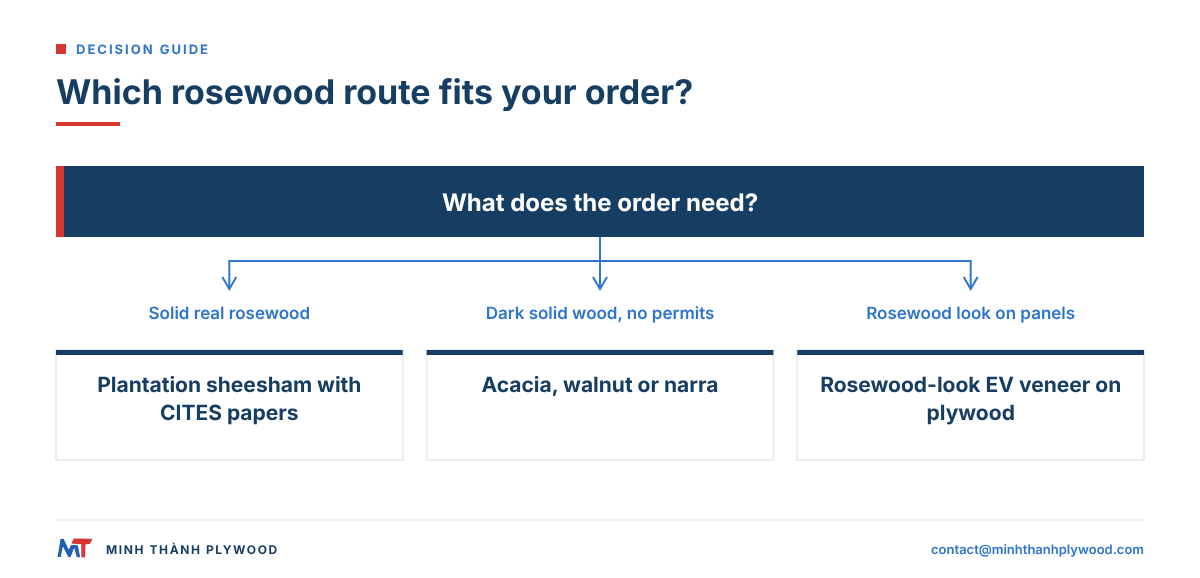
The legal alternatives to rosewood are documented plantation sheesham, other dark hardwoods such as acacia and walnut, and rosewood-look engineered veneer on plywood. Each avoids part or all of the permit work that Dalbergia timber brings.
| Alternative | Look | CITES | Best for |
|---|---|---|---|
| Plantation sheesham with full papers | Real sheesham | Appendix II rules apply | Solid furniture |
| Acacia | Golden to dark brown, figured | Not listed | Solid tables, outdoor furniture |
| Walnut | Chocolate brown | Not listed | Fine furniture, veneer |
| Narra | Golden to red-brown | Not listed | Furniture, flooring |
| Rosewood-look engineered veneer on plywood | Even dark figure | Not listed | Cabinet faces, wall panels, furniture parts |
How does a rosewood-look plywood panel work?
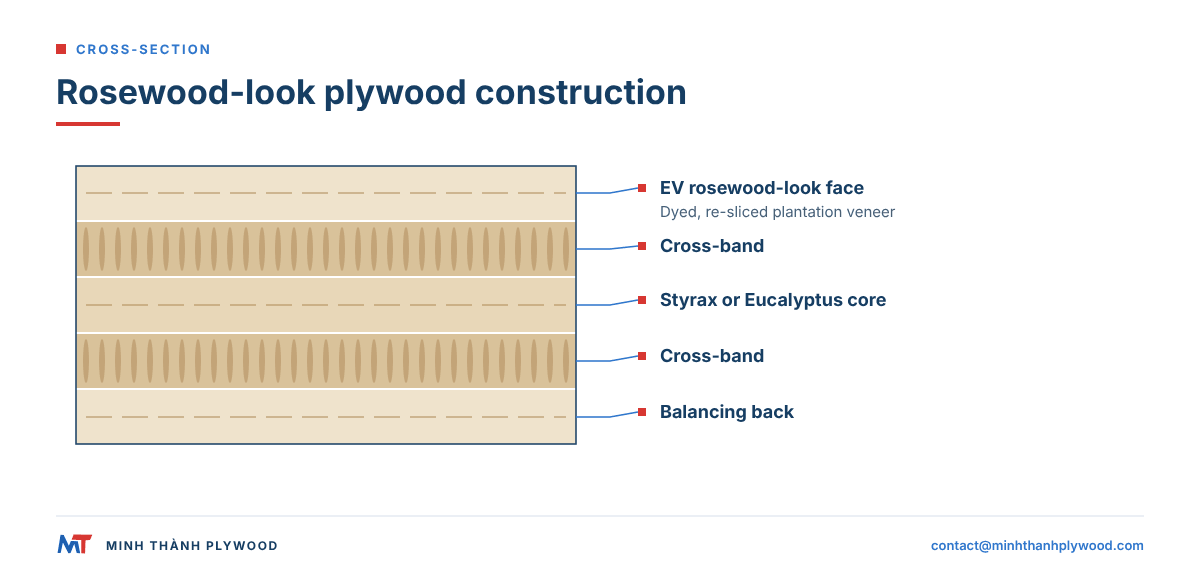
A rosewood-look panel is plywood faced with engineered veneer (EV): veneer from fast-grown plantation wood, dyed and re-sliced to a chosen grain and colour. It gives the dark, streaked face of rosewood on every sheet, with no Dalbergia in the panel and no CITES permit.
Minh Thanh Plywood produces most of its faces as EV, chosen for the look the buyer orders. What is behind such a panel:
- Core: white Styrax or Eucalyptus.
- Glue and emission: UF glue at E0 emission for furniture and interior panels; resin and emission class are separate specifications.
- Build: core layers stitched both horizontally and vertically; furniture-grade panels pressed twice, core first, then face and back.
- Tolerance: sanded to ±0.2–0.3 mm, down to ±0.2 mm.
- Sizes: 1220 × 2440 mm and 1250 × 2500 mm, plus custom sizes; thickness 3–40 mm.
See EV plywood for the face range.
How do you tell real sheesham from look-alikes?
Tell real sheesham by its weight, its interlocked grain with darker streaks, its golden-to-reddish heartwood set sharply against pale sapwood, and a mild spicy smell when a hidden spot is sanded. Mango wood and acacia are the usual look-alikes in low-cost “sheesham” furniture.
| Clue | Sheesham | Mango wood | Acacia |
|---|---|---|---|
| Weight in hand | Heavy | Light to medium | Medium to heavy |
| Colour | Golden to reddish brown, dark streaks | Pale tan, grey or brown spalting | Golden to dark brown, contrasting bands |
| Grain | Interlocked, lustrous | Plain, sometimes black spalting lines | Wavy, often with sapwood stripes |
| Smell when sanded | Mild, spicy | Faint | Faint |
A heavy stain can hide all of these clues. For a container order, ask for an unstained offcut from the production lot and the botanical name on the invoice.
How do you care for sheesham furniture?
Care for sheesham furniture by keeping it out of direct sun and away from radiators, wiping it with a dry or slightly damp cloth, and renewing the oil or wax finish once or twice a year. Sudden swings in room humidity, not use, cause most splits and loose joints.
- Place it well: away from heaters, air-conditioning outlets and strong sunlight, which fades and dries the surface.
- Clean gently: a soft cloth; no silicone sprays, which build up and stop later refinishing.
- Feed the finish: a furniture wax or a light oil on oiled pieces; lacquered pieces need only cleaning.
- Watch the joints: tighten bolts on beds and tables after the first heating season.
How does sheesham compare with teak?
Sheesham is harder, darker and cheaper than teak; teak is more stable, naturally oily and the better choice outdoors. Sheesham suits carved and heavy indoor furniture. Read the colour of teak wood guide for the teak side.
| Factor | Sheesham (Dalbergia sissoo) | Teak (Tectona grandis) |
|---|---|---|
| Hardness (Janka) | 1,660 lbf | 1,070 lbf |
| Density | about 770 kg/m³ | about 655 kg/m³ |
| Durability | Hard, with durable heartwood that resists decay and termites indoors | Very durable, naturally oily, lasts for decades outdoors |
| Termite and moisture resistance | Good indoors, lower than teak; needs sealing and a roof outdoors | High; the natural oils repel water and insects |
| Workability | Harder to cut, takes carving and a high polish | Easy to work, but dulls tools because of its silica |
| Cost | Lower; farm-grown and plentiful | Higher; plantation teak needs trees about 30 m tall and 50 years old |
| Sustainability | Fast-growing farm and roadside tree | Slow crop; buy certified plantation stock |
| Outdoor use | Covered patios only, with regular oil | Open decks, boats, garden furniture |
What should a sheesham or rosewood-look order say?
A sheesham order should name the species, the CITES position, the moisture content, the grade and the finish; a rosewood-look panel order should name face, core, glue, thickness and size. These lines turn “Indian rosewood furniture” into one product a supplier can quote.
For solid sheesham:
- Species: Dalbergia sissoo, harvest country.
- Permits: CITES position for the product and destination.
- Moisture content: kiln-dried to the destination climate.
- Grade: heartwood on visible faces.
- Finish: to an approved sample.
For a rosewood-look panel we can quote from:
- Face/back: EV rosewood-look face, A/B, to an approved sample.
- Core: white Styrax or Eucalyptus.
- Glue and emission: UF glue at E0 emission.
- Thickness and size: 18 mm ±0.2 mm, 1220 × 2440 mm.
- Terms: one 40HC (MOQ), FOB Hai Phong, CFR or CIF; furniture plywood from US$350/m³ (October 2026, indicative).
Free samples let you match the face before you order: write to contact@minhthanhplywood.com, or compare more species in types of wood.
Buyer questions, answered
What is sheesham wood in English?
Sheesham wood is called North Indian rosewood, Indian rosewood or shisham in English. Its botanical name is Dalbergia sissoo, and it belongs to the same genus as the classic rosewoods.
Is sheesham wood good for furniture?
Yes. Sheesham is hard (Janka 1,660 lbf), heavy (about 770 kg/m³) and has a durable heartwood that holds screws and carving well. It suits beds, tables, cabinets and chairs indoors.
What colour is rosewood?
Most rosewood is dark: chocolate to purple-brown with near-black streaks in Indian rosewood, brown to violet in Brazilian rosewood and orange-red to deep red in Siamese rosewood. Sheesham is lighter, golden to reddish brown.
Is sheesham the same as Indian rosewood?
Not exactly. Sheesham is Dalbergia sissoo, North Indian rosewood. The rosewood sold as East Indian or Indian rosewood is usually Dalbergia latifolia, a harder, darker species from southern India and Java.
Is rosewood banned?
Rosewood is not banned, but all Dalbergia species are listed in CITES Appendix II, so commercial trade needs CITES permits. Brazilian rosewood is in Appendix I, which stops commercial trade in new wood.
Does sheesham furniture need a CITES permit?
Sheesham stays in CITES Appendix II. At CoP19 in November 2022 the parties eased the rules for finished sheesham furniture and handicrafts from India, so check the current annotation with your customs broker before each shipment.
Is sheesham wood waterproof?
No wood is waterproof. Sheesham heartwood resists rot and termites well indoors, but outdoors it needs a finish and shelter; teak is the better choice for unprotected outdoor use.
Why does sheesham furniture crack?
Sheesham cracks when it is dried in a humid region and then used in a dry, heated room. Ask for kiln-dried wood at a moisture content that matches the destination climate.
What is a legal alternative to rosewood?
Acacia and walnut give a dark, figured look in solid wood. For panels, an engineered veneer with a rosewood-look pattern on plywood gives an even colour on every sheet with no CITES permit.