
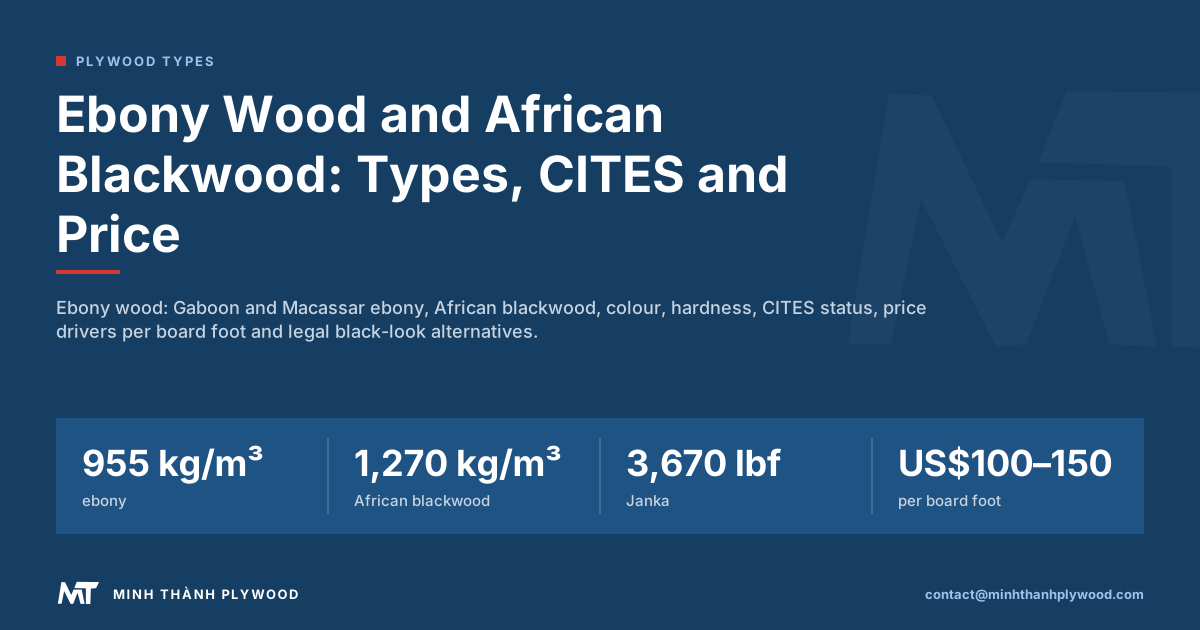
Ebony wood is the near-black, very dense heartwood of certain Diospyros trees, chiefly Gaboon ebony from West and Central Africa and the striped Macassar ebony from Indonesia. African blackwood is a different tree, Dalbergia melanoxylon, a rosewood with the same dark look and the highest density of the group. Both are scarce and priced per piece or per board foot, not per cubic metre. Minh Thanh Plywood makes furniture plywood; this guide covers the species, the price drivers, the permits and the black-look panel route.
What is ebony wood?
Ebony wood is the black or near-black heartwood of slow-growing Diospyros trees, the persimmon family. The two commercial ebonies are Gaboon ebony (Diospyros crassiflora) from Cameroon, Gabon and the Congo basin, which is jet black, and Macassar ebony (Diospyros celebica) from Sulawesi in Indonesia, which is striped black and brown.
The word comes from the Ancient Egyptian hbny, through Greek ebenos and Latin ebenus into English, and carved ebony has been found in Egyptian tombs, among them a label of the pharaoh Den from Abydos dated about 3000 BC. It is still counted among the most expensive woods in the world, with African blackwood, sandalwood and agarwood.
Ebony is so dense that it sinks in water and polishes to a glassy shine without a finish. Only the core of the trunk is black; the pale sapwood around it is cut away. That small yield, slow growth and the tendency of the wood to crack while drying make ebony one of the costliest timbers in the trade.
What are the types of ebony?
The main types of ebony are Gaboon, Macassar, Ceylon and Madagascar ebony, plus mun ebony from Southeast Asia. Only Gaboon and Macassar are in regular international trade today.
| Ebony | Botanical name | Origin | Colour | Density (dried) | Janka hardness | Trade status |
|---|---|---|---|---|---|---|
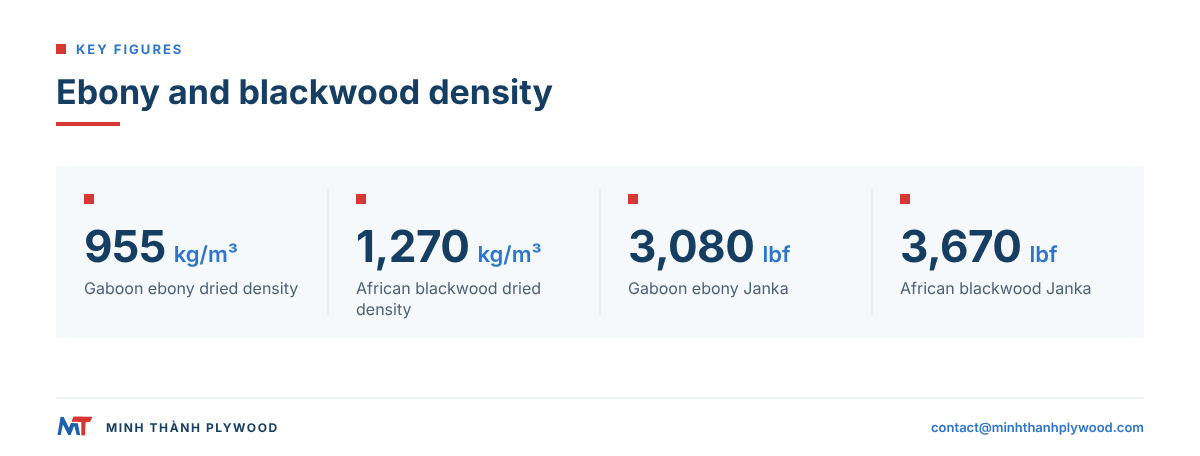
| Gaboon ebony | Diospyros crassiflora | Cameroon, Gabon, Congo basin | Jet black | about 955 kg/m³ | 3,080 lbf | Traded under national export rules |
| Macassar ebony | Diospyros celebica | Sulawesi, Indonesia | Black with brown stripes | about 1,120 kg/m³ | 3,220 lbf | Scarce; Indonesian export rules |
| Ceylon ebony | Diospyros ebenum | Sri Lanka, southern India | Jet black | very high | very high | Protected; rare in trade |
| Madagascar ebony | Diospyros spp. | Madagascar | Black | very high | very high | CITES Appendix II; exports stopped |
| Mun ebony | Diospyros mun | Laos, Vietnam | Black with brown stripes | very high | very high | Rare in trade |
Density and hardness from The Wood Database species pages for Gaboon ebony and Macassar ebony, read October 2026.
What colour is ebony wood?
Gaboon ebony is jet black, sometimes with faint grey or brown streaks; Macassar ebony is dark brown to black with lighter tan stripes. Musical-instrument buyers long paid most for “pure black” Gaboon, which led cutters to leave streaked trees standing. Instrument makers now accept streaked ebony, so more of each tree is used.
Ebony needs no stain: oil or wax alone brings up the black. Any brown patch on a supposed ebony board is either sapwood, a streak, or a sign the wood is a dyed substitute.
What is African blackwood wood?
African blackwood wood is the heartwood of Dalbergia melanoxylon, a small, crooked rosewood tree of the dry woodlands of Tanzania, Mozambique and neighbouring East and southern African countries. It is dark purple-brown to black, oily and the densest of the black woods, at about 1,270 kg/m³ and a Janka hardness of 3,670 lbf.
In Swahili it is called mpingo. Because the trees are small and twisted, the usable heartwood comes out as short billets, which suits its main use: clarinets, oboes, bagpipe chanters and flutes. The wood is stable, takes fine threads and polishes without a finish.
How do ebony and African blackwood compare?
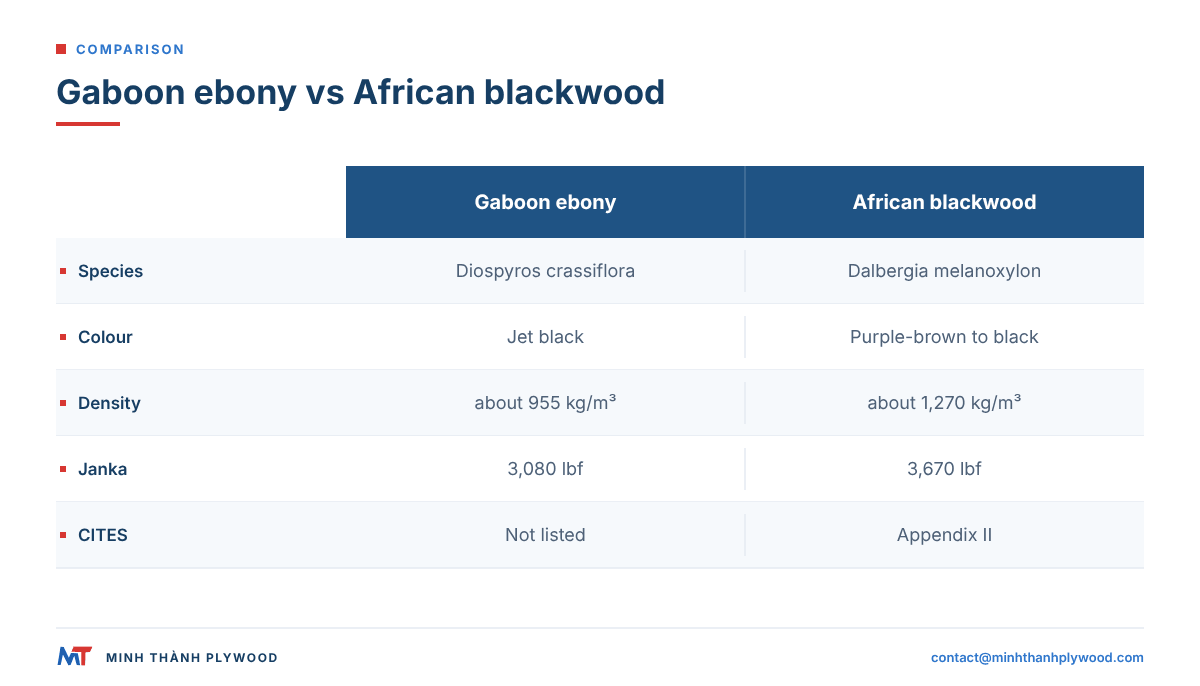
Ebony and African blackwood look alike but are different trees: ebony is Diospyros, African blackwood is Dalbergia, a rosewood. African blackwood is heavier, harder and oilier; ebony is blacker and more brittle. African blackwood is listed in CITES Appendix II with all Dalbergia; Gaboon ebony is not CITES-listed.
| Property | Gaboon ebony | African blackwood |
|---|---|---|
| Botanical name | Diospyros crassiflora | Dalbergia melanoxylon |
| Colour | Jet black | Dark purple-brown to black |
| Density (dried) | about 955 kg/m³ | about 1,270 kg/m³ |
| Janka hardness | 3,080 lbf (13,700 N) | 3,670 lbf (16,320 N) |
| Oiliness | Low | High |
| Main use | Fingerboards, piano keys, inlay | Clarinets, oboes, bagpipes |
| CITES | Not listed | Appendix II (all Dalbergia) |
| Usual sale unit | Board foot, pound, blank | Billet or blank, per piece |
African blackwood values from The Wood Database, read October 2026.
How much do ebony and African blackwood cost?
Ebony and African blackwood cost roughly US$25 to well over US$100 per board foot at dealers, and the top instrument-grade billets cost more again. In an October 2026 search, a US dealer listed Gaboon ebony lumber at US$100–150 per board foot by grade, and cost guides put African blackwood at about US$25–85 per board foot, with top grades above US$100.
These are retail search snapshots, not a market index, and much stock is sold per piece, which makes per-board-foot figures look higher. One board foot is 1/12 of a cubic foot; at 423.8 board feet per cubic metre, US$100 per board foot is about US$42,400 per cubic metre. That is around a hundred times the indicative price of furniture plywood.
What drives ebony and blackwood price?
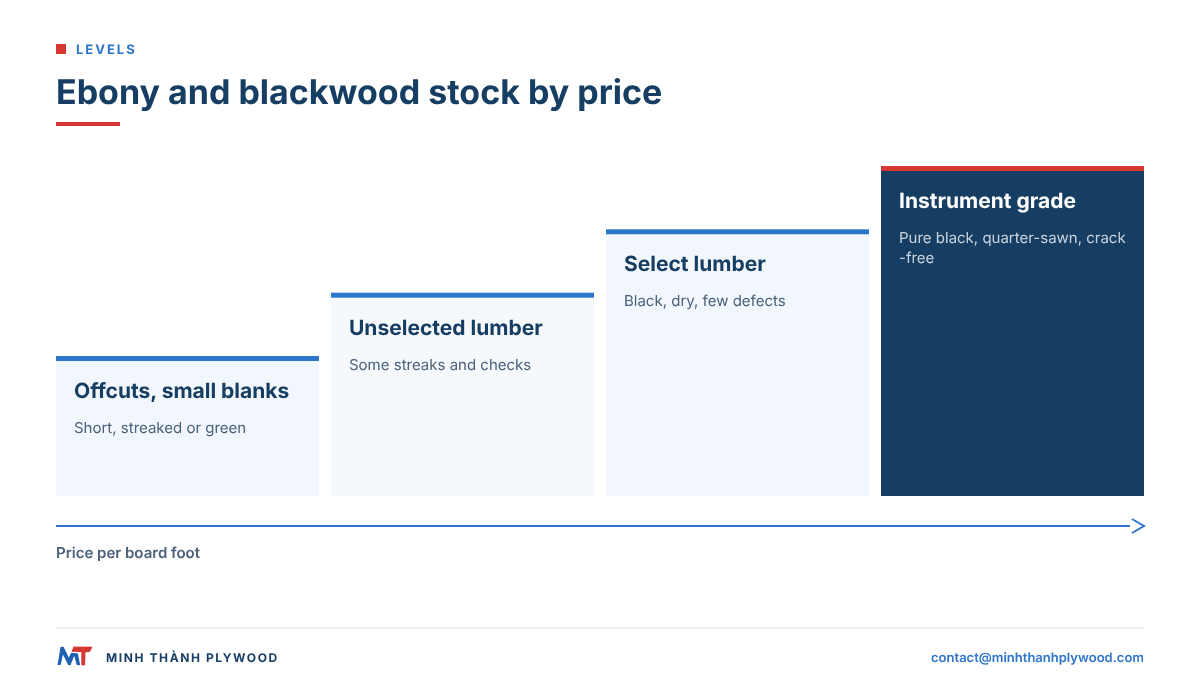
Ebony and blackwood prices are driven by colour, piece size, freedom from cracks, dryness, species and legal paperwork. A long, wide, crack-free, pure black board of Gaboon ebony is the costliest form; short, streaked or green pieces cost far less.
| Price driver | Raises the price | Lowers the price |
|---|---|---|
| Colour | Pure black, even | Streaked, brown patches |
| Size | Long, wide, thick pieces | Short blanks, offcuts |
| Defects | No checks or cracks | Checks, end splits |
| Drying | Air-dried for years, stable | Green or recently cut |
| Grade | Instrument grade, quarter-sawn | Unselected |
| Species | Macassar figure, Gaboon black | Lesser Diospyros species |
| Paperwork | Legal harvest and export permits | Unclear origin (and legal risk) |
How do CITES and export rules apply to ebony and blackwood?
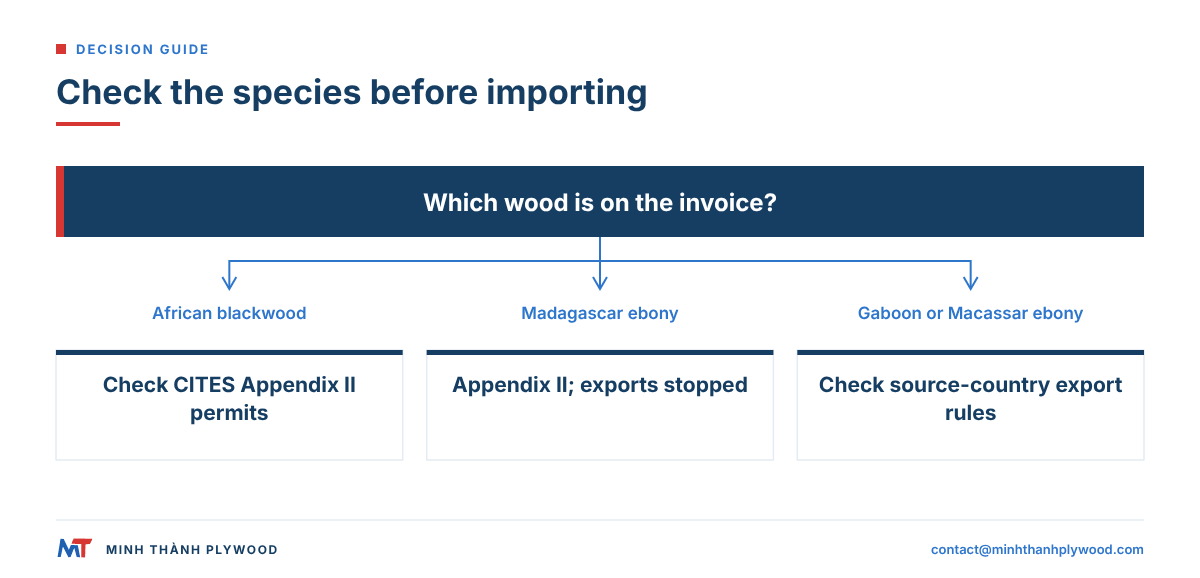
African blackwood is in CITES Appendix II as part of the genus-wide Dalbergia listing in force since 2 January 2017, so commercial shipments need CITES export permits; finished musical instruments have been exempt since November 2019. Madagascar ebony (Diospyros spp., Madagascar populations) has been in Appendix II since June 2013, and Madagascar has stopped its export. Gaboon and Macassar ebony are not CITES-listed, but source countries control their export.
For EU imports, CITES is applied by Council Regulation (EC) No 338/97 (read October 2026), and an EU import permit may be needed on top of the export permit. In the US, the Lacey Act, as amended in 1981 and 2008, makes it illegal to import wood harvested in breach of the source country’s laws. Importers file a plant and plant product declaration (APHIS form PPQ 505) naming the genus, species and country of harvest.
Ebony fingerboards are the best-known enforcement case: in 2009 the US Fish and Wildlife Service raided Gibson Guitar over ebony imported from Madagascar (a second raid in 2011 concerned wood from India), and Gibson settled in 2012. Paper from the source country, the species name on the invoice and a CITES permit where listed are what a US buyer keeps on file. Check the current listing in the CITES species database before any order.
What is black wood used for?
Black wood is used for small, precise, hard-wearing parts where the black colour or the density matters: instrument parts, piano keys, handles, inlay and turnings. Large black surfaces such as furniture fronts or wall panels are almost never solid ebony.
| Use | Wood | Why |
|---|---|---|
| Guitar and violin fingerboards | Gaboon ebony | Hard, smooth, wear-resistant |
| Piano sharps | Ebony | Black, polishes without paint |
| Clarinets, oboes, bagpipe chanters | African blackwood | Stable, oily, takes fine threads |
| Knife handles and cue butts | Ebony, African blackwood | Dense, stable, polished feel |
| Chess pieces and turnings | Ebony | Black, fine detail |
| Inlay and marquetry | Macassar ebony | Striped figure |
| Furniture fronts and wall panels | Ebony-look veneer on plywood | Black face on a stable panel |
What buyers see in US shops: retail ebony comes as small blanks. Cook Woods lists ebony pieces such as 9-1/4 × 1-15/16 × 1-13/16 in and 11-1/16 × 1-15/16 × 1-9/16 in for knife scales and turning, 10-15/16 × 1-5/16 × 1/4 in for fingerboard stock, and 31-1/16 × 2-15/16 × 7/16 in for longer inlay or pen-case strips, with free shipping over US$99. Turning and knife blanks are typically 1 to 2 in square. Any larger black surface is a veneer job, not a solid-wood one.
What are the legal alternatives to ebony?
The legal alternatives to ebony are dyed or fumed engineered veneer on plywood for panels, and dyed hardwoods such as maple or pear for solid parts. They give the black look without the cost, scarcity or permit work of real ebony.
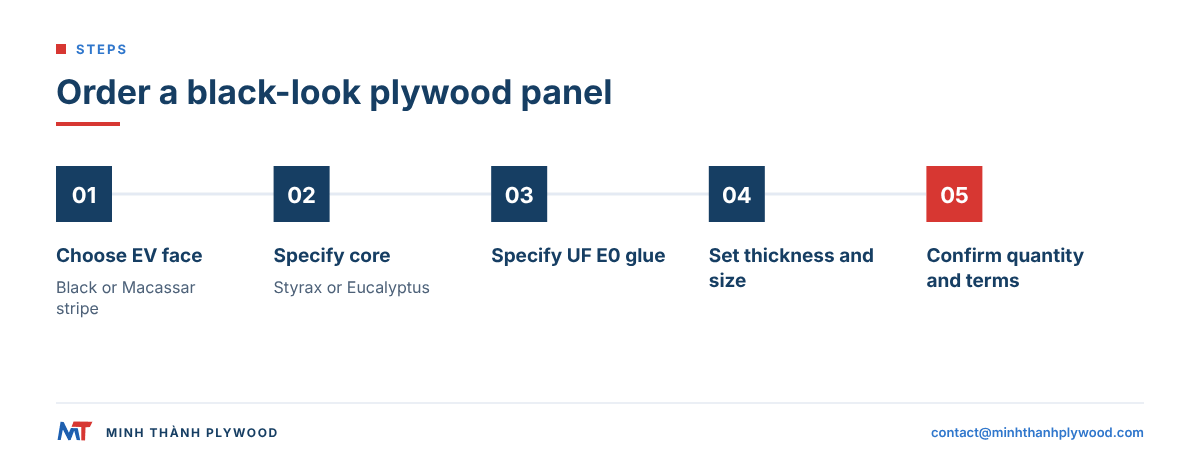
For furniture and interiors, an ebony-look panel is the practical route. Engineered veneer (EV) is veneer from fast-grown plantation wood, dyed and re-sliced to a chosen colour and grain, and it gives the same black or striped Macassar look on every sheet. Minh Thanh Plywood produces most of its faces as EV, chosen for the look the buyer orders, on white Styrax or Eucalyptus cores; see EV plywood.
What sits behind an ebony-look panel from our factory:
- UF glue at E0 emission for furniture and interior panels.
- Core layers stitched both horizontally and vertically; furniture-grade panels pressed twice, core first, then face and back.
- Sanded faces to ±0.2–0.3 mm, down to ±0.2 mm; both faces UV-ready for the buyer’s own coating.
- Thickness 3–40 mm; sizes 1220 × 2440 mm and 1250 × 2500 mm, plus custom sizes.
- Furniture and interior plywood from US$350/m³ (October 2026, indicative; face, core, glue, thickness, size and quantity set the final price).
Why does ebony crack, and how is it dried?
Ebony cracks because its very dense wood dries slowly and unevenly: the surface shrinks before the core, and end grain loses moisture many times faster than the faces. Most ebony is lost to end checks and hidden splits during drying, which is part of why clear pieces cost so much.
Dealers who sell stable ebony do four things:
- Seal the ends with wax as soon as the log is cut.
- Cut to small sizes early, so each piece dries through more evenly.
- Air-dry slowly, often for several years for instrument stock, before any kiln step.
- Store it in stable, shaded conditions until sale.
Buy ebony that has already been through this. A green board that looks perfect on arrival can open a crack weeks later in a heated workshop.
How do you work and finish ebony and African blackwood?
Work ebony and African blackwood with sharp carbide tools, light cuts and slow feed, and finish them with fine abrasives and polish rather than a thick film. Both woods are hard enough to blunt steel edges quickly and brittle enough to chip at the end of a cut.
- Cutting: carbide blades and bits, a backing board to stop tear-out, light passes.
- Gluing: wipe the surface with a solvent first on oily African blackwood, then glue at once.
- Sanding: work up through fine grits; ebony dust stains lighter woods nearby, so clean between steps.
- Finishing: buffing, a little oil or wax; the wood polishes to a shine on its own.
- Health: wear dust protection: fine dust of both woods is a known skin and breathing irritant.
How do you buy ebony or blackwood without problems?
Buy ebony or blackwood from a dealer who states the botanical name, the country of harvest and the permits, and who sells dried, inspected stock. Most problems come from cracks that open after delivery and from paperwork that does not match the species.
- Name the species: Diospyros crassiflora, D. celebica or Dalbergia melanoxylon, not “ebony” alone.
- Ask for the origin and permits: harvest country, export permit, and a CITES permit for African blackwood.
- Ask for dried stock: air-dried or kiln-dried, with ends sealed with wax.
- Inspect for cracks: end checks and hidden splits, before payment.
- Fix the colour: pure black or streaked, by photo or sample.
What should a black-look panel order say?
A black-look panel order should state face, core, glue, thickness, size and quantity. This is a spec line we can quote from:
- Face/back: EV ebony-look face (black or Macassar stripe), A/B, to an approved sample.
- Core: white Styrax or Eucalyptus.
- Glue and emission: UF glue at E0 emission.
- Thickness and size: 18 mm ±0.2 mm, 1220 × 2440 mm or 1250 × 2500 mm.
- Terms: one 40HC (MOQ), FOB Hai Phong, CFR or CIF.
Free samples let you check the black before you order. Write to contact@minhthanhplywood.com, or compare more species in types of wood.
Buyer questions, answered
What colour is ebony wood?
Gaboon ebony is jet black, sometimes with faint brown streaks. Macassar ebony is dark brown to black with lighter tan or brown stripes. The sapwood of both is pale and is cut away before sale.
What is the ebony wood tree?
Ebony comes from trees of the genus Diospyros, the persimmon family. Commercial ebony is mainly Diospyros crassiflora (Gaboon ebony, Central and West Africa) and Diospyros celebica (Macassar ebony, Sulawesi in Indonesia).
Is African blackwood an ebony?
No. African blackwood is Dalbergia melanoxylon, a rosewood from East and southern Africa. It looks like ebony and is used for the same small, precise parts, but it is a different genus and is listed in CITES Appendix II.
Why is ebony so expensive?
Ebony trees grow slowly, only a small core of each trunk is black heartwood, clear pieces are short and much of the cut is lost to cracks. Dealers sell it per board foot, per pound or per blank, often at US$100 or more per board foot.
What is African blackwood price per board foot?
African blackwood is mostly sold as blanks and billets priced per piece. Converted to a board-foot basis, dealer prices in an October 2026 search ran from about US$25 for small offcuts to over US$100 for clear, large stock.
Is ebony wood illegal?
Ebony is not banned, but Madagascar Diospyros is in CITES Appendix II and its export has been stopped by Madagascar. Gaboon ebony from Cameroon is traded under national export rules; buyers need proof of legal harvest.
Is ebony the hardest wood?
Ebony is among the hardest commercial woods: Gaboon ebony has a Janka hardness of 3,080 lbf. African blackwood is harder, at 3,670 lbf, and a few rare woods such as lignum vitae are harder still.
What is black wood used for?
Black wood such as ebony and African blackwood is used for piano keys, fingerboards, clarinets and oboes, knife handles, chess pieces, inlay and small turnings. For large black surfaces such as furniture panels, a black-look veneer on plywood is used instead.
What is a legal alternative to ebony?
Fumed or dyed engineered veneer gives a black, ebony-look face on plywood with an even colour on every sheet. For solid parts, dyed hard maple or dyed pear is used in instruments.