
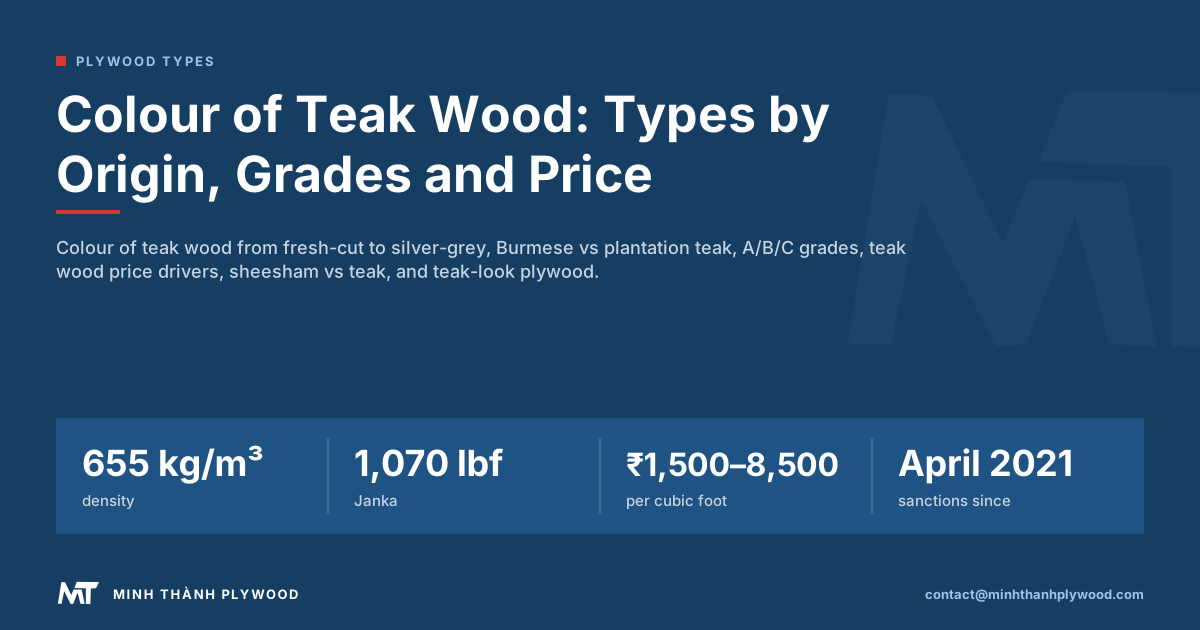
The colour of teak wood is golden to medium brown in the heartwood, with a pale yellow-white sapwood; fresh-cut heartwood can look olive and darkens to honey brown within weeks, and teak left outdoors weathers to silver-grey. Colour, oil content and price all follow the same thing: how much mature heartwood a board holds. Minh Thanh Plywood makes furniture plywood, and this guide shows how to read teak offers and where a teak-look panel does the same job for less.
What is the colour of teak wood?
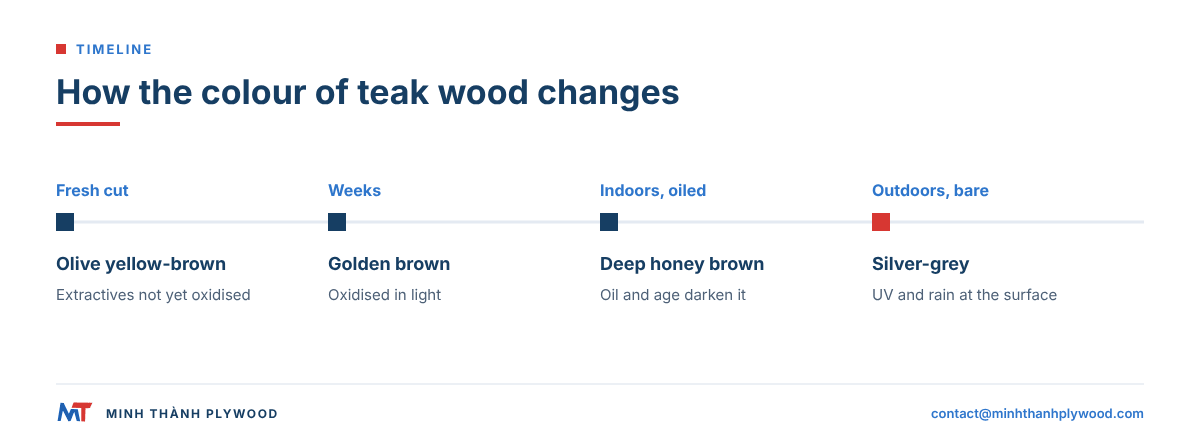
The colour of teak wood is golden to medium brown in the heartwood, often with darker brown streaks, and pale yellow-white in the narrow sapwood. The shade then moves with time and exposure: fresh-cut boards look olive, indoor teak darkens to a deep honey brown, and outdoor teak turns silver-grey.
| Stage | Colour of teak wood | What causes it |
|---|---|---|
| Freshly cut heartwood | Olive or greenish yellow-brown | Extractives not yet oxidised |
| After a few weeks in light | Golden brown | Oxidation of the extractives |
| Oiled or finished indoors | Deep honey to medium brown | Oil and age darken the surface |
| Outdoors, unfinished | Even silver-grey | UV breaks down lignin, rain washes out extractives |
| Sapwood (any stage) | Pale yellow-white to cream | No extractives; also less durable |
Colour is the fastest grade check a buyer has. A board that is golden brown edge to edge is mostly heartwood; a board with a cream stripe along one edge carries sapwood, which is lighter, softer and not durable outdoors.
What is the color of teak wood when it weathers outdoors?
The color of teak wood left outdoors without a finish is an even silver-grey, usually reached within the first year of sun and rain. The grey is a thin surface layer; underneath, the wood keeps its brown colour, its oil and its durability.
Owners choose one of two routes:
- Let it grey. No maintenance beyond washing. The silver patina is the classic look of teak decks and garden benches.
- Keep it brown. Clean the surface, then apply a teak oil or a UV-filtering teak sealer once or twice a year.
How do you keep or restore teak colour?
Keep the golden colour with a short routine, and bring grey teak back with a clean, a light sand and a fresh coat.
- Clean. Scrub with a teak cleaner and soft brush, rinse and let the wood dry fully.
- Sand lightly. Use 120-150 grit to open the grain, along the grain only.
- Test. Try the oil or stain on a hidden spot and wait for it to dry, because colour looks different on each board.
- Apply. Wipe on thin coats of oil, stain or UV-filtering sealer and remove the excess.
- Re-coat on a schedule. Outdoors, every 1 to 2 years depending on sun and rain; indoors, 5 years or more.
To turn grey teak golden again, use the same sequence: cleaner, light sand, then oil or sealer.
Teak oil, despite the name, is rarely teak’s own oil: most products are linseed or tung oil blends with driers. They darken the surface and need renewing. A sealer with UV filters holds the golden colour longer on garden furniture.
What is teak wood?
Teak wood is the timber of Tectona grandis, a large tropical hardwood tree of the mint family (Lamiaceae; formerly placed in the verbena family) native to India, Myanmar, Laos and Thailand. Its heartwood is naturally oily, rich in silica and very durable, which is why it has been used for ship decks, outdoor furniture and window frames for centuries.
Teak characteristics that matter to a buyer:
| Property | Typical value for teak | What it means in use |
|---|---|---|
| Density (dried) | about 655 kg/m³ | Medium weight, easy to handle |
| Janka hardness | 1,070 lbf (4,740 N); other sources quote 1,000-1,155 lbf | Harder than mahogany, softer than oak |
| Bending strength (MOR) | 97.1 MPa | Strong enough for frames and decks |
| Stiffness (MOE) | 12.28 GPa | Holds shape on long rails |
| Volumetric shrinkage | 7.2 % | Among the most stable hardwoods |
| Durability | Very durable heartwood | Resists rot and termites without treatment |
| Silica content | High | Dulls saw blades and planer knives fast |
Values are averages published by The Wood Database for Tectona grandis, read October 2026. Plantation teak cut young tends to sit below these figures on density and durability.
Where does teak wood come from?
Teak wood comes from natural forests in Myanmar, India, Laos and Thailand, and from plantations across the tropics. Natural-forest teak is now a small share of the trade; most teak sold for furniture and decking is plantation-grown, mainly in Indonesia, India, West Africa and Latin America.
- Myanmar (Burma): the historic source of old-growth teak and of the trade’s grading language. Exports run through Myanma Timber Enterprise (MTE).
- India: both a producer (Kerala’s Nilambur, central India’s CP teak) and the largest importer of teak logs.
- Indonesia: large state plantations on Java, the source of most Indonesian teak furniture.
- West Africa: Ghana, Benin, Togo, Nigeria and Ivory Coast export plantation teak, mostly to India.
- Latin America: Brazil, Costa Rica, Panama and Ecuador grow fast plantation teak on 20–25 year rotations.
The origin sets the colour and the price, but it does not change the species. A buyer should write the botanical name and the harvest country on separate lines of the order.
What are the types of teak wood by origin?
The types of teak wood by origin are Burmese, Indian, Indonesian, African and Latin American teak. All are Tectona grandis; they differ in tree age, growth rate and therefore heartwood share, oil content and colour.
| Type | Typical source | Colour and look | Oil and durability | Price position |
|---|---|---|---|---|
| Burmese (Myanmar) teak | Old natural forest | Even golden brown, fine straight grain | Highest oil, very durable | Highest; sanctioned in the US and EU |
| Indian teak (Nilambur, CP) | Old plantations and forest | Golden to dark brown, attractive figure | High | High in India |
| Indonesian teak | State plantations on Java | Golden brown, more colour variation | Good when mature | Middle |
| African teak | Plantations in Ghana, Benin, Togo, Ivory Coast | Lighter, more streaks, wider sapwood | Moderate when young | Low to middle |
| Latin American teak | Fast plantations in Brazil, Costa Rica, Panama | Light golden, wide growth rings | Lower, younger trees | Low to middle |
Watch the trade names. “African teak” is sometimes iroko (Milicia excelsa), and “Brazilian teak” is often cumaru (Dipteryx odorata): useful timbers, but not teak. Other Tectona species, such as T. hamiltoniana in Myanmar, are rare and not in commercial trade.
How is teak graded: Grade A, B and C?
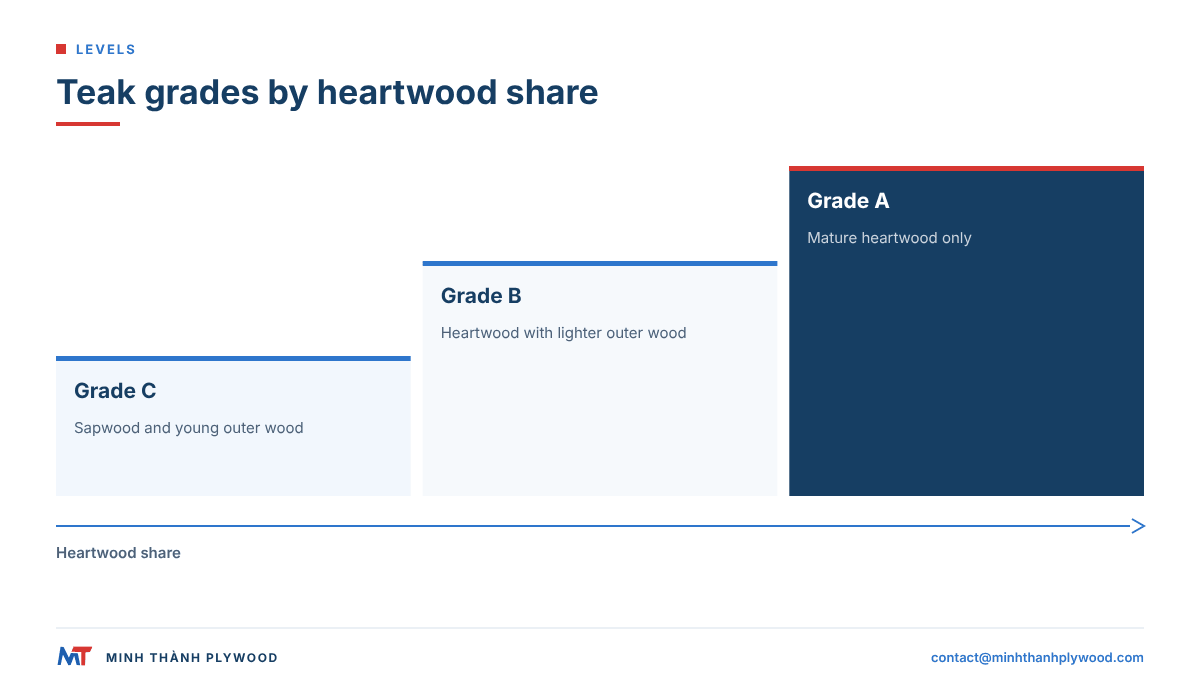
Teak furniture and lumber are commonly graded A, B and C by the share of heartwood. Grade A is all heartwood from mature trees, Grade B carries some sapwood and lighter wood, Grade C is mostly sapwood or outer wood from young trees.
| Grade | Wood | Colour | Typical use |
|---|---|---|---|
| Grade A | Mature heartwood only | Uniform golden brown | Outdoor furniture, decking, boat trim |
| Grade B | Heartwood with some lighter outer wood | Less even, lighter patches | Indoor furniture |
| Grade C | Sapwood and young outer wood | Pale, patchy, uneven | Hidden parts, low-cost items |
These letters are trade practice, not a published standard, so each seller’s Grade A can differ. For a firm order, write the limits: heartwood only on visible faces, no sapwood on outdoor parts, maximum knot size, moisture content and an approved sample. Myanmar logs use their own sawing grades (SG-1 to SG-7), which buyers of sawn teak also meet.
Which teak variety is best?
Old-growth Burmese teak is still the reference: the most even colour, the narrowest growth rings and the highest oil content. Since 2021 it is off the table for US and EU buyers, so the best teak a legal buyer can order is mature plantation teak, Grade A, all heartwood.
How to pick between legal sources:
- Outdoor furniture and decking: mature Indonesian or Indian plantation teak, Grade A heartwood only.
- Indoor furniture: Grade A or B plantation teak; the colour difference matters less under a finish.
- Boat decks: quarter-sawn Grade A strips; many builders now use teak-look alternatives to cut cost and weight.
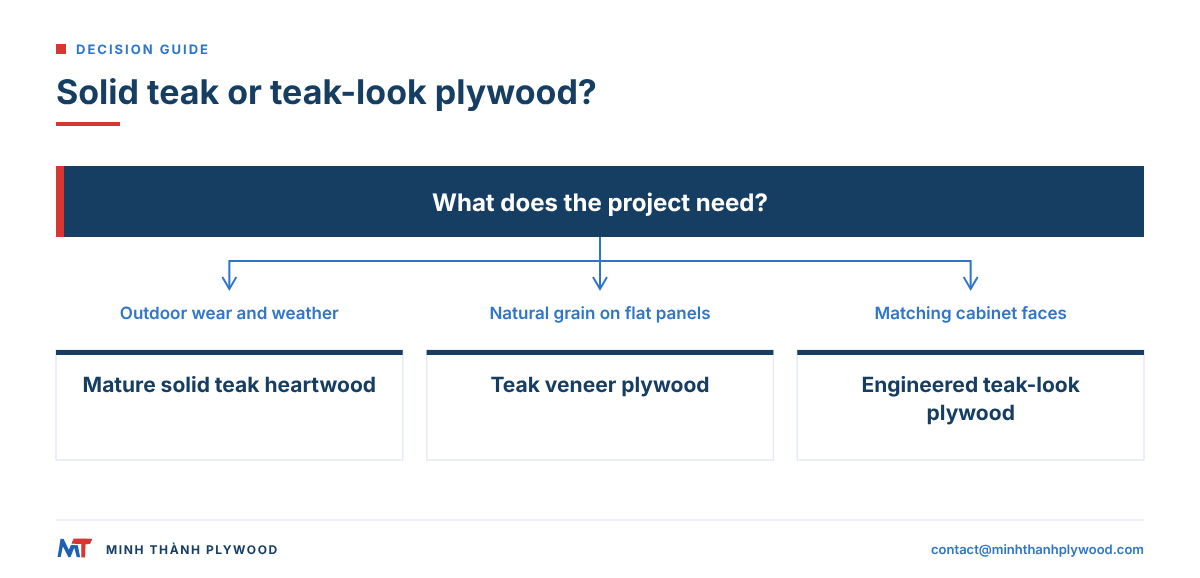
- Panels and cabinet faces: teak veneer or an engineered teak-look veneer on plywood, rather than solid boards.
What drives teak wood price?
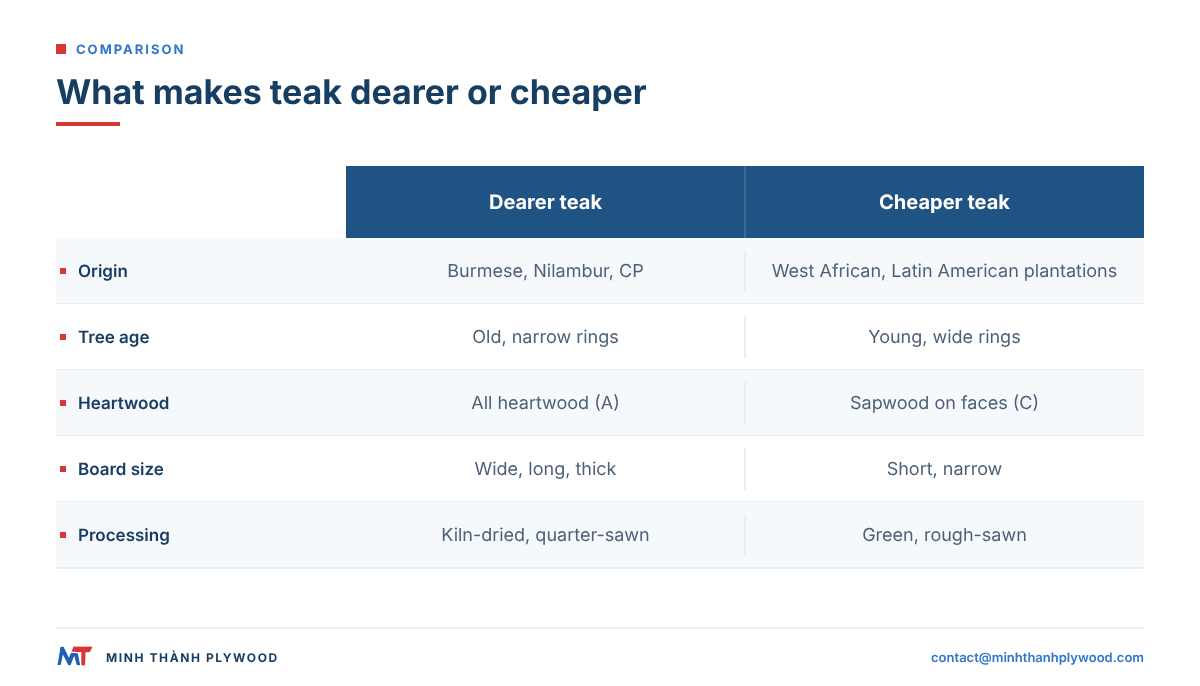
Teak wood price is set by origin, tree age, heartwood share, board size and grade. Old-growth Burmese and Indian teak sits at the top, young plantation teak from West Africa and Latin America at the bottom, and wide, long, clear boards cost far more per unit volume than short narrow ones.
| Price driver | Raises the price | Lowers the price |
|---|---|---|
| Origin | Burmese, Nilambur, CP teak | West African and Latin American plantations |
| Tree age | Old trees, narrow rings | Young trees, wide rings |
| Heartwood share | All heartwood (Grade A) | Sapwood on faces (Grade C) |
| Board size | Wide, long, thick boards | Short, narrow pieces |
| Processing | Kiln-dried, planed, quarter-sawn | Green, rough-sawn |
| Legality paperwork | Full chain-of-custody records | Unclear origin (and legal risk) |
US prices. In the United States, teak lumber retails at roughly US$7-41 per board foot, with plantation teak and short or sapwood-heavy boards at the low end and old-growth, all-heartwood (FAS) boards at the top. Vermont Woods Studios quotes the same range, and a Janka figure of 1,155 lbf for its teak, which is why Janka values for teak differ by source and origin: slow-grown old trees test harder than young plantation trees.
Teak is sold by the cubic metre in the log and sawn timber trade, by the cubic foot in India and by the board foot in North America. One cubic metre is 35.31 cubic feet, or 423.8 board feet.
Sheesham wood vs teak wood: which should you choose?
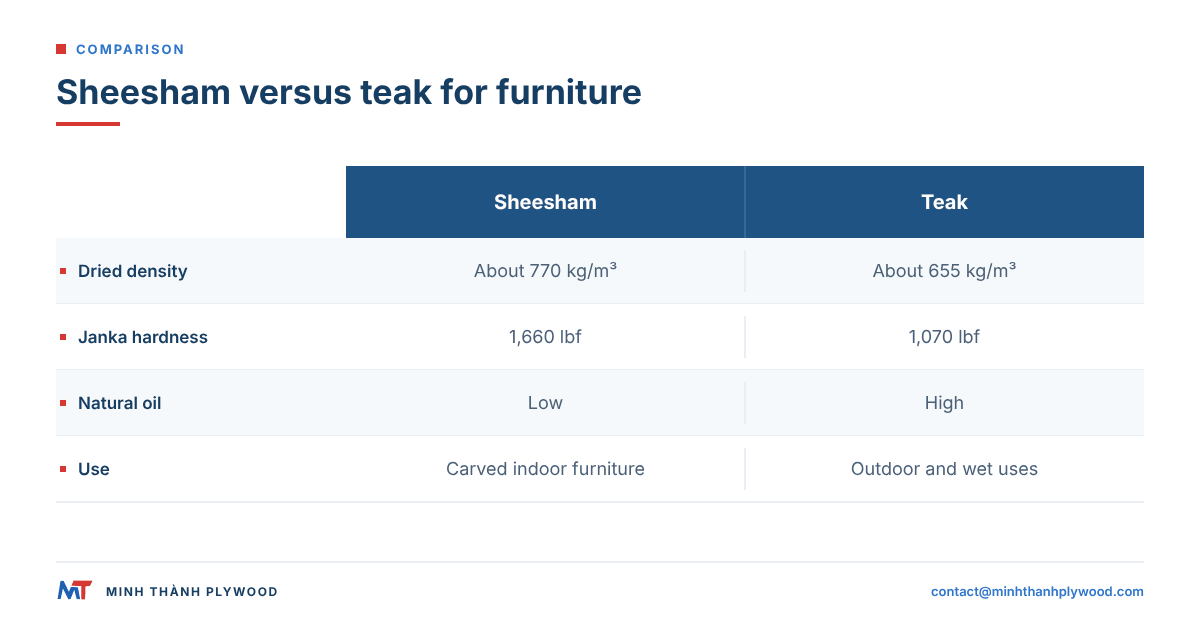
Choose sheesham for heavy, carved indoor furniture and teak for anything outdoors, wet or on a boat. Sheesham wood is harder and darker; teak wood is more stable, oilier and more weather-resistant.
| Property | Sheesham (Dalbergia sissoo) | Teak (Tectona grandis) |
|---|---|---|
| Colour | Golden to deep brown, darker streaks | Golden to medium brown |
| Density (dried) | about 770 kg/m³ | about 655 kg/m³ |
| Janka hardness | 1,660 lbf | 1,070 lbf |
| Natural oil | Low | High |
| Outdoors | Needs a finish and shelter | Very durable unfinished |
| Movement | Moderate | Very low |
| Price in India | Usually lower than good teak | Higher |
| Trade rules | CITES Appendix II (Dalbergia) | Not CITES-listed |
Sheesham is a rosewood, and its export from India runs under CITES rules; see sheesham wood and rosewood for the permit side.
What is the teak wood rate in India?
The teak wood rate in India runs from about ₹1,500 to ₹8,500 per cubic foot in seller listings, by origin and grade. In an October 2026 snapshot of a large Indian B2B marketplace, Ivory Coast teak was offered at about ₹1,500, Hunsur teak at about ₹3,500, Nagpur teak at about ₹4,500, Indian teak at about ₹5,350 and Burma teak at up to ₹8,500 per cubic foot.
These are asking prices, not traded prices, and they mix sizes and grades. Use them to rank origins, then ask for a quotation per cubic foot on your own size, grade and moisture content. Converted at 35.31 cubic feet per cubic metre, ₹4,500 per cubic foot is about ₹158,900 per cubic metre.
What can teak wood be used for?
Teak wood is used where wood meets water, sun and wear: boat decks and trim, outdoor and garden furniture, decking, window and door frames, bathroom fittings, cutting boards and high-end indoor furniture. Thin teak veneer extends it to cabinet faces, wall panels and yacht interiors.
| Use | Why teak works | Grade to ask for |
|---|---|---|
| Boat decks and trim | Oily, stable, non-slip when weathered | Grade A, quarter-sawn |
| Outdoor furniture | Very durable heartwood, no treatment | Grade A |
| Decking | Rot- and termite-resistant | Grade A or B, heartwood |
| Windows and doors | Low movement | Grade A or B |
| Bathroom and sauna fittings | Holds up to humidity | Grade A |
| Indoor furniture | Colour and figure | Grade B |
| Wall panels and cabinet faces | Look of teak at low wood use | Teak veneer or teak-look veneer on plywood |
For a comparison with acacia, eucalyptus and iroko outdoors, read best wood for outdoor furniture.
Can Burmese teak still be imported?
New Burmese teak cannot be imported into the US or the EU in practice. The US Treasury sanctioned Myanma Timber Enterprise, the state seller of Myanmar teak, on 21 April 2021, and the EU followed in June 2021; EU authorities have since treated timber exported from Myanmar as illegal under EU timber rules.
For EU buyers, the EU Deforestation Regulation (Regulation (EU) 2023/1115, read October 2026) adds geolocation of the harvest plot for wood products placed on the market, which plantation teak with good records can meet. The Commission states that the regulation applies from 30 December 2026 for large and medium operators and from 30 June 2027 for other micro and small operators (European Commission, EUDR, checked on 27 October 2026). Ask a teak supplier for the plantation, the harvest country and the chain-of-custody documents before price talks. Check the current sanction lists with your customs broker before any order of teak from older stock.
Is there teak plywood, and what does a teak-look panel cost you?
Yes: teak plywood is a panel with a thin sliced teak veneer, usually 0.3–0.6 mm, on a hardwood or softwood core. It gives a teak face on cabinets, wall panels and yacht interiors with a small fraction of the teak a solid board needs.
A second route is engineered veneer (EV): veneer from fast-grown plantation wood, dyed and re-sliced to a chosen grain and colour, including teak-look patterns. EV gives the same colour on every sheet, which natural teak cannot, and it avoids the origin questions of teak logs. Minh Thanh Plywood produces most of its faces as EV, chosen for the look the buyer orders, on white Styrax or Eucalyptus cores; see EV plywood.
What sits behind a teak-look panel from our factory:
- UF glue at E0 emission for furniture and interior panels.
- Core layers stitched both horizontally and vertically, and furniture-grade panels pressed twice: core pressed and calibrated, then face and back pressed on.
- Thickness 3–40 mm, sanded to ±0.2–0.3 mm, down to ±0.2 mm.
- CARB P2 / TSCA Title VI certification (ICTT mill no. 23024) for US orders. The US limit for hardwood plywood with a veneer core is 0.05 ppm under 40 CFR 770.10.
- Furniture and interior plywood from US$350/m³ (October 2026, indicative; face, core, glue, thickness, size and quantity set the final price).
What should a teak or teak-look order say?
A teak order should name the species, origin, grade, colour limits and moisture content; a teak-look plywood order should name the face, core, glue, thickness and size. Without these lines, “Grade A teak” or “teak plywood” can mean three different products.
For solid teak:
- Species and origin: Tectona grandis, plantation, harvest country.
- Grade: heartwood only on visible faces; sapwood limits for hidden parts.
- Colour: golden brown to an approved sample; no cream sapwood on outdoor parts.
- Moisture content: kiln-dried for indoor use.
- Documents: chain of custody, and EUDR geolocation for EU orders.
For a teak-look panel we can quote from:
- Face/back: EV teak-look face, A/B, to an approved sample.
- Core: white Styrax or Eucalyptus.
- Glue and emission: UF glue at E0 emission.
- Thickness and size: 18 mm ±0.2 mm, 1220 × 2440 mm or 1250 × 2500 mm.
- Quantity: one 40HC (MOQ), FOB Hai Phong, CFR or CIF.
Free samples let you match the face colour before the order. Send your spec line to contact@minhthanhplywood.com, or start from the types of wood guide to compare teak with other species.
Buyer questions, answered
What is the natural colour of teak wood?
Teak heartwood is golden to medium brown, sometimes with darker brown streaks; the sapwood is pale yellow-white. Freshly cut heartwood can have an olive or greenish cast that turns golden brown after a few weeks in light.
Why does teak turn grey?
Sunlight breaks down lignin at the surface and rain washes out the brown extractives, so unfinished teak outdoors weathers to an even silver-grey. The wood under the grey layer is unchanged; sanding or a teak cleaner brings the brown back.
Where does teak wood come from?
Teak (Tectona grandis) is native to India, Myanmar, Laos and Thailand. Most teak traded today is plantation-grown in Indonesia, India, West Africa (Ghana, Benin, Togo, Ivory Coast) and Latin America (Brazil, Costa Rica, Panama, Ecuador).
Which teak is the best?
Old-growth Burmese teak has the most uniform golden colour, the highest oil content and the narrowest growth rings. Among legal sources today, mature plantation teak with a high heartwood share, sold as Grade A, comes closest.
Which teak wood is most expensive?
Burmese (Myanmar) teak and old Indian teak such as Nilambur and CP teak sit at the top of the price range. In an October 2026 marketplace snapshot, Burma teak was offered at up to ₹8,500 per cubic foot, against about ₹1,500 for Ivory Coast teak.
Is sheesham better than teak?
Sheesham is harder and darker, so it suits carved and heavy indoor furniture. Teak is more stable and naturally oily, so it is the better choice outdoors, in bathrooms and on boats.
Is plantation teak real teak?
Yes. Plantation teak is the same species, Tectona grandis. It is cut younger, so it has more sapwood, wider growth rings, a lighter and less even colour and less natural oil than old-growth teak.
What colour is teak polish?
Teak polish or teak stain is a warm golden to reddish brown, sold to make other woods look like oiled teak. On real teak, a clear teak oil deepens the natural honey colour without adding pigment.
Is there teak plywood?
Yes. Teak plywood carries a thin sliced teak veneer on a hardwood or softwood core. Engineered veneer (EV) faces give a teak look at a lower cost and with a repeatable colour from sheet to sheet.
Can Burmese teak be imported into the US or EU?
Teak sold by Myanma Timber Enterprise has been under US sanctions since April 2021 and EU sanctions since June 2021. Importers in both markets treat new Myanmar teak as a no-go.