
Fir plywood vs spruce plywood is a trade-off between stiffness and weight: Douglas fir is the stiffer, harder structural panel, spruce the lightest and palest, and pine sits between them with more resin and knots. All three are softwood plywood for sheathing, floors and site work. Minh Thanh Plywood makes pine-faced panels, so this guide compares the three from a maker's bench.
Fir plywood vs spruce plywood vs pine: the short answer
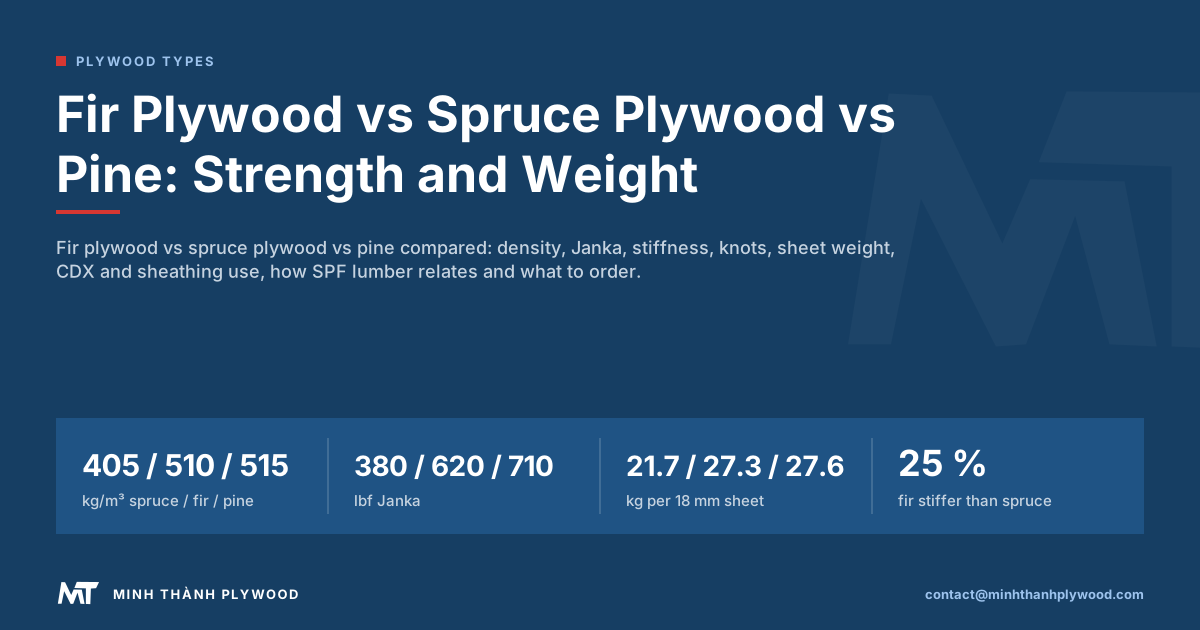
Fir plywood vs spruce plywood comes down to stiffness against weight. Douglas fir plywood is the stiffer, harder structural panel; spruce plywood is the lightest and palest; pine plywood sits between them, heavier and harder than spruce, with more resin and knots, and its strength depends on which pine.
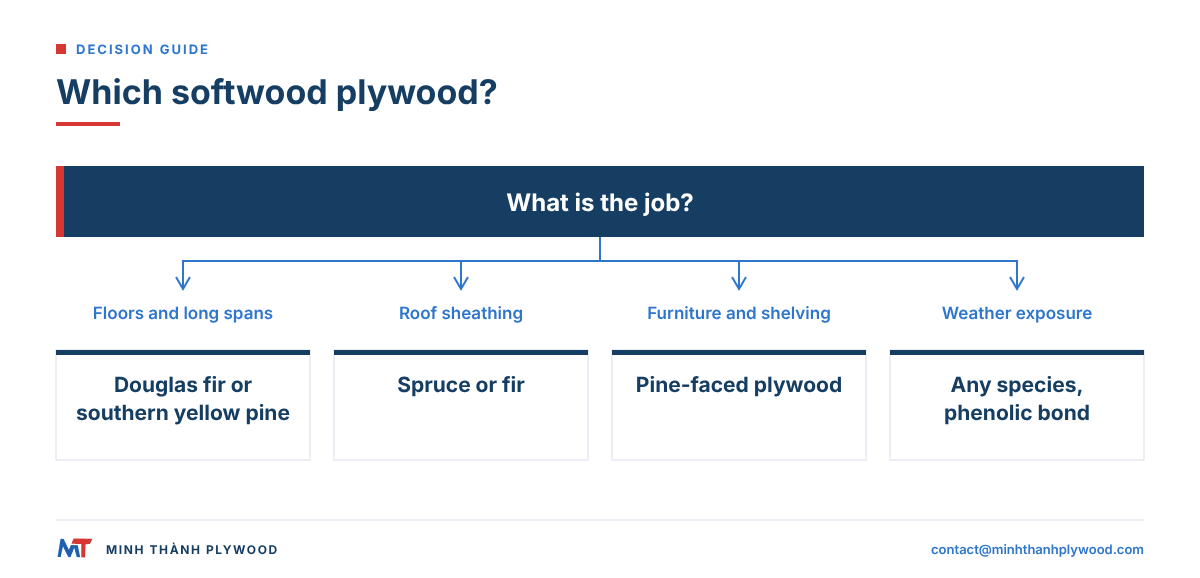
- Floors and long spans: Douglas fir, or dense southern yellow pine.
- Roof and wall sheathing: spruce or fir; spruce is lighter to lift.
- Painted or clear-finished panels: pine-faced plywood with an A or B face.
- Concrete forms and site use: any of the three with a phenolic bond.
- Light panelling and crates: spruce or radiata pine.
The sections below give the numbers for each species, a comparison table, and how to specify each one.
What is spruce plywood?
Spruce plywood is softwood plywood made from spruce veneers, mostly Norway spruce in Northern Europe and white or black spruce in Canada. It is light, pale and fairly soft, with small, tight knots, and is used mainly for roof and wall sheathing, floors, packaging and site work.
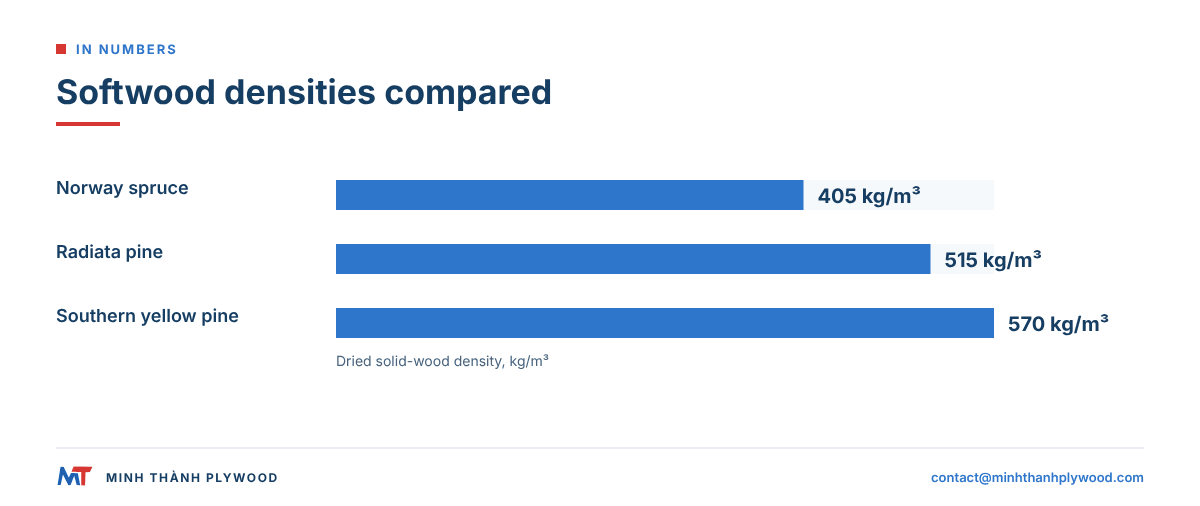
- Norway spruce: about 405 kg/m³ dried, Janka about 380 lbf (1,680 N).
- Sitka spruce: about 425 kg/m³, Janka about 510 lbf (2,270 N), the stiff, light spruce of aircraft and boats.
- Look: creamy white to pale yellow, with small knots and little resin.
- Common builds: structural sheathing panels, often with an exterior glue.
All solid-wood values in this guide come from The Wood Database, averaged for dried wood at 12 % moisture (Norway spruce, read 20 October 2026).
What is pine plywood?
Pine plywood is softwood plywood made from pine veneers, and “pine” covers species that behave quite differently: radiata pine from plantations in New Zealand and Chile, southern yellow pine from the US South, slash pine (elliottii) from plantations in South America, and Scots pine in Europe.
- Radiata pine: about 515 kg/m³, Janka about 710 lbf, stiffness about 10.06 GPa.
- Southern yellow pine (loblolly): about 570 kg/m³, Janka about 690 lbf, stiffness about 12.30 GPa.
- Scots pine: about 550 kg/m³, Janka about 540 lbf, stiffness about 10.08 GPa.
- Look: yellow to light brown, with visible resin, larger knots and a strong grain.
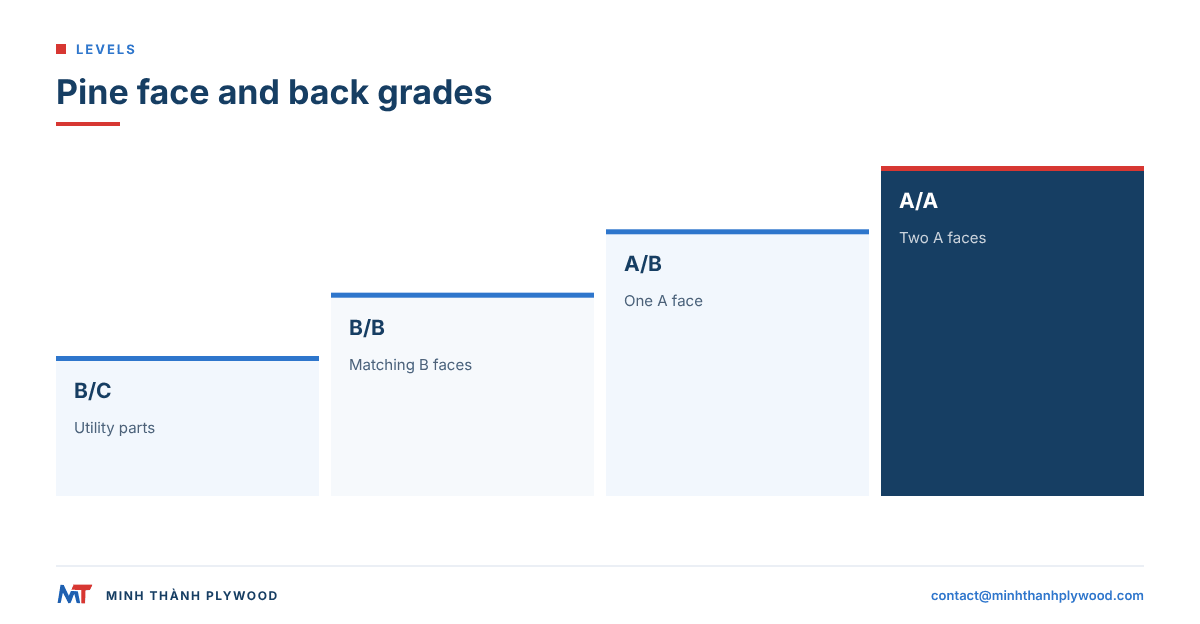
Pine faces also go onto hardwood cores: our pine-faced panels are quoted as face/back pairs A/A, A/B and B/B (B/C for utility parts), matched to the approved sample. That ladder is comparable to the European softwood face classes I to IV and the US A to D grades.
What is fir plywood?
Fir plywood almost always means Douglas fir plywood, made in the US Pacific Northwest and British Columbia. Douglas fir is not a true fir, but it is the benchmark structural softwood: about 510 kg/m³ dried, Janka about 620 lbf (2,760 N), bending strength about 86.2 MPa and stiffness about 12.17 GPa.
- Strength: high stiffness at a moderate weight.
- Look: reddish-brown latewood bands, a strong rotary-cut figure that can raise under paint.
- Grading: in North America, A to D veneer grades under the US Voluntary Product Standard PS 1, and Douglas fir plywood (DFP) under CSA O121 in Canada.
- Uses: floors, roofs, walls, concrete forms and structural panels.
True firs (balsam, white and grand fir) are lighter and softer, and are usually sold within mixed species groups rather than as “fir plywood”.
Softwood plywood comparison table: spruce, pine and fir
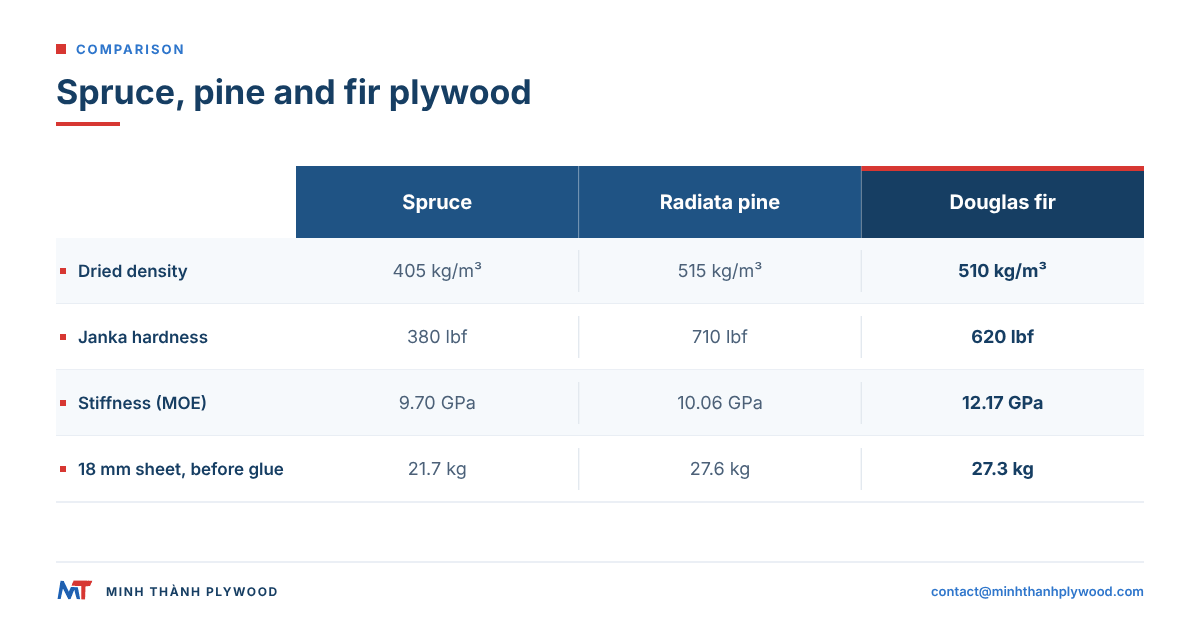
This table compares spruce, pine and fir one metric per row. Solid-wood values are averages for dried wood at 12 % moisture from The Wood Database; sheet weights are computed for a 1220 × 2440 × 18 mm sheet (0.0536 m³) at the wood’s average density, before glue.
| Metric | Norway spruce | Radiata pine | Southern yellow pine | Douglas fir |
|---|---|---|---|---|
| Average dried density | 405 kg/m³ | 515 kg/m³ | 570 kg/m³ | 510 kg/m³ |
| Janka hardness | 380 lbf (1,680 N) | 710 lbf (3,150 N) | 690 lbf (3,070 N) | 620 lbf (2,760 N) |
| Bending strength (MOR) | 63.0 MPa | 79.2 MPa | 88.3 MPa | 86.2 MPa |
| Stiffness (MOE) | 9.70 GPa | 10.06 GPa | 12.30 GPa | 12.17 GPa |
| Sheet weight, 18 mm, before glue | 21.7 kg | 27.6 kg | 30.5 kg | 27.3 kg |
| Knots | Small, tight | Larger, some loose | Larger, resinous | Fewer, sound |
| Resin | Little | Some | High | Some |
| Colour | Creamy white | Pale yellow | Yellow to orange-brown | Reddish-brown bands |
| Typical plywood use | Sheathing, light floors | Sheathing, furniture, packing | Floors, sheathing | Floors, roofs, forms |
Read the table by job. For stiffness per kilogram, Norway spruce and Douglas fir are nearly equal in these solid-wood averages. For the lightest sheet, spruce wins. For hardness and screw holding at a moderate weight, radiata pine is the strongest softwood face here. Southern yellow pine is the heaviest and close to fir in stiffness.
Spruce vs fir plywood
Spruce vs fir plywood is a choice between a lighter, paler, softer panel and a stiffer, harder, heavier one. Douglas fir is about a quarter denser than Norway spruce, about 60 % harder on the Janka scale and about 25 % stiffer, so the solid wood is stiffer and more dent-resistant; allowable plywood spans still depend on the panel’s grade and layup.
| Point | Spruce plywood | Fir plywood |
|---|---|---|
| Weight | Lighter | Heavier |
| Stiffness | Lower | Higher |
| Surface | Pale, smooth, small knots | Strong grain, can raise under paint |
| Best for | Roofs, walls, light floors | Floors, long spans, forms |
| Common origin | Northern Europe, Canada | US Pacific Northwest, Canada |
Where a building code or engineer specifies a span rating, both species are made to meet it, often at different thicknesses. Match the rating first, then choose the species by weight and finish.
What are the differences between pine plywood and spruce plywood?
Spruce vs pine plywood is a choice between light and clean (spruce) and harder and more resinous (pine). Radiata pine is about 27 % denser than Norway spruce and nearly twice as hard on the Janka scale, so it holds screws and resists dents better; spruce is lighter, paler and has less resin to bleed through paint.
| Point | Spruce plywood | Pine plywood |
|---|---|---|
| Density | 405 kg/m³ (Norway spruce) | 515 kg/m³ (radiata) to 570 kg/m³ (southern yellow) |
| Hardness | 380 lbf | 540 to 710 lbf |
| Knots | Small, tight | Larger |
| Resin | Little | More; can bleed through paint |
| Finish | Pale, even | Yellow, strong grain |
| Typical use | Sheathing, packaging | Sheathing, furniture, shelving, packing |
For general building, the two are often interchangeable at the same rating. For furniture, shelving and visible panels, pine faces are chosen far more often because of their hardness and warm look.
Fir vs pine plywood
Fir vs pine plywood depends on which pine. Douglas fir is stiffer and more uniform than radiata pine (about 12.17 against 10.06 GPa), and about equal to southern yellow pine in stiffness, while southern yellow pine is heavier and more resinous. Radiata pine is the hardest face of the three and the easiest to finish.
- Choose Douglas fir for structural floors and roofs where stiffness per weight matters.
- Choose southern yellow pine where it is the local structural panel; it is dense and strong.
- Choose radiata or other plantation pine for furniture, shelving, packing and painted or clear-finished faces.
- Watch for raised grain: fir’s hard latewood bands can show through paint; pine’s resin can bleed.
Spruce vs pine: the wood itself
As solid wood, spruce is lighter, softer and paler than pine, with smaller knots and less resin; pine is heavier, harder and more yellow. Scots pine, the common European pine, averages about 550 kg/m³ and 540 lbf Janka, against about 405 kg/m³ and 380 lbf for Norway spruce.
- Spruce: little colour difference between heartwood and sapwood; dull lustre; low resin.
- Pine: distinct reddish heartwood in Scots pine; resin canals; stronger smell when cut.
- Telling them apart: pine’s resin and darker heartwood; spruce’s even pale colour and small, tight knots.
These differences carry through to plywood faces, which is why spruce sheathing looks pale and plain and pine faces look warmer and more figured.
How SPF lumber relates to softwood plywood
SPF (spruce-pine-fir) is a Canadian group of softwood species, mainly white spruce, lodgepole pine and balsam fir, sold and graded together as framing lumber because their strength is similar. SPF is lumber, not plywood, but Canadian softwood plywood (CSP, made under CSA O151) draws on many of the same species.
- SPF lumber: studs, joists and rafters, grade-stamped for structural use.
- CSP: Canadian softwood plywood from mixed softwood veneers, often spruce and pine.
- DFP: Douglas fir plywood under CSA O121.
- In the US: structural plywood under PS 1, by species group and span rating.
If a drawing calls for SPF framing and plywood sheathing, the two are separate line items with separate grades.
CDX, sheathing and structural grades
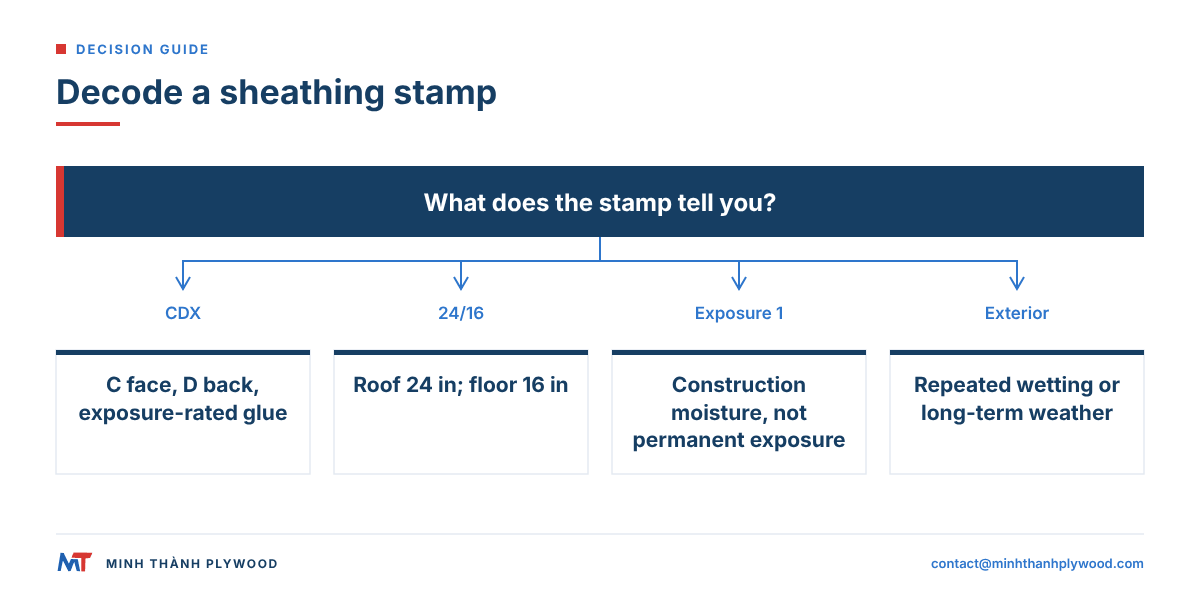
CDX is a grade, not a species: a C face, a D back and a glue rated for exposure during construction. CDX panels are made from Douglas fir, southern pine, spruce or mixed softwoods, and are used for roof, wall and floor sheathing that will be covered.
| Grade term | What it means |
|---|---|
| A, B, C, D | Veneer grades from best (A) to roughest (D) |
| CDX | C face, D back, exposure-rated glue |
| Sheathing | Structural panel rated for roofs, walls or floors |
| Exterior | Glue and veneers suited to permanent outdoor exposure |
| Span rating | Maximum support spacing for roof or floor use |
| Exposure 1 | Fully waterproof bond, for panels that see weather during construction but not permanent exposure |
| Exposure 2 | Not a bond classification in current PS 1-22 |
A span rating is two numbers stamped on a US sheathing panel: the first is the maximum support spacing in inches for roofs, the second for subfloors, so 24/16 is a roof panel for 24 in spacing and a floor panel for 16 in. The APA span-rating sheet pairs them with typical thicknesses (APA span ratings, read 21 October 2026):
| Span rating | Typical thickness | Typical use |
|---|---|---|
| 24/16 | 7/16 in | Roof sheathing at light spans, floors at 16 in |
| 32/16 | 15/32 or 1/2 in | Roofs and walls, subfloor at 16 in joists |
| 40/20 | 19/32 or 5/8 in | Roofs and subfloor at 20 in |
| 48/24 | 23/32 or 3/4 in | Subfloor at 24 in joists |
Roof sheathing is commonly cited from 3/8 in at the minimum (Family Handyman, checked on 21 October 2026), but local building codes decide, so check them before ordering. For current structural plywood, PS 1-22 specifies Exposure 1 for construction moisture and similar conditions, and Exterior for repeated wetting or long-term weather exposure.
In Europe the structural test is different: designers calculate spruce plywood for construction to Eurocode 5, as makers such as UPM WISA (checked on 21 October 2026) state for their spruce panels. The panels carry the CE2+ marking under EN 13986. M1 is the Finnish low-emission class that appears beside CE2+ on those panels.
Our exterior and CDX-type panels use utility C/D face and back appearance with water-resistant melamine-fortified or phenolic (WBP) glue, for outdoor uses such as stair treads and wall sheathing. See our guide to exterior plywood grades for the full ladder.
Cost: fir vs spruce vs pine plywood
Douglas fir plywood usually costs more than spruce or SPF-group sheathing, and pine sits between them. The gap comes from the log: fir peels into larger, cleaner veneer and carries higher span ratings at the same thickness, spruce is the economy sheathing face, and plantation pine is the volume species in Asia and South America. The grade, the glue and the thickness move the price as much as the species does.
| Price driver | Cheaper | Dearer |
|---|---|---|
| Species | Spruce or SPF group | Douglas fir |
| Face grade | C or D utility | A or B sanded |
| Glue | Interior bond | Exposure 1 or exterior |
| Thickness | Thin sheathing | Heavy subfloor panels |
| Order size | Full container | Small mixed lots |
We do not publish a sheet price list. As a reference, furniture and interior plywood from our factory starts from US$350/m³ (October 2026), and pine-faced panels are quoted by grade pair and glue on the same basis.
Environmental impact: which softwood plywood is greener?
All three species are fast-growing softwoods from managed or plantation forests, so the environmental difference lies in the certificate and the glue, not in the tree. Spruce and fir come mostly from natural and managed northern forests, pine from plantations. Ask for chain-of-custody (FSC or PEFC) when the buyer’s project needs it, and for the emission class of the glue. We supply the EUDR compliance dossier (origin records and geolocation files) with orders, and CARB P2 / TSCA Title VI covers formaldehyde for US buyers.
Water, glue and outdoor use: does the species matter?
For water resistance, the glue matters far more than the species: spruce, pine and fir plywood with a phenolic (WBP) or exterior-rated bond all resist repeated wetting without the plies separating, and all three need a finish to keep the wood itself dry. The species decides how the wood behaves once water gets in.
- Spruce: little natural decay resistance; keep it covered, painted or behind cladding.
- Douglas fir: heartwood with moderate natural durability, still not rated for ground contact untreated.
- Pine: the sapwood takes preservative treatment well, which is why pressure-treated pine is common for outdoor timber.
- All three: seal edges and screw holes; end grain draws water fastest.
- Interior glue: whatever the species, a panel with interior UF glue is for dry use only.
When a panel will see weather, specify the bond first, the finish second and the species third. A spruce panel with a phenolic bond, painted and sealed, outlasts a bare pine panel with interior glue every time.
Which softwood plywood for which job?
Choose softwood plywood by the job: stiffness and span for floors, weight for roofs, face quality for visible work, and glue for anything wet. This verdict table sums up the comparison.
| Job | Best choice | Why |
|---|---|---|
| Subfloors and long spans | Douglas fir or southern yellow pine | Highest stiffness |
| Roof sheathing | Spruce or fir | Light to lift, rated spans |
| Wall sheathing | Any rated panel | Covered, rating matters most |
| Concrete forms | Any species, phenolic bond | Glue and coating decide reuse |
| Furniture and shelving | Pine-faced plywood | Harder face, warm look |
| Painted panels | Pine with an A or B face | Sound face; seal resin knots |
| Packing and crates | Spruce or pine, utility grade | Low cost, adequate strength |
Pine plywood from Vietnam: what we make
Our softwood face is pine: pine-faced panels on white Styrax or Eucalyptus cores for furniture, interiors and packing, and pine cores made on order. Pine faces are quoted as A/A, A/B and B/B face/back pairs (B/C for utility parts), matched to the buyer’s approved sample.
| Specification | Our pine-faced panels |
|---|---|
| Face grades | A/A, A/B, B/B; B/C for utility parts |
| Core | White Styrax or Eucalyptus; Pine and Acacia on order |
| Glue and emission | UF glue at E0 emission; MR or phenolic (WBP) by order |
| Thickness | 3–40 mm |
| Sizes | 1220 × 2440 and 1250 × 2500 mm; custom sizes on order |
| Moisture | 8–12 % at dispatch |
Furniture plywood from our factory starts from US$350/m³ and commercial plywood from US$250/m³ (October 2026), by face, core, glue, thickness, size, quantity and delivery term. See our pine plywood page for the full specification.
What to write on a softwood plywood order
A softwood plywood order that can be quoted names the species or face, grade, glue, thickness, size and use. Send these lines:
- Application: sheathing, flooring, furniture, packing or formwork.
- Face species and grade: for example pine A/B, or C/D utility for sheathing.
- Core: white Styrax, Eucalyptus or pine.
- Glue: UF glue at E0 emission for interiors; MR or phenolic (WBP) for damp or outdoor use.
- Size and thickness: for example 1220 × 2440 × 18 mm.
- Packing and quantity: from one 40HC, mixed specifications by agreement; destination port.
Production is 15–45 days after the 30% deposit, FOB Hai Phong, CFR or CIF, with free samples. Read our guide to hardwood vs softwood plywood for core choices, the hardwood plywood guide for the hardwood side, and how to bend plywood for curved work.
Buyer questions, answered
Is fir plywood stronger than spruce plywood?
Compare the actual panel grades and layups. Douglas fir's solid-wood averages are higher than Norway spruce's for density, hardness and stiffness, but those averages are not design values for the finished plywood.
What is the difference between pine plywood and spruce plywood?
Pine plywood is heavier and harder, with more resin and larger knots; spruce plywood is lighter, paler and softer, with small, tight knots. Pine holds screws better; spruce is easier to handle and cut.
What are the key differences between fir and pine plywood?
Douglas fir plywood is stiffer and more even in strength, with a strong grain figure. Pine plywood varies by species: radiata pine is softer and lower in stiffness, southern yellow pine is denser and close to fir in strength.
Is spruce or pine better for plywood?
Spruce is better where low weight and a pale, clean face matter, such as roof sheathing and light panelling. Pine is better where hardness, screw holding or a face for paint or clear finish matter.
Is CDX plywood fir, spruce or pine?
CDX can be any of them. CDX names the grade (a C face, a D back and an exposure-rated glue), not the species; in North America it is commonly Douglas fir or southern pine, and spruce in Canada.
What is SPF lumber?
SPF stands for spruce-pine-fir, a group of Canadian softwood species sold and graded together as framing lumber because their strength is similar. It is lumber, not plywood, though Canadian softwood plywood uses many of the same species.
Which softwood plywood is the lightest?
Spruce plywood is the lightest of the three. A 1220 × 2440 × 18 mm sheet at Norway spruce's average density weighs about 21.7 kg before glue, against about 27.3 kg for Douglas fir and 27.6 kg for radiata pine.
Can pine plywood be used outdoors?
Yes, when it is bonded with a phenolic (WBP) or exterior glue and its edges and faces are sealed. The glue class decides outdoor use, not the species.
Is spruce plywood good for subfloors?
Yes. Spruce plywood rated for structural use is a common subfloor and roof panel in Canada and Northern Europe; check the span rating and thickness for your joist spacing.
What face grades does pine plywood come in?
Our pine-faced panels are quoted as face/back pairs A/A, A/B and B/B, with B/C for utility parts, matched to the buyer's approved sample.
What do Exposure 1 and Exposure 2 mean on plywood?
PS 1-22 classifies structural plywood as Exposure 1 or Exterior. Exposure 1 covers construction moisture and similar conditions; Exterior covers repeated wetting or long-term weather exposure. Exposure 2 is not a current PS 1-22 bond classification.
Is fir plywood more expensive than spruce or pine plywood?
Usually yes. Douglas fir panels cost more than spruce or SPF-group sheathing, with pine in between. Grade, glue and thickness move the price as much as the species.
What does a 24/16 span rating mean on plywood?
The first number is the maximum support spacing in inches for roof use and the second is the maximum for subfloor use, so a 24/16 panel spans 24 in on a roof and 16 in as a floor.