
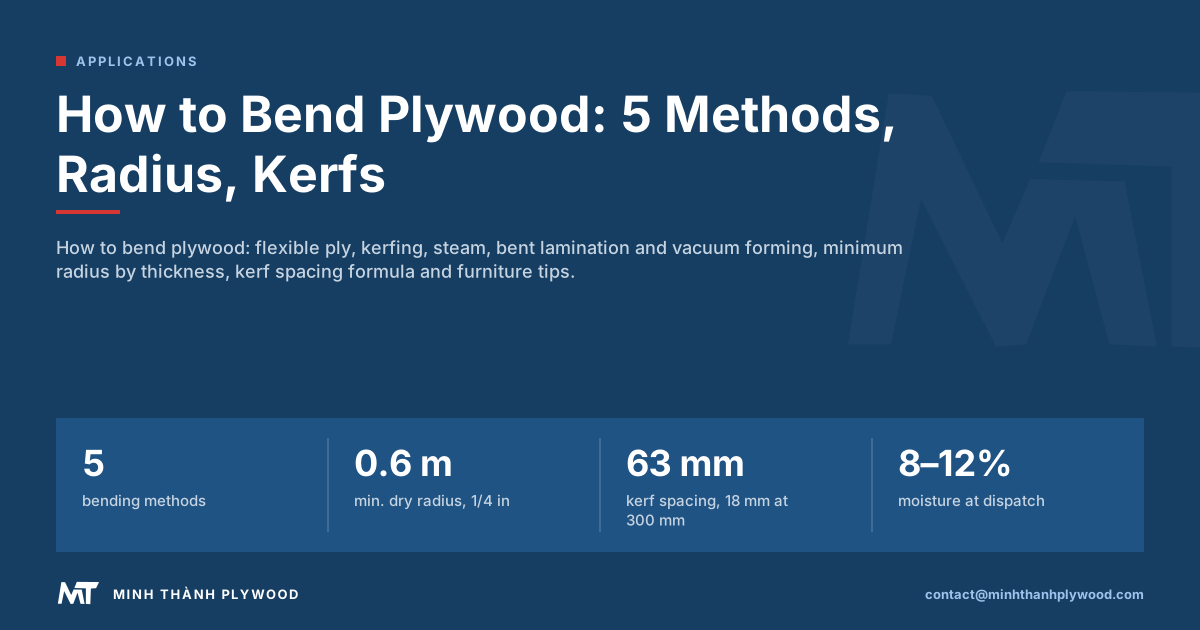
You bend plywood in one of five ways: buy flexible plywood, cut kerfs in the inside face, soften thin sheets with steam or hot water, glue thin layers over a former, or press them in a vacuum bag. The right method follows from the radius and the thickness. Minh Thanh Plywood, a furniture plywood manufacturer in Phu Tho, explains each method with the numbers a workshop needs.
What are the ways to bend plywood?
Five methods bend plywood, and the radius you need decides which one works. A gentle curve takes a dry sheet; a tight curve needs flexible plywood, kerfs, steam or thin glued layers.
| Method | How it works | Typical radius | Best for | Show face |
|---|---|---|---|---|
| Dry bend | Fix a standard sheet over ribs | Large: about 0.6 m and up at 6 mm | Wall linings, counters, curved panels | Smooth |
| Flexible plywood | Sheet built to bend by hand | Tight, by thickness | Reception desks, columns, display units | Smooth |
| Kerfing | Saw cuts close up on the inside face | Tight on thick sheets | Rigid curved panels, cases, skirts | Smooth outside, cut inside |
| Steam or hot water | Moisture and heat soften the plies | Tighter than dry | Thin sheets, one-off parts | Smooth after drying |
| Bent lamination | Thin layers glued over a former | Tight and repeatable | Chair seats, backs, arms | Smooth, any veneer |
| Vacuum bag | Atmospheric pressure holds layers on the former | Tight, any shape the former has | Short runs, compound curves | Smooth |
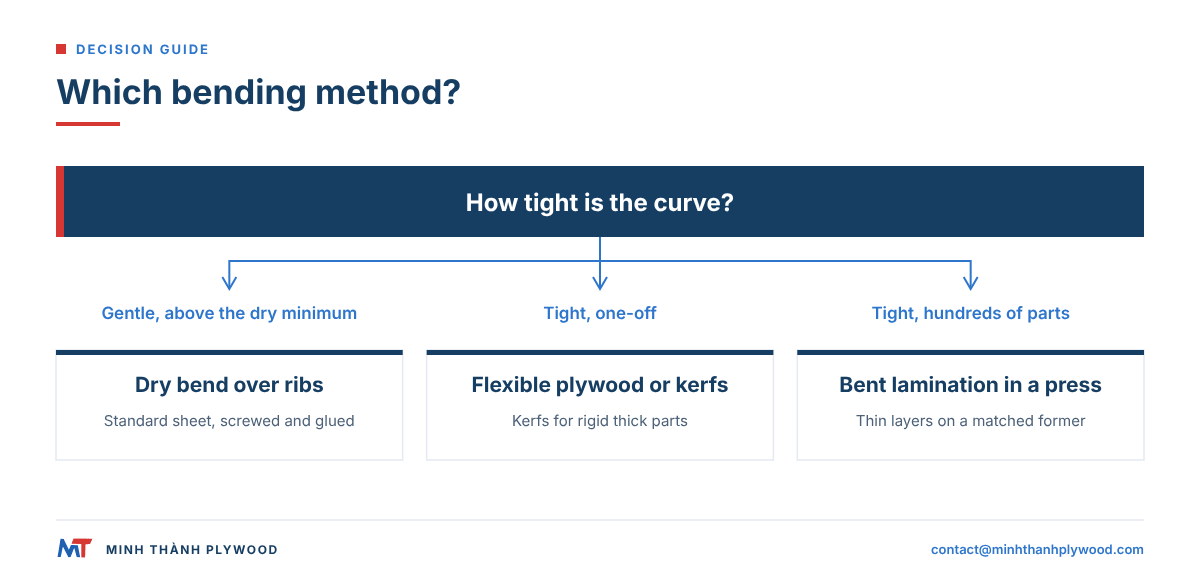
Choose by the part: a one-off counter front takes flexible plywood or kerfs; a run of 500 chair backs takes bent lamination in a press.
How to bend plywood: the steps for any method
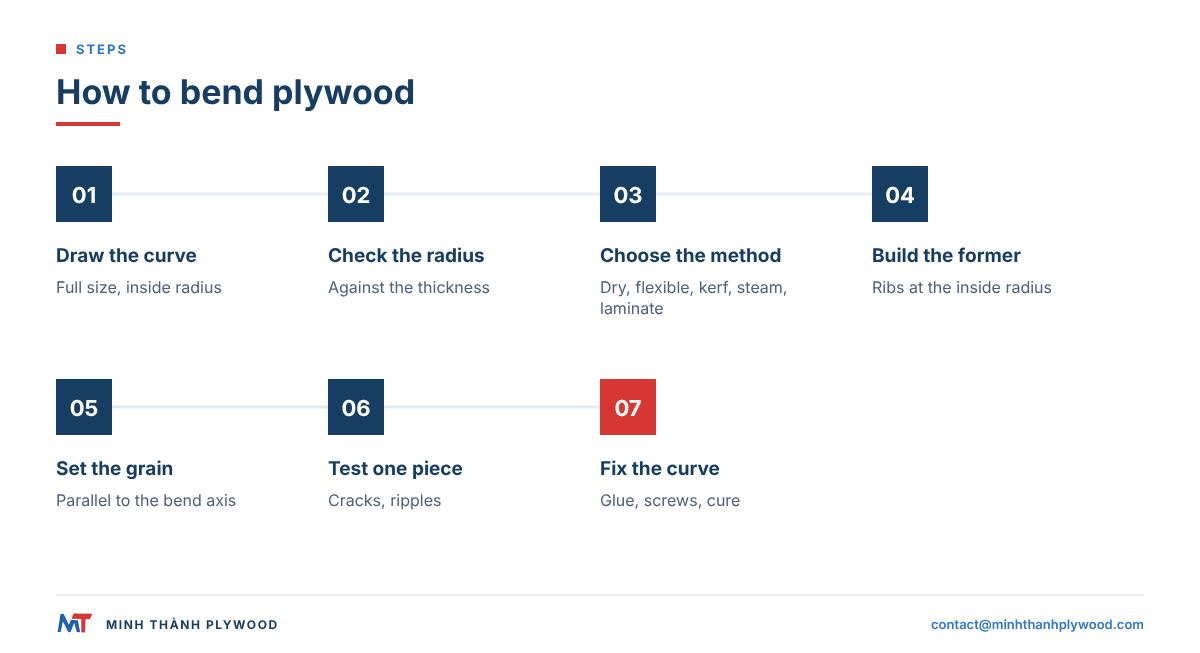
The same seven steps apply whichever method you pick. Draw the curve, pick the method, then prove it on one piece before cutting the whole order. Check the minimum radius for the sheet thickness first, set the face grain parallel to the bend axis where the design allows, and bend a test piece before you fix the curve.
- Draw the curve at full size and mark the inside radius.
- Check the minimum radius for the sheet thickness against the table below.
- Choose the method: dry, flexible plywood, kerfs, steam or lamination.
- Build the former or ribs to the inside radius, with a spring-back allowance for laminations.
- Set the grain direction: face grain parallel to the bend axis wherever the design allows.
- Bend a test piece and check for cracks on the outside face and ripples on the inside.
- Fix the curve: screw and glue to the ribs, glue the kerfs, or let the laminate cure fully before release.
What is the minimum bend radius for plywood?
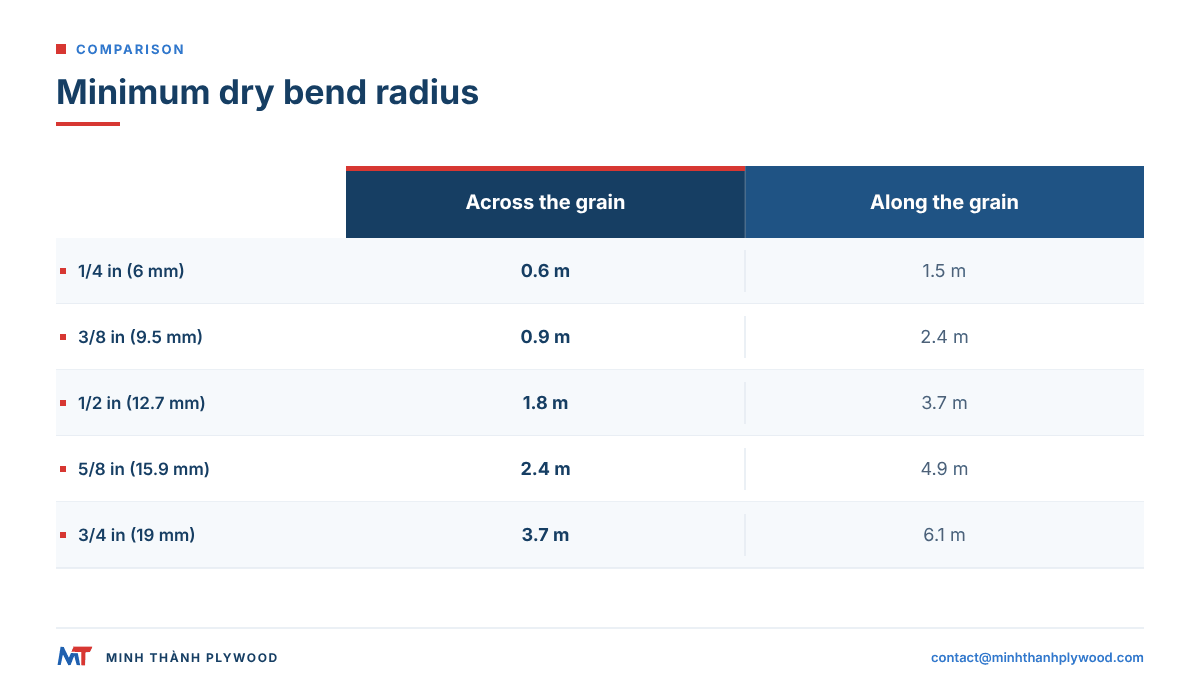
The minimum radius grows with thickness. Thin plywood bends to well under a metre dry; an 18 mm sheet needs several metres unless it is kerfed, steamed or replaced by thinner layers.
Published minimums for dry, standard plywood (APA bending data, converted to metres):
| Panel thickness | Bent across the grain | Bent along the grain |
|---|---|---|
| 1/4 in (about 6 mm) | 0.6 m | 1.5 m |
| 3/8 in (about 9.5 mm) | 0.9 m | 2.4 m |
| 1/2 in (about 12.7 mm) | 1.8 m | 3.7 m |
| 5/8 in (about 15.9 mm) | 2.4 m | 4.9 m |
| 3/4 in (about 19 mm) | 3.7 m | 6.1 m |
“Across the grain” means the face grain runs parallel to the bend axis, so the face veneer does not have to stretch along its fibres. The source notes that an occasional panel can still crack at these radii, so build the former a little larger for a production run. Wetting or steaming allows a tighter radius, and flexible plywood goes far tighter than any figure in the table.
Which plywood is best for bending?
The best plywood for bending is thin, made with plies that bend easily and bonded with a glue that suits the method. Three types cover most work.
- Flexible plywood: built to bend by hand, sold as long-grain (bends across the short side) or cross-grain (bends across the long side). Our sibling guide on flexible plywood covers long-grain versus cross-grain in detail.
- Thin plywood, 3–5 mm: stiff enough to handle, thin enough for laminations and gentle dry bends. Ours is always 5-ply, with a 3 mm sheet built from one core veneer, two cross-band veneers and two faces.
- Standard furniture plywood, 12–18 mm: bends only over a large radius dry, so it is kerfed for tight curves.
What thickness and size of flexible plywood do US shops sell?
US shops sell flexible plywood in 1/8, 3/16 (5 mm), 1/4 and 3/8 in thicknesses, in two sheet orientations that decide the bend direction. A 4 × 8 ft sheet is long-grain, sold as “column” stock: it curls across its 4 ft width and stands 8 ft tall. An 8 × 4 ft sheet is cross-grain, sold as “barrel” stock: it curls along its 8 ft length, stands 4 ft tall and wraps round like a barrel. The two sizes differ in the direction the sheet bends, so order the one that matches your curve.
| Thickness | Metric | Typical minimum radius, easy direction | Typical minimum radius, cross direction |
|---|---|---|---|
| 1/8 in | 3 mm | about 6 in (150 mm) | about 18 in (450 mm) |
| 3/16 in | 5 mm | about 10 in (250 mm) | about 24 in (600 mm) |
| 1/4 in | 6 mm | about 12 in (300 mm) | about 30 in (750 mm) |
| 3/8 in | 9 mm | 12 to 18 in (300 to 450 mm) | about 43 in (1100 mm) |
These are starting points from supplier charts: the Columbia Forest Products radius-bending panel publishes a 12 in minimum in 3/8 in stock, and a manufacturer chart gives the 1/8, 3/16 and 3/8 in rows. The 1/4 in row is interpolated between them. Trial one piece first, as the values differ by maker.
For US-bound sheets, ask for the formaldehyde proof. The limit is 0.05 ppm for veneer-core hardwood plywood under CARB Phase 2 and under TSCA Title VI (40 CFR 770.10). US sellers list their bending panels as TSCA Title VI compliant. Six ASTM D6007 chamber tests on our panels, April 2025 to June 2026 on 9, 15 and 18 mm sheets, averaged 0.014 to 0.032 ppm.
Pick the face for the finish. A lacquered curve shows the face veneer, so poplar, birch, okoume or engineered veneer (EV) faces are chosen for looks; a curve that will be laminated or painted can take a utility face.
How to curve plywood with kerfs
Kerfing curves thick plywood by cutting a row of saw cuts across the inside face, leaving a thin skin on the outside. When the sheet bends, the cuts close and the skin takes the curve.
The kerf spacing formula:
spacing = kerf width × (inside radius + kerf depth) ÷ kerf depth
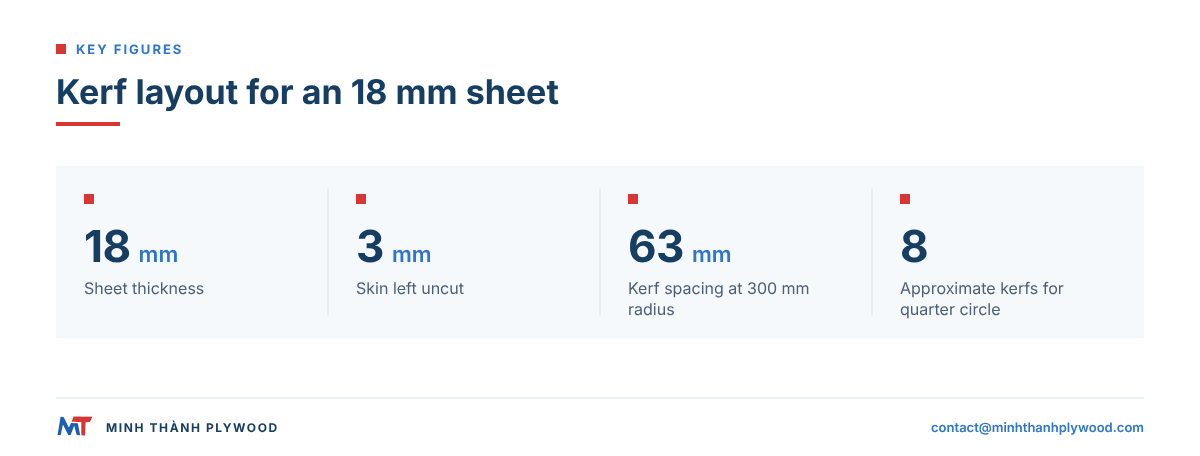
Worked example for an 18 mm sheet, cut to leave a 3 mm skin:
| Input | Value |
|---|---|
| Kerf width (saw blade) | 3 mm |
| Kerf depth | 15 mm |
| Inside radius | 300 mm |
| Spacing | 3 × 315 ÷ 15 = 63 mm |
| Kerfs for a quarter circle | about 8 |
The same example in inches, for a 3/4 in sheet and a 1/8 in saw blade: leave a skin of 1/16 in, so the kerf depth is 11/16 in (0.6875 in). For a 12 in inside radius the spacing is 0.125 × (12 + 0.6875) ÷ 0.6875 = 2.3 in, about 2 5/16 in. Leaving 1/32 in of skin instead (kerf depth 23/32 in) tightens the spacing to 2.2 in. Woodworking guides advise leaving 1/32 to 1/64 in of skin for tight bends and cutting spacing within 1/32 to 1/16 in of the target.
The quarter-circle count comes from bend angle × kerf depth ÷ kerf width: 1.571 × 15 ÷ 3 = 7.9, rounded up to 8.
How do you test kerf spacing without the formula?
Cut one kerf near the end of an offcut, clamp the board down on one side of the cut and lift the free end until the kerf closes. Measure along the board from the kerf to the point where you want the centre of the curve, then measure how far the end has risen at that distance: that rise is the kerf spacing for that radius. The test includes the real blade width and the real ply build, so it is the safest check before cutting a full sheet.
What makes kerfing go wrong?
Kerfs show through the face when the skin is too thin, so the face telegraphs ridges, and the skin cracks when it is too thick. Uneven thickness is the hidden cause: if the sheet varies, a fixed saw depth leaves a skin that varies too. Our sanded furniture panels are calibrated to ±0.2–0.3 mm, which keeps the skin even along the sheet. Fill the closed kerfs with glue, or glue a thin veneer over the inside face, to lock the curve.
Plywood steam bending and hot water: does it work?
Plywood steam bending works on thin sheets. Steam or hot water softens the wood so the sheet takes a tighter curve than it would dry, and it keeps the curve once it dries clamped on the former.
How to do it:
- Use thin stock: 3–6 mm sheets respond well; thick sheets take long to heat through.
- Check the bond: water softens a standard interior glue line, so use a sheet with a water-resistant bond for steaming.
- Steam or soak: a steam box near 100 °C, or towels and hot water for a short bend. A common rule for solid wood is about one hour of steaming per 25 mm of thickness; thin plywood needs far less.
- Bend at once over the former and clamp every few centimetres.
- Dry on the former until the sheet is back to room moisture, then release.
The BSI description of BS EN 314-2 defines bonding-quality requirements for plywood, and the BSI description of BS EN 636 covers plywood for dry, humid or exterior conditions. Ask the mill which bond and class its steaming sheets carry.
Steaming raises the moisture of the wood, and the part shrinks as it dries. Leave it on the former until it reaches the moisture of the room it will live in. Furniture plywood leaves our mill at 8–12% moisture, the normal range for indoor furniture.
How is wood bent in furniture plants? Bent lamination
Wood is bent in furniture plants mainly by bent lamination: thin veneers or thin sheets are glued and pressed over a former, and the cured glue line fixes the curve. This is how moulded chair seats, backs and arms are made.
- Cut the layers from veneer or thin plywood, a little oversize.
- Lay up with glue on each joint; most layers run the same way along the curve, with cross layers where the part needs stiffness across.
- Press over a matched male and female former, or in a vacuum bag.
- Cure fully: heat speeds a resin glue line, cold glue needs longer.
- Trim and sand to the final outline.
Spring-back is small when the layers are thin and the glue is rigid. Thicker layers spring back more, so the former is made slightly tighter than the final radius and proved on the first parts. Our guide on curved and moulded plywood covers seats and bent components.
Bending plywood for furniture: what decides a good curved part?
Bending plywood for furniture succeeds when the radius, the face and the glue suit the finish the buyer will see. A curved part is judged on its outside face, so face quality and flatness before bending matter as much as the bend.
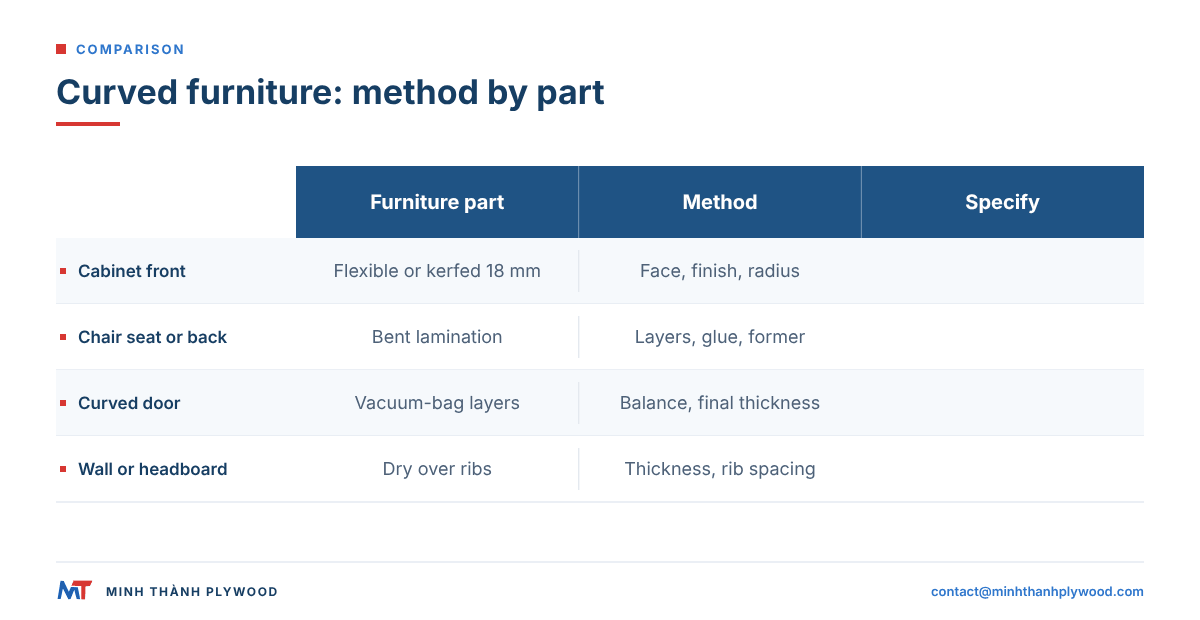
| Furniture part | Usual method | What to specify |
|---|---|---|
| Curved cabinet or reception desk front | Flexible plywood or kerfed 18 mm | Face species and grade, finish side, radius |
| Chair seat and back | Bent lamination | Veneer species, layer count, glue, former drawing |
| Curved drawer or door panel | Thin layers in a vacuum bag | Face both sides, balance, thickness after pressing |
| Bed head or wall panel | Dry bend over ribs | Thickness, rib spacing, face grade |
| Display or column cladding | Flexible plywood | Long-grain or cross-grain, sheet size |
A sanded, flat face takes lacquer evenly on a curve. Our furniture panels are pressed twice as standard: the core board is pressed and calibrated, then the faces are pressed on, which gives a flat face and an even thickness to work from.
How do you bend plywood with a former and clamps?
A former is the shape the plywood is bent around, and clamps or straps hold the sheet on it while the glue cures or the sheet dries. A good former decides whether the curve is true.
- Build it from stacked MDF or plywood ribs, cut to the inside radius and faced with thin hardboard so the curve is smooth.
- Space the ribs closely for thin or flexible sheets, so the face does not flatten between them.
- Use cauls or a matching outer former to spread clamp pressure along the curve.
- Ratchet straps pull a sheet round a large former when there are too few clamps.
- Wax or tape the former so squeezed-out glue does not stick the part to it.
How to bend a full sheet of plywood
To bend a full sheet, screw it to curved ribs over a radius the sheet can take dry, or build the curve from two thinner sheets. Two 9 mm layers bend more easily than one 18 mm sheet and end up as stiff once glued together on the ribs.
Steps for a full curved wall or counter:
- Set the ribs at the curve, close enough that the sheet does not flatten between them.
- Bend the first thin layer and screw it to each rib.
- Spread glue and bend the second layer over it, joints staggered from the first.
- Screw or clamp until the glue cures, then fill and sand.
A 1220 × 2440 mm sheet bent across its short side follows a curve 2440 mm long; bent across its long side, a 1220 mm curve. Order the sheet so the face grain lies the way the bend needs.
What can go wrong when you bend plywood?
Most failures come from a radius too tight for the method, the wrong grain direction or a weak glue line. Each shows a clear sign.
| Problem | Sign | Fix |
|---|---|---|
| Radius too tight | Cracks across the outside face | Larger radius, thinner sheet, flexible plywood or steam |
| Wrong grain direction | Splits along the face grain | Turn the sheet so grain runs parallel to the bend axis |
| Kerf skin too thin | Ridges telegraph through the face | Shallower kerfs or a veneer over the inside |
| Uneven thickness | Kerf skin varies, curve has flats | Calibrated, sanded sheets |
| Weak glue line wetted | Plies separate after steaming | Water-resistant bond for steam work |
| Spring-back | Part opens after release | Tighter former, thinner layers, rigid glue |
What to specify when you order plywood for bending
An order for bending work needs the method, the radius and the grain direction, so the mill can supply sheets that bend as planned. Write them on the enquiry with the usual panel specification.
| Specification line | Example |
|---|---|
| Use and method | Kerfed curved cabinet fronts, inside radius 300 mm |
| Thickness and tolerance | 18 mm, sanded, ±0.2–0.3 mm |
| Face and back | Poplar A/B, or birch D+/D, matched to the approved sample |
| Face grain direction | Along the 2440 mm side |
| Core | White Styrax or Eucalyptus |
| Glue and emission | UF glue at E0 emission; MR or WBP bond for steam work |
| Size and quantity | 1220 × 2440 mm, sheets per month |
Minh Thanh Plywood makes furniture and interior plywood from 3 to 40 mm, with free samples to test on your former before the order.
Buyer questions, answered
What is the easiest way to bend plywood?
Buy flexible plywood made for bending and fix it over ribs or a former. It bends by hand to tight curves without kerfs, steam or glue-up, and it stays smooth on the show face.
How do you bend plywood without breaking it?
Keep the radius above the minimum for the thickness, bend across the face grain where you can, and move to kerfing, thin layers or flexible plywood when the curve is tighter than a dry sheet allows.
Can you bend plywood with hot water?
Yes, for thin sheets. Soaking or steaming softens the outer plies so a thin panel takes a tighter curve; clamp it over a former until it dries. Use a water-resistant bond, because water weakens a standard interior glue line.
What thickness of plywood bends best?
Thin plywood bends best. A 6 mm sheet takes a far tighter curve than an 18 mm sheet: on published dry minimums, a quarter-inch panel bends to about 0.6 m across the grain and a three-quarter-inch panel needs about 3.7 m.
How far apart should kerfs be to bend plywood?
Use spacing = kerf width × (inside radius + kerf depth) ÷ kerf depth. An 18 mm sheet with a 3 mm saw kerf cut 15 mm deep around a 300 mm inside radius needs kerfs about 63 mm apart.
Can you bend a full sheet of plywood?
Yes, over a large radius. A full dry sheet bends over a gentle curve with ribs every few hundred millimetres; for a tighter curve on a full sheet, use flexible plywood or two thinner layers glued together on the former.
Which way should the grain run when bending plywood?
Bend across the face grain, with the grain running parallel to the bend axis. On published dry minimums the across-grain radius is roughly 40-60% of the along-grain radius for the same thickness.
What glue is used for bent plywood laminations?
A rigid, slow-setting wood glue that cures hard, such as urea-formaldehyde resin, epoxy or a two-part laminating glue. Soft PVA glues can creep and let the curve spring back over time.
How do furniture plants bend plywood for chairs?
They glue thin veneers or thin sheets in a heated or cold press over a matched former, so the curve is fixed by the glue line. This bent lamination gives repeatable parts for seats, backs and arms.