
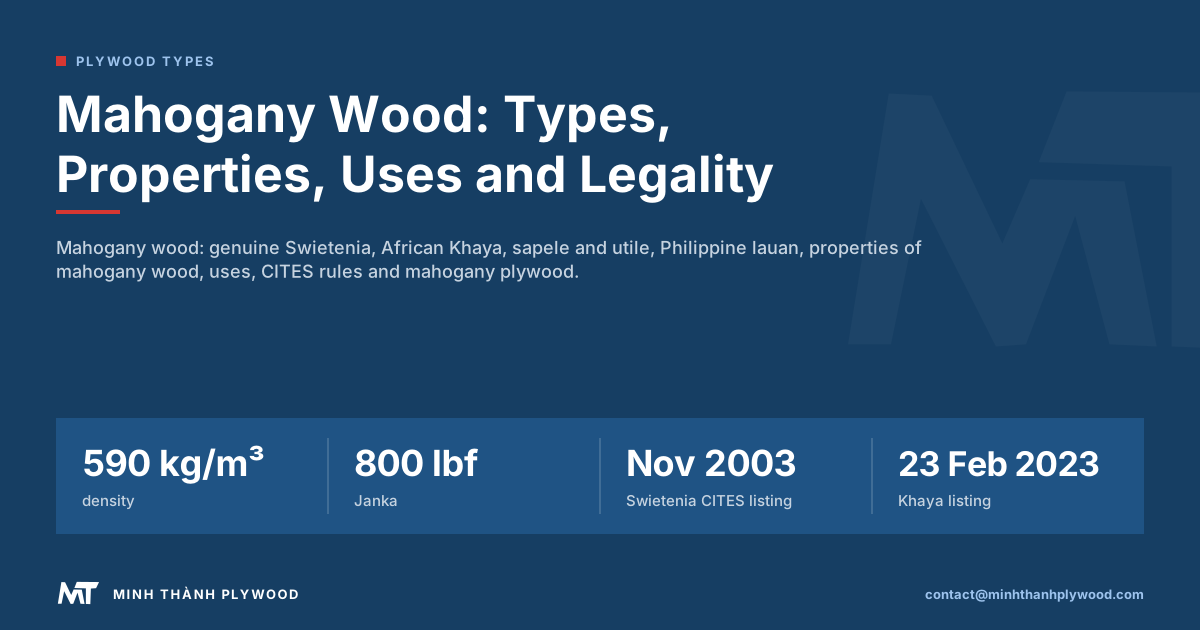
Mahogany wood is the reddish-brown, straight-grained, stable timber of Swietenia trees from tropical America, the genuine mahogany; the name is also used for African mahogany (Khaya) and its relatives sapele and utile, and loosely for Philippine lauan. All genuine mahogany and African Khaya now trade under CITES Appendix II. Minh Thanh Plywood makes furniture plywood with sapele faces on request, and this guide sorts the types, properties, uses and paperwork a buyer meets.
What is mahogany wood?
Mahogany wood is the timber of Swietenia trees of tropical America: a reddish-brown, straight-grained, medium-density hardwood famous for its stability and its finish. The trade also calls related African timbers “mahogany”, chiefly Khaya (African mahogany), and the name stretches to sapele, utile and Philippine lauan.
Genuine mahogany built Georgian furniture, sailing yachts and the bodies of classic guitars. Overcutting through the 20th century led to its listing under CITES, and most “mahogany” sold today is African mahogany, sapele, utile or plantation Swietenia grown outside the Americas.
What are the types of mahogany wood?
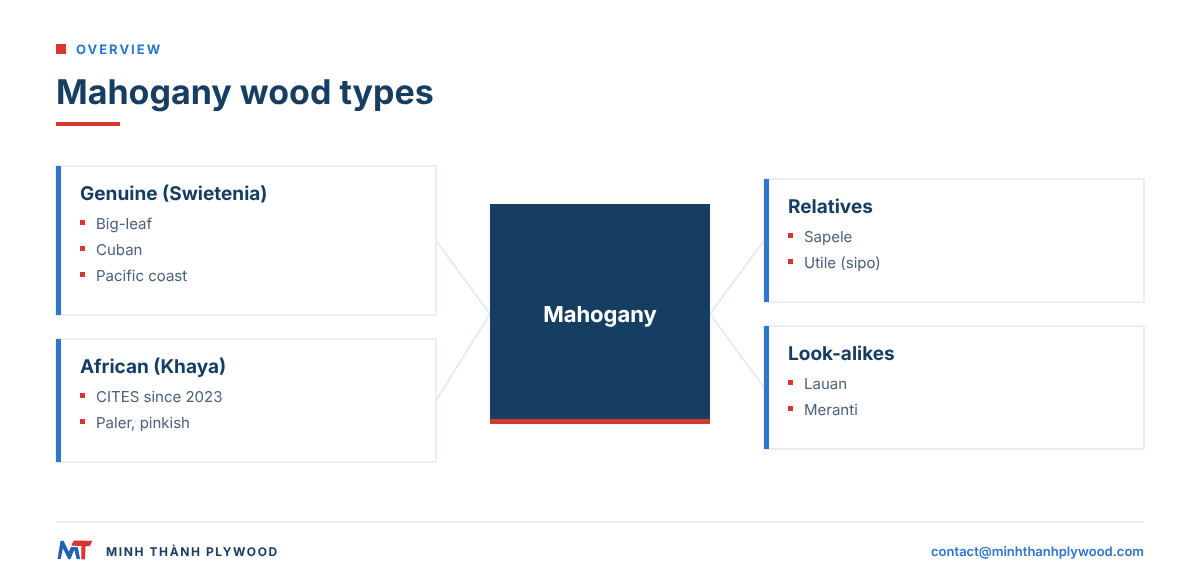
The types of mahogany wood are genuine mahogany (Swietenia), African mahogany (Khaya), the mahogany relatives sapele and utile (Entandrophragma), and look-alikes such as Philippine mahogany (lauan, Shorea). Only Swietenia is genuine mahogany.
| Type | Botanical name | Origin | Family | CITES |
|---|---|---|---|---|
| Big-leaf (Honduran) mahogany | Swietenia macrophylla | Mexico to the Amazon; plantations in Fiji and Asia | Meliaceae | Appendix II (Neotropical populations, since November 2003) |
| Cuban (West Indies) mahogany | Swietenia mahagoni | Caribbean, Florida | Meliaceae | Appendix II |
| Pacific coast mahogany | Swietenia humilis | Pacific coast of Central America | Meliaceae | Appendix II |
| African mahogany | Khaya spp. | West and Central Africa | Meliaceae | Appendix II (African populations, since 23 February 2023) |
| Sapele | Entandrophragma cylindricum | West and Central Africa | Meliaceae | Not listed |
| Utile (sipo) | Entandrophragma utile | West and Central Africa | Meliaceae | Not listed |
| Philippine mahogany (lauan) | Shorea spp. | Philippines, Southeast Asia | Dipterocarpaceae | Not listed |
Lauan is not a mahogany at all; it is a meranti-type timber sold under the name for its colour.
The US naming rule. Only Swietenia is genuine mahogany. The US Federal Trade Commission lets African and Philippine timbers be sold only under qualified names such as “African mahogany” or “Philippine mahogany”, and relatives such as Toona, Chukrasia and Entandrophragma cannot be sold as plain “mahogany” in the United States.
Density by type. African mahogany runs 500-850 kg/m³, Cuban mahogany averages about 600 kg/m³ and Honduran about 590 kg/m³ (“Spanish mahogany” is an old trade name for Cuban mahogany), which is why a “mahogany” door and a “mahogany” drawer side can differ in weight by a third.
A short trade history. Mahogany from Jamaica supplied Georgian furniture until the 1790s, when Jamaican stocks were largely exhausted and the trade moved to Cuban and Honduran logs; the Cuban stock was cut out in turn, and today’s supply is Honduran-type plantation timber and African species.
What are the properties of mahogany wood?
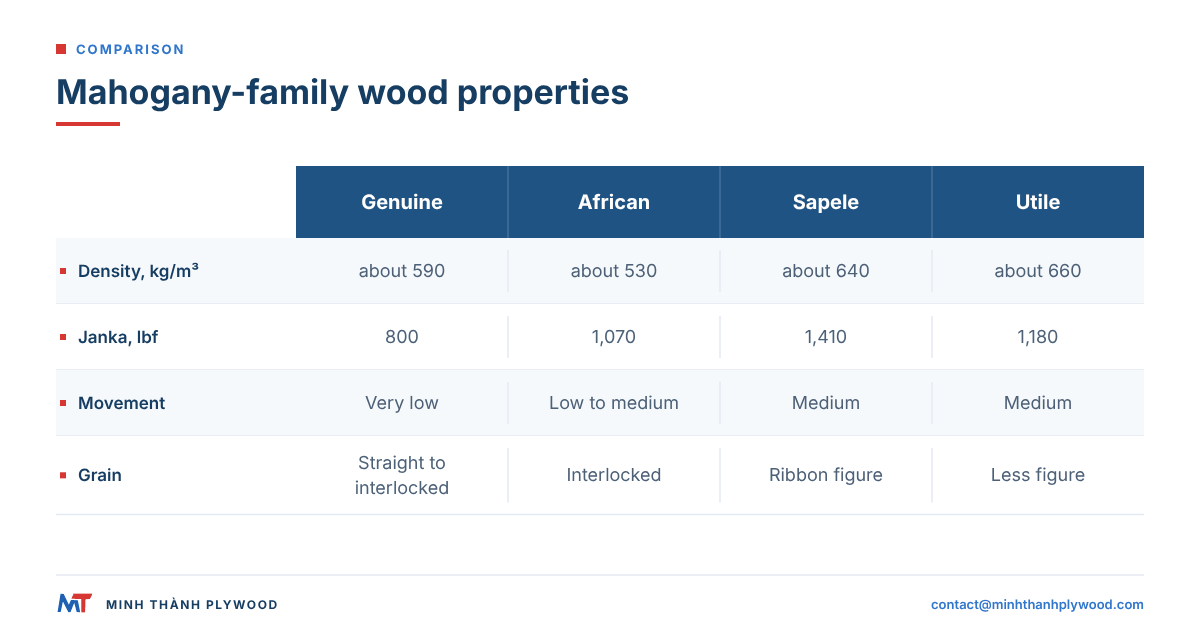
The properties of mahogany wood are medium density (about 590 kg/m³), moderate hardness (Janka 800 lbf), very low movement, an even texture and a heartwood that is moderately durable to durable. It is easy to work, glue and finish, which is why it became the joinery wood of choice.
| Property | Genuine mahogany | African mahogany | Sapele | Utile |
|---|---|---|---|---|
| Density (dried) | about 590 kg/m³ | about 530 kg/m³ | about 640 kg/m³ | about 660 kg/m³ |
| Janka hardness | 800 lbf (3,560 N) | 1,070 lbf (4,760 N) | 1,410 lbf (6,280 N) | 1,180 lbf (5,260 N) |
| Movement | Very low | Low to medium | Medium | Medium |
| Durability | Moderately durable to durable | Moderately durable | Moderately durable | Moderately durable to durable |
| Grain | Straight to interlocked, even | Interlocked | Interlocked, ribbon figure | Interlocked, less figure |
Values are averages published by The Wood Database for genuine mahogany, African mahogany, sapele and utile, read October 2026.
What colour is mahogany wood?
Mahogany heartwood is pinkish to salmon when freshly cut and darkens to a deep reddish brown with age and light. The sapwood is pale yellowish. Quarter-sawn boards often shimmer under light, a figure known as chatoyance.
Sapele is darker and redder, with a striped ribbon figure on quarter-sawn faces. African mahogany is paler and pinker, and lauan ranges from pale to dark red-brown. Most “mahogany” furniture is stained, so the stain colour, not the wood, sets the look you see in a showroom.
What is mahogany wood used for?
Mahogany wood is used for fine furniture, cabinets, boat building, doors and windows, interior panelling, guitar necks and bodies, carving and decorative veneer. Its stability matters in each: parts stay flat and joints stay tight as humidity changes, and the even texture takes stain and finish well.
| Use | Why mahogany works | Type to ask for |
|---|---|---|
| Fine furniture and cabinets | Even texture, finishes well | Genuine or African mahogany, sapele |
| Boat building and trim | Stable, moderately durable | Genuine mahogany, utile |
| Doors and windows | Low movement | Sapele, utile, African mahogany |
| Guitar necks and bodies | Stable, resonant | Genuine or African mahogany |
| Panelling and veneer | Figure and colour | Sapele, quarter-sawn |
| Carving | Cuts cleanly | Genuine mahogany |
| Marine and boat plywood faces | Stable, glues well | Sapele, African mahogany, okoume |
Buying mahogany lumber: what sizes and price per board foot?
US shops sell mahogany as surfaced boards 3/4 in thick and 2, 4 or 6 in wide (to within 1/16 in), as rough 4/4 to 8/4 stock, and as turning blanks 1.5 and 2 in square. Barrington Hardwoods lists the 3/4 × 2, 4 and 6 in boards in packs of 2 to 4, and Cook Woods sells single boards cut to size, such as 60-7/8 × 9-9/16 × 15/16 in, with free shipping over US$99.
| Type sold as mahogany | Indicative US$ per board foot (2026 price guides) | Note |
|---|---|---|
| Genuine plantation Swietenia | about US$10-18 | Scarce; ask for the species on the invoice |
| African mahogany (Khaya) | about US$12-20 | Often priced like genuine mahogany for wide, clear boards |
| Sapele | about US$7-10 | Interlocked grain, ribbon figure |
| Lauan (Philippine mahogany) | about US$4-7 | Not a true mahogany |
The ranges overlap with grade, width and drying, so compare quotes by species and grade, not by the word “mahogany”. For wide panels, cabinet sides and doors, a sapele-faced plywood is usually cheaper and more stable than glued-up boards; see sapele plywood.
Is genuine mahogany different from African mahogany?
Yes. Genuine mahogany is Swietenia from tropical America; African mahogany is Khaya from Africa. Both are Meliaceae and look alike, but African mahogany is a little lighter, more interlocked in grain and less durable, and it tears more easily when planed.
For most furniture and joinery, African mahogany does the job at a lower price. For boat parts exposed to weather and for instruments where tradition matters, buyers still ask for Swietenia, today usually plantation-grown big-leaf mahogany from Fiji or Asia.
How do sapele and utile compare with mahogany?
Sapele and utile are the closest legal substitutes for mahogany: same family, similar reddish-brown colour, harder and denser than genuine mahogany, and not CITES-listed. Sapele has the stronger ribbon figure; utile (sold as sipo in Europe) is plainer and more stable.
Sapele is the usual face on “mahogany” doors and veneered panels, and its interlocked grain gives the striped look buyers know from mahogany furniture. Read about our okoume plywood for a lighter Meliaceae-like face, or our hardwood veneered plywood guide for face species side by side.
How do you tell mahogany from look-alikes?
Tell mahogany from look-alikes by the end grain, the weight, the figure and the colour of fresh wood. Genuine mahogany shows open pores, sometimes with dark gum deposits, a fine white-line pattern of rays, an even pinkish-to-red colour and a medium weight.
| Clue | Genuine mahogany | Sapele | African mahogany | Lauan |
|---|---|---|---|---|
| Colour | Pinkish to reddish brown | Darker red-brown | Paler, pinkish | Pale to dark red |
| Figure | Even, some ribbon | Strong ribbon stripes | Interlocked, mild | Plain, coarse |
| Weight in hand | Medium | Heavier | Lighter | Light to medium |
| Texture | Fine to medium | Fine | Medium to coarse | Coarse |
| Scent when cut | Faint | Cedar-like | Faint | None |
When it matters, ask for the botanical name on the invoice; a wood lab can confirm the genus from a small sample.
How do CITES rules apply to mahogany?
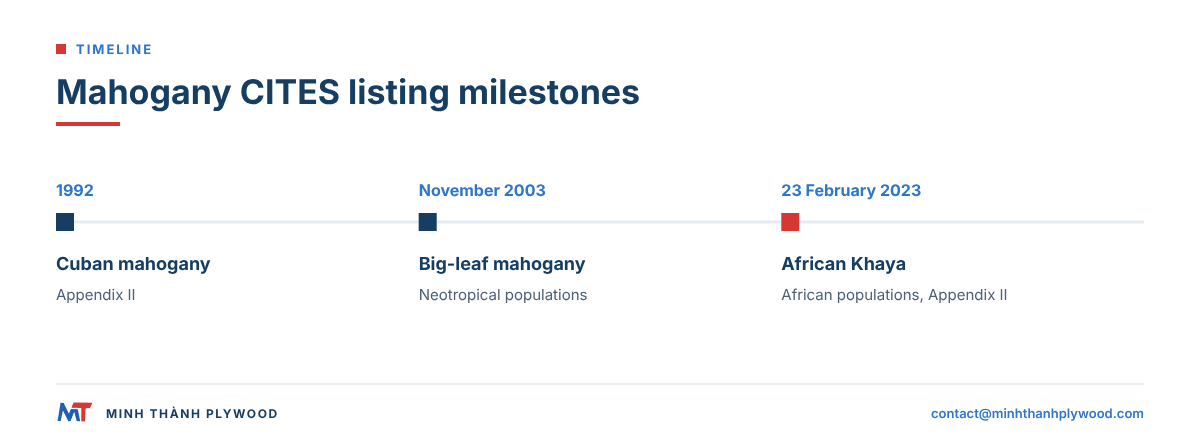
Genuine mahogany and African mahogany are listed in CITES Appendix II, so commercial trade in logs, sawn wood, veneer sheets and plywood needs CITES permits. Big-leaf mahogany (Neotropical populations) has been listed since 15 November 2003; African Khaya joined on 23 February 2023, after CoP19.
| Date | Listing | What it covers |
|---|---|---|
| 1992 | Cuban mahogany (S. mahagoni) Appendix II | Logs, sawn wood, veneer |
| November 2003 | Big-leaf mahogany (S. macrophylla) Appendix II | Logs, sawn wood, veneer sheets, plywood (Neotropical populations) |
| 23 February 2023 | African mahogany (Khaya spp.) Appendix II | Logs, sawn wood, veneer sheets, plywood, transformed wood (African populations) |
Finished furniture and most manufactured goods fall outside these annotations, but plywood with a Khaya or Swietenia face can fall inside. In the EU, CITES is applied through Council Regulation (EC) No 338/97 (read October 2026). In the United States, the Fish and Wildlife Service carries out CITES under the Endangered Species Act. Check the CITES species database for the current annotation before you order.
Is there mahogany plywood?
Yes. Mahogany plywood is plywood with a face veneer of sapele, African mahogany or lauan on a hardwood core; in Sweden it is sold as mahogny plywood. Genuine Swietenia faces are rare in plywood today. Sapele-faced plywood is the common choice for furniture, doors and boat interiors.
Minh Thanh Plywood makes sapele-faced plywood on request, and okoume plywood as a standard product. What sits behind those panels:
- Faces: sapele on request; okoume, birch, poplar, pine and EV faces chosen for the look the buyer orders.
- Core: white Styrax or Eucalyptus.
- Glue and emission: UF glue at E0 emission for furniture and interior panels; MR or phenolic (WBP) bonds to the order.
- Build: core layers stitched both horizontally and vertically; furniture-grade panels pressed twice.
- Tolerance: sanded to ±0.2–0.3 mm, down to ±0.2 mm; thickness 3–40 mm.
- Sizes: 1220 × 2440 mm and 1250 × 2500 mm, plus custom sizes.
For boat hulls and decks, read our marine plywood buying guide before choosing a face.
Where does plantation mahogany come from?
Plantation mahogany comes mostly from big-leaf mahogany (Swietenia macrophylla) planted outside its native range: Fiji, Indonesia, the Philippines, India, Sri Lanka and parts of the Pacific and Africa. Fiji holds some of the largest mature mahogany plantations in the world and exports sawn timber and veneer.
The CITES listing of big-leaf mahogany covers its Neotropical populations, the wild range from Mexico to the Amazon. Plantation wood grown outside that range sits outside the listing, but buyers still need proof of where it grew: a plantation certificate, the harvest country on the invoice and, for EU orders, the plantation geolocation required by the EU Deforestation Regulation (Regulation (EU) 2023/1115, read October 2026).
Plantation mahogany is usually cut younger than old-growth wood. Expect a paler colour, wider growth rings and a little lower density, while the stability and easy working that made mahogany famous remain.
How do you work and finish mahogany?
Mahogany works easily with hand and machine tools, glues well and takes stain and finish evenly, which is why it became the classic cabinet wood. The one trap is interlocked grain, which can tear out on planing; a sharp blade at a low cutting angle, or a light final pass, gives a clean face.
- Plane and sand: sharp tools, light final passes, sand through to a fine grit.
- Fill the pores: for a mirror finish, use a grain filler first; open pores show under gloss.
- Colour: a clear oil deepens the red-brown; stain only when boards of different colour must match.
- Finish: oil, shellac, lacquer or marine varnish for boats and doors; exterior parts need renewing every few seasons.
Sapele and African mahogany follow the same steps but tear out more on interlocked grain, so the low-angle final pass matters more.
Which mahogany should you choose for your project?
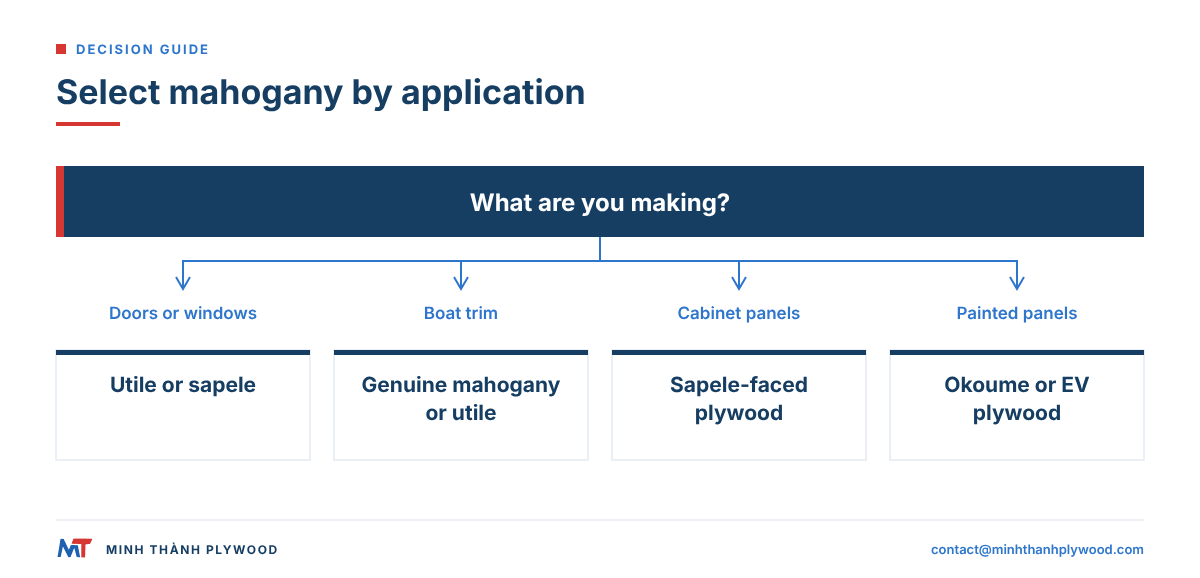
Choose by use and by paperwork: sapele or utile for doors, windows and furniture without permits; African or plantation genuine mahogany with CITES papers when the project calls for the real wood; sapele- or okoume-faced plywood for panels.
| Project | First choice | Why |
|---|---|---|
| Furniture and cabinets | Sapele or African mahogany | Colour and figure at a fair price |
| Exterior doors and windows | Utile or sapele | Stable, not CITES-listed |
| Boat trim and brightwork | Genuine mahogany or utile | Durability and tradition |
| Guitar bodies and necks | African or genuine mahogany | Tone and stability |
| Cabinet carcasses and panels | Sapele-faced plywood | Flat, stable, full sheets |
| Painted panels | Okoume or EV-faced plywood | Smooth face, lower cost |
What should a mahogany or mahogany plywood order say?
A mahogany order should name the species, origin, grade, moisture content and CITES permits; a mahogany plywood order should name the face species, core, glue, thickness and size. This is a plywood spec line we can quote from:
- Face/back: sapele, quarter-cut or rotary, A/B, to an approved sample.
- Core: white Styrax or Eucalyptus.
- Glue and emission: UF glue at E0 emission for interior; WBP to the order for wet areas.
- Thickness and size: 18 mm ±0.2 mm, 1220 × 2440 mm or 1250 × 2500 mm.
- Terms: one 40HC (MOQ), FOB Hai Phong, CFR or CIF; furniture plywood from US$350/m³ (October 2026, indicative; face, core, glue, thickness, size and quantity set the final price).
Free samples let you check the face before you order. Write to contact@minhthanhplywood.com, or compare species in types of wood.
Buyer questions, answered
What is mahogany wood used for?
Mahogany wood is used for fine furniture, cabinets, boat building, doors and windows, panelling, guitar necks and bodies, carving and veneer. Its stability and even texture make it a joinery wood more than a structural one.
What are the types of mahogany wood?
Genuine mahogany is Swietenia: big-leaf (Honduran), Cuban and Pacific coast mahogany. African mahogany is Khaya. Sapele and utile (sipo) are close relatives sold as mahogany substitutes, and Philippine mahogany is lauan, a Shorea, not a true mahogany.
Is mahogany a hardwood?
Yes. Mahogany is a tropical hardwood of the Meliaceae family. It is a medium-density hardwood: genuine mahogany has a Janka hardness of about 800 lbf, softer than oak but harder than most softwoods.
Is mahogany wood expensive?
Genuine Swietenia mahogany is expensive because it is CITES-listed and scarce. African mahogany and sapele cost less and are the usual choice for joinery and furniture today.
Is mahogany wood illegal?
No, but genuine mahogany (Swietenia) has been in CITES Appendix II since 2003 for big-leaf mahogany, and African Khaya since February 2023, so legal trade needs CITES permits. Sapele and utile are not CITES-listed.
What colour is mahogany wood?
Mahogany heartwood is pinkish to salmon when freshly cut and darkens to a deep reddish brown with age and light. Sapele is darker and shows a striped ribbon figure.
Is there mahogany plywood?
Yes. Mahogany plywood carries a face of sapele, African mahogany or lauan veneer on a hardwood core. In Sweden it is sold as mahogny plywood. Minh Thanh Plywood makes sapele-faced plywood on request.
Is sapele a mahogany?
Sapele (Entandrophragma cylindricum) is in the mahogany family, Meliaceae, and is sold as a mahogany substitute. It is harder and denser than genuine mahogany and shows a striped ribbon figure on quarter-sawn faces.
Is mahogany good for outdoor use?
Genuine mahogany is moderately durable to durable, so it works outdoors on boats, doors and windows with a good finish. African mahogany and sapele are less durable and need a finish and good detailing outdoors.