
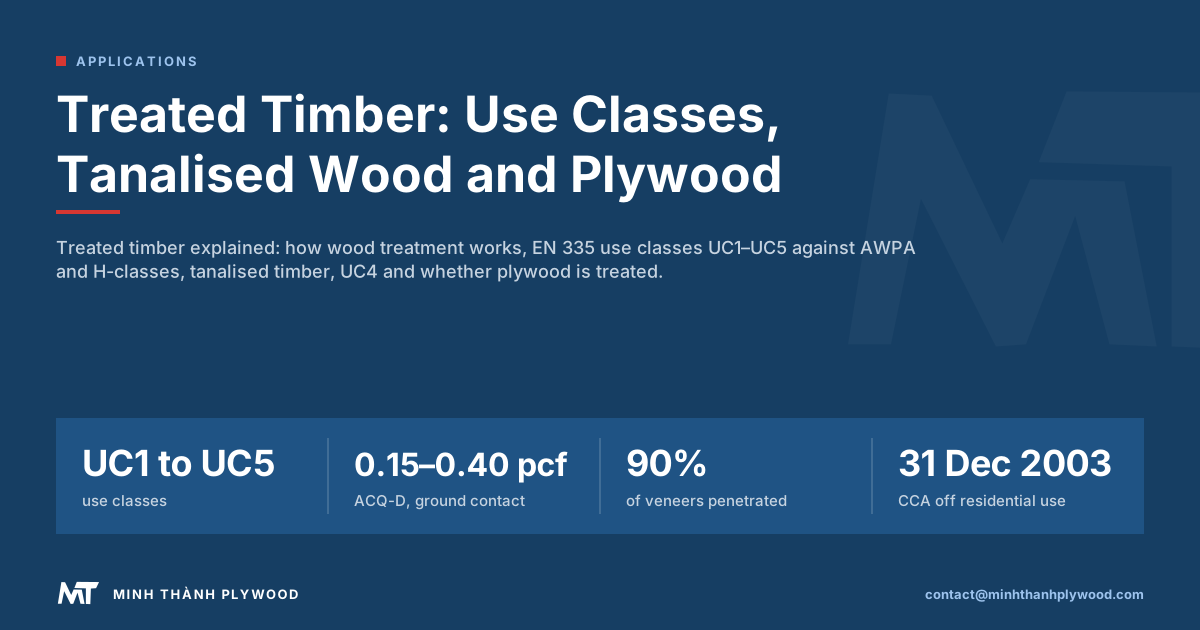
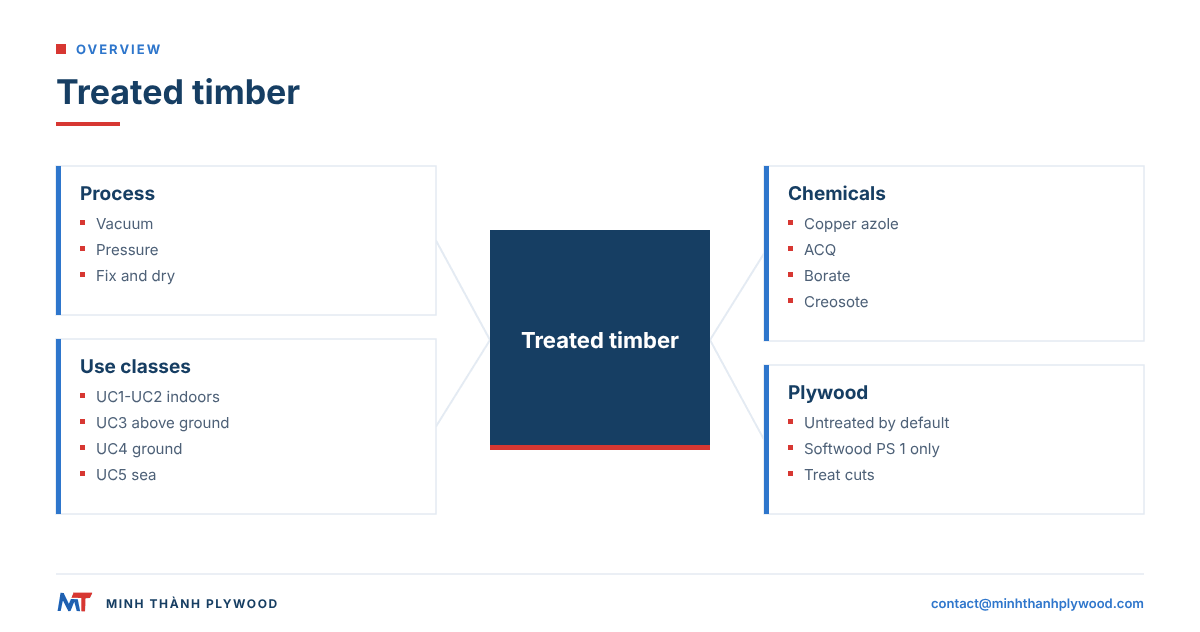
Treated timber is wood impregnated with a preservative, usually under vacuum and pressure, so it resists fungal decay and insects for the use class it is sold for. The class matters more than the word treated: UC3 wood is for outdoor use above ground, UC4 for ground contact. Minh Thanh Plywood, a Vietnamese plywood manufacturer, explains the classes, tanalised timber and why most plywood, including hardwood plywood, is supplied untreated.
What is treated timber?
Treated timber is wood that has been impregnated with a preservative, usually under pressure, to protect it from decay fungi and wood-boring insects for a stated use class. The same word covers different products, from a lightly treated roof batten to a fence post for permanent ground contact, so the use class on the label is what you buy.
Three facts frame the subject:
- Treatment fights biology, not water. It stops rot and insects; it does not make wood waterproof or stop it moving with moisture.
- The class sets the loading. Ground-contact wood carries more preservative than wood for use above ground.
- Cut ends are untreated wood. Any field cut through a treated piece needs a brushed-on end-cut preservative.
Treatment of wood: how preservative gets into timber
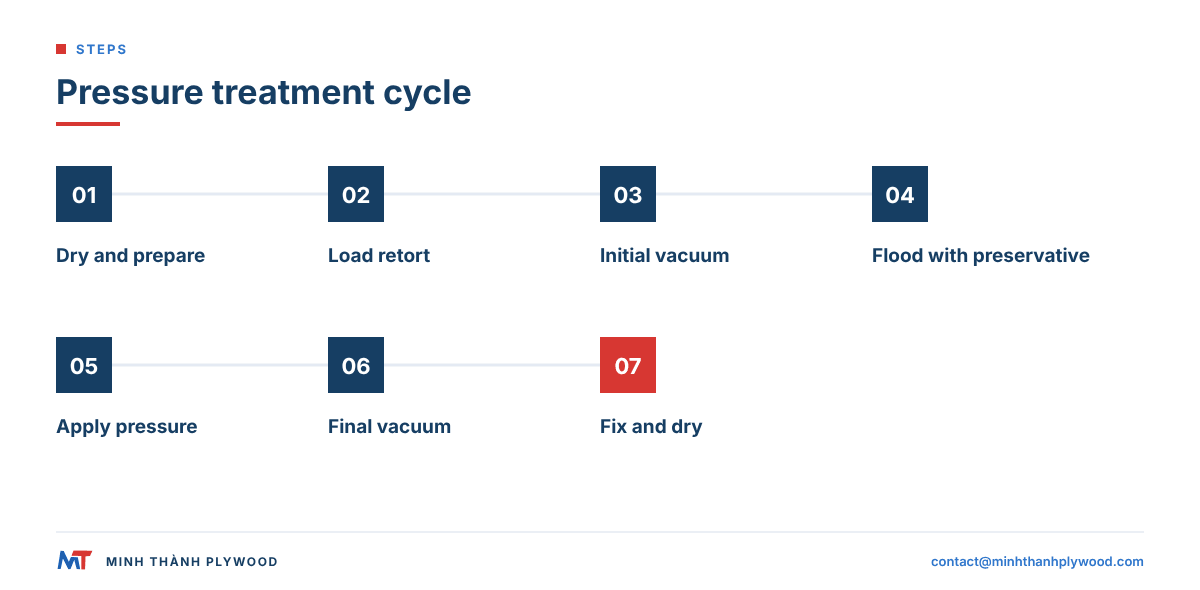
The treatment of wood for long service is done in a closed steel cylinder, called a retort, by a vacuum-pressure cycle that drives preservative deep into the wood cells. Dipping or brushing only coats the surface.
- Dry and prepare the wood. Timber is dried and, for species that resist treatment, incised with small slits so preservative can enter.
- Load the retort. Packs roll in on bogies and the door is sealed.
- Initial vacuum. Air is drawn out of the wood cells.
- Flood. The retort fills with preservative solution under vacuum.
- Pressure. Pressure forces the solution into the wood; the hold time sets penetration and loading.
- Final vacuum. Excess solution is drawn off the surface.
- Fix and dry. The preservative fixes in the wood, and the timber dries before use.
APA’s data file on preservative-treated plywood describes the same pressure process and notes that “superficial applications provide limited protection” (APA Preservative-Treated Plywood, Form Q220, checked 20 October 2026).
Treated wood use classes: EN 335 UC1 to UC5 and their equivalents
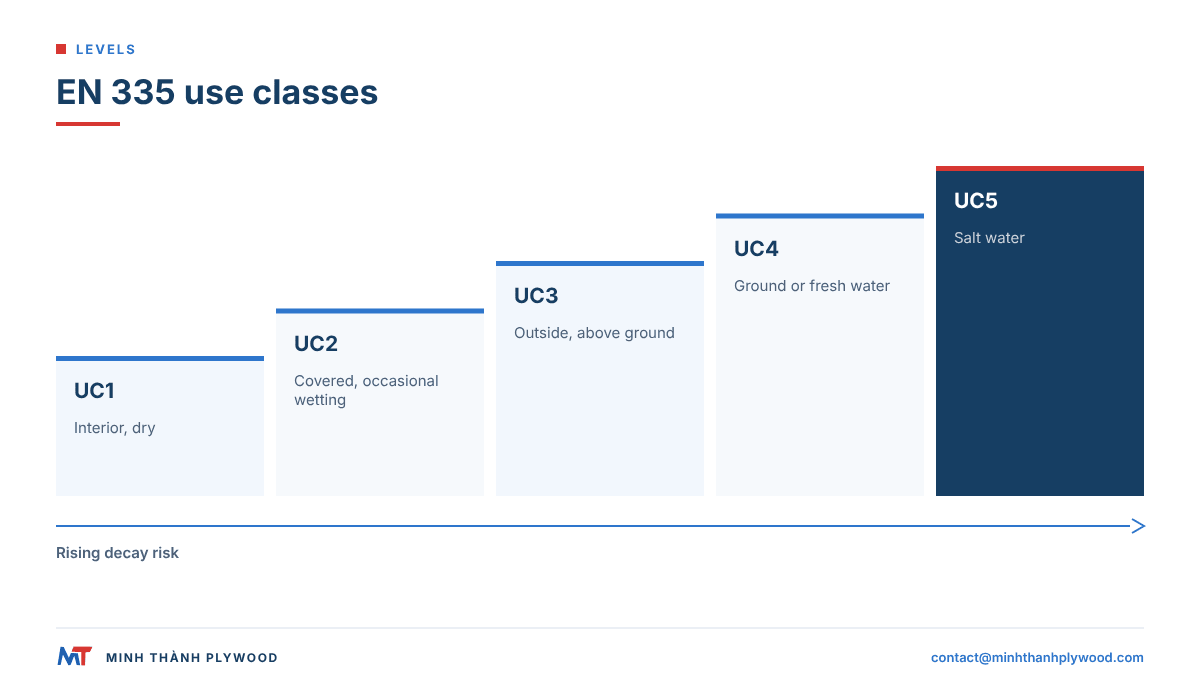
Treated wood is sold by use class, and the European scale in EN 335 runs from UC1, dry indoors, to UC5, in sea water. The US, New Zealand and Australia use their own scales. The table maps the closest equivalents; always buy to the scale of the country where the wood is used.
| EN 335 use class | Exposure | US AWPA U1 (closest) | NZ hazard class (closest) | Australia hazard class (closest) |
|---|---|---|---|---|
| UC1 | Interior, dry | UC1 | H1.1 | H1 |
| UC2 | Interior or covered, risk of occasional wetting | UC2 | H1.2 | H2 |
| UC3.1 | Exterior above ground, coated, water runs off | UC3A | H3.1 | H3 |
| UC3.2 | Exterior above ground, uncoated, wet for long periods | UC3B | H3.2 | H3 |
| UC4 | In contact with the ground or fresh water | UC4A to UC4C | H4 / H5 | H4 / H5 |
| UC5 | In salt water | UC5A to UC5C | H6 | H6 |
Rules of thumb that hold on every scale:
- Never step down a class. Above-ground wood in soil fails early, often within a few seasons.
- Critical parts go one class up. Posts that hold a structure, or parts hard to replace, take the heavy-duty class.
- Termites change the choice. Australia’s H2 and similar classes exist because termite risk, not decay, drives treatment indoors.
What is UC4 timber?
UC4 timber is wood treated for EN 335 use class 4: in direct contact with the ground or fresh water, where decay risk is highest on land. It carries a higher preservative loading than UC3 wood treated with the same chemical.
The US data show how big the step is. In AWPA U1 retentions for plywood listed by APA, alkaline copper quat type D (ACQ-D) rises from 0.15 pcf (pounds per cubic foot) for UC1 to UC3B up to 0.40 pcf for ground-contact UC4A and 0.60 pcf for heavy-duty UC4B; copper azole type C rises from 0.06 to 0.15 and 0.31 pcf.
Use UC4 for:
- Fence posts, gravel boards and sole plates on soil.
- Garden structures in the ground, raised-bed sides and retaining boards.
- Deck joists and posts close to the ground or hard to inspect and replace.
What is tanalised timber?
Tanalised timber is wood pressure-treated with Tanalith, a branded copper-based preservative, and in the UK the word is used for most green or brown pressure-treated softwood. Tanalising timber is the same vacuum-pressure process described in the treatment steps, run to the loading of the use class ordered.
What buyers should know about tanalised timber:
- Colour. Fresh tanalised wood is green or brown from the copper; it weathers to a silver-grey outdoors.
- Class on the label. Tanalised is a treatment name, not a class. Ask for UC3 or UC4 on the delivery note or end tag.
- Weeping. Freshly treated wood can show surface salts and feel damp; let it dry before finishing.
- Cut ends. Re-treat every cut with an end-grain preservative, especially in UC4 use.
Pressure treated, dip treated or surface treated: what is the difference?
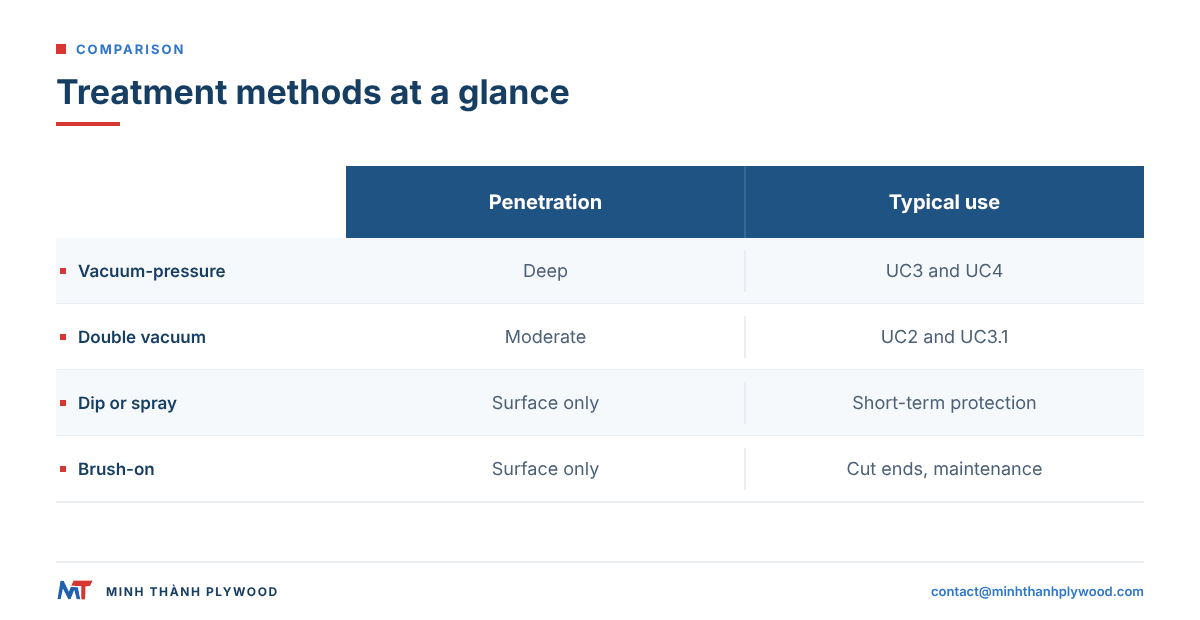
Pressure treatment forces preservative deep into the wood in a retort; dip and surface treatments coat the outer layer only. That difference decides where each belongs.
| Method | How it works | Penetration | Typical use |
|---|---|---|---|
| Vacuum-pressure | Retort cycle, preservative forced in | Deep, to the class loading | UC3 and UC4 outdoor and ground-contact timber |
| Double vacuum (solvent or water-based) | Low-pressure cycle | Moderate, around the outer zone | Joinery and cladding, UC2 and UC3.1 |
| Dip or spray | Wood passed through a bath or spray | Surface only | Short-term protection, sap-stain control |
| Brush-on | Applied by hand | Surface only | Cut ends, maintenance |
LOSP (light organic solvent preservative), used in Australia and New Zealand for H3 joinery and framing, is a double-vacuum process that leaves the wood dimensionally stable and ready to paint.
Timber treatments by chemical: copper azole, ACQ, borate and creosote
Timber treatments today are mostly copper-based for outdoor and ground-contact use, borate for dry interiors, and oil-type preservatives for industrial and marine work. The table summarises the families APA lists for plywood.
| Preservative family | Examples | Classes it serves | Appearance and finishing |
|---|---|---|---|
| Copper-based waterborne | ACQ-C, ACQ-D, copper azole (CA-B, CA-C) | UC1 to UC4 | Green to brown; paintable when dry |
| Borate | SBX (inorganic boron) | UC1, UC2 | Natural colour; leaches in rain |
| Copper naphthenate | CuN | Above ground | Light green, fades |
| Oxine copper | Cu8 | Above ground, food handling | Greenish-brown |
| Creosote | CR, CR-S | Industrial, ground and sea water | Dark, oily, not paintable |
| Pentachlorophenol | Penta | Industrial, ground contact | Restricted use, not residential |
| CCA | Chromated copper arsenate | Industrial only today | Green; restricted |
APA also notes that waterborne preservatives make tongue-and-groove edges harder to mate, so square-edge panels or edges milled after treatment are the safer choice.
How can you tell if wood is treated?
You can tell treated wood by its label first and its look second. Colour alone does not show the class.
- End tag or stamp. Treated timber and plywood carry a tag or mark naming the preservative, the use class and the treating plant or inspection agency.
- Incisions. Rows of small slits on the faces show the wood was incised to take preservative.
- Colour on a fresh cut. Copper treatments show green or brown in the outer zone; the heart of a large section can stay pale.
- Delivery documents. The invoice or delivery note should name the class, such as UC4 or H3.2.
Without a tag or document, treat the wood as untreated for design purposes.
Is plywood treated timber?
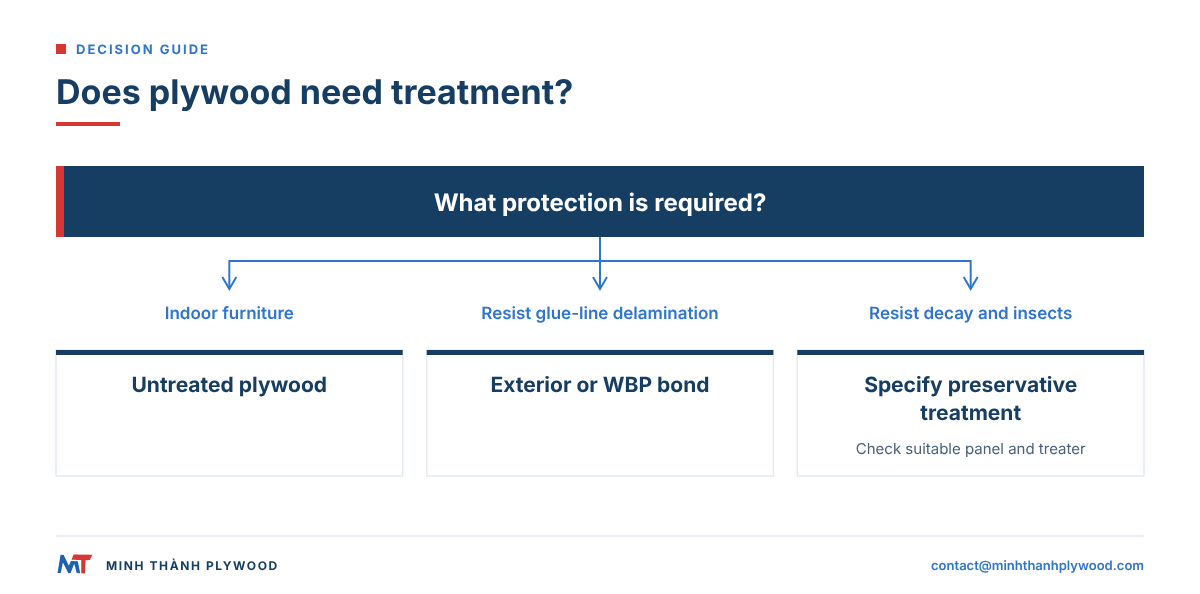
Plywood is not treated timber by default: standard interior, structural, furniture and film-faced panels ship untreated, and treated plywood is a separate product bought on purpose. The US standard confirms the limit for hardwood panels: “AWPA Standard U1 is only applicable for plywood composed of softwood veneers meeting PS 1. Hardwood plywood and softwood plywood containing hardwood veneers are excluded” (APA Form Q220).
What this means by panel type:
- Softwood structural plywood can be pressure-treated to a use class, with the treater’s mark.
- Hardwood plywood for furniture and interiors, including Minh Thanh panels on Styrax and Eucalyptus cores, is supplied untreated; its water resistance comes from the bond.
- Exterior and WBP plywood resists delamination by its glue line, which is a different property from decay resistance.
A durable glue line and a preservative answer different failures, so the order should name both when both matter.
Treated plywood vs treated solid timber: what changes?
Treated plywood behaves differently from treated solid timber because it is made of thin veneers and glue lines. Three differences matter to a buyer.
| Point | Treated solid timber | Treated plywood |
|---|---|---|
| How penetration is judged | Depth into the outer zone of the section | AWPA requires 90% of veneers penetrated |
| Glue line | None | Must suit both the exposure and the treatment |
| Field cuts | Expose untreated heart | Expose untreated inner veneers |
| Sizing | Cut before or after treatment | Fabricate before treatment where possible |
| Swelling after treatment | Moderate | Edges and tongue-and-groove joints can tighten |
APA strongly recommends doing all fabrication, trimming and boring before pressure treatment, and field-treating every cut, hole or damaged area afterwards. Plywood for treatment should have an exterior or Exposure 1 bond, because a waterborne process wets the whole panel.
How do you cut, fix and finish treated timber?
Cut, fix and finish treated timber in a way that keeps the treated envelope whole and the fasteners from corroding.
- Re-treat cuts. Brush or dip every cut end and bored hole with an end-cut preservative to saturation.
- Use compatible fasteners. APA cites the model codes: fasteners in contact with preservative-treated wood are hot-dip galvanised steel, stainless steel, silicon bronze or copper, and connectors with no maker guidance use at least ASTM A653 G185 zinc coating.
- Let it dry before finishing. Treated wood leaves the plant wet. Paint or stain only when the surface is dry.
- Prime against bleed. A stain-blocking primer under latex paints limits green or brown discolouration.
- Detail for drainage. Gaps, slopes and end protection keep water moving off the wood.
Which treated timber class for decking, fencing and framing?
Most garden and building jobs fall into a handful of positions, and each has a usual class. Buy one class higher when the part holds up a structure or is hard to replace.
| Job | Position | Usual EN 335 class | NZ / Australia (closest) |
|---|---|---|---|
| Roof battens, internal framing | Covered, dry | UC1 to UC2 | H1.2 / H2 |
| Cladding, coated and draining | Outside, above ground | UC3.1 | H3.1 / H3 |
| Deck boards and rails | Outside, above ground, uncoated | UC3.2 | H3.2 / H3 |
| Deck joists close to the ground | Hard to inspect, stays damp | UC4 | H4 / H4 |
| Fence posts and gravel boards | In or on soil | UC4 | H4 / H4 |
| Retaining walls, structural posts in soil | Ground contact, critical | UC4, heavy duty | H5 / H5 |
| Jetty piles in sea water | Salt water | UC5 | H6 / H6 |
Common UK treated timber sizes, classes and prices
In Britain treated sawn softwood is sold in a short list of sizes in metric sections and 1.8, 2.4, 3.0, 3.6 and 4.8 m lengths. Wickes lists treated sizes such as 19 × 38, 22 × 47, 22 × 100, 22 × 150, 25 × 38, 45 × 45 and 47 × 47 mm. Selco Builders Warehouse prices the structural sections. The prices below are Selco’s, ex VAT, read on 21 October 2026; merchants change them often, so use them as a band.
| Section (mm) | Common use | Usual EN 335 class | Selco price ex VAT |
|---|---|---|---|
| 38 × 19 sawn batten | Trellis, light fixing battens | UC3.1 | from £1.35 |
| 50 × 25 graded roof batten | Slate and tile battens, covered | UC2 | from £3.75 |
| 50 × 47 (2×2), 3 m, kiln dried | Fence rails, small frames | UC3.1 | £4.80 |
| 75 × 47 (3×2), kiln dried | Studs, rails, light framing | UC2 to UC3.1 | from £3.60 |
| 100 × 47 (4×2) C16, 2.4 m | Joists, rafters, deck joists | UC2 inside, UC3.2 outside | £5.00 |
| 100 × 47 (4×2) C16, 4.8 m | Joists, rafters, deck joists | UC2 inside, UC3.2 outside | £10.00 |
| 100 × 47 (4×2) C24 | Longer spans, heavier floors | UC2 inside, UC3.2 outside | from £8.82 |
| 22 × 150 | Gravel boards, deck boards, fascia | UC3.2 (UC4 on soil) | see merchant |
C16 and C24 are the strength classes of EN 338 for structural softwood: C16 carries a characteristic bending strength of 16 MPa and C24 of 24 MPa. The treatment class and the strength class are two separate labels; a delivery note for a deck joist should show both, such as “C16, UC3.2”.
In the UK, BS 8417 is the code of practice that turns a use class into a treatment. It links the EN 335 class to the preservative loading and penetration needed for a desired service life of 15, 30 or 60 years, so a buyer who needs a stated life asks the treater for the BS 8417 specification, not only for “treated” (NHBC Standards, timber preservation, read 21 October 2026). The edition changes, so check the current one with BSI.
Two mistakes cause most early failures: using deck-board stock (UC3) for joists and posts in contact with soil, and cutting posts to length on site without treating the cut end that then goes into the ground. Ask the merchant for the class on the delivery note, not just “treated” or “tanalised”.
For plywood in the same positions, the class works the same way, but the base panel also needs an exterior-type bond. A covered, coated exterior panel with a phenolic WBP bond often needs no preservative at all.
Is treated timber safe to handle, and how is it disposed of?
Treated timber is safe to use with sensible handling, and the precautions are about dust and offcuts. The APA data file lists the usual rules:
- Wear a dust mask and goggles when sawing or machining, and work outdoors where possible.
- Wear gloves and long sleeves for frequent handling, and wash hands before eating or drinking.
- Wash work clothes separately.
- Never burn offcuts in a stove or open fire; dispose of them as local rules require, which can mean a licensed site.
Which rules govern wood preservatives?
Wood preservatives are regulated as biocides in the EU and as registered pesticides in the US, so the chemicals allowed in treated timber change by market. Two dated rules shape what treated wood contains today.
- EU. Preservatives are authorised under the Biocidal Products Regulation (EU) No 528/2012 (checked 20 October 2026). Arsenic-treated wood has been restricted since 30 June 2004 under Directive 2003/2/EC, with exceptions for some industrial uses.
- US. The EPA page on chromated arsenicals (CCA) (checked 20 October 2026) records that manufacturers voluntarily ended CCA treatment for most residential uses from December 2003; copper-based systems replaced it.
For a buyer, the practical check is that the treater’s mark names a preservative approved in the country of use.
When do you not need treated timber?
You do not need treated timber where wood stays dry, or where the design and the material already resist the exposure. Treatment adds cost and handling rules, so it belongs only where decay or insects are a real risk.
- Interior furniture and joinery in heated buildings: untreated wood and plywood, UC1 at most.
- Protected exterior parts that are coated and drain freely: durable species or well-detailed, coated exterior plywood.
- Panels that must not delaminate when wet: an exterior bond such as phenolic WBP; add treatment only if decay is also a risk.
- Concrete formwork: film-faced plywood with a WBP bond, which lasts by its face film and bond rather than by preservative.
What Minh Thanh Plywood supplies for exterior and humid uses
Minh Thanh Plywood supplies untreated exterior plywood with a water-resistant bond and utility faces, and buyers who need a use class have the panels treated by a treater in their market.
| Specification | Exterior plywood from Minh Thanh |
|---|---|
| Faces | C/D-type utility faces, to the approved sample |
| Core | Styrax or Eucalyptus |
| Bond | Phenolic WBP, pressed at 130–145 °C, or melamine-fortified for humid uses |
| Thickness | 3–40 mm |
| Sizes | 1220 × 2440 mm and 1250 × 2500 mm, plus custom sizes |
| Tolerance | ±0.5 mm on thickness, ±2 mm on length and width |
| Order | 1×40HC, production 15–45 days after deposit |
Send the application, exposure, face pair, core, bond, thickness and quantity to contact@minhthanhplywood.com or WhatsApp Lisa on +84 988 586 601; we reply within hours and send free samples. See the exterior plywood page and compare marine plywood vs pressure-treated plywood.
Buyer questions, answered
What is treated timber?
Treated timber is wood impregnated with a preservative so it resists decay fungi and insects. It is sold by use class, such as UC3 for outdoor use above ground or UC4 for ground contact, and the class must match where the wood goes.
What does UC4 timber mean?
UC4 timber is treated for use class 4 of EN 335: in contact with the ground or fresh water. It carries a higher preservative loading than UC3 wood and is the class for fence posts, sole plates on soil and garden structures in the ground.
What is tanalised timber?
Tanalised timber is wood pressure-treated with Tanalith, a copper-based preservative brand. The name is used in the UK for most green or brown pressure-treated softwood.
Is plywood treated timber?
Not by default. Most plywood ships untreated. Treated plywood is a separate product, and the US AWPA U1 standard covers only softwood plywood made to PS 1; hardwood plywood is excluded.
How can I tell if wood is treated?
Look for an end tag or stamp naming the preservative and use class, small incisions on the faces, and a green or brown tint on the cut end. Without a tag, assume it is not treated to any class.
How long does treated timber last?
It lasts as long as the treatment class matches the exposure and cut ends are re-treated. UC3 wood used in the ground, or untreated cut ends, is the usual reason treated timber rots early.
Can you paint treated timber?
Yes, once it is dry. Freshly treated wood holds water from the process; let it dry, then use a stain-blocking primer to limit green or brown discolouration of the paint.
What screws should I use with treated timber?
Hot-dip galvanised, stainless steel, silicon bronze or copper fasteners. Copper-based preservatives corrode plain steel, so connectors also need the coating the connector maker lists for treated wood.
Is CCA-treated wood still sold?
Not for homes. In the US, CCA was withdrawn from residential uses from 31 December 2003, and in the EU arsenic-treated wood has been restricted since 30 June 2004, with industrial exceptions.
What exterior plywood does Minh Thanh Plywood supply?
We supply exterior plywood with a phenolic WBP bond and utility faces, untreated and ready for treatment, plus furniture plywood for interiors. Buyers who need a use class have the panels treated by a treater in their market.