
Marine plywood and pressure treated plywood solve different problems. Marine plywood resists water through its durable bond and gap-free core, so it suits boats and permanently wet work above the ground. Pressure treated plywood resists rot and insects through preservative in the wood, so it suits decks, fences and ground contact. Minh Thanh Plywood, a Vietnamese plywood manufacturer, compares them line by line and shows where exterior WBP plywood fits.
Marine plywood vs pressure treated plywood: the short answer
Marine plywood vs pressure treated plywood comes down to the failure you need to prevent: choose marine plywood when water and delamination are the threat, and pressure treated plywood when rot, insects and soil contact are the threat. Neither replaces the other.
| Job | Better choice | Why |
|---|---|---|
| Boat hull, deck, transom | Marine plywood | Durable bond, no core voids, takes epoxy |
| Dock decking above the water | Either, by exposure; treated for rot risk | Treated resists decay; marine resists wet cycles |
| Ground contact, fence boards | Pressure treated plywood (UC4) | Preservative resists soil fungi and termites |
| Deck substrate, garden structure | Pressure treated plywood (UC3) | Decay resistance at lower cost |
| Covered exterior sheathing | Exterior WBP plywood | Water-resistant bond, no preservative needed |
Is marine plywood the same as pressure treated?
Marine plywood is not the same as pressure treated plywood: marine names how the panel is built, pressure treated names a process applied to a finished panel. A marine panel resists water through its bond and veneers; a treated panel resists biological attack through preservative in the wood.
The confusion comes from both being sold for outdoor use. They protect against different things:
- Water and delamination. Constant wetting attacks the glue line and fills any core void with water. A durable bond and a gap-free core stop this. That is marine plywood’s job.
- Rot and insects. Decay fungi and termites eat wood that stays damp. Preservative in the fibre stops them. That is pressure treatment’s job.
A panel can be built for the first and treated for the second, but most panels on sale are one or the other.
Treated vs marine plywood: side-by-side comparison
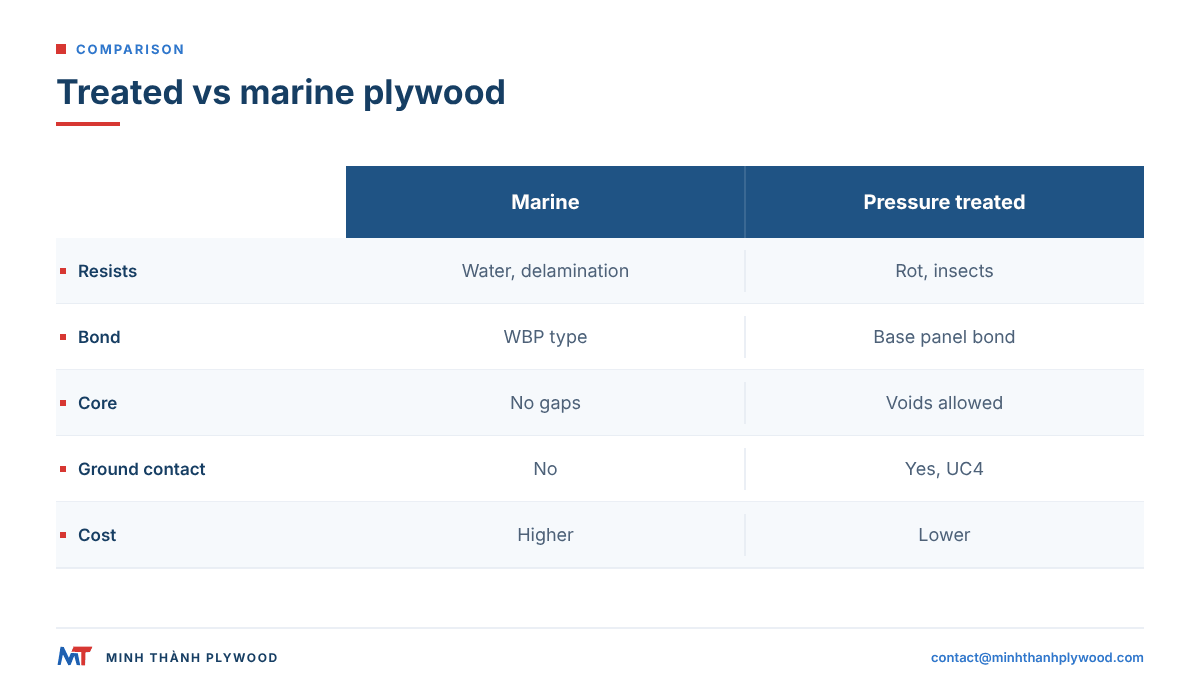
Treated vs marine plywood differ on almost every line of a specification. The table compares the panels most buyers meet: marine plywood to BS 1088 and softwood plywood pressure-treated to AWPA U1.
| Metric | Marine plywood (BS 1088 type) | Pressure treated plywood (AWPA U1 type) |
|---|---|---|
| What it resists | Water, delamination, wet-dry cycles | Decay fungi, insects, marine borers at high retention |
| Bond | Weather and boil proof (WBP) type, durable in boiling water | Exterior or Exposure 1 bond of the base panel |
| Core | Selected veneers, no gaps or overlaps | Standard veneers; voids allowed by base grade |
| Species | Hardwoods such as okoume or meranti | Softwoods such as pine and fir |
| Treatment | None by default | Preservative to a use class |
| Rot resistance | From species durability and coating | From preservative loading |
| Ground contact | Not suitable untreated | Yes, at UC4 retention |
| Weight when dry | Lighter species available | Wet after treatment, heavier until dry |
| Finishing | Epoxy, varnish and paint | Paint or stain once dry, stain-blocking primer |
| Fasteners | Stainless or bronze in boats | Hot-dip galvanised, stainless, bronze or copper |
| Cost | Higher | Lower |
| Typical uses | Boats, transoms, wet fit-outs | Decks, fences, ground contact, foundations |
What makes plywood marine grade?
Plywood is marine grade when it meets a marine product standard, most often BS 1088 in Europe and much of the world, and not just because its glue is waterproof. The standard covers three things together:
- Veneer quality. Face and inner veneers from selected species, with limits on defects.
- Core construction. Inner plies laid without gaps or overlaps, so there are no voids for water or rot to settle in.
- Bond. A durable, weather and boil proof type bond that survives long soaking and boiling.
The current edition is BS 1088:2018, which, in the BSI listing checked on 27 October 2026, specifies two classes of marine plywood, standard and lightweight, made from untreated tropical hardwood veneers.
Marine panels are made in face species such as okoume and meranti, and boat designers specify the standard and thickness on the plan. Our marine plywood buying guide covers sample approval and documents in detail.
What makes plywood pressure treated?
Plywood is pressure treated when a treating plant impregnates the finished panel with preservative in a retort, to the retention set for its use class, and marks it. In the US the governing standard is AWPA U1, and APA’s data file sets an important limit: “AWPA Standard U1 is only applicable for plywood composed of softwood veneers meeting PS 1. Hardwood plywood and softwood plywood containing hardwood veneers are excluded” (APA Preservative-Treated Plywood, Form Q220, checked 20 October 2026). NIST lists PS 1-22 as the current structural plywood standard (checked on 27 October 2026).
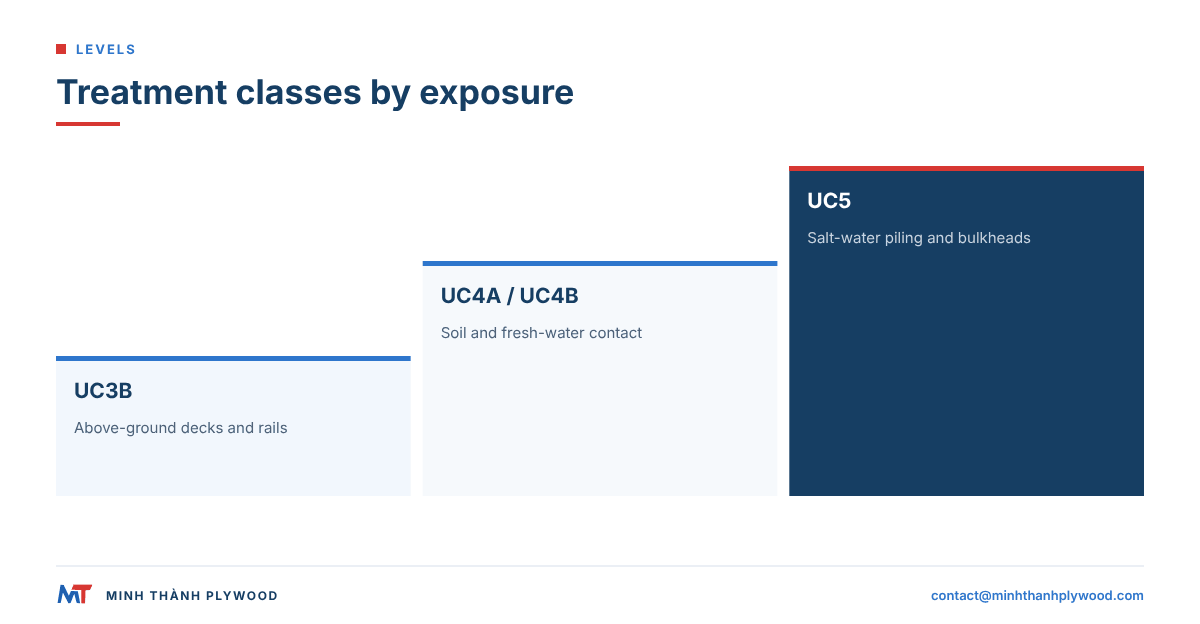
What the class means in practice:
- Above ground (UC3B): decks, rails and uncoated exterior parts.
- Ground contact (UC4A, UC4B): fences, foundations and parts in soil or fresh water.
- Salt water (UC5): piling and bulkheads, at high creosote or CCA-type retentions.
The retention step is large: for ACQ-D, APA lists 0.15 pcf for above-ground use and 0.40 pcf for ground contact. Our guide to treated timber use classes maps these to the European UC and the NZ and Australian H scales.
Glue line or preservative: which failure does each prevent?
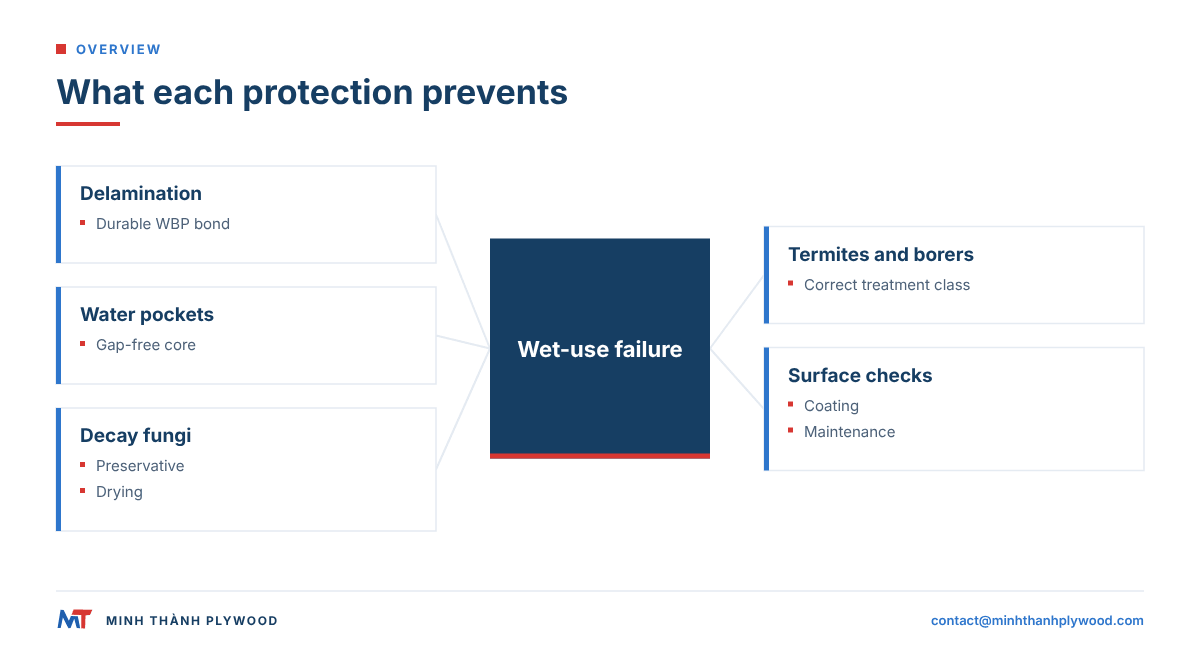
The glue line prevents delamination; the preservative prevents decay. Matching the protection to the failure is the whole decision.
| Failure | What causes it | What prevents it |
|---|---|---|
| Plies separate | Water attacks a non-durable glue line | WBP or phenolic bond |
| Water pockets inside | Core gaps and overlaps fill with water | Gap-free core |
| Soft, brown, crumbling wood | Decay fungi in damp wood | Preservative, durable species, drying |
| Galleries and holes | Termites and borers | Preservative at the right class |
| Surface checks | Wet-dry cycles and sun | Coating and maintenance |
A treated panel with an interior-type glue line can still delaminate, and a marine panel left in damp soil can still rot. That is why “waterproof” is the wrong question for both.
Core voids: why they matter in wet use
Core voids matter in wet use because a void is a hidden pocket where water sits, glue lines weaken and rot starts, and where a screw finds nothing to bite. Marine standards forbid them; treated softwood sheathing grades allow some.
- In a boat, a void under a fastener or a fitting lets water track along the ply and spread unseen.
- On a deck, a void under a screw point gives a soft spot and a crack in the coating.
- In treated panels, the preservative coats the void but does not fill it.
Cut a sample edge before ordering any panel for wet use and look for dark gaps between plies. Our exterior plywood uses AB core veneers laid loose or joined, on Styrax or Eucalyptus cores.
Marine plywood vs treated plywood for boats and docks
Marine plywood vs treated plywood for boats is an easy choice: boat plans call for marine plywood, built to a named standard and bonded with epoxy. For docks, the choice depends on which part of the dock and how wet it stays.
| Dock or boat part | Panel to use | Reason |
|---|---|---|
| Hull, deck, bulkheads | Marine plywood | No voids, durable bond, epoxy-compatible |
| Dock decking above water, drains freely | Treated plywood at UC3B, or marine plywood coated | Decay is the main threat |
| Dock framing in splash zone | Treated, heavy-duty class | Rot and borer risk |
| Floats and parts in salt water | Marine-use class treated material or non-wood | Salt-water organisms |
Marine plywood vs treated plywood for decks, fences and ground contact
For decks, fences and ground contact, pressure treated plywood is the right panel: it resists decay at a lower cost, and marine plywood has no preservative to stop soil fungi. Use the class that matches the position:
- Deck substrate under a finished surface: UC3B or equivalent, with drainage gaps.
- Fence panels and gravel boards near soil: UC4, because splash and soil keep them damp.
- Retaining boards, foundations, raised beds: UC4B or the heavy-duty class.
Seal every cut with end-cut preservative, use galvanised or stainless fixings, and keep panels off standing water.
Weight, workability, finishing and fasteners
Marine and treated panels handle differently on site. Four points decide how much work each takes.
- Weight. Treated panels leave the plant wet and stay heavier until they dry. Marine panels in okoume are among the lighter hardwood panels.
- Workability. Marine plywood cuts and machines cleanly with few voids. Treated panels need dust masks, gloves and sealed cuts.
- Finishing. Marine plywood takes epoxy, varnish and paint. Treated plywood takes paint or stain after drying, over a stain-blocking primer.
- Fasteners. Copper preservatives corrode plain steel; APA cites hot-dip galvanised, stainless steel, silicon bronze or copper fasteners for treated wood, and at least G185 zinc coating on connectors with no maker guidance.
Cost and service life: which gives more for the money?
Pressure treated plywood gives more for the money wherever decay is the main risk, and marine plywood gives more where water and delamination are. Paying for marine grade on a fence wastes money; using treated sheathing on a boat wastes the boat.
Service life depends more on detailing than on the panel:
- Sealed edges and cut ends add more life than any upgrade in grade.
- Drainage and air gaps stop water sitting on the panel.
- The right class for the position, never one step lower.
- Coating maintenance on marine work, renewed before the wood greys.
Can a panel be both marine grade and pressure treated?
Yes, a panel can be built to a marine standard and then treated, but it is a special order, not a stock item. Some markets sell marine plywood with an added preservative for marine structures, and treaters can treat marine panels to a use class on request.
Points to check before ordering both:
- The bond must suit the treatment, since a waterborne process wets the whole panel.
- The species must take treatment; many hardwoods resist penetration.
- Fabricate before treatment wherever possible, then treat cuts.
- Check epoxy compatibility with the treater if the panel will be glued or sheathed.
How do you verify a marine or treated panel on delivery?
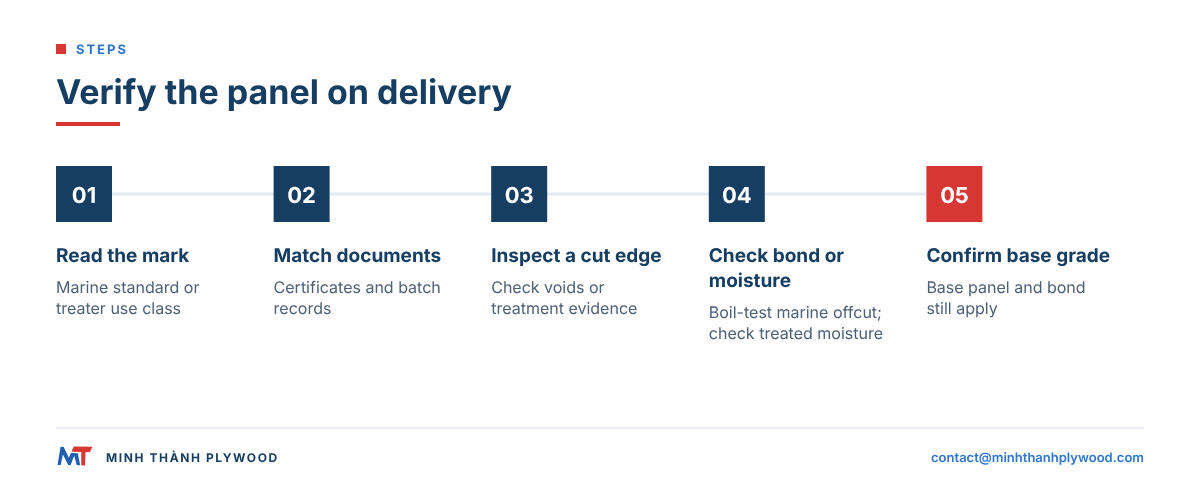
Verify the panel against its marks and documents first, then against a cut edge. Both products are easy to imitate with a face veneer or a green stain, so the paperwork and the edge decide.
For marine plywood:
- Read the panel mark. A marine panel carries the standard it claims, such as BS 1088, with the maker’s mark.
- Check the documents. Ask for the certificate or test record behind the claim, matched to the batch.
- Cut a sample edge. Count plies against the order and look for any gap or overlap in the core.
- Check the bond. A boil test on an offcut separates a durable bond from an interior one.
For pressure treated plywood:
- Read the treater’s mark or tag. It names the preservative, the use class or retention and the inspection agency.
- Check the colour on a fresh cut. Copper treatments show in the outer veneers; the class still comes from the mark.
- Check moisture. Treated panels arrive wet unless the order asks for kiln drying after treatment.
- Check the base grade. The underlying panel grade and bond still apply.
For exterior WBP plywood from Minh Thanh, every shipment is photographed and filmed before loading, and buyers get the photos and video with the shipping documents.
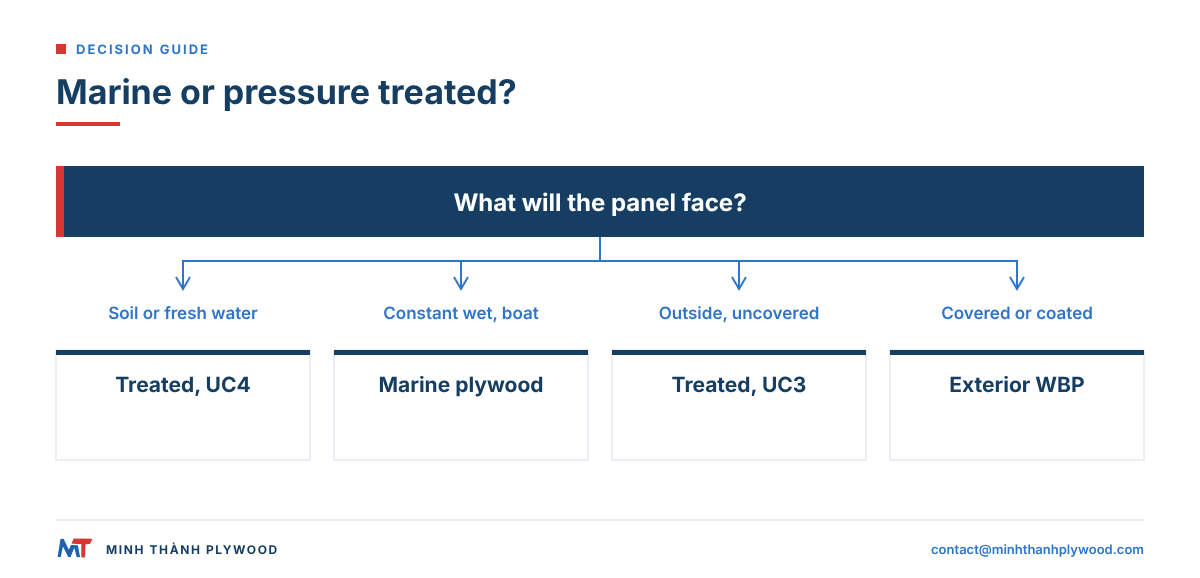
Marine or pressure treated: a decision tree
Answer three questions in order and the panel follows.
- Will the panel touch soil or fresh water, or stay damp for long periods? If yes, choose pressure treated plywood at UC4 (ground contact). If no, go on.
- Will it be wet often, and must it never delaminate or hide voids, as in a boat? If yes, choose marine plywood to the named standard. If no, go on.
- Is it outside but covered, coated or protected? If yes, choose exterior plywood with a phenolic WBP bond. If it is outside, uncovered and above ground with rot risk, choose treated plywood at UC3.
When two answers apply, such as a dock in the splash zone, combine them: a treated panel at the heavier class, or a marine panel with added treatment.
Where exterior WBP plywood fits between the two
Exterior WBP plywood fits between marine and treated plywood: it has a water-resistant phenolic bond like marine panels, with practical utility faces and a lower cost, and no preservative. It suits covered or coated outdoor work where the panel must not delaminate. The BSI description of BS EN 636:2012+A1:2015, consulted on 27 October 2026, covers plywood for structural and general-purpose use in dry, humid or exterior conditions.
Minh Thanh Plywood makes exterior plywood to this build:
| Specification | Minh Thanh exterior plywood |
|---|---|
| Faces | C/D-type utility faces, to the approved sample |
| Core | AB core veneers, Styrax or Eucalyptus |
| Bond | Phenolic WBP pressed at 130–145 °C, or melamine-fortified at 110–120 °C for humid uses |
| Thickness | 3–40 mm |
| Sizes | 1220 × 2440 mm and 1250 × 2500 mm |
| Tolerance | ±0.5 mm on thickness, ±2 mm on length and width |
| 40HC at 18 mm, Styrax core | 990 sheets, about 53 m³, 26.8 kg per sheet |
Uses include wall sheathing, hoarding, stair components with a designed support and finish, and utility parts exposed to humidity. Our okoume-faced panels are interior furniture panels and are a separate product from BS 1088 marine plywood. See the exterior plywood page.
How to specify marine or treated plywood on the order
Specify the standard, the protection and the build on separate lines, so no supplier can answer with the wrong panel.
- For marine plywood: standard (for example BS 1088), face species, thickness and ply count, documents and certificates, sample approval.
- For pressure treated plywood: base panel grade and bond, preservative, use class or retention, treating standard, treater’s mark, drying before delivery.
- For exterior WBP plywood: face/back grade, core species, bond (phenolic WBP or melamine-fortified), thickness and tolerance, size, quantity and destination.
Orders start at one 40HC, with production in 15–45 days after deposit. Send your exterior plywood specification to contact@minhthanhplywood.com or WhatsApp Lisa on +84 988 586 601; we reply within hours and send free samples.
Buyer questions, answered
Is marine plywood pressure treated?
Usually not. Marine plywood gets its water resistance from a durable bond, selected veneers and a core without gaps. Preservative treatment is a separate process and is added only when a specification asks for it.
Is marine plywood the same as pressure treated plywood?
No. Marine plywood is a panel grade built to resist water and delamination; pressure treated plywood is a panel impregnated with preservative to resist rot and insects. They answer different failures.
Is pressure treated plywood as good as marine grade plywood?
For ground contact, decks and fences it is the better choice and costs less. For boats, transoms and work that stays wet and must not delaminate or carry voids, marine plywood is better.
Can I use pressure treated plywood on a boat?
It is not the normal choice. Treated softwood plywood can have core voids, is heavier when wet and many copper treatments do not suit epoxy bonding; boat plans call for marine plywood.
Can I use marine plywood in the ground?
Not untreated. Marine plywood resists water but not soil fungi and termites over time; ground contact needs a UC4 or H4 treated panel.
Which lasts longer outdoors, marine or treated plywood?
Treated plywood lasts longer where rot and insects attack; marine plywood lasts longer where constant water would open glue lines or voids. Both need sealed edges and drainage.
Is marine plywood waterproof?
The bond is: it survives soaking and boiling. The wood itself still absorbs water, so marine plywood is coated, edge-sealed and maintained.
Can you paint pressure treated plywood?
Yes, once it is dry. Use a stain-blocking primer under latex paint to limit green or brown bleed from copper treatments.
What is cheaper, marine or pressure treated plywood?
Pressure treated plywood is usually the cheaper panel. Marine plywood costs more because of the selected veneers, gap-free core and certified bond.
What fasteners go with pressure treated plywood?
Hot-dip galvanised, stainless steel, silicon bronze or copper. Copper preservatives corrode plain steel screws and connectors.
Does Minh Thanh Plywood supply marine plywood?
We supply exterior plywood with a phenolic WBP bond and utility faces on Styrax or Eucalyptus cores, and okoume-faced interior panels. For a boat built to BS 1088, specify a panel certified to that standard.