
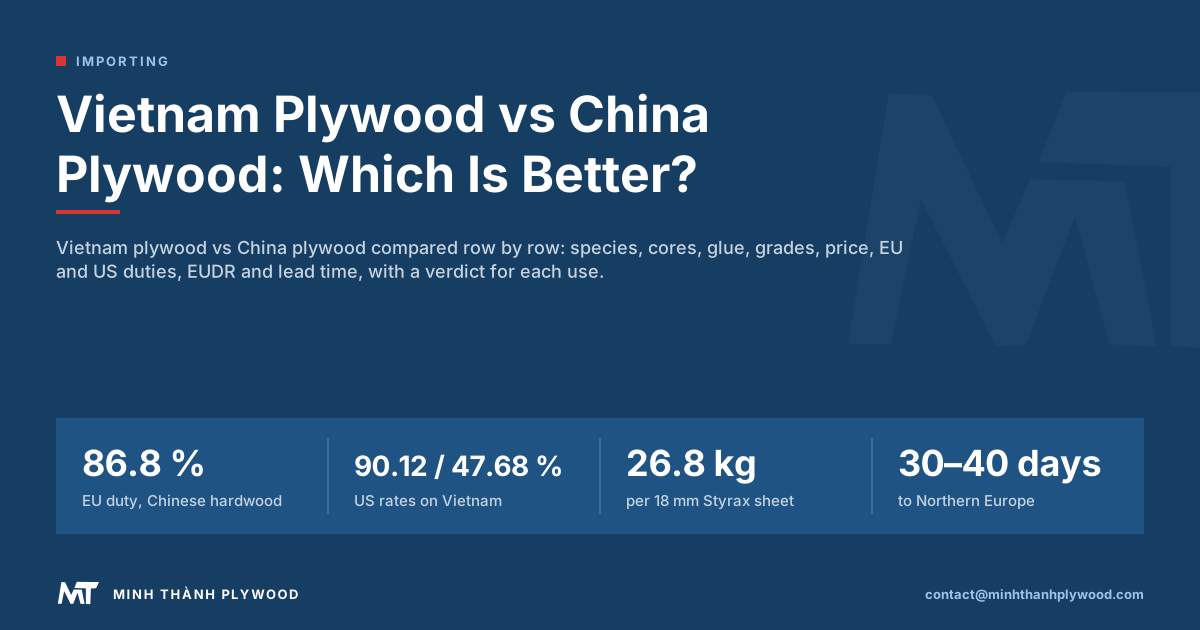
Vietnam plywood vs China plywood is a choice of mill and market more than of country. Both make every grade, from packing panels to top furniture plywood. The differences that decide a purchase are the core species, the duties your market charges, the origin documents and the weight per container. This comparison sets them side by side, with a verdict by use, from Minh Thanh Plywood, a Vietnamese furniture plywood manufacturer.
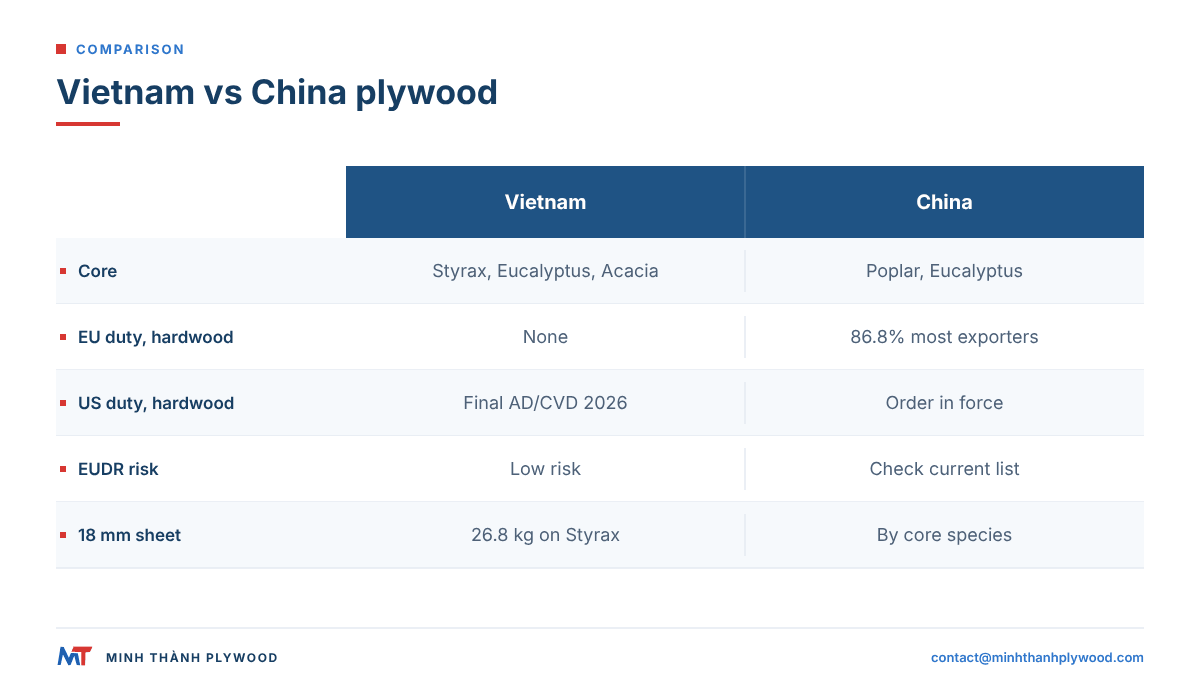
Vietnam plywood vs China plywood: the comparison in one table
Vietnam plywood vs China plywood comes down to core species, market duties, documents and weight, because both countries make every grade. China is the larger producer with a deeper range; Vietnam builds lighter white-core furniture panels and faces fewer duties in the EU.
| Metric | Vietnam plywood | China plywood |
|---|---|---|
| Typical core species | White Styrax, Eucalyptus, Acacia; rubberwood in the south | Poplar, Eucalyptus; mixed hardwood |
| Faces | Poplar, birch, EV, okoume, pine, eucalyptus and more | Poplar, birch, bintangor, okoume, EV and more |
| Glue for furniture panels | UF glue at E0 emission; MR, melamine, phenolic on order | Same glue families, by mill |
| Grade names | Pairs such as A/B; birch D+, D, E | Codes such as B/BB, BB/CC, CP |
| Grade range | Packing to top furniture plywood | Packing to top furniture plywood |
| EU anti-dumping duty on hardwood plywood | None | 86.8 % for most exporters (Reg. (EU) 2025/2333) |
| US duties on hardwood and decorative plywood | Final AD/CVD determinations of 21 July 2026 | AD/CVD order in force; 2023 circumvention finding |
| EUDR country risk | Low risk (Reg. (EU) 2025/1093) | Check the current list for your shipment |
| Weight of an 18 mm sheet | 26.8 kg on a Styrax core | Depends on core species |
| Sea time to Northern Europe | About 30–40 days from Hai Phong | By port and route |
Read the table by market. An EU furniture buyer and a US distributor reach different answers from the same rows.
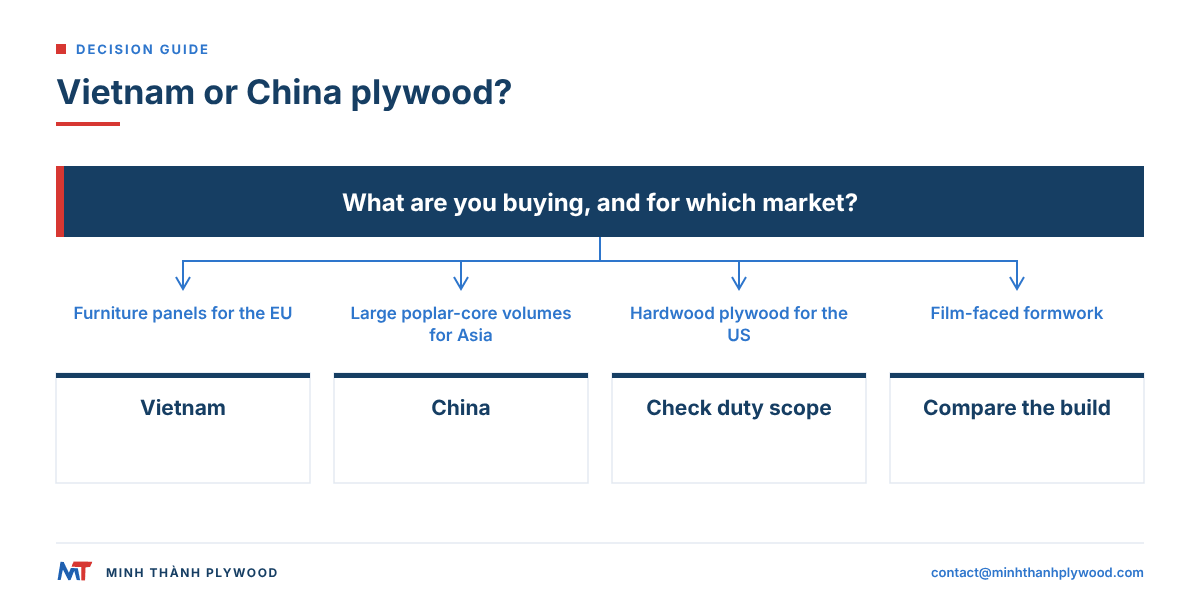
Vietnam plywood vs China plywood: which is better?
Vietnam plywood is the better buy for light, flat furniture panels going to the EU; China plywood is the better buy for very large volumes of poplar-core panels and some specialty products in markets without duties on Chinese origin. For most other uses, the mill matters more than the country.
| Use | Verdict | Why |
|---|---|---|
| Furniture and cabinet panels for the EU | Vietnam | No EU anti-dumping duty, light Styrax core, origin files |
| Birch-faced panels as a Baltic birch alternative | Vietnam | White core under the birch face, documented imported faces |
| Large poplar-core volumes for Asia | China | Scale and range of poplar mills |
| Hardwood plywood for the US | Neither by default | US duties now reach both origins; check each scope |
| Film-faced formwork panels | Either | Core, film and glue decide; compare builds |
| Packing plywood | Either | Price and thickness tolerance decide |
Treat “which is better” as two questions: which mill makes your build well, and what your market adds at the border. The rest of this comparison answers both.
Chinese plywood quality and Chinese plywood problems: what buyers report
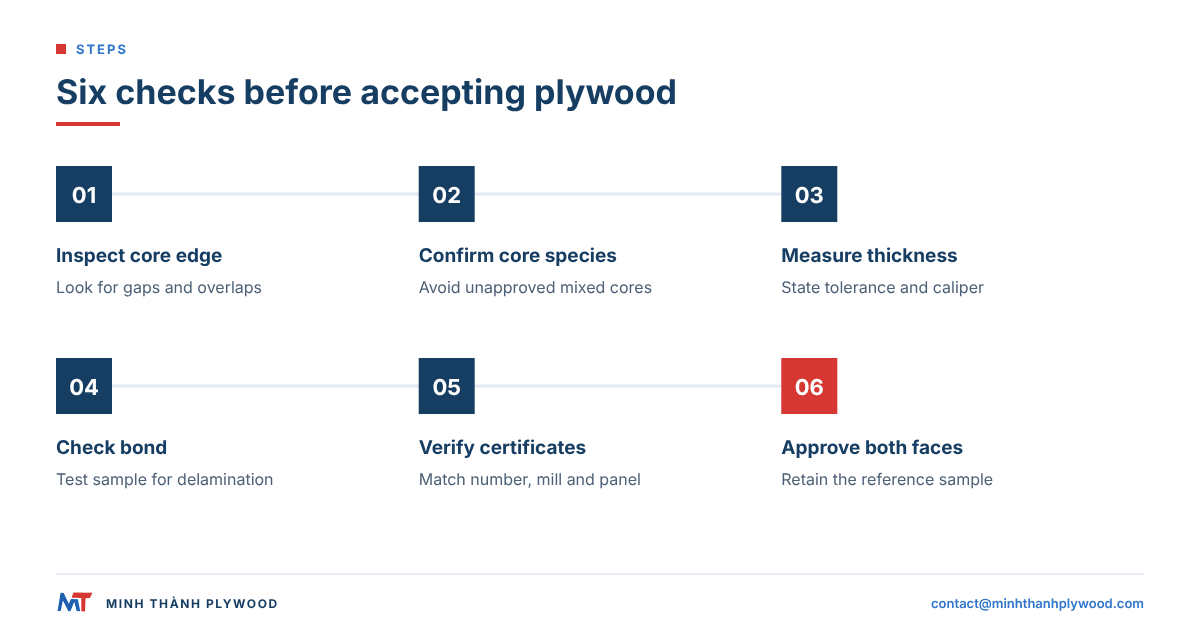
Chinese plywood quality ranges from top furniture grade to poor, and the problems buyers report come from the low end: core gaps, soft mixed cores, thin sheets, delamination and paperwork that does not match the panel. None of these is unique to China; the same low-end panel exists in Vietnam.
| Problem buyers report | Usual cause | How to prevent it |
|---|---|---|
| Core gaps and overlaps | Loose lay-up, unjoined core veneers | Specify joined or stitched cores; check the sample edge |
| Soft or mixed core | Low-density or mixed species | Name the core species on the order |
| Thickness below nominal | Thin veneers, no calibration | State thickness and tolerance; caliper on arrival |
| Delamination | Wrong glue, poor press cycle | Name the glue; bond test on the sample |
| Certificates that do not fit | Certificate of another mill or product | Ask for numbers and the mill name on the certificate |
| Face differs from sample | Loose grading | Approve a sample and keep it at both ends |
A buyer who orders “18 mm plywood” by name gets whatever build the supplier can source at the lowest cost, in either country. A written build and an approved sample remove most of the risk. Minh Thanh’s furniture line stitches cores both horizontally and vertically and presses twice, which removes the first three causes at source.
Core species: Styrax and Eucalyptus vs poplar
The core is the clearest physical difference: Vietnamese furniture mills use white Styrax and Eucalyptus cores, while many Chinese mills use poplar. The core sets weight, stiffness, edge colour and how many sheets fit in a container.
- White Styrax: light, pale and even, about 500 kg/m³ for planning; grown in northern Vietnam near mills such as Minh Thanh’s in Ha Hoa, Phu Tho.
- Eucalyptus: denser, about 650 kg/m³, for stiff shelves and tops.
- Acacia: about 580 kg/m³, for general and construction panels.
- Poplar: light and soft, the base of a large share of Chinese plywood; good for weight, softer under screws.
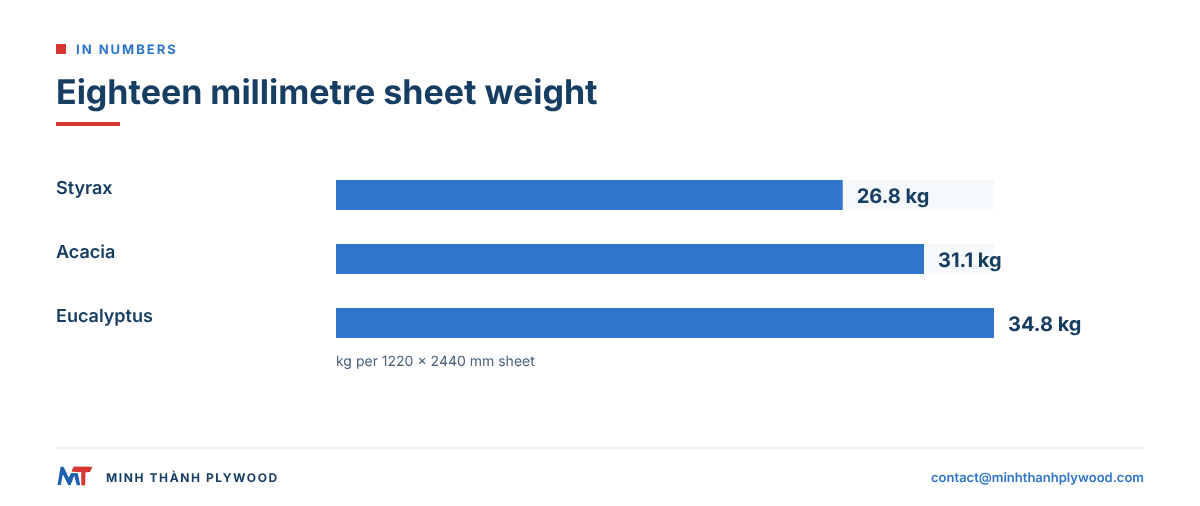
An 18 mm, 1220 × 2440 mm sheet weighs about 26.8 kg on Styrax, 31.1 kg on Acacia and 34.8 kg on Eucalyptus. A 40HC takes 990 sheets on Styrax and 795 on Eucalyptus, because the heavier core reaches the weight limit first. Read more in Vietnamese wood.
Glue, emission and certificates
Glue and emission are specified the same way in both countries; what differs between mills is the evidence they show. Ask for the certificate number, the issuing body and a test report naming the panel.
Minh Thanh’s evidence, as an example of what to ask any mill for:
- CARB P2 / TSCA Title VI: ICTT mill no. 23024, for hardwood plywood with a veneer core.
- Chamber tests: six ASTM D6007 tests between April 2025 and June 2026 on 9, 15 and 18 mm panels averaged 0.014–0.032 ppm, against the 0.05 ppm limit; three by Shanghai Hongjun, three by ICTT Vietnam.
- Quality system: ISO 9001:2015 (KAC25/0185) and TCVN 11902:2017 for veneer-faced plywood (VietCert 141.1-VNC-HC).
- Available*: FSC and CE.
The US emission limit is set out by the EPA formaldehyde standards for composite wood products. For Europe, panels meet the emission requirements furniture buyers ask for, and SGS tests to EN 717-1 on request. Furniture plywood uses UF glue at E0 emission; glue and emission class are two separate lines on the order.
*Supplied directly or through qualified partner mills.
Grade names: Chinese codes and Vietnamese grade pairs
Chinese and Vietnamese mills use different grade names for the same ladder of faces. Poplar faces from Vietnam are quoted as A/A, A/B and B/B, and buyers also order them by the Chinese codes B/BB, BB/CC and CP, which map onto the same ladder.
| Use of the face | Vietnamese grade pair | Chinese code used by buyers |
|---|---|---|
| Two visible faces | A/A | B/BB |
| One visible face | A/B | BB/CC |
| Painted or overlaid | B/B | CP |
Birch faces are named D+, D and E in Vietnam; as a buying comparison, D+ is close to European B, D close to BB and E close to CP or C. Whatever the names, the approved sample fixes the face, and a buyer switching from a Chinese supplier sends the old sample to match.
Price: is plywood cheaper in Vietnam than in China?
At the factory gate, Vietnamese and Chinese plywood overlap grade for grade; the landed price is where they part. Duties, weight per container and freight change the comparison more than the mill price.
What moves the comparison:
- Same build: compare the same core, glue, face pair, thickness and tolerance. Two quotes for “18 mm plywood” are usually two builds.
- Duties in your market: EU anti-dumping duty on Chinese hardwood plywood is 86.8 % for most exporters; US duties reach hardwood and decorative plywood from both countries.
- Weight per container: a light core puts more cubic metres in a 40HC, so freight per m³ falls.
- Freight lane: compare the actual booking from each port to yours.
For reference, Minh Thanh’s furniture and interior plywood started from US$350/m³ and commercial plywood from US$250/m³ in October 2026, with the final price set by face, core, glue, thickness, size, quantity and delivery term. Compare offers line by line with how to compare plywood quotations.
Scale: how much plywood do China and Vietnam export?
China shipped 10.7 million m³ in 2023, 43 % of world plywood trade, and 13.6 million m³ of HS 4412 plywood in 2025 (USDA FAS Solid Wood Annual, China). Vietnam is a fast-growing mid-size exporter focused on furniture and film-faced panels.
| China | Vietnam | |
|---|---|---|
| Plywood exports | 10.7 million m³ in 2023; 13.6 million m³ in 2025 | US$487.29 million in the first half of 2024, volume up 34.1 % on the year |
| Main buyers | Spread across Asia, Europe, Africa, the Americas | Korea, the US, Malaysia and Japan took 72.5 % of volume in H1 2024 |
| Workforce | Over 1 million specialised workers, as one Chinese exporter states | Concentrated in the northern and southern wood regions |
| Mills a buyer meets | Large groups such as Happy Wood, Shengda and Fenglin | Plantation-based furniture and film-faced mills |
| Lead time from order | About 30-45 days to loading, per a Chinese exporter | 15-45 days of production after the deposit at Minh Thanh |
Sources: Tadex Ply on Vietnam’s first-half 2024 exports, TLPlywood on Chinese supply. Export statistics differ by source and year, so read them as an order of magnitude: China ships many times Vietnam’s volume, which is why its range of grades and sizes is deeper, and why Vietnamese mills compete on build, light cores and documents rather than on scale.
Vietnam plywood vs China plywood for UAE and Gulf buyers
For a buyer in Dubai, Abu Dhabi or the wider Gulf, Vietnam and China plywood face the same 5 % GCC common external tariff on CIF value, so the choice rests on build, lead time and documents rather than on duty. Goods held in a free zone such as Jebel Ali pay duty only when they move to the mainland (UAE customs guide).
| Point for a Gulf importer | Vietnam (Hai Phong) | China |
|---|---|---|
| GCC import duty | 5 % on CIF value | 5 % on CIF value |
| Sea time | About 15-25 days from Hai Phong to the Middle East | By port and route |
| Core | White Styrax, Eucalyptus or Acacia; light and flat | Often poplar or Eucalyptus |
| Heat and humidity | Veneers dried to 8-12 % moisture at dispatch | Ask for the moisture reading |
| Minimum order | One 40HC at Minh Thanh, mixed specifications by agreement | By mill |
Two Gulf-specific points save money. First, a furniture or joinery shop in a hot, humid climate should order panels dried to 8-12 % moisture and keep the packs wrapped until use. Second, if you re-export from a free zone, ask the mill for the certificate of origin and the full specification so that your own buyers receive documents that match the panels. Send the part list and port (Jebel Ali, Khalifa or Dammam) with the enquiry.
Anti-dumping duties: EU, US and other markets
Duties are the largest single difference between the two origins, and they differ by market. Here they are as published, with the scope that matters.
- EU, Chinese hardwood plywood: Implementing Regulation (EU) 2025/2333 of 19 November 2025 sets a definitive anti-dumping duty on hardwood plywood from China. The duty is 86.8 % for most Chinese exporters and 43.3 % for one named company, on the net free-at-Union-frontier price. The measure does not cover plywood from Vietnam.
- US, Vietnamese hardwood and decorative plywood: the Department of Commerce issued its final anti-dumping determination on July 21, 2026, with an all-others rate of 90.12 percent (final AD determination). The final countervailing determination set an all-others rate of 47.68 %, and the US International Trade Commission voted affirmatively on injury on 19 August 2026 (published in the Federal Register on 9 September 2026). Structural PS 1 and PS 2 plywood, phenolic film-faced plyform, flooring and ready-to-assemble furniture are outside the scope.
- US, Chinese hardwood plywood: the existing anti-dumping and countervailing orders (A-570-051 and C-570-052) apply, and a 2023 finding extends it to panels finished in Vietnam with Chinese core components (core platforms or core veneers, with or without Chinese faces) (Federal Register, July 20, 2023).
- Gulf and Asian markets: compare on price, weight and lead time; sea time from Hai Phong to the Middle East is about 15–25 days.
Duties are a border cost to plan for, not a reason to choose a supplier. Read the scope for your exact product before you compare landed prices.
EUDR and origin records
From 30 December 2026, every plywood shipment into the EU needs due diligence under the EU Deforestation Regulation, whichever country it comes from. What changes between origins is the country risk and how easily a mill supplies the records.
- Dates: EUDR applies from 30 December 2026 to large and medium operators and to micro and small firms already under EUTR, and from 30 June 2027 to other micro and small firms.
- Vietnam: listed as low risk under Implementing Regulation (EU) 2025/1093; simplified due diligence applies only when every commodity in the product comes from low-risk countries.
- Every layer counts: core, face and back veneers are all traced to their plots of origin.
Minh Thanh supplies the EUDR compliance dossier (origin records and geolocation files) with orders, with imported faces such as birch documented from their country of origin. Ask any supplier, in either country, for the same files before you order.
Why are European importers switching from Chinese to Vietnamese plywood?
European importers are switching from Chinese to Vietnamese plywood for four reasons: EU anti-dumping duty on Chinese hardwood plywood, the search for birch alternatives since 2022, light white cores, and origin files ready for EUDR.
- Duty: Regulation (EU) 2025/2333 added 86.8 % for most Chinese exporters of hardwood plywood.
- Birch supply: EU measures banned wood imports from Russia from 9 April 2022 (Regulation (EU) 2022/576). Separate EU measures cover Belarus, and furniture plants looked for birch-faced panels on other cores.
- Core: a white Styrax core gives a light, pale, flat panel that machines and bands well.
- Documents: a low-risk origin and mills that supply geolocation files with orders.
Vietnam plywood as an alternative to Chinese imports works best when the buyer moves the full specification across, not just the product name. Minh Thanh ships to European buyers regularly, with repeat orders into Italy.
Construction plywood: Vietnam vs China
For construction plywood, Vietnam vs China is a match on build: both countries make film-faced formwork panels, structural panels and exterior plywood, and the core, film and glue decide the result. Vietnamese film-faced panels usually run on Acacia or Eucalyptus cores; many Chinese panels run on poplar or Eucalyptus.
| Point | What to compare |
|---|---|
| Core | A-grade, joined, no gaps; species named |
| Glue | Phenolic for the most pours, melamine for the middle |
| Film | About 120–135 g/m² standard, from 135 g/m² premium |
| Reuses | Up to about 25 phenolic, around 12–15 melamine, with proper handling, release agent and edge sealing |
| US scope | Phenolic film-faced plyform is outside the 2026 Vietnam case |
A 40HC holds about 43 m³ of film-faced panels on a Eucalyptus core and about 47 m³ on Acacia. The detailed comparison is in Vietnamese vs Chinese film-faced plywood.
When is China plywood the better choice?
China plywood is the better choice when your market charges no duty on Chinese origin for your product, you buy very large volumes of poplar-core panels, or you need a specialty panel only a few Chinese mills make. Choosing China then is a sound commercial decision.
Cases where China often wins:
- Volume: very large monthly volumes of one poplar-core build for Asian or African markets.
- Range: specialty panels, overlays and sizes from large integrated groups.
- Existing approval: a qualified Chinese mill already passing your audits.
Cases where Vietnam often wins:
- EU furniture panels, where Chinese hardwood plywood pays 86.8 % for most exporters.
- Light panels, where Styrax puts more sheets in a container.
- Birch-faced alternatives on a white core.
For the full field of origins, see which country makes the best plywood and importing plywood from China.
Is Vietnamese plywood made in China?
No. Vietnamese plywood is made in Vietnamese mills from Vietnamese plantation cores: peeled, dried, laid up, pressed, sanded and packed in Vietnam. Some faces, such as birch and okoume, are imported veneers, documented from their origin.
Origin matters at the border. US rules treat panels finished in Vietnam with Chinese core components (core platforms or core veneers, with or without Chinese faces) as Chinese for the existing order, and other Vietnamese panels need importer and exporter certifications. For US orders, Minh Thanh supplies face and core species with the Vietnamese harvest origin for the importer’s Lacey Act declaration, and the TSCA Title VI label on each panel.
Lead time, payment and logistics from Vietnam
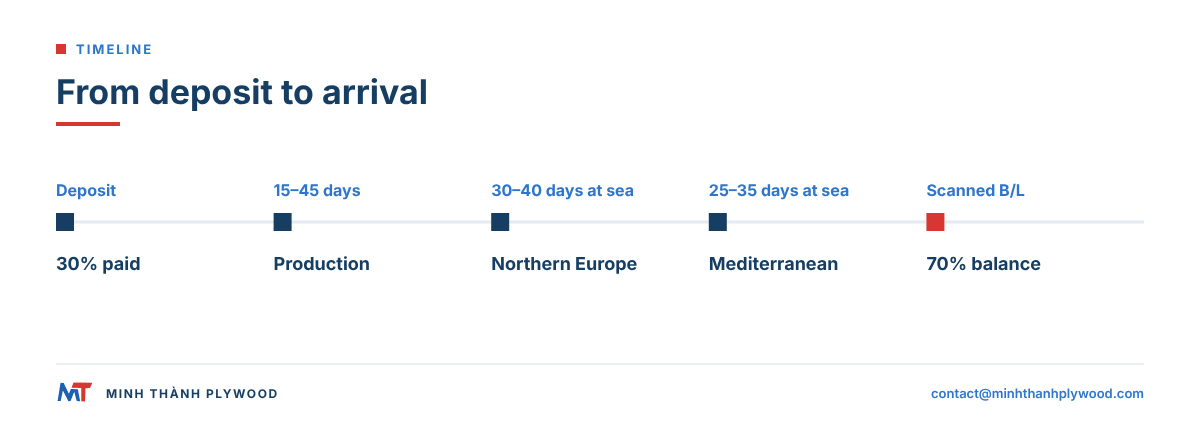
From a Vietnamese mill such as Minh Thanh, production takes 15–45 days after the deposit, and sea time from Hai Phong runs about 30–40 days to Northern Europe and 25–35 days to the Mediterranean. Payment is a 30 % deposit and 70 % against the scanned B/L, or an irrevocable L/C at sight.
| Destination | Typical days at sea from Hai Phong |
|---|---|
| South-East Asia | 5–12 |
| Middle East | 15–25 |
| Mediterranean | 25–35 |
| Northern Europe | 30–40 |
| US West Coast | 20–30 |
| US East Coast | 35–45 |
Transit depends on carrier and route. A buyer moving from a Chinese supplier usually runs one trial container alongside the existing supply: same thickness, same face grade, the old sample sent to the mill as the reference, and the new panels measured on arrival with the same caliper and moisture meter. One container on a known build gives a fair comparison of flatness, weight, face and edge before the volume moves. The minimum order is one 40HC, with mixed specifications by agreement, and every shipment is photographed and filmed before loading.
How to decide between Vietnam and China plywood
Decide in four steps, and the country answer follows from your market and build:
- Write the build: application, core, glue and emission, face and back grade, thickness, size, tolerance, packing.
- Check your border: duties and their scope for your product and origin.
- Ask for evidence: certificate numbers, test reports, origin files and a sample of the exact build.
- Compare landed cost per m³: mill price, freight, duty and handling, for the same build.
To test a Vietnamese build against your current Chinese panel, send the specification and your current sample’s grade to contact@minhthanhplywood.com or WhatsApp Lisa on +84 988 586 601; free samples go out with the quotation. The furniture range is on furniture plywood from Vietnam.
Buyer questions, answered
How much plywood does China export compared with Vietnam?
China exported 10.7 million m³ of plywood in 2023, 43 % of world trade, and 13.6 million m³ in 2025. Vietnam's plywood exports were worth US$487.29 million in the first half of 2024, up 34.1 % in volume. China is far larger; Vietnam competes on build and documents.
Is Vietnam or China plywood better for the UAE and Gulf?
Both pay the same 5 % GCC common external tariff on CIF value, so compare build, price and lead time. Vietnam ships to the Middle East in about 15 to 25 days at sea, on light Styrax, Eucalyptus or Acacia cores dried to 8 to 12 % moisture.
Is Vietnam plywood better than China plywood?
Neither country is better across the board; both make every grade. Vietnam is the stronger choice for light white-core furniture panels sold into the EU, and China for very large volumes of poplar-core and some specialty panels where duties do not apply.
Is Vietnam plywood cheaper than China plywood?
At the mill gate the two overlap grade for grade. The landed price differs more: the EU charges anti-dumping duty on Chinese hardwood plywood, while US duties now also reach hardwood and decorative plywood from Vietnam.
What are the common problems with Chinese plywood?
The complaints buyers raise are core gaps, soft or mixed cores, thickness below the nominal size, delamination and certificates that do not match the mill. The same problems appear in low-end panels from any country; a written build and a sample prevent them.
Is Vietnamese plywood made in China?
No. Vietnamese mills peel, dry, lay up and press their own panels from Vietnamese plantation cores. Some faces, such as birch, are imported veneers, and the origin of every layer is documented.
Does Vietnam plywood face anti-dumping duties in the US?
Yes, for hardwood and decorative plywood. The US Department of Commerce issued final determinations on 21 July 2026, with all-others rates of 90.12 % anti-dumping and 47.68 % countervailing duty; structural PS 1 and PS 2 panels and phenolic film-faced plyform are outside the scope.
What anti-dumping duty does the EU charge on Chinese plywood?
Implementing Regulation (EU) 2025/2333 sets 86.8 % on hardwood plywood from China for most exporters, on the net free-at-Union-frontier price, with one lower company rate. It does not apply to plywood from Vietnam.
Why are European importers switching from Chinese to Vietnamese plywood?
EU anti-dumping duty on Chinese hardwood plywood, the search for birch alternatives since the 2022 Russia measures, light white Styrax cores and origin files for EUDR have moved European furniture buyers towards Vietnamese mills.
Which certifications can a Vietnamese plywood mill show?
Minh Thanh holds CARB P2 / TSCA Title VI (ICTT mill no. 23024), ISO 9001:2015 (KAC25/0185) and TCVN 11902:2017 (VietCert 141.1-VNC-HC); FSC and CE are available*. Ask any mill, in either country, for numbers you can check.
Is Vietnamese film-faced plywood better than Chinese film-faced plywood?
Both countries make good and poor film-faced plywood. Judge the core grade, film weight and glue: a phenolic bond gives up to about 25 pours against 12 to 15 for melamine, with proper handling, release agent and edge sealing.
Can I import plywood from China into the EU?
Yes, but hardwood plywood from China pays the EU anti-dumping duty set by Regulation (EU) 2025/2333 on top of normal duty, and from 30 December 2026 the shipment also needs EUDR due diligence.