
Chinese film faced plywood and Vietnamese film-faced plywood are the same product on paper: a plywood core with a phenolic film on both faces for concrete formwork. In practice both countries make every grade, from one-pour panels to premium shuttering, and the difference comes from the core species, the glue, the film weight and the edge sealing. Minh Thanh Plywood makes film-faced plywood in Vietnam and shows how to compare any two offers.
Chinese film faced plywood vs Vietnamese: the short answer
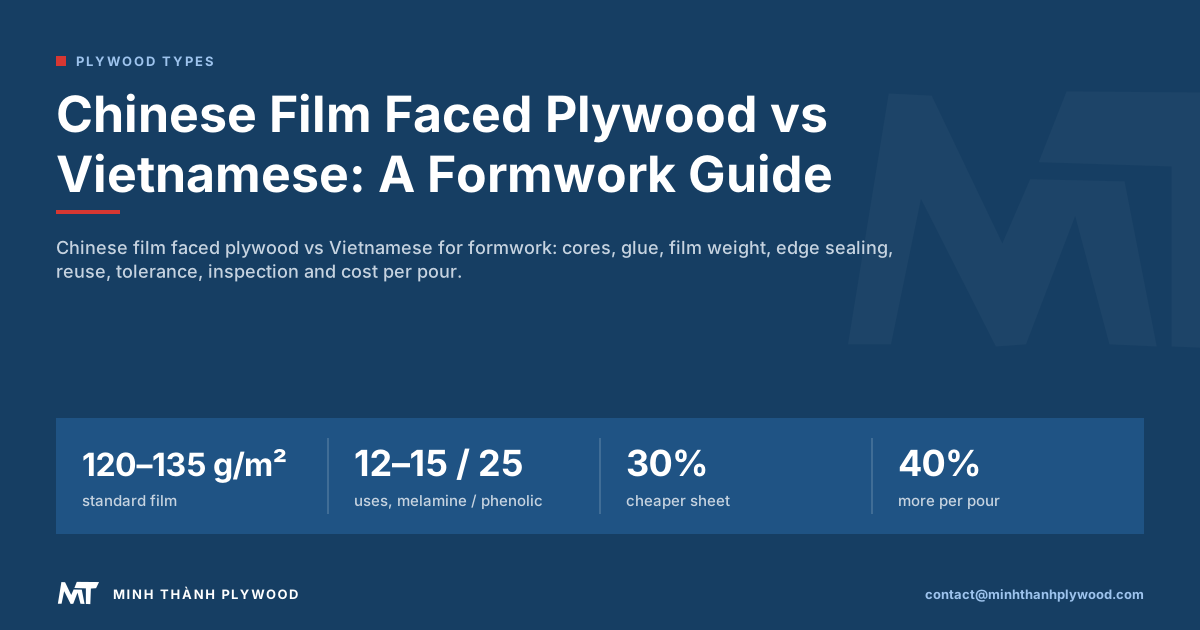
Chinese film faced plywood and Vietnamese film-faced plywood both range from budget to premium; the panel that gives more pours for the money is the one with a dense core, phenolic glue, a heavier film and sealed edges, wherever it is made. Compare the build line by line, not the origin.
- Core: Vietnamese panels usually use plantation eucalyptus and acacia; Chinese panels often use poplar, eucalyptus, birch or combination cores.
- Glue: melamine-fortified for medium reuse, phenolic (WBP) for the most pours, in both countries.
- Film: about 120–135 g/m² standard, from about 135 g/m² premium.
- Reuse: set by core, glue, film and site handling.
The rest of this guide shows how each point changes reuse and cost per pour.
UK buyer guide: stock specs and prices against a Vietnamese container
Chinese film faced plywood is what UK merchants stock, so the useful comparison for a UK buyer is stock spec against price per sheet against the container route. The table lines them up for 18 mm sheets of 2440 × 1220 mm.
| Option | Spec | Price signal, October 2026 | How you get it |
|---|---|---|---|
| Merchant stock, national chain | Chinese, 120 g/m² smooth brown film | Price on the product page, collect from 140+ branches in 1–5 working days (MKM, checked on 21 October 2026) | Trade counter |
| Merchant stock, budget FSC | Poplar core, film both sides, FSC | About £29.69 per sheet ex VAT (Sheet Materials Wholesale, checked on 21 October 2026) | Wholesale delivery |
| Merchant stock, mid-range | Smooth phenolic film | £34.45 ex VAT (The Timber Group, checked on 21 October 2026); £42.88 (Haldane Fisher, checked on 21 October 2026) | Trade counter |
| Formwork house, FSC | Chinese FSC panel, 180 g/m² film both faces, BS EN 314 Class 2 (humid) (PERI UK, checked on 21 October 2026) | Quoted per project | Formwork supplier |
| Minh Thanh container | Eucalyptus or Acacia core, film about 120–135 g/m², premium from about 135 g/m², melamine-fortified or phenolic (WBP), ±0.5 mm | Commercial plywood base from US$250/m³, about US$13.4 per 18 mm sheet before film, glue and edge paint | One 40HC of 795 to 880 sheets, FOB Hai Phong, CFR or CIF |
Calculation for the last row: an 18 mm sheet of 1220 × 2440 mm is 0.0536 m³, and 0.0536 × US$250/m³ = US$13.40. That is a raw FOB example for the base panel from our price list, not a film-faced quote; film, glue, edge paint and sea freight add to it.
A merchant sheet at £30–45 against a container sheet at a fraction of that on the base is why contractors with steady formwork volume ship by container: the margin per sheet funds the freight, duty and your stock-holding on a 795 to 880 sheet load. Duty and VAT depend on the HS code and the date, so confirm with your broker before you book.
What is film faced plywood from China?
Chinese film faced plywood is concrete formwork plywood made in China: a cross-laminated veneer core with a phenolic resin-impregnated paper film on both faces and paint-sealed edges. China is a large producer, so offers range from premium shuttering panels to low-cost panels for single pours.
- Common cores: poplar, eucalyptus, birch, or combination cores with hardwood outer plies.
- Film colours: brown or black, sometimes red or other colours by brand.
- Sizes: 1220 × 2440 mm is the common sheet, with 1250 × 2500 mm for European systems.
- Grades: sold by glue, film weight and expected reuse, often under the mill’s own grade names.
Is Chinese film faced plywood good?
Chinese film faced plywood can be good, but the quality depends on the build, not the origin. Offers range from premium shuttering panels to low-cost panels for single pours, and film faced plywood from China carries many trade names, so the grade name alone does not tell you the build. Ask for the core species, glue type, film weight and plies.
What is Vietnamese film-faced plywood?
Vietnamese film-faced plywood is the same formwork product built on plantation hardwood cores, mainly eucalyptus and acacia, which are denser than poplar and give a stiff, heavy panel. Most Vietnamese mills supply film-faced panels alongside furniture and commercial plywood.
- Cores: eucalyptus and acacia plantation veneers grown in northern Vietnam.
- Densities used for load planning: Acacia 580 kg/m³, Eucalyptus 650 kg/m³.
- Glue: melamine-fortified (MR) or phenolic (WBP) to specification.
- Sizes: 1220 × 2440 mm and 1250 × 2500 mm.
At our mill, film-faced plywood is made with a ±0.5 mm thickness tolerance, and WBP panels are hot-pressed at about 130–145 °C.
Vietnamese film-faced plywood vs Chinese film-faced plywood for formwork: comparison table
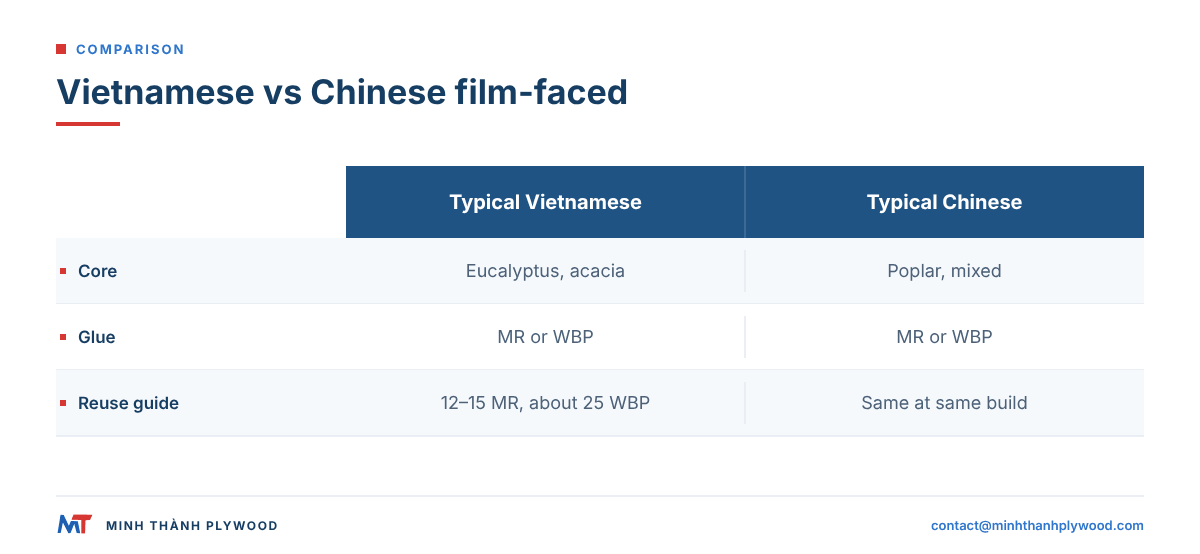
The table compares typical Vietnamese and Chinese film-faced plywood offers for formwork, one property per row. Both countries make both ends of the market, from budget panels for single pours to premium panels for many pours, so the table shows where the common offers sit rather than ranking the two origins.
| Property | Typical Vietnamese offer | Typical Chinese offer |
|---|---|---|
| Core species | Eucalyptus, acacia | Poplar, eucalyptus, birch, combination |
| Core density | Medium to high | Low to medium on poplar, higher on hardwood |
| Glue | Melamine-fortified or phenolic (WBP) | Melamine-fortified or phenolic (WBP) |
| Film weight | About 120–135 g/m², premium from 135 | Wide range, by grade |
| Edge sealing | Paint-sealed | Paint-sealed |
| Thickness tolerance | ±0.5 mm on our film-faced panels | By mill and grade |
| Reuse guide | About 12–15 uses on melamine, up to about 25 on phenolic | Same ranges at the same build |
| Sheet weight | Heavier on hardwood cores | Lighter on poplar cores |
| Best fit | Repeated pours, walls and slabs | Wide range, from single pours to systems |
The decision is not country against country. It is core, glue, film and tolerance against the number of pours your project needs.
Core species: eucalyptus and acacia vs poplar
A dense hardwood core gives a stiffer panel that deflects less under wet concrete, holds nails and screws better at the edges and keeps its shape over more strip-and-reuse cycles. A poplar core is lighter and easier to carry but softer and less stiff.
| Core | Density for planning | Stiffness | Handling | Where it fits |
|---|---|---|---|---|
| Eucalyptus | 650 kg/m³ | High | Heavy | Repeated pours, high walls |
| Acacia | 580 kg/m³ | High | Medium-heavy | Repeated pours |
| Poplar | Lower than the hardwoods | Lower | Light | Light formwork, few pours |
An 18 mm sheet at 1220 × 2440 mm weighs about 34.8 kg on Eucalyptus and 31.1 kg on Acacia at those densities. Heavier sheets mean fewer sheets per container before the payload limit, which is the trade-off for stiffness.
Glue: melamine-fortified vs phenolic WBP
Glue sets the ceiling on reuse: as an industry guide, melamine-fortified glue gives about 12–15 uses and phenolic (WBP) glue up to about 25, with proper handling, release agent and edge sealing. The glue type must be written on the order, because film colour does not show it.
- Melamine-fortified (MR): water-resistant, cost-effective, suits medium reuse.
- Phenolic (WBP): weather- and boil-resistant, dark glue line, the choice for many pours.
- Bond class (BS EN 314-2): Class 1 is for dry interiors, Class 2 for humid conditions and protected exteriors, Class 3 for unprotected exterior use (APA Europe, EN 314-2, checked on 21 October 2026). UK stock panels are often sold at Class 2; a phenolic (WBP) bond is the one to ask for when the formwork is outdoors for months and must reach Class 3.
- Bond test: a cut sample is boiled and checked for delamination; the 72-hour boil is the traditional WBP test.
- Emission: glue type and emission class are two separate specifications.
We make film-faced plywood with melamine-fortified or phenolic (WBP) glue to your specification.
Film weight and edge sealing
Film weight decides how long the face survives abrasion, vibrators and stripping; standard film runs about 120–135 g/m², premium from about 135 g/m², and anti-slip deck film around 220 g/m². Edge sealing decides how long the core stays dry.
- Film weight: ask for the grams per square metre on both faces, and the film brand if your project names one.
- Film colour: brown and black are both standard; colour does not show quality.
- Edge paint: water-resistant paint on all four edges, applied after cutting.
- Re-seal cut edges on site: every cut edge needs paint before the panel’s first pour.
- Anti-slip faces: textured film such as rice-grain, hexagon or mesh patterns for platforms.
Water entering bare edges swells the core, lifts the film at the edges and ends the panel’s life early, on any core.
Reuse cycles and what decides them
Reuse is a target for a build and a way of working, not a fixed property of the panel: the same sheet gives very different numbers on two sites. Core, glue and film set the ceiling; handling decides how close you get.
| Factor | Raises reuse | Lowers reuse |
|---|---|---|
| Core | Dense hardwood, no gaps | Light core, gaps and overlaps |
| Glue | Phenolic (WBP) | Weak interior glue |
| Film | Heavier film | Thin film |
| Edges | Sealed, re-sealed after cuts | Bare cut edges |
| Release agent | Applied every pour | Skipped |
| Stripping | Careful, no prying on faces | Crowbars on the film |
| Storage | Flat, covered, dry | Stacked wet in the sun |
Budget panels with unstitched mixed cores give only a few uses even with good handling. If your project plans 15 pours, buy a build rated for more than 15.
Thickness, tolerance and sheet weight
Thickness tolerance matters on formwork because panels sit side by side in a form and any step shows in the concrete face. Our film-faced panels hold ±0.5 mm, and length and width hold ±2 mm.
| Thickness | Common use |
|---|---|
| 12 mm | Curved forms, light work |
| 15 mm | Columns and walls with close supports |
| 18 mm | Walls and slabs, the most common |
| 21 mm | Slabs with wider support spacing |
Measure a sample at several points with a calliper: a panel that runs thin in the middle, or varies from sheet to sheet, makes joints step in the cast face. Our guide to 18 mm film-faced plywood covers the most-used thickness in detail.
How to inspect any film-faced panel before you buy
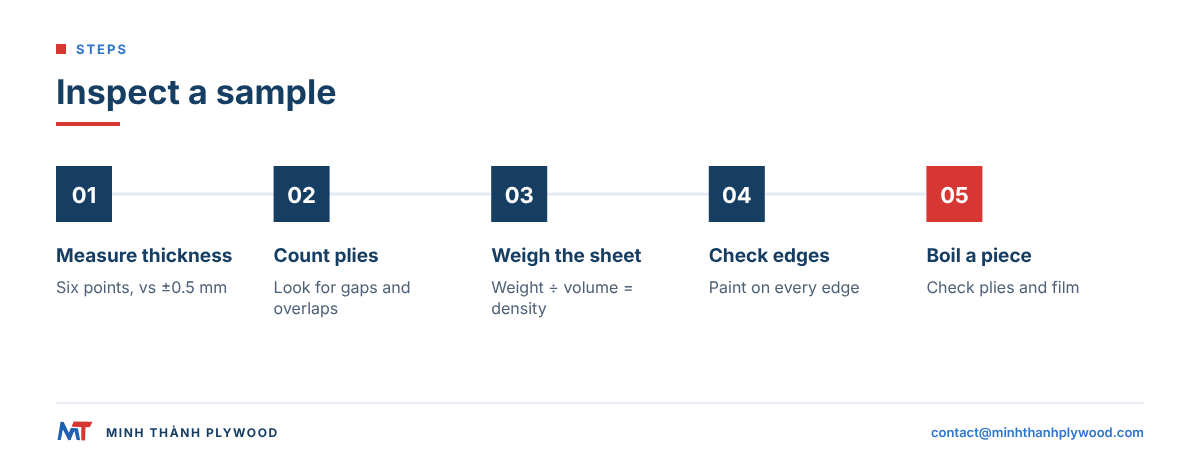
Inspect a film-faced panel by measuring it, cutting it, weighing it and boiling it: five checks on a free sample show the build better than any grade name. They work the same on panels from any country.
- Measure thickness at six points; compare with the stated tolerance.
- Cut a strip and count the plies; look for gaps, overlaps and soft layers in the core.
- Weigh the sheet and divide by its volume to check the core density.
- Check the edges: paint should cover every edge evenly, with no bare veneer.
- Boil a sample to test the glue bond, then check the plies and the film for lifting.
Panels whose film covers an uneven or patched core often show it as dips and ridges under a straightedge laid across the face. Our guide to Vietnam vs China plywood covers the wider comparison of the two supply countries.
Price per pour, not per sheet
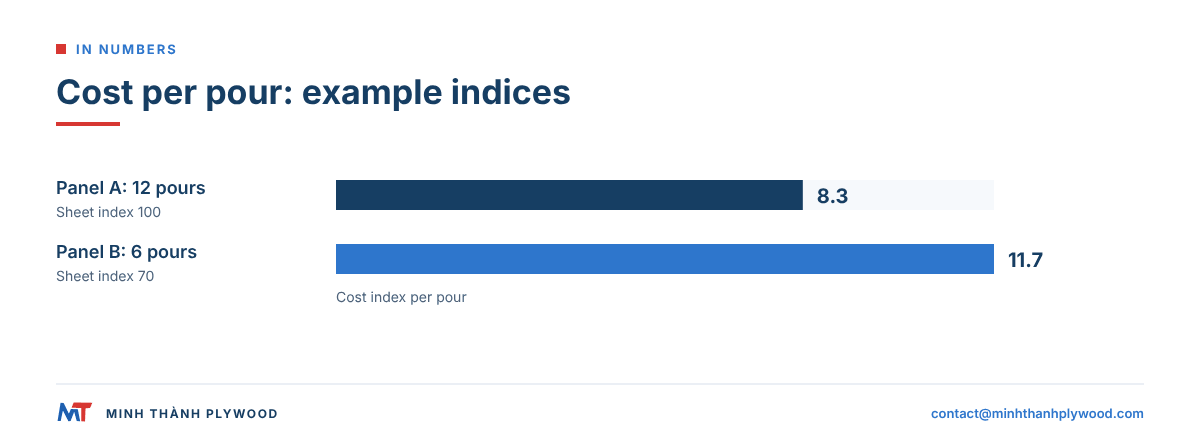
Compare film-faced plywood by cost per pour: the sheet price divided by the number of uses you get on your site. A cheaper sheet that gives fewer uses often costs more per pour.
| Example | Sheet price | Uses on site | Cost per pour |
|---|---|---|---|
| Panel A | Index 100 | 12 | Index 8.3 |
| Panel B | Index 70, 30% cheaper | 6 | Index 11.7, 40% higher |
The example uses index prices, not quotes. It shows why a 30% lower sheet price can mean a 40% higher cost per pour. The same logic in pounds: a UK merchant sheet at £30 that gives 6 pours costs £5.00 per pour, and a £45 sheet with phenolic film that gives 12 pours costs £3.75 per pour, 25 % less, before the labour of handling twice as many sheets. The pour counts are example values for the build, not a promise for any brand.
Add the labour of handling more sheets, the waste, and the concrete finish: a panel that fails early also leaves marks that need patching. Indicative starting prices for commercial plywood are from US$250/m³ (October 2026); the final price depends on core, glue, film, thickness, size and quantity.
Compliance and documents for European importers
European importers of film-faced plywood need origin documents for every order. We supply the EUDR compliance dossier (origin records and geolocation files) with orders, as required under Regulation (EU) 2023/1115 (checked on 20 October 2026). The application date for large and medium operators is 30 December 2026, set by Regulation (EU) 2025/2650.
- UK buyers: the EUDR does not apply in Great Britain. The UK Timber Regulation, the Timber and Timber Products (Placing on the Market) Regulations 2013, applies there, so the importer carries out due diligence before the panels are placed on the market and keeps the records for 5 years (Carbmee, Great Britain deforestation policy, checked on 21 October 2026). The origin records and geolocation files we supply for the EUDR serve as the same evidence.
- FSC: Chinese stock in the UK is often sold FSC-certified; FSC is available on request from our mill, so state it on the enquiry if the contract needs it.
- Shipping documents: commercial invoice, packing list, B/L, certificate of origin (EUR.1 for the EU), phytosanitary and fumigation certificates, insurance with CIF.
- Quality system: ISO 9001:2015 quality management for plywood manufacturing.
- Testing: third-party testing to the buyer’s method is arranged through SGS on request.
- Photos: every shipment is photographed and filmed before loading; buyers get the photos and video.
For duties and import rules that apply to plywood from China, see our guide to importing plywood from China.
Lead time and container loads to Europe
Film-faced plywood from Vietnam is produced 15–45 days after the deposit, and typical days at sea from Hai Phong are 30–40 to Northern Europe and 25–35 to the Mediterranean, by carrier and route.
| Core | 40HC load at 1220 × 2440 mm, 18 mm | Sheet weight |
|---|---|---|
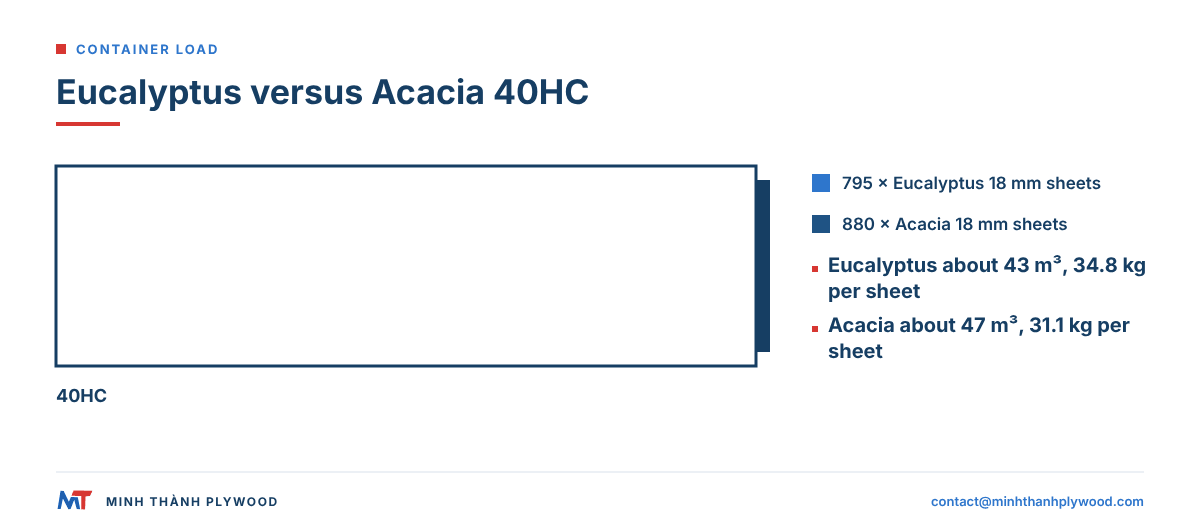
| Eucalyptus | 795 sheets, about 43 m³ | 34.8 kg |
| Acacia | 880 sheets, about 47 m³ | 31.1 kg |
These loads are planned against a 28,000 kg payload unless the booking is lower; a buyer with a lower booking cap gets fewer sheets. Terms are FOB Hai Phong, CFR or CIF, from one 40HC with mixed specifications by agreement.
Which panel for which formwork job?
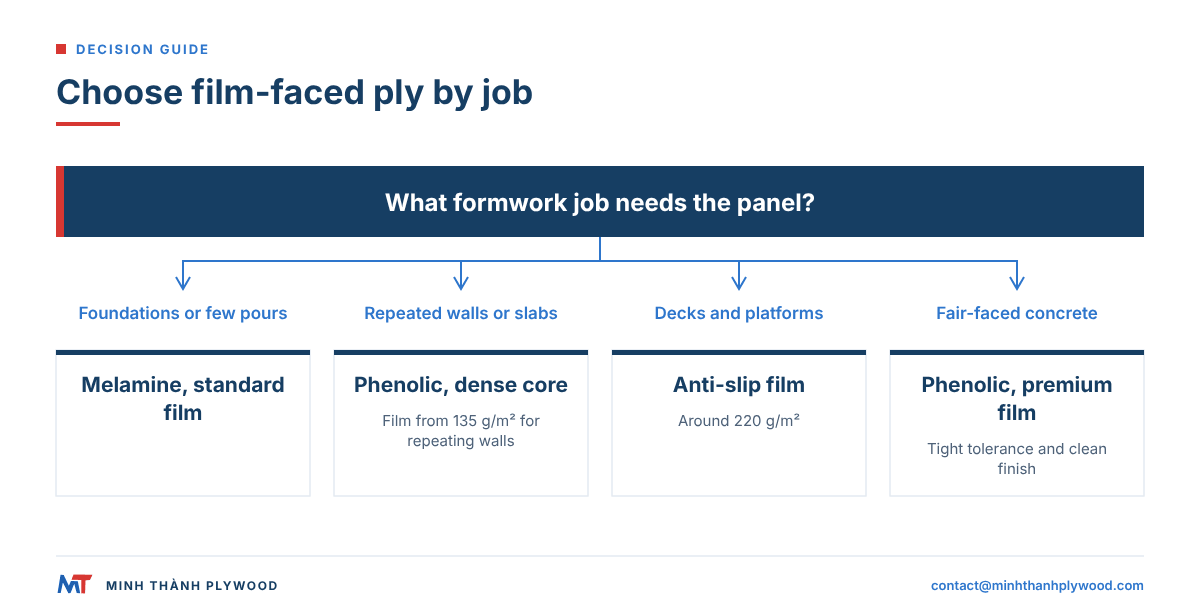
Match the build to the number of pours and the finish you need, not to the country. The matrix gives the verdict by job.
| Formwork job | Build to choose | Why |
|---|---|---|
| One or two pours, hidden concrete | Melamine-fortified, standard film | Lowest cost per job |
| Foundations and footings | Melamine-fortified, standard film | Few pours, rough use |
| Walls in a repeating system | Phenolic (WBP), dense core, film from 135 g/m² | Many pours, flat face |
| Slabs on tables or shores | Phenolic (WBP), 18 mm or 21 mm | Stiffness and reuse |
| Fair-faced architectural concrete | Phenolic (WBP), premium film, tight tolerance | Clean joints and finish |
| Decks and platforms | Anti-slip film around 220 g/m² | Grip underfoot |
What this means for your film-faced order
A film-faced order that compares like with like names the core, the glue, the film weight and the tolerance. Send these lines with your request:
- Application: walls, slabs, columns, foundations or fair-faced concrete; planned pours.
- Core: eucalyptus or acacia for repeated pours.
- Glue: melamine-fortified or phenolic (WBP).
- Face: film weight per face, colour, smooth or anti-slip.
- Size and thickness: 1220 × 2440 mm or 1250 × 2500 mm; 12, 15, 18 or 21 mm; ±0.5 mm.
- Packing and quantity: from one 40HC, mixed specifications by agreement; destination port.
Free samples are available. See our film-faced plywood page, or read which country makes the best plywood for the wider picture.
Buyer questions, answered
What is Chinese film faced plywood?
Chinese film faced plywood is formwork plywood made in China: a plywood core, often poplar, eucalyptus, birch or a combination, with a phenolic resin film pressed on both faces and sealed edges. It is used to form concrete walls, slabs and columns.
Is Chinese film faced plywood good?
Good Chinese film faced plywood exists, and so does very cheap panel built for one or two pours. Judge each offer by its core species, glue, film weight, edge sealing and a sample boil test, not by the country on the label.
What is the difference between Vietnamese and Chinese film faced plywood?
The main difference is the core: Vietnamese panels usually use dense plantation hardwoods such as eucalyptus and acacia, while Chinese panels often use poplar or combination cores. Glue, film weight and edge sealing then decide reuse in both.
How many times can film faced plywood be reused?
As an industry guide, film-faced plywood with melamine-fortified glue gives about 12–15 uses and phenolic (WBP) glue up to about 25, with proper handling, release agent and edge sealing. Low-cost panels with weak cores give far fewer.
What film weight should formwork plywood have?
Standard film is about 120–135 g/m², and premium panels start from about 135 g/m². Anti-slip film for decks and platforms is around 220 g/m² with a textured pattern.
Why is Chinese plywood sometimes cheaper upfront?
A lower sheet price usually reflects a lighter core, fewer plies, a cheaper glue or a thinner film. Compare cost per pour: a cheaper panel that gives half the uses costs more per pour.
Is Vietnam film faced plywood suitable for high-rise projects?
Yes. Phenolic WBP-bonded panels on dense hardwood cores, with sealed edges and a tight thickness tolerance, suit repeated pours on core walls and slabs. Specify the glue, film weight and tolerance on the order.
How long does film-faced plywood take to ship from Vietnam to Europe?
Production takes 15–45 days after the deposit. Typical days at sea from Hai Phong are 30–40 to Northern Europe and 25–35 to the Mediterranean, by carrier and route.
How do I test film faced plywood before buying?
Ask for a free sample, check thickness at several points, cut it to count plies and inspect the core, check the edge paint, and boil a piece to test the glue bond. Compare the results with the offer's specification.
Which core is best for film faced plywood?
Dense hardwood cores such as eucalyptus and acacia give stiff, heavy panels that hold their shape over many pours. Lighter cores are easier to handle but bend more and wear faster under vibrators and stripping.