
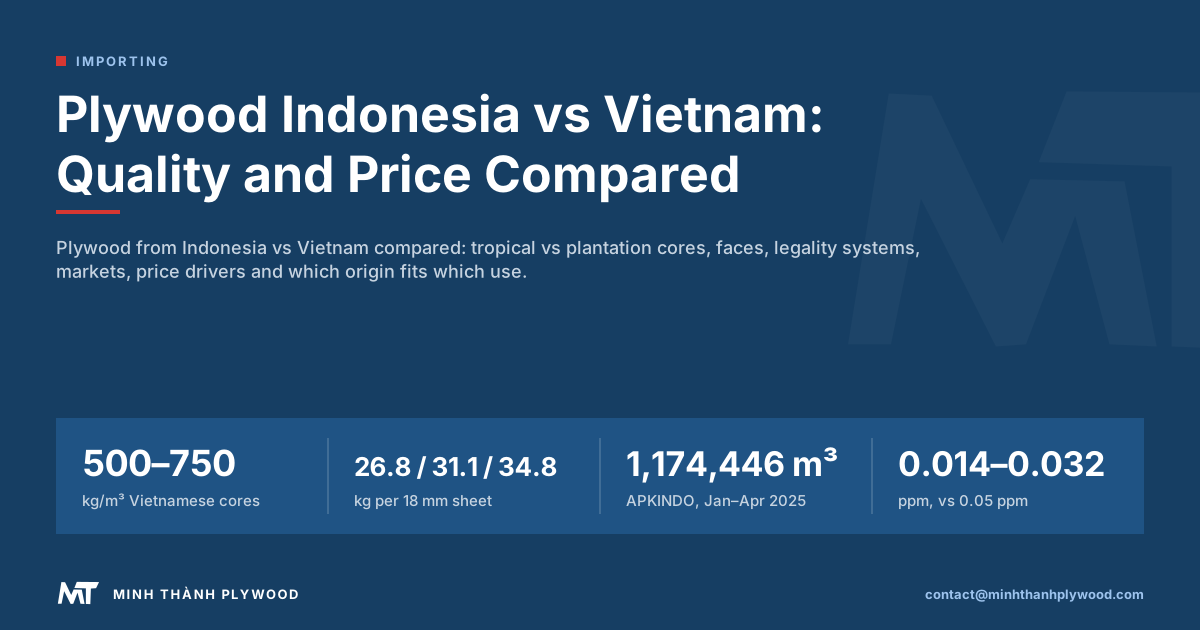
Plywood from Indonesia is built mainly on tropical hardwood and light plantation cores and sells strongly to the US and Japan; Vietnamese plywood uses plantation acacia, eucalyptus and Styrax cores and leads in furniture panels for Europe. Neither origin is better everywhere. Minh Thanh Plywood compares cores, faces, documents and price drivers so you can choose by use.
Plywood from Indonesia vs Vietnam: the short answer
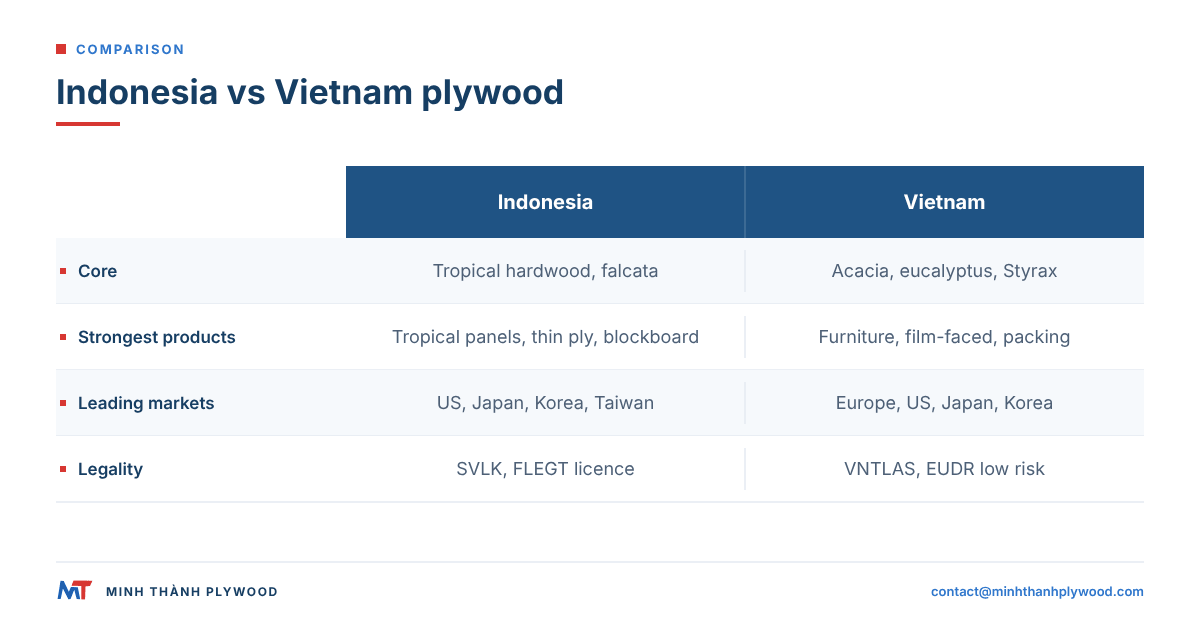
Plywood from Indonesia and plywood from Vietnam differ first in the core: Indonesian mills build on tropical hardwoods and light falcata, Vietnamese mills on plantation acacia, eucalyptus and Styrax. That one difference sets weight, look, price and the markets each origin serves best.
| Point | Indonesia | Vietnam |
|---|---|---|
| Main core species | Meranti, keruing and mixed tropical hardwood; falcata (sengon) for light cores | Acacia, eucalyptus, Styrax (white core) |
| Common faces | Meranti, keruing, bintangor, film | EV, poplar, birch, okoume, pine, bintangor, eucalyptus, film |
| Strongest products | Tropical hardwood panels, thin plywood, light falcata boards, blockboard | Furniture and interior panels, film-faced, packing plywood |
| Leading markets | United States, Japan, South Korea, Taiwan, EU | Europe, US, Japan, Korea, Middle East |
| Legality system | SVLK, FLEGT-licensed for the EU | VNTLAS; EUDR low-risk country |
| Typical lead time | By mill | 15–45 days after deposit at Minh Thanh Plywood |
Choose by use: a buyer of light, flat furniture panels for Europe and a buyer of tropical hardwood panels for Japan will rightly pick different origins. The sections below go row by row.
What is plywood in Indonesia?
Plywood in Indonesia, called kayu lapis, is one of the country’s largest wood exports, made by integrated mills that peel tropical hardwood logs and plantation timber into veneer. Indonesian plywood exporters ship mainly to the United States, Japan, South Korea, Taiwan and the EU.
The Indonesian Wood Panel Association, APKINDO, reported panel exports of 1,174,446 m³ worth US$599,973,779 from January to April 2025, up 5% in volume and 4% in value on the year before. The United States led by value in that period, at US$175,903,181, with Japan next at US$140,576,705. For January–December 2024, plywood made up 80% of the volume and 78% of the value of those panel exports, and blockboard most of the rest (APKINDO).
Indonesian mills are known for thin tropical plywood, concrete-form panels and blockboard, and for long experience with Japanese buyers. For a world view of producing countries, see plywood producing countries worldwide.
Indonesian plywood manufacturers: what they make
Indonesian plywood manufacturers make three main families of panel: tropical hardwood plywood, light plantation-core plywood and blockboard. Each serves a different buyer.
- Tropical hardwood plywood. Meranti or keruing faces over mixed tropical cores. Used for joinery, concrete forms, flooring bases and Japanese building uses.
- Falcata and light plantation plywood. Falcata (sengon) peels fast and gives a very light core. Used for packing, caravans, light furniture and core stock.
- Blockboard. A core of sawn strips between veneers, for doors and shelving.
- Thin plywood. Panels of a few millimetres for door skins, furniture backs and laminating.
Large Indonesian mills sit on Kalimantan, Sumatra and Java, close to their log supply. Many hold Japanese product certification for their Japanese buyers. As with any origin, the mill’s own name, address and documents decide what you buy, not the country.
Vietnamese plywood: what it does best
Vietnamese plywood does best in furniture and interior panels on plantation cores, film-faced plywood and packing plywood. Northern Vietnam grows acacia, eucalyptus and Styrax close to the mills, and that short supply line shapes the product.
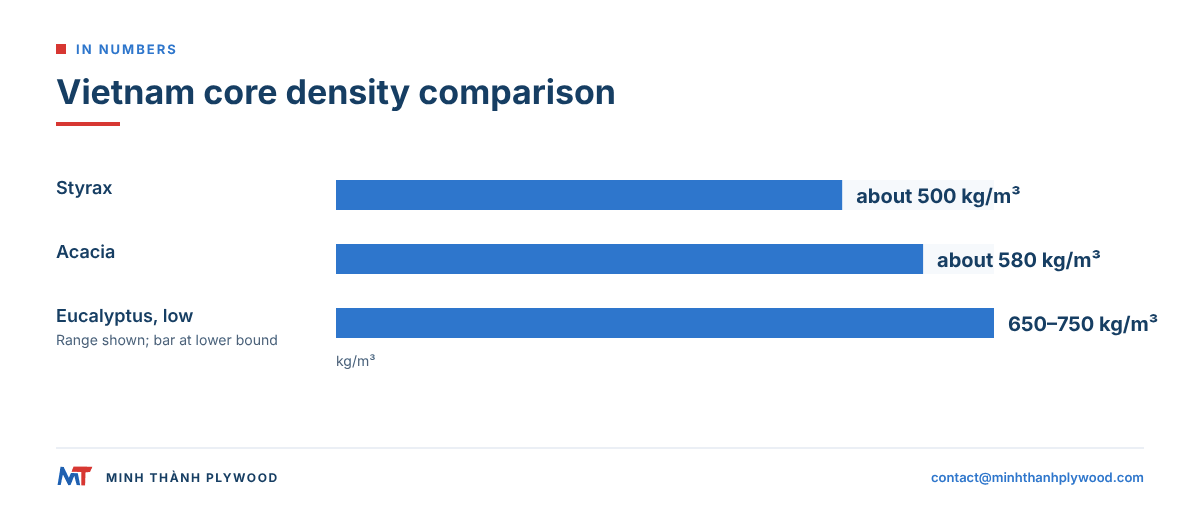
Styrax, the white core of northern Vietnam, gives a light, pale, even core at about 500 kg/m³. Acacia, at about 580 kg/m³, and eucalyptus, at 650–750 kg/m³, give heavier, stiffer panels for commercial, film-faced and site use. A buyer can choose the weight of the core for the job.
Minh Thanh Plywood, in Ha Hoa, Phu Tho, makes furniture and interior plywood with Europe as its main market, plus commercial, packing and film-faced plywood. Furniture panels are pressed twice: the core board is pressed and calibrated, then face and back are pressed on. Core layers are stitched horizontally and vertically, and sanded furniture panels are held to ±0.2–0.3 mm, down to ±0.2 mm.
Core species: tropical hardwood or plantation timber?
The core is most of a plywood panel’s volume, so the core species sets its weight, stiffness and price more than any other line. Indonesian panels often use tropical hardwood or falcata cores; Vietnamese panels use acacia, eucalyptus or Styrax.
| Core | Origin | Density | What it gives |
|---|---|---|---|
| Falcata (sengon) | Indonesia | Very light | Lightest boards; lower screw hold |
| Mixed tropical hardwood | Indonesia | Medium to heavy | Strong, dark cores; natural-forest log supply |
| Styrax (white core) | Vietnam | About 500 kg/m³ | Light, pale, flat furniture cores |
| Acacia | Vietnam | About 580 kg/m³ | Stiffer commercial and film-faced cores |
| Eucalyptus | Vietnam | 650–750 kg/m³ | Heavy, hard cores for formwork and site use |
At 1220 × 2440 × 18 mm, density converts directly into sheet weight: about 26.8 kg on Styrax, 31.1 kg on acacia and 34.8 kg on eucalyptus. Weight decides how many sheets fit under a container’s payload, and so the freight cost per cubic metre.
Face veneers and appearance grades
Indonesian plywood is best known for tropical faces such as meranti, keruing and bintangor; Vietnamese plywood offers a wider choice of furniture faces, including EV, poplar, birch, okoume and pine. Both supply film faces for formwork.
At Minh Thanh Plywood, 10+ face veneers are available, mostly EV (engineered veneer), poplar, birch, okoume and pine; bintangor, eucalyptus, gurjan, sapele and others are made on request. Faces are quoted as face/back grade pairs fixed by the approved sample:
- Poplar faces: A/A, A/B and B/B; buyers also order by the Chinese codes B/BB, BB/CC and CP, which map onto the same ladder.
- Birch faces: D+, D and E, quoted as pairs such as D+/D, comparable to B/BB on the European ladder.
- Eucalyptus faces: A/A, A/B and B/B.
Ask any mill, in either country, for the grade pair in writing and a sample of both faces.
Quality differences between Indonesian and Vietnamese plywood
The quality difference between Indonesian and Vietnamese plywood comes from each mill’s segment, not from the country: both origins have mills for high-grade panels and mills for low-cost commercial board. Compare the build line by line.
- Core grade and joining. Are core veneers graded, and are they stitched or loose-laid? Gaps and overlaps show up as dips under a high-gloss finish.
- Pressing. Double pressing gives a flatter furniture panel.
- Glue and emission. Which bond (UF, melamine-fortified, phenolic WBP) and which emission class (E2, E1, E0, CARB P2 / TSCA Title VI)?
- Thickness tolerance. Sanded furniture panels from Minh Thanh Plywood are held to ±0.2–0.3 mm; commercial and film-faced panels to ±0.5 mm.
- Moisture. Minh Thanh panels are dried to 8–12 % moisture content at dispatch.
Two quotes under the same product name can describe two different builds. The difference comes from core grade, joining method, face preparation, adhesive system and tolerance. Our guide is Vietnamese plywood good quality covers the checks in detail.
Price differences: what makes one origin cost more?
Price differences between Vietnamese and Indonesian plywood come mainly from the log: plantation cores grown close to the mill cost less than tropical hardwood logs from natural forests. For like-for-like furniture and commercial panels, Vietnamese mills are usually the more cost-effective origin.
| Price driver | Effect |
|---|---|
| Core species and log source | Plantation acacia, eucalyptus and Styrax cost less than tropical hardwood logs |
| Face | Imported birch and okoume, and clear tropical faces, cost more than EV or poplar |
| Glue and emission | Phenolic WBP and E0 or CARB P2 cost more than MR and E2 |
| Thickness and size | Per sheet rises with thickness; custom sizes cost more |
| Quantity | A full 40HC carries the lowest unit cost |
| Delivery term | FOB, CFR or CIF moves freight and insurance into the price |
At Minh Thanh Plywood, indicative starting prices in October 2026 are US$250/m³ for commercial plywood and US$350/m³ for furniture and interior plywood. Compare any two quotes per cubic metre, on the same build and the same delivery term.
Indonesian plywood prices in Saudi Arabia and the Gulf
Indonesian ordinary plywood sells in Saudi Arabia for SAR57.50–143.75 a sheet across 4–18 mm, and Indonesian film-faced plywood for about SAR92.00, VAT included, at Al Zaben in October 2026. A Vietnamese container price lands well under those shelf prices, even after freight, 5% duty and 15% VAT.
| Sheet | Origin and type | Shelf or factory price | Where listed |
|---|---|---|---|
| 4–18 mm | Indonesian ordinary plywood | SAR57.50–143.75 incl. VAT | Al Zaben |
| Formwork sheet | Indonesian film-faced plywood | SAR92.00 incl. VAT | Al Zaben |
| 1220 × 2440 × 18 mm, raw FOB example | Minh Thanh furniture and interior plywood, from US$350/m³ | about SAR70.31 before freight, duty and VAT | Minh Thanh Plywood, October 2026 |
| 1220 × 2440 × 18 mm, raw FOB example | Minh Thanh commercial plywood, from US$250/m³ | about SAR50.25 before freight, duty and VAT | Minh Thanh Plywood, October 2026 |
The FOB rows multiply the price per m³ by one sheet’s volume, 1.22 × 2.44 × 0.018 = 0.0536 m³, and convert at the fixed SAR3.75 per US$ (Saudi Central Bank). They are raw FOB examples, not sheet prices. On top come sea freight, about 15–25 days from Hai Phong to the Middle East by carrier and route, the 5% GCC common customs duty on plywood and 15% VAT on the landed value.
A Riyadh, Jeddah or Dammam importer who brings in a 40HC of Vietnamese commercial or furniture plywood sets that landed cost beside SAR57.50–143.75 on the shelf for Indonesian ordinary board. Our 18 mm plywood price in Saudi Arabia guide gives more Saudi shelf prices by origin.
Legality and documents: SVLK, FLEGT, VNTLAS and EUDR
Indonesia and Vietnam both run national timber legality systems: Indonesia’s SVLK backs FLEGT licences for the EU, and Vietnam’s VNTLAS came from its Voluntary Partnership Agreement with the EU. For EU buyers, the EUDR now sets the paperwork for both.
- Indonesia, FLEGT licences. Indonesia was the first country to issue FLEGT licences, after the EU added it to the FLEGT licensing annex in 2016 (Delegated Regulation (EU) 2016/1387).
- Vietnam, low risk under the EUDR. Commission Implementing Regulation (EU) 2025/1093 lists Vietnam as low risk (EUR-Lex), which allows simplified due diligence when every commodity in the product comes from low-risk countries.
- EUDR from 30 December 2026. Large and medium operators, including plywood importers, apply the EUDR from 30 December 2026; other micro and small operators from 30 June 2027.
Minh Thanh Plywood supplies the EUDR compliance dossier, with origin records and geolocation files, with orders. See EUDR traceability for what the dossier contains.
Emission and US buyers
For US buyers, both origins must meet the TSCA Title VI emission limit of 0.05 ppm for hardwood plywood with a veneer core, and both appear in the US trade investigations on hardwood and decorative plywood. Check the panel’s certificate and its scope.
Minh Thanh Plywood holds CARB P2 / TSCA Title VI certification (ICTT mill no. 23024). Six third-party chamber tests to ASTM D6007 between April 2025 and June 2026, on 9, 15 and 18 mm panels, averaged 0.014–0.032 ppm. The limit for veneer-core hardwood plywood is 0.05 ppm under 40 CFR 770.10. Those are sample-test results, with method and laboratory on each report.
The US anti-dumping and countervailing duty cases on hardwood and decorative plywood cover China, Indonesia and Vietnam. For Vietnam, final determinations came on 21 July 2026 and the ITC voted affirmative injury on 19 August 2026 (published 9 September 2026); structural PS 1 / PS 2 plywood, phenolic film-faced plyform, flooring and ready-to-assemble furniture are outside the scope. A US importer should check the scope and rate for each origin with a customs broker.
Logistics, lead time and container loads
Lead time for a container of plywood from Vietnam is production plus transit. Minh Thanh Plywood produces in 15–45 days after the 30% deposit, and typical days at sea from Hai Phong are 5–12 to South-East Asia, 30–40 to Northern Europe and 20–30 to the US West Coast, by carrier and route.
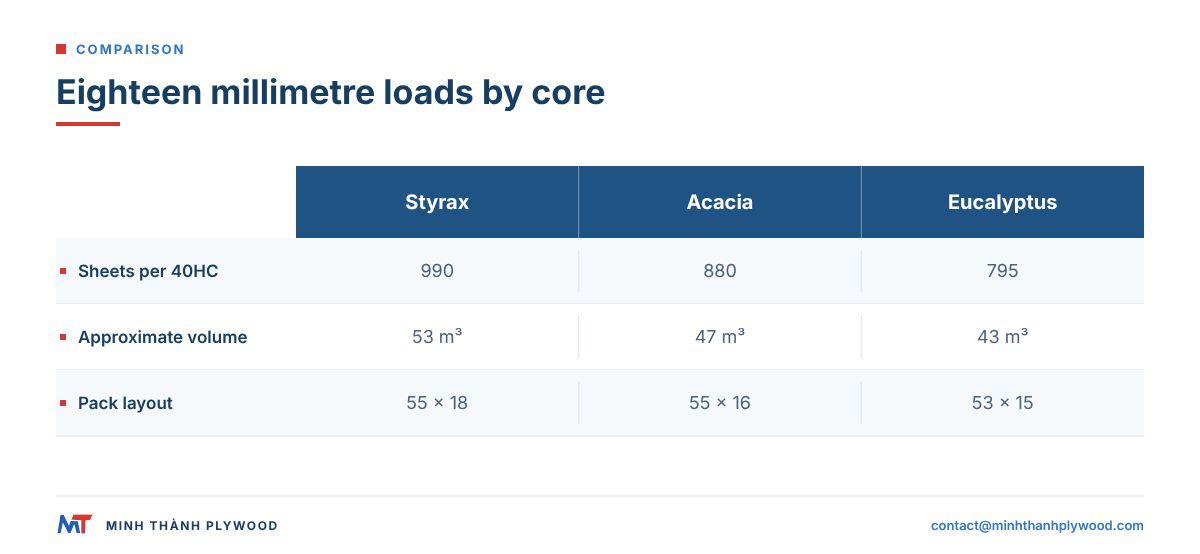
At 18 mm and 1220 × 2440 mm, a 40HC carries 990 sheets on a Styrax core (55 sheets × 18 packs, about 53 m³), 880 on acacia (55 × 16, about 47 m³) and 795 on eucalyptus (53 × 15, about 43 m³), capped by weight within a 28,000 kg planning payload. A lighter core puts more cubic metres in the same box.
Every Minh Thanh shipment is photographed and filmed before loading, and buyers get the photos and video. Use the packing calculator to work out your own load.
Which origin fits which use?
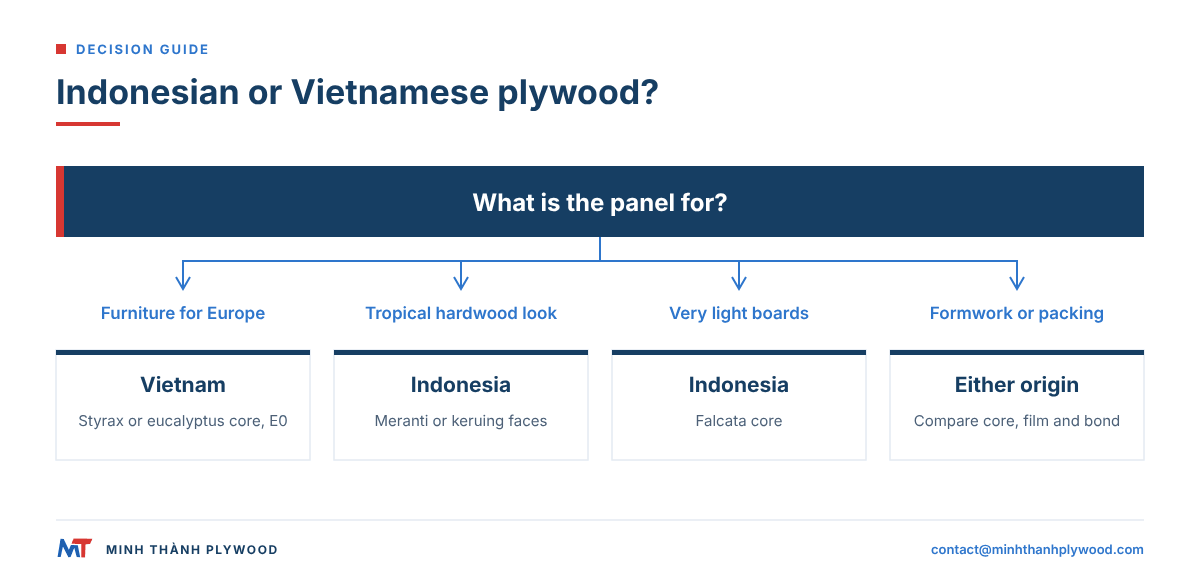
Choose Indonesian plywood for tropical hardwood looks, very light falcata boards and Japanese-market grades; choose Vietnamese plywood for light, flat furniture panels, a wide choice of faces, film-faced and packing plywood. Many importers buy from both.
| Use | Better-fitting origin | Why |
|---|---|---|
| Furniture and cabinets for Europe | Vietnam | Styrax or eucalyptus cores, E0, many faces, EUDR low risk |
| Tropical hardwood joinery panels | Indonesia | Meranti and keruing faces |
| Very light boards (caravans, packing) | Indonesia | Falcata cores |
| Film-faced formwork | Either | Compare core, film weight and bond |
| Packing and crates | Vietnam | Acacia and eucalyptus commercial cores |
| Birch-faced panels at a lower cost than solid birch | Vietnam | Birch faces over plantation hardwood cores |
For a wider view of sourcing countries, read which country makes the best plywood and Vietnam vs China plywood.
Indonesian plywood exporters or a Vietnamese manufacturer: how to choose a supplier
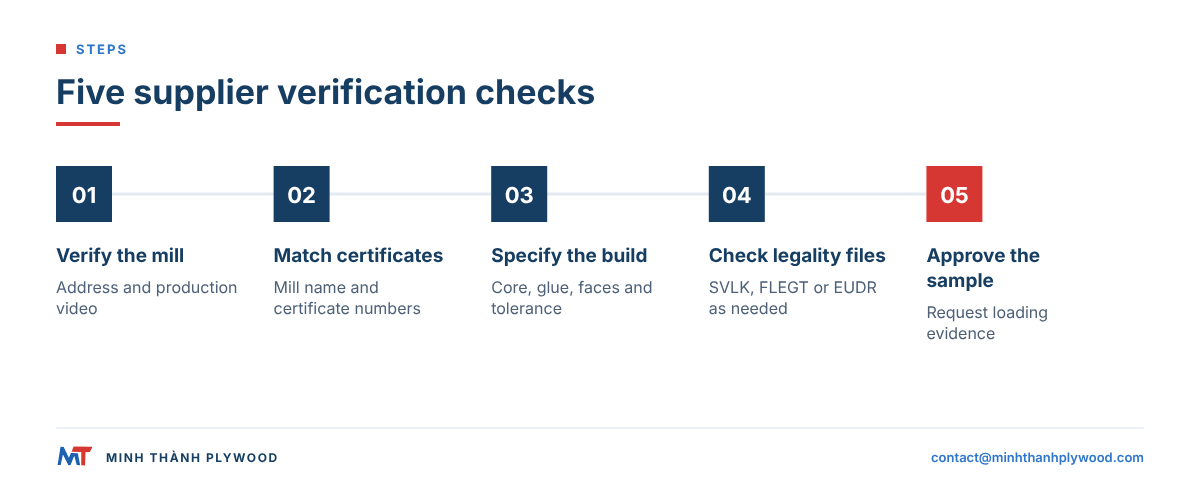
Whichever origin you choose, buy from a manufacturer that names its mill, shows its own production and puts the full build on the quote. Five checks work for Indonesian plywood exporters and Vietnamese mills alike.
- A real mill address and photos or video of its own lines.
- Certificates in the mill’s name, with numbers, such as CARB P2 / TSCA Title VI or ISO 9001.
- Written specification: core, glue, emission, face grade pair, tolerance and moisture.
- Legality documents: SVLK and FLEGT licence for Indonesia; EUDR dossier for EU orders from either country.
- A sample before the order and photos before loading.
Minh Thanh Plywood holds ISO 9001:2015 (KAC25/0185), CARB P2 / TSCA Title VI (ICTT mill no. 23024) and TCVN 11902:2017 (VietCert 141.1-VNC-HC), and offers free samples. See the furniture plywood range.
What to send for a quote from Vietnam
Send the use, the build and the delivery port, and we reply within hours with a quote you can set beside an Indonesian offer per cubic metre.
- Application: furniture, cabinets, joinery, formwork, packing or exterior use.
- Core: Styrax, eucalyptus or acacia; stitched or not.
- Glue and emission: MR, melamine-fortified or phenolic WBP; E0, E1 or CARB P2 / TSCA Title VI.
- Face and back: species and grade pair, sanded or not.
- Size and thickness: 1220 × 2440 or 1250 × 2500 mm, thickness and tolerance.
- Packing and quantity: containers per month, destination port, FOB Hai Phong, CFR or CIF.
Write to contact@minhthanhplywood.com or WhatsApp +84 988 586 601 (Lisa), Monday–Friday, 08:00–17:00 Vietnam time.
Buyer questions, answered
How does Indonesian plywood compare to Vietnamese plywood?
Indonesian plywood is strongest in tropical hardwood panels, light falcata-core boards and thin plywood for Japan and the US. Vietnamese plywood is strongest in furniture and interior panels on plantation cores, film-faced and packing plywood, with Europe as a leading market.
Is plywood from Indonesia good quality?
Yes, the established Indonesian mills make good plywood, especially tropical hardwood panels and Japanese-market grades. As with any origin, quality depends on the mill's core grade, glue and tolerance, so compare written specifications.
Which is cheaper, Vietnamese or Indonesian plywood?
For plantation-core furniture and commercial panels, Vietnamese mills are usually the more cost-effective origin, because their core logs are grown close to the factories. Tropical hardwood panels from Indonesia carry the higher cost of natural forest logs.
What wood is used in Indonesian plywood?
Indonesian plywood uses tropical hardwoods such as meranti and keruing for faces and cores, and fast-growing plantation species such as falcata, also called sengon, for light cores.
What wood is used in Vietnamese plywood?
Vietnamese plywood uses plantation acacia, eucalyptus and Styrax for cores, with faces such as EV, poplar, birch, okoume, pine and bintangor. Minh Thanh Plywood uses Styrax or eucalyptus cores as standard.
How much is Indonesian plywood in Saudi Arabia?
Indonesian ordinary plywood is listed at SAR57.50–143.75 a sheet across 4–18 mm, VAT included, at a Saudi building-materials retailer in October 2026. Vietnamese plywood bought by the container starts from US$250/m³ FOB for commercial grades, about SAR50.25 for one 18 mm sheet as a raw FOB example before freight, 5% duty and 15% VAT.
Does Indonesia issue FLEGT licences?
Yes. Indonesia was the first country to issue FLEGT licences for timber shipped to the EU, under its SVLK timber legality system and its Voluntary Partnership Agreement with the EU.
Is Vietnam low risk under the EUDR?
Yes. Commission Implementing Regulation (EU) 2025/1093 lists Vietnam as a low-risk country. Minh Thanh Plywood supplies the EUDR compliance dossier, with origin records and geolocation files, with orders.
Who are the main Indonesian plywood exporters?
Indonesian plywood exports come from large integrated mills in Kalimantan, Sumatra and Java, organised in the Indonesian Wood Panel Association, APKINDO. Ask any exporter for its SVLK documents and its own mill address.
Which plywood manufacturers in Vietnam export to Indonesia?
Vietnamese manufacturers such as Minh Thanh Plywood supply buyers across Asia, including furniture and film-faced plywood. Typical days at sea from Hai Phong to South-East Asia are 5–12, by carrier and route.
Which origin is better for film-faced plywood?
Both make film-faced plywood. Vietnamese film-faced panels use acacia or eucalyptus cores, with reuse of about 12–15 pours on a melamine bond and up to about 25 on a phenolic bond, with proper handling, release agent and edge sealing.