
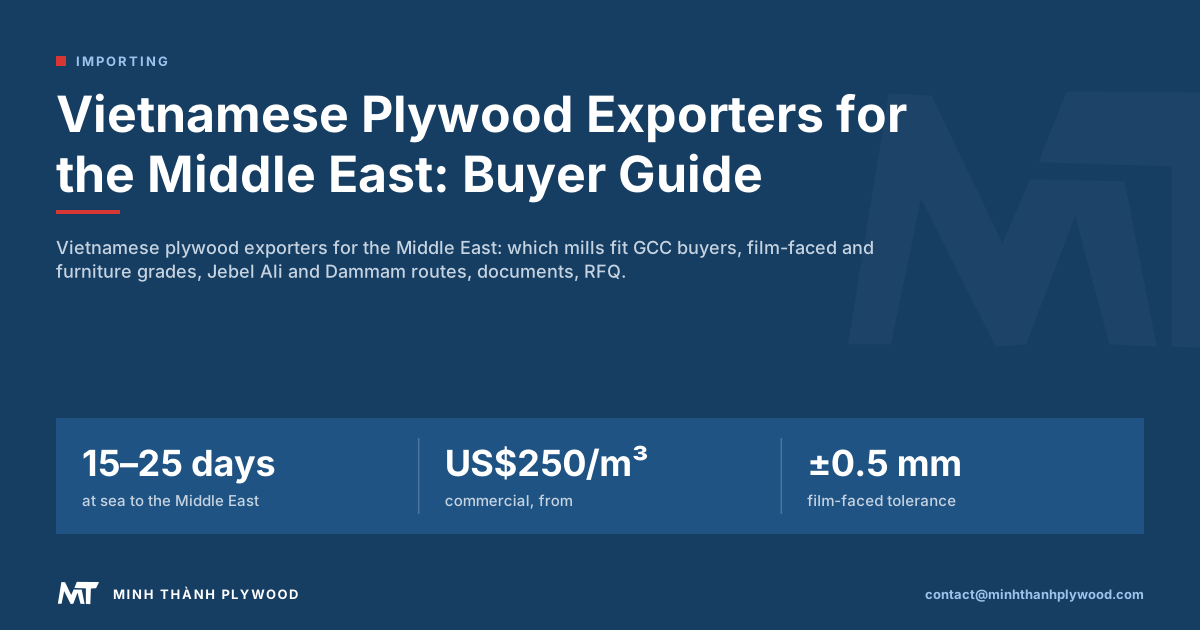
Vietnamese plywood exporters ship to the Middle East from Hai Phong and Ho Chi Minh City, mostly film-faced plywood for concrete formwork, commercial plywood for joinery and furniture plywood for fit-out. Choose a real manufacturer by glue line, core and tolerance, not film colour. Minh Thanh Plywood quotes FOB Hai Phong, CFR or CIF to Gulf ports, 15–25 days at sea.
Which Vietnamese plywood exporters supply the Middle East?
Vietnamese plywood exporters to the Middle East fall into three groups: mills in the north that ship through Hai Phong, mills in the south that ship through Ho Chi Minh City, and trading companies that buy from several mills and resell. All three quote Gulf ports.
The difference shows when a container arrives, in how consistent the glue line, core and thickness are from pack to pack.
For a Gulf importer the useful shortlist is not “the top ten exporters” but the manufacturers that make the exact grade you buy, in their own factory, and can prove it. A contractor buying formwork panels needs a mill that presses film-faced plywood with the right glue. A joinery or fit-out buyer needs sanded panels with tight tolerance and a known core. Few mills do both well; ask each one which it is built for.
Here is who a Gulf buyer meets in the first week of searching, from each company’s own website (checked on 21 October 2026). It is a starting list, not an endorsement of anyone; ask every one of them for the same three things: the glue line, the core and the test reports.
| Exporter | Where it presents itself | What its site lists | What to ask |
|---|---|---|---|
| Vinawood | Export mill and trader, production since 1992 | Film-faced and concrete-form plywood in graded reuse lines, sizes 1220 × 2440 mm and 1250 × 2500 mm; claims about 5,000 containers a year (its own figure) | Which grade is made in its own press and which is bought in |
| TT Plywood | Maker and exporter, Vietnam | Film-faced 18 mm in 11 layers, packing plywood with okoume face, melamine and commercial plywood, core plywood in E0, E1 and E2 glue | The glue class on the exact product, with a test report |
| Fomex Group | Hanoi office, factory network | Commercial, film-faced, packing and furniture plywood; lists FSC, CARB P2, E0 and ISO 9001 | Which certificate covers which factory |
| Tadex Ply | Maker in Phu Tho, northern Vietnam | Formply, film-faced, birch, calibrated and packing plywood; writes for Gulf formwork buyers | The reuse count it will put in the contract |
| Long Dat | Maker in Phu Tho, northern Vietnam | Packing, commercial, film-faced, container flooring and birch plywood | Product-by-product specification sheets |
| Minh Thanh Plywood | Maker in Phu Tho, containers from Hai Phong | Furniture and interior plywood as the core line; also commercial, packing and film-faced | The same three questions: we answer them with the six chamber test reports, SGS testing on request and the pack plan |
Which plywood manufacturers in Vietnam export to Saudi Arabia?
Several of the exporters in the table above are mills in northern Vietnam, where the container leaves from Hai Phong, and they quote Saudi ports such as Dammam and Jeddah. Saudi Arabia is also the market where conformity checks and attested documents matter most, so what separates the mills is documented proof, not the shopfront.
Minh Thanh Plywood is a manufacturer in Ha Hoa, Phu Tho, in northern Vietnam, with a capacity of 50,000+ m³ per year. The factory is built for top-grade furniture and interior plywood, and it also makes commercial, packing and film-faced plywood. Containers leave from Hai Phong.
What do Middle East buyers import from Vietnam?
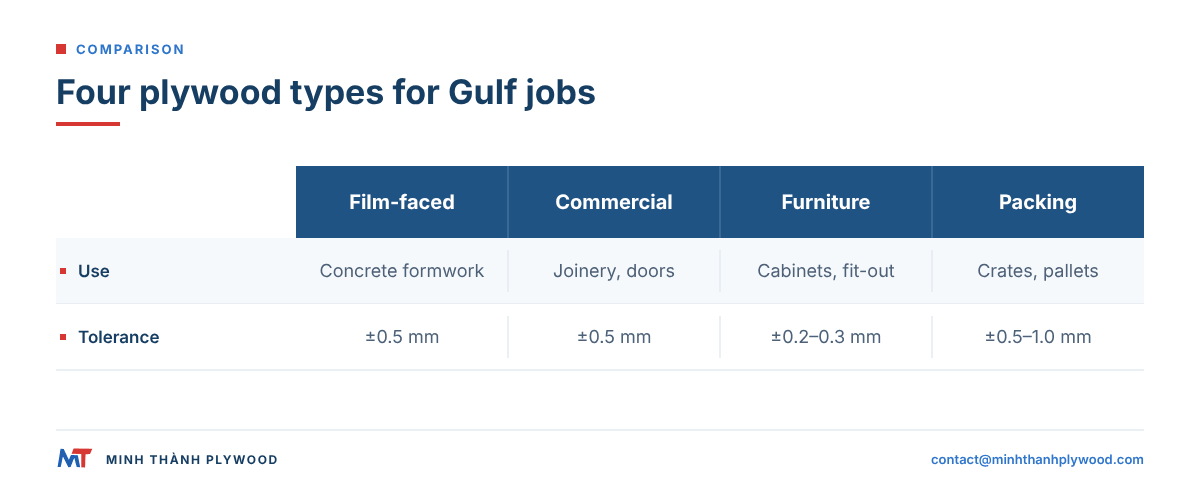
Middle East buyers import four kinds of plywood from Vietnam, each for a different job:
| Product | Typical Gulf use | What to specify | Minh Thanh tolerance |
|---|---|---|---|
| Film-faced plywood | Concrete formwork, shuttering for slabs, walls and columns | Glue type, core species, film, edge sealing | ±0.5 mm |
| Commercial plywood | Joinery, doors, partitions, site hoarding | Face grade, core, glue, thickness | ±0.5 mm |
| Furniture plywood | Cabinets, wardrobes, hotel and office fit-out | Face species and grade pair, core, emission class, sanding | ±0.2–0.3 mm, down to ±0.2 mm |
| Packing plywood | Crates and pallets for export cargo | Thickness, size, packing | ±0.5–1.0 mm |
Film-faced plywood takes most of the volume because Gulf construction uses a lot of timber formwork. Furniture plywood is a smaller share by volume but the higher-value one, and it is where the gap between mills is widest.
How do you choose a Vietnamese plywood exporter for the Gulf?
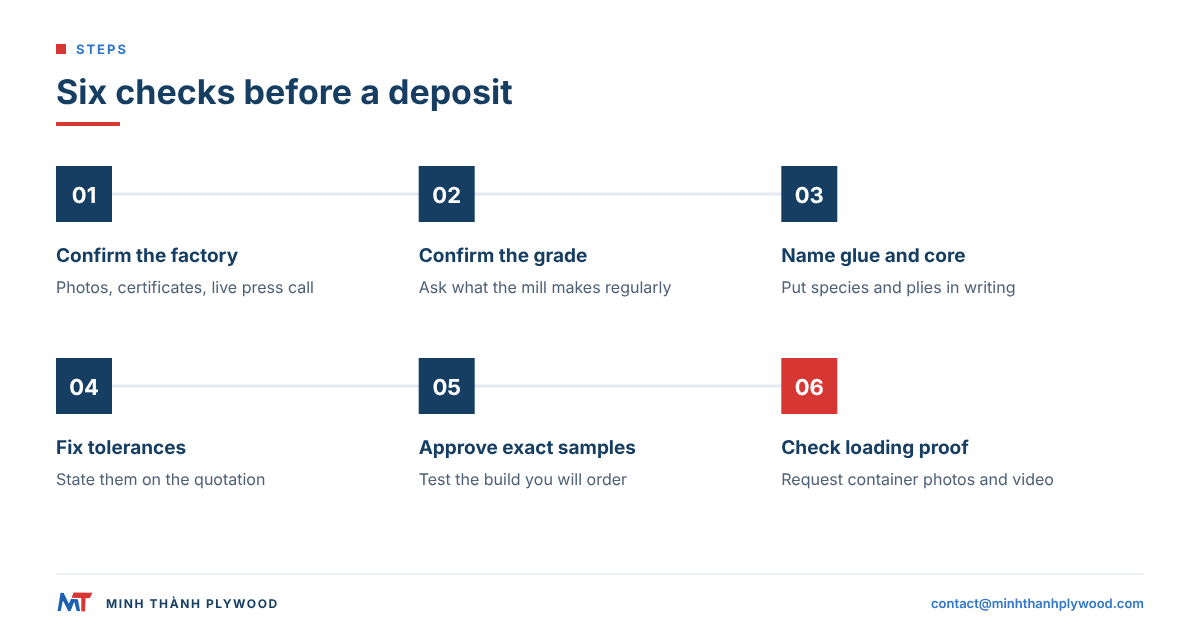
Choose a Vietnamese plywood exporter for the Gulf in six checks, before any deposit:
- Manufacturer or trader. Ask for factory photos and videos, the certificates in the company’s own name and a live call from the press line. Our guide to telling a factory or trading company lists the questions.
- The grade you need. Ask what share of the mill’s output is your product. A furniture mill pressing film-faced panels once a month is not a formwork specialist, and the reverse is also true.
- Glue and core in writing. The quotation should name the glue (UF, melamine-fortified MR or phenolic WBP), the core species and the number of plies, not “good quality”.
- Tolerance in writing. Thickness and size tolerance by product, stated on the quotation.
- Samples in the exact build. Free samples from Minh Thanh, made to the specification you will order.
- Loading evidence. Photos and video of every container before loading; ask to see a recent example.
A supplier who answers all six in writing within a day or two is worth a trial container. One who answers in adjectives is not.
Read the glue line, not the film colour
The film on a film-faced panel tells you nothing about the bond underneath. Brown, black and red films are all common, and a low-grade panel can carry the same film as a good one. What decides how many pours a formwork panel survives is the glue between the veneers and how well the core is built.
Minh Thanh makes melamine-fortified (MR) and phenolic (WBP) bonds to the customer’s specification. Phenolic glue is the one for formwork that is cast, stripped and reused outdoors in Gulf heat. Melamine-fortified glue suits lighter use and shorter cycles at a lower price. UF glue at E0 emission is the standard for furniture and interior panels and does not belong in formwork.
Write the glue type on the RFQ in words, and ask for a boiling or soaking test result on the sample if your site needs proof. A supplier who will not name the glue is answering the question.
What is an honest grade ladder for film-faced plywood?
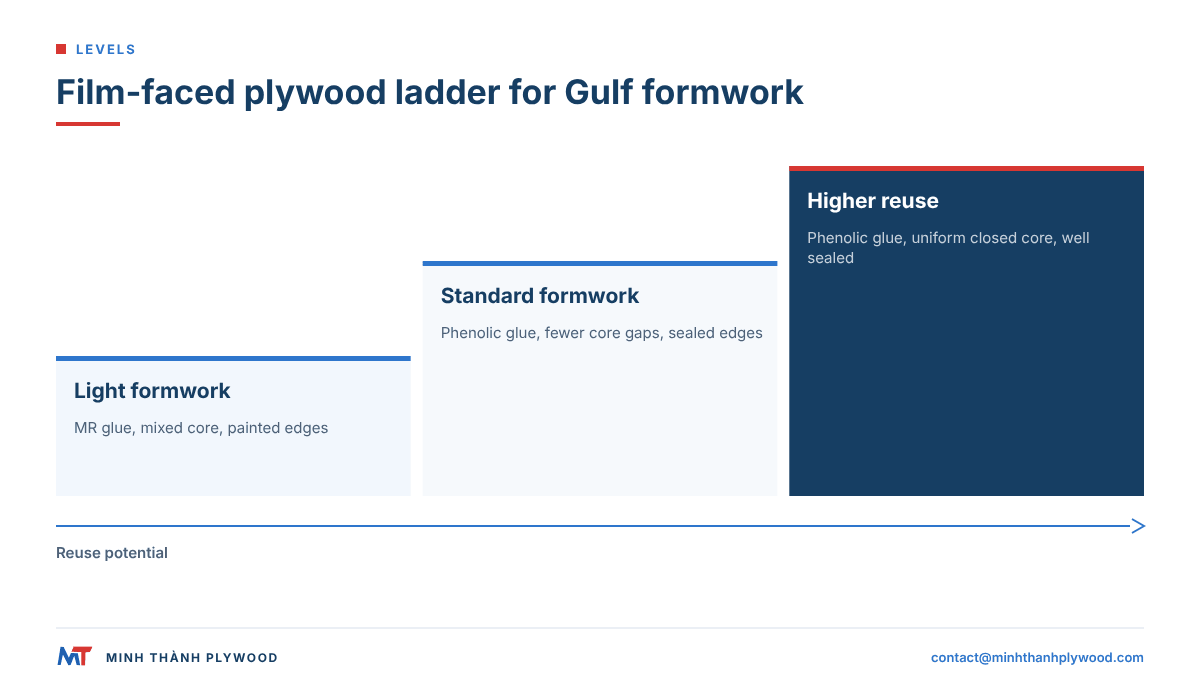
An honest grade ladder for film-faced plywood runs on three things the buyer can verify: glue, core and edge sealing. From the lowest to the highest:
- Single-use or light formwork: melamine-fortified glue, mixed hardwood core, painted edges. Lowest price, fewest pours.
- Standard formwork: phenolic glue, mixed core with fewer gaps, sealed edges.
- Higher-reuse formwork: phenolic glue, a uniform core with closed layers, faces and edges well sealed.
The number of reuses depends as much on the site as on the panel: release agent, stripping care, edge protection and storage between pours. Treat any fixed reuse number in a quotation as a claim to test on a trial order, not as a specification.
Minh Thanh presses its furniture-grade panels twice, core first and faces second, and stitches core layers both horizontally and vertically. Ask any mill which of those steps it applies to its film-faced line, and see the answer on a cut sample edge.
Vietnamese plywood exporter in Dubai: buying through a stockist or direct?
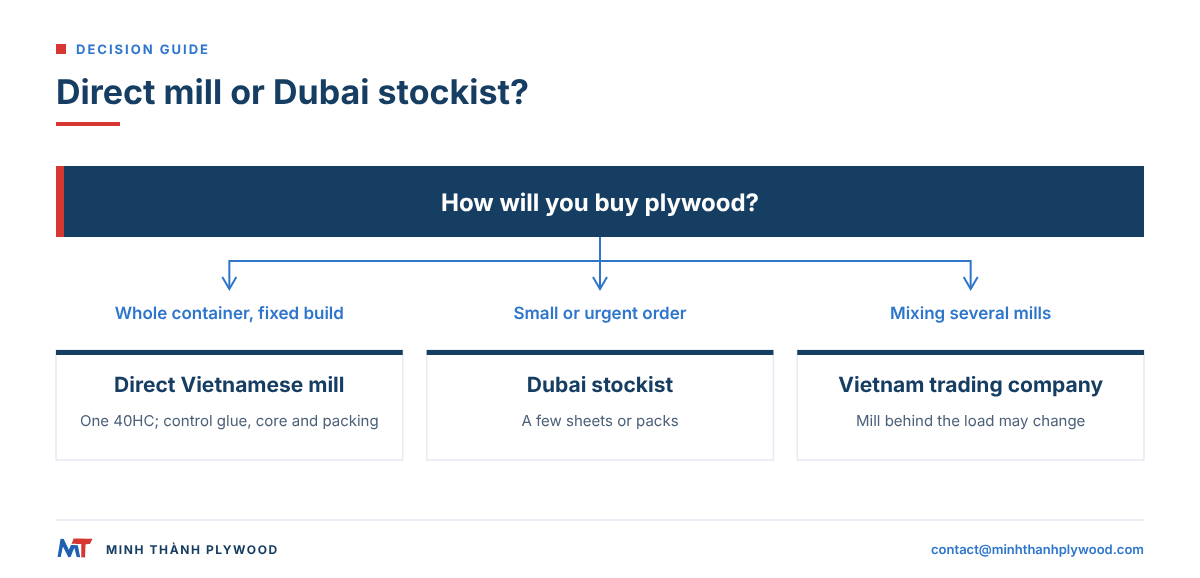
A Vietnamese plywood exporter in Dubai can mean two things: a Vietnamese mill that ships direct to Jebel Ali, or a stockist in Dubai who holds Vietnamese plywood in a local warehouse. Both work; they suit different buyers.
| Route | Best for | Minimum | What you control |
|---|---|---|---|
| Direct from a Vietnamese mill | Contractors, distributors and factories buying whole containers | One 40HC | Specification, glue, core, tolerance, packing |
| Dubai stockist | Small or urgent site orders | A few sheets or packs | Price and delivery only |
| Trading company in Vietnam | Buyers mixing many mills in one load | Varies | Little: the mill behind it can change |
Buying direct costs the longest lead time and needs a full container, but it is the only route where the buyer sets the build. For a project with repeated pours or a furniture line with a fixed specification, that control is worth more than the shorter wait.
How long does plywood take from Vietnam to Jebel Ali, Dammam or Sohar?
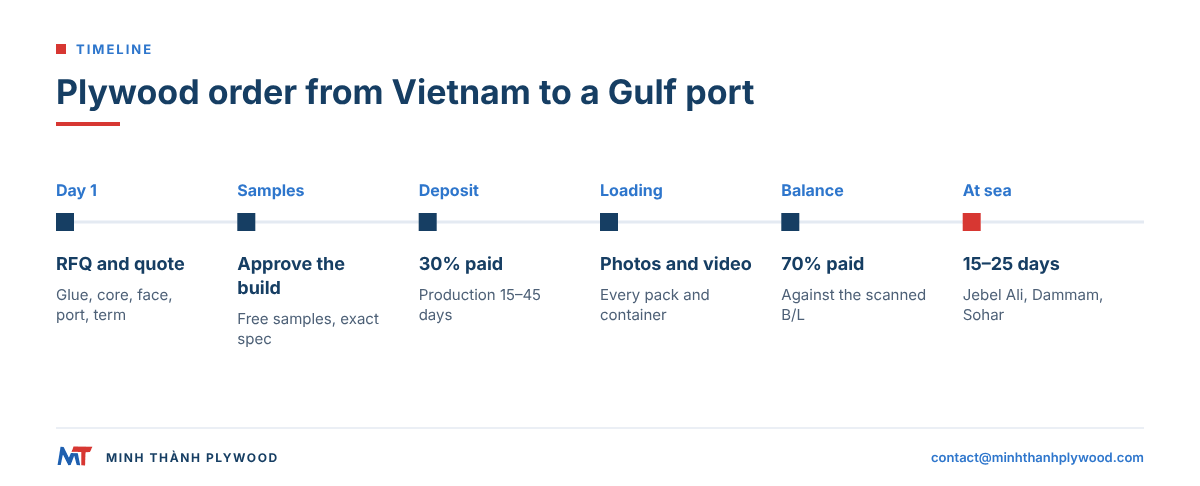
Plywood from Vietnam takes 15–25 days at sea from Hai Phong to the Middle East, depending on carrier and route. Add production of 15–45 days after the 30% deposit, plus a few days for booking and loading. A first order therefore reaches a Gulf port about five to ten weeks after the deposit.
The main Gulf discharge ports for plywood are Jebel Ali for Dubai and the northern Emirates, Khalifa Port for Abu Dhabi, Dammam and Jeddah for Saudi Arabia, Sohar for Oman, and Hamad Port for Qatar. Name the port of discharge on the RFQ; CFR and CIF prices are quoted to that port.
Plan formwork orders against the pour schedule, not the order date. A contractor who needs panels for a slab programme orders by the slab programme minus the timeline above.
What does a Vietnamese plywood order to the Gulf look like, step by step?
A Vietnamese plywood order to the Gulf runs through eight steps:
- RFQ with application, glue, core, face, size, thickness, quantity and port.
- Quotation FOB Hai Phong, CFR or CIF to your port, with tolerance and pack plan.
- Free samples in the exact build.
- Proforma invoice and the 30% deposit.
- Production of 15–45 days.
- Pre-loading photos and video of packs and container.
- Balance of 70% against the scanned bill of lading, or payment under an irrevocable letter of credit at sight.
- Original documents by courier, and the container to your port in 15–25 days.
Minh Thanh’s minimum is one 40HC, with mixed specifications by agreement: usually one or two per container, three to six by agreement.
Which documents come with a plywood container to the GCC?
A plywood container to the GCC comes with four core documents and a few optional ones. Minh Thanh prepares per shipment: commercial invoice, packing list, bill of lading and certificate of origin, with phytosanitary and fumigation certificates where the buyer or destination asks, and insurance when the sale is CIF.
Gulf destinations often add one step: legalisation. Some importers need the certificate of origin and invoice attested by the chamber of commerce and the embassy of the destination country, and the importer’s clearing agent knows which apply. Our article on origin marking and document legalisation covers marks and attestation.
Plywood is processed wood, so the panels and plywood packaging need no ISPM 15 treatment. Any solid wood bearers under the packs are heat treated and marked.
How should plywood be stored in Gulf heat between pours?
Store plywood in the Gulf flat, shaded and covered, on level bearers off the ground. Direct sun on one face of a pack dries that face faster than the other, and an uneven panel is one that bows.
For film-faced panels on site:
- keep packs under cover and out of direct sun until used;
- stack stripped panels flat, face to face, on level bearers, not leaning against a wall;
- clean and apply release agent before each pour, and seal cut edges the same day;
- do not let panels stand in water from curing or washing.
Edge sealing matters most. Water and heat enter a film-faced panel through its edges, not its film, and a freshly cut edge left unsealed is where delamination starts.
What import duty and tax apply to Vietnamese plywood in the Gulf?
The GCC applies a common external tariff of at least five percent to most goods imported from outside the union (US International Trade Administration, Saudi Arabia import tariffs, published 2026-05-11). The duty is charged on the CIF value once, at the first point of entry, and the goods then move between member states without a second charge. Plywood is not one of the food and farm lines that Saudi Arabia taxes higher, but the GCC Integrated Customs Tariff splits heading 4412 into common 12-digit lines, so your broker confirms the exact line before the order.
Value added tax comes on top and differs by country: Saudi Arabia raised its rate from 5% to 15% in July 2020 (same source). For landed cost, the sequence is the CIF value, then duty on it, then VAT on the total; recoverable VAT is a cash-flow item, not a cost, when the importer is registered.
Plan on the 5% as the base case and ask your broker whether any preference applies to your origin documents. A certificate of origin from the Vietnam Chamber of Commerce and Industry goes in the document set either way, because Gulf customs and many buyers ask for it. Saudi Arabia is the market to watch for conformity checks and attested documents; a late attestation can mean terminal storage charges (Vinawood, import guide, 27 March 2026). Ask your broker about it before the vessel sails.
How much does plywood from Vietnam cost for Middle East buyers?
As of October 2026, Minh Thanh’s indicative starting prices are from US$250/m³ for commercial plywood and from US$350/m³ for furniture and interior plywood. The final price depends on face, core, glue, thickness, size, quantity and delivery term.
Compare quotations line by line, not by the bottom number. A cheaper film-faced quote with melamine-fortified glue is not the same product as one with phenolic glue, and a furniture panel quoted without a tolerance is not the same as one at ±0.2 mm. Freight to the Gulf is quoted separately when you buy FOB, or built in under CFR or CIF.
What should a GCC buyer check on the first container?
A GCC buyer should check the first container against the RFQ, pack by pack. On arrival:
- Seal number against the bill of lading, and the outside of the container.
- Pack count and pack numbers against the packing list.
- Thickness with a caliper on several sheets per pack, against the agreed tolerance.
- Glue: cut a sample strip from a panel and run a boil test if the order was phenolic.
- Core: look at a cut edge for gaps, overlaps and the declared species.
- Faces and film: colour, coverage and edge sealing.
Record results with photos and pack numbers. A first container checked this carefully sets the standard for every repeat order, and our guide on moving from trial order to long-term supply covers what to agree after it.
Do Vietnamese plywood exporters also serve Israel, Bulgaria and Romania?
Yes, the same shortlisting method applies to buyers in Israel, Bulgaria and Romania. The checks do not change: manufacturer or trader, the grade the mill is built for, glue and core in writing, tolerance, samples in the exact build, and loading evidence.
For Bulgaria and Romania, inside the European Union, the order also needs the EU paperwork: the certificate of origin as an EUR.1 for preferential duty under the EU-Vietnam trade agreement, and, for the EU Deforestation Regulation (Regulation (EU) 2023/1115), the EUDR compliance dossier, origin records and geolocation files, which Minh Thanh supplies with orders. The EUDR applies to large and medium operators from 30 December 2026 under Regulation (EU) 2025/2650. Europe is Minh Thanh’s strongest market, and the guide for Vietnamese plywood suppliers for Europe covers it.
What should you put on the RFQ for a Gulf plywood order?
Put seven lines on the RFQ and any serious Vietnamese plywood exporter can quote within a day:
- Application: formwork slabs, walls, joinery, cabinets, packing.
- Core: species and plies, for example Eucalyptus core.
- Glue and emission: phenolic WBP, melamine-fortified MR, or UF at E0 for furniture.
- Face: film type and colour for formwork; species and grade pair for furniture.
- Size and thickness: 1220 × 2440 mm or 1250 × 2500 mm, thickness, tolerance.
- Packing and quantity: sheets or cubic metres, containers, mixed specifications.
- Port and term: Jebel Ali, Dammam, Sohar or other; FOB, CFR or CIF.
Send it to Minh Thanh by email or WhatsApp; replies come within hours, and samples are free. For formwork panels see film-faced plywood; for fit-out see furniture plywood from Vietnam. The full checklist is in the plywood RFQ checklist, and the wider method in how to choose a plywood supplier in Vietnam.
Buyer questions, answered
Which Vietnamese plywood exporters supply the Middle East?
Vietnamese plywood mills in the north ship through Hai Phong and mills in the south through Ho Chi Minh City, alongside trading companies that buy from several mills. For a Gulf buyer the shortlist should be manufacturers that make the grade you need and quote CFR to your port.
Which plywood do Middle East buyers import from Vietnam?
Mostly film-faced plywood for concrete formwork, commercial plywood for joinery, doors and packing, and furniture plywood for cabinets and interior fit-out. Packing plywood and cut-to-size parts follow the same route.
How long is the sea transit from Vietnam to the Gulf?
Typical days at sea from Hai Phong to the Middle East are 15–25, by carrier and route. Add production time of 15–45 days after the deposit.
What glue should film-faced plywood for the Gulf have?
Phenolic (WBP) glue for formwork that is cast, stripped and reused outdoors; melamine-fortified (MR) glue for lighter or single-use work. Write the glue type on the RFQ, because film colour says nothing about the bond under it.
What is the minimum order for plywood from Vietnam to Dubai?
Minh Thanh's minimum is one 40HC container, with mixed specifications by agreement, usually one or two specifications per container.
What are the payment terms with a Vietnamese plywood exporter?
Minh Thanh works with a 30% deposit and the 70% balance against the scanned bill of lading, or an irrevocable letter of credit at sight.
How much does plywood from Vietnam cost for Middle East buyers?
As of October 2026, commercial plywood starts from US$250/m³ and furniture or interior plywood from US$350/m³, FOB. The final price depends on face, core, glue, thickness, size, quantity and delivery term.
Which documents come with a plywood container to the GCC?
Commercial invoice, packing list, bill of lading and certificate of origin, plus phytosanitary and fumigation certificates where the buyer or destination asks, and insurance when the sale is CIF.
How do I tell a Vietnamese plywood factory from a trading company?
Ask for factory photos and video, the certificates in the company's own name, a live video call from the press line and loading photos of a recent container. A manufacturer shows its own production; a trader shows other people's.
Do Vietnamese plywood exporters offer free samples?
Minh Thanh sends free samples. Order them in the exact build you will buy: face, core, glue and thickness.