
Wood grain is the direction and arrangement of the wood fibres in a tree, and it decides how a board looks, cuts, bends and moves. Grain, texture and figure together, read on a clean end-grain cut with a 10× lens, are also how you identify a species. Minh Thanh Plywood, a Vietnamese manufacturer that lays up veneers into plywood every day, explains how to read them.
What is wood grain?
Wood grain is the direction, size and arrangement of the fibres in a piece of wood. The fibres run up the trunk, so grain is first a direction: a board is strong and stiff along the grain and weak across it, it splits along the grain and it shrinks mostly across it.
Woodworkers use the word in three ways, and it helps to keep them apart:
- Grain direction. The line the fibres follow: straight, spiral, interlocked, wavy or irregular.
- Grain pattern. What the growth rings and rays look like on a cut face: cathedrals, straight lines or ray fleck.
- Texture. The size of the pores and cells: fine (birch, maple) or coarse (oak, ash).
Figure is a fourth term: a special pattern, such as quilted or birdseye, caused by the grain growing in an unusual way. The terms follow R. Bruce Hoadley, Understanding Wood: A Craftsman’s Guide to Wood Technology (Taunton). For more detail, see Eric Meier’s Wood Database entry on grain and texture and Wikipedia’s article on wood grain. All four show on a plywood face, which is why the types of wood used for faces look so different.
Wood grain patterns: straight, spiral, interlocked and wavy
The common wood grain patterns are straight, spiral, interlocked, wavy and irregular grain. Each one comes from how the tree grew, and each one changes how the wood machines and moves.
| Grain type | What it is | Typical species | What it means in use |
|---|---|---|---|
| Straight | Fibres parallel to the trunk | Pine, spruce, poplar, birch | Easy to cut and plane; stable |
| Spiral | Fibres twist around the trunk | Some eucalyptus, pine | Boards twist as they dry |
| Interlocked | Spiral direction reverses in alternate layers | Sapele, mahogany, many tropical hardwoods | Ribbon stripe figure; tears out when planed |
| Wavy | Fibres undulate | Maple, sycamore, birch | Fiddleback or curly figure |
| Irregular | Fibres deviate around knots and branches | Most species near knots | Tear-out and weak points |
Interlocked grain is common in tropical hardwoods. It gives the ribbon stripe on quarter-sliced sapele and makes the wood harder to split, but planing against the reversing grain tears the surface. Sliced veneer for plywood faces avoids planing, which is one reason interlocked species are used as veneer.
Ring-porous, semi-ring-porous and diffuse-porous wood
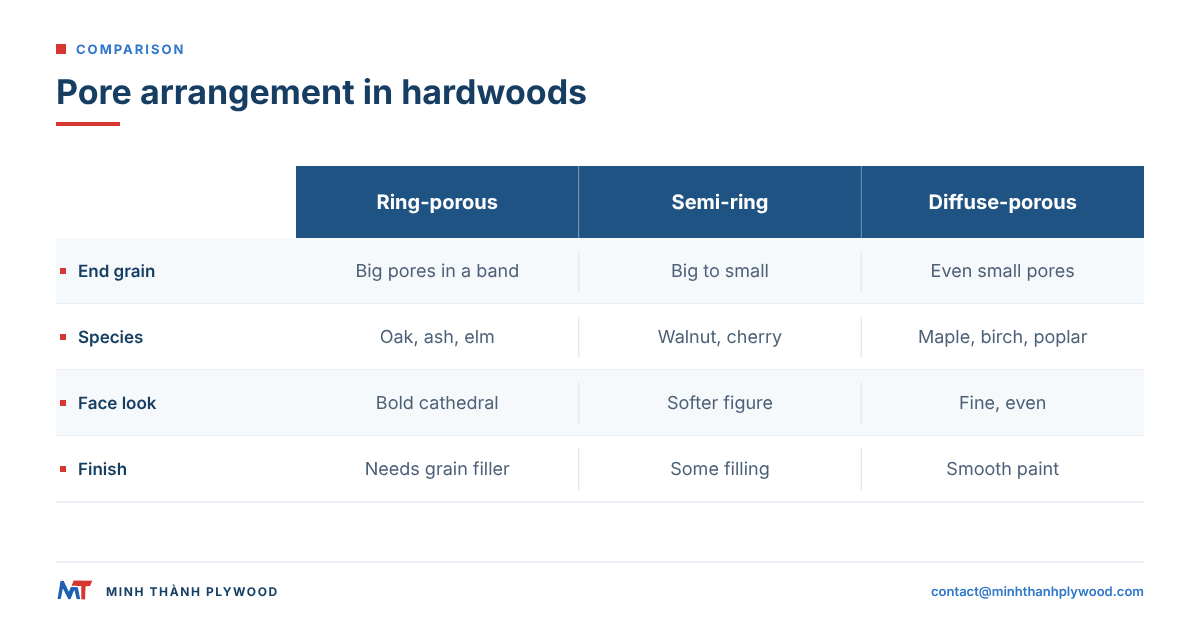
Hardwoods are divided by how their pores, or vessels, are arranged in each growth ring: ring-porous, semi-ring-porous and diffuse-porous. This arrangement is the first thing to look for on an end-grain cut, and it sets the texture you see on a face.
| Pore arrangement | What you see on end grain | Species | Face look |
|---|---|---|---|
| Ring-porous | A band of large pores at the start of each ring, small pores after | Oak, ash, elm, chestnut, teak (often) | Strong cathedral, coarse open texture |
| Semi-ring-porous | Pores large at the start, gradually smaller | Walnut, cherry (borderline) | Visible but softer figure |
| Diffuse-porous | Pores of similar size spread evenly | Maple, birch, poplar, beech, mango | Fine, even texture |
| Non-porous (softwoods) | No vessels; earlywood and latewood bands | Pine, spruce, fir, larch | Contrast between soft and hard bands |
Ring-porous woods take stain unevenly and need grain filling for a mirror finish. Diffuse-porous woods, such as the birch and poplar used for plywood faces, give a smoother painted or lacquered surface.
Earlywood, latewood and growth rings
A growth ring is one season of growth, made of earlywood and latewood. Earlywood forms in spring with large, thin-walled cells and is lighter; latewood forms later in the season with smaller, thick-walled cells and is darker and denser.
In softwoods such as pine and Douglas fir, the contrast between soft earlywood and hard latewood creates the strong grain lines you see on a board and on a rotary-peeled face. In tropical trees with no winter, rings can be faint or missing, which is why many tropical hardwoods look uniform.
Ring width also matters. In softwoods, narrow rings with a high share of latewood usually mean denser, stronger wood. In ring-porous hardwoods such as oak, the opposite holds: wide rings mean more dense latewood.
Sapwood and heartwood: what is heartwood?
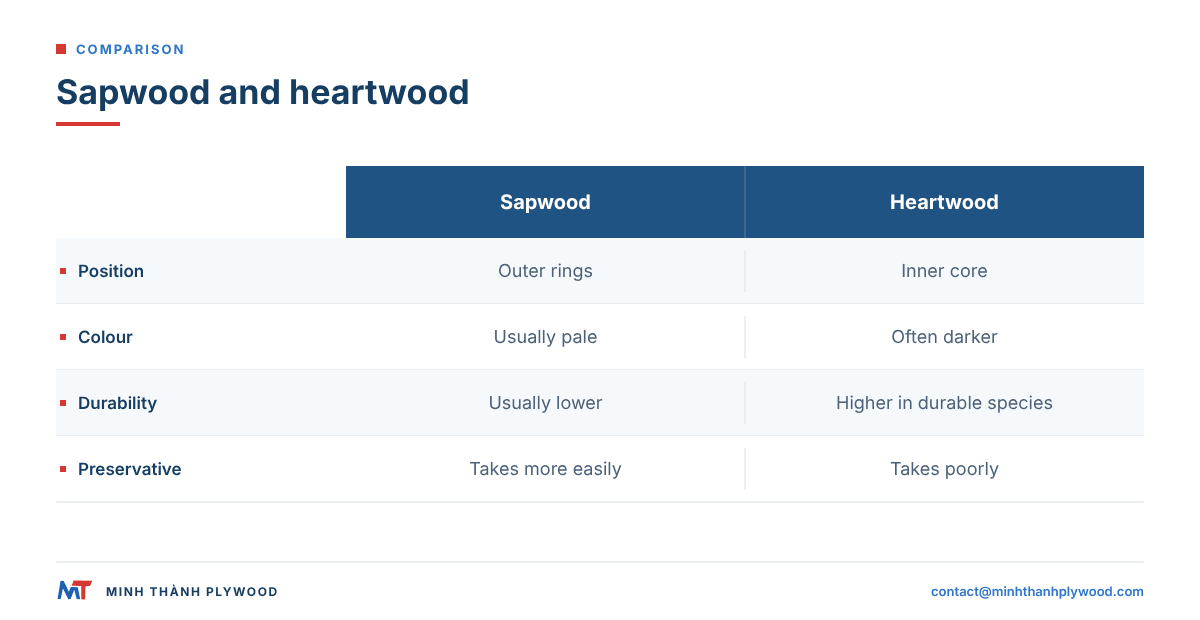
Heartwood is the inner, dead part of the trunk, where the tree deposits extractives that often darken the wood and give it natural decay resistance. Sapwood is the outer, living band that carries water from the roots; it is usually paler, more permeable and less durable.
| Feature | Sapwood | Heartwood |
|---|---|---|
| Position | Outer rings, under the bark | Inner core |
| Function | Carries water and stores food | Mechanical support only |
| Colour | Usually pale | Often darker (walnut, teak, oak) |
| Natural durability | Low; prone to insects and fungi | Higher in durable species |
| Takes preservative | Easily | Poorly |
| Shrinkage | Similar | Similar, sometimes slightly less |
Some species show no visible difference: in birch, poplar, spruce and maple, heartwood and sapwood are close in colour. In walnut, the cream sapwood against brown heartwood is a grading point. For plywood faces, colour difference between sapwood and heartwood is part of the face grade.
Wood figure: quilted, birdseye, ray fleck and fiddleback
Figure is any distinctive pattern on a wood surface caused by grain irregularities, rays or the way the wood was cut. It is what makes a single board or veneer more valuable than straight-grained wood of the same species.
- Ray fleck. Large rays cut on the quarter show as shiny flakes, most famous in quartersawn white oak.
- Fiddleback (curly). Wavy grain cut on the quarter gives bands across the board, as in maple and sycamore used for violin backs.
- Quilted. A bulging, three-dimensional pattern, mainly in bigleaf maple.
- Birdseye. Small circular figures, mostly in hard maple, from tiny buds that never grew.
- Crotch. A feather-like pattern where a branch meets the trunk.
- Burl. Swirling grain from a growth on the trunk.
Figured veneers are sliced, not peeled, so the pattern is kept and can be book-matched across a panel.
How cutting changes wood grain on a board and on veneer
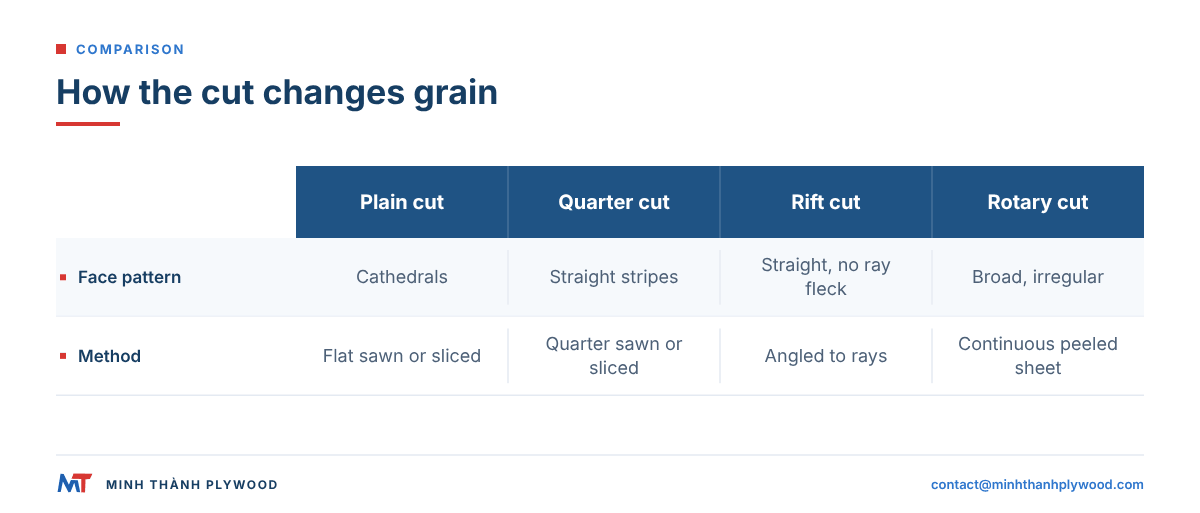
The same log shows different grain depending on how it is cut. For sawn boards the cuts are plain sawn, quarter sawn and rift sawn; for veneer they are rotary, plain sliced, quarter sliced and rift sliced.
| Cut | How it is made | Grain on the face |
|---|---|---|
| Plain sawn / plain sliced (flat cut) | Parallel to a line through the centre of the log | Cathedrals in the middle, straight lines at the edges |
| Quarter sawn / quarter sliced | Roughly perpendicular to the growth rings | Straight parallel stripes; ray fleck in oak |
| Rift sawn / rift sliced | At an angle to the rays | Straight grain without ray fleck |
| Rotary cut (peeled) | The log turns against a knife, peeling a continuous sheet | Broad, wild, irregular pattern |
Quarter-sawn and rift-sawn boards move less across their width, because the growth rings run through the thickness. VG (vertical grain) Douglas fir is the softwood version: rings at a steep angle to the face, fine parallel lines, used for doors, joinery and premium plywood faces.
How wood grain shows on rotary and sliced plywood faces
On plywood, wood grain depends on the cut of the face veneer. Most plywood faces, including birch, poplar, eucalyptus and pine, are rotary peeled, so they show a broad, irregular pattern; sliced faces such as oak or walnut show cathedrals or stripes like a sawn board.
| Face | Cut | What the grain looks like |
|---|---|---|
| Birch | Rotary | Pale, fine, gently wavy; little contrast |
| Poplar | Rotary | Very pale and even; quiet under paint |
| Pine | Rotary | Strong earlywood and latewood contrast; knots by grade |
| Eucalyptus | Rotary | Warmer colour, interlocked streaks in places |
| Okoume | Rotary | Pinkish, even, faint figure |
| EV (engineered veneer) | Sliced from a reconstituted block | Chosen grain and colour, repeated across panels |
EV, the face we produce most, is made by dyeing and gluing plantation veneers into a block and slicing it again. The grain is designed, so it repeats from sheet to sheet, which suits furniture runs that must match. Our EV plywood and poplar plywood pages show the faces.
Grain direction also matters inside the panel: each veneer is laid at right angles to the next, and the face grain runs along the length of a 1220 × 2440 mm sheet. Shelves are stiffer when they span along the face grain.
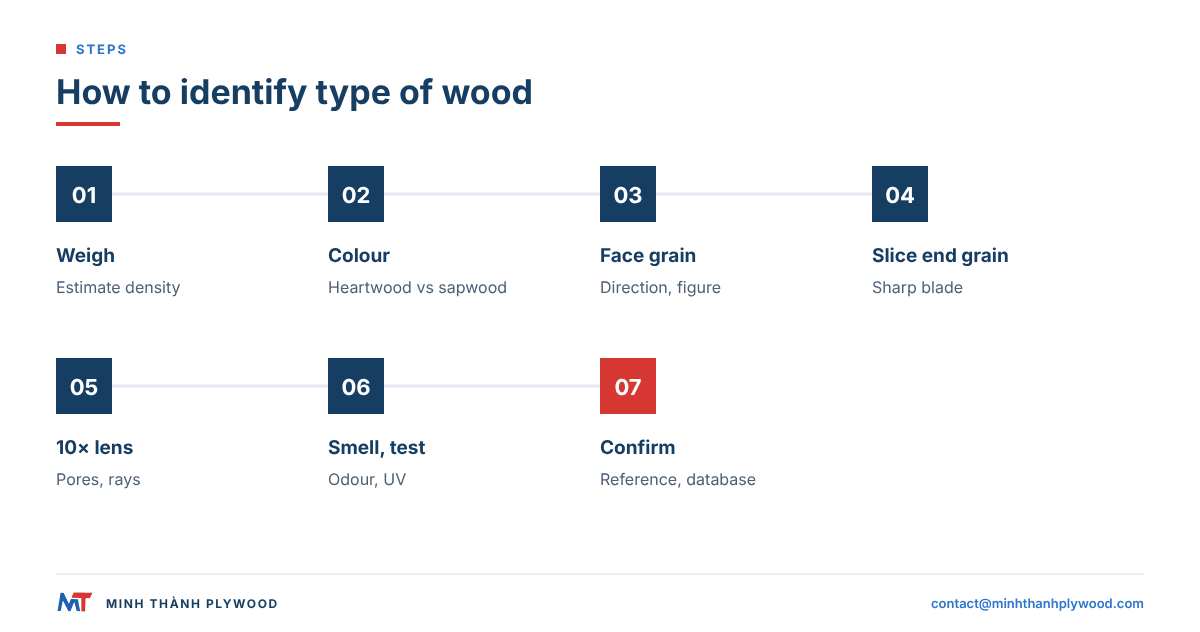
How to identify type of wood: seven steps
To identify a type of wood, combine what you see on the face with what you see on a clean end-grain cut under a lens, then confirm with a reference. Follow these steps in order; each one narrows the list.
- Weigh it in your hand and estimate density. Light woods such as poplar and Styrax feel very different from dense woods such as eucalyptus or oak.
- Note colour, and heartwood against sapwood. Look at a freshly cut surface; old surfaces darken or fade.
- Read the grain direction and figure on the face. Straight, interlocked, wavy; ray fleck or ribbon stripe.
- Cut a clean end-grain surface. Use a sharp blade to slice, not saw, a small patch so the cells are not crushed.
- Look at it with a 10× hand lens. Note pores (present or absent), their arrangement (ring-porous or diffuse), their size, rays, and parenchyma patterns around the pores.
- Smell and test. Freshly cut wood smells distinct: cedar, teak and camphor are easy to tell; some woods glow under UV light or react with simple chemicals.
- Confirm with a reference. Compare with a labelled sample collection or a database such as InsideWood, which uses the IAWA list of microscopic features for hardwood identification.
Wood grain identification on end grain: what to look for
End grain is the most reliable surface for wood grain identification, because pores, rays and parenchyma are shown in cross-section and do not change with the cut. Face colour and figure vary from board to board; end-grain anatomy stays constant within a species.
| Feature on end grain | What to note | Example |
|---|---|---|
| Pores | Present (hardwood) or absent (softwood) | Pine has no pores; oak has many |
| Pore arrangement | Ring-porous, semi-ring, diffuse | Ash ring-porous; maple diffuse |
| Pore grouping | Solitary, in multiples, in clusters | Birch pores in short radial multiples |
| Rays | Narrow, wide, visible to the eye | Oak and beech have wide rays |
| Parenchyma | Around pores, in bands, absent | Many tropical hardwoods show banded parenchyma |
| Resin canals | Present or absent in softwoods | Pine and larch have them; true firs do not |
A good photo for remote identification is taken with a phone through a 10× lens, of a fresh slice across the grain, with a millimetre scale beside it.
Physical properties of wood that grain affects
The main physical properties of wood are density, moisture content, shrinkage, hardness and grain direction. Grain links them: wood is strongest along the grain, shrinks most across it, and its density and hardness follow the species and ring structure.
- Density. Weight per volume at a stated moisture content; it predicts strength, hardness and screw holding. Our plywood cores range from Styrax at about 500 kg/m³ to Eucalyptus at about 650 kg/m³.
- Moisture content. Wood takes up and gives off water until it matches the air. Our veneers and panels are dried to 8–12 % at dispatch, the normal range for furniture plywood.
- Shrinkage. Wood shrinks most tangentially (along the rings), about half as much radially and very little along the grain; this is why flat-sawn boards cup.
- Hardness. Resistance to denting, often given as a Janka value in pounds-force (lbf) or newtons.
- Direction. Strength along the grain is many times strength across it, so cross-laminating veneers into plywood evens out the panel.
The USDA Wood Handbook (Forest Products Laboratory, 2010) gives these properties for hundreds of species.
Wood characteristics by species: a quick reference
Wood characteristics combine grain, texture, colour and hardness. The table lists common furniture and plywood species with the features you would use to recognise them.
| Species | Grain and texture | Pores | Heartwood colour | Janka hardness |
|---|---|---|---|---|
| White oak | Straight, coarse; ray fleck when quartered | Ring-porous | Light to mid brown | about 1,360 lbf |
| Hard maple | Straight to wavy, fine | Diffuse | Cream, little contrast | about 1,450 lbf |
| Yellow birch | Straight to wavy, fine | Diffuse | Light reddish brown | about 1,260 lbf |
| Poplar (tulip) | Straight, fine, even | Diffuse | Cream to greenish | about 540 lbf |
| Black walnut | Straight to irregular, medium | Semi-ring-porous | Chocolate brown | about 1,010 lbf |
| Teak | Straight, coarse, oily | Ring to semi-ring | Golden brown | about 1,155 lbf |
| Mango | Interlocked, medium to coarse | Diffuse | Light tan, often spalted | about 1,070 lbf |
| English oak (Quercus robur) | Straight to irregular, coarse; ray fleck when quartered | Ring-porous | Light to mid brown | about 1,120 lbf |
| European ash (Fraxinus excelsior) | Straight, medium to coarse | Ring-porous | Light to medium brown | about 1,480 lbf |
| Sycamore (Acer pseudoplatanus) | Straight to wavy, fine and even | Diffuse | Nearly white to light golden | about 1,050 lbf |
| English elm (Ulmus procera) | Interlocked, coarse and uneven; wavy latewood | Ring-porous | Light to medium reddish brown | about 810 lbf |
| European beech | Straight, fine to medium, uniform | Diffuse, sometimes semi-ring | Pale straw, pink or brown tint | about 1,450 lbf |
| Pine (radiata) | Straight; strong ring contrast | Non-porous, resin canals | Pale yellow | about 710 lbf |
Hardness figures for the UK species come from the Wood Database pages for each species (checked on 21 October 2026). Wood ID gives English oak values too; published values differ by a few per cent between sources. Sycamore here is the UK tree Acer pseudoplatanus, a maple, not the American sycamore (Platanus). Our sibling guides cover species in depth: wood species compared, types of hardwood and mango wood.
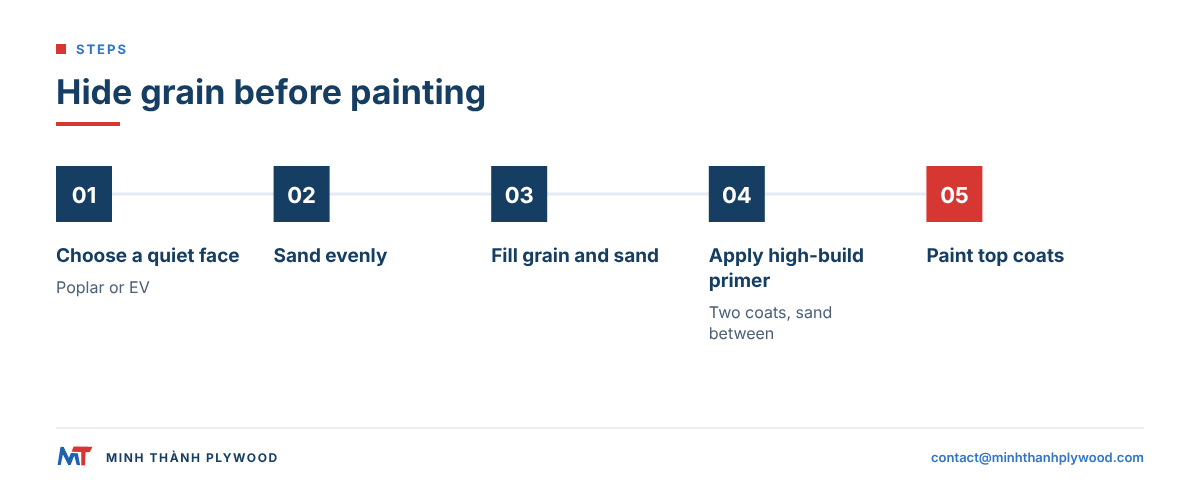
How to hide wood grain in plywood
To hide wood grain in plywood under paint, fill the grain, prime with a high-build primer and sand smooth before the top coats. Choosing a close-grained, pale face from the start does most of the work.
- Choose the face. Poplar or EV faces have the quietest grain; pine and open-pored faces telegraph through paint.
- Sand. Sand the face evenly; our sanded faces arrive ready for finishing.
- Fill. Apply a grain filler or a thin coat of filler compound, let it dry and sand back.
- Prime. Use a high-build or sanding primer; two coats with a light sanding between them.
- Paint. Apply the top coats with a roller or spray, sanding lightly between coats.
For factory UV lines, both faces of our furniture panels are UV-ready, sanded to the standard customers need to apply their own UV coating.
When to send a wood sample for laboratory identification
Send a sample to a laboratory when the species must be proven for a legal record, a dispute or a high-value order. A hand lens separates genera, but only microscopy, wood anatomy experts, DNA or isotope tests can confirm a species or its origin with confidence.
In the UK, wood identification is done by the Royal Botanic Gardens, Kew, whose Jodrell Laboratory and wood collection of more than 40,000 named reference samples support timber identification for customs and trade enforcement, and by university wood anatomy groups. Contact the laboratory first for current terms and fees, and send a clean, labelled end-grain block with the species, origin and supplier on the label.
Common reasons in the timber trade:
- Import declarations. US Lacey Act declarations need the species and country of harvest; we supply face and core species and Vietnamese harvest origin for the importer’s declaration.
- EU due diligence. Under the EU Deforestation Regulation (EU) 2023/1115, importers keep the species and geolocation of origin; we supply the EUDR compliance dossier (origin records and geolocation files) with orders.
- Quality disputes. Confirming that a face or core is the species ordered.
What this means for your order
When you order plywood or veneer, describe the grain you want, not just the species: the face species, the cut (rotary or sliced), the face grade and, for matched runs, an approved sample. Grain decides how the finished furniture looks, and naming it avoids the most common appearance claims.
A typical specification line:
Kitchen carcasses with painted doors, Styrax core, UF glue at E0 emission, poplar A/B faces sanded for paint, 1220 × 2440 × 18 mm, ±0.2 mm, export packs, 1×40HC to [your port].
We send free samples so you can see the grain before ordering, and reply within hours. Our faces include EV, poplar, birch, okoume and pine, with eucalyptus, bintangor, gurjan and sapele on request.
Buyer questions, answered
What is wood grain?
Wood grain is the direction, size and arrangement of the fibres in wood. Woodworkers use the word for three things: the direction of the fibres, the pattern of growth rings on a cut surface, and the texture of the pores.
What are the main wood grain patterns?
Straight, spiral, interlocked, wavy and irregular grain describe fibre direction. Cathedral, straight stripes, ray fleck and figures such as quilted, birdseye and fiddleback describe how the grain looks on a cut face.
What is the difference between heartwood and sapwood?
Sapwood is the outer, living part of the trunk that carries water; it is usually paler and less durable. Heartwood is the inner, dead core, often darker, where extractives build up and give colour and natural decay resistance.
How do you identify the type of wood?
Cut a clean end-grain surface, look at it with a 10× hand lens, and note the pores, their arrangement, the rays and the parenchyma. Combine that with colour, weight, smell and grain, then confirm with a reference database or a laboratory.
What is the difference between ring-porous and diffuse-porous wood?
In ring-porous wood, such as oak and ash, large pores form a clear band at the start of each growth ring. In diffuse-porous wood, such as maple, birch and poplar, pores of similar size are spread evenly across the ring.
How does grain look on rotary-cut plywood?
Rotary peeling follows the growth rings around the log, so the face shows a broad, wild, irregular pattern. Sliced veneer shows cathedrals or straight stripes like sawn boards.
How do you hide wood grain in plywood before painting?
Sand to a fine grit, apply a grain filler or a high-build primer, sand again and paint. Choosing a close-grained face such as poplar or engineered veneer makes the grain far less visible under paint.
What is VG fir plywood?
VG means vertical grain: Douglas fir cut so the growth rings run at a steep angle to the face, giving fine parallel lines. VG fir plywood uses a sliced vertical-grain face veneer and is a premium decorative panel.
Can you identify wood from a photo?
Only roughly. Colour and figure in a face photo are often misleading; a sharp, magnified photo of a clean end-grain cut allows a much better identification, and only a laboratory can confirm a species for legal records.
What are the physical properties of wood?
The main ones are density, moisture content, shrinkage, hardness and grain direction. They decide weight, stiffness, how much a part moves with humidity and how it machines.
Is grain direction important in plywood?
Yes. Each veneer is laid at right angles to the next, and the face grain runs along the panel length. A panel is stiffer along the face grain, so shelves should span in that direction.