
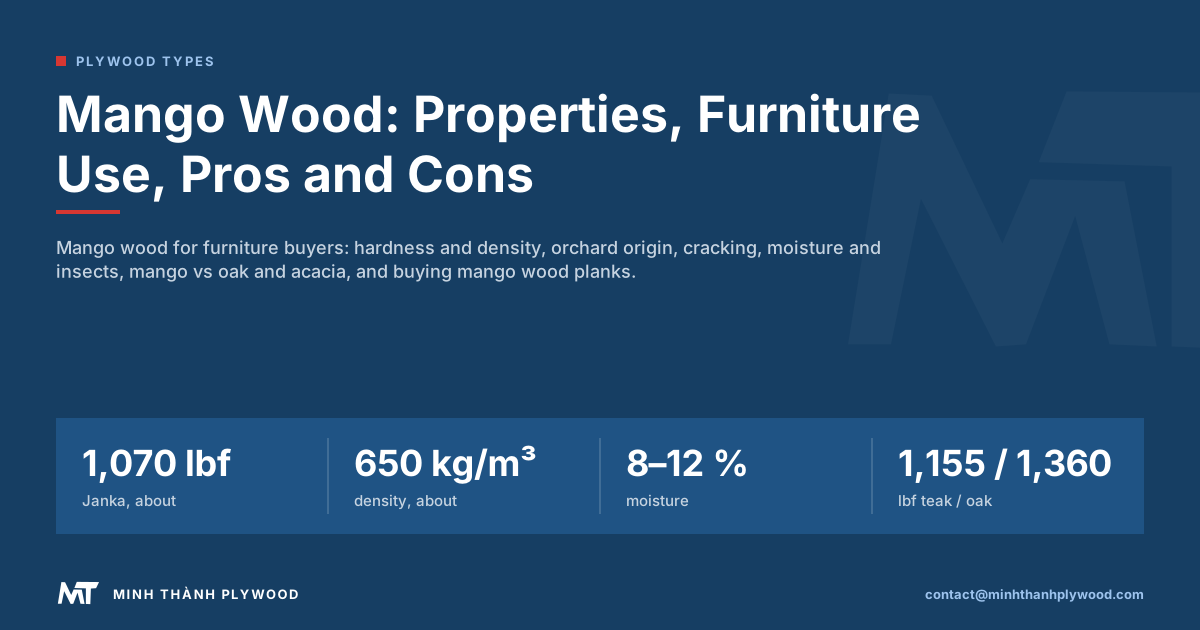
Mango wood is the timber of the mango tree (Mangifera indica), a medium-hard tropical hardwood cut from orchard trees after their fruiting years. It is good for indoor furniture: about as hard as teak, cost-effective and attractive, but it needs kiln drying, insect treatment and a sealed finish. Minh Thanh Plywood, a Vietnamese plywood manufacturer supplying furniture plants, explains how to buy it.
What is mango wood?
Mango wood is the timber of the mango tree (Mangifera indica), a medium-density tropical hardwood used for furniture, tableware and decorative pieces. Most of it is cut from orchard trees that have passed their best fruiting years, so the timber is a by-product of fruit farming rather than of forest logging.
Key facts at a glance:
| Property | Mango wood |
|---|---|
| Botanical name | Mangifera indica, cashew family (Anacardiaceae) |
| Type | Tropical hardwood, diffuse-porous |
| Colour | Light tan to golden brown, often with pink, yellow or dark spalted streaks |
| Grain | Interlocked to wavy, medium to coarse texture |
| Tree size | 80-100 ft (24-30 m) tall, trunk under 3-4 ft (1-1.2 m) across |
| Dried weight | 675 kg/m³ (42.1 lb/ft³) |
| Specific gravity | 0.52 (basic), 0.68 (12 % MC) |
| Janka hardness | 1,070 lbf (4,780 N) |
| Modulus of rupture (bending strength) | 12,830 psi (88.5 MPa) |
| Modulus of elasticity (stiffness) | 1,672,000 psi (11.53 GPa) |
| Crushing strength | 7,240 psi (49.9 MPa) |
| Shrinkage, green to oven-dry | 3.6 % radial, 5.5 % tangential, 8.9 % volumetric (T/R ratio 1.5) |
| Durability outdoors | Perishable; indoor use |
| Main producing regions for furniture | India and South-East Asia |
Property values come from the Wood Database mango entry (checked on 21 October 2026). The density places mango wood in the same class as the Eucalyptus our factory uses for plywood cores, about 650 kg/m³ for planning, and above white Styrax at about 500 kg/m³. A shrinkage ratio of 1.5 between tangential and radial is low for a hardwood, which is why well-dried mango stays flat. For other species, see our guide to types of wood.
Where does mango wood come from?
Mango wood comes from fruit orchards in tropical and subtropical countries, with India the best-known source of mango wood furniture. Trees are felled when fruit yield falls and the orchard is replanted, so the timber supply follows the fruit industry.
Three things follow from that origin:
- Supply. Mango wood is available in volume wherever mango orchards are renewed, and no tree is planted for timber alone.
- Log size. Orchard trees branch low, so logs are short and crooked; boards are shorter and narrower than plantation timber grown for wood.
- Variation. Trees of different ages and growing conditions give boards that differ in colour and figure.
For importers into the EU, wooden furniture and sawn wood are listed in Annex I of the EU Deforestation Regulation, Regulation (EU) 2023/1115, so mango wood products need the same due diligence and plot geolocation as any other timber, orchard wood included. The European Commission gives 30 December 2026 as the application date for large and medium operators (checked on 20 October 2026). For plywood, we supply the EUDR compliance dossier (origin records and geolocation files) with orders.
Is mango wood good for furniture?
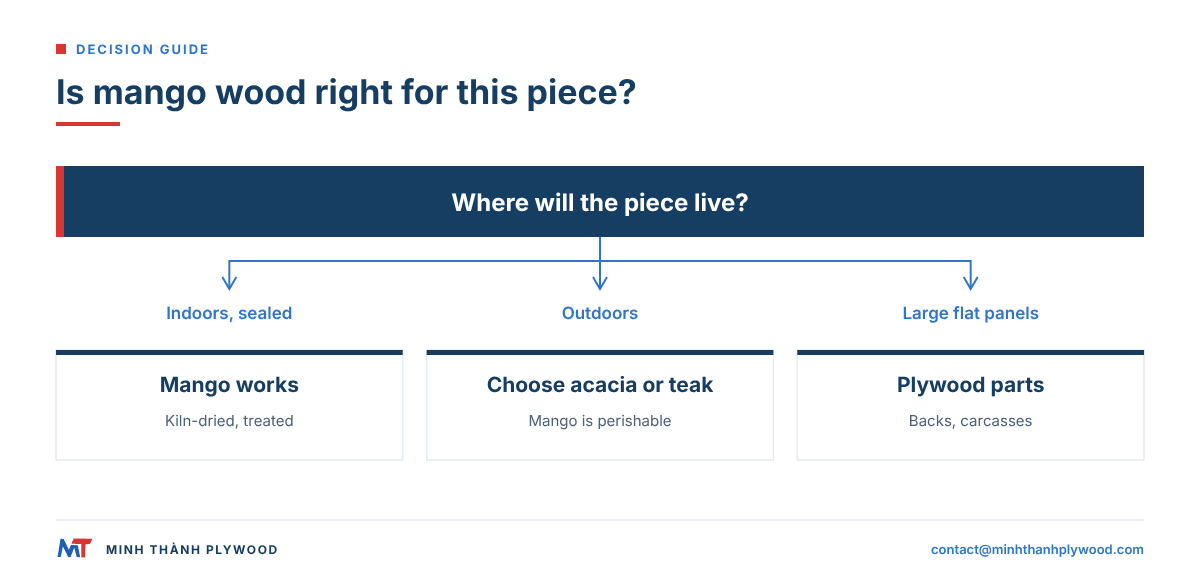
Yes, mango wood is good for indoor furniture. It is hard enough for tables, chairs, sideboards and cabinets, takes stains and lacquers well, shows attractive figure and costs less than oak, walnut or teak. It is not suitable for outdoor furniture without heavy protection.
What makes it a good furniture wood:
- Hardness close to teak. About 1,070 lbf against about 1,155 lbf for teak.
- Workability. It saws, sands and turns well, though interlocked grain can tear out when planed.
- Finish. It takes oil, lacquer and stain evenly once sealed.
- Look. Golden tones and natural streaks give each piece a distinct appearance.
What a furniture buyer must check:
- Kiln drying to an indoor moisture content, typically 8–12 %.
- Insect treatment, because untreated sapwood attracts borers.
- Board selection for colour, if pieces must match.
Mango wood hardness and strength
Mango wood has a Janka hardness of about 1,070 lbf (4,780 N), which makes it a medium-hard wood: harder than walnut and cherry, close to teak, softer than oak and maple. It is strong enough for furniture frames and tops in normal indoor use.
| Species | Janka hardness | Typical use in furniture |
|---|---|---|
| Hard maple | about 1,450 lbf | Tops, worktops, flooring |
| White oak | about 1,360 lbf | Frames, tops, cabinets |
| Teak | about 1,155 lbf | Indoor and outdoor furniture |
| Mango | about 1,070 lbf | Tables, sideboards, chairs, decor |
| Black walnut | about 1,010 lbf | Premium tops and cabinets |
| Cherry | about 950 lbf | Cabinets and fine furniture |
Hardness measures resistance to dents, not bending strength. For long shelves and table aprons, the stiffness of the section matters more; mango is in the medium range, so very long spans need a deeper section or a support.
Does mango wood crack easily?
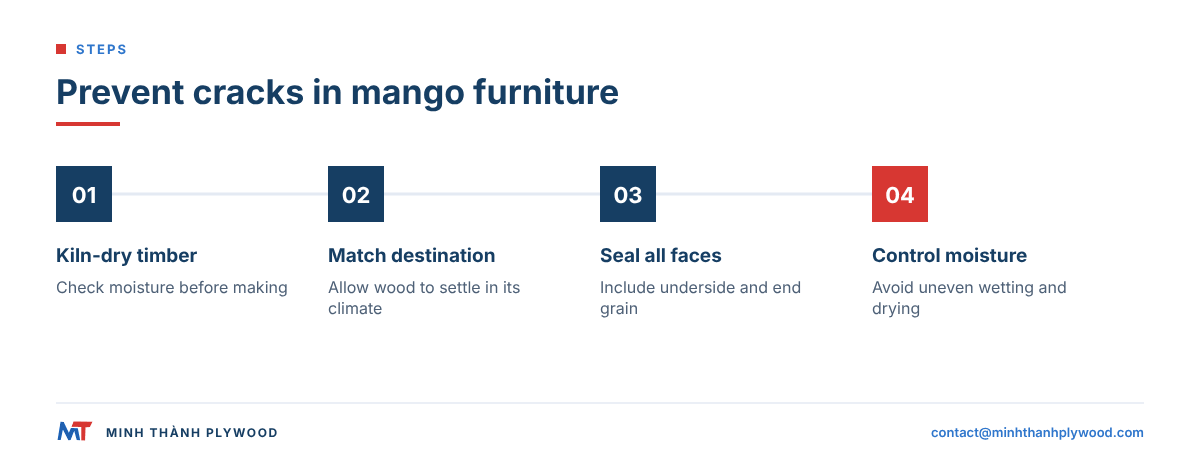
Mango wood does not crack easily once it is properly kiln-dried and sealed, but green or poorly dried mango wood cracks, checks and warps as it loses moisture. Most complaints about cracking mango furniture trace back to drying, not to the species.
Why cracks happen:
- Drying too fast or not enough. The outside dries and shrinks before the core, and splits open.
- Moisture mismatch. Furniture made at a humid workshop’s moisture content dries further in a heated home and shrinks.
- Unsealed faces. An unfinished underside takes up and loses water faster than the finished top, which pulls the board out of shape.
- Interlocked grain. It resists splitting but builds stress that releases as twist.
How to prevent it: buy kiln-dried timber, check moisture before making, seal every face including ends, and let the wood settle in the destination climate before final assembly.
Moisture, insects and spalting: the downsides of mango wood
The downsides of mango wood are insect attack, fungal staining, low outdoor durability, short boards and colour variation. None of them stops it being a good indoor furniture wood, but each must be managed in production.
- Insects. Mango sapwood is rich in sugars and attracts powder-post beetles and borers. Furniture makers treat the timber, typically with a borate solution, before drying.
- Fungal stain and spalting. Logs left too long before sawing grow fungi that leave dark lines. Light spalting is decorative; heavy spalting softens the wood.
- Outdoor durability. Mango heartwood is perishable in ground contact and in the weather.
- Short, narrow boards. Orchard logs give limited widths and lengths, so wide tops are edge-glued from many strips.
- Sawdust. Mango is in the cashew family; its dust and sap can irritate skin and airways, so workshops need dust extraction and masks.
Is mango wood toxic or allergenic?
Mango wood is safe for furniture and tableware once it is dried and finished, but the raw sap and sawdust can irritate. Mango belongs to the cashew family (Anacardiaceae), and some people react to the sap or fine dust with skin rashes or airway irritation, so workshops use dust extraction and masks.
The wood does not give off formaldehyde by itself; the formaldehyde in a finished panel comes from the glue. Ask for the emission test of any plywood or board beside the solid wood. Our own plywood was tested in six ASTM D6007 chamber tests that averaged 0.014-0.032 ppm. The US limit for veneer-core hardwood plywood is 0.05 ppm under 40 CFR 770.10 (checked on 20 October 2026).
Does mango wood turn grey?
Unfinished mango wood fades and greys under sunlight. UV light breaks down the surface lignin, and the golden tan turns silver-grey over months on a bare piece near a window. Some makers use this on purpose for a weathered look. To keep the warm colour, seal the wood with a UV-resistant lacquer or hard wax oil and keep it out of direct sun.
How do you dry mango wood?
Dry mango slabs slowly: air-dry first, then finish in a kiln to 8-12 % moisture. Free water leaves first, down to the fibre saturation point of about 25 %; below that the wood starts to shrink, which is where checks and warp begin, so the last stage needs control.
Woodworkers report 2 in (50 mm) boards reaching 10-12 % in a few weeks in an air-conditioned room with a fan, starting from about 30 %. Large slabs, such as the 15-30 in (380-760 mm) diameter pieces some buyers ask about, take months and are best kiln-dried with the ends sealed. Kiln schedules also kill insects, which is why most mango furniture timber is sold kiln-dried.
Mango wood planks: sizes, grades and drying
Mango wood planks are sold mostly as short, narrow boards, kiln-dried and graded by appearance, because orchard logs are short and crooked. Wide tables and cabinet sides are made from edge-glued panels or finger-jointed lamellas rather than single wide planks.
What to specify when buying mango wood planks:
| Item | What to ask for |
|---|---|
| Moisture content | Kiln-dried to the indoor range of the destination, typically 8–12 % |
| Treatment | Insect treatment before drying, with the method stated |
| Grade | Clear, rustic or spalted, by appearance; knots and sapwood limits |
| Dimensions | Thickness, width and length, with machining allowance |
| Format | Solid planks, edge-glued panels or finger-jointed lamellas |
| Documents | Species, country of harvest, phytosanitary certificate |
For plywood, our panels and veneers are dried to 8–12 % moisture content at dispatch, the same range a furniture plant expects from its solid timber, so solid mango parts and plywood parts move together after assembly.
Mango wood vs oak and acacia
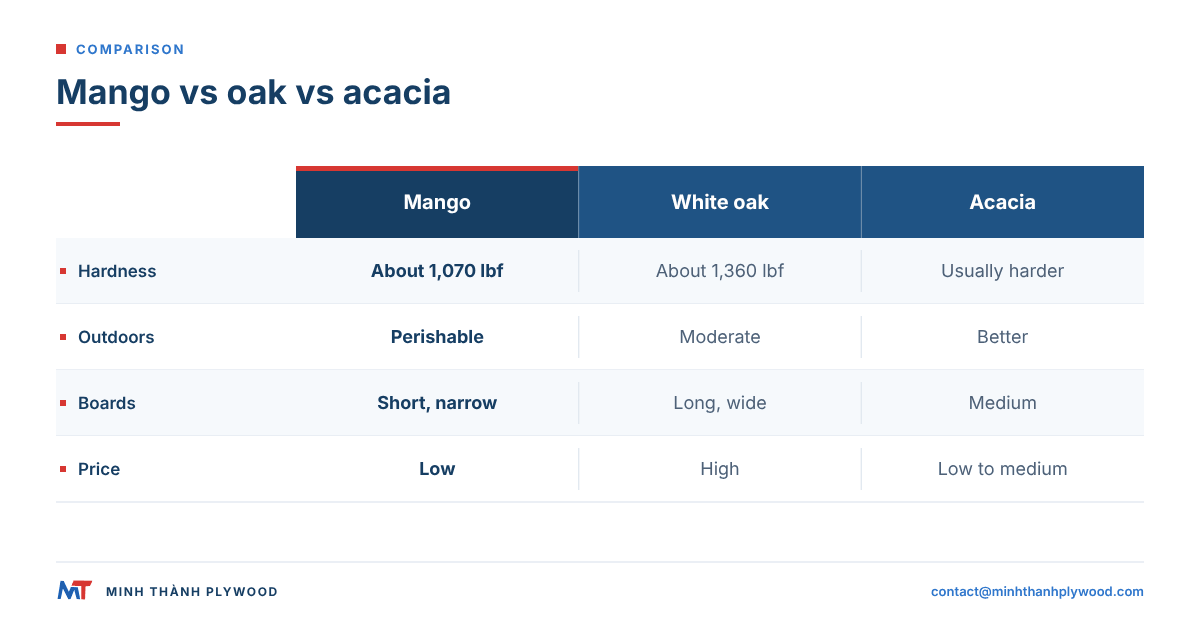
Mango wood is softer and less durable than oak and acacia, but it costs less, has a warmer, more varied look and is easy to work. Choose oak for premium, long-life furniture; acacia for harder wearing and outdoor-adjacent pieces; mango for cost-effective indoor furniture with character.
| Factor | Mango | Oak (white) | Acacia |
|---|---|---|---|
| Hardness | Medium, about 1,070 lbf | Higher, about 1,360 lbf | Usually higher than mango; varies by species |
| Colour | Light tan to golden, streaky | Light to mid brown | Golden to dark brown, strong contrast |
| Grain | Interlocked, wavy | Straight, ray fleck when quartered | Straight to wavy |
| Outdoor durability | Perishable | Moderately durable heartwood | Better than mango; used for garden furniture |
| Board sizes | Short, narrow | Long, wide | Medium; often finger-jointed |
| Price level | Low | High | Low to medium |
| Typical products | Tables, sideboards, decor | Premium tables, cabinets, floors | Tables, garden furniture, worktops |
Acacia is also a core species in plywood. Our Acacia-core plywood is made on order, at a reference density of about 580 kg/m³, and Acacia veneers go into our LVL.
Is mango wood expensive?
No, mango wood is not expensive. It is one of the most cost-effective furniture hardwoods, because the trees are grown for fruit and the timber comes from orchard renewal. Mango furniture usually costs less than the same design in oak, walnut or teak.
What drives the price of a mango wood piece:
- Drying and treatment. Proper kiln drying and insect treatment add cost but prevent claims.
- Yield. Short, narrow boards mean more jointing and more waste.
- Selection. Matched colour and clear grades cost more than rustic grades.
- Finish. Multi-coat lacquer or hand-rubbed oil adds labour.
Cheap mango furniture often saves on exactly these steps, which is where cracking and insect problems start.
Can mango wood get wet, and does it need sealing?
Mango wood tolerates occasional spills on a sealed surface, but it should not stay wet. Standing water, rain and constant humidity cause stains, swelling, mould and decay, so mango is an indoor wood that needs a sealed finish on every face.
Finishes that work:
- Lacquer or polyurethane for tables and sideboards: the best protection against water rings and stains.
- Hard wax oil for a natural feel; renew it every year or two on tops.
- Food-grade mineral oil for boards and bowls used with food.
Seal the underside and the end grain as well as the visible faces. An unsealed underside absorbs moisture at a different rate and pulls the top out of flat.
How to clean and disinfect mango wood
Clean mango wood furniture with a damp cloth and mild soap, then dry it at once. Avoid harsh solvents, abrasive pads and standing water, which damage the finish and then the wood.
For mango boards and bowls used with food:
- Wash by hand with warm water and mild detergent.
- Never soak, and never use a dishwasher.
- To disinfect, wipe with a diluted white vinegar solution, rinse and dry upright.
- Re-oil with food-grade mineral oil when the surface looks dry.
For furniture, keep pieces away from radiators and direct sun, which dry the wood unevenly and fade the colour.
Plywood in mango wood furniture
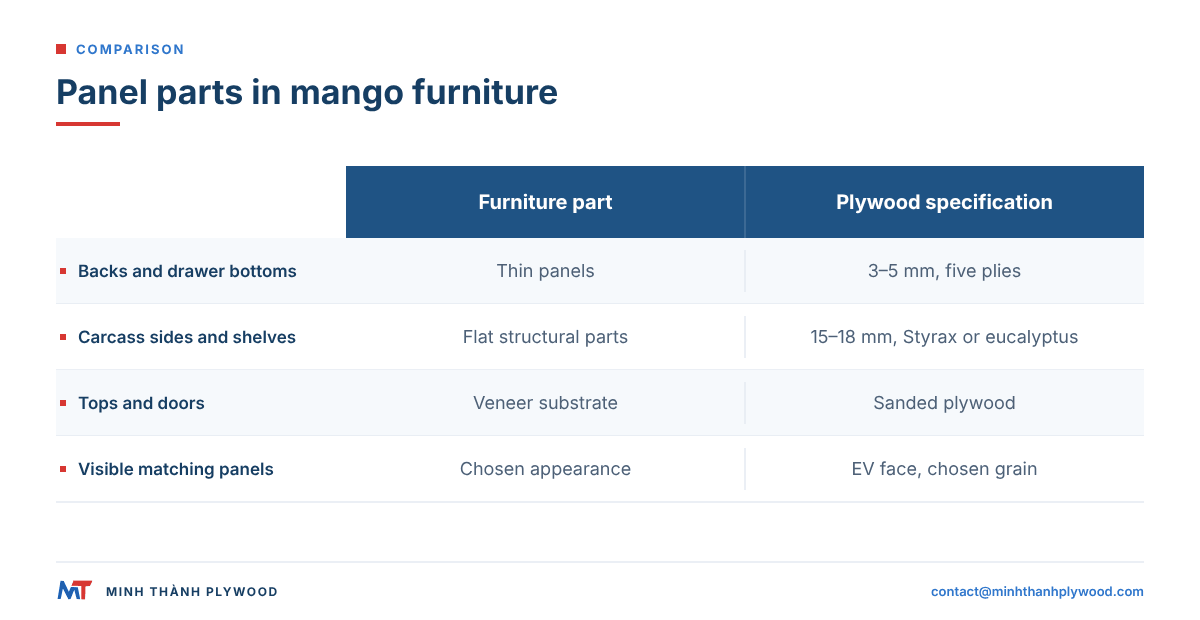
Most mango wood furniture combines solid mango for the visible parts with plywood for hidden and large flat parts: cabinet backs, drawer bottoms, carcass sides and table substrates. Plywood gives the large, flat, stable panels that short mango boards cannot, at lower cost and weight.
Plywood parts a mango furniture plant typically buys:
| Part | Plywood build |
|---|---|
| Cabinet backs and drawer bottoms | Thin plywood, 3–5 mm, always five plies |
| Carcass sides and shelves | 15–18 mm on a Styrax or Eucalyptus core |
| Veneered tops and doors | Sanded plywood ready for a mango or other veneer |
| Matching visible panels | EV faces in a chosen colour and grain |
Our furniture plywood is pressed twice as standard, with a calibrated core and sanded faces held to ±0.2–0.3 mm, so veneered and painted parts stay flat. The EV face can be ordered in a colour and grain chosen to sit beside solid wood.
What this means for your order
If you make or import mango wood furniture, buy kiln-dried, insect-treated timber, seal every face and keep it indoors. For the panel parts that sit beside it, order plywood dried to the same moisture range so the whole piece moves together.
A typical plywood request from a mango furniture plant:
Sideboard carcasses and drawer bottoms, Styrax core, UF glue at E0 emission, poplar B/B faces for veneering, 1220 × 2440 × 18 mm and 4 mm thin plywood, ±0.2 mm, export packs, 1×40HC mixed load to [your port].
Minh Thanh sends free samples, replies within hours and ships one 40HC minimum with mixed specifications by agreement, 15–45 days after the 30% deposit. See our furniture plywood for the full range of cores and faces.
Buyer questions, answered
What is mango wood?
Mango wood is the timber of the mango tree, Mangifera indica. It is a medium-density tropical hardwood, mostly cut from orchard trees that no longer bear enough fruit, and used for furniture, tableware and decorative items.
Is mango wood good for furniture?
Yes, for indoor furniture. It is about as hard as teak, machines and finishes well and costs less than oak or walnut. It must be kiln-dried, treated against insects and sealed, and it is not durable outdoors.
Is mango a hardwood or softwood?
Mango is a hardwood: it comes from a flowering, broad-leaved tree and has pores in its wood. With a Janka hardness of about 1,070 lbf, it sits close to teak and below white oak.
Does mango wood crack easily?
Only if it is badly dried. Air-dried or green mango wood cracks and warps as it loses moisture; properly kiln-dried mango wood, sealed on all faces, is stable indoors.
Is mango an expensive wood?
No. Mango wood is one of the most cost-effective furniture hardwoods, because the trees are grown for fruit and the timber is a by-product. It usually costs less than oak, walnut or teak.
What are the downsides of mango wood?
It is prone to insects and fungal stain if untreated, perishable outdoors, often comes in short, narrow boards, and its sawdust can irritate skin and lungs. Its colour also varies a lot between boards.
Can mango wood get wet?
Occasional spills on a sealed surface are fine if wiped quickly. Standing water, outdoor rain and constant humidity cause stains, swelling and decay, so mango wood is an indoor timber.
Does mango wood need to be sealed?
Yes. A lacquer, oil or polyurethane finish on all faces, including undersides and ends, slows moisture exchange, reduces cracking and protects against stains.
How do you clean or disinfect mango wood?
Wipe with a damp cloth and mild soap, then dry at once. For boards used with food, wash by hand, never soak or put in a dishwasher, and re-oil with a food-grade mineral oil.
Is mango wood stronger than oak?
No. Oak is denser and harder: white oak has a Janka hardness of about 1,360 lbf against about 1,070 lbf for mango. Mango is strong enough for tables, chairs and cabinets used indoors.
What is spalted mango wood?
Spalted mango wood shows dark lines and patches caused by fungi that grew in the wood before drying. It is valued for decorative items, but heavy spalting softens the wood and is not wanted in load-bearing parts.
Is mango wood toxic or allergenic?
Dried and finished mango wood is safe for furniture and tableware. Mango is in the cashew family, so raw sap and fine dust can irritate skin and airways; use dust extraction and a mask when machining it.
Does mango wood turn grey?
Unfinished mango wood greys in sunlight as UV breaks down the surface. A UV-resistant lacquer or hard wax oil and keeping it out of direct sun hold the golden colour.
Is mango wood the same as acacia?
No. They are different species. Acacia is usually harder, darker and more durable outdoors; mango is lighter in colour, slightly softer and an indoor timber.