
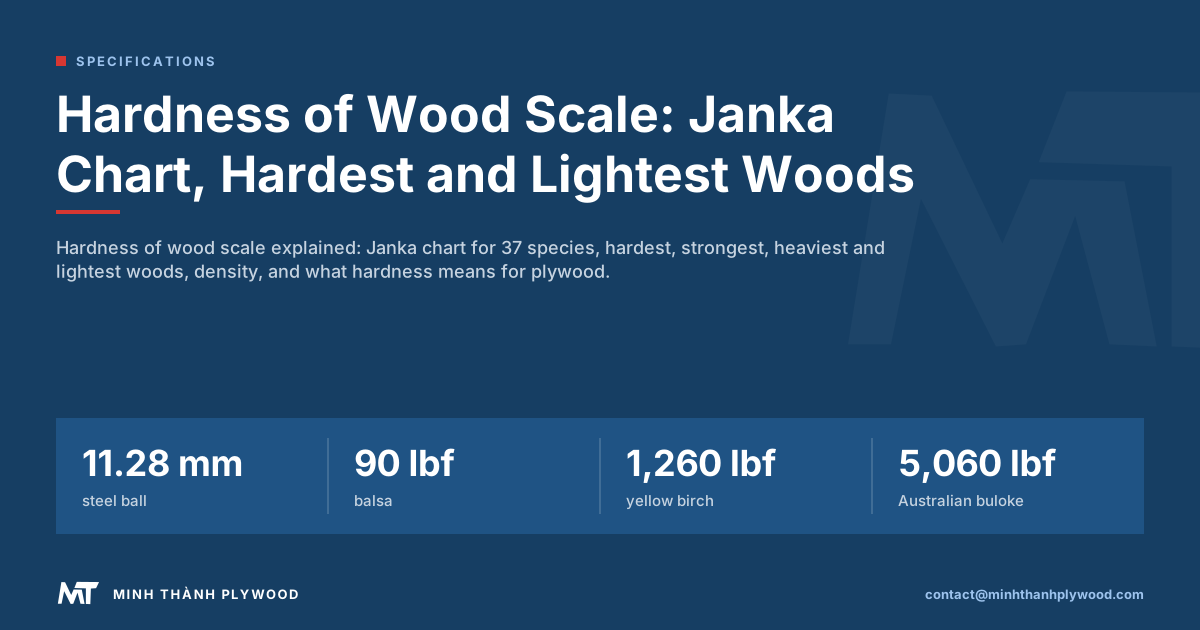
The hardness of wood scale used worldwide is the Janka scale: the force needed to press a 11.28 mm steel ball halfway into a wood sample, in pounds-force (lbf) or newtons (N). Balsa sits near 90 lbf, oak around 1,300 lbf and Australian buloke above 5,000 lbf. This guide gives the chart, the hardest, strongest, heaviest and lightest woods, and what hardness means for a plywood face. Minh Thanh Plywood makes furniture plywood in Vietnam.
What is the hardness of wood scale?
The hardness of wood scale is a ranking of timbers by how hard they are to dent, and the standard one is the Janka hardness test. It measures the force needed to press a steel ball 11.28 mm in diameter halfway into a wood sample, which leaves a dent of 100 mm² in area.
- Unit: pounds-force (lbf) in the US; newtons (N) or kilonewtons (kN) in Europe, Australia and most other markets.
- Direction: “side hardness” on the face of a board is the usual value; “end hardness” on the end grain is higher.
- Moisture: values are given for wood at about 12 % moisture content; wet wood rates softer.
- Standards: ASTM D143 in the US; ISO 13061-12 for the static hardness of small clear wood specimens.
The scale comes from Gabriel Janka, who published the test in 1906. A higher number means a harder wood, more resistant to dents, scratches and wear. Our plywood products page shows which species we use for faces and cores.
Janka hardness scale wood chart: 37 species
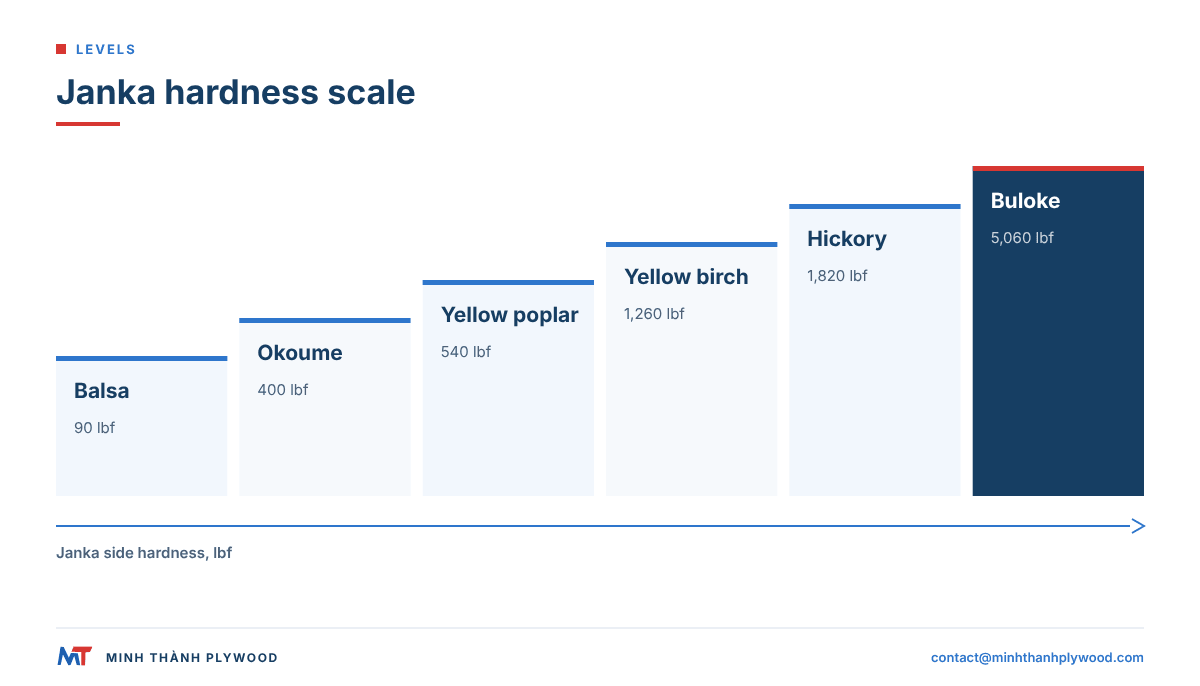
The Janka hardness scale wood chart below lists side hardness in lbf, from the hardest wood down to the softest, with newtons for the same value. Values are typical published figures for dry wood; a single board can rate 10–20 % higher or lower.
| Wood | Janka (lbf) | Janka (N) | Group |
|---|---|---|---|
| Australian buloke | 5,060 | 22,510 | Hardwood |
| Quebracho | 4,570 | 20,330 | Hardwood |
| Lignum vitae | 4,390 | 19,530 | Hardwood |
| Snakewood | 3,800 | 16,900 | Hardwood |
| Ipe | 3,510 | 15,610 | Hardwood |
| Cumaru | 3,330 | 14,810 | Hardwood |
| Jatoba (Brazilian cherry) | 2,690 | 11,970 | Hardwood |
| Purpleheart | 2,520 | 11,210 | Hardwood |
| Bubinga | 2,410 | 10,720 | Hardwood |
| Wenge | 1,930 | 8,590 | Hardwood |
| Merbau | 1,925 | 8,560 | Hardwood |
| Hickory | 1,820 | 8,100 | Hardwood |
| Hard maple | 1,450 | 6,450 | Hardwood |
| Sapele | 1,410 | 6,270 | Hardwood |
| White oak | 1,360 | 6,050 | Hardwood |
| White ash | 1,320 | 5,870 | Hardwood |
| European beech | 1,300 | 5,780 | Hardwood |
| Red oak | 1,290 | 5,740 | Hardwood |
| Yellow birch | 1,260 | 5,600 | Hardwood |
| Iroko | 1,260 | 5,600 | Hardwood |
| Silver birch | 1,210 | 5,380 | Hardwood |
| Teak | 1,155 | 5,140 | Hardwood |
| Black walnut | 1,010 | 4,490 | Hardwood |
| Rubberwood | 960 | 4,270 | Hardwood |
| Black cherry | 950 | 4,230 | Hardwood |
| Honduran mahogany | 900 | 4,000 | Hardwood |
| European larch | 830 | 3,690 | Softwood |
| Radiata pine | 710 | 3,160 | Softwood |
| Southern yellow pine | 690 | 3,070 | Softwood |
| Douglas fir | 660 | 2,940 | Softwood |
| Scots pine | 540 | 2,400 | Softwood |
| Yellow poplar | 540 | 2,400 | Hardwood |
| Okoume | 400 | 1,780 | Hardwood |
| Norway spruce | 380 | 1,690 | Softwood |
| Western red cedar | 350 | 1,560 | Softwood |
| Paulownia | 300 | 1,330 | Hardwood |
| Balsa | 90 | 400 | Hardwood |
Source and spread. Values are side hardness measured to ASTM D143. They are collected from The Wood Database and the US Forest Products Laboratory Wood Handbook (checked on 27 October 2026). All values are at 12 % moisture content. Where sources differ, one figure is shown: Australian buloke is listed at about 5,060 lbf, and other charts quote a different number for the same species depending on the sample and the test year.
The newton column is the lbf value multiplied by 4.448 and rounded. Our birch-faced plywood and okoume plywood pages use two of these species as faces, at opposite ends of the scale.
Janka hardness for UK flooring buyers
UK floor buyers meet three hardness questions: which species, solid or engineered, and how much wear the room gives. The species that UK merchants stock, with side hardness at 12 % moisture content from The Wood Database (read October 2026):
| Species | Janka (lbf) | Janka (N) | Where UK buyers use it |
|---|---|---|---|
| European ash | 1,480 | 6,580 | Floors, stair parts, tool handles |
| White oak | 1,360 | 6,050 | The reference floor species |
| Red oak | 1,290 | 5,740 | US-grown oak floors |
| English oak | 1,120 | 4,980 | Boards, beams and joinery |
| Black walnut | 1,010 | 4,490 | Living and dining rooms |
| Sweet chestnut | 680 | 3,010 | Fencing, outdoor joinery |
Engineered flooring takes its hardness from the top wear layer, not from the core: a plywood or softwood core under an oak layer wears like oak, and it moves less with heating and humidity than a solid plank of the same thickness. Solid boards can be sanded back more often. That split is why a hard species on a stable core is a common pick for underfloor-heated rooms.
How the Janka test is done
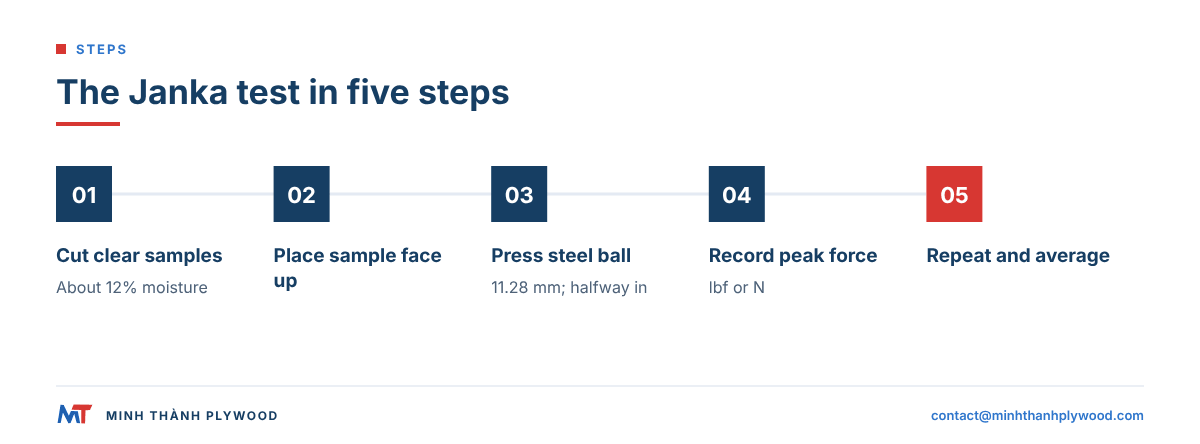
The Janka test presses a 11.28 mm steel ball into a small clear wood sample, without knots, until half the ball is buried, and records the peak force. Several samples are tested and averaged for the published value.
- Cut clear samples of the species, usually 50 × 50 mm in section, conditioned to about 12 % moisture.
- Place the sample in a testing machine with the face to be tested up.
- Press the ball into the wood at a steady rate until it is embedded to half its diameter.
- Record the force at that depth, in lbf or N.
- Repeat on the radial and tangential faces and on the end grain; average the side values.
Because the test needs a clear sample, its result describes the wood itself. Knots, grain slope and finish change how a real board or panel behaves under a dent.
What are the hardest woods in the world?
The hardest woods in the world are dense tropical and Australian hardwoods rated above 3,500 lbf, led by Australian buloke at about 5,060 lbf. These woods are so hard that they blunt standard saw blades and need pre-drilling for every screw.
| Rank | Wood | Janka (lbf) | Typical use |
|---|---|---|---|
| 1 | Australian buloke | 5,060 | Turning, small specialty items |
| 2 | Quebracho | 4,570 | Tannin, posts, sleepers |
| 3 | Lignum vitae | 4,390 | Bearings, mallets, ship parts |
| 4 | Snakewood | 3,800 | Bows, handles, inlay |
| 5 | Ipe | 3,510 | Decking, boardwalks |
| 6 | Cumaru | 3,330 | Decking, flooring |
What is the hardest wood in the world? Australian buloke on most charts; some lists also name black ironwood, which has no standard commercial supply. For buyers, ipe and cumaru are the hardest woods traded in volume.
What is the strongest wood? Hardness is not strength
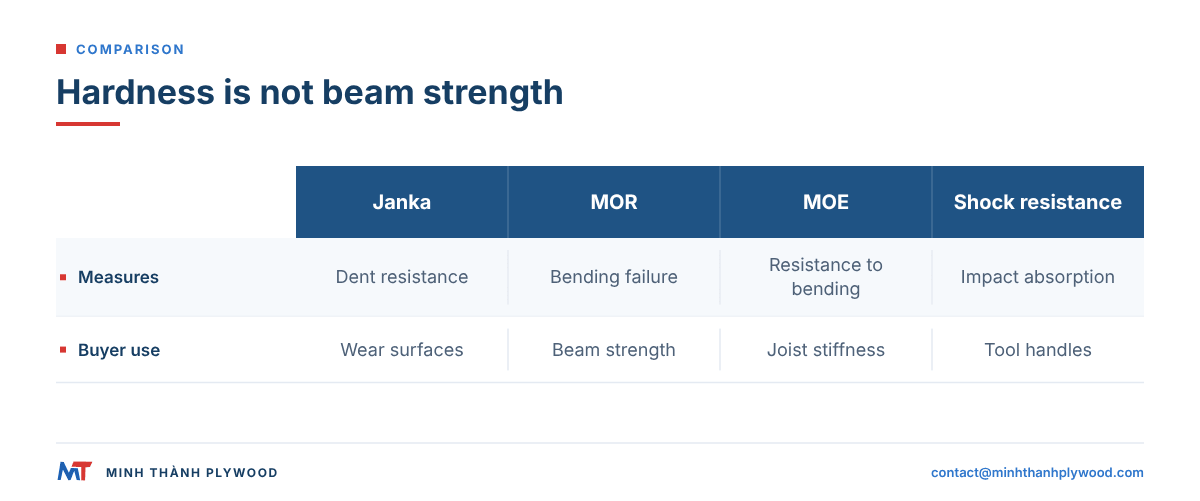
The strongest wood depends on the property measured: hardness, bending strength, stiffness or shock resistance. Janka hardness only measures resistance to denting, so the hardest wood is not always the strongest wood for a beam.
- Hardness (Janka): resistance to dents; lignum vitae and ipe lead.
- Bending strength (MOR, modulus of rupture): the load at which a beam breaks; dense tropical hardwoods and hickory rate high.
- Stiffness (MOE, modulus of elasticity): how little a beam bends under load; this sets the size of floor joists and LVL beams.
- Shock resistance: hickory and ash are chosen for tool handles because they absorb impact without splitting.
- Strength for weight: spruce and other light softwoods give high strength per kilogram.
For structural work, engineers use strength classes and design values, not Janka numbers. Our LVL laminated veneer lumber is chosen by its stiffness and bending values for the same reason.
What is the lightest wood, and the strongest lightweight wood?
Balsa is the lightest wood in commercial use, and spruce and paulownia are the usual answers for the strongest lightweight wood among everyday timbers. Light woods are soft on the Janka scale, but some give excellent strength for their weight.
| Lightweight wood | Janka (lbf) | Where it is used |
|---|---|---|
| Balsa | 90 | Sandwich cores, models, surfboards |
| Paulownia | 300 | Furniture parts, surfboards, drawer sides |
| Western red cedar | 350 | Cladding, decking, boxes |
| Norway spruce | 380 | Framing, instrument tops, CLT |
| Okoume | 400 | Plywood faces and cores, boats |
| Yellow poplar | 540 | Painted furniture, plywood faces |
Sitka spruce was used for aircraft frames because of its strength for its weight. In panels, lightweight wood is used as the core and harder wood as the face, so the board stays light while its surface resists wear.
Wood density and hardness: the heaviest woods
Wood hardness rises with density: the heavier a wood is for its size, the harder it usually rates on the Janka scale. The heaviest woods, such as lignum vitae, black ironwood and African blackwood, are denser than water and sink.
- Very light: balsa and paulownia, under about 300 kg/m³ dry.
- Light: spruce, cedar, poplar and okoume, roughly 350–500 kg/m³.
- Medium: birch, beech, oak, maple and ash, roughly 600–750 kg/m³.
- Heavy: jatoba, ipe and wenge, above about 850 kg/m³.
- Heaviest: lignum vitae and ironwoods, above 1,000 kg/m³.
Density is also how a plywood mill sorts its core woods. At our mill, the reference densities are Styrax about 500 kg/m³, Acacia about 580 kg/m³ and Eucalyptus 650–750 kg/m³, so a Eucalyptus core panel is the hardest and heaviest of the three, and Styrax the lightest.
Hardwood vs softwood: does the name mean harder?
Hardwood and softwood are botanical groups, not hardness grades: hardwoods come from broad-leaved trees, softwoods from conifers. Most hardwoods are harder than most softwoods, but the ranges overlap.
| Example | Group | Janka (lbf) |
|---|---|---|
| Balsa | Hardwood | 90 |
| Paulownia | Hardwood | 300 |
| Yellow poplar | Hardwood | 540 |
| European larch | Softwood | 830 |
| Southern yellow pine | Softwood | 690 |
| Douglas fir | Softwood | 660 |
Balsa, the softest wood on the chart, is a hardwood; larch and southern yellow pine, both softwoods, are harder than poplar. Our guide to types of hardwood explains the botanical split.
Hardness of plywood species: birch, eucalyptus, acacia, poplar, okoume
The face species decides how hard a plywood surface feels, and the core decides how well it resists a deep dent. Among common plywood species, birch is the hardest face and okoume and poplar the softest.
| Plywood species | Role | Hardness | Effect on the panel |
|---|---|---|---|
| Birch | Face | Hard, about 1,210–1,260 lbf | Resists dents, sands smooth, clear finish |
| Eucalyptus | Core and face | Hard and dense, 650–750 kg/m³ at our mill | Firm, heavy core; good screw holding |
| Acacia | Core | Medium-hard, about 580 kg/m³ at our mill | Firm core for furniture panels |
| Pine (radiata) | Face and core | Medium, about 710 lbf | Knotty look; softwood faces dent more easily |
| Poplar | Face and core | Soft, about 540 lbf | Light; pale face for paint and laminates |
| Okoume | Face | Soft, about 400 lbf | Light, smooth decorative face |
Our eucalyptus-faced plywood pairs a hard face with a dense core; a poplar or okoume face is chosen for weight and finish, not for dent resistance.
Why a plywood panel has no single Janka number
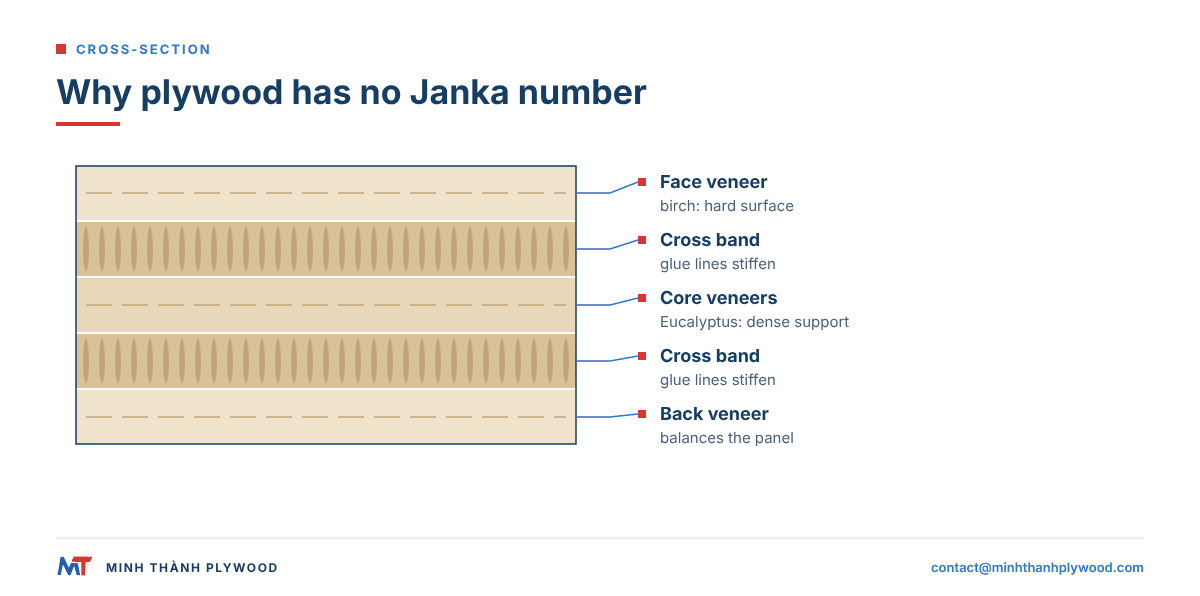
Plywood has no single Janka number, because the steel ball only meets the face veneer, a layer around half a millimetre to two millimetres thick, with the core beneath it. A dent in plywood is the sum of the face species, the core density, the glue lines and the finish.
- Face: a hard face such as birch spreads the load before it dents.
- Core: a dense core such as Eucalyptus supports the face; a light core gives way earlier.
- Glue lines: cured glue between veneers is harder than wood and stiffens the surface.
- Pressing: our furniture panels are pressed twice: the core board is pressed and calibrated, then face and back are pressed on, which gives a flat, firm base for the face.
- Finish: lacquer, UV coating or laminate adds the wear surface; our faces are UV-ready for the buyer’s own coating.
For a surface that must resist wear, specify the face, the core and the finish together. Our guide on how much weight plywood can hold covers the panel’s load side.
How to use hardness when choosing wood or plywood
Choose a hardness that matches the wear the part will see, then check the finish and the core. Very high hardness costs more, weighs more and is harder to machine, so pick the lowest rating that does the job.
| Use | Hardness to aim for | Typical choice |
|---|---|---|
| Hallway and commercial floors | 1,300 lbf and above | Oak, maple, hickory, jatoba |
| Home floors in living rooms | About 1,000–1,300 lbf | Walnut, birch, oak |
| Decking | 1,900 lbf and above | Ipe, cumaru, merbau |
| Cabinet doors and tabletops | About 1,000 lbf and above | Birch, oak, maple, or hard-faced plywood |
| Painted carcasses and shelves | Medium | Poplar or EV face over a firm core |
| Drawer sides and light parts | Low to medium | Poplar, paulownia, pine |
For furniture plywood, a hard face over a dense core is the usual answer for tabletops; a light core with a coated face is the answer for parts where weight matters more than dents.
Wood hardness for machining, fixings and finishing
Harder woods are slower to machine, blunt tools faster and need pre-drilled holes, but they hold screws well and take a fine polish. Softer woods machine quickly but tear out and dent under clamps.
- Relative hardness for cutting: red oak at 1,290 lbf is about 14 times harder than balsa at 90 lbf (1,290 / 90 = 14.3), so a router bit or saw blade that cuts balsa and poplar cleanly wears much faster in oak. CNC shops pick bit coating and feed rate by hardness band: soft woods below about 700 lbf, medium woods 700 to 1,500 lbf, and hard woods above that.
- Saws and routers: carbide tooling for woods over about 1,500 lbf; dense tropical woods dull steel quickly.
- Screws: pre-drill hard woods; softer woods and light cores need longer or coarser screws.
- Sanding: hard faces sand to a fine finish; soft faces need lighter pressure to avoid dishing.
- Gluing: oily hard woods such as teak and ipe may need cleaning before gluing.
- Thickness: a sanded furniture panel at our mill holds a thickness tolerance of ±0.2–0.3 mm, which keeps hard and soft faces equally flat after sanding.
Which plywood face to order for hard-wearing furniture
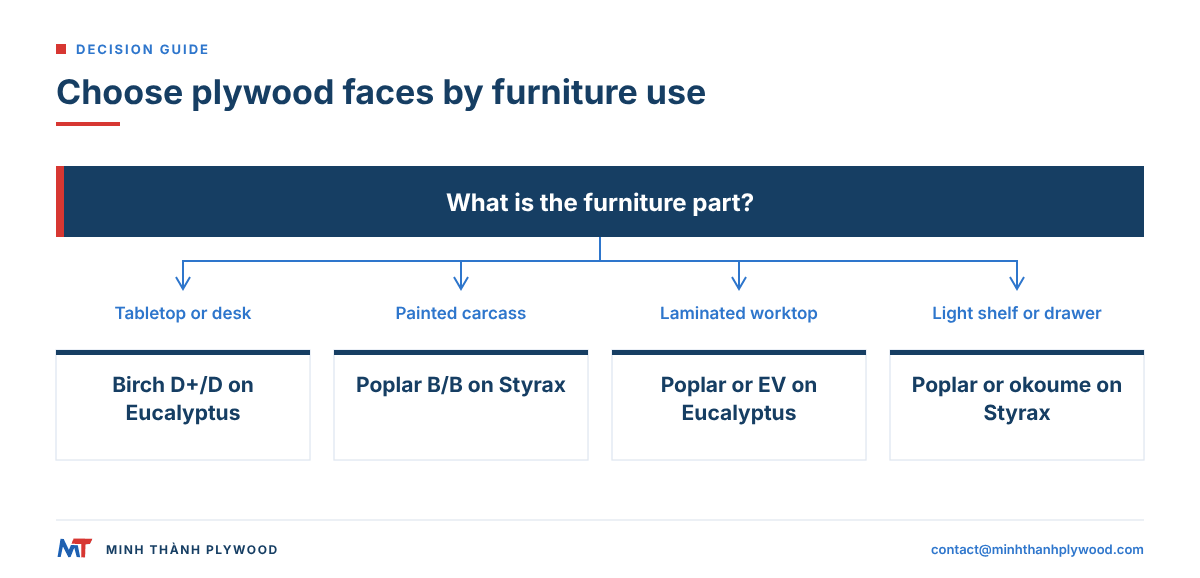
For hard-wearing furniture, order a birch or eucalyptus face over a Eucalyptus core, pressed twice and sanded, and apply the finish that the use needs. For painted or laminated parts, a poplar or EV face over a Styrax core keeps the panel lighter.
| Furniture part | Face | Core | Why |
|---|---|---|---|
| Tabletops, desks | Birch D+/D | Eucalyptus | Hard face, dense support |
| Cabinet doors (clear finish) | Birch or eucalyptus A/B | Eucalyptus or Styrax | Hard, even face |
| Painted carcasses | Poplar B/B | Styrax | Light, smooth paint base |
| Laminated worktops | Poplar or EV | Eucalyptus | Laminate gives the wear surface |
| Light shelving and drawers | Poplar or okoume | Styrax | Low weight |
Birch faces are graded D+, D and E in Vietnam and quoted as face/back pairs such as D+/D, matched to your approved sample.
What this means for your plywood order
Write the face species, the core and the finish on the order, because together they decide how hard the panel surface is. For a furniture panel from our mill, send these lines:
- Application: tabletop, cabinet door, carcass, shelf or drawer.
- Face and back: species and grade pair, for example birch D+/D or poplar A/B.
- Core: white Styrax (lighter) or Eucalyptus (harder, denser); Acacia or Pine on order.
- Glue and emission: UF glue at E0 emission, CARB P2 / TSCA Title VI for US orders (EPA formaldehyde standards for composite wood, read 20 October 2026).
- Size and thickness: 1220 × 2440 or 1250 × 2500 mm, 3–40 mm.
- Packing and quantity: from one 40HC, mixed specifications by agreement.
Production takes 15–45 days after the deposit, and free samples are available. Related reading: types of wood, wood species compared and birch wood.
Buyer questions, answered
What is the Janka hardness scale?
The Janka hardness scale rates wood by the force needed to press a 11.28 mm steel ball halfway into a sample. It is reported in pounds-force (lbf) in the US and in newtons (N) in most other markets.
What is the hardest wood in the world?
Australian buloke is usually listed as the hardest commercial wood, at about 5,060 lbf on the Janka scale. Quebracho, lignum vitae and snakewood follow, all above 3,800 lbf.
What is the strongest wood?
The answer changes with the property: lignum vitae and other dense tropical woods are the hardest, while hickory is known for bending strength and shock resistance. For structural use, engineers rate strength by bending strength (MOR) and stiffness (MOE), not by Janka hardness.
What is the lightest wood?
Balsa is the lightest commercial wood, at roughly 100–200 kg/m³ dry, with a Janka hardness near 90 lbf. Paulownia is the lightest wood commonly used in furniture and panels.
What is the strongest lightweight wood?
Spruce and paulownia give the most strength for their weight among common timbers; Sitka spruce was used in aircraft for that reason. Balsa is lighter still and is used as a core between stronger skins.
What is the heaviest wood?
Lignum vitae, black ironwood and African blackwood are among the heaviest woods, all denser than water at over 1,000 kg/m³ dry, so they sink.
Is oak a hardwood on the Janka scale?
Yes. Red oak is about 1,290 lbf and white oak about 1,360 lbf, which is why oak is the reference point in most flooring hardness charts.
How do I convert Janka lbf to newtons?
Multiply pounds-force by 4.448 to get newtons. For example, 1,000 lbf is about 4,450 N, or 4.45 kN.
Does plywood have a Janka rating?
Plywood has no single Janka rating, because only its face veneer meets the ball. A dent depends on the face species, the core under it and the finish, so plywood is chosen by face species and core density.
Which is harder, birch or poplar plywood?
Birch is much harder: yellow birch rates about 1,260 lbf against about 540 lbf for yellow poplar. Birch faces resist dents better; poplar faces are lighter and paint well.