
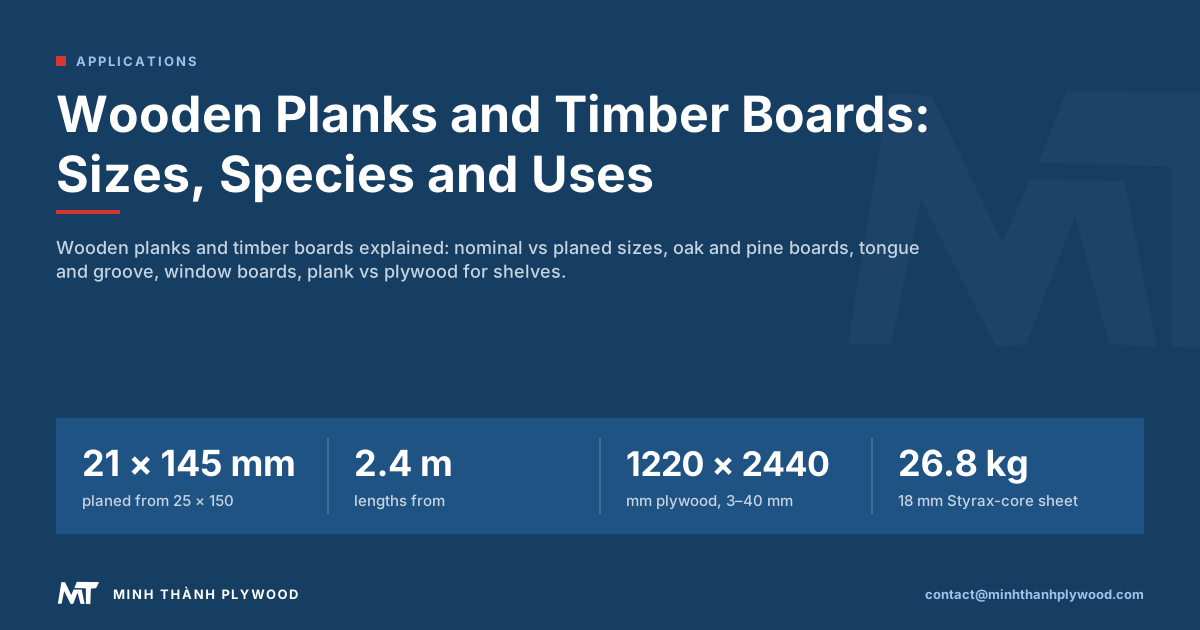
Wooden planks and timber boards are sawn or planed lengths of solid wood, sold by a nominal size that shrinks when the board is planed: a 25 × 150 mm board usually finishes at about 21 × 145 mm. This guide sets out formats, species and profiles, and where a plywood sheet from Minh Thanh Plywood does the same job wider, flatter and more stable.
Wooden planks in short
Wooden planks are lengths of solid wood cut along the grain, sold by species, grade, nominal size and finish. Four choices decide what you buy:
- Format: sawn, planed all round (PAR in the UK, DAR in Australia), tongue and groove, or a profiled board such as a window board.
- Species: oak, ash and other hardwoods for show; pine, spruce and other softwoods for value.
- Size: nominal sawn thickness and width, then the smaller finished size after planing.
- Alternative: a plywood sheet when the part must be wide, flat and stable.
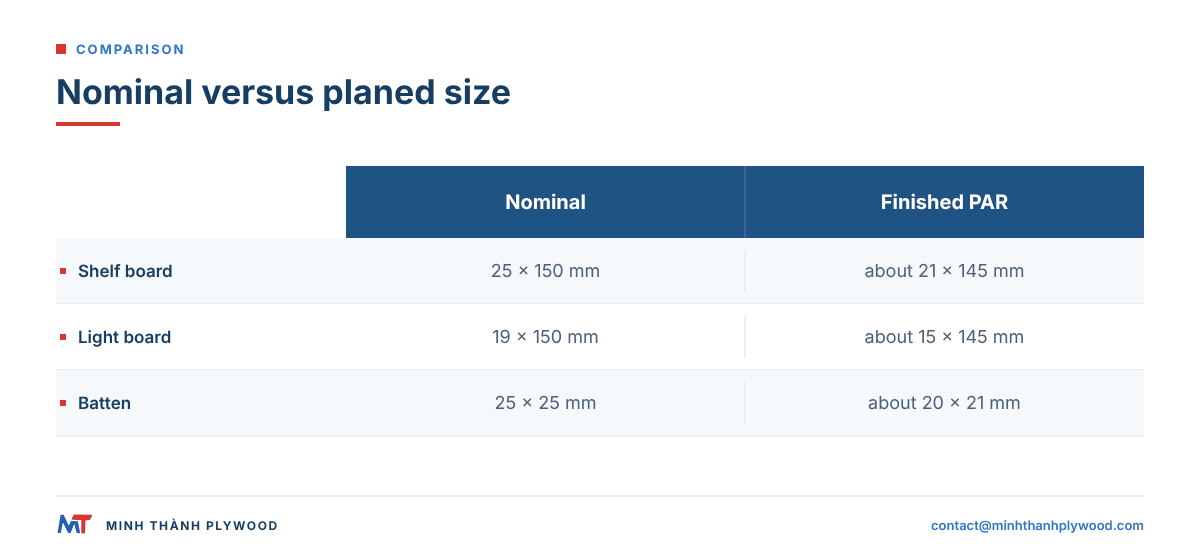
The size table below shows how nominal and finished sizes differ.
Wooden planks in Australia: DAR sizes, species and scaffold planks
Australian buyers ask for wooden planks by the dressed section, and the common name is DAR (dressed all round), the local term for what UK merchants call PAR. Bunnings lists the staple sections as 42 × 19 mm and 90 × 19 mm; the 42 × 19 mm pine comes in 1.2, 1.8, 2.4 and 3.0 m lengths, and a treated 90 × 19 mm H3 board is sold at 4.8 m.
| Australian plank | Typical section | Typical use |
|---|---|---|
| DAR pine, untreated | 42 × 19 mm, 90 × 19 mm | Shelving, trim, joinery, painted work |
| Treated pine DAR, H3 | 90 × 19 mm | Outdoor above-ground cladding, pergolas, fascia |
| Scaffold plank (timber or LVL) | 225 × 38 mm | Work platforms |
Species follow the local forest. Radiata pine is the value board: untreated for interiors, treated to H3 (above-ground outdoor) or H4 (in-ground contact) for exterior work. Hardwood boards come from Tasmanian oak and Victorian ash for furniture and stair work, and from spotted gum, blackbutt and jarrah where hardness and durability matter, such as decking and bench tops.
Price follows the same order: pine DAR is cheapest per lineal metre, the eucalypt hardwoods cost more, and wide, long or clear boards cost most. Check the price per lineal metre against the section, because a 90 mm board and a 42 mm board of the same species are not the same value.
Scaffold planks are a separate product with their own standard. AS/NZS 1577 covers scaffold decking components, and it sets a minimum plank width of 220 mm, so a 225 × 38 mm plank clears it. Planks are made from solid timber or from laminated veneer lumber (LVL), and LVL planks are supplied in 38 or 42 mm thicknesses and 225 or 230 mm widths. A scaffold plank is not a shelf board: use it only as a rated platform, with the marking the standard requires. Structural timber in buildings is designed under AS 1720.
Where an Australian project needs wide, flat panels rather than boards, a plywood sheet replaces a run of glued planks, and our pine and furniture plywood ships factory-direct in 40HC containers.
Wood planks, timber boards and lumber: the words
Wood planks and timber boards are both solid wood cut along the grain, and the names overlap. Merchants usually call thinner, narrower stock boards and thicker, wider stock planks; “timber” is the British word and “lumber” the North American word for the same material.
Four words appear on every timber list:
- Sawn: rough from the saw, at the full nominal size, for hidden or structural work.
- PAR (planed all round): all four faces planed smooth; also called PSE or dressed timber.
- Nominal size: the sawn size the board is named by.
- Finished size: the real size after planing, a few millimetres smaller.
What size are wood planks?
Wood planks are named by their nominal sawn size, and a planed board finishes a few millimetres smaller in thickness and width. A 25 × 150 mm board, for example, finishes at about 21 × 145 mm planed all round. Merchants publish the finished size next to the nominal one; always design to the finished size.
| Nominal size | Typical PAR finished size | Typical use |
|---|---|---|
| 25 × 150 mm | about 21 × 145 mm | Shelves, skirting, joinery |
| 19 × 150 mm | about 15 × 145 mm | Light shelving, cladding |
| 25 × 25 mm | about 20 × 21 mm | Battens, framing strips |
Lengths of planed softwood usually start at 2.4 m and rise in regular steps. Boards sold in inches convert at exactly 25.4 mm to the inch. Hardwood boards such as planed European oak are sold cut to length or in random lengths and widths.
Moisture also moves the numbers. Timber shrinks and swells with the air’s humidity, mostly across its width, so a wide board measured in a damp yard can be narrower in a heated room.
Oak boards: properties and uses
An oak board is hard, heavy and durable, with a strong grain that takes oil and lacquer well, which makes it the reference hardwood for show furniture, worktops, stair treads and window boards. European and American white oak are the usual species; red oak is more porous and less suited to damp places.
Oak costs more than softwood and needs sharp tools and pre-drilling. Wide oak boards cup if one face dries faster than the other, so furniture makers glue narrow strips into panels or choose quarter-sawn boards, which move less. The oak wood guide covers species and grades.
Pine boards and other softwood boards
Pine boards are the value choice for solid wood: light, easy to cut and fix, and cheap compared with hardwood. Redwood (Scots pine) and whitewood (spruce) are the common European softwoods; knots are part of the look in most grades.
- Uses: shelving, painted joinery, cladding, sheds, rustic furniture.
- Limits: soft surface that dents, resin pockets, knots that can bleed through paint unless sealed.
- Grades: clear (few knots) for joinery, knotty grades for rustic and hidden work.
Where a pine look is wanted over a large area, pine-faced plywood gives the same face on a stable sheet. Our pine-faced panels are quoted as face/back grade pairs A/A, A/B and B/B (B/C for utility parts), matched to the buyer’s approved sample; the ladder is comparable to the European softwood face classes I to IV and the US A to D grades.
Hardwood and softwood boards compared by species
Hardwood boards win on wear and grain, softwood boards win on price and ease of working, and the species inside each group decides the rest. The table compares the boards buyers ask for most, one property per column.
| Species | Group | Hardness and wear | Workability | Typical board uses |
|---|---|---|---|---|
| European oak | Hardwood | Hard, durable | Needs sharp tools, pre-drill | Furniture, sills, treads, worktops |
| Ash | Hardwood | Hard, tough | Good | Furniture, shelves, handles |
| Beech | Hardwood | Hard, even | Good, moves with humidity | Furniture, worktops, toys |
| Walnut | Hardwood | Medium-hard | Very good | Show furniture, shelves |
| Redwood (Scots pine) | Softwood | Soft | Easy | Joinery, shelving, painted work |
| Whitewood (spruce) | Softwood | Soft | Easy | Framing, cladding, hidden parts |
| Larch | Softwood | Harder than pine, resinous | Fair | Cladding, decking, outdoor |
Two rules help when the list is long. First, the heavier and harder the board, the better it resists dents and the more it costs. Second, outdoor work needs a naturally durable species or a treated board, whatever its group.
For panel work, the same species appear as plywood faces. A birch, pine, okoume or engineered veneer face gives the look of the species on a stable sheet, at a lower cost per square metre than solid boards of the same width. The wood species compared guide goes species by species.
Sawn or planed: which boards to buy
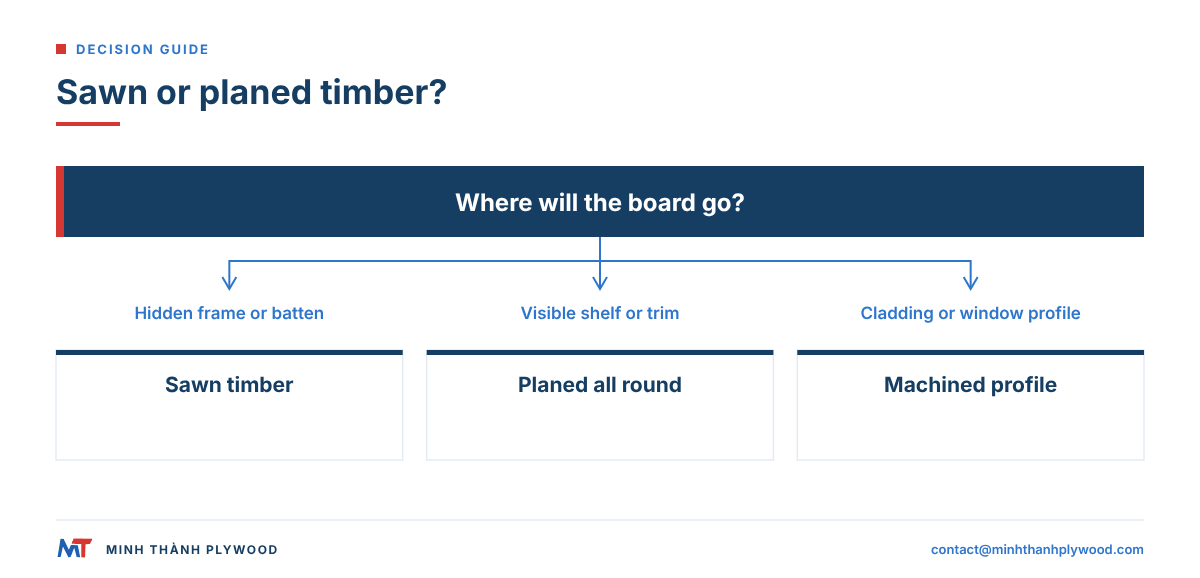
Buy sawn boards for hidden and structural work, and planed boards for anything that is seen, painted or joined. Sawn timber is cheaper and keeps its full nominal size; planed timber is smooth, square and ready to fix, but smaller and dearer.
- Sawn: framing, battens behind cladding, packing, rough outdoor work.
- Planed all round: shelves, skirting, architrave, furniture parts, visible framing.
- Machined profiles: tongue and groove, shiplap, window boards, mouldings.
If a drawing gives a size, check whether it is nominal or finished before ordering, especially for parts that must fit between other parts.
Tongue and groove timber
Tongue and groove timber has a tongue along one edge and a groove along the other, so boards lock together into a flat surface with hidden fixings. It is used for wall and ceiling cladding, wainscoting, sheds and floors.
The joint lets each board move with humidity without opening a gap, and secret nailing through the tongue keeps the face clean. VJ (V-jointed) boards add a chamfer on each edge to make a V line between boards; beadboard adds a rounded bead.
For large wall and ceiling areas, plywood sheets with routed grooves give the same lines with far fewer joints. The plywood wall panels guide covers grooved and flat sheet panelling.
Window boards and windowsill wood
Windowsill wood for interior window boards is usually solid oak or pine, MDF with a paint or foil finish, or veneered board with a bullnose edge. Exterior sills are a different product: they need a durable hardwood or a treated softwood, a drip groove and a slope to shed water.
| Window board | Look | Moisture near the window | Note |
|---|---|---|---|
| Solid oak | Natural, premium | Good when sealed | Can cup if wide; seal all faces |
| Solid pine | Natural or painted | Fair | Seal knots before painting |
| MDF, painted or foiled | Smooth, uniform | Poor at open edges | Low cost, common in new builds |
| Veneered plywood | Real wood face | Good, by bond | Stable on wide boards |
Wide window boards are where solid timber moves most, because the radiator below dries the underside. A veneered plywood board stays flat at widths where a solid board would cup.
What wood is best for shelves?
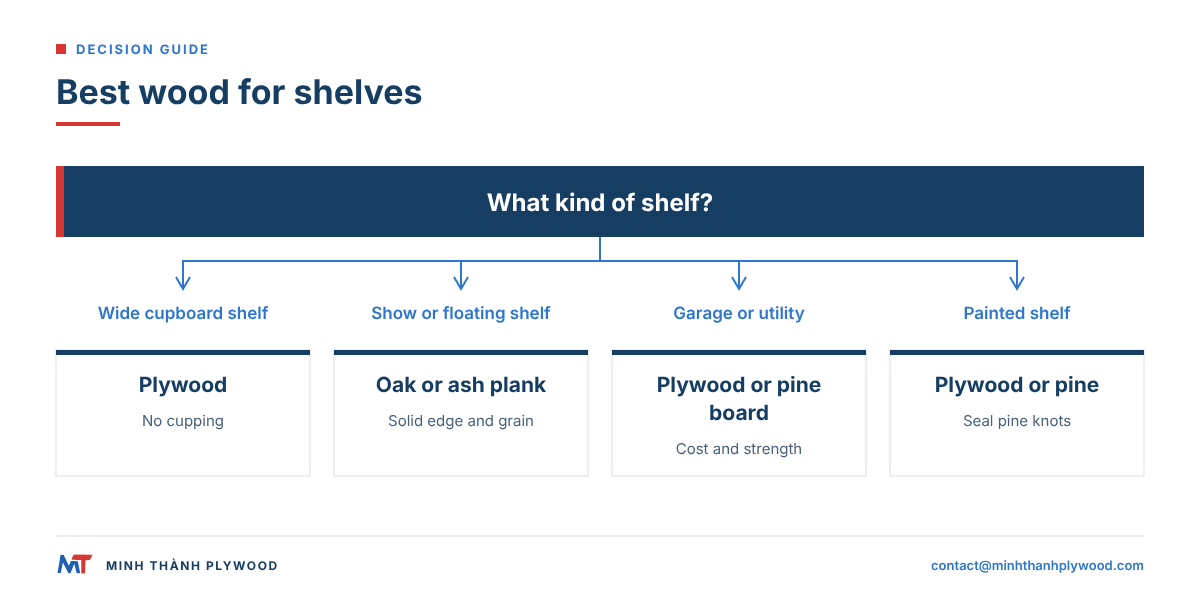
For most shelves, plywood is the best material: it is stable, it does not cup or split, it comes in wide sheets and it costs less than solid hardwood. Solid oak or ash planks are the best choice when the shelf is on show and its edge and grain must be solid timber. Pine boards are the budget solid-wood option for light loads.
| Shelf need | Best choice | Why |
|---|---|---|
| Wide cupboard and wardrobe shelves | Plywood | No cupping, wide sheets, strong across the width |
| Show shelf, floating shelf | Oak or ash plank | Solid edge and grain |
| Garage and utility shelving | Plywood or pine board | Cost and strength |
| Long spans with books | Thick plywood or hardwood | Resists sag |
| Painted shelves | Plywood or pine | Paints well; seal pine knots |
A plywood shelf with a solid wood lipping on its front edge gives the look of a plank with the stability of a sheet. The plywood for shelves guide gives thicknesses by span.
Plank vs plywood sheet for shelves and walls
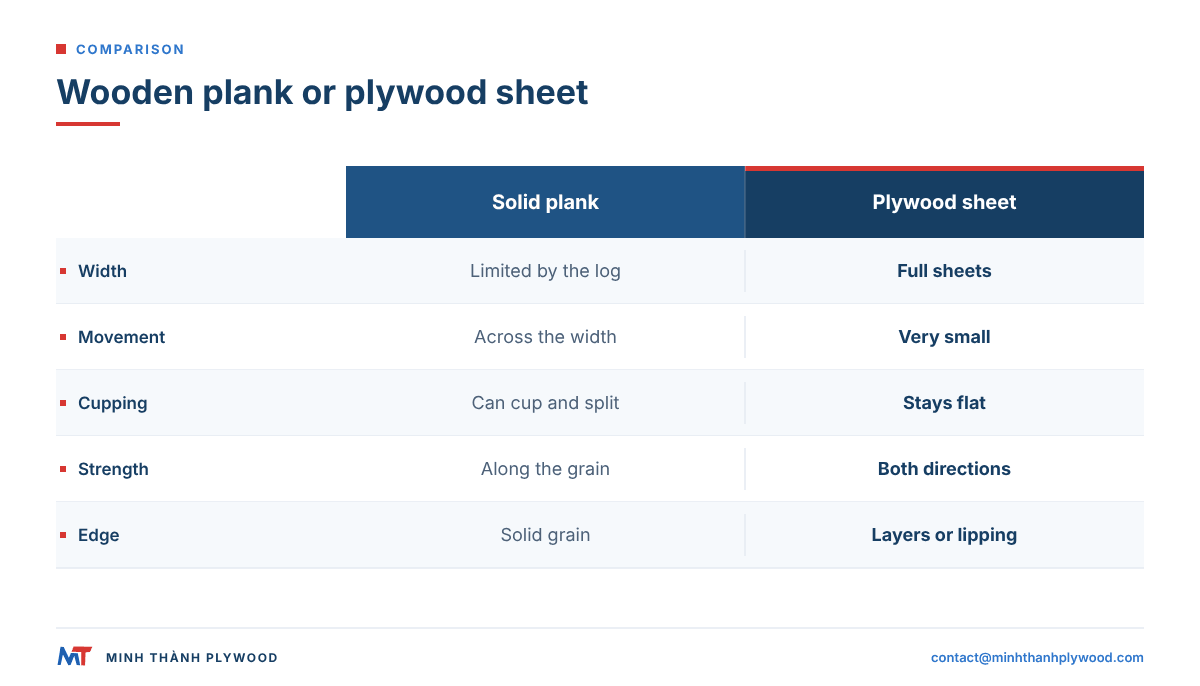
A plank is strong along its grain and weak across it, while a plywood sheet is strong and stable in both directions because its veneers cross. That difference decides most choices between the two.
| Metric | Solid plank or board | Plywood sheet |
|---|---|---|
| Width | Limited by the log; wide boards are glued up | Full sheets, 1220 × 2440 mm or 1250 × 2500 mm |
| Movement with humidity | Shrinks and swells across the width | Very small in both directions |
| Cupping and splitting | Can cup and split at ends | Does not cup or split |
| Strength | Stiff along the grain | Strong in both directions |
| Fixing near edges | Can split | Holds screws near edges |
| Look | Solid grain on face and edge | Veneer face; layered edge or lipping |
| Repair | Sand deep and refinish | Light sanding of the face |
Choose planks for solid show pieces, worktops and parts where the end grain is seen. Choose plywood for carcasses, wide shelves, wall linings and anything that must stay flat.
Plywood planks for ceilings and walls
Plywood planks are long strips cut from plywood sheets and fixed like timber boards, and they are a common way to build a wood plank ceiling or wall at a lower cost and with less movement. The edges are chamfered or grooved to make the plank lines; the face can be pine, poplar, birch, okoume or engineered veneer.
Cut-to-size orders help here: we cut one panel into 4, 6 or 8 pieces, so strips arrive ready for a plank ceiling. An 18 mm Styrax-core sheet of 1220 × 2440 mm weighs about 26.8 kg; thinner sheets keep a ceiling light.
Installation cost on a ceiling depends far more on labour and the frame than on the panel. Ask the contractor to price the frame, the panel and the finish as separate lines.
How to choose timber boards: species, grade and moisture
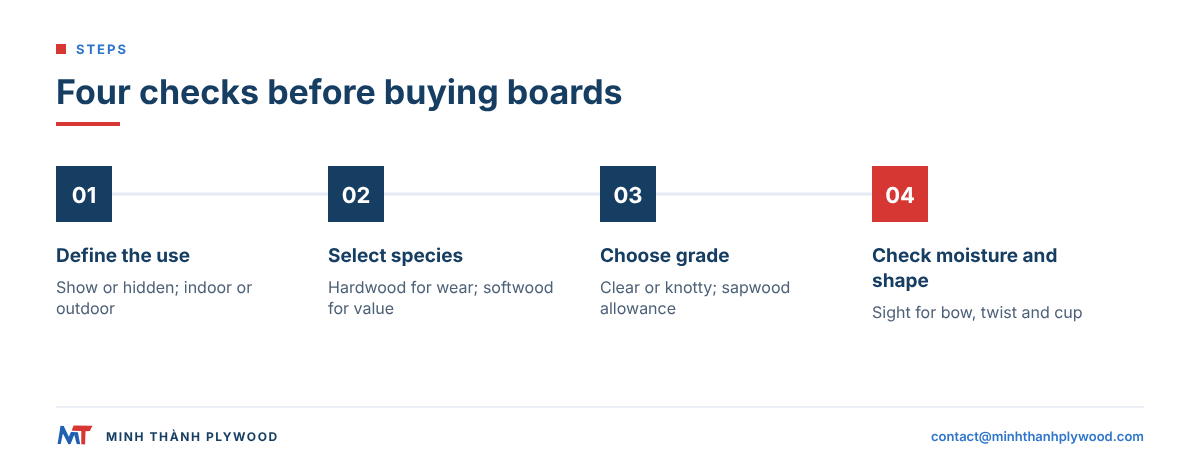
Choose timber boards by four checks, in this order:
- Use: show or hidden, indoor or outdoor, load or no load.
- Species: hardwood for wear and show, softwood for value and paint, durable species outdoors.
- Grade: clear or knotty, and whether sapwood is allowed.
- Moisture and straightness: dried to suit the room; sight along the board for bow, twist and cup.
Buy a little extra for joinery: boards with a split end or a twist are cut out, and grain is matched across a visible run.
Where solid timber is still the better choice
Solid timber is the better choice wherever the edge, the end grain or the full depth of the wood is seen or worked. Typical cases:
- Worktops, tables and benches: solid edges that can be sanded and re-oiled many times.
- Stair treads and handrails: wear and shaped profiles.
- Turned and carved parts: legs, balusters and mouldings.
- Exterior joinery: durable species for sills, frames and decking.
For panels, carcasses and large flat areas, a plywood sheet gives a steadier, wider and more economical result.
Solid planks shipped to Great Britain are regulated wood, so the importer must meet the plant health requirements in the GOV.UK guidance on importing timber, wood products or bark before the goods are exported.
What this means for your plywood order
A buyer replacing planks with plywood sheets for shelves, wall linings or plank ceilings should send these lines:
- Application: shelves, wall planks, ceiling planks or carcasses; strip width if you want cut-to-size.
- Core: white Styrax for light panels, or Eucalyptus at 650–750 kg/m³ for denser ones.
- Glue and emission: UF glue at E0 emission for dry interiors; MR or WBP to your specification.
- Face: pine, poplar, birch, okoume or engineered veneer; face and back grade.
- Size and thickness: 1220 × 2440 mm or 1250 × 2500 mm, 3–40 mm; sanded furniture panels ±0.2–0.3 mm, down to ±0.2 mm; length and width ±2 mm.
- Packing and quantity: from one 40HC, mixed specifications by agreement; destination port.
Our panels are CARB P2 / TSCA Title VI certified (ICTT mill no. 23024), tested in six ASTM D6007 chamber tests at 0.014–0.032 ppm. The US limit for veneer-core hardwood plywood is 0.05 ppm under EPA’s formaldehyde emission limits. Production takes 15–45 days after the deposit, FOB Hai Phong, CFR or CIF, with free samples. For species, see types of wood and wood species compared.
Buyer questions, answered
What size are wood planks?
Wood planks are sold by nominal sawn size, such as 25 × 150 mm, and planed boards finish a few millimetres smaller, about 21 × 145 mm for that size. Common lengths start at 2.4 m and rise in regular steps.
What is the difference between a plank and a board?
In everyday use the words overlap. Timber trades usually call thinner, narrower pieces boards and thicker, wider pieces planks; both are solid wood cut along the grain.
What wood is best for shelves?
For plain shelves, plywood is the most stable and cost-effective choice because it does not cup and comes in wide sheets. For show shelves, oak or ash planks look best, and pine boards are the budget solid-wood option.
What does PAR mean on timber boards?
PAR means planed all round: all four faces are planed smooth and square, so the board is ready for joinery. PSE (planed square edge) is the same idea in some merchants' terms.
Are oak boards better than pine boards?
Oak boards are harder, heavier and more durable, with a strong grain, and cost much more. Pine boards are lighter, softer, easier to work and cheaper, and they suit painted or rustic work.
What is tongue and groove timber used for?
Tongue and groove timber is used for wall and ceiling cladding, floors, sheds and wainscoting. Each board's tongue fits the next board's groove, hiding the fixings and allowing seasonal movement.
What wood is used for windowsills?
Interior window boards are made from solid oak or pine, from MDF with a paint or foil finish, or from veneered board. Exterior sills need a durable hardwood such as oak or sapele, or a treated softwood.
Is plywood stronger than a wooden plank?
Across the width, yes: plywood's cross layers make it strong and stable in both directions, while a plank is strong along the grain and weak across it. Along the grain, a solid plank of the same thickness is stiffer.
Can plywood be used as ceiling planks?
Yes. Plywood sheets cut into long strips make ceiling and wall planks with a wood face, fewer defects and less movement than solid boards. The edges are chamfered or grooved to make the plank lines.