
Film faced birch plywood has birch veneers through the whole panel under a phenolic film; it is dense, stiff and the usual choice for the highest repetition, at the highest price. Hardwood formply on a eucalyptus or acacia core gives most of that stiffness at a lower cost per sheet and suits the bulk of wall and slab work. Minh Thanh Plywood, a Vietnamese manufacturer, compares the two by density, weight, container load and use.
What is film faced birch plywood?
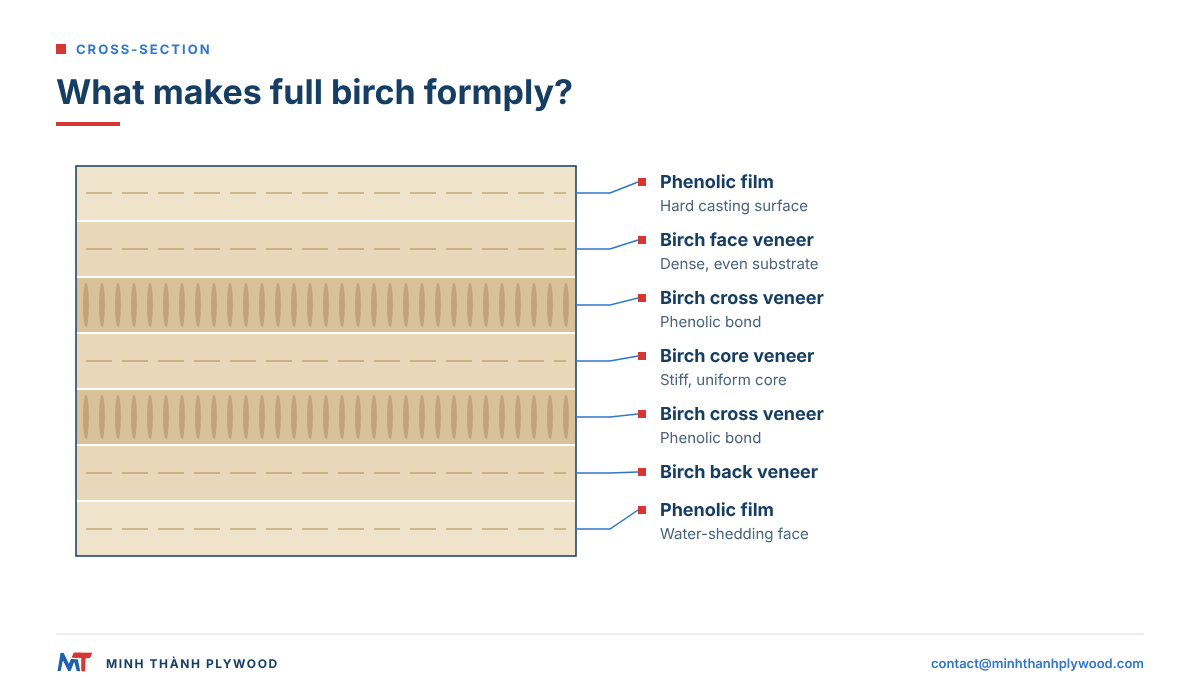
Film faced birch plywood is plywood made of birch veneers through the whole panel, faced on both sides with a resin-impregnated film and with sealed edges. The film is usually phenolic, and the panel is used for concrete formwork, vehicle floors, trailer beds and stage platforms.
Three features define it:
- Birch through the whole panel: every ply, not only the face, is birch. Panels like this come mainly from Nordic and Baltic mills.
- A phenolic film: brown or black film pressed onto both faces, giving a hard, smooth casting surface.
- A water-resistant glue: usually a phenolic (WBP, water and boil proof) bond.
Hardwood formply has the same film and glue on a core of tropical or plantation hardwood such as eucalyptus or acacia. The difference between the two is the core, and the core decides weight, stiffness, cost and how many sheets fit in a container.
Birch vs hardwood film faced plywood: the comparison
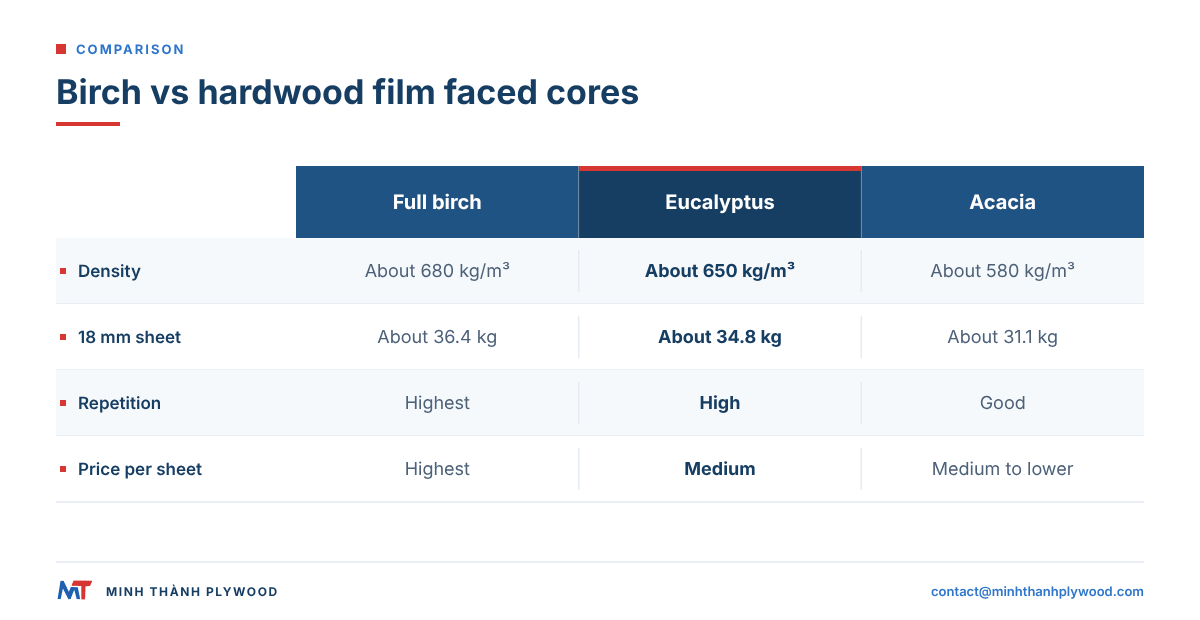
Full birch is the denser, more even and more expensive core; hardwood cores on eucalyptus or acacia cost less per sheet and give a good share of birch’s stiffness. The table compares them on the points a formwork buyer checks.
| Metric | Full birch film faced | Eucalyptus-core formply | Acacia-core formply | Softwood (spruce or pine) |
|---|---|---|---|---|
| Typical origin | Nordic and Baltic mills | Vietnam and other plantation regions | Vietnam and other plantation regions | Nordic and other softwood regions |
| Density | About 680 kg/m³ | About 650 kg/m³ reference, 650–750 kg/m³ in practice | About 580 kg/m³ | Lightest of the four |
| 18 mm sheet, 1220 × 2440 mm | About 36.4 kg | About 34.8 kg | About 31.1 kg | Lightest |
| Stiffness and hardness | Highest, very even | High | Good | Lower |
| Face under the film | Birch | Hardwood or birch face to order | Hardwood or birch face to order | Spruce or pine |
| Glue | Phenolic (WBP) | Phenolic (WBP) or melamine (MR) to order | Phenolic (WBP) or melamine (MR) to order | Phenolic or melamine |
| Repetition (pours, depends on care) | Highest: Finnish makers quote 20-80 pours | High: up to about 25 with phenolic glue, 12-15 with melamine | Good: 12-15 with melamine, up to about 25 with phenolic | Lower: fewer pours, light projects |
| Price per sheet | Highest | Medium | Medium to lower | Lower |
| Best use | Fair-faced concrete, high-rise cycles, rental fleets | General walls and slabs, repeated pours | Walls, slabs, easier handling | Light pours, short projects |
Reuse figures are ranges, not promises. UPM, the maker of WISA-Form Birch, lists 20-80 uses for walls and slabs and states that the count depends on site practice, the finish required, compaction, handling and storage, and the release agent (UPM WISA concrete forming brochure, 2026). Hardwood formply with melamine or phenolic glue reaches the lower ranges above with the same care; our guide on how many times film faced plywood can be reused shows what moves a panel up or down the range.
Phenolic film-faced birch plywood: why birch and phenolic go together
Phenolic film-faced birch plywood pairs the most even core with the most water-resistant glue and film, which is why it is the reference panel for high repetition. Each part protects the others.
- The birch core is dense and uniform, so the panel stays flat and stiff over many pours and holds fixings well.
- The phenolic glue resists boiling water, so the plies stay bonded through repeated wetting and drying.
- The phenolic film gives a hard, water-shedding face that releases concrete cleanly.
A phenolic film on a weak core, or a birch core with a moisture-resistant glue, gives away much of the benefit. Buyers who pay for birch should also specify a phenolic glue and a film weight to match. With a phenolic bond, film faced plywood reaches up to about 25 pours with proper handling, release agent and edge sealing; our guide on how many times film faced plywood can be reused explains the rest of the range.
Hardwood formply: eucalyptus and acacia cores
Hardwood formply uses a core of hardwood veneers, mainly eucalyptus or acacia in Vietnam, under a phenolic or melamine film. It is the most widely used formwork panel across Asia, the Middle East and Africa, because it gives good stiffness and repetition at a moderate price.
| Core | Reference density | Character | Typical choice |
|---|---|---|---|
| Eucalyptus | About 650 kg/m³ (650–750 kg/m³ in practice) | Dense, stiff, hard face substrate | Repeated pours, heavier loads |
| Acacia | About 580 kg/m³ | Lighter, good stiffness, easy to handle | General walls and slabs |
| Styrax | About 500 kg/m³ | Light, pale, very even | Furniture panels more than formwork |
Vietnam has plantation eucalyptus and acacia close to the mills, which keeps core veneer supply steady. Our cores are stitched both horizontally and vertically before pressing, so joints stay closed and the face stays flat under the film.
Eucalyptus or acacia for formwork?
Choose eucalyptus for the stiffest hardwood panel and the most demanding pours; choose acacia when lighter sheets and more sheets per container matter more. Both take the same films and glues.
- Eucalyptus is the denser of the two. An 18 mm sheet of 1220 × 2440 mm weighs about 34.8 kg on our reference density, and the panel is stiffer over the same support spacing.
- Acacia is lighter. The same sheet weighs about 31.1 kg, which is easier for crews handling panels by hand all day.
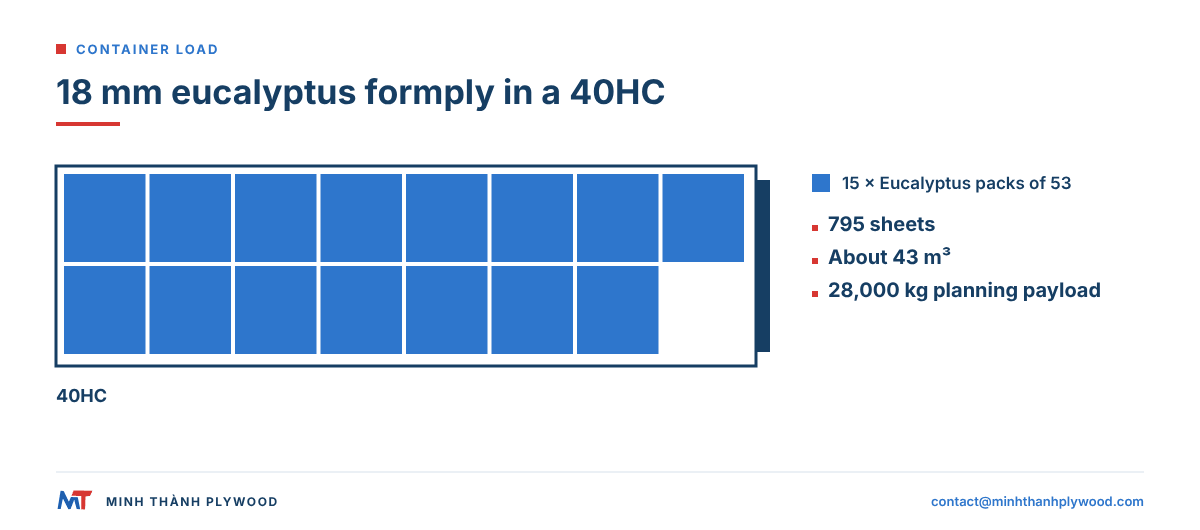
- Container load follows weight: a 40HC (40-foot high-cube container) takes about 795 sheets of 18 mm on eucalyptus and about 880 on acacia before reaching the planning payload of 28,000 kg.
For fair-faced work and many repetitions, eucalyptus with a phenolic glue is the stronger hardwood choice. For standard walls and slabs where crews move panels by hand, acacia is often the better balance.
Softwood shuttering plywood and poplar cores: where they fit
Softwood shuttering plywood, such as spruce or pine, and panels on soft hardwood cores such as poplar are the lighter end of the market. They cut and handle easily but are less stiff and less hard than birch, eucalyptus or acacia.
- Spruce and pine film-faced panels are light and common in Northern Europe for lighter forms and short projects.
- Poplar-core panels are light and low-cost; they suit one-off or low-repetition work and hidden concrete.
- Both dent more easily under vibrators and stripping tools, and the film is supported by a softer substrate.
Softwood or soft-core panels can be the right buy when the project needs few pours and crews move panels by hand. They are not a substitute for birch or hardwood where many repetitions or fair-faced concrete are required.
Weight, density and container load by core
Sheet weight follows density: weight equals density times sheet volume. An 18 mm sheet of 1220 × 2440 mm has a volume of about 0.0536 cubic metres, so each core gives a predictable weight and a predictable container load.
| Core | Density | 18 mm sheet weight | Sheets per 40HC (18 mm) | Volume per 40HC |
|---|---|---|---|---|
| Birch (full) | About 680 kg/m³ | About 36.4 kg | Limited by payload | Lowest of the four |
| Eucalyptus | About 650 kg/m³ | About 34.8 kg | 795 sheets in 15 packs of 53 | About 43 m³ |
| Acacia | About 580 kg/m³ | About 31.1 kg | 880 sheets in 16 packs of 55 | About 47 m³ |
| Styrax | About 500 kg/m³ | About 26.8 kg | 990 sheets in 18 packs of 55 | About 53 m³ |
Our container figures are planned on a payload of 28,000 kg unless the booking sets a lower limit, with packs about one metre high. Dense cores reach the payload before the container is full by volume, which is why a container of eucalyptus panels carries fewer cubic metres than one of acacia. Weigh real sheets of the ordered build before booking, because film and glue add weight to the reference figures.
Birch-faced plywood on a hardwood core: the middle option
A birch-faced panel on a hardwood core places an imported birch face veneer under the film, on a eucalyptus or acacia core. It gives a smooth, fine-grained substrate under the film and a birch look at the edges, at a cost between hardwood formply and full birch.
Two points keep this option honest:
- It is not full birch. The core is hardwood, so density, weight and stiffness follow the core, not the face.
- Under a film, the face species matters less. The film carries the casting surface; the face veneer supports it. A birch face helps evenness under thin films and gives a cleaner edge for panels that stay visible.
We make birch-faced panels with birch faces graded D+, D and E, quoted as face/back pairs such as D+/D or D/E. For individual faces, D+ is close to European grade B, D to BB and E to CP or C, matched to an approved sample.
Where is film faced birch plywood made, and how has supply changed?
Full birch film faced plywood is made where birch grows: Finland, the Baltic states and other northern forest regions. Supply to Europe changed in 2022, when the EU banned imports of Russian and Belarusian wood products, plywood included.
- Russia: Council Regulation (EU) 2022/576 added wood products to the import ban under Regulation 833/2014, Article 3i, in force from 9 April 2022, with contracts signed before that date allowed to run until 10 July 2022.
- Belarus: Council Regulation (EU) 2022/355 of 2 March 2022 added wood products under Regulation 765/2006, Article 1o, with contracts concluded before 2 March 2022 allowed to run until 4 June 2022.
The bans cover goods that originate in or are exported from those countries. For EU buyers, full birch now comes from the remaining birch-producing countries, and many projects have moved part of their formwork to hardwood formply from Asia. The European Commission’s announcement of 14 May 2024 extends the anti-dumping duties on birch plywood to tackle circumvention of them. Rules checked on 20 October 2026.
Sizes, thicknesses and pack counts for film faced plywood
Film faced plywood is sold in a few standard sheet formats, in thicknesses with inch equivalents, and in packs counted by thickness.
| Item | Common options |
|---|---|
| Standard sheets | 1220 × 2440 mm (4 × 8 ft) and 1250 × 2500 mm |
| Half sheets | 610 × 2440 mm (2 × 8 ft), cut from the full sheet |
| Oversize | 1500 × 3000 mm and 1525 × 3050 mm, offered by birch mills; PERI lists FinPly birch in 2440 × 1220, 2500 × 1250 and 3000 × 1500 mm |
| Thickness | 12 mm (1/2 in), 15 mm (5/8 in), 18 mm (3/4 in), 21 mm |
| Sheets per pack | About 1,000 mm of pack height divided by the thickness: 83 sheets at 12 mm, 66 at 15 mm, 55 at 18 mm, 47 at 21 mm |
| Anti-slip film | Wire-mesh film panels for platforms and decks, sold with an R13 slip rating in 12 and 18 mm |
The Australian trade also grades eucalyptus formply by structural stress grade such as F14 and writes the bond as EXT. Our panels are made to the thickness and glue on your order, and 1220 × 2440 mm and 1250 × 2500 mm full sheets are the formats we make; half sheets and other sizes are cut on request. Sellers such as Plyonline in Australia and Asala Wood in Saudi Arabia list the same 12, 15 and 18 mm thicknesses.
Buying film faced plywood for Saudi Arabia and the Gulf
A Saudi or Gulf buyer asks for shuttering plywood, formply, marine plywood or “red plywood” and means the same film faced panel. Asala Wood, a Saudi seller, lists those names and sources from Indonesia, Malaysia, China and Russia, in 12, 15 and 18 mm (1/2, 5/8 and 3/4 in), 122 × 244 cm and 61 × 244 cm, priced per piece.
What a Gulf importer compares:
- Price per sheet against price per cubic metre. Chinese export listings for 18 mm film faced shuttering panels show US$9-16 per 1220 × 2440 mm sheet with a minimum order of 100 pieces (Alibaba listing, October 2026). An 18 mm sheet holds 0.0536 m³, so US$9-16 is about US$168-299 per m³, and that range hides core density, film weight and glue. A dense hardwood core and a phenolic bond carry more material per sheet; compare quotes at the same spec.
- Origin and glue. Competing supply comes from China, Indonesia, Malaysia and Russia; Vietnamese eucalyptus and acacia formply competes on core density, thickness tolerance and a phenolic or melamine bond to the buyer’s specification.
- Terms. We quote FOB Hai Phong, CFR or CIF to Dammam and Jeddah. Sea time from Hai Phong to the Middle East is typically 15-25 days, and production takes 15-45 days after the deposit.
- Sheet and pack format. Saudi trade quotes 4 × 8 ft sheets in 1/2, 5/8 and 3/4 in; our 12, 15 and 18 mm are the metric equivalents, packed to the pack counts above.
Request samples of the exact build before a container order, and ask for the film weight, glue type and thickness tolerance in writing (see the grading table below).
Which core suits which formwork job?
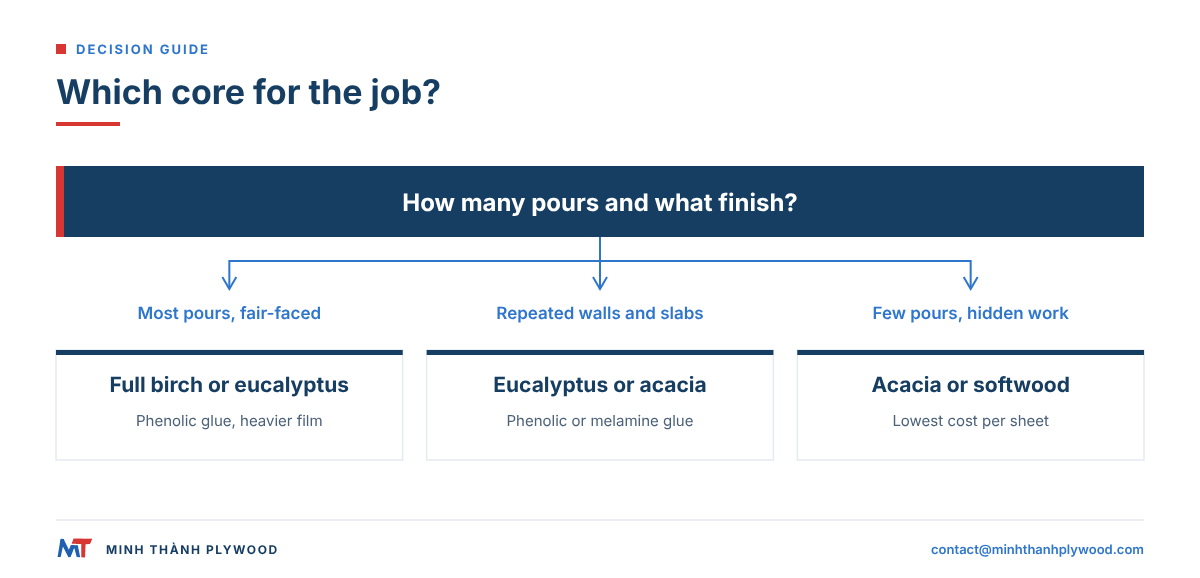
Match the core to the number of pours and the finish the job needs: full birch for the most demanding cycles, eucalyptus for repeated hardwood use, acacia for general work and easier handling, softwood for light short jobs.
| Job | Best core | Why |
|---|---|---|
| Fair-faced architectural concrete | Full birch, or eucalyptus with phenolic glue and heavier film | Flattest, most even face for longest |
| High-rise slab cycles, rental fleets | Full birch or eucalyptus, phenolic glue | Highest repetition |
| General walls and slabs | Eucalyptus or acacia, phenolic or melamine glue | Good repetition at moderate cost |
| Crews handling panels by hand | Acacia | Lighter sheets |
| Footings, one-off pours, hidden concrete | Acacia, poplar or softwood | Low cost per sheet, few pours needed |
| Vehicle floors and platforms | Birch or eucalyptus with anti-slip film | Hard, stiff, textured face |
How are film-faced panels graded?
Film-faced panels are graded mainly by film weight and glue, not by face veneer grade, because the face is covered by the film. The core grade still matters, because gaps and overlaps in the core print through the film and weaken the panel.
| Grading item | What to specify |
|---|---|
| Film weight | Standard formwork film about 120–135 g/m²; premium from about 135 g/m²; anti-slip film about 220 g/m² |
| Film colour and brand | As ordered: brown, black or another colour |
| Glue | Phenolic (WBP) or melamine-fortified (MR) |
| Core | Species and core grade, stitched core layers |
| Thickness and tolerance | For example 18 mm, ±0.5 mm |
| Edges | Sealed, edge paint colour |
A buyer comparing a birch panel with a hardwood panel should compare all six lines, not the core species alone.
How to specify film faced birch or hardwood plywood
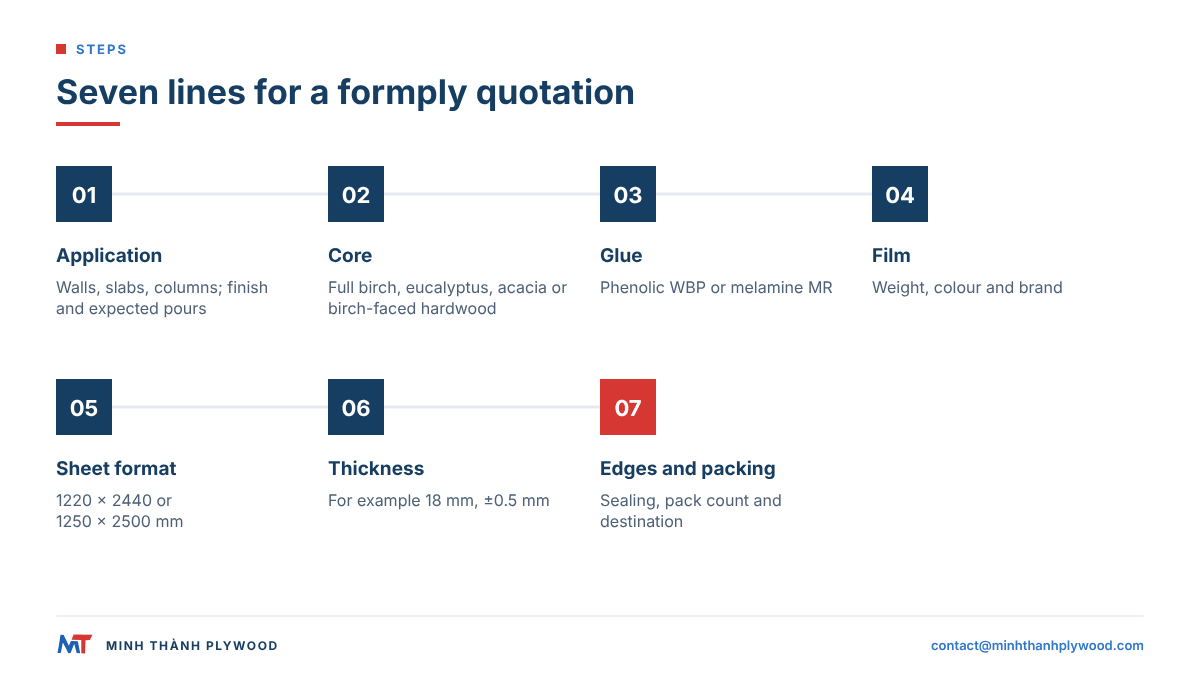
Specify film faced plywood by core, glue, film, size, thickness and tolerance, edges, packing and quantity. A complete line lets every supplier quote the same panel.
- Application: formwork for walls, slabs or columns; number of pours expected; fair-faced or hidden.
- Core: full birch, eucalyptus, acacia or birch face on a hardwood core.
- Glue: phenolic (WBP) or melamine-fortified (MR).
- Film: weight, colour and brand.
- Size: 1220 × 2440 mm or 1250 × 2500 mm, or a cut list.
- Thickness and tolerance: for example 18 mm, ±0.5 mm.
- Edges and packing: sealed edges and colour, sheets per pack, number of packs, destination port.
Our guide to film faced plywood defects lists the checks to run on the first delivery.
What Minh Thanh offers in film-faced plywood
We make hardwood film-faced plywood on eucalyptus and acacia cores, with birch faces on order, in thicknesses within 3–40 mm. Glue is MR or phenolic (WBP) to the buyer’s specification, and film weight, colour and brand are written on the order.
| Item | Our offer |
|---|---|
| Cores | Eucalyptus and acacia; Styrax for furniture panels |
| Faces under the film | Hardwood, or imported birch graded D+, D and E |
| Glue | MR or phenolic (WBP) |
| Thickness tolerance | ±0.5 mm on film-faced panels; ±2 mm on length and width |
| Sizes | 1220 × 2440 mm and 1250 × 2500 mm; cut to size on request |
| Order terms | MOQ one 40HC with mixed specifications by agreement; 15–45 days production after deposit; FOB Hai Phong, CFR or CIF |
| Samples | Free samples |
Every shipment is photographed and filmed before loading, and buyers get the photos and video. Send your specification through the film-faced plywood page or, for birch-faced panels, the birch plywood page; we reply within hours. The concrete form plywood buying guide and our page on shutter ply board cover sizes and grades for other markets.
Buyer questions, answered
What is film faced birch plywood?
Plywood made of birch veneers through the whole panel, faced on both sides with a resin-impregnated film, usually phenolic, and with sealed edges. It is used for concrete formwork, vehicle floors and platforms.
Is birch better than hardwood for formwork?
Full birch is denser and more even, so it suits the highest repetition and fair-faced concrete. A eucalyptus or acacia hardwood core is a lower-cost choice that serves most wall and slab work well.
Is eucalyptus or acacia better for formwork?
Eucalyptus is denser and stiffer, at about 650 kg/m³ for our reference sheet. Acacia is lighter, at about 580 kg/m³, so more sheets fit in a container and panels are easier to handle.
How heavy is an 18 mm film faced birch plywood sheet?
At a birch density of about 680 kg/m³, an 18 mm sheet of 1220 × 2440 mm weighs about 36.4 kg. Our eucalyptus-core sheet of the same size weighs about 34.8 kg and an acacia-core sheet about 31.1 kg.
Does Vietnam make full birch plywood?
No. Vietnamese plywood uses local hardwood cores such as eucalyptus, acacia and Styrax. Birch is imported as face veneer, so a Vietnamese birch-faced panel has a birch face on a hardwood core.
What is hardwood formply?
Formply with a core of hardwood veneers such as eucalyptus or acacia, faced with phenolic or melamine film. It is the most common formwork panel in Asia, the Middle East and Africa.
Is softwood shuttering plywood any good?
Softwood shuttering plywood, such as spruce or pine, is light and easy to handle and cut. It is less stiff and less hard than birch or hardwood, so it suits lighter pours and fewer reuses.
What grade is film faced plywood?
Film-faced panels are graded mainly by film weight and glue, not by face veneer grade, because the face is covered by the film. The core grade still matters for stiffness and flatness.
Can Russian birch plywood be imported into the EU?
No. The EU has banned imports of wood products, plywood included, from Russia since 9 April 2022 and from Belarus since 3 March 2022, so EU buyers source birch elsewhere or use hardwood formply.