
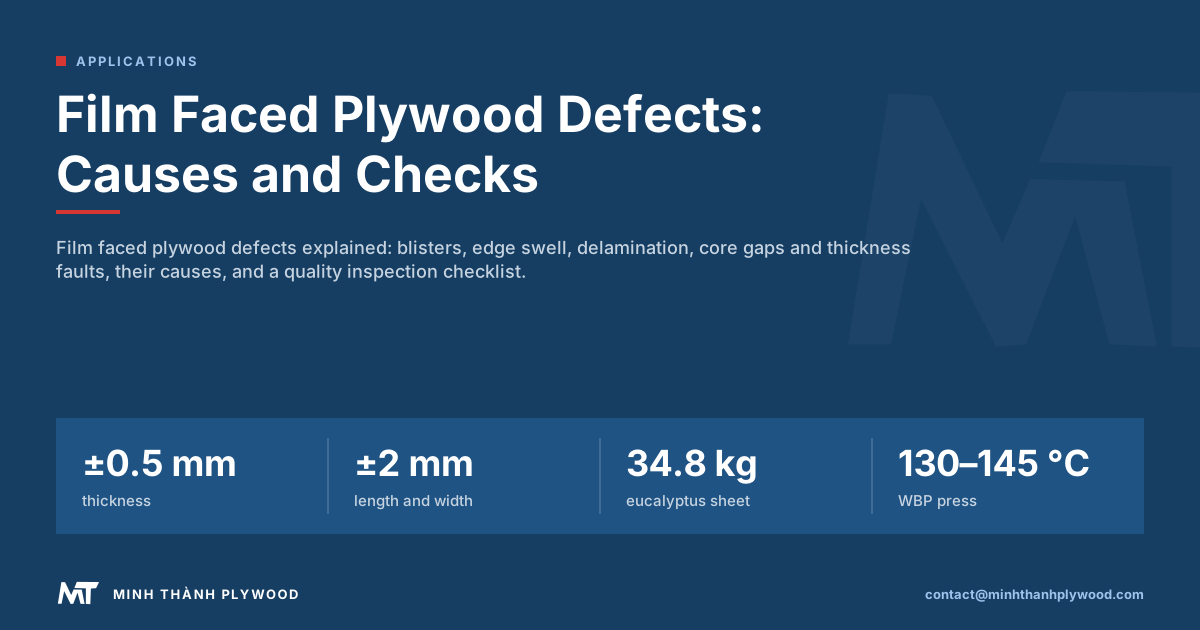
The film faced plywood defects that matter are film blisters and thin spots, edge swell, delamination, core gaps and overlaps, thickness outside tolerance and warping. Each has a production cause and a simple check, and most can be caught before loading with a ruler, a caliper, a moisture meter and a bucket of water. Minh Thanh Plywood, a plywood manufacturer in Vietnam, sets out each defect and the checklist that finds it.
What are the common film faced plywood defects?
The common film faced plywood defects fall into six groups: film faults, edge faults, weak bonds, core faults, dimension faults and warping. Each starts at a known point in production, and each has a check a buyer can run with simple tools.
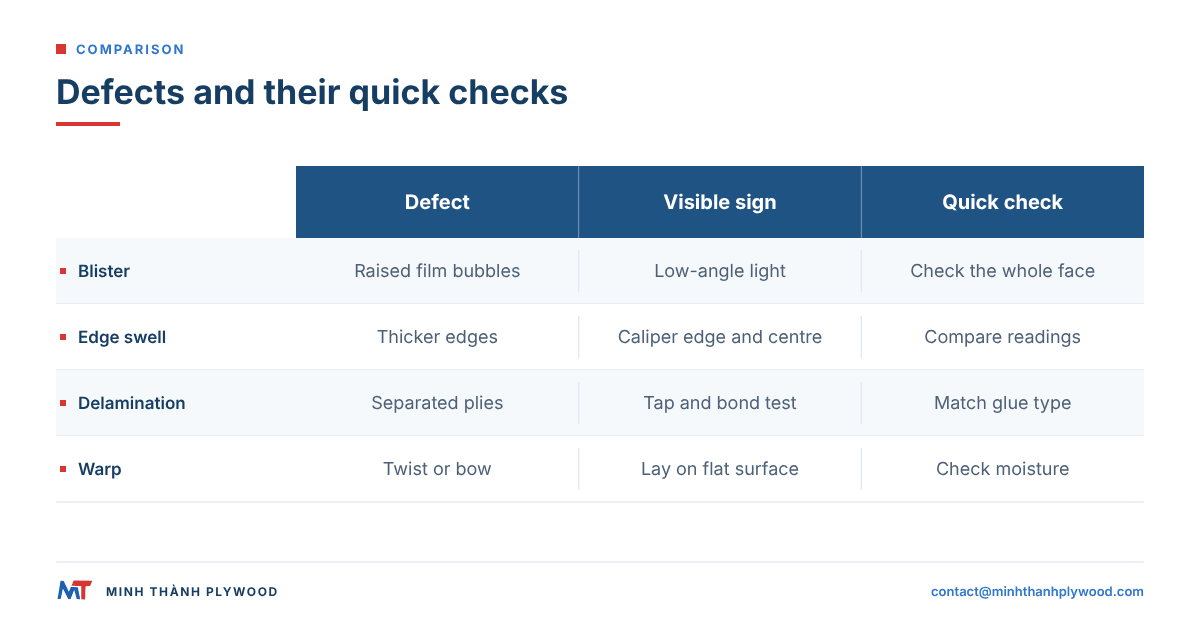
| Defect | What you see | Usual production cause | Quick check |
|---|---|---|---|
| Film blisters | Raised bubbles under the film | Wet veneer, short press cycle | Look across the face in low-angle light |
| Film folds and thin spots | Creases, lighter patches, paper texture showing | Film laid badly, low film weight, low resin | Inspect in good light, feel the face |
| Burnt film | Dark, scorched or glossy-brown patches, brittle film | Press temperature or dwell too high or uneven, contamination on the face | Look across the face in low-angle light; scratch a patch with a coin |
| Film colour difference | Sheets or areas of a pack that differ in shade | Film from different lots, uneven press heat, film colour not fixed on the order | Lay sheets from several packs side by side against the approved sample |
| Edge swell | Thickened, soft edges | Wet veneer, edges not sealed | Caliper at the edge versus the centre |
| Delamination | Plies separating, hollow areas | Weak glue line, wrong glue for the use | Tap test, soak or boil test on cut pieces |
| Core gaps and overlaps | Gaps or ridges at the edges, steps in the face | Careless core lay-up | Look along all four edges |
| Thickness out of tolerance | Sheets thinner or thicker than ordered | Uneven veneer, uneven pressing | Caliper at several points per sheet |
| Size and squareness faults | Wrong size, unequal diagonals | Trimming errors | Tape both sides and both diagonals |
| Warping | Sheet does not lie flat | Uneven moisture, unbalanced build | Lay a sheet on a flat surface |
The sections below take each group in turn: what it looks like, why it happens and what to accept.
Film defects: blisters, folds, thin spots and scratches
Film defects are visible on the face and print straight onto concrete, so they matter most for exposed work. The four to look for are blisters, folds, thin spots and scratches.
- Blisters are bubbles of trapped moisture or gas under the film. They come from veneer that went into the press too wet or a press cycle that was too short. A blister bursts on site and leaves a crater in the concrete.
- Folds and creases come from film paper that was not laid flat before pressing. They show as lines on the concrete.
- Thin spots are areas where the film has too little resin or the paper is too light. They look duller and wear through in the first pours.
- Scratches and dents usually come from handling and packing: grit between sheets, forklift tines, dropped packs.
Standard formwork film weighs about 120–135 g/m², and premium film starts at about 135 g/m². Film weight is written on the order, so a thin spot can be checked against the film the buyer paid for.
Edge defects: swelling, open edges and broken corners
Edge defects let water into the core, which is how most film faced panels fail early. Check edges on new panels before they ever reach a form.
| Edge defect | What it looks like | Cause | What to do |
|---|---|---|---|
| Edge swell on new panels | Edges thicker than the centre | Wet veneer at pressing, bare edges in storage | Measure; reject if outside the thickness tolerance |
| Unsealed edges | Bare veneer and glue lines visible | Edge paint skipped or too thin | Seal before use; ask for sealed edges on the order |
| Chipped or broken corners | Missing pieces at corners | Rough handling, weak packing | Check corner protection on packs |
| Open glue lines at the edge | Visible thin gaps between plies | Weak bond near the edge | Tap test and bond test |
A caliper reading at the edge compared with the centre of the same sheet shows swelling at once. On a good panel, both readings sit within the same tolerance.
Delamination and weak bonds: how to spot them early
Delamination is plies separating because the glue line failed, and it is the defect that ends a panel’s life. A tap test and a soak or boil test find weak bonds before the panels go into a form.
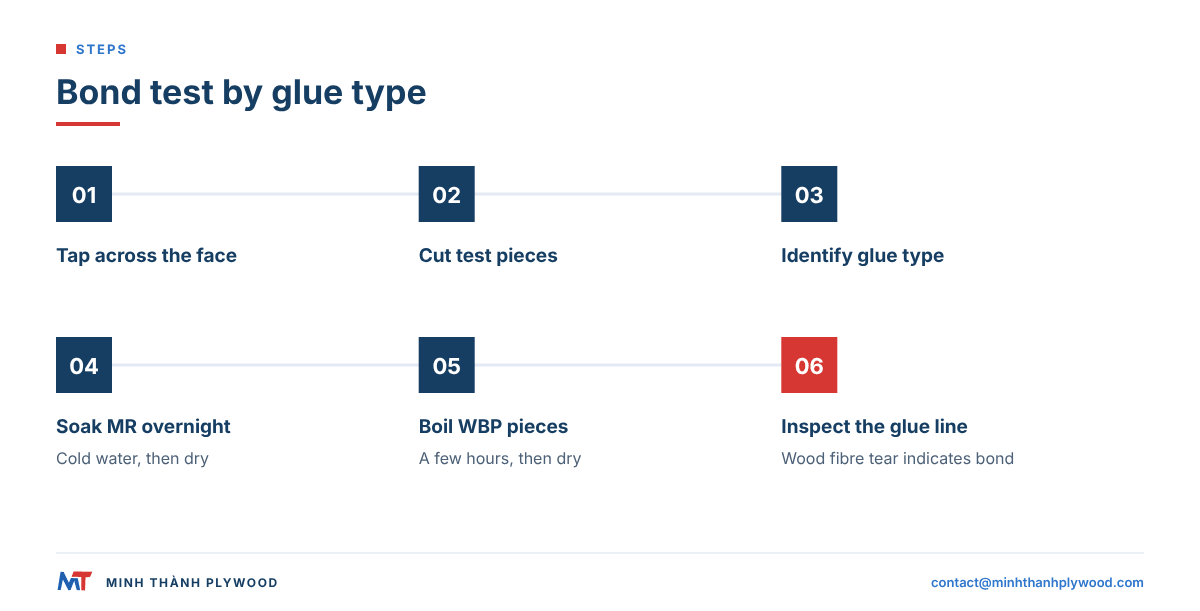
- Tap the face with a coin or a small hammer across the sheet. A solid panel sounds the same everywhere; a hollow or dull sound marks a void or a separated ply.
- Cut test pieces from a sample sheet, roughly the size of a hand.
- Soak pieces in cold water overnight for melamine-fortified (MR) glue, then let them dry.
- Boil pieces in water for a few hours for phenolic (WBP, water and boil proof) glue, then let them dry.
- Try to split the plies with a chisel. Wood fibre torn from the veneer on the glue line means a sound bond; clean, smooth glue surfaces mean a weak one.
Match the test to the glue that was ordered. A melamine-fortified bond is made to resist moisture, not hours of boiling, so boiling an MR panel tests the wrong thing. A panel sold as phenolic should pass the boil test.
Laboratories run the same idea to a standard. EN 314-1 sets the test and EN 314-2 sets the pass requirement for bond Class 2 (humid) and Class 3 (exterior); for Class 3, separate sets of specimens are soaked for 24 hours at 20 °C, boiled for 6 hours, and either boiled for 4 hours, dried for 16–20 hours at 60 °C and boiled again for 4 hours, or boiled for 72 hours; each set is cooled in water and then sheared (WBPI, EN 636-3 and EN 314-2). The bonding-quality requirements are catalogued by BSI as BS EN 314-2:1993.
Bending strength and stiffness (MOR and MOE) are tested to EN 310 and moisture content to EN 322. In the US, the PS 1 structural plywood standard tests Exterior bonds with vacuum-pressure and boiling cycles and reads the result as wood failure (NIST PS 1-22). Ask the supplier which standard its test report follows and which glue class it covers.
Core gaps, overlaps and voids
Core gaps and overlaps come from core veneers laid with spaces between them or on top of each other. They weaken the panel, create steps that print through the film and give water a path through the sheet.
- Gaps show at the edges as open slots between veneer pieces. Inside the sheet they are voids that a tap test finds.
- Overlaps show as ridges or bumps across the face, often visible in low-angle light and felt by hand.
- Broken or split veneers in the core show at the edges and weaken the panel along that line.
Look along all four edges of sampled sheets with a torch. A few short hairline joints are normal in a hardwood core; open gaps you can push a card into, or ridges you can feel through the film, are defects. Stitching the core veneers together before lay-up holds them in place and keeps joints closed.
Thickness, size and squareness: measuring against the order
Thickness, size and squareness are measured with a caliper and a tape against the tolerance written on the order. Without a written tolerance, a sheet cannot be called out of specification.
| Measurement | How to check | Our film-faced tolerance |
|---|---|---|
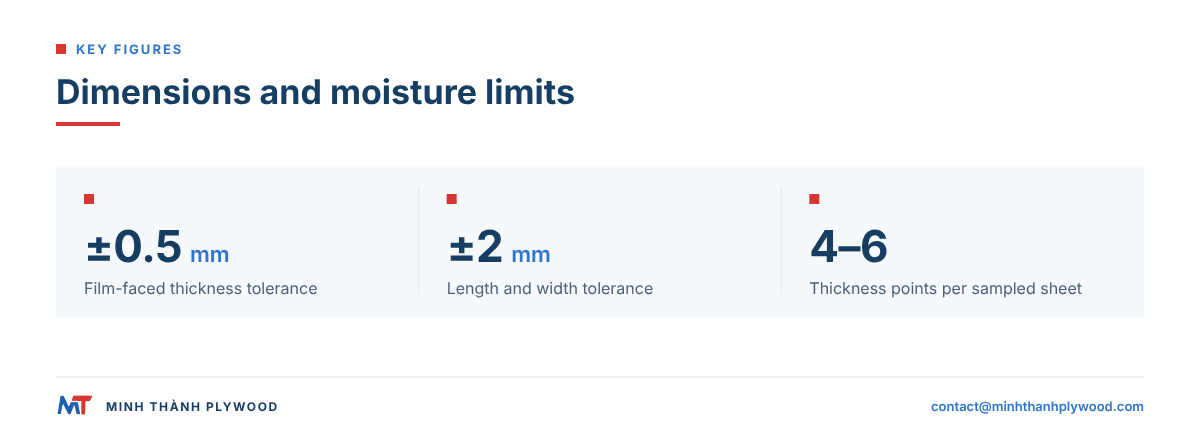
| Thickness | Caliper at the four corners and the centre of each long edge | ±0.5 mm |
| Length and width | Steel tape along both edges | ±2 mm |
| Squareness | Compare the two diagonals | Diagonals equal within the size tolerance |
| Edge straightness | String line or straightedge along each edge | No visible bow |
Thin sheets matter twice in formwork: they reduce stiffness, and a mix of thicknesses in one form leaves steps in the concrete face. Measure enough sheets from several packs to see the spread, not just one sheet.
Warping and moisture problems
Warping means a sheet that will not lie flat, and it comes from uneven moisture or an unbalanced build. A warped panel fights the form, opens joints and prints a wavy line.
- Check flatness by laying a sheet on a flat floor or a stack of sheets; a slight bow that flattens under its own weight is normal, a twist or a pronounced warp is not.
- Moisture limit: panels leave the mill at 8-12 % moisture content, and plywood above 12 % should be picked out of the shipment (Yalong Wood). Reject sheets that read above 12 %, and send a sample to a laboratory for the EN 322 oven-dry method if a dispute follows.
- Read moisture with a meter at several points on each sampled sheet; readings that vary a lot across one sheet or between sheets point to uneven drying.
- Check the build: plies must be balanced around the centre, with the same species and thickness on both sides of the core.
Panels can also warp after delivery if they are stored on uneven bearers, partly unwrapped or in damp. Record moisture on arrival so the starting point is on file.
What are common complaints about film-faced formwork plywood from Vietnam?
The complaints importers raise about imported film-faced formwork plywood are the same in every market: sheets thinner than ordered, a glue that does not match the description, core gaps, film that wears through early and packs mixed with lower grades. Each one is prevented by a written specification and a check before loading.
| Complaint | Usual root | Prevention |
|---|---|---|
| Thinner than ordered | No tolerance on the order, uneven veneer | Write nominal thickness and tolerance; caliper check before loading |
| Glue weaker than described | Glue type not specified, or described loosely | Name the glue (MR or WBP phenolic); boil or soak test on samples |
| Core gaps and voids | Low core grade, no stitching | Specify core grade; edge and tap checks |
| Film wears through early | Light film or low resin | Specify film weight and brand |
| Mixed grades in one pack | No pack-by-pack check | Inspect several packs; photos of every pack before loading |
| Edge swell on arrival | Wet veneer, unsealed edges | Sealed edges on the order; moisture readings before loading |
Vietnam supplies a broad range of film-faced plywood, from low-cost panels for one-off use to phenolic panels for repeated pours. The specification on the order, not the origin, decides which one arrives.
How to identify high quality film faced plywood
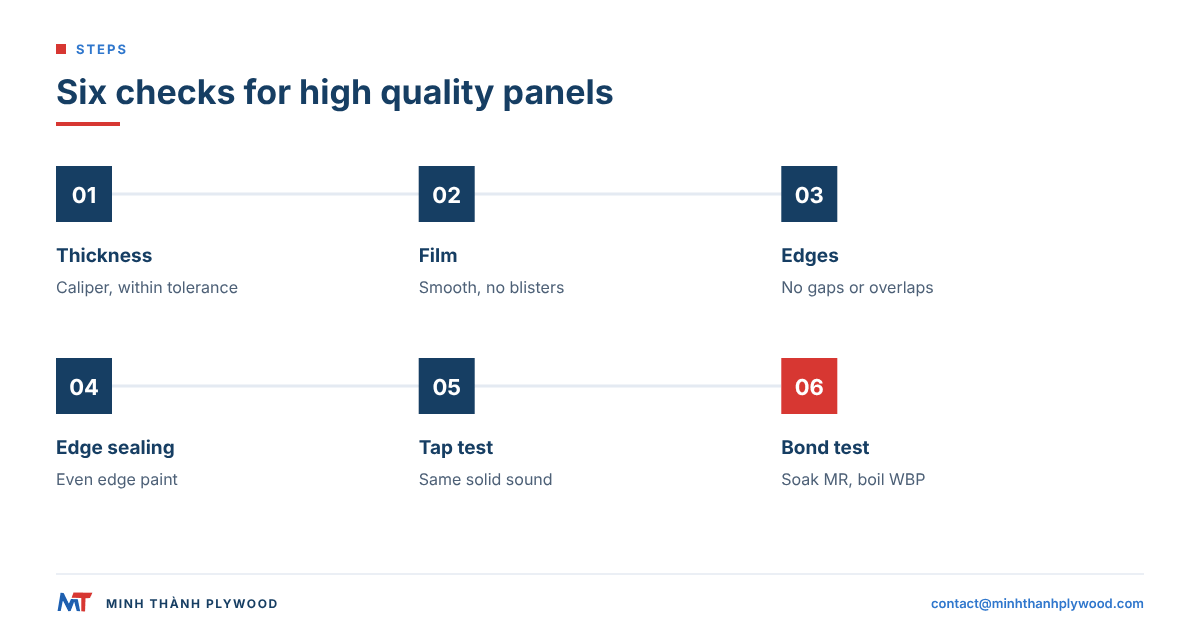
To identify high quality film faced plywood, check six things: even thickness, an unbroken smooth film, tight edges, sealed edges, a solid tap sound and a bond that survives water. All six can be checked on a sample before ordering.
- Thickness: caliper readings within the agreed tolerance on every point measured.
- Film: smooth and even under low-angle light, no blisters, folds, thin spots or exposed paper texture.
- Edges: no open gaps or overlaps along any edge; plies straight and even.
- Edge sealing: an even coat of edge paint covering all veneer edges.
- Tap test: the same solid sound across the whole face.
- Bond test: cut pieces soaked (MR) or boiled (WBP) stay bonded, with wood fibre torn on the glue line when split.
Weight helps as a cross-check: a hardwood core of the stated species gives a predictable sheet weight. At 18 mm and 1220 × 2440 mm, our reference weights are about 34.8 kg on a eucalyptus core and about 31.1 kg on an acacia core. A sheet far lighter than its stated core suggests a different core or voids.
Film faced plywood quality inspection checklist
A film faced plywood quality inspection checklist covers documents, dimensions, film, edges, bond, moisture and packing, in that order. Use it at the mill before loading, and again on arrival.
| Stage | Check | Tool | Accept when |
|---|---|---|---|
| Documents | Order specification, approved sample, packing list | Paperwork | Goods match the order lines |
| Thickness | Five points per sampled sheet | Caliper | Within the written tolerance |
| Size and squareness | Both edges, both diagonals | Steel tape | Within the written tolerance |
| Film | Whole face in low-angle light | Eyes, hand | No blisters, folds, thin spots |
| Film weight and colour | Against the order | Order, sample | As ordered |
| Edges | All four edges | Torch | No open gaps, overlaps or swell; sealed |
| Bond | Tap test; soak or boil test on cut pieces | Coin or hammer; water | Solid sound; plies stay bonded |
| Moisture | Several points per sheet | Moisture meter | Even readings within the agreed range |
| Flatness | Sheet on a flat surface | Straightedge | No twist or pronounced warp |
| Packing and count | Sheets per pack, labels, corner protection | Count, eyes | As on the packing list |
How many sheets should you check?
Check sheets from the top, middle and bottom of several packs across the order. Where one sheet fails, check more from the same pack and the packs next to it, so the result shows whether the fault is isolated or runs through a batch.
For the physical checks, measure thickness at 4-6 points per sheet (corners and centre) and cross-cut 1-2 sheets per batch to expose core gaps and overlaps (Kosmex). Buyers who want a formal sampling plan can agree one under ISO 2859-1 with their inspector before the visit: at General Inspection Level II, a lot of 501-1,200 pieces is code letter J, a sample of 80, and at AQL 2.5 the lot passes with 5 defects and fails at 6 (AIU Inspections AQL table).
Acceptance criteria to paste into the purchase order
- Film faced plywood, size and thickness as ordered; thickness tolerance as written on the order (±0.5 mm on film faced panels), length and width ±2 mm.
- Glue: phenolic (WBP) or melamine-fortified (MR) as ordered, with a bond test report to EN 314-2 (Class 2 or Class 3) for the build.
- Moisture content 8-12 % on arrival; sheets above 12 % are rejected.
- No blisters, burnt film, open edges, delamination or core gaps a card can enter; film colour and weight as the approved sample.
- Sampling: 4-6 thickness points per sampled sheet, 1-2 sheets cross-cut per batch, and a sampling plan to ISO 2859-1 agreed before inspection.
- Documents: packing list, bond and emission test reports, and the inspection photos from loading.
Defect or normal wear: how to tell them apart
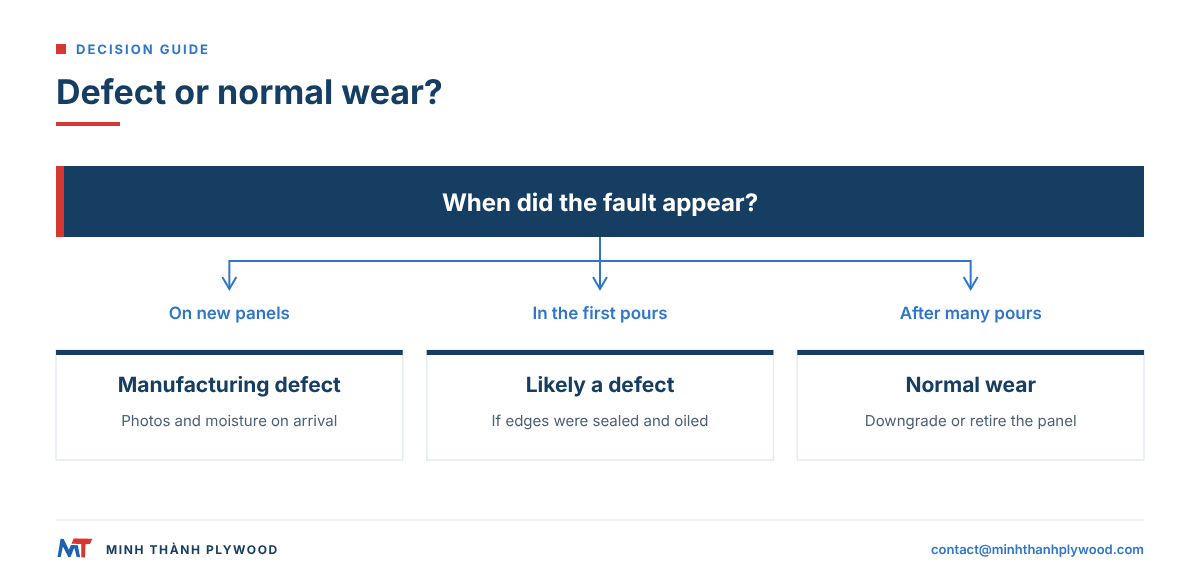
A defect is present on new panels or appears early under normal use; normal wear builds up with pours. Telling them apart protects both the buyer and the mill when a panel fails on site.
| What you see | Points to a defect when | Points to wear when |
|---|---|---|
| Blisters | On new, unused panels | After water entered through bare cut edges |
| Edge swell | On delivery, on uncut edges | At cut edges and holes after several pours |
| Delamination | Within the first few pours on sealed panels | Late in life, or after long wet storage |
| Film worn through | In patches on new or barely used panels | Evenly across the face near the end of life |
| Dents and scratches | In the pack on arrival | After stripping with bars or cleaning with steel tools |
| Warping | On arrival, across many sheets | After storage on uneven ground or in damp |
Photos of panels on arrival, a moisture reading on file and a simple reuse log make the cause clear. Our guide to how many times film faced plywood can be reused explains which site habits shorten panel life.
Pre-shipment inspection and the records to ask for
A pre-shipment inspection checks the goods at the mill while a fault still costs only time to correct. Agree the checklist, the sample and the records before production starts.
- Agree the specification: thickness and tolerance, size, glue, film weight and colour, core, edge sealing, packing.
- Approve a sample and keep one piece on each side.
- Book the inspection for when production is packed but not loaded.
- Run the checklist on sheets from several packs.
- Test the bond on cut pieces if the glue is in doubt.
- Release the goods in writing, or list the corrections.
- Receive loading photos and video of the packs and the container.
Every shipment we load is photographed and filmed before loading, and buyers get the photos and video. Third-party testing to the buyer’s method is arranged through SGS on request.
How Minh Thanh prevents film faced plywood defects
We prevent film faced plywood defects at the points where they start: the core lay-up, the glue, the press and the final checks. The build is fixed on the order, so the inspection has a clear target.
| Defect | Where we prevent it |
|---|---|
| Core gaps and overlaps | Core layers stitched both horizontally and vertically before pressing |
| Weak bond, delamination | Glue type to the buyer’s specification: MR or phenolic (WBP) |
| Blisters | Hot pressing at 110–120 °C for MR and 130–145 °C for WBP |
| Thickness out of tolerance | ±0.5 mm on film-faced panels; ±2 mm on length and width |
| Wrong film | Film weight, brand and colour written on the order |
| Mixed or damaged packs | Every shipment photographed and filmed before loading |
Our quality management system is certified to ISO 9001:2015 for plywood manufacturing (KAC25/0185). Free samples of the exact build are available, so the bond, film and edge tests can be run before the first container.
Send your specification through the film-faced plywood page and we reply within hours. For the choice of core and face, see birch vs hardwood film faced plywood, and for second-hand panels, the guide to used formwork plywood.
Buyer questions, answered
What are the most common film faced plywood defects?
Film blisters and thin spots, edge swell, delamination, core gaps and overlaps, thickness outside the agreed tolerance, and warped sheets. Most trace back to the glue, the veneer moisture or the core lay-up.
How can I check film faced plywood quality without a laboratory?
Measure thickness with a caliper at several points, check size and diagonals with a tape, read moisture with a meter, look along the edges for gaps, tap the face for dull spots, and soak or boil cut pieces to test the bond.
How do you identify high quality film faced plywood?
Even thickness within the agreed tolerance, a smooth unbroken film, tight edges with no visible gaps, sealed edges, a solid sound when tapped and cut pieces that stay bonded after soaking or boiling.
What causes blisters in the film?
Trapped moisture or gas under the film, usually from veneer that was too wet when pressed or from too short a press time. Blisters can also appear on site when water enters through unsealed edges.
What causes delamination in film faced plywood?
A weak glue line: too little glue, a glue type unsuited to the use, wet veneer, or an incomplete press cycle. On site, water entering through bare edges speeds it up.
Is edge swelling a manufacturing defect?
Swelling on new, unused panels points to wet veneer or unsealed edges at the mill. Swelling after several pours is usually site wear from bare cut edges and holes.
What thickness tolerance is normal for film faced plywood?
Our film-faced panels are made to ±0.5 mm on thickness and ±2 mm on length and width. Write the tolerance on the order so the inspection has a number to check.
How many sheets should be checked in an inspection?
Check sheets from the top, middle and bottom of several packs across the order, and more sheets from any pack where a defect appears, so the result shows whether a fault is isolated or general.
What is the difference between a defect and normal wear?
A defect is present on new panels or appears early under normal use. Normal wear builds up with pours: scratches, worn film near the end of life, and edge damage from fixing and stripping.
Can a third party inspect film faced plywood before shipment?
Yes. Buyers often send an inspector before loading, and third-party testing to the buyer's method can be arranged through SGS on request.