
Film faced plywood bonded with a melamine-fortified glue is typically reused about 12 to 15 times, and panels with phenolic (WBP) glue up to about 25 times, with proper handling, release agent and edge sealing. The glue, the film, the core and the site decide where in that range a panel lands. This guide from Minh Thanh Plywood, a Vietnamese plywood manufacturer, explains each factor and how to price formwork per pour.
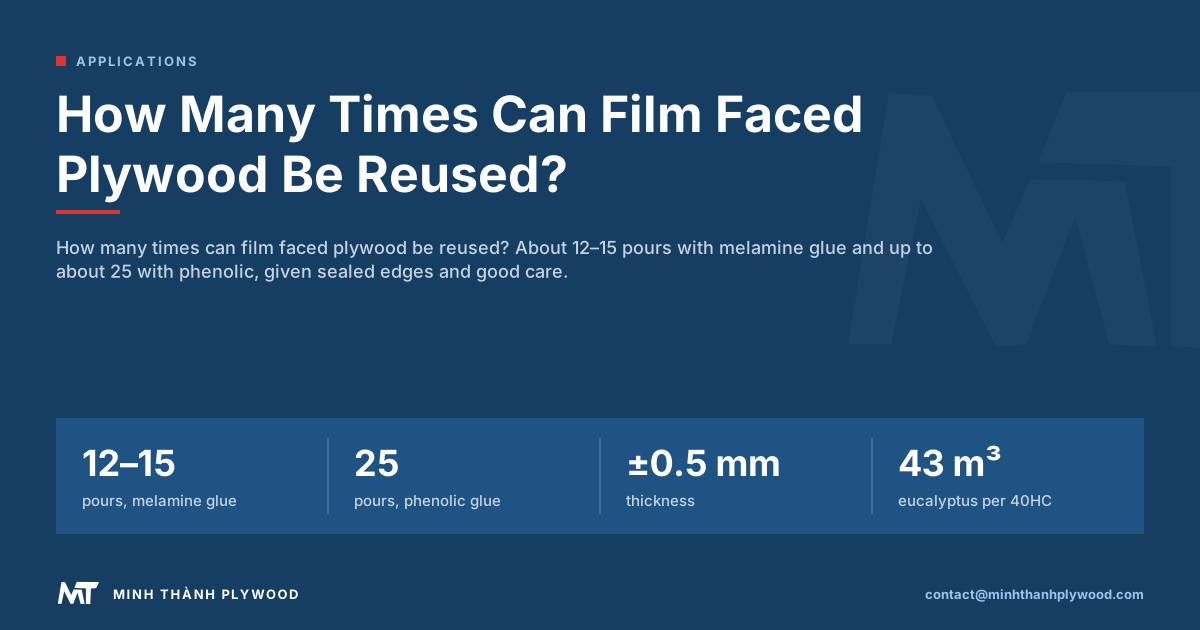
How many times can film faced plywood be reused?
Film faced plywood is typically reused about 12 to 15 times when it is bonded with a melamine-fortified glue, and up to about 25 times with a phenolic (WBP, water and boil proof) glue. Both figures assume proper handling, a release agent before every pour and sealed edges.
The range is wide because reuse is not a property printed in the sheet. It is the result of two things:
- The build: glue type, film weight and resin, core species and core quality, thickness and the number of plies.
- The site: how panels are fixed, oiled, stripped, cleaned, repaired and stored between pours.
A well-built panel treated badly on site can fail in a handful of pours. A modest panel treated well can outlast its expected range. The rest of this guide covers both sides and how to turn them into a cost per pour.
| Panel build | Typical reuse with good site practice | Typical use |
|---|---|---|
| Phenolic (WBP) glue, hardwood core, heavier film | Up to about 25 pours | Repeated slabs and walls, high-rise cycles |
| Melamine-fortified (MR) glue, hardwood core, standard film | About 12 to 15 pours | General walls, columns, mid-size projects |
| Low-cost panel, ungraded or gapped core, thin film | Far fewer pours | Footings, one-off or hidden work |
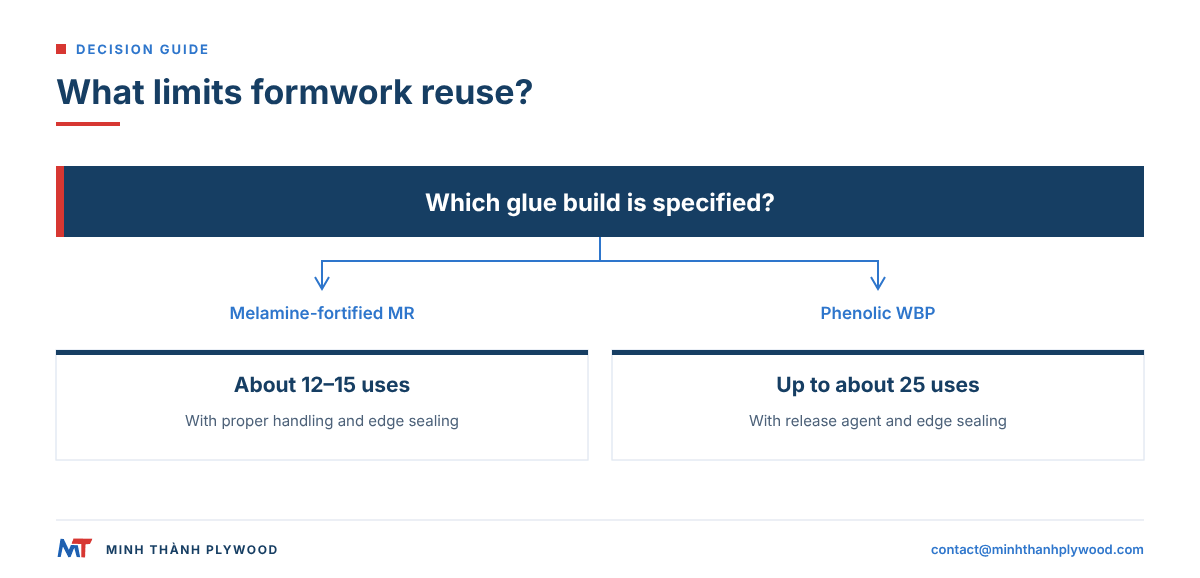
What counts as one reuse cycle?
One reuse cycle is one full round of the panel through the formwork: fix, pour, strip, clean and oil. Counting the same way on every project is the only way to compare panels.
- Fix: the panel is set into the form and fastened or clamped.
- Pour: concrete is placed against the film.
- Strip: the panel is removed after the concrete has gained strength.
- Clean: residue is scraped off the film and edges.
- Oil: release agent is applied before the next fix.
Two counts are worth keeping apart. Pours at fair-faced finish count how long a panel gives a smooth, unmarked concrete face. Pours to structural retirement count how long it stays stiff, flat and bonded enough for hidden concrete. The second number is always the larger, which is why panels move from exposed faces to footings as they age.
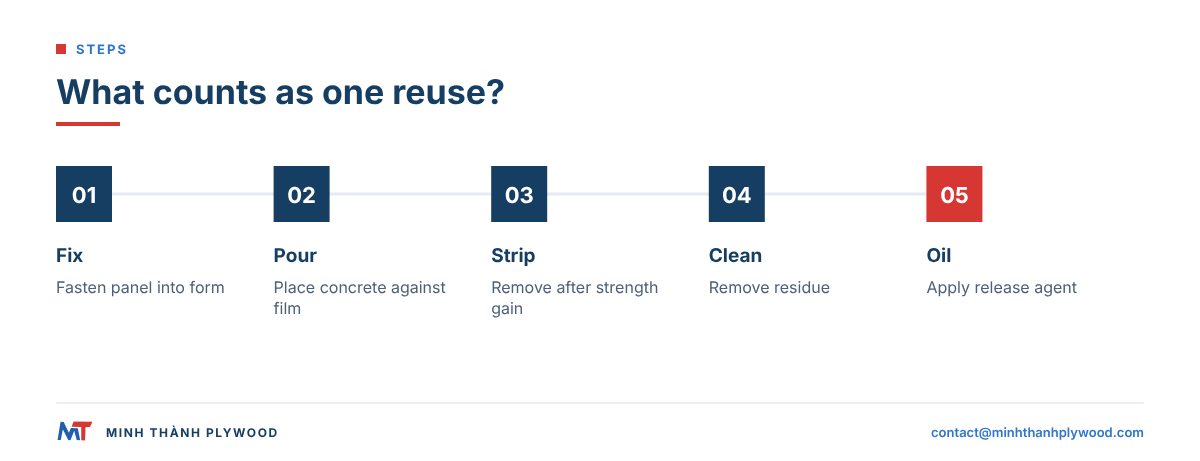
Which panel factors decide film faced plywood reuse?
The glue decides most of a panel’s reuse range, followed by the film, the core and the thickness. A buyer controls all four on the order.
| Factor | Builds a longer life | Shortens life |
|---|---|---|
| Glue | Phenolic (WBP), pressed at 130–145 °C; boil resistance up to 72 hours | Melamine-fortified (MR), pressed at 110–120 °C, boil resistance of about 4-8 hours; or thin glue spread |
| Film | Heavier film with a high resin content, from about 135 g/m² | Thin film with little resin, which wears through quickly |
| Core | Graded hardwood veneers, closed joints, stitched core layers | Gaps, overlaps, broken veneers and soft species |
| Thickness tolerance | Even thickness, ±0.5 mm on film-faced panels | Uneven sheets that rock in the form and print steps |
| Thickness for the span | Panel stiff enough for the support spacing | Thin panels over wide spans that bend at every pour |
| Edges | Sealed at the mill and after every cut | Bare edges and unsealed holes |
Why does the glue matter most?
The glue holds the veneers together through repeated wetting and drying. The boil test shows the gap: ordinary melamine glue keeps panels laminated in boiling water for about 4-8 hours, while premium phenolic glue withstands 72 hours (plywood.cc, 2026); Vietnamese maker Fomex quotes boil resistance of 8-25 hours across its grades (Fomex, 2026).
Buyers should ask which hours the supplier’s test report shows for the exact build, and which bonding class it was tested to under BS EN 314-2:1993. The service class of the panel (dry, humid or exterior conditions) is set in BS EN 636:2012+A1:2015. A phenolic bond resists boiling water and keeps its strength through many wet cycles. A melamine-fortified bond resists moisture well but gives way sooner when water reaches the core, which is why the two reuse ranges differ.
Why does film weight alone not decide reuse?
Standard formwork film weighs about 120–135 g/m², and premium film starts at about 135 g/m². A heavier film wears through more slowly, but the resin content of the paper, the press conditions and the core under the film decide how long it stays bonded. Compare film weight together with glue and core, never alone.
Shuttering ply repetition by use: walls, slabs, columns and fair-faced work
Shuttering ply repetition depends on the job as much as on the panel: the same sheet lasts longer on a simple slab than on a column with many cut-outs. Plan repetition by use, not by one number for the whole project.
| Use | Effect on repetition | Why |
|---|---|---|
| Flat slab soffits | Highest repetition | Large uncut sheets, low edge exposure, easy stripping |
| Straight walls | High repetition | Large sheets; tie holes are the weak points |
| Columns and beams | Lower repetition | Many cuts and edges, tight stripping, corner damage |
| Fair-faced architectural concrete | Lowest at fair-faced finish | Panels retire from exposed faces at the first marks |
| Footings and hidden concrete | Uses panels near the end of their life | Finish does not matter, stiffness does |
A sensible plan starts new panels on fair-faced or exposed work, moves them to standard walls and slabs as the film marks, and ends them on footings and blinding. Each panel then delivers all the pours its build allows.
Formwork plywood lifespan: what ends a panel early?
Formwork plywood lifespan is cut short mostly on site: water entering through edges and holes, film torn during stripping, and panels stored badly. These causes end more panels than poor manufacturing does.
- Bare cut edges: a cut exposes veneer and glue lines; unsealed, it swells within a few pours.
- Nail and screw holes: each fixing through the film is a small open edge; seal or plug unused holes.
- No release agent: concrete bonds to dry film and pulls pieces off at stripping.
- Steel bars as levers: crowbars dent the face and crush edges; use wedges and plastic or timber stripping tools.
- Dropping panels: corners split and the film cracks; lower panels, do not throw them.
- Cleaning with steel tools: wire brushes and steel scrapers score the film; use plastic scrapers and water.
- Wet or sunny storage: water soaks in through the edges and sun dries the film unevenly; store flat, off the ground, covered and dry.
- Long gaps without oil: dry film between jobs ages faster; oil panels before storage.
Our guide to film faced plywood defects shows how each of these looks on a panel and how to tell site damage from a manufacturing fault.
Does black film last longer than brown film?
No, film colour alone does not set the number of reuses. The colour is a dye in the film paper; the film weight, the resin in the paper and the glue under it decide how long the face lasts.
Brown, black and red films are all used on formwork panels, and each can be made heavy or light. A buyer comparing two offers should compare:
| Compare this | Not this |
|---|---|
| Film weight in g/m² | Film colour |
| Resin type and content of the film | Gloss when new |
| Glue type (phenolic WBP or melamine MR) | The word “marine” or “waterproof” on a label |
| Core species and core grade | Sheet price alone |
| Edge sealing | Edge paint colour |
Film colour, film weight and film brand are all order specifications, so the colour can be chosen for site identification without changing the build.
Does thicker plywood have more reuse cycles?
A thicker panel usually gives more reuse cycles over the same support spacing, because it deflects less under the pressure of wet concrete and is stressed less at every pour. Thickness only helps when it matches the span.
A 12 mm panel on supports spaced for 18 mm bends further at each pour. Repeated bending opens glue lines and cracks film over the supports, and the panel loses flatness early. The same 12 mm panel over closer supports can last as long as a thicker one.
- Slabs and walls on standard spacing: 18 mm is the common choice; 21 mm for heavy pours or wider spacing.
- Curved or tight forms: 9 to 12 mm, over closer supports.
- Fillers and small pieces: off-cuts of the main thickness.
Plywood formwork design, including support spacing for each thickness, is covered in our guide to plywood formwork design. Whatever the panel’s age, the form must still carry the concrete: the US rule for cast-in-place concrete requires formwork to support all loads that may reasonably be anticipated without failure (OSHA standard 1926.703).
How to get more pours from every film faced panel
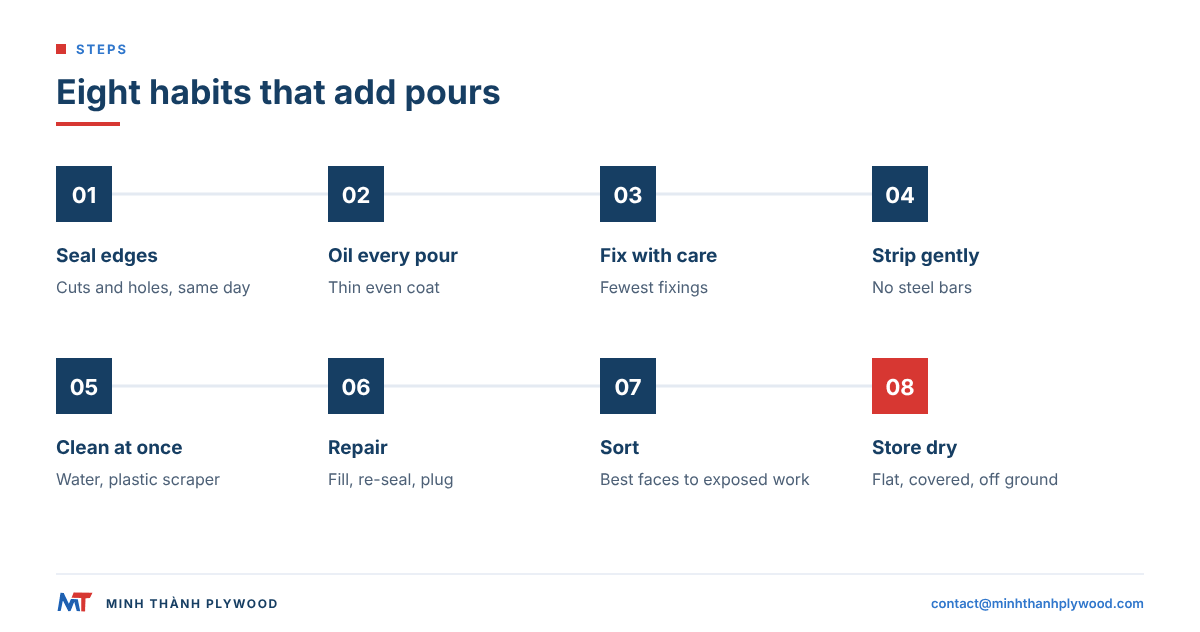
To get more pours from film faced plywood, protect the edges, oil before every pour, strip gently and store panels dry. These eight habits move a panel towards the top of its range.
- Seal every cut edge and hole the day it is made, with water-resistant edge paint.
- Apply release agent before every pour, a thin even coat on clean film.
- Fix with care: pre-drill and use the fewest fixings the design allows; reuse existing holes where you can.
- Strip once the concrete is ready, with wedges and timber or plastic tools, not steel bars.
- Clean right after stripping, with water and a plastic scraper while residue is soft.
- Repair small damage at once: fill dents, re-seal edges, plug unused holes.
- Sort panels after each pour: best faces back to exposed work, marked faces to hidden work.
- Store flat and dry: on even bearers, off the ground, covered, out of direct sun.
Release agents and how much to apply are covered in our guide to concrete form release agents.
How much does release agent change the reuse count?
Release agent changes the reuse count more than any other site habit, because a dry film bonds to concrete and loses pieces at every strip. Apply a thin, even coat to clean film before every pour, wipe off pools and runs, and keep the coat off reinforcement. Too much agent stains the concrete and collects dust; too little leaves dry spots that tear. Use a release agent made for film-faced panels, not diesel or waste oil, which soften the film resin and stain the concrete.
How should film faced panels be stored between pours?
Store film faced panels flat, off the ground, covered and dry between pours and between jobs. Storage decides whether a panel starts its next pour flat and sealed or already swollen at the edges.
- Stack flat on even bearers, spaced closely enough that sheets do not sag, with the bottom sheet clear of the ground.
- Keep stacks level and square, with sheets of one size together, so edges are not crushed by overhangs.
- Cover the stack with a waterproof sheet that sheds rain but lets air move at the sides.
- Keep panels out of direct sun, which dries the film and edges unevenly and opens fine cracks. In the Gulf, where summer sun is strong and storage yards are open, keep stacks in shade or under a ventilated cover and leave the packs wrapped until use.
- Clean and oil before stacking, so residue does not harden on the film during storage.
- Check stored stacks after heavy rain and re-seal any edges that took up water.
New panels arrive wrapped and strapped in packs. Keep them in the packs until use, on a firm level base, and open one pack at a time.
How to calculate formwork cost per pour
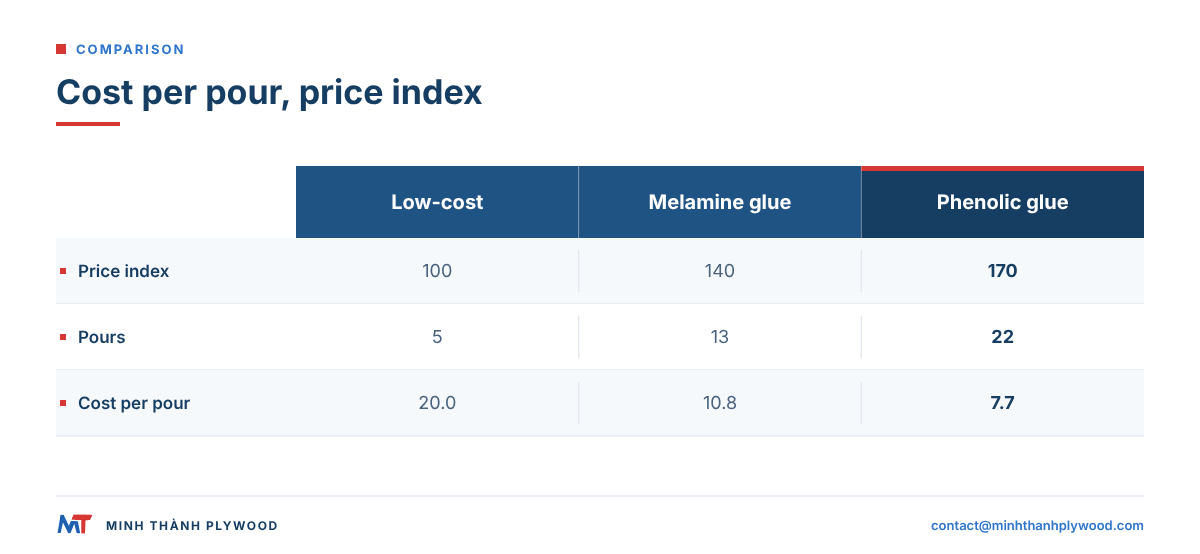
Formwork cost per pour is the panel’s total cost divided by the number of pours it delivers at the finish you need. It is the number to compare between offers, because the sheet price alone hides the reuse.
Cost per pour = (panel price + repairs and handling) ÷ pours at the required finish
The example uses a price index rather than prices, so it works for any currency and any year. A panel priced at index 100 is the reference.
| Panel | Price index | Pours delivered | Cost per pour (index) |
|---|---|---|---|
| Low-cost panel | 100 | 5 | 20.0 |
| Melamine-glue panel | 140 | 13 | 10.8 |
| Phenolic-glue panel | 170 | 22 | 7.7 |
In this example the phenolic panel costs 70 percent more per sheet and about 60 percent less per pour than the low-cost panel.
Worked example in US dollars. A contractor forms 10,000 m² of contact area in total. One 1220 × 2440 mm sheet covers 2.9768 m² (about 2.98 m²), so the job needs at least 3,360 sheet-uses before cutting waste: 10,000 ÷ 2.9768, rounded up. For this worked example, assume US$12 per sheet for the low-cost panel.
The US$25 and US$40 inputs are rounded October 2026 public price points for Fomex Standard and Promax panels (Fomex), used here for the melamine and phenolic rows. The pours delivered are the figures from the index table above, not Fomex’s own tiers.
| Panel | Sheet price | Pours delivered | Sheets to buy | Panel cost for the job | Cost per sheet-pour |
|---|---|---|---|---|---|
| Low-cost panel | US$12 | 5 | 672 | US$8,064 | US$2.40 |
| Melamine-glue panel | US$25 | 13 | 259 | US$6,475 | US$1.92 |
| Phenolic-glue panel | US$40 | 22 | 153 | US$6,120 | US$1.82 |
The panel bill falls by about 24 percent from the low-cost panel to the phenolic one, and the phenolic job handles 519 fewer sheets, which are 519 fewer panels to cut, oil, store and replace. Fomex’s own comparison reaches the same direction: US$25 for 4 uses is US$6.25 per use, against US$40 for 15 uses at US$2.67 per use. Swap in your quoted prices and your logged pour counts; the method does not change. The pours each panel delivers come from your own site records; a reuse log, described further on, gives them.
What else belongs in the cost per pour?
Add the costs that change with panel quality: the labour to replace failed panels mid-project, repairs to concrete faces marked by worn film, and delays when panels run out early. A panel that fails during a pour cycle costs far more than its price.
When to repair, downgrade or retire a film faced panel
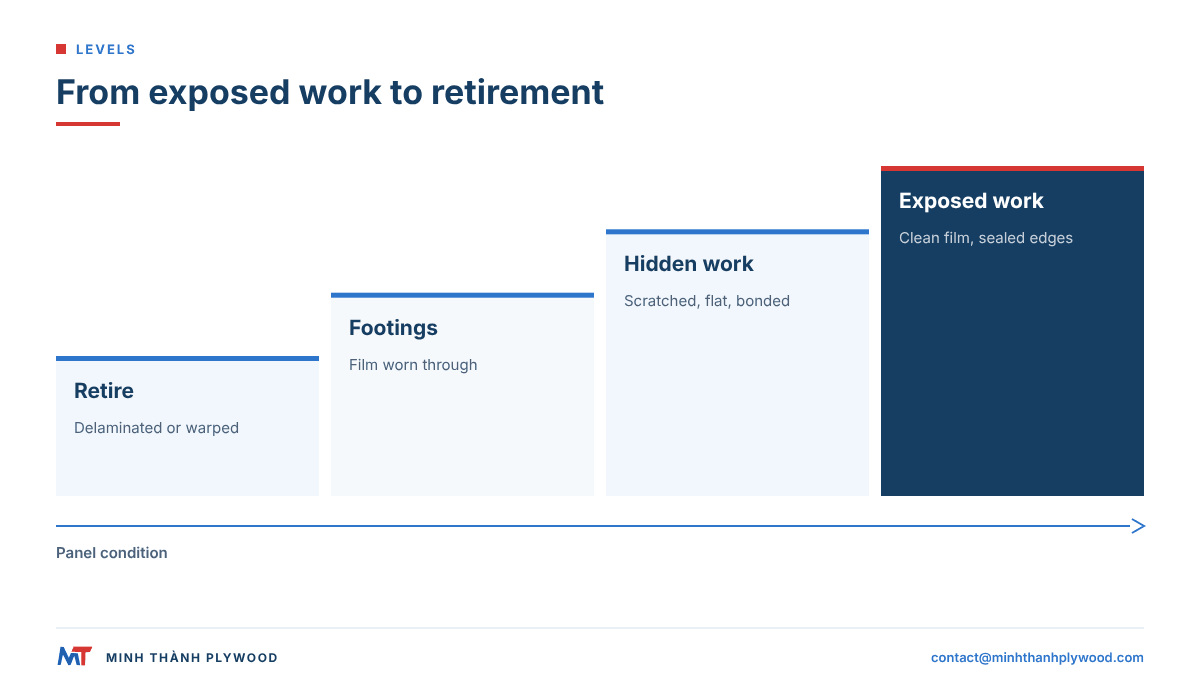
Repair a panel when the damage is local, downgrade it when the film is worn but the panel is flat and bonded, and retire it when the core or bond has failed. Checking after every strip keeps bad panels out of exposed work.
| Condition after stripping | Decision | Next use |
|---|---|---|
| Clean film, sealed edges, flat | Reuse as is | Any face, including exposed |
| Light scratches or small dents | Repair, then reuse | Standard walls and slabs |
| Chipped edges, open nail holes | Cut back or re-seal, then reuse | Standard work, smaller pieces |
| Film worn through in patches | Downgrade | Hidden faces, footings |
| Swollen edges, soft corners | Cut off the damaged strip | Smaller panels, fillers |
| Delamination, blistered film, warped sheet | Retire | Not for formwork |
How to keep a film faced plywood reuse log
A reuse log records each batch of panels from delivery to retirement, so the next order can be priced on real pours instead of a sales figure. A simple sheet per batch is enough.
| Column | What to record |
|---|---|
| Batch | Supplier, delivery date, specification (glue, film, thickness) |
| Panels | Number received, number cut and to what size |
| Pour date | Date and element (wall, slab, column) |
| Condition | After stripping: reuse, repair, downgrade or retire |
| Panels retired | Number and reason (edge swell, delamination, film wear) |
| Running count | Pours completed by the batch |
After two or three projects, the log shows which build gives the lowest cost per pour on your sites, and which site habits lose panels early.
What to put on the order for a higher reuse target
To buy for a higher reuse target, specify the build that sets reuse: glue type, film weight, core, thickness and tolerance, edge sealing and packing. A reuse number on its own is not a specification.
- Glue: phenolic (WBP) for the highest repetition; melamine-fortified (MR) for standard work.
- Film: film weight, film brand and colour.
- Core: hardwood core, graded veneers, stitched core layers.
- Thickness and tolerance: for example 18 mm, ±0.5 mm.
- Size: 1220 × 2440 mm or 1250 × 2500 mm, or a cut list.
- Edges: sealed, edge paint colour.
- Packing: sheets per pack, corner protection and covers.
Ask for a sample of the exact build and test it on site before a large order: a few pours on real work tell more than a datasheet. Free samples are available on request.
Why a reuse figure needs its conditions
A reuse figure without conditions cannot be compared. The same panel gives very different counts on a slab with good oiling and on columns stripped with bars. Write the use and the site practice next to any reuse figure you compare.
Can a scratched or marked panel be reused?
Yes, a scratched film faced panel can be reused, but not on exposed concrete. Every scratch and dent prints onto the concrete face, so marked panels belong on hidden work.
- Light surface scratches: reuse on walls that will be plastered or clad, and on slabs with a finish on top.
- Dents: fill with a formwork filler, sand flush and oil; the repair may still show on fair-faced concrete.
- Film worn to veneer: use only on footings, blinding or the back of a form.
- Cracks over a support line: check for delamination by tapping; a dull sound means the bond has gone.
Panels that have reached the end of formwork use can still serve as hoardings or site boards, and the guide on cutting and painting film faced plywood explains how to repaint them.
How Minh Thanh builds film-faced panels for repeated pours
We build film-faced plywood to the buyer’s specification for glue, film and thickness. The parts of the build that set reuse are written on every order.
| Build item | Our practice |
|---|---|
| Glue | MR (melamine-fortified) or phenolic (WBP) to the buyer’s specification |
| Press | Hot pressed at 110–120 °C for MR and 130–145 °C for WBP |
| Core | Core layers stitched both horizontally and vertically |
| Thickness tolerance | ±0.5 mm on film-faced panels; ±2 mm on length and width |
| Sizes | 1220 × 2440 mm and 1250 × 2500 mm; cut to size on request |
| Film | Film weight, brand and colour as ordered |
| Loading | Every shipment photographed and filmed before loading, sent to the buyer |
A full 40HC (40-foot high-cube container) holds about 43 m³ of 18 mm film-faced panels on a eucalyptus core or about 47 m³ on an acacia core, because the heavier eucalyptus reaches the payload first. Mixed specifications in one container are possible by agreement.
Send your specification, the use and the reuse you need through the film-faced plywood page; we reply within hours. Our concrete form plywood buying guide covers the choice of grade and core, and the article on buying used formwork plywood explains when a second-hand panel is the better buy.
Buyer questions, answered
How many times can film faced plywood be reused?
Panels with melamine-fortified glue are typically reused about 12 to 15 times, and panels with phenolic (WBP) glue up to about 25 times, with proper handling, release agent and edge sealing.
Can film faced plywood be reused 20 times?
Yes, a phenolic-bonded panel with a hardwood core, a good film and sealed edges can reach 20 pours on walls and slabs when it is oiled before every pour and stored flat and dry. Melamine-bonded panels rarely reach it.
What counts as one reuse cycle?
One cycle is one full round of fixing the panel in the form, pouring, stripping, cleaning and oiling. A panel that is fixed once but carries several lifts still counts each pour.
Does black film last longer than brown film?
Not by colour alone. Film colour is a dye; reuse depends on the film weight, the resin in the film and the glue under it. Compare those specifications, not the colour.
Does thicker plywood have more reuse cycles?
A thicker panel deflects less over the same support spacing, so it is stressed less at each pour and usually lasts longer. Matching thickness to the span matters more than thickness alone.
Can a scratched panel be reused?
Yes, for structural or hidden concrete. Light scratches print onto the concrete, so move scratched panels from exposed faces to footings, walls that will be clad, or the back of the form.
What shortens formwork plywood lifespan most?
Unsealed cut edges and nail holes, pours without release agent, levering panels off with steel bars, and storing panels wet or in the sun. Each one lets water into the core or tears the film.
How do you calculate formwork cost per pour?
Divide the panel price plus its share of repairs and handling by the number of pours at the finish you need. A dearer panel that lasts many more pours usually costs less per pour.
Is reuse guaranteed by the manufacturer?
Reuse is a target for a given build and given site practice, not a fixed property of a sheet. The build can be specified; handling, oiling and storage stay with the site.
How long does film faced plywood last in storage?
Stored flat on even bearers, off the ground, covered and dry, new panels keep their condition for a long time. Panels stored wet or in sun lose pours before they are ever used.