
Marine plywood for boat building should be made to BS 1088 or an equivalent marine standard: durable face and core veneers, no core gaps, and a boil-proof phenolic bond. Okoume is the light choice for small boats and stitch-and-glue hulls; meranti is heavier, harder and more durable. Thickness and ply count follow the designer's plans part by part. Minh Thanh Plywood, a Vietnamese furniture plywood manufacturer, explains how to choose and check a sheet.
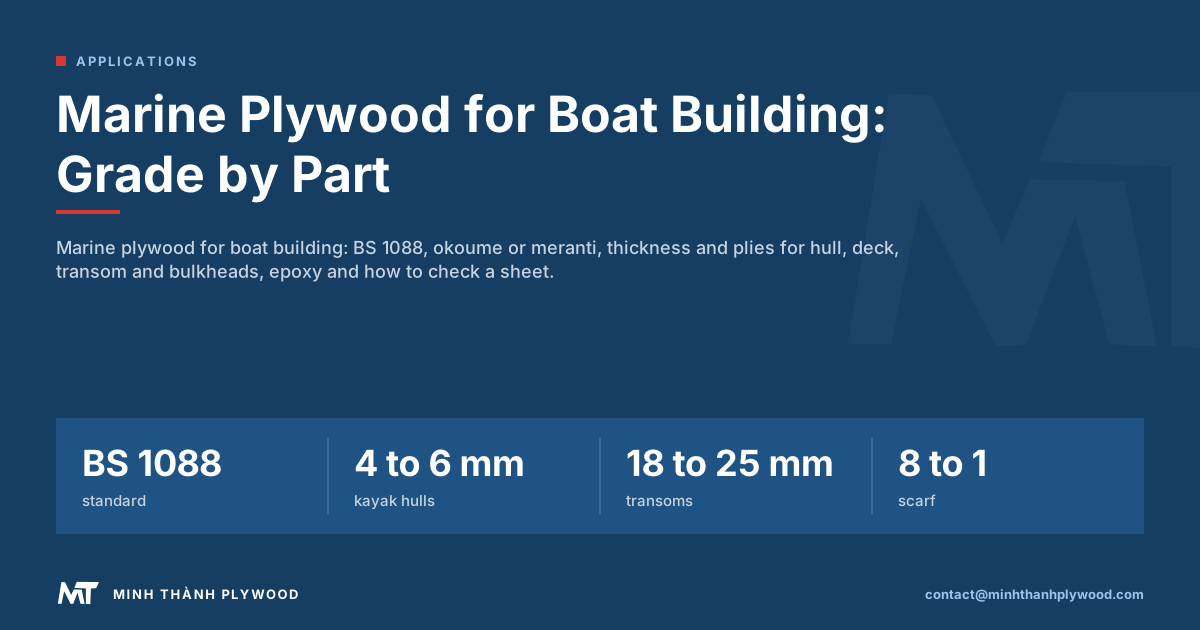
Marine plywood for boat building: what to buy
Buy marine plywood to BS 1088 or an equivalent marine standard, in the species, thickness and ply count the boat plans call for. BS 1088 is the British standard for marine plywood and the reference most designers and stockists use worldwide. It sets durable veneers, no gaps in the core, and a glue bond that survives boiling.
Three choices decide the sheet:
- Standard. BS 1088 for nearly all boat building; AS/NZS 2272 in Australia and New Zealand; APA Marine grade in North America. Lloyd’s Register approval is added for some commercial craft.
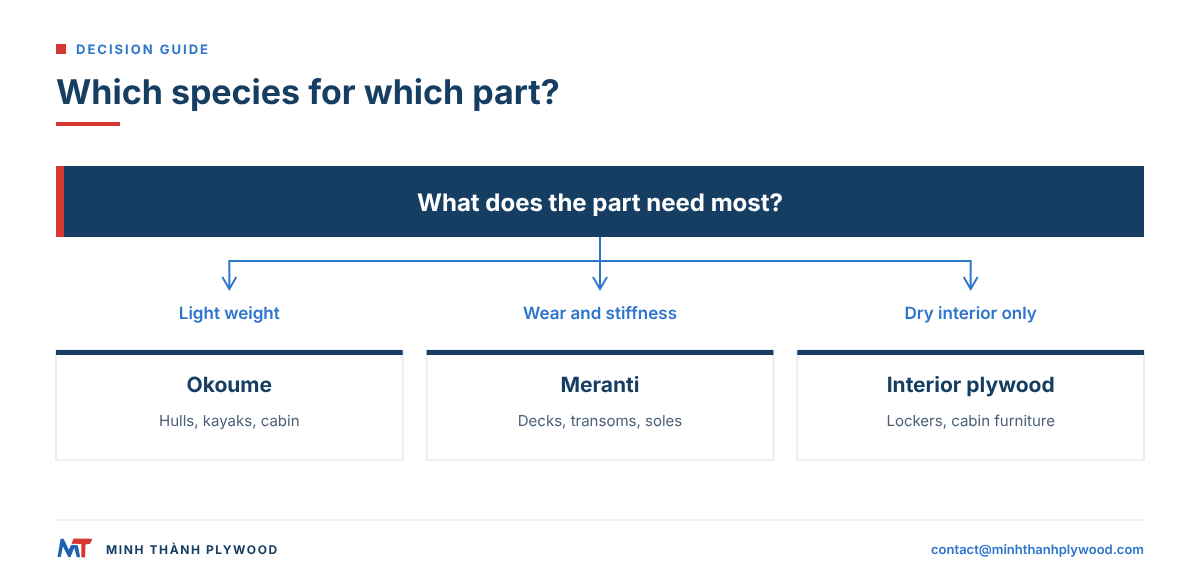
- Species. Okoume for light hulls; meranti for weight-bearing and wearing parts.
- Thickness and plies. Set part by part by the designer.
For a boat meant to last, the sheet is only half the system. Epoxy coating and glass sheathing keep water out of the wood, because a waterproof glue line does not make the timber itself rot-proof.
What makes plywood “marine” grade?
Marine plywood is defined by its construction, not its face species. A sheet becomes marine grade when its veneers, its core and its glue line meet a marine standard.
The main requirements of BS 1088 are:
- Bond. A weather- and boil-proof glue, normally phenolic, tested to a boil-resistance method.
- Core. No gaps or overlaps between core veneers, so water has no channel to travel along inside the panel.
- Veneers. Face and core veneers from listed hardwood species of adequate durability, with defined limits on knots, splits and patches.
- Construction. Balanced lay-up with grain alternating ply by ply and limits on veneer thickness.
- Marking. Each sheet stamped with the standard, the maker and the species.
The 2018 edition of BS 1088 replaced the older two-part version (BS 1088-1 and -2:2003). Panels that pass the standard and the audit of Lloyd’s Register can also carry Lloyd’s approval.
Exterior plywood shares the waterproof glue but allows core gaps and lower-grade inner veneers. Those voids are where water collects and rot starts in a hull.
Okoume, meranti and other species compared
Okoume is the lightest marine plywood and the easiest to bend; meranti is heavier, harder and more durable. The species is the second choice after the standard, and it follows the boat’s weight budget and the part’s wear.
| Species | Weight | Bending | Durability | Hardness | Best parts |
|---|---|---|---|---|---|
| Okoume (gaboon) | Lightest | Very good | Moderate, needs full epoxy | Soft face, dents | Stitch-and-glue hulls, kayaks, dinghies, cabin parts |
| Meranti (red) | Medium to heavy | Good | Good | Harder face | Decks, transoms, bulkheads, larger hulls |
| Khaya and sapele | Medium to heavy | Fair | Good | Hard | Brightwork, interiors, decks |
| Douglas fir (APA Marine) | Medium | Fair | Moderate | Checks at the face | Workboats, heavier hulls in North America |
| Birch (exterior WBP) | Heavy | Fair | Low unless sealed | Hard | Interior furniture, not hulls |
Okoume BS 1088 is the most common sheet in small-boat building. It weighs noticeably less than meranti for the same thickness, takes epoxy well, and bends around hull curves without cracking. Its soft face dents, so builders glass-sheathe bottoms and decks.
Meranti carries knocks and foot traffic better, which is why plans often call for it on decks, cockpit soles and transoms. A builder can mix the two: okoume for topsides and cabin, meranti for the bottom and transom.
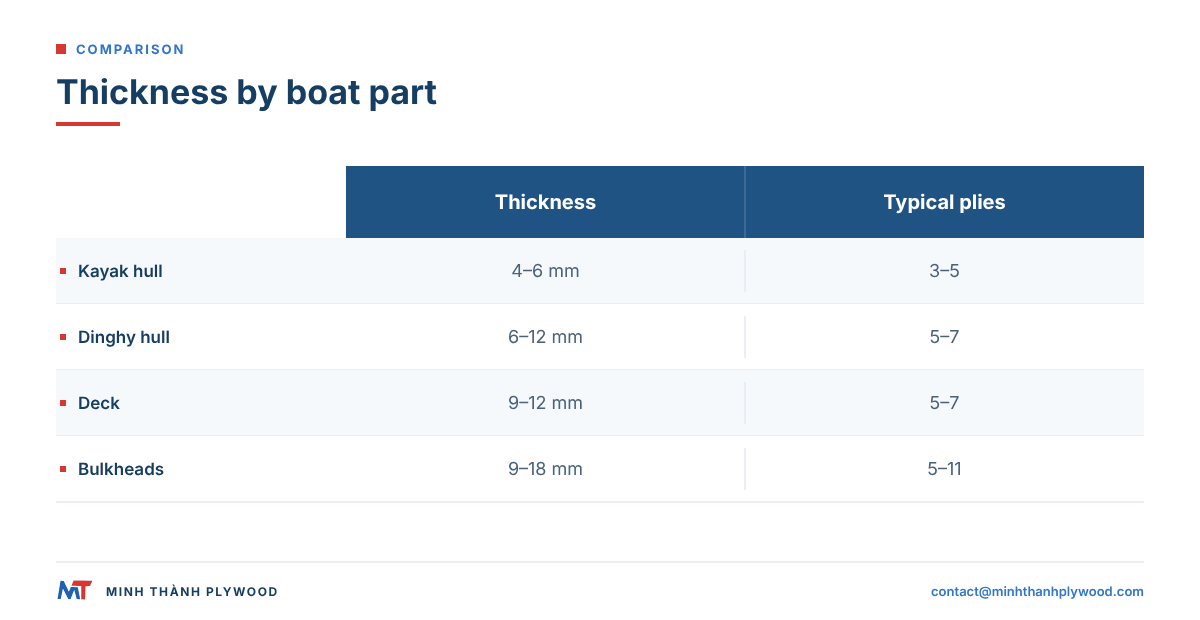
Thickness and ply count by part of the boat
Thickness and ply count follow the part’s job. The table gives common ranges for small and medium boats; the boat plans always decide.
| Part | Common thickness | Typical plies | Species | Notes |
|---|---|---|---|---|
| Kayak and canoe hull | 4 to 6 mm | 3 to 5 | Okoume | Stitch-and-glue, glass both sides |
| Dinghy and skiff hull | 6 to 12 mm | 5 to 7 | Okoume or meranti | Glass the bottom |
| Larger hull planking | 12 to 18 mm | 7 to 11 | Meranti or okoume | Often two layers |
| Deck and cabin top | 9 to 12 mm | 5 to 7 | Meranti or okoume | Glass sheathing for wear |
| Transom (outboard) | 18 to 25 mm total | Laminated | Meranti | Two sheets epoxied together |
| Bulkheads and frames | 9 to 18 mm | 5 to 11 | Okoume or meranti | Fillet and tape to the hull |
| Cockpit sole and floors | 12 to 18 mm | 7 to 11 | Meranti | Non-slip finish |
| Seats, lockers, interior | 6 to 12 mm | 3 to 7 | Okoume | Coat edges |
More plies for a given thickness means thinner veneers and more uniform strength in both directions. A 6 mm 5-ply sheet is stiffer across the grain and less prone to splitting than a 6 mm 3-ply.
Our sibling guide on plywood for boat floors and decks covers floors, soles and transoms in more detail.
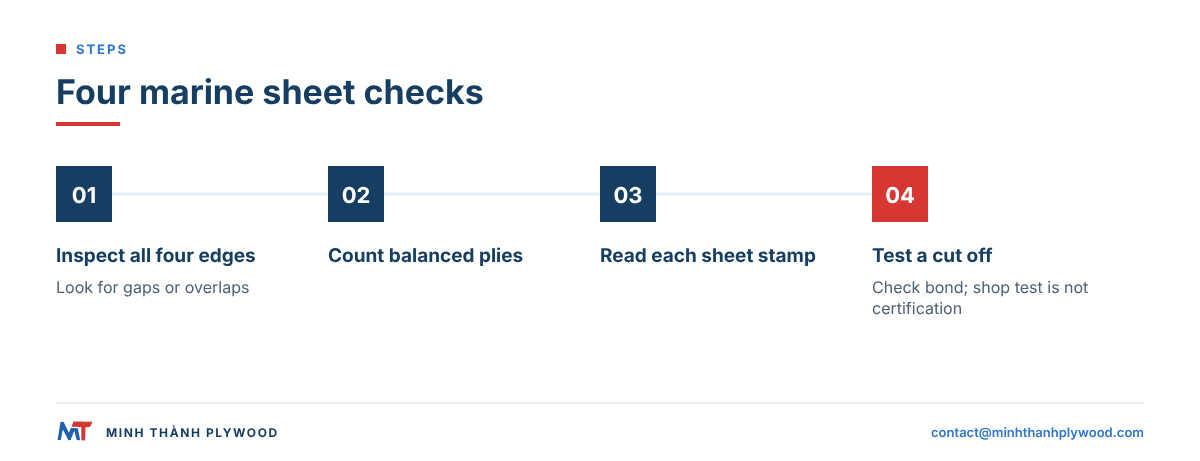
How do you check a marine plywood sheet? Glue lines and core gaps
Check a marine plywood sheet at its edges, its stamp and its glue line. Four checks catch most poor sheets before they go into a boat.
- Edges. Look along all four edges with a torch. Every inner ply should be continuous, with no gaps, overlaps or filler.
- Ply count and symmetry. Count the plies and check that the lay-up is balanced, with the same thickness on both sides of the centre ply.
- Stamp. Each sheet should carry the standard, the maker and the species, not only the top sheet of a pack.
- Boil test. Boil a 25 mm wide offcut, let it cool, and try to split the plies with a chisel. A marine bond tears wood, not glue. The published tests set the hours: the aircraft specification MIL-P-6070 shear-tests plywood after 3 hours in boiling water (Epoxyworks). The boil cycle behind BS 1088 bond approval runs 72 hours in total. A kitchen boil of 3 hours is a sensible shop check; a bond that survives it and then splits wood is a good one.
Face repairs and ply count in other standards. The US standard PS 1 for marine Douglas fir allows no more than 9 repairs on an A face of a 4 x 8 ft sheet, and most plywood under 6 mm is 3-ply, with 5 or more plies from 1/4 in up (Epoxyworks). Count the patches on a sheet before you buy; more than that on one face is a sign of a lower grade.
A tap test helps too. Tap the face with a coin across the sheet; a dull sound marks a void or a weak glue line.
These are the same checks a plywood mill runs on its own production. In our furniture lines, core veneers are stitched both horizontally and vertically before pressing, so no gap opens between core sheets, and panels are pressed twice: the core board first, then face and back. Gap-free cores are what a marine standard demands, for a different reason: water.
Marine plywood and epoxy: coating and glass sheathing
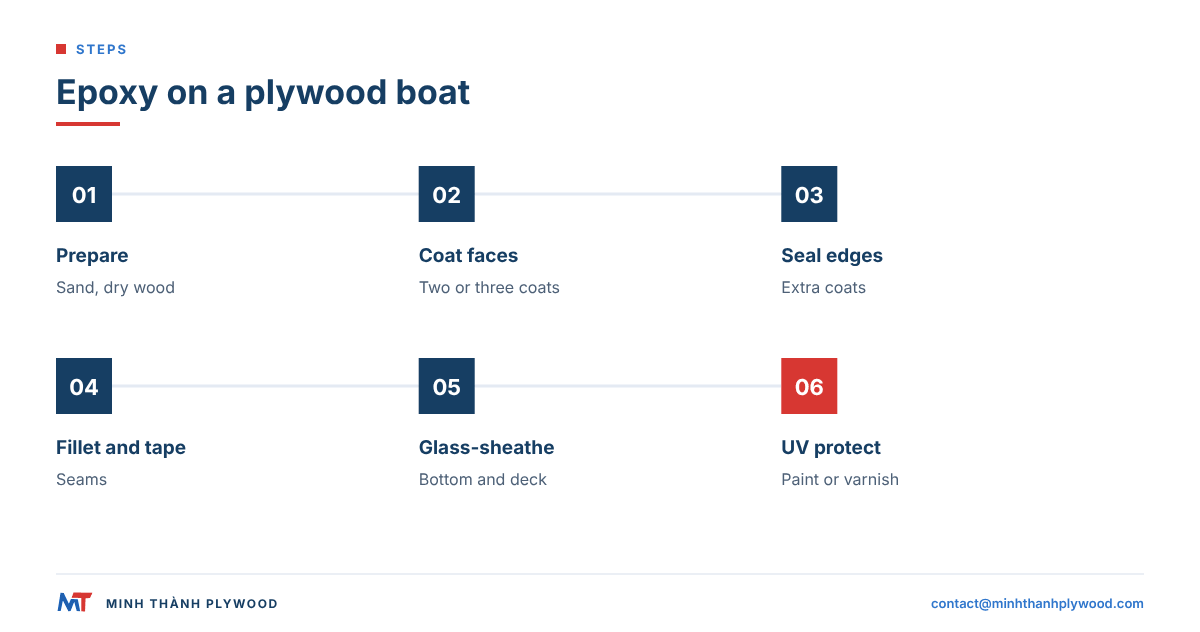
Epoxy is what makes a plywood boat last. Marine plywood epoxy work seals the wood from water, glues the joints and, with glass cloth, protects the hull from abrasion.
How builders use it:
- Prepare. Sand faces lightly, remove dust, and work on dry wood; most epoxy makers ask for timber below about 12 % moisture content.
- Coat all faces. Roll two or three coats on every surface, inside and out.
- Seal every edge. Edges absorb water fastest, so they get extra coats, and screw holes are drilled oversize, filled with epoxy and re-drilled.
- Fillet and tape. In stitch-and-glue boats, thickened epoxy fillets and glass tape form the seams.
- Glass-sheathe. Lay glass cloth in epoxy on the hull bottom, deck and other wear areas.
- Protect from sun. Epoxy breaks down in sunlight, so paint or varnish with UV protection over it.
Okoume absorbs the first coat readily and bonds well. Meranti and other dense species need a thorough sand for good adhesion. Polyester resin bonds less well to wood than epoxy and is not the choice for wooden boats.
Building a wooden boat: which method needs which plywood?
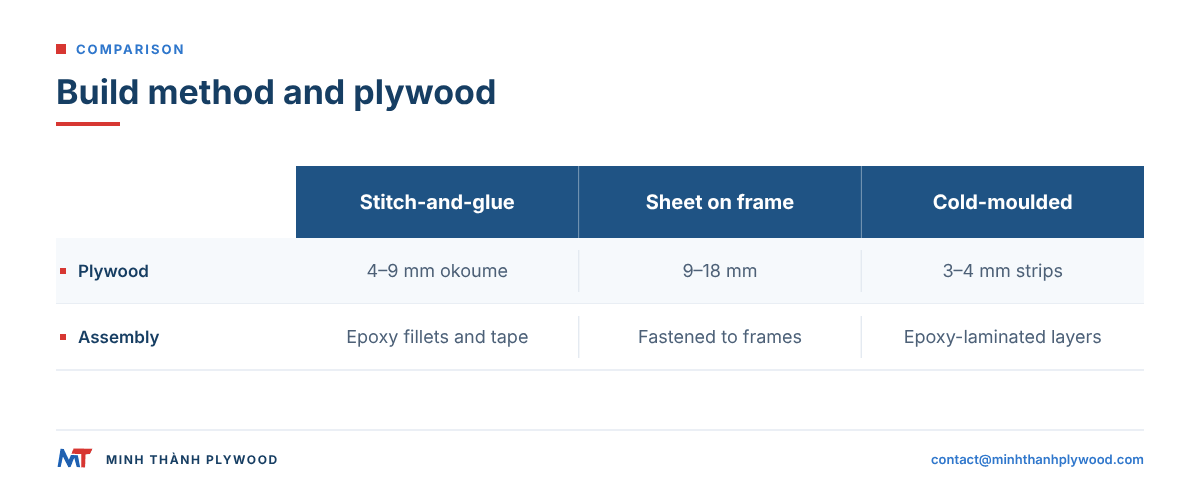
The building method sets how the plywood must behave. Building a wooden boat in plywood usually takes one of three routes.
Stitch-and-glue. Panels are cut from sheets, stitched together with wire or ties along their edges, then glued with epoxy fillets and glass tape. The method needs thin, light, flexible sheets: okoume BS 1088 in 4 to 9 mm. It is the most popular way for a first boat.
Sheet on frame. Plywood panels are fastened and glued to sawn frames, chines and stringers. The sheet must hold fastenings and carry loads between frames, so 9 to 18 mm meranti or okoume is common.
Cold-moulded. Thin veneers or 3 to 4 mm plywood strips are laminated in layers over a mould with epoxy. The result is a strong, light, curved hull.
Among wooden boats to build for a beginner, a flat-bottomed pram dinghy, a small skiff or a stitch-and-glue kayak are the usual first projects. They need between two and six sheets, simple joints and basic tools. Choose plans with full-size patterns and a material list that names the sheet standard.
Marine plywood vs exterior plywood for boats
Marine plywood and exterior plywood share a waterproof glue; marine plywood adds gap-free cores, better veneers and tighter construction rules. That difference decides how a sheet lasts once water gets in.
| Metric | Marine plywood (BS 1088) | Exterior / WBP plywood |
|---|---|---|
| Glue | Phenolic, boil-proof | Phenolic or melamine-fortified, waterproof |
| Core gaps | Not allowed | Allowed within limits |
| Veneer species | Listed durable hardwoods | Mixed species |
| Inner veneer grade | High | Lower |
| Marking | Stamp on each sheet | Varies |
| Weight per sheet | Light (okoume) to medium | Varies with core |
| Price | Highest | Lower |
| Use on a boat | Hulls, decks, transoms, bulkheads | Temporary or dry interior parts |
Exterior plywood in a hull traps water in its core gaps, out of reach of epoxy, and rots from the inside. For details, see marine plywood vs regular plywood.
Which marine plywood brand is best? What to ask a supplier
The best marine plywood for boat building is a sheet you can trace to a standard and a mill, not a brand name alone. Buyers in Ireland, New Zealand, Canada, South Africa, Saudi Arabia, Indonesia and Singapore ask the same question, and the answer is the same everywhere: check the evidence.
Ask any supplier for:
- The standard on each sheet: BS 1088, AS/NZS 2272 or APA Marine, as the plans require.
- The mill name and batch: so a fault can be traced.
- A recent bond test report: a boil-resistance test by a third-party laboratory.
- Lloyd’s Register approval: only when a surveyor or class rule requires it.
- Species declaration: face and core species, so a “marine” sheet is not a mixed core with an okoume face.
- Moisture at dispatch and storage conditions: sheets kept flat, dry and covered.
A good stockist will also open a pack so you can see the edges of several sheets before you buy.
Where do builders in Singapore buy marine plywood, and what does it cost?
Singapore boat builders and DIY makers buy marine plywood in 1.22 x 2.44 m (4 x 8 ft) sheets from hardware chains and timber merchants, and they pay by the sheet. Horme Hardware lists a 4 x 8 ft marine plywood plank across stores at Woodlands, Tampines and Lower Delta Road, with free delivery above S$120 for members (Horme, 2026). A Singapore online merchant lists an 18 mm high-grade marine plywood sheet at 244 x 122 cm for S$252 (Plywood Online, 2026). Prices change with the exchange rate and the okoume log market, so treat them as a dated reference.
What that means for a yard or a stockist: a retail sheet at S$252 is the figure an importer’s landed cost must beat with margin. Ask any supplier, in Singapore or abroad, for the standard on the stamp, the species and the mill, because a hardware shelf label of “marine plywood” does not tell you the standard.
Who builds with what. Kit makers such as Chesapeake Light Craft use okoume to BS 6566 selectively next to BS 1088 and buy from the French mill Joubert, which WoodenBoat describes as its main supplier of okoume (WoodenBoat, consumer’s guide). The same guide notes that BS 1088 is a voluntary standard with “no BS 1088 police”, so the buyer’s checks on edges, stamp and bond matter more than the label.
Marine plywood sizes and scarf joints
Marine plywood comes mainly in 1220 × 2440 mm (4 × 8 ft) and 1250 × 2500 mm sheets, with longer sheets from some mills. Boats longer than a sheet need panels joined end to end.
Builders join sheets in three ways:
- Scarf joint. The ends are bevelled at a slope of about 8 to 1 and glued with epoxy, making a joint as strong as the panel.
- Butt block. The ends meet over a plywood block glued and fastened behind them; quick, but adds weight and a lump inside the hull.
- Puzzle joint. Interlocking cut shapes, often pre-cut in boat kits, glued with epoxy.
Our guide to marine plywood sizes and thickness lists formats and nominal thicknesses by market.
Buyer checklist for importers supplying boat yards
An importer supplying boat yards needs every sheet traceable and every document ready before the container lands. Boat builders return poor sheets fast, and a single bad pack can lose a customer.
- Specification: standard, species, thickness, ply count, size, face grade.
- Documents: standard certificate or approval, bond test report, species and origin declaration.
- Sampling: edge photos of several sheets per pack before loading, and a boil test of an offcut.
- Packing: sheets wrapped against moisture, packs on solid bearers, corners protected.
- Marking: each sheet stamped; each pack labelled with thickness, count and batch.
- Storage on arrival: flat, covered, off the floor, out of the sun.
Shipments from our mill are photographed and filmed before loading, and buyers receive the photos and video. That record helps any importer settle questions about condition on arrival.
Where Minh Thanh plywood fits in a boat project
Minh Thanh Plywood makes furniture and interior plywood, so our panels fit the protected interior of a boat: cabin furniture, locker fronts, headliners and joinery that stays dry. They are offered as interior panels, separate from BS 1088 hull plywood.
What we make for those parts:
- Okoume-faced plywood on white Styrax or Eucalyptus cores, sanded and polished, both faces UV-ready for the buyer’s own UV coating.
- Birch and poplar faces for painted or veneered cabin furniture.
- Thicknesses from 3 to 40 mm, with sanded panels to ±0.2–0.3 mm.
- Bonds to the buyer’s specification: UF glue at E0 emission for dry interiors, MR or WBP for humid ones.
- Emission records: CARB P2 / TSCA Title VI certification (ICTT mill no. 23024), with chamber tests averaging 0.014–0.032 ppm. The TSCA Title VI limit for veneer-core hardwood plywood is 0.05 ppm under 40 CFR 770.10.
For cabin joinery, see our okoume plywood page and the marine plywood buying guide.
What to write on a marine plywood order
A marine plywood order names the standard, the species, the build and the evidence for every line.
- Use: hull, deck, transom, bulkhead or interior, and the boat type.
- Standard: BS 1088, AS/NZS 2272 or APA Marine; Lloyd’s approval if required.
- Species: face and core species, written separately.
- Thickness and plies: for example 9 mm, 5 or 7 plies.
- Size: 1220 × 2440 mm or 1250 × 2500 mm, or longer sheets.
- Bond: phenolic, with the boil test report.
- Face grade: both faces, as the plans require for bright or painted finish.
- Packing and marking: wrap, bearers, stamps and pack labels.
For interior and cabin panels, send the drawing, the face, the bond and the finish to contact@minhthanhplywood.com. Minh Thanh Plywood offers free samples and replies within hours.
Buyer questions, answered
What is the best marine plywood for boat building?
BS 1088 plywood is the reference for boat building worldwide. Okoume BS 1088 suits light hulls, kayaks and dinghies; meranti BS 1088 suits heavier boats, decks and parts that see wear. Lloyd's Register approved panels are asked for on some commercial craft.
Which marine plywood brand is best for boat building?
Judge the sheet, not the brand: a BS 1088 or equivalent stamp on every sheet, a mill name and batch you can trace, a recent bond test report, and edges with no core gaps. Buy from a stockist who keeps those records.
Is okoume or meranti better for a boat?
Okoume is lighter and easier to bend, so it suits stitch-and-glue hulls and small boats. Meranti is heavier, harder and more durable, so it suits decks, transoms and larger boats.
Do you need to epoxy marine plywood?
Yes, for a long life. Marine plywood has a waterproof glue, but the wood itself can still rot; coating every face and edge with epoxy, and glass-sheathing the hull bottom, keeps water out.
What thickness of marine plywood for a boat hull?
Small kayaks and canoes use 4 to 6 mm, dinghies and skiffs 6 to 12 mm, and larger hulls 12 to 18 mm, often in two layers. Always follow the thickness in the boat plans.
What thickness should a boat transom be?
Outboard transoms are usually 18 to 25 mm thick in total, often two sheets of marine plywood laminated with epoxy, then glassed. The motor maker states the transom thickness its bracket needs.
Is exterior plywood good enough for a boat?
Exterior plywood has a waterproof bond but allows core gaps and lower-grade veneers, which trap water and rot. It can serve a short-lived work punt; any boat meant to last should use marine plywood.
What standard covers marine plywood in Australia and New Zealand?
AS/NZS 2272 is the marine plywood standard in Australia and New Zealand; BS 1088 panels are also widely sold there. In the United States, APA Marine grade Douglas fir plywood is made under Voluntary Product Standard PS 1.
How do I check if marine plywood is real?
Look for a stamp on each sheet, check all four edges for gaps or overlaps in the inner plies, count the plies, and ask for a boil-test report. A small offcut boiled for 3 hours should not delaminate.
Does Minh Thanh supply BS 1088 marine plywood?
Minh Thanh makes furniture and interior plywood, including okoume-faced panels on Styrax or Eucalyptus cores for cabin joinery and protected interiors. These are offered as interior panels, without a BS 1088 claim.