
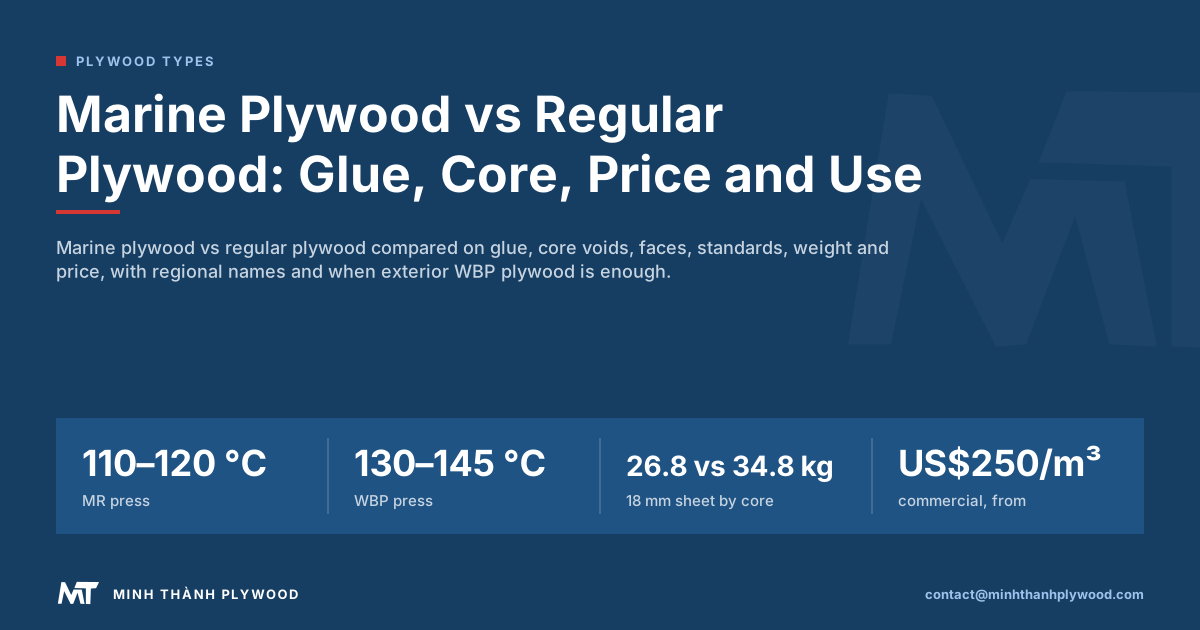
Marine plywood vs regular plywood differs in three things: a phenolic (WBP) glue line that survives boiling and long wet periods, a core without gaps, and faces graded to a marine standard such as BS 1088. Regular plywood covers interior, commercial and exterior grades that cost far less and do most jobs well. This guide compares both and shows when exterior plywood is enough. Minh Thanh Plywood makes interior and exterior plywood in Vietnam.
Marine plywood vs regular plywood: the short answer
Marine plywood vs regular plywood comes down to glue, core and grade: marine plywood has a phenolic (WBP) bond, no core gaps and marine-graded veneers; regular plywood uses the glue, core and faces the job needs and costs much less. Choose marine for boats and parts that stay wet; choose regular plywood for everything else.
- Marine plywood: built to a marine standard such as BS 1088; durable glue line, void-free core, high-grade veneers throughout.
- Exterior plywood: phenolic (WBP) or melamine bond, utility faces, small core gaps allowed. For sheathing, roofs and outdoor parts.
- Interior plywood: UF or MR bond, any face from utility to furniture grade. For furniture, cabinets and dry interiors.
Most outdoor building work needs exterior plywood, not marine. The extra cost of marine buys the void-free core and veneer grades that matter in a hull.
What is the difference between marine plywood and regular plywood?
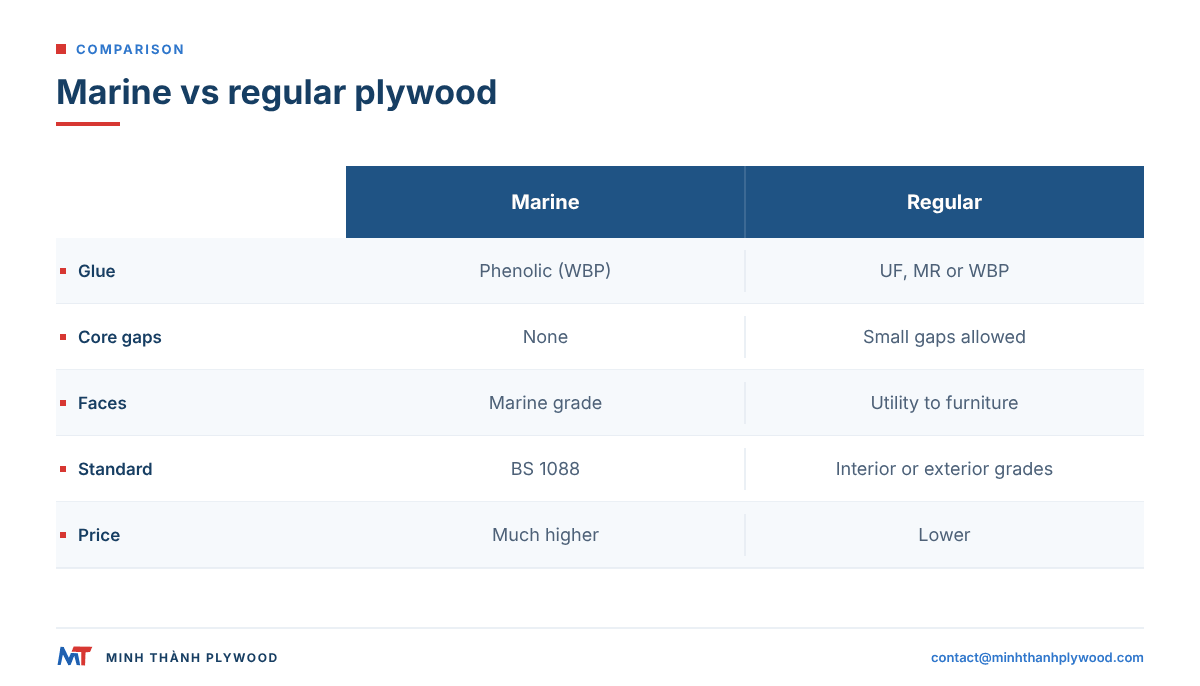
The difference between marine plywood and regular plywood lies in the glue, the core, the veneer grade and the standard behind them. The table compares one property per row.
| Property | Marine plywood | Regular plywood |
|---|---|---|
| Glue | Phenolic (WBP), boil-proof | UF, MR, melamine or phenolic, by grade |
| Core gaps | None allowed | Small gaps allowed by grade |
| Inner veneers | Same high grade as faces | Utility grades in the core |
| Face grade | Marine face, few defects | From utility C/D to furniture grade |
| Species | Okoume, meranti, sapele and similar | Any: birch, poplar, pine, eucalyptus |
| Standard | BS 1088, BS 6566, Lloyd’s approval | Interior, commercial or exterior grades |
| Weight | Often dense hardwood | Light to heavy, by core |
| Price | Much higher | Lower, set by face and glue |
| Best use | Boats, docks, parts that stay wet | Furniture, building, packing, exterior |
What is marine plywood?
Marine plywood is plywood made to a marine standard, with a durable phenolic glue line, no gaps in any ply and veneers of a high grade throughout. BS 1088 is the best-known marine plywood standard; BS 6566 sets the related tests, and Lloyd’s Register approves some marine production.
- Glue: phenolic (WBP) that holds through boiling and long wet periods.
- Core: every inner veneer is solid, with no overlaps or open joints.
- Grades: faces and inner plies are graded, not only the outside.
- Species: in BS 1088 panels, okoume and meranti are the common species.
- Marking: each sheet carries the standard and the maker’s stamp.
The void-free core matters as much as the glue. A gap inside the panel traps water, crushes under a fastener and starts rot from the inside. Our guide to marine plywood grades and the marine plywood buying guide go further.
What is regular plywood?
Regular plywood is any plywood not built to a marine standard: interior, commercial, furniture, packing and exterior grades. Each grade picks the glue, core and faces its job needs, which is why regular plywood costs less.
- Interior plywood: UF glue at E0 emission or MR glue; for furniture, cabinets and wall panels.
- Commercial plywood: utility faces and a sound core for joinery and hidden parts.
- Furniture plywood: fine faces, stitched and calibrated cores, pressed twice.
- Exterior plywood: phenolic (WBP) or melamine-fortified bond with utility C/D faces.
- Packing plywood: a cost-effective core for crates and pallets.
Regular plywood is the right panel for most jobs. A dry wardrobe made in marine plywood costs more and works no better.
Glue: phenolic WBP vs UF and MR
The glue line is the first difference between marine and regular plywood: marine plywood always uses a phenolic (WBP) bond, while regular plywood may use UF, MR or phenolic glue. The glue sets how the panel survives water, not how strong it is when dry.
| Glue | Hot-press range | Water resistance | Used in |
|---|---|---|---|
| UF at E0 emission | Not quoted here | Dry interiors | Furniture, cabinets |
| MR or melamine-fortified | 110–120 °C | Damp interiors, some exterior | Kitchens, formwork |
| Phenolic (WBP) | 130–145 °C | Weather, boiling, wet-dry cycles | Exterior, film-faced, marine |
A long boil test, often 72 hours in the IS 710 and older BS WBP tradition, checks the bond on a sample. It proves the glue line, not the core or the veneer grade, so a boil-proof panel is not marine plywood by that test alone.
Core voids and veneer quality
Marine plywood allows no core voids, and regular plywood allows small gaps whose size depends on the grade. That rule is the reason marine plywood holds fasteners, resists crushing and keeps water out of its centre.
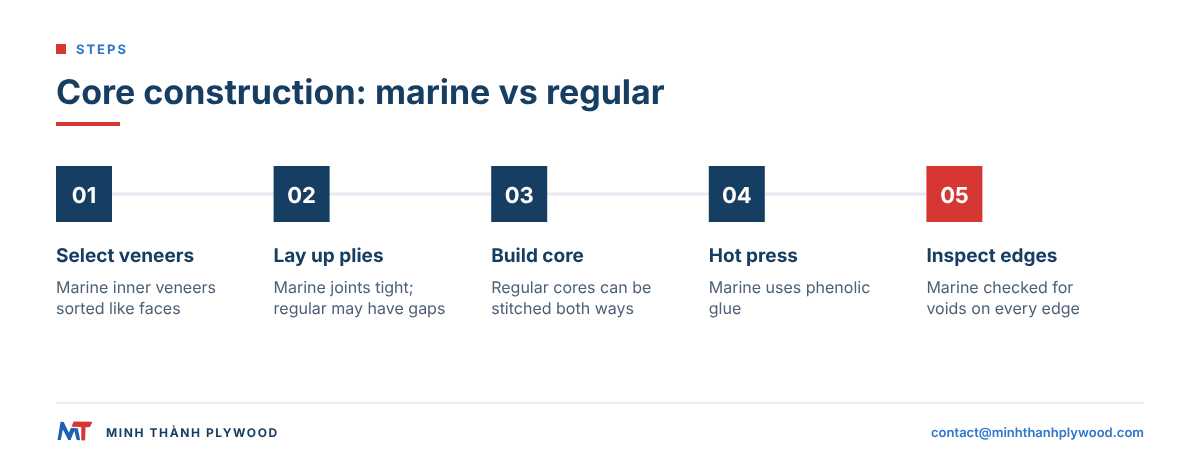
- Veneer selection: marine inner veneers are sorted like faces; regular cores use utility veneers.
- Lay-up: marine veneers are jointed tight; regular cores may have small open joints.
- Core build: stitching core layers both ways keeps a regular panel closed and flat.
- Pressing: both are hot-pressed; marine panels are pressed with phenolic glue.
- Inspection: marine panels are checked for voids on every edge; regular panels by sample.
On our furniture panels, core layers are stitched both horizontally and vertically, and the core board is pressed and calibrated before the faces go on. That closes most gaps, but it does not turn an interior panel into a marine one.
Is hardwood ply the same as marine ply?
No, hardwood ply is not the same as marine ply: hardwood names the species, marine names the build standard. Hardwood marine plywood is a hardwood panel that also meets a marine standard such as BS 1088; most hardwood plywood does not, so check the standard on the panel, not the word hardwood.
What is hardwood marine plywood?
- Hardwood plywood: faces and core from hardwoods such as birch, poplar, okoume or eucalyptus; any glue.
- Hardwood marine plywood: hardwood veneers, usually okoume or meranti, with a phenolic bond and a void-free core to BS 1088.
- Marine plywood vs hardwood plywood in shops: in the UK, Ireland and Australia, “hardwood ply” is the general-purpose sheet, and “marine ply” is the boat-grade sheet beside it.
Ask for the standard on the stamp. A “hardwood exterior” sheet with WBP glue is a good outdoor panel; it is marine plywood only when the stamp says BS 1088 or another marine standard. Our guide to hardwood plywood explains the species.
Marine plywood vs exterior plywood
Marine plywood and exterior plywood can share a phenolic (WBP) glue line, but exterior plywood allows core gaps and utility faces, so it costs less and suits building work rather than boats. That is the main choice buyers in Ireland, Australia and Canada face. In Europe, plywood for dry, humid or exterior conditions is covered by the BSI description of BS EN 636:2012+A1:2015.
| Point | Marine plywood | Exterior plywood |
|---|---|---|
| Glue | Phenolic (WBP) | Phenolic (WBP) or melamine-fortified |
| Core | Void-free | Small gaps allowed |
| Faces | Marine grade | Utility C/D |
| Typical use | Boats, docks, wet parts | Sheathing, roofs, stair treads, hoardings |
| In Australia | AS/NZS 2272 marine | AS/NZS 2271 exterior |
| In Canada and the US | Marine-grade Douglas fir or BS 1088 imports | Exterior and CDX sheathing grades |
| In the UK and Ireland | BS 1088 marine ply | WBP or exterior hardwood ply |
For houses, sheds, fences and signs, exterior plywood with sealed edges and paint is enough. Our guide to exterior plywood grades shows what each face grade allows.
Marine plywood vs waterproof plywood in India and ordinary plywood in the Philippines
Regional names hide the same choice between marine and regular plywood. In India, marine plywood means IS 710 and waterproof plywood usually means a BWP or BWR grade; in the Philippines, ordinary plywood is the interior panel sold against marine plywood.
- India: IS 710 is marine plywood; IS 303 covers general-purpose plywood in MR and BWR grades. “Waterproof” or BWP plywood is often a phenolic-bonded IS 303 panel, sold for kitchens and bathrooms.
- Philippines: “ordinary plywood” is interior commercial plywood; “marine plywood” is the phenolic-bonded panel used for formwork, kitchens, bathrooms and boats.
- Indonesia, Singapore and Malaysia: marine plywood is often meranti in BS 1088 or local exterior grades.
- Cyprus and the rest of Europe: buyers compare BS 1088 marine panels with exterior WBP hardwood plywood.
Ask for the standard and the glue on the invoice, whatever the local name.
Price: what the marine premium buys
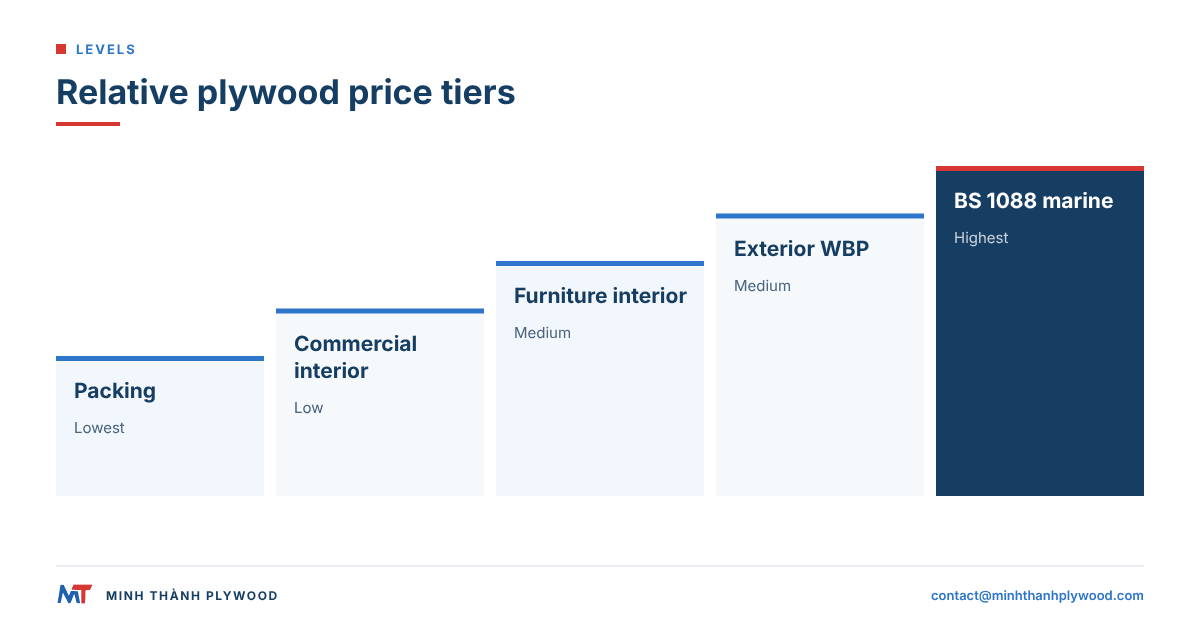
Marine plywood costs much more than regular plywood of the same thickness, because it needs phenolic glue, high-grade veneers in every ply and full inspection for core voids. The premium pays for the core and grades, not for the glue alone.
| Panel | What sets the price | Relative price |
|---|---|---|
| BS 1088 marine | Species, marine veneers, phenolic glue, inspection | Highest |
| Exterior WBP | Phenolic glue, utility faces | Medium |
| Furniture interior | Face species and grade, calibration | Medium |
| Commercial interior | Utility faces, UF or MR glue | Low |
| Packing | Sound core, loose tolerance | Lowest |
As a guide, commercial plywood starts from US$250/m³ and furniture and interior plywood from US$350/m³ (October 2026). Paying marine prices for dry or covered work buys nothing the job uses.
Weight and strength
Marine and regular plywood of the same species and thickness have similar dry strength; marine panels are often heavier only because they use dense hardwoods and have no voids. The core species sets most of the weight.
- Okoume marine: light, about the weight of a white Styrax-core panel.
- Meranti marine: denser and harder; heavier per sheet.
- Regular hardwood plywood: from about 500 kg/m³ on a Styrax core to 650–750 kg/m³ on Eucalyptus.
- Fastener holding: better in void-free panels, because screws do not fall into gaps.
At 18 mm and 1220 × 2440 mm, a Styrax-core panel weighs about 26.8 kg and a Eucalyptus-core panel about 34.8 kg.
When is exterior WBP plywood enough?
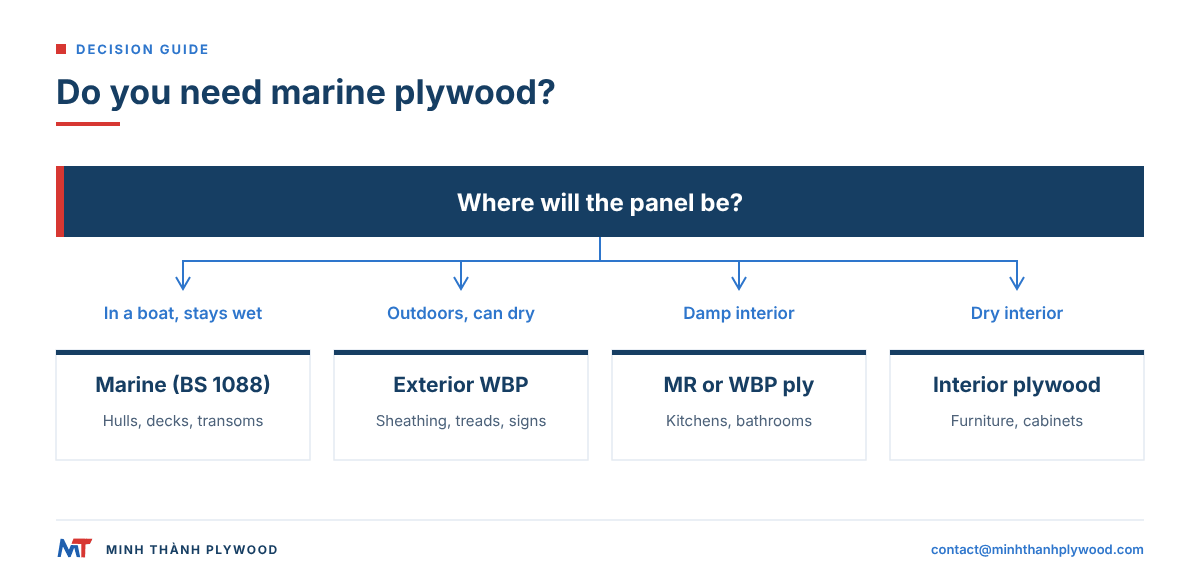
Exterior WBP plywood is enough whenever the panel can dry out between wettings and its edges and faces are sealed. Marine plywood is needed only where the panel stays wet, carries fasteners in wet wood or must not fail at sea.
| Use | Marine needed? | Panel to use |
|---|---|---|
| Boat hulls, decks and transoms | Yes | BS 1088 marine |
| Docks and pontoons | Yes, or treated | Marine or treated exterior |
| Roof and wall sheathing | No | Exterior WBP |
| Outdoor stair treads | No | Exterior WBP, painted |
| Kitchen and bathroom cabinets | No | MR or WBP hardwood plywood |
| Concrete formwork | No | Film-faced plywood |
| Signs and hoardings | No | Exterior WBP, painted |
| Dry furniture | No | Interior furniture plywood |
What are the disadvantages of marine plywood?
The main disadvantages of marine plywood are its price, its weight in dense species and the fact that it still rots if left bare in permanent wet. It is a better boat panel, not an indestructible one.
- Cost: much higher than exterior plywood for the same thickness.
- Weight: meranti and sapele marine panels are heavy to lift and ship.
- Not rot-proof: the glue holds, but the wood still needs a coating and sealed edges.
- Overkill on land: most building and furniture jobs gain nothing from the marine grade.
- Labelling risk: some sheets sold as marine are exterior plywood with a marine name.
Can you stain or paint marine plywood? Finishing and edges
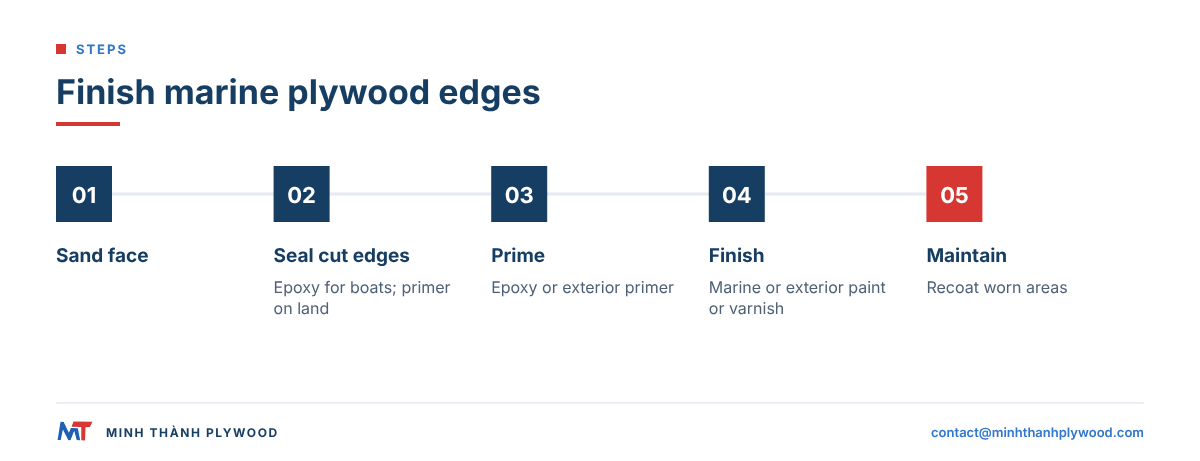
Yes, marine plywood takes stain, varnish and paint well, and every cut edge should be sealed before the face is finished. The same rules apply to exterior regular plywood.
- Sand the face lightly to open it for the finish.
- Seal edges with epoxy on boats, or primer on land.
- Prime with an epoxy primer for boats or an exterior primer for building work.
- Finish with marine paint or varnish afloat, exterior paint or stain on land.
- Maintain by recoating worn areas before the wood greys or cracks.
On boats, builders often sheathe okoume marine plywood in epoxy and glass cloth. See our guide to marine plywood for boat building.
How to tell real marine plywood from relabelled panels
Real marine plywood shows its standard on a stamp, a void-free edge on all four sides and the same veneer quality inside as outside. Check these before you pay marine prices.
- Stamp: BS 1088 or another marine standard and the maker’s name on each sheet.
- Edges: no gaps, overlaps or filler on any edge.
- Inner plies: cut a strip; inner veneers should be as sound as the faces.
- Bond test: a boil test on a strip confirms the phenolic glue line.
- Documents: the invoice names the standard, the glue and the species.
Our guide to the BS 1088 marine plywood standard lists what the standard requires.
What we make: regular plywood with the bond your job needs
Minh Thanh Plywood makes interior, furniture, commercial and exterior plywood, with the glue chosen for the job; we do not sell BS 1088 marine plywood. For outdoor and damp uses, we make exterior plywood with phenolic (WBP) or melamine-fortified bonds and utility C/D faces.
- Exterior plywood: phenolic (WBP) or melamine-fortified glue, C/D faces, for stair treads, wall sheathing and outdoor parts.
- Furniture and interior plywood: UF glue at E0 emission, stitched cores, pressed twice, ±0.2–0.3 mm on sanded panels.
- Emission proof: CARB P2 / TSCA Title VI certified (ICTT mill no. 23024), with chamber results of 0.014–0.032 ppm. The limit for veneer-core hardwood plywood is 0.05 ppm under EPA’s formaldehyde emission limits.
- Sizes: 1220 × 2440 and 1250 × 2500 mm, 3–40 mm.
See our exterior plywood and construction plywood pages.
What to put in your request
For exterior or interior plywood quoted to the right bond, send these lines:
- Application: sheathing, stair treads, kitchens, furniture or another use, and whether it stays wet.
- Core: Acacia or Eucalyptus for exterior, white Styrax or Eucalyptus for furniture.
- Glue and emission: phenolic (WBP), melamine-fortified, MR, or UF glue at E0 emission.
- Face: utility C/D for exterior, or the furniture face and grade pair.
- Size and thickness: 1220 × 2440 or 1250 × 2500 mm, 3–40 mm.
- Packing and quantity: from one 40HC, mixed specifications by agreement.
Production takes 15–45 days after the 30% deposit, and free samples are available.
Buyer questions, answered
What is the difference between marine plywood and regular plywood?
Marine plywood has a phenolic (WBP) bond, a core without gaps and faces graded to a marine standard such as BS 1088. Regular plywood may use interior UF or MR glue, allows small core gaps and is graded for appearance and cost.
Is marine plywood better than regular plywood?
Only for boats and parts that stay wet. For dry furniture, cabinets and covered building work, regular plywood does the same job at a much lower price, and exterior WBP plywood covers most outdoor work.
Is marine plywood the same as exterior plywood?
No. Both can use a phenolic (WBP) bond, but marine plywood also has a void-free core and higher-grade faces and inner plies. Exterior plywood allows core gaps and utility faces, so it costs less.
Is hardwood ply the same as marine ply?
No. Hardwood ply names the species of the faces and core; marine ply names a build standard. A hardwood plywood is only marine plywood when its glue, core and grades meet a marine standard such as BS 1088.
What are the disadvantages of marine plywood?
It costs much more, it is often heavier than lightweight interior panels, and it is not rot-proof. Without sealed edges and a coating, marine plywood still absorbs water and decays in permanent wet.
Can you stain or paint marine plywood?
Yes. Sand lightly, seal the edges, then use an epoxy primer and marine paint or varnish for boats, or exterior paint and stain on land. The smooth marine face takes a clear finish well.
Is marine plywood waterproof?
The glue line of marine plywood is waterproof, but the wood is not. Water still enters through unsealed edges and bare faces, so boats and outdoor parts need epoxy or paint to keep the wood dry.
What is ordinary plywood in the Philippines?
Ordinary plywood is the local name for interior, commercial-grade plywood, sold against marine plywood for wet use. Marine plywood is used there for formwork, kitchens and bathrooms as well as boats.
Is marine plywood heavier than regular plywood?
Usually, because marine panels use dense hardwoods such as meranti and have no core gaps. Okoume marine plywood is the light exception and weighs less than many hardwood-cored regular panels.