
Plywood can be recycled: clean waste plywood is chipped and pressed into particleboard, and mixed or coated plywood becomes biomass fuel. It does not go back into new plywood, which is peeled from logs. Minh Thanh Plywood explains the waste wood grades, the steps, reuse first, and how buyers order sizes that leave fewer offcuts.
Can plywood be recycled?
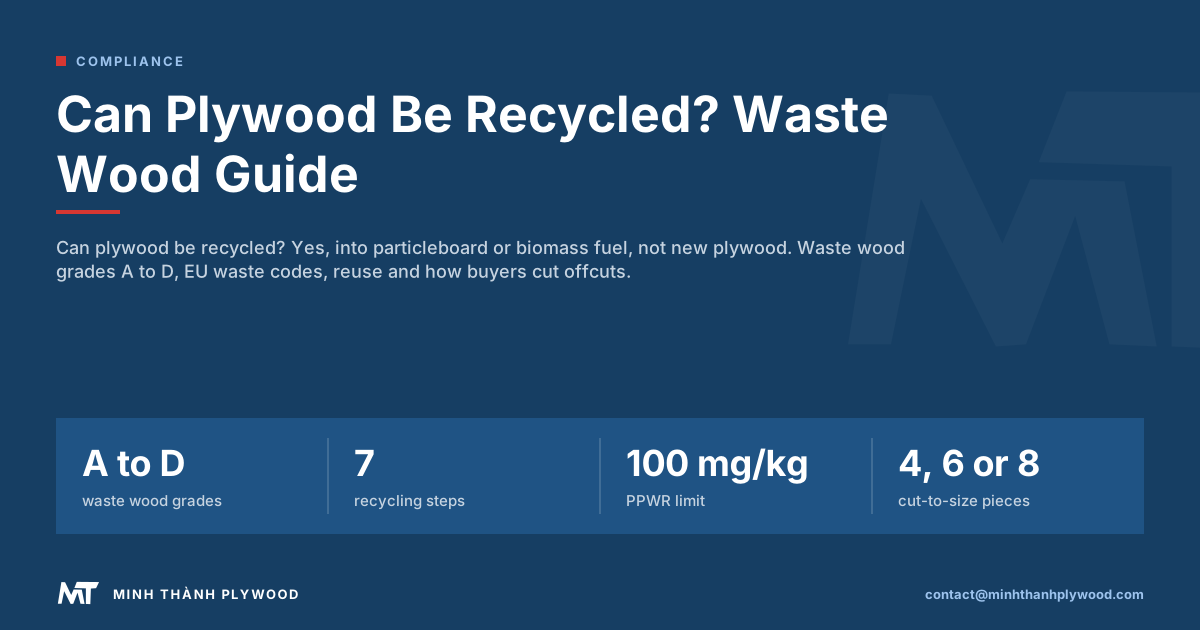
Yes, plywood can be recycled, but not back into plywood. Clean waste plywood is shredded into chips that particleboard plants press into new panels; plywood that is painted, film-faced or mixed with other waste is burned as biomass fuel to make heat and power. Before either, plywood can often be reused as it is.
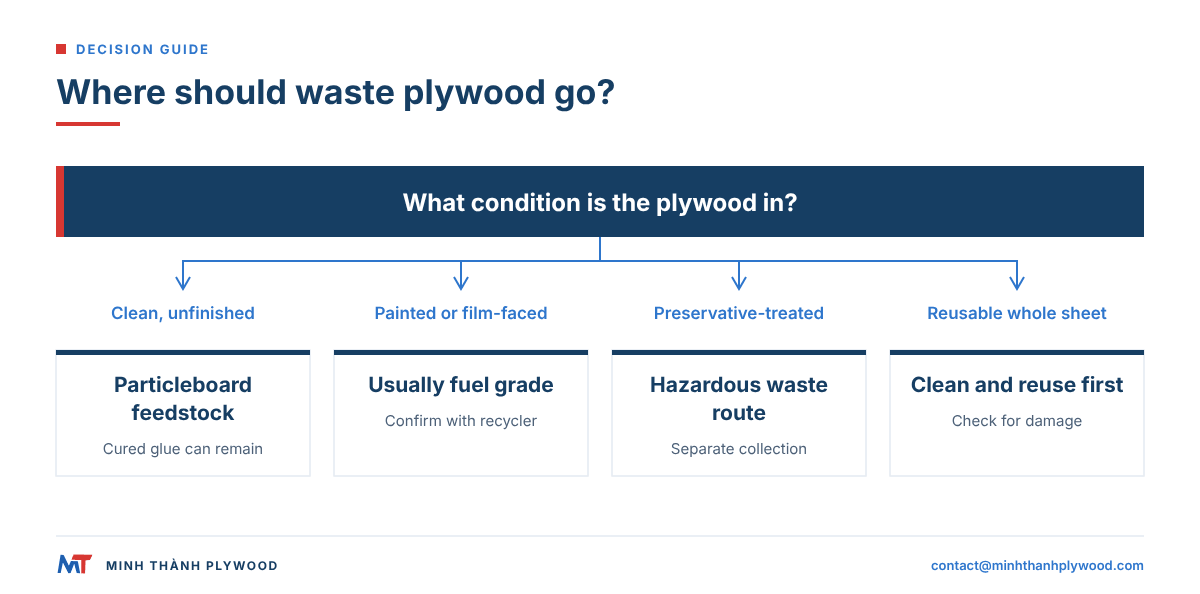
What it becomes depends on how clean it is. A clean offcut from a furniture plant is a raw material; a painted sheet from a demolition skip is fuel; plywood treated with wood preservatives is hazardous waste with its own route. Sorting decides the value, and the sorting is done by waste wood grade.
Is plywood made from recycled wood?
No, plywood is not made from recycled wood. Every ply is a veneer peeled from a log on a rotary lathe, dried and glued with its grain crossing the next one. Chips from waste wood cannot be peeled into veneer, so recycled wood goes into particleboard and fibreboard, the panels made from particles and fibres.
Minh Thanh plywood is made from fresh veneer. Furniture panels use white Styrax or Eucalyptus cores as standard, from plantation timber grown locally around Ha Hoa in Phu Tho province, with face veneers chosen for the look the buyer orders. Acacia and Pine cores are made on order.
What carries over from the forest to the panel is traceability, not recycled content: we supply the EUDR compliance dossier, with origin records and geolocation files, with orders. Our EUDR traceability page shows what it contains.
How plywood recycling works, step by step
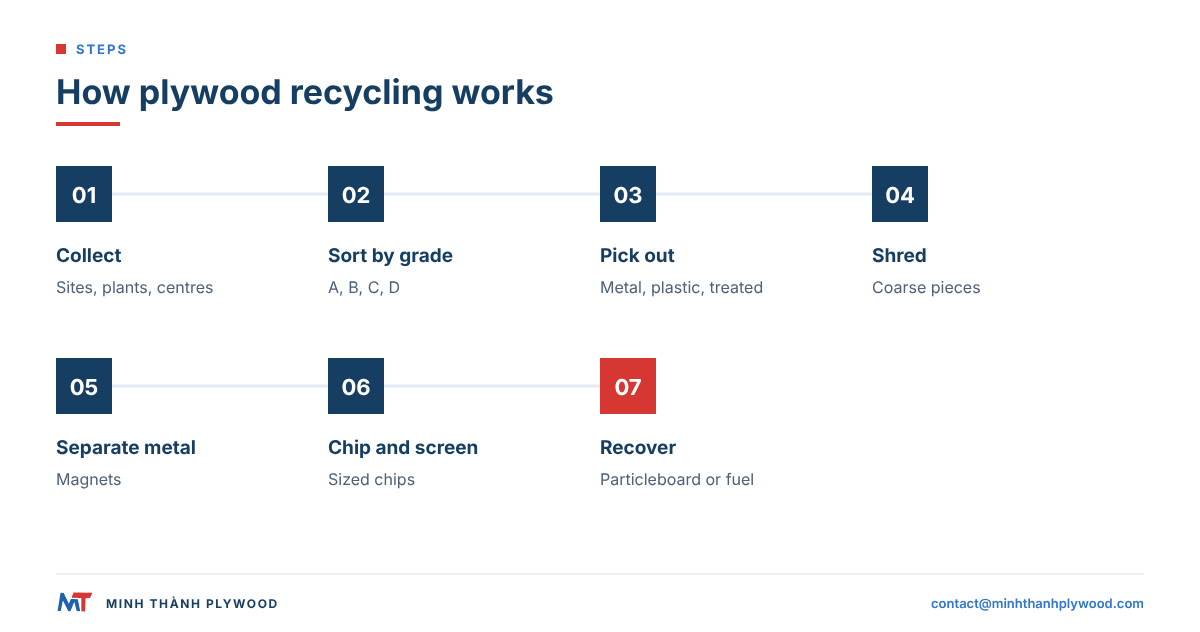
Plywood recycling follows the same route as other waste wood. At a wood recycling plant it runs in seven steps:
- Collection. Waste plywood arrives from construction sites, furniture and joinery plants, packaging returns and household recycling centres.
- Sorting by grade. Loads are inspected and separated into clean, industrial, fuel and hazardous grades.
- Removing contaminants. Large metal, plastics, stone and treated pieces are picked out before shredding.
- Primary shredding. Sheets and offcuts are broken into coarse pieces.
- Metal separation. Magnets and eddy-current separators pull out nails, screws and hinges.
- Screening and chipping. The material is sized into chips for the buyer: particleboard plants or biomass boilers.
- Recovery. Clean grades go into particleboard; the rest is burned for energy under emission controls.
The steps are mechanical. Glue lines in plywood do not have to be removed: the cured resin goes with the chips into particleboard feedstock or burns with the wood.
Waste wood grades: where plywood sits
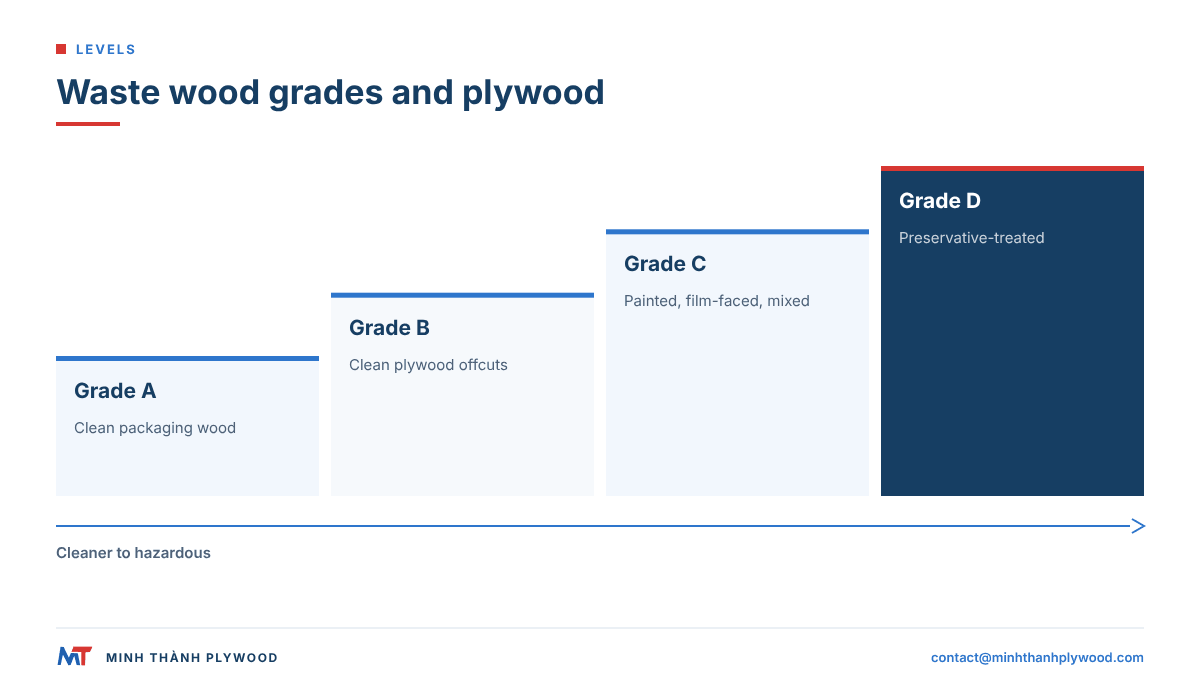
Waste wood in the UK is graded A to D under the grading used by wood recyclers, and plywood falls into Grade B or C in most cases. The grade sets where the wood can go.
| Grade | Name | Typical sources | Where it goes | Plywood that lands here |
|---|---|---|---|---|
| A | Clean recycled wood | Pallets, packaging, distribution waste | Animal bedding, panelboard, mulch | Rarely: solid wood only in most streams |
| B | Industrial feedstock | Grade A plus construction and demolition wood | Panelboard (particleboard) | Clean plywood offcuts and sheets |
| C | Fuel grade | Recycling centres, mixed collections, panel products | Biomass fuel | Painted, film-faced or mixed plywood |
| D | Hazardous | Fence posts, sleepers, preservative-treated wood | Hazardous waste routes | Preservative-treated plywood |
In the EU the same material is identified by waste codes from the European List of Waste, Decision 2000/532/EC (checked 20 October 2026). The codes are 03 01 05 for sawdust, shavings, cuttings, wood, particle board and veneer from wood processing; 15 01 03 for wooden packaging; 17 02 01 for wood from construction and demolition; 20 01 38 for municipal wood. Codes marked with an asterisk, such as 03 01 04*, are for wood that contains hazardous substances.
Does glue, film or paint stop plywood being recycled?
Glue does not stop plywood being recycled; coatings and treatment decide its grade. Particleboard plants take clean panel waste with cured adhesive in their feedstock, so an unfinished UF-bonded furniture panel offcut is a good raw material.
The surface changes the route:
- Unfinished or lacquered furniture plywood: usually industrial feedstock for particleboard.
- Painted, laminated or melamine-faced plywood: often fuel grade, depending on the recycler.
- Film-faced plywood: the phenolic film makes it fuel grade in most streams.
- Preservative-treated plywood: hazardous grade, separate collection.
Formaldehyde-based glues are part of every grade’s normal feedstock. Minh Thanh furniture panels use UF glue at E0 emission, and six ASTM D6007 chamber tests between April 2025 and June 2026 averaged 0.014–0.032 ppm against the 0.05 ppm CARB Phase 2 limit, so the offcuts a furniture plant sends back into the wood stream start from a low-emission panel.
What happens to plywood mill waste?
Plywood mills produce waste at every stage, and almost all of it is used again. The by-products are the same in every veneer mill:
| Stage | By-product | Usual use |
|---|---|---|
| Log peeling | Peeler cores, the round centre left on the lathe | Sawn into small timber, pallet blocks, or chipped |
| Veneer clipping and drying | Clippings, broken and off-size veneer | Patched into core layers, or chipped and burned |
| Trimming the pressed panel | Edge trims | Chipped, or burned for heat |
| Sanding | Sanding dust | Burned in the boiler that heats dryers and presses |
| Grading | Rejected panels | Cut down for packing plywood or small parts |
The heat side matters most. Veneer dryers and hot presses need a lot of heat, and mills burn their own trims and dust to make it. Hot pressing runs at about 110–120 °C for melamine-fortified (MR) bonds and 130–145 °C for phenolic (WBP) bonds, and wood waste is the normal fuel for that heat in a veneer mill.
Reclaimed plywood: reuse before recycling
Reclaimed plywood is used plywood taken back into service as it is, without shredding, and it is the first choice in the waste hierarchy. Whole sheets from site hoardings, exhibition stands, shop fit-outs and formwork can be cleaned, cut down and used again.
Reuse works best for:
- Formwork panels retired from walls and slabs, cut down for smaller pours, site boxes and protection boards.
- Crates and transport frames, reused within a supply chain.
- Event and shop fit-out panels, refinished for the next build.
- Large furniture offcuts, used for drawer bottoms, backs and jigs.
The limits are moisture damage, delamination and old fixings. A reclaimed sheet with an open glue line or a soft edge is fuel, not a building material.
How to make use of waste plywood in a furniture plant
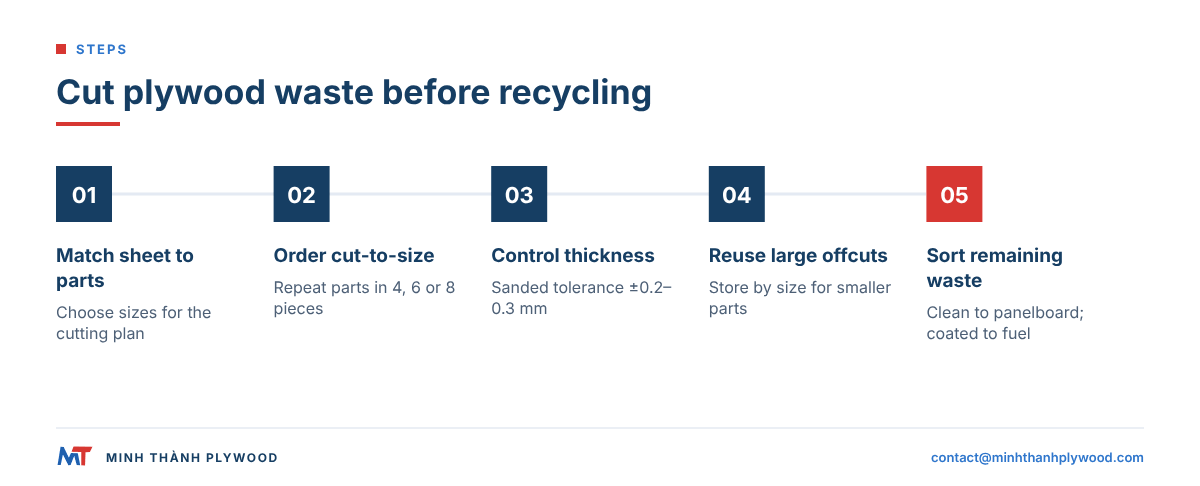
A furniture or cabinet plant cuts its plywood waste at three points: the order, the cutting plan and the offcut rack. In practice:
- Order the size your parts need. Minh Thanh supplies 1220 × 2440 and 1250 × 2500 mm sheets and custom sizes such as 1220 × 2500 and 1220 × 2280 mm, so the panel fits the cutting plan instead of the other way round.
- Order cut-to-size where the parts repeat. One panel cut into 4, 6 or 8 pieces arrives ready to machine, and the mill’s trims stay at the mill.
- Hold the thickness tolerance. Sanded panels held to ±0.2–0.3 mm need less re-sanding and give fewer rejects at edging and laminating.
- Keep an offcut rack by size. Large offcuts become small parts, backs, drawer bottoms and jigs.
- Send the rest by grade. Clean offcuts go to a panelboard recycler; coated ones go to fuel.
Our furniture plywood is double pressed and calibrated for this kind of production, which keeps rejects low before any waste is sorted.
How to recycle plywood from a site or a workshop
To recycle plywood, keep it clean, dry and separate from other waste, then hand it to a waste wood collector or a recycling centre’s wood container. On a building site or in a workshop the routine is:
- Set up two wood containers: one for clean, unfinished plywood and solid wood, one for painted, film-faced and laminated pieces.
- Keep treated wood out: preservative-treated plywood and timber go to a separate hazardous collection.
- Pull out large fixings: hinges, brackets and long screws come out by hand; nails and small screws are removed at the plant.
- Keep it dry: wet, mouldy wood is downgraded or refused for panelboard.
- Ask the collector for the grade and the route: panelboard, fuel or hazardous, and keep the waste transfer notes.
Households take plywood to the wood container at a recycling centre; it does not go in the kerbside recycling bin. A furniture plant that produces clean offcuts every week can often sell them as feedstock instead of paying for collection.
Can plywood be composted or used as mulch or animal bedding?
No, plywood should not be composted or used as garden mulch or animal bedding. These uses take clean, untreated solid wood, mostly Grade A from pallets and packaging, because the material ends up in soil or in contact with animals. Plywood contains cured glue lines, and coated or treated plywood carries finishes the recycler cannot see in a chip.
Plywood shavings from a joinery shop belong with the clean panel waste for particleboard or with the fuel grade, not in a garden. The same rule applies to sanding dust from plywood: it goes to the wood waste stream, where mills and boilers use it as fuel.
Wood recycling of plywood packaging
Plywood used as packaging, in pallets, crates, pallet tops and blocks, goes into the wood recycling stream as wooden packaging, waste code 15 01 03 in the EU. Packing plywood is the grade most often reused, because crates and pallets go back into service before they are scrapped.
Packaging also has its own EU rule. The Packaging and Packaging Waste Regulation, Regulation (EU) 2025/40 (checked 20 October 2026), applies from 12 August 2026 and limits the sum of lead, cadmium, mercury and hexavalent chromium in packaging to 100 mg/kg. Minh Thanh’s packaging materials, cardboard, plywood and pallet blocks, strapping band and wrapping film, were tested by SGS in September 2026: none of the four metals was detected and all four materials passed. The PPWR packaging page shows the report.
Plywood itself is a processed wood product, so ISPM 15 heat treatment marks are not needed on plywood packaging; solid wood bearers and pallet bases still need them.
Waste wood rules in the EU: the waste hierarchy
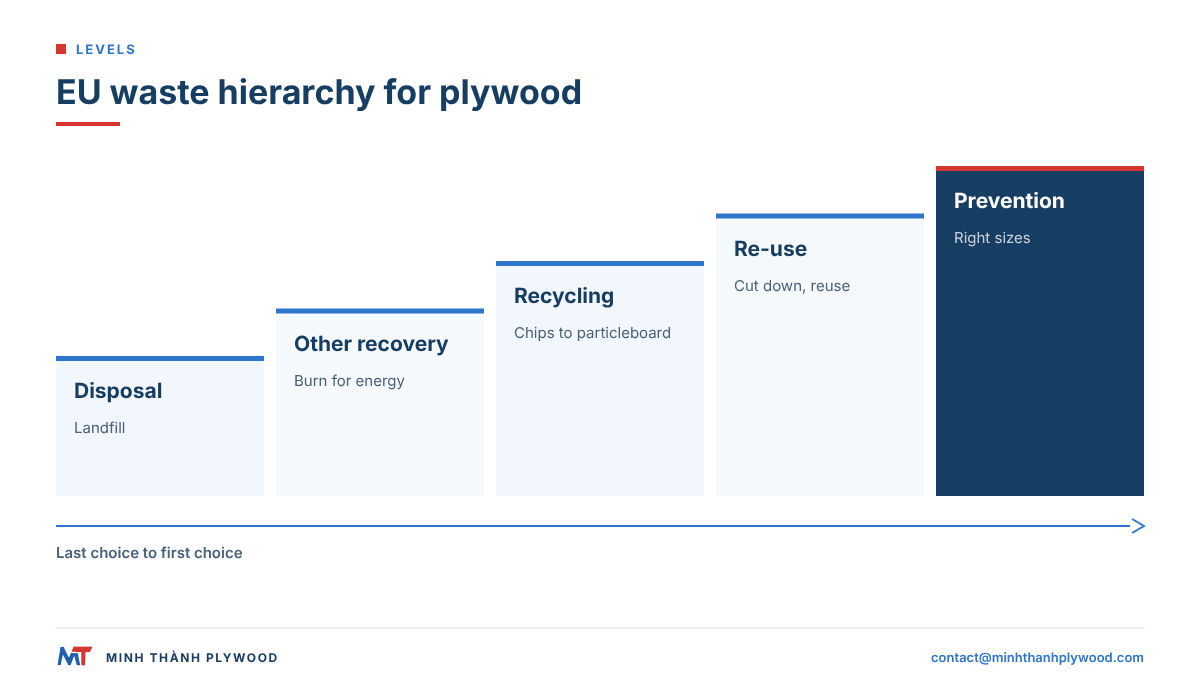
EU waste law ranks what to do with waste plywood in a fixed order. The Waste Framework Directive 2008/98/EC (checked 20 October 2026) sets the hierarchy:
- Prevention: less waste at the source, through sizes and cutting plans.
- Preparing for re-use: cleaning and cutting down reclaimed plywood.
- Recycling: chips into particleboard.
- Other recovery: burning for energy.
- Disposal: landfill, the last option.
Member states set their own rules on top, from landfill bans on wood to targets for packaging recycling. For a plywood buyer the hierarchy translates into a simple order of questions: can we order less waste, can we reuse it, who takes it as feedstock, and only then who burns it.
Wood recycling vs burning: which is better for plywood?
Recycling plywood into particleboard ranks above burning it, because the wood stays in a product and keeps its carbon stored; burning releases that carbon and gives heat once. Energy recovery still ranks above landfill, where the wood gives nothing back.
The choice is made by the grade, not by preference. Clean plywood goes to recycling when a panelboard plant is within reach; coated, mixed and contaminated plywood goes to energy. A buyer moves material up the hierarchy by keeping clean offcuts apart from coated ones at the plant.
Is plywood a good choice if waste matters to your buyers?
Plywood is a good choice when waste matters, for three practical reasons: it lasts, it can be cut down and reused, and at the end its clean waste is feedstock for other panels. Its weak point is coated and treated plywood, which ends up as fuel.
The questions to ask a mill are concrete: where the timber comes from and with what records, what glue and emission class the panel has, what sizes and cut-to-size options cut your offcuts, and what the packaging is made of. Minh Thanh answers them with the EUDR dossier, the UF glue at E0 emission and chamber test results, the size list above, and the SGS packaging test. Our guide to EN 13986 and CE marking and the article on plywood strength values cover the other documents buyers ask for.
What to write in your RFQ to cut plywood waste
Write the sizes, the cutting and the documents into the RFQ, so less waste reaches your plant:
18 mm, cut-to-size from 1220 × 2440 mm into 6 pieces; face/back: poplar A/B; core: Styrax; UF glue at E0 emission; thickness ±0.3 mm; EUDR dossier and SGS packaging test with the shipping documents; 1×40HC CIF your port.
Minh Thanh sends free samples and replies within hours: [email protected] or WhatsApp +84 988 586 601.
Buyer questions, answered
Can plywood be recycled?
Yes. Clean waste plywood is chipped and used as raw material for particleboard, and mixed or coated plywood is burned as biomass fuel. It is not made back into new plywood.
Is plywood made from recycled wood?
No. Plywood is made from veneers peeled from logs and glued in crossed layers. Recycled wood chips cannot be peeled, so they go into particleboard, not plywood.
Can you put plywood in the recycling bin?
Not in household recycling. Take plywood to a recycling centre's wood container or a waste wood collector, who sorts it by grade; painted or film-faced pieces usually go to the fuel grade.
Which waste wood grade is plywood?
Under the UK grading used by wood recyclers, clean plywood offcuts are usually Grade B, industrial feedstock, and plywood in mixed loads from demolition or recycling centres is Grade C, fuel. Preservative-treated plywood is Grade D, hazardous.
Can film-faced plywood be recycled?
It can be recovered, not recycled into panels in most cases: the phenolic film and glue make it a fuel-grade waste wood. Reusing it first, cut down from formwork to smaller jobs, keeps it in use longer.
Does the glue in plywood stop it being recycled?
Not on its own. Particleboard plants accept panel waste with cured adhesive in their feedstock grades. Coatings, metal fixings and preservative treatment decide the grade more than the glue does.
What happens to plywood mill waste?
Peeler cores, veneer clippings, panel trims and sanding dust are by-products of every plywood mill. They are used again as small parts, sold as chips, or burned to heat veneer dryers and presses.
How can I make use of waste plywood?
Reuse large offcuts for small parts, jigs, drawer bottoms or packing blocks, and send the rest to a waste wood collector by grade. Ordering panel sizes that fit your cutting plan cuts the waste at the source.
Is plywood packaging recyclable under the EU PPWR?
Plywood pallet tops, crates and blocks are wood packaging and go to the wood recycling stream. Minh Thanh's packaging materials were tested by SGS in September 2026 under the PPWR heavy-metal limit of 100 mg/kg and passed.
Is burning waste plywood better than landfill?
Yes, under the EU waste hierarchy energy recovery ranks above disposal. Recycling into particleboard and reuse rank above energy recovery, because the wood stays in use.