
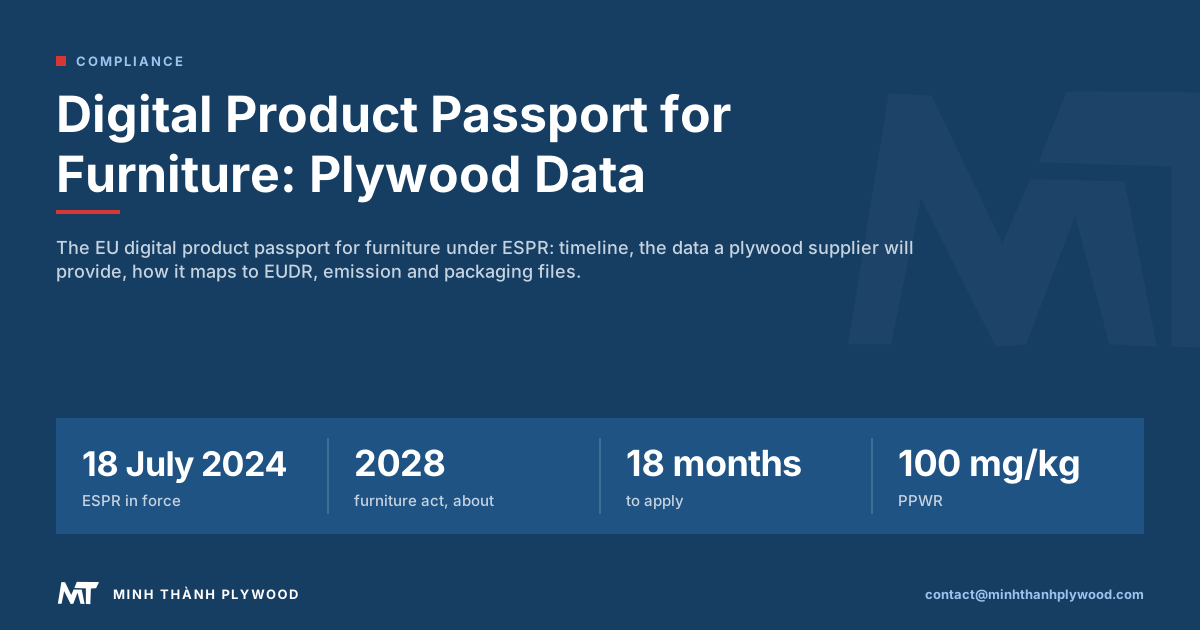
A digital product passport for furniture is the product record the EU ecodesign regulation (ESPR) will require, read from a QR code. Furniture is a priority group, with its rules expected around 2028; plywood enters as a material. Minh Thanh Plywood already holds most of the data: EUDR origin files, emission tests, packaging test.
What is the EU digital product passport for furniture?
The EU digital product passport for furniture is a digital record of a furniture product, opened from a data carrier such as a QR code, that will hold its identity, materials, substances of concern and information on use, repair and end of life. The company that places the furniture on the EU market creates it.
Buyers, repairers, recyclers and market authorities read it.
The legal basis is the EU ecodesign regulation for products, Regulation (EU) 2024/1781 (ESPR; checked 20 October 2026). ESPR is a framework: product-specific ecodesign and passport requirements are set through delegated acts, which specify the passport data and any applicable exemptions.
For furniture made from plywood, the panels are a large part of the product. The passport will therefore ask about the wood, the glue and the emission behaviour of the boards inside, which is data the plywood mill holds.
When does ESPR apply to wood products?
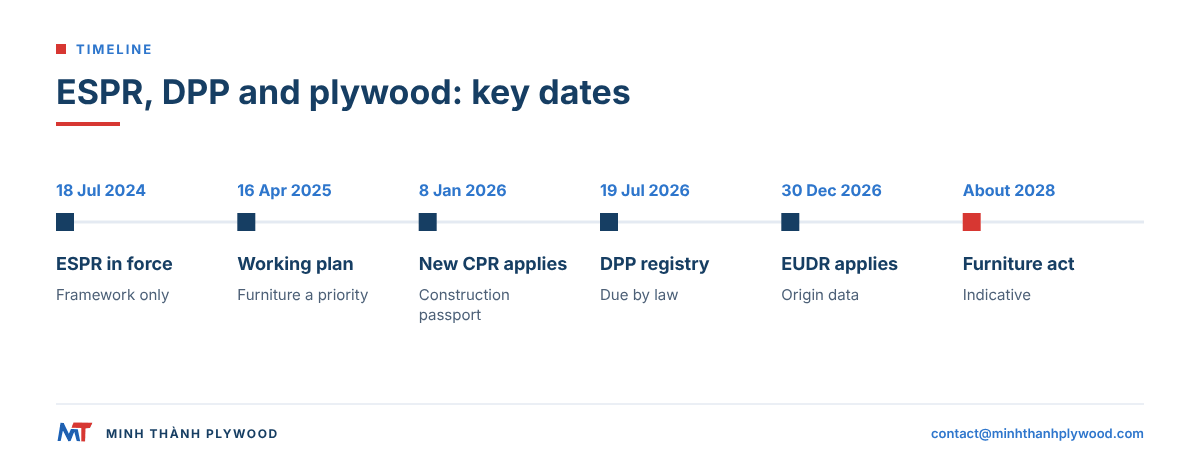
ESPR has been in force since 18 July 2024, but it applies to wood products only through product-group rules, and none has been adopted for furniture or wood panels yet. The dates that matter for a furniture or plywood buyer are:
| Date | Step | What it means for plywood |
|---|---|---|
| 18 July 2024 | ESPR enters into force | Framework only; no product rules yet |
| 16 April 2025 | First ESPR working plan, 2025–2030 | Furniture and mattresses listed as separate priority product groups |
| 8 January 2026 | New Construction Products Regulation applies | A passport for construction products becomes possible, per product family |
| 19 July 2026 | EU digital product passport registry due | The registry that passports link to |
| 30 December 2026 | EUDR applies to plywood importers | Origin and geolocation data become mandatory per shipment |
| About 2028 (indicative) | Furniture delegated act expected | Sets the furniture passport fields |
| At least 18 months later | Furniture rules apply | Passport needed on furniture placed on the EU market |
The furniture date is the Commission’s indicative plan, not law. Until the act is adopted, no plywood or furniture product needs a passport under ESPR.
Is there an ESPR digital product passport for wood?
There is no ESPR digital product passport for wood or wood panels today, and the first working plan does not list plywood as a product group. Its intermediate products are iron, steel and aluminium; its final products include furniture, mattresses, textiles and tyres.
Wood enters the passport through the products made from it. A cabinet, a wardrobe or a desk built from plywood will carry the furniture passport, and the furniture maker will fill the material lines from its panel suppliers. That makes plywood data a supplier obligation in practice, set by contract and the buyer’s own compliance, before any rule names plywood directly.
DPP for plywood: furniture panels and construction panels
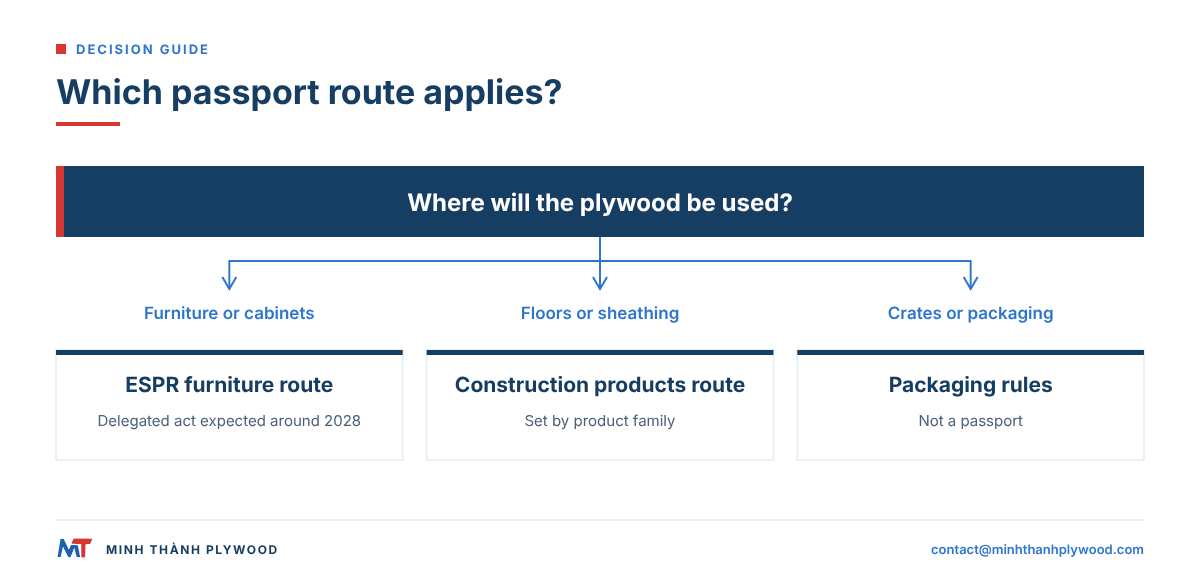
A plywood panel can meet the passport by two routes, depending on its use. Furniture and interior plywood feeds the furniture passport under ESPR; construction plywood can get its own passport under the new Construction Products Regulation, Regulation (EU) 2024/3110, applying since 8 January 2026 (checked 20 October 2026).
| Plywood use | Rule | Who holds the passport | Status |
|---|---|---|---|
| Furniture, cabinets, interior fittings | ESPR furniture delegated act | The furniture manufacturer or importer | Act expected around 2028 |
| Construction: floors, sheathing, structural parts | Construction Products Regulation (EU) 2024/3110 | The panel manufacturer, with the declaration of performance and conformity | Set per product family under the new regulation |
| Packaging, crates | Packaging rules, not a passport | – | PPWR applies from 12 August 2026 |
For construction plywood, the CE marking and Declaration of Performance under EN 13986 remain the documents today; our guide to EN 13986 and CE marking explains them.
What data will a plywood supplier have to provide?
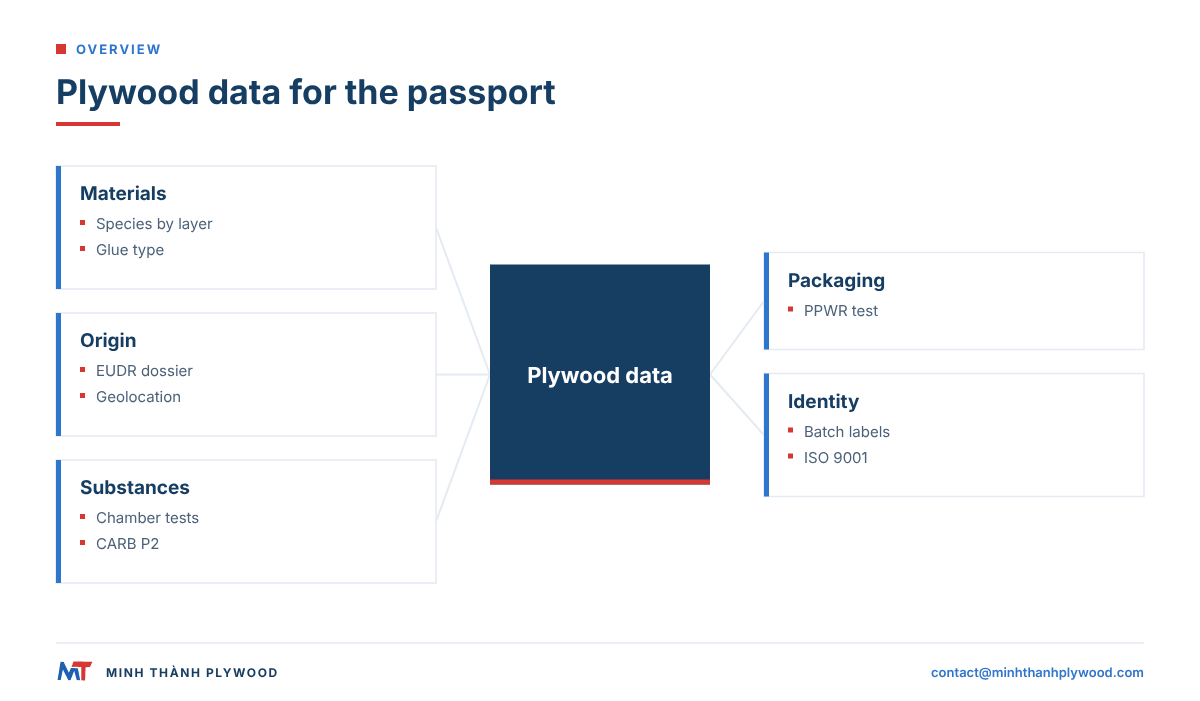
A plywood supplier will provide the material data the furniture passport needs: what the panel is made of, where the wood comes from, what it emits, how it is packed and who made it. ESPR’s general list of passport information, and the files plywood buyers already ask for, point to these fields:
| Likely passport field | What it means for plywood | Document a mill holds today |
|---|---|---|
| Unique product and operator identifiers | Panel type, batch and mill | Order specification, pack labels, invoice |
| Materials | Face, core and back species, glue type, thickness and build | Species statement per order |
| Origin of the wood | Country of harvest and production plots | EUDR compliance dossier: origin records and geolocation files |
| Substances of concern | Formaldehyde emission | Chamber test reports, emission certificate |
| Compliance documentation | Rules the panel meets | CARB P2 / TSCA Title VI certificate, test reports |
| Packaging | Materials and heavy-metal content | PPWR test report |
| Quality management | How production is controlled | ISO 9001 certificate |
| End-of-life information | How the panel can be recovered | Panel type and coating, for the recycler’s grade |
The exact list will come from the furniture delegated act. A mill that already holds these files per order will map them, not create them.
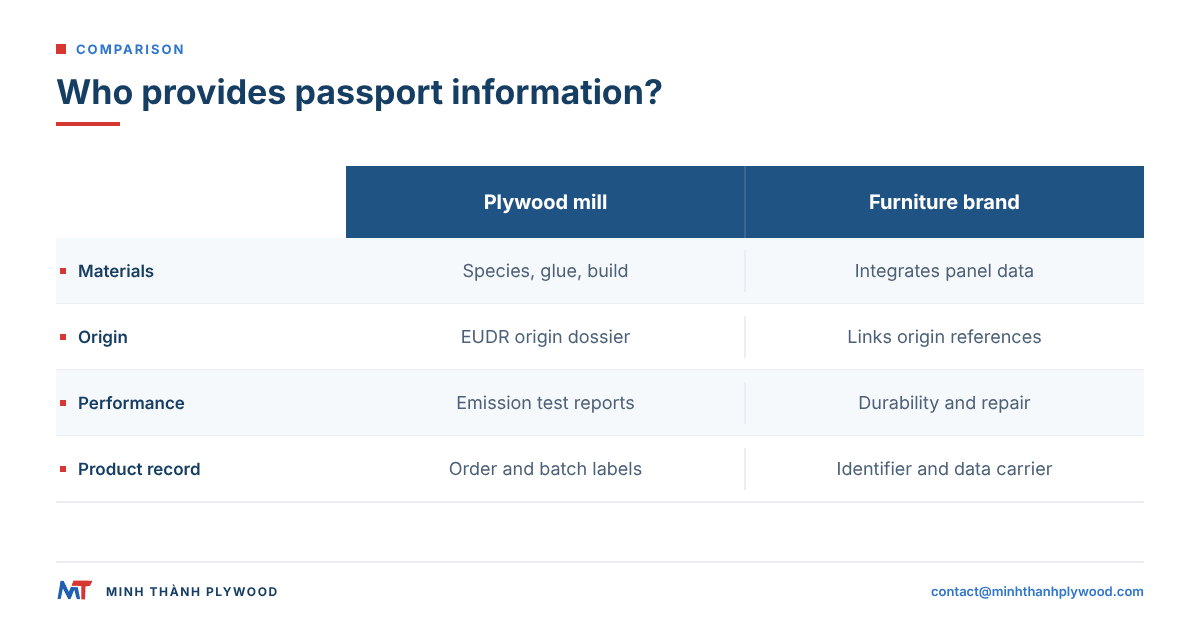
What the furniture brand must add on top of plywood data
The plywood mill supplies the material file; the furniture brand owns the passport and must add the product-level data a panel does not carry. A US, UK or Asian brand selling into the EU is in the same position as a European one: the passport applies to every product placed on the EU market, wherever it is made.
| Passport block | Who holds the data | What the brand adds |
|---|---|---|
| Durability and reparability | Furniture brand | Load and cycle test results, spare parts, repair instructions, disassembly steps |
| Recyclability and recycled content | Furniture brand, with mill data on panel and coating | Share of recycled material, how the panel and fittings separate at end of life |
| Lifecycle information | Furniture brand | Use, care and take-back information, plus the environmental footprint if the delegated act asks for it |
| Material and substance data | Plywood mill | Species, glue, emission class and test reports, which the brand copies in |
| Origin and due diligence | Plywood mill | EUDR dossier references, which the brand links |
| Who hosts the record | Furniture brand | A product information system (PIM or ERP) that holds the record, a QR code or other data carrier on the product, and a unique product identifier |
Data access is tiered. ESPR lets the delegated act decide which fields the public, customs, market authorities and repairers can read; trade secrets stay restricted. A brand therefore does not publish its supplier’s price or recipe: it publishes the fields the act lists and keeps the rest behind access rights.
A mill that sends its files per order, tied to a panel type and batch, lets the brand load them into the PIM without re-keying. That is the practical test when comparing plywood suppliers.
DPP vs EPD: what is the difference?
| Digital product passport (DPP) | Environmental product declaration (EPD) | |
|---|---|---|
| Legal status | Mandatory for product groups covered by a delegated act under ESPR | Voluntary, unless a buyer, tender or building scheme asks for it |
| What it is | A structured product record read through a QR code or similar carrier | A verified life-cycle assessment report for one product or product family |
| Content | Identity, materials, substances, durability, repair, recycling, origin | Environmental impacts such as global warming potential, from a life-cycle assessment |
| Standard behind it | Delegated act per product group | ISO 14025 and, for construction products, EN 15804 |
| Furniture timing | Furniture act about 2028, enforcement about 2030 (indicative) | Available today |
An EPD can feed the passport as one of its data sources, but it does not replace it. A supplier with an EPD still has to deliver the structured fields once the furniture act is adopted.
How passport data flows from the plywood mill to the furniture maker
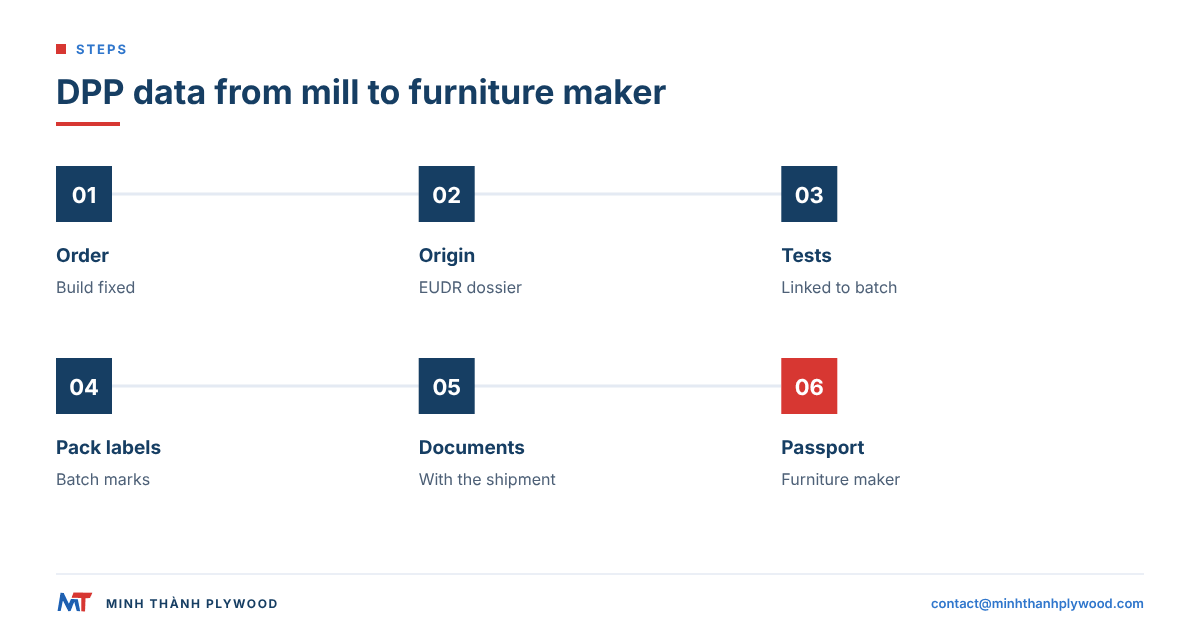
Passport data for plywood starts at the mill and moves with the order, in this sequence:
- The order fixes the build. Face, core, glue, emission class, thickness and size are written in the RFQ and the confirmed specification.
- The mill records the origin. Species and production plots of the timber are filed for the EUDR dossier.
- Production is tied to tests. Emission and other test reports are linked to the panel type and the batch.
- Packs are labelled. Each pack carries the product, thickness, batch and buyer marks.
- Documents go with the shipment. Invoice, packing list, the EUDR dossier and the certificate files reach the importer.
- The furniture maker builds the passport. It adds the panel data to its own product data and publishes the record behind the data carrier.
Steps 1 to 5 are what a plywood importer receives today. The passport adds step 6 and a common format, not new facts about the panel.
Formaldehyde data: the substance line in the passport
Formaldehyde emission is the substance line a plywood-based furniture passport is most likely to carry, because the EU already limits it. Since 6 August 2026, Regulation (EU) 2023/1464 (REACH Annex XVII, entry 77; checked 20 October 2026) bans placing furniture and wood-based articles on the EU market if their emission exceeds 0.062 mg/m³ under the regulation’s test conditions.
Minh Thanh furniture plywood uses UF glue at E0 emission. We hold CARB P2 / TSCA Title VI certification (ICTT mill no. 23024). Six ASTM D6007 chamber tests on 9, 15 and 18 mm panels between April 2025 and June 2026 averaged 0.014–0.032 ppm against the 0.05 ppm limit; three were run by Shanghai Hongjun and three by ICTT Vietnam. Third-party testing to the buyer’s method, such as EN 717-1, is arranged through SGS on request.
For the passport, keep each report with the panel type and batch it covers. A test result without the panel build is a weak data line; with the build, it is the evidence. Our CARB P2 and TSCA Title VI page lists the reports.
Origin data: DPP and EUDR use the same file
The origin data a passport will ask for is the data the EU Deforestation Regulation already requires: species, country of production and the geolocation of the production plots. From 30 December 2026, Regulation (EU) 2023/1115, as amended by Regulation (EU) 2025/2650 (checked 20 October 2026), requires plywood importers to submit a due diligence statement before customs entry.
The two instruments do different jobs. The EUDR statement proves the wood is deforestation-free and legal for one placing on the market; the passport describes the product for its whole life. The file behind both is one origin dossier, so a buyer who has it per shipment for EUDR has the passport’s origin lines too. Vietnam is classed as low risk in Implementing Regulation (EU) 2025/1093, which allows simplified due diligence.
Minh Thanh supplies the EUDR compliance dossier, origin records and geolocation files, with orders. Plywood cores come from Vietnamese plantation timber; face veneers are chosen for the look the buyer orders, and every species in the panel, face and core, is in the file. The EUDR traceability page shows the structure.
Packaging data: the PPWR test
Packaging is the part of a plywood shipment that already has an EU product rule with a test limit. The Packaging and Packaging Waste Regulation, Regulation (EU) 2025/40 (checked 20 October 2026), applies from 12 August 2026 and limits lead, cadmium, mercury and hexavalent chromium in packaging to 100 mg/kg combined.
Minh Thanh’s four packaging materials, cardboard, plywood and pallet blocks, strapping band and wrapping film, were tested by SGS in September 2026 under that regulation: none of the four metals was detected, and all four passed. The report covers the packaging, not the panels, and it is the file a buyer’s packaging data line will point to. The PPWR packaging page shows it.
How to choose a plywood supplier ready for the digital product passport
A plywood supplier is ready for the passport when it can send, for each order, a complete data file that matches the panels in the container. Check these points before you choose:
- Species by layer: face, core and back, with scientific names, in the order confirmation.
- Origin dossier: EUDR origin records and geolocation files for every species in the panel.
- Emission evidence: a certificate and chamber test reports with the laboratory, method, thickness and date.
- Glue named correctly: resin and emission class as two specifications, for example UF glue at E0 emission.
- Packaging test: a PPWR report for the packaging materials used.
- Batch labelling: pack labels that tie each pack to the order and the documents.
- A quality system: ISO 9001 or equal, so the data comes from controlled production.
- Fast answers: a supplier who sends this file within a day has it on hand.
Ask for the file for a past shipment of the same specification. What arrives tells you more than any statement about readiness.
What the mill needs from you
A plywood mill fills passport data faster when the buyer sends four things with the order:
- Your item code for each specification, so the mill prints it on pack labels and documents.
- The furniture product the panels go into, when the data must follow a product family.
- Your data format: a spreadsheet template or the fields your passport software asks for.
- The test method you want, if your market needs a result beyond the reports the mill holds, for example EN 717-1 through SGS.
With these, the mill delivers the data on your template with the shipment documents, and your team does not rebuild it from PDFs.
What Minh Thanh supplies today
Minh Thanh Plywood makes top-grade furniture and interior plywood for European buyers and supplies the data files below with orders. No ESPR passport is required for plywood or furniture yet; these are the files the passport will draw on.
| File | Content | Status |
|---|---|---|
| EUDR compliance dossier | Origin records and geolocation files | Supplied with orders |
| Species statement | Face, core and back species per specification | Per order |
| CARB P2 / TSCA Title VI | Certification, ICTT mill no. 23024 | Held |
| Chamber test reports | Six ASTM D6007 tests, 0.014–0.032 ppm average | Held |
| PPWR packaging test | SGS, September 2026, four materials, pass | Held |
| ISO 9001:2015 | Quality management system, KAC25/0185 | Held |
| TCVN 11902:2017 | Veneer-faced plywood certificate, VietCert 141.1-VNC-HC | Held |
| Shipping documents | Invoice, packing list, B/L, certificate of origin (EUR.1 for the EU) | Every shipment |
Every shipment is also photographed and filmed before loading, and buyers get the photos and video. Our furniture plywood page lists the specifications.
What to write in your RFQ for passport-ready plywood
Put the data you need in the RFQ, so it becomes part of the order:
18 mm × 1220 × 2440 mm; face/back: birch D+/D; core: Styrax; UF glue at E0 emission; CARB P2 / TSCA Title VI; species statement with scientific names per layer; EUDR dossier; chamber test reports and SGS packaging test; our item code on pack labels; data on our spreadsheet template; 1×40HC CIF your port.
Minh Thanh sends free samples and replies within hours: [email protected] or WhatsApp +84 988 586 601.
Buyer questions, answered
What is the EU digital product passport for furniture?
It is a digital record of a furniture product's identity, materials, substances, repair and end-of-life information, linked to the product by a data carrier such as a QR code. ESPR sets the framework; a furniture delegated act will set the exact fields.
When does the digital product passport apply to furniture?
Not yet. Furniture is a priority product group in the Commission's ESPR working plan of April 2025, with its delegated act expected around 2028 and application at least 18 months after adoption.
When does ESPR apply to wood products?
ESPR has been in force since 18 July 2024; product-specific ecodesign and passport requirements are set through delegated acts. No act covers plywood or other wood panels yet; wood enters first through the furniture act.
Will plywood need its own digital product passport?
Plywood is not a product group in the first ESPR working plan. Construction plywood can get a passport under the new Construction Products Regulation, and furniture plywood will feed data into the furniture maker's passport.
What data will a plywood supplier have to provide?
Expect the species and origin of each layer, the glue and emission class with test reports, the panel build, the packaging materials, and an identifier for the product and the mill. The furniture delegated act will fix the list.
Is the DPP the same as the EUDR due diligence statement?
No. The EUDR due diligence statement proves deforestation-free supply and applies from 30 December 2026; the passport is a product record for buyers and authorities. The origin data behind both is the same.
Who creates the digital product passport?
The economic operator placing the product on the EU market, usually the furniture manufacturer or importer. Suppliers such as plywood mills provide the material data it needs.
Does Minh Thanh supply DPP data for its plywood?
Yes, the data that exists today: the EUDR compliance dossier with origin records and geolocation files, the face and core species, the glue and emission class, the chamber test reports and the SGS packaging test, per order.
What is a unique product identifier in the DPP?
It is the code that links a physical product, or its model or batch, to its passport record. ESPR lets each delegated act set whether the passport sits at model, batch or item level.
Do I need to change my plywood orders now?
Start collecting the data per order now: species by layer, origin files, emission reports and packaging tests. When the furniture act is adopted, a buyer with a complete file per batch only has to map it to the fields.