
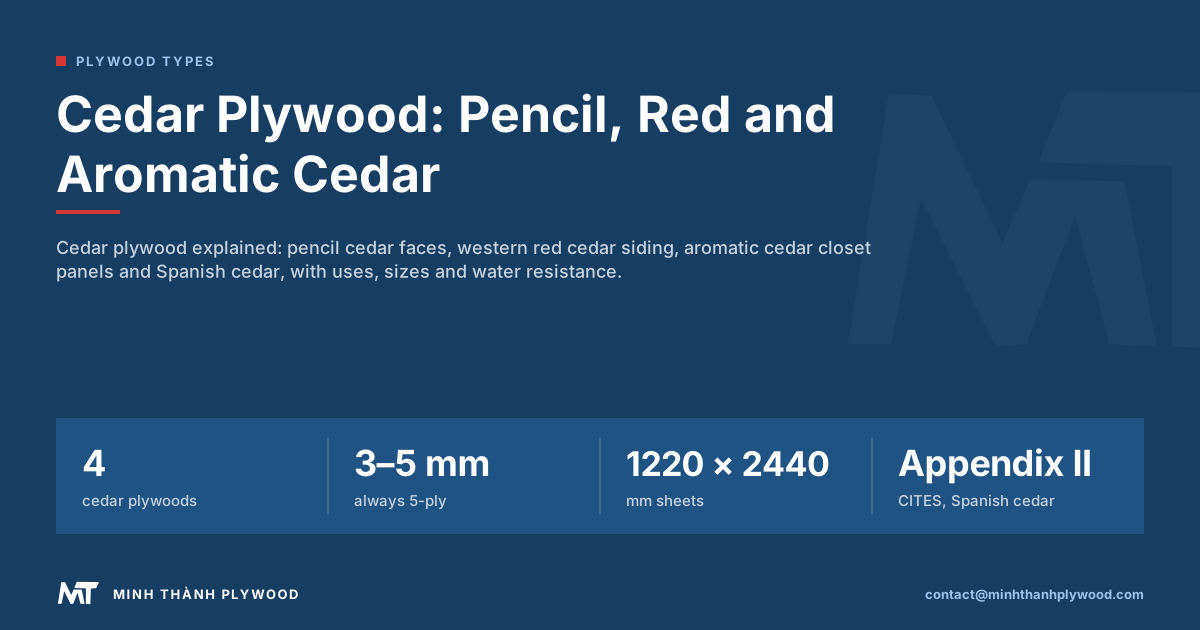
Yes, cedar plywood exists, but the name covers four different panels: pencil cedar faces on hardwood cores from Asian mills, western red cedar siding panels, aromatic cedar closet lining and Spanish cedar for humidors. They differ in look, smell, use and papers. Minh Thanh Plywood compares all four and shows what to specify for each.
Is there such a thing as cedar plywood?
Yes. Cedar plywood is a real product, but four different panels share the name, and a buyer has to know which one is meant before asking for a price.
- Pencil cedar plywood: a commercial face sold under the trade name pencil cedar, rotary-cut and pressed on a hardwood core, made by mills in Vietnam and elsewhere in Asia.
- Western red cedar plywood: panels faced with western red cedar (Thuja plicata), mostly textured siding and soffits in North America.
- Aromatic cedar plywood: thin panels faced with eastern red cedar (Juniperus virginiana), used to line closets and chests.
- Spanish cedar plywood: panels faced with Cedrela odorata, used for humidors and cigar boxes.
None of the four is a true cedar (Cedrus) in the botanical sense: western red cedar is a thuja, aromatic cedar a juniper, Spanish cedar a relative of mahogany, and pencil cedar a trade name. The rest of this guide compares them and shows what to specify.
The four cedar plywoods compared
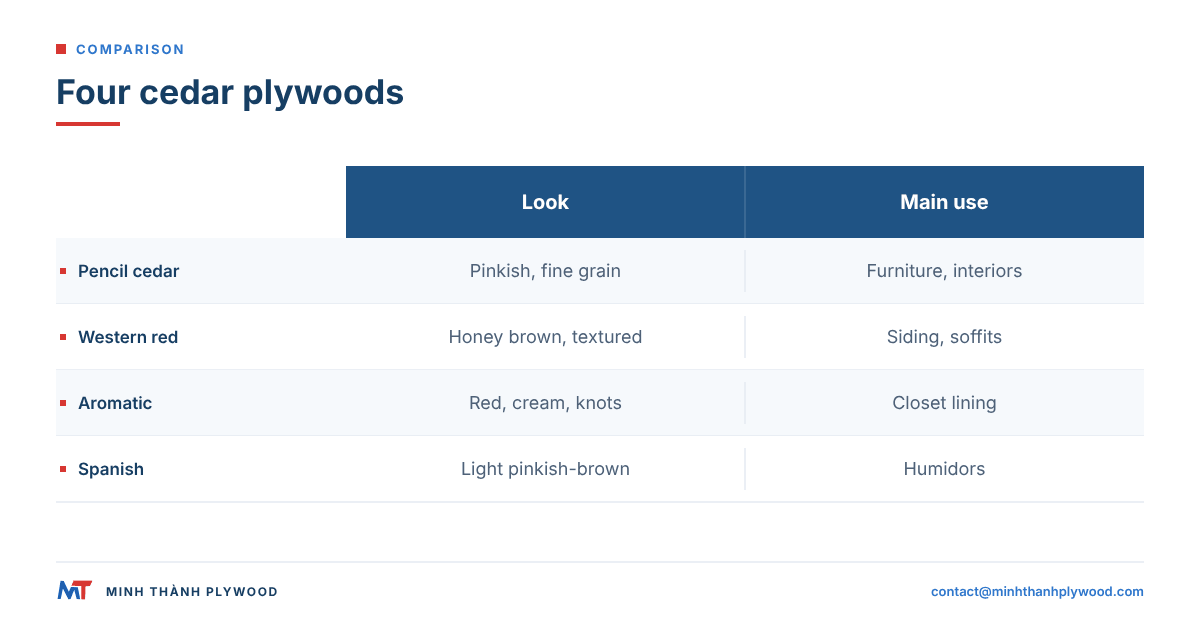
Each cedar plywood has its own look, scent and job. The table compares them on the points buyers ask about.
| Cedar plywood | Face species | Look | Scent | Typical use | Typical build |
|---|---|---|---|---|---|
| Pencil cedar | Trade name; species varies by mill | Pinkish to reddish-brown, fine straight grain | Little | Furniture, interiors, painted and laminated parts | Rotary face on hardwood core |
| Western red cedar | Thuja plicata | Reddish to honey brown, often rough-sawn texture | Mild, sweet | Exterior siding, soffits, feature walls | Textured face, exterior glue |
| Aromatic cedar | Juniperus virginiana | Red heart with cream streaks and knots | Strong, cedar-chest scent | Closet and chest lining | Thin panel, often 1/4 inch |
| Spanish cedar | Cedrela odorata | Light pinkish-brown, straight grain | Mild, spicy | Humidors, cigar boxes, mouldings | Thin panels and veneer |
For an importer of panels by the container, pencil cedar-faced plywood is the cedar plywood that ships in volume. The other three are specialty products bought in smaller quantities.
What is pencil cedar plywood?
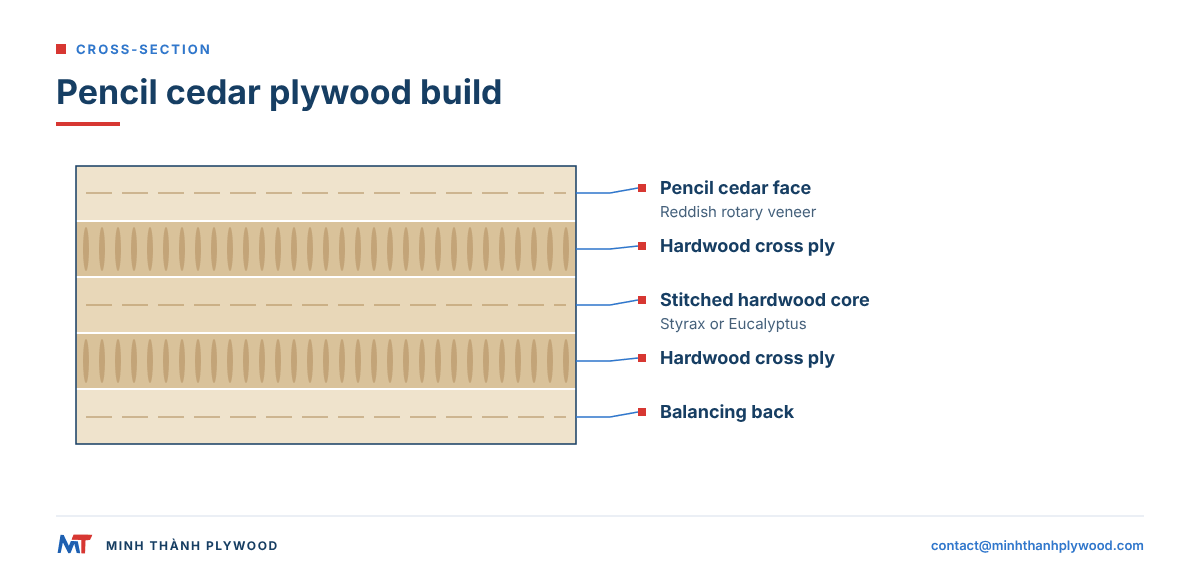
Pencil cedar plywood is a commercial hardwood plywood whose face is sold under the trade name pencil cedar: a rotary-cut veneer with a pinkish to reddish-brown colour and a fine, straight grain like the wood of a pencil. It is pressed on a hardwood core and sold for furniture and interiors.
Why buyers choose it:
- Warm colour: a reddish face between pale poplar and darker bintangor.
- Smooth surface: fine grain that sands and paints well.
- Light handling: the face adds little weight; the core decides the panel weight.
- Cost: a commercial face, priced well below sliced decorative veneers.
Because pencil cedar is a trade name, the botanical species behind the face can differ from mill to mill. Ask for the genus and species in writing: the US Lacey Act declaration needs it, and so do EU origin records. Minh Thanh supplies face and core species and the Vietnamese harvest origin of its cores with every order.
Pencil cedar faces on Vietnamese cores
A pencil cedar face is only as good as the core under it. On a Vietnamese panel, the core is plantation hardwood, and the build decides flatness, weight and screw holding.
At Minh Thanh, furniture panels use white Styrax or Eucalyptus cores as standard, with Acacia and Pine cores made on order. White Styrax gives a light panel; Eucalyptus gives a stiffer, heavier one. Faces outside the main list, such as pencil cedar, are laid up on request on the same lines as the 10+ standard faces.
What the build adds under the face:
- Stitched cores: core layers stitched both horizontally and vertically, so there are no gaps under the face.
- Pressing twice: furniture-grade panels are pressed twice as standard; the core board is pressed and calibrated, then face and back are pressed on.
- Tolerance: sanded furniture panels at ±0.2–0.3 mm, down to ±0.2 mm; commercial panels at ±0.5 mm.
- Glue: UF glue at E0 emission for interior panels; MR and phenolic (WBP) bonds to the customer’s specification.
See commercial plywood from Vietnam for the commercial builds and sizes.
Western red cedar plywood
Western red cedar plywood is faced with Thuja plicata, the light, aromatic softwood of the Pacific Northwest, and is sold mostly as exterior siding, soffit and feature-wall panels in North America. The face is often rough-sawn or brushed for a textured, rustic look, and some panels are grooved to look like boards.
Western red cedar heartwood has natural decay resistance, which is why it is used outdoors, but the panel is only as weatherproof as its glue and finish. Siding panels use exterior glue, and installers prime or stain all faces and edges.
For importers outside North America, western red cedar plywood is a niche product. Buyers who want a warm red face for interiors often choose pencil cedar or another reddish hardwood face at a lower cost.
Aromatic cedar plywood
Aromatic cedar plywood is faced with eastern red cedar (Juniperus virginiana), a juniper with a strong cedar-chest scent, and is used to line closets, chests and drawers. The face shows red heartwood streaked with cream sapwood and small knots, which buyers accept as part of the look.
Most aromatic cedar plywood is thin, often 1/4 inch, and is nailed or glued over the closet wall. The scent fades over years and can be refreshed by a light sanding of the face. Leave the face unfinished: a coating seals in the scent.
Aromatic cedar is a North American specialty. For a Vietnamese mill, a closet-lining job is usually made with a pencil cedar or other reddish face for the look, without the cedar scent.
Spanish cedar plywood
Spanish cedar plywood is faced with Cedrela odorata, a light pinkish-brown tropical hardwood related to mahogany, used for humidors, cigar boxes and boxes for instruments. It holds humidity well and has a mild, spicy scent.
The trade in Cedrela is controlled. All Cedrela species, neotropical populations, were listed in CITES Appendix II with effect from 28 August 2020, so veneer and plywood need a CITES export permit from the country of origin. Check the current listing in the CITES checklist before ordering.
Spanish cedar panels are usually thin and bought in small quantities by humidor and box makers. Buyers in Asia, including Taiwan, ask for Spanish cedar plywood by name; the CITES papers and a named species in the documents are the first things to request from any supplier.
Is cedar plywood water resistant?
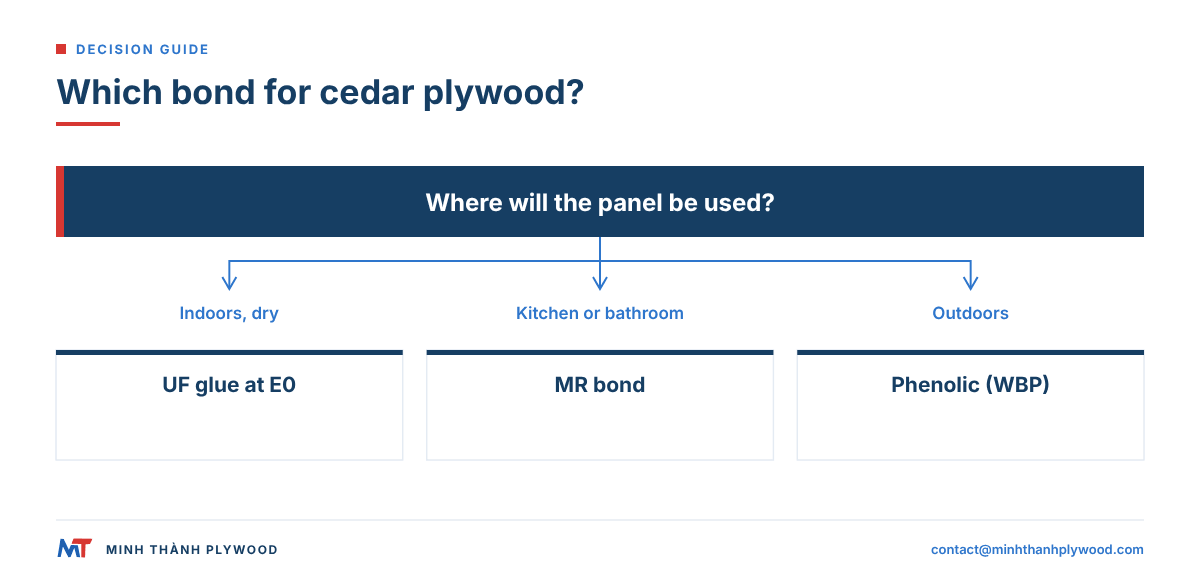
Cedar plywood is water resistant only when its glue and edges are. The wood species matters less than the bond: a cedar face on interior UF glue is an indoor panel, whatever the face, while a phenolic or exterior bond with sealed edges and a finished face can take damp and weather.
| Use | Bond to specify | Edges | Face finish |
|---|---|---|---|
| Interior furniture, closets | UF glue at E0 | Banded or sealed | Clear coat, paint or none |
| Kitchens, bathrooms | MR (melamine-fortified) | Sealed | Water-resistant coating |
| Exterior siding, soffits | Phenolic (WBP) | Sealed and primed | Stain or paint, renewed |
Western red cedar heartwood resists decay, which helps outdoors, but it still needs a phenolic bond, sealed edges and a maintained finish. Pencil cedar faces are interior faces; for wet or exterior work, see exterior plywood with a WBP bond.
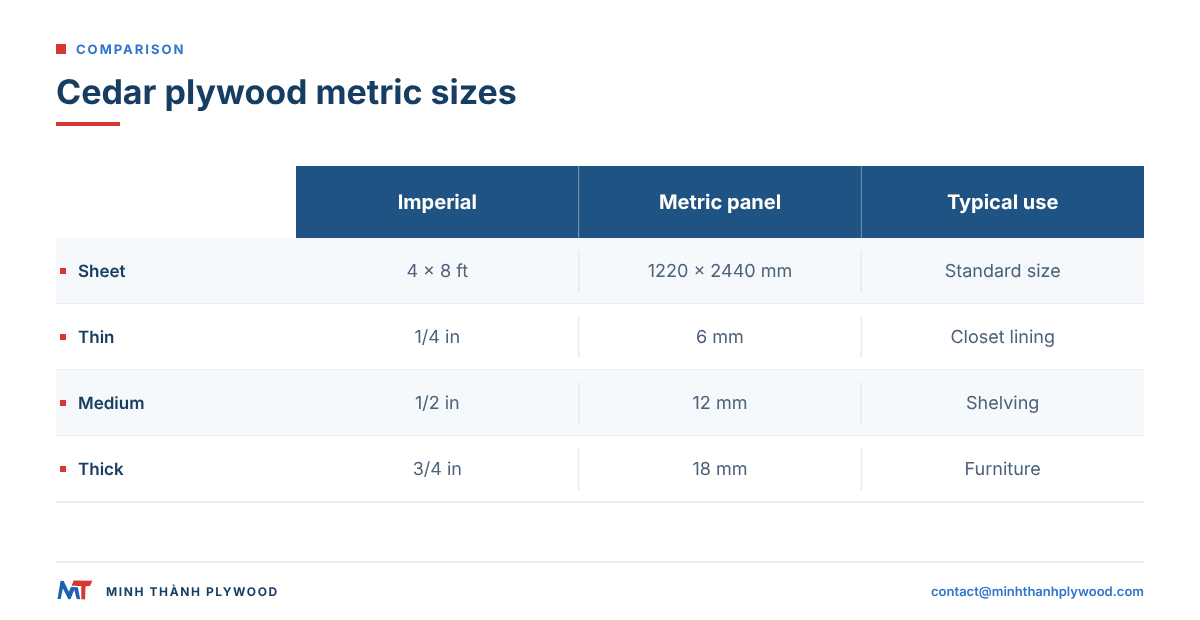
Cedar plywood sizes: 1/4” panels and 4 x 8 sheets
Cedar plywood comes in the standard 4 × 8 ft sheet, made in Vietnam as 1220 × 2440 mm, with 1250 × 2500 mm common for Europe. Custom sizes such as 1220 × 2500 and 1220 × 2280 mm are made to order.
| Imperial size | Metric equivalent | Note |
|---|---|---|
| 4 × 8 ft sheet | 1220 × 2440 mm | Standard sheet |
| 1/4 inch | 6.35 mm, made as 6 mm | Closet lining, backs, skins |
| 1/2 inch | 12.7 mm, made as 12 mm | Shelving, carcasses |
| 3/4 inch | 19.05 mm, made as 18 mm | Furniture panels, tops |
A 1/4” cedar plywood panel from a metric mill is a 6 mm panel. At Minh Thanh, thin plywood from 3 to 5 mm is always 5-ply; for a 6 mm panel the ply count and lay-up are confirmed with the order. Thicknesses run from 3 to 40 mm in total; see thin plywood for 3 to 5 mm builds.
Grades of pencil cedar plywood
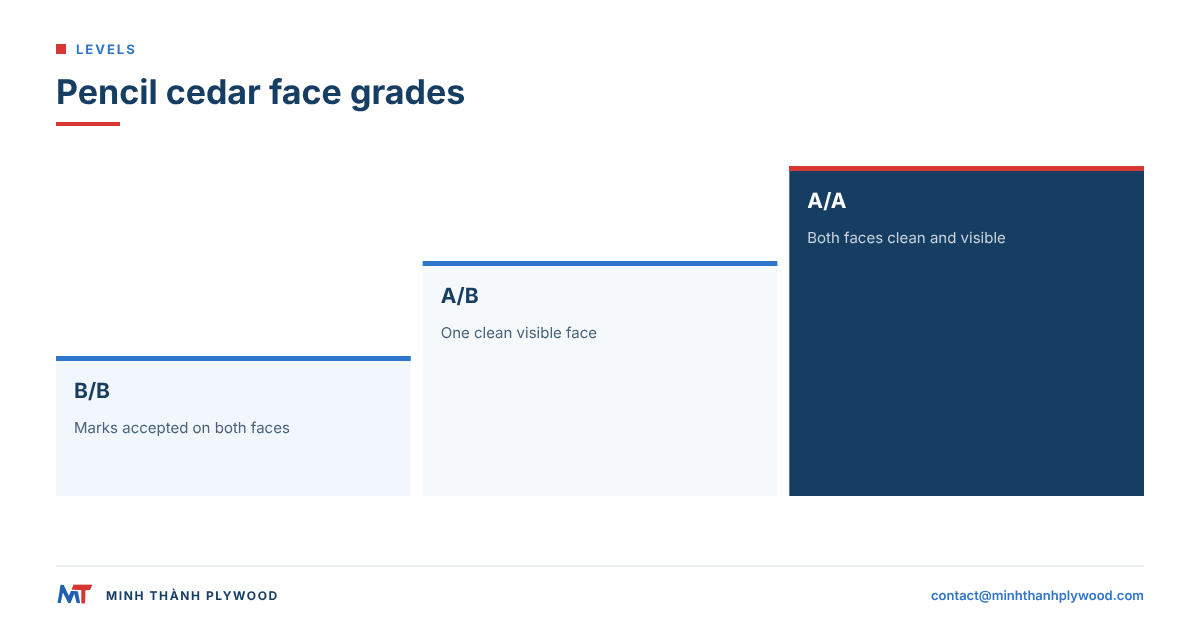
Pencil cedar plywood is graded like other Vietnamese commercial and furniture faces: as a face/back pair, fixed by an approved sample. A higher face grade means fewer knots, splits, patches and colour changes.
- A/A: both faces clean, for panels seen on both sides.
- A/B: one clean face, one with small marks, for panels seen on one side.
- B/B: marks accepted on both faces, for painted or laminated work.
Mills in Vietnam use the same pair system for pine, poplar and eucalyptus faces, matched to the buyer’s approved sample. Agree the colour range of the pencil cedar face too: rotary-cut reddish faces vary from pink to brown, and a sample of the accepted range avoids arguments on arrival.
Aromatic cedar sold in the US also carries a US back grade from 1 to 4 (the HPVA system). A 1 back is the cleanest and suits a visible back; a 2 back allows larger sound knots and repairs; 3 and 4 backs are for concealed areas.
Colour is part of the grade too: aromatic cedar heartwood is reddish to violet-brown, and pale yellow sapwood shows as streaks and stripes. A buyer who compares quotations for cedar across markets should compare the back grade, not only the face.
Price and where to buy cedar plywood
How much a 4x8 sheet of cedar plywood costs depends first on which cedar it is. In the US, a 4 x 8 ft sheet of aromatic cedar in 1/8 or 1/4 inch retails at about US$93 to US$161 (2026); pencil cedar-faced plywood is a commercial panel priced by the cubic metre for container orders.
| Cedar plywood | Typical size | Where it is sold | Price signal |
|---|---|---|---|
| Aromatic cedar, 1/8 and 1/4 in | 4 x 8 ft sheet | US specialty mill stores such as Cherokee Wood Products | US$92.75 to US$160.76 per sheet (2026) |
| Aromatic cedar project panels | 2 x 8 ft, 1/4, 1/2 and 3/4 in | Home Depot, Columbia PureBond panels with free custom cut | Priced per panel at the store |
| Aromatic cedar, 1/4 in | 4 x 8 ft (48 x 96 in) | Columbia Forest Products dealers | Through the dealer locator |
| Pencil cedar-faced plywood | 1220 x 2440 mm | Asian mills, by the container | Commercial plywood from US$250/m³, furniture plywood from US$350/m³ FOB (October 2026) |
The US rows are single sheets for closet and workshop use. The last row is a raw FOB price per cubic metre for 40HC loads, not a price per sheet. An importer who wants the cedar look at scale compares the two on a landed cost per square metre, not per sheet.
Where each is sold:
- Retail in North America: big-box stores and lumberyards stock cedar siding panels and aromatic cedar project panels; specialty mill stores sell full sheets.
- Specialty suppliers: Spanish cedar panels through humidor and box-making suppliers.
- Mills in Asia: pencil cedar-faced plywood by the container for importers, distributors and furniture plants. Minh Thanh Plywood is one of them.
The final container price depends on face, core, glue, thickness, size, quantity and delivery term.
Buying cedar plywood in the EU: CE marking, EN 636, EUDR and E1
A cedar-faced plywood sold in the EU needs three sets of papers: CE marking, a formaldehyde class and deforestation due diligence. Missing any one stops the load at the importer’s door.
- CE marking: plywood used in construction (cladding, wall and ceiling linings, flooring) carries the CE mark under the Construction Products Regulation, with a declaration of performance. The harmonised standard is EN 13986.
- Bond class: the BSI listing of BS EN 636 covers plywood for dry, humid or exterior conditions. The classes are EN 636-1 (dry), EN 636-2 (humid) and EN 636-3 (exterior). A cedar face on interior glue is an EN 636-1 panel; a wet-area or outdoor panel needs the humid or exterior class and a phenolic bond.
- Formaldehyde class to EN 717-1: class E1 means chamber emission of 0.124 mg/m³ or less in the EN 717-1 test; panels with phenolic or other negligible-formaldehyde glue qualify as E1 without testing. Minh Thanh builds furniture panels to E0 with UF glue for interior use.
- EUDR: the EU Deforestation Regulation (Regulation (EU) 2023/1115) covers plywood (HS 4412). Application was postponed to 30 December 2026 for large and medium operators and for micro and small operators already covered by the EUTR, including plywood importers; other micro and small operators follow on 30 June 2027; importers file a due diligence statement with the geolocation of the harvest and proof of legality. Minh Thanh supplies the species and the Vietnamese harvest origin of its cores with every order.
Spanish cedar adds CITES papers (see the Spanish cedar plywood section), and a US shipment adds the Lacey Act declaration.
Pencil cedar vs other reddish faces
Pencil cedar is one of several reddish commercial faces. Buyers who want a warm face choose between them by colour, grain and price.
| Face | Colour | Grain | Typical use |
|---|---|---|---|
| Pencil cedar | Pinkish to reddish-brown | Fine, straight | Furniture, interiors, painted work |
| Bintangor | Reddish-brown | Interlocked, coarser | Commercial and furniture panels |
| Okoume | Pinkish-brown | Fine, even | Furniture, interior panels |
| Eucalyptus | Warm pink to reddish | Fine, sometimes striped | Furniture, stiff parts |
| Gurjan | Reddish-brown | Straight, medium | Furniture, commercial panels |
Okoume is one of Minh Thanh’s main faces; bintangor, eucalyptus and gurjan faces are also made on request; see bintangor plywood and okoume plywood. If you are comparing a pencil cedar quotation, ask for the same build with one of these faces too.
Where cedar plywood is used
Cedar plywood is used where a warm reddish face, a scent or a natural outdoor look is wanted.
- Pencil cedar: furniture carcasses, shelving, wardrobes, interior wall panels, painted and laminated parts.
- Western red cedar: exterior siding, soffits, garden buildings and feature walls.
- Aromatic cedar: closet linings, blanket chests, drawer bottoms.
- Spanish cedar: humidors, cigar boxes and boxes for instruments.
European buyers use pencil cedar-faced panels mainly in furniture and interiors, where E0 emission and a calibrated core matter more than the face species.
How to finish and look after cedar plywood
Finish cedar plywood according to its use: clear or painted coats for pencil cedar indoors, stain or paint outdoors for western red cedar, and no finish at all for aromatic cedar linings.
- Pencil cedar indoors: sand with 150 then 180 grit, seal, then two coats of a clear waterborne finish or a paint system. The reddish face warms under a clear coat; test stain on an offcut, because rotary faces take stain unevenly.
- Western red cedar outdoors: prime or stain every face and edge before installation, and renew the finish as the coating wears; untreated cedar weathers to silver-grey.
- Aromatic cedar linings: leave the face bare so the scent can escape; refresh it with a light sanding when it fades.
- Spanish cedar in humidors: left unfinished inside, so it can take up and release humidity.
Seal every cut edge on any panel exposed to humidity. Edges absorb water faster than faces, and swelling starts there.
What this means for your order
Name the cedar first, then the build. “Cedar plywood” alone gets you four different quotations. A specification line for pencil cedar-faced plywood looks like this:
18 mm, 1220 × 2440 mm, face/back pencil cedar A/B to approved sample (species named), white Styrax core stitched and pressed twice, UF glue at E0, sanded, ±0.2 mm; quantity; destination port.
- Name the face species in writing for the Lacey Act and EU origin records.
- Agree the colour range with a sample.
- Choose the bond for the use: UF indoors, MR in kitchens and baths, phenolic outdoors.
- Fix the size in millimetres: 1220 × 2440 or 1250 × 2500 mm.
Minh Thanh’s minimum order is one 40HC with mixed specifications by agreement, production takes 15–45 days after the 30% deposit, and free samples go out with the quotation. Send your cedar plywood specification to [email protected].
Buyer questions, answered
Is there such a thing as cedar plywood?
Yes. Cedar plywood is sold as pencil cedar-faced plywood from Asian mills, western red cedar plywood siding, aromatic cedar closet panels and Spanish cedar panels. Each is a different species and use.
Is cedar plywood water resistant?
Western red cedar heartwood resists decay, but water resistance of any plywood depends on its glue. A cedar face on interior UF glue is for indoor use; outdoor cedar plywood needs an exterior phenolic bond and sealed edges.
What is pencil cedar plywood?
Pencil cedar plywood is a commercial hardwood plywood with a rotary-cut face sold under the trade name pencil cedar: a pinkish to reddish-brown face with fine, straight grain. It is used for furniture, interiors and painted or laminated work.
Is pencil cedar a real cedar?
Pencil cedar is a trade name, not a botanical one. Ask the mill for the genus and species of the face, which you need for a US Lacey Act declaration and EU origin records.
What is aromatic cedar plywood used for?
Aromatic cedar plywood lines closets, chests and drawers. Its scent comes from eastern red cedar (Juniperus virginiana), usually in thin 1/4-inch panels with knots and red-and-cream colour.
What is Spanish cedar plywood used for?
Spanish cedar (Cedrela odorata) lines cigar humidors and boxes because it holds humidity and has a mild scent. Cedrela is listed in CITES Appendix II, so veneer and plywood need export papers.
How much is a 4x8 sheet of cedar plywood?
In the US, a 4 x 8 ft sheet of aromatic cedar in 1/8 or 1/4 inch retails at about US$93 to US$161 (2026). For container orders from Vietnam, commercial plywood starts from US$250/m³ FOB (October 2026), and the face adds to that; that is a price per cubic metre, not per sheet.
Does Home Depot sell cedar plywood?
Big-box stores in North America stock some cedar plywood siding and aromatic cedar closet liner, depending on region. Importers and furniture plants buy cedar-faced plywood by the container from mills.
What thickness is 1/4 inch cedar plywood in mm?
A quarter inch is 6.35 mm; metric mills make it as 6 mm. At Minh Thanh, the ply count of a 6 mm panel is confirmed with the order.
Is pencil cedar plywood good for furniture?
Yes, for carcasses, shelves, painted and laminated parts and interior panels where a light, warm-coloured face is wanted. Specify a calibrated core and E0 emission for furniture.
What size is cedar plywood?
The standard sheet is 4 × 8 ft, made in Vietnam as 1220 × 2440 mm; 1250 × 2500 mm is common for Europe. Thickness runs from thin 3 mm skins to 18 mm and more.