
Bug holes in concrete are small surface voids left where air or bleed water was trapped against the form face. They come mainly from the mix, the vibration and the release agent; the form face decides how easily that air escapes. Minh Thanh Plywood, a maker of film-faced formwork plywood, sets out each defect, its cause and the form-side fix.
What are bug holes in concrete?
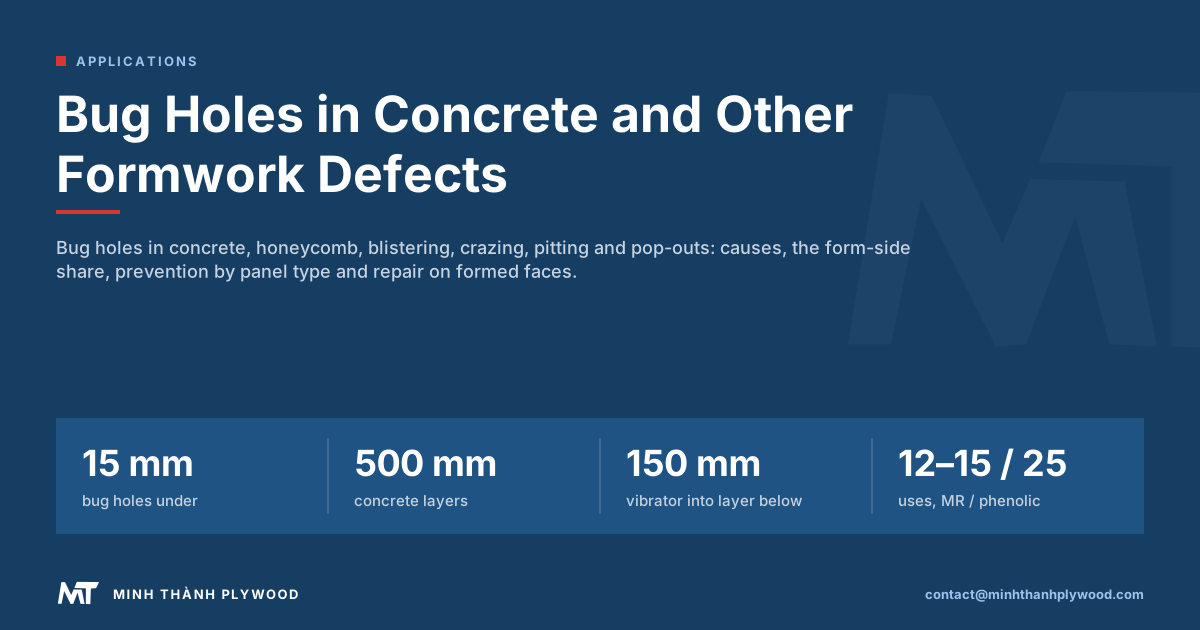
Bug holes in concrete are small, rounded voids on a formed surface, usually less than about 15 mm across, left where pockets of air or bleed water were trapped against the form face. They cluster on vertical faces such as walls and columns and on the sloping faces of beams, and they are a surface feature, not a sign of weak concrete through the section.
The trade also calls them blowholes or surface air voids. They form during placing: as the concrete is vibrated, entrapped air rises and escapes, but bubbles pinned between the fresh concrete and the form face stay there. When the form is stripped, each one is a small crater.
The American Concrete Institute grades formed surfaces in its ACI 347.3R guide to formed concrete surfaces, which uses reference photographs to rate surface voids from few to many. Specifiers use it to agree how many bug holes are acceptable on each surface category before the pour, not after.
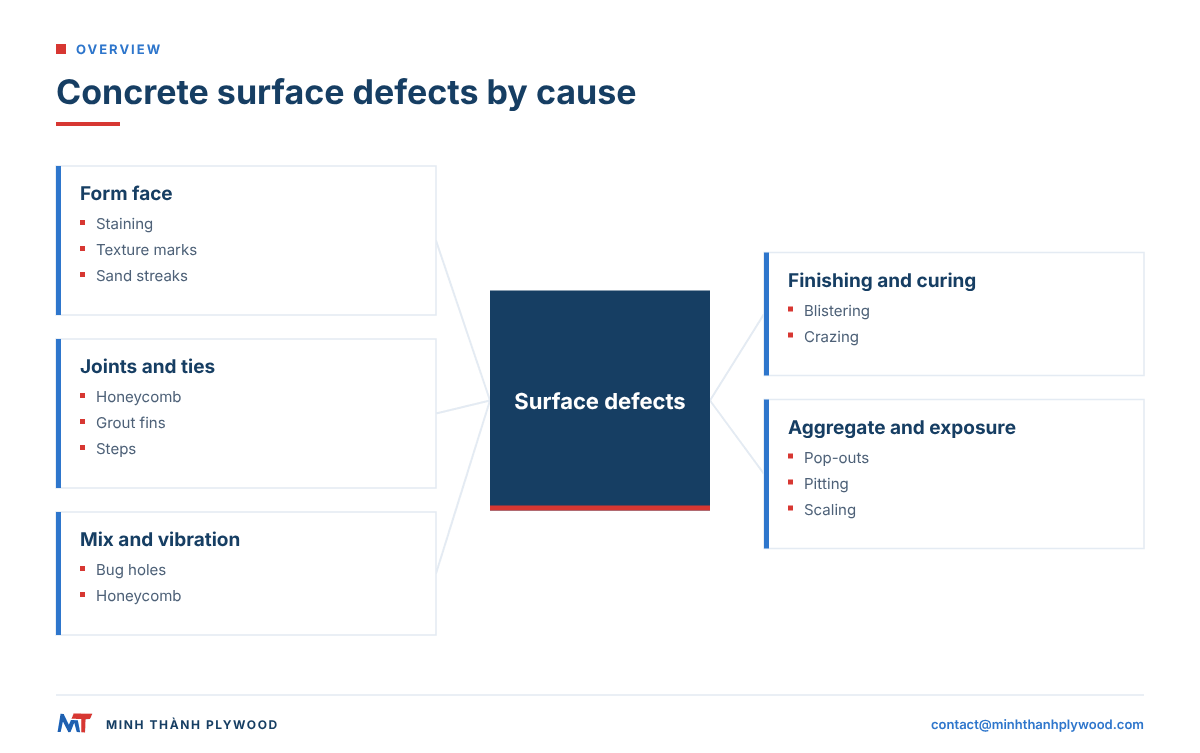
Formed concrete surface defects at a glance
Each surface defect has a main cause, and only some of them start at the form. The table sorts the common defects by what they look like, what causes them and the share the formwork plays.
| Defect | What you see | Main cause | Form-side share | Form-side prevention |
|---|---|---|---|---|
| Bug holes | Small round voids on vertical faces | Trapped air, sticky mix, thin or no vibration | Medium: release agent and face texture | Thin, even release coat; smooth, clean, sealed face |
| Honeycomb | Rough area of exposed coarse aggregate | Poor consolidation, congested bars, grout leakage | High at joints | Tight, sealed joints and ties; stiff forms that do not open |
| Sand streaking | Dark lines of sand along joints or the face | Bleed water running along the form, lean mix | Medium | Sealed joints, non-absorbent face, controlled vibration |
| Staining and colour variation | Dark or light patches, panel outlines | Mixed absorbency, excess release agent, rust | High | One panel type and film per face, even release coat |
| Form marks and texture transfer | Grain, scratches or patches printed on the face | Worn, scratched or patched film | High | Replace worn panels on exposed faces |
| Crazing | Fine map cracks | Paste-rich surface, fast drying, poor curing | Low | Do not over-vibrate against the form; cure after stripping |
| Blistering | Bumps under a trowelled slab skin | Early trowelling over rising air or water | None | A finishing issue |
| Pitting and scaling | Small pits or flaking on slabs | Freeze-thaw, de-icing salts, weak surface | None | Air entrainment, curing |
| Pop-outs | Cone-shaped spalls | Porous or reactive aggregate | None | Aggregate selection |
The pattern is clear: bug holes, honeycomb, streaking, staining and texture marks are where the formwork can help or hurt. Blistering, pitting, scaling and pop-outs belong to the mix, the finishing and the exposure.
What causes bug holes?
Bug holes are caused by air and water that cannot escape from the form face before the concrete stiffens. Precast producers often split the causes roughly three ways: the release agent, the mix, and the placing and vibration. The form face sets how easily the air moves, which is why the same mix can give different results on different panels.
Mix. Sticky, sandy or low-workability mixes hold air. High cement and fines contents make the paste cohesive; very stiff mixes do not flow against the form. Self-compacting concrete reduces bug holes when its flow is right.
Placing and vibration. Deep lifts placed at once trap air against the lower form. Vibrators kept away from the face, or pulled out too fast, leave air near the surface. Under-vibration is the most common cause.
Release agent. Too much release agent, or a thick, sticky product, holds air bubbles on the face. Water-based or chemically reactive agents applied thin and even give fewer voids.
Form face. Absorbent faces, such as bare wood, draw water and produce a rough, open surface. Very smooth faces release air well when the release coat is thin, but trap it when the coat is thick. Sloping faces trap the most air because bubbles rise against them.
Can bug holes in concrete be prevented?
Bug holes can be reduced to an acceptable level on almost every job, though not removed entirely. Prevention combines the mix, placing and the form; work on all three before the pour. In Europe, BS EN 13670 covers the execution of concrete structures.
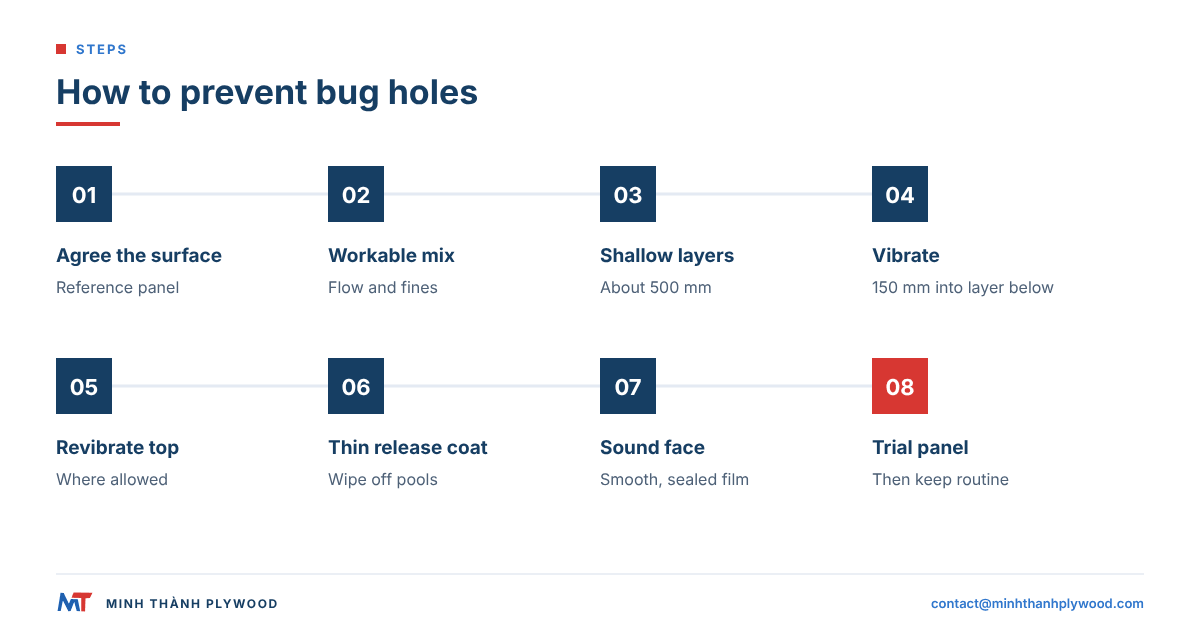
- Agree the acceptable surface with the specifier, using a reference panel or ACI 347.3R surface void ratings.
- Choose a workable mix that flows and consolidates; ask the supplier about fines, admixtures and slump or flow for walls.
- Place in shallow layers, typically no deeper than about 500 mm, so air has a short way to rise.
- Vibrate systematically: insert the vibrator vertically at close regular spacing, let it sink into the layer below by about 150 mm, and withdraw it slowly.
- Revibrate the top layer where the specification allows, to release air trapped near the surface.
- Tap or vibrate the form from outside: a rubber mallet on the back of the panel, or an external form vibrator on a heavy steel form, draws trapped air and water bubbles away from the face. Tap along the stiffeners, not on the film, and stop once bubbles stop rising. Smooth-On’s mould-making hints recommend vibrating both the inside and outside of the mould, and hammering it to clear residual voids.
- Apply release agent thin and even, wiping off pools and runs before placing.
- Use a smooth, clean, sealed face: film-faced plywood in good condition, without patches or scratches on exposed faces.
- Do a trial panel for fair-faced work, then keep the mix, agent, panel and vibration routine unchanged for the real pours.
Bug holes in SCC and precast: what changes without a vibrator?
Self-consolidating concrete (SCC) is not vibrated, so bug holes there come from free water, release agent pooling and the distance the mix travels along the form. Precast producers work to a short flow path, a thin low-viscosity release agent and a mix with controlled free water.
John Pelicone, a precast consultant with more than 40 years in concrete materials, testing and sales, gathers producers’ practice in Precast Inc.. Greg Stratis of Shea Concrete Products says his plant does not use external vibration on its SCC products, because the mix is easy to over-vibrate, and uses SCC on 95% of its product with a 5,000 psi design and a 26 in spread. Claudio Subacchi of Hawkeye Pedershaab advises that on large architectural surfaces SCC should not travel more than half a metre on a 40 mm thick pour. If it does, the surface may show no bug holes but takes a shadow from the release agent.
For thin architectural SCC and precast panels:
- Keep the flow short: feed the mix at several points, so no part of it runs more than about 0.5 m across a 40 mm section.
- Use a low-viscosity release agent, sprayed in a thin coat and wiped of pools.
- Limit free water in the mix and check it by the spread test.
- Use a clean, non-absorbent film that is replaced when worn.
The guidance on vibration in ACI 309R, the Institute’s guide to consolidation, is the reference most concrete contractors follow for insertion pattern and layer depth.
Honeycomb in concrete: causes and the form joints
Honeycomb in concrete is a rough, stony patch where mortar did not fill the gaps between the coarse aggregate. It is a more serious defect than bug holes because it can reach the reinforcement and reduce cover. The two main causes are poor consolidation and mortar escaping through form joints.
Poor consolidation happens with congested reinforcement, mixes too stiff for the section, aggregate too large for the gap between bars, and concrete dropped from height so it segregates. The form side matters at joints and ties: wherever two panels meet with a gap, the cement paste leaks out under vibration and leaves the stones behind.
Form-side prevention:
- Tight joints. Butt panel edges closely and seal gaps with tape, foam strip or sealant on fair-faced work.
- Sealed edges. Unsealed plywood edges swell when wet, then shrink and open the joint for the next pour.
- Stiff panels and supports. A panel that deflects between supports opens its joints under pressure; choose the thickness and spacing the formwork design gives.
- Sealed tie holes. Use cones or sleeves that seal around ties.
Small honeycomb patches are cut back to sound concrete and repaired with a bonded repair mortar. Large or deep honeycomb, especially at the reinforcement, needs an engineer’s assessment.
Concrete blistering: why it is a finishing defect
Concrete blistering is a set of bumps, from coin size upwards, that appears under the surface of a trowelled slab when air or bleed water is trapped beneath a skin sealed too early. It is a flatwork finishing defect and does not come from the formwork.
Blisters form when the surface is trowelled, especially with a steel trowel or power float, while air and water are still rising through the slab. Thick slabs, sticky mixes, entrained air in trowelled slabs, wind and heat that dry the top early, and cold bases that slow setting at the bottom all increase the risk.
Prevention is in the finishing routine: wait until bleeding has stopped before final trowelling, avoid entrained air in hard-trowelled interior slabs unless it is specified, and protect the surface from fast drying. Blisters that delaminate are ground out and repaired.
On formed faces, the defect that looks similar is a thin skin of paste lifting over a void. That is a bug hole beneath a surface film and is treated as one.
Concrete crazing on formed faces
Concrete crazing is a network of fine, shallow cracks on the surface, forming irregular hexagons that are usually a few centimetres across. It is cosmetic in almost all cases and does not affect strength or durability, but it shows on fair-faced walls and on slabs when they are wet.
Crazing comes from the surface layer shrinking faster than the concrete below. On slabs the causes are fast drying, over-trowelling and a paste-rich surface. On formed faces it shows most on dense, smooth surfaces cast against non-absorbent forms, where vibration brings paste to the face and the wall is then stripped early and left to dry.
Form-side prevention:
- Do not over-vibrate against the form face; it draws excess paste to the surface.
- Strip at the time the specification gives, then cure the face at once with water, wrapping or a curing compound.
- Keep the same panel type and release agent across one face, so curing conditions at the surface are even.
Crazing does not normally grow after the concrete has dried and cured. A penetrating sealer reduces how visible the cracks are when dirt collects in them.
Concrete pitting, scaling and pop-outs
Concrete pitting, scaling and pop-outs are surface defects of slabs and exposed concrete that come from the mix, the finish and the exposure, not from the formwork. They are included here because buyers ask about them alongside bug holes.
Pitting is a scatter of small holes, on slabs often from de-icing salts or freeze-thaw on a weak surface, and on formed faces usually a dense pattern of bug holes. Scaling is the flaking of the top surface, mainly in cold climates with salts, prevented by air entrainment, proper finishing and curing. Pop-outs are cone-shaped pieces broken out by a porous or reactive aggregate particle near the surface that expands.
The fixes are aggregate selection, air entrainment for freeze-thaw exposure, correct finishing and curing. A formwork panel cannot prevent any of them.
Staining, sand streaks and colour variation
Staining and colour variation on formed concrete come mainly from differences in the form face and the release agent across one surface. Concrete takes the colour of the conditions it cures against, so a face cast against mixed panels shows each panel’s outline.
The usual causes:
- Mixed absorbency. New and old panels, or film-faced and bare plywood, in one face cure the surface differently.
- Excess or uneven release agent, which leaves dark patches and drips.
- Rust from reinforcement or ties touching the form.
- Wood sugars from bare or worn plywood faces that retard the surface and leave dusty, light patches.
- Sand streaks from bleed water running along leaky joints or down a smooth face with a lean, bleeding mix.
Use one panel type, film weight and age on each exposed face, apply release agent with a sprayer and wipe off excess, and seal joints. Our guide to concrete form release agents covers the agent types and how much to use.
Which formwork face gives the fewest defects?
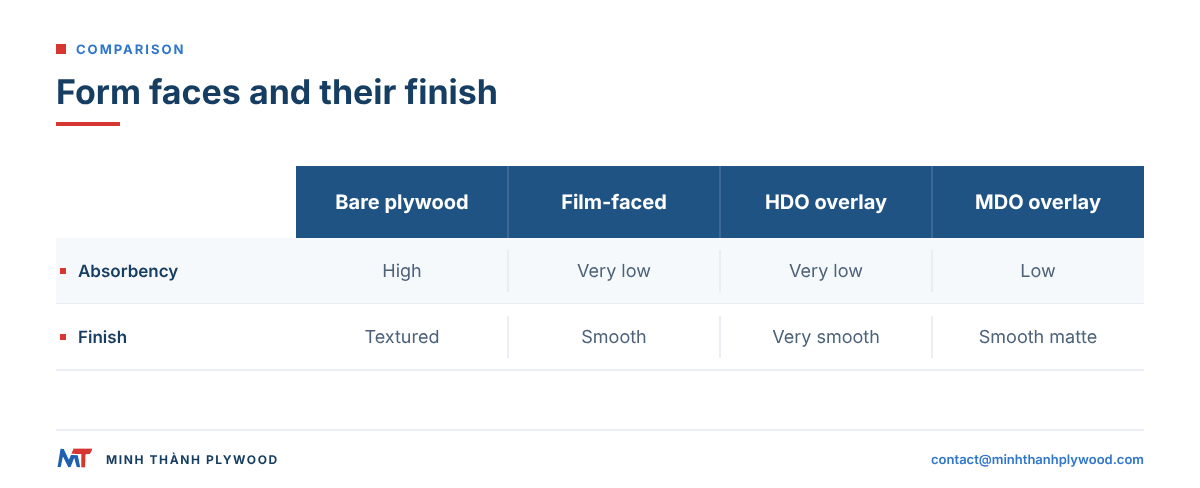
A smooth, non-absorbent face in good condition gives the most uniform concrete, and the face matters most on exposed concrete. Film-faced plywood is the standard choice; HDO overlay panels and plastic-faced panels give the most uniform architectural finish, while bare plywood and boards give a textured or variable surface.
| Form face | Absorbency | Typical finish | Notes |
|---|---|---|---|
| Bare plywood or sawn boards | High | Textured, with wood grain and colour variation | Board-marked concrete uses it on purpose |
| Film-faced plywood, standard film | Very low | Smooth, uniform when the film is intact | The usual choice for walls, slabs and columns |
| Film-faced plywood, premium film | Very low | Smooth over more reuses | Heavier film resists wear and scratches longer |
| HDO overlay plywood | Very low | Very smooth, architectural | See HDO plywood vs MDO plywood |
| MDO overlay plywood | Low | Smooth matte, paintable | Fewer reuses in formwork |
Film weight matters for repeat use: Minh Thanh presses standard film of 120–135 g/m² and premium film from 135 g/m². Heavier film resists scratching for longer, so the face stays smooth over more pours.
How worn film shows up on the concrete
Worn film shows up on the concrete as texture, scratches and colour patches, because once the film wears through, the wood below absorbs water and prints its grain. A panel’s reuse life for exposed faces ends when its film is scratched or worn, even if it is still strong enough for hidden work.
Signs a panel should move from exposed faces to hidden work:
- Scratches from vibrators, nails or scrapers visible in the film.
- Dull, porous patches where the film has worn through.
- Swollen or broken edges that no longer close the joint.
- Patches, screws or filled holes in the face.
Film-faced panels give about 12–15 uses with melamine-fortified glue and up to about 25 with phenolic WBP glue, with proper handling, release agent and edge sealing. Sorting panels by face condition, best ones on exposed faces, gets the most finish quality out of each set.
Form joints, ties and edge sealing
Form joints, tie holes and panel edges are where formwork causes the most defects, because they are where cement paste and bleed water escape. Grout loss at a joint leaves honeycomb, sand streaks, or a fin of paste; a swollen edge leaves a step in the face.
In the US, the Occupational Safety and Health Administration requires formwork to be designed, built and maintained to support all vertical and lateral loads that may reasonably be anticipated (OSHA standard 1926.703). A panel that deflects under that load opens its joints.
The routine that prevents them:
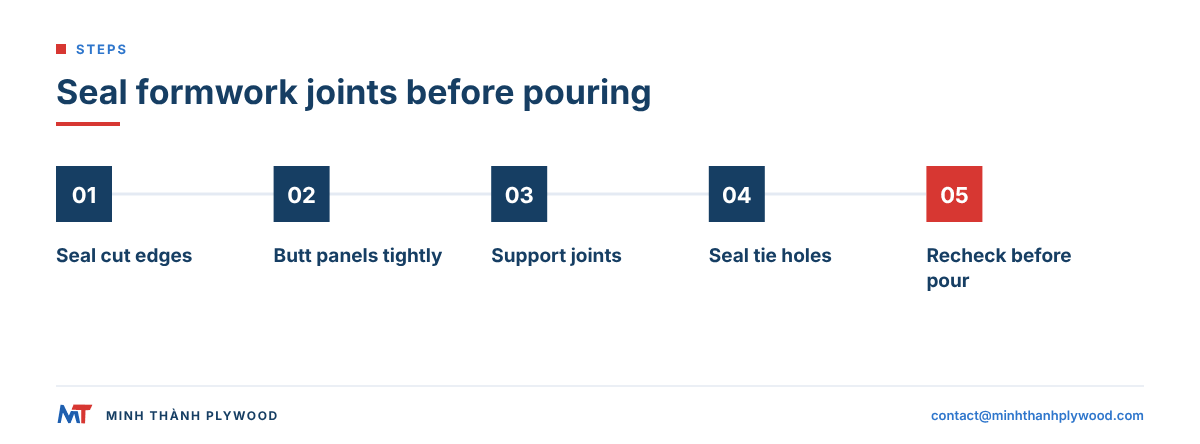
- Seal every factory and cut edge of film-faced plywood before first use and after recutting. The sealed edge protects the glue line, whose bond-quality requirements are in BS EN 314-2.
- Butt panels tightly and line up their faces; on exposed work, seal joints with tape or foam strip.
- Place joints on supports, so both panel edges are held at the same level.
- Seal tie holes with cones or plugs and keep ties clean of release agent.
- Check the forms for gaps again after fixing the reinforcement and before the pour.
Minh Thanh seals the edges of film-faced sheets at the factory with water-resistant paint, and the thickness tolerance of ±0.5 mm keeps adjoining sheets level at the joint.
Repairing bug holes and other surface defects
Bug holes are repaired by filling them with a cementitious paste or a fine repair mortar matched to the concrete’s colour, then rubbing the surface smooth. This is often called sack rubbing or bagging, and on fair-faced work it is done only to the extent the specification allows.
For each defect:
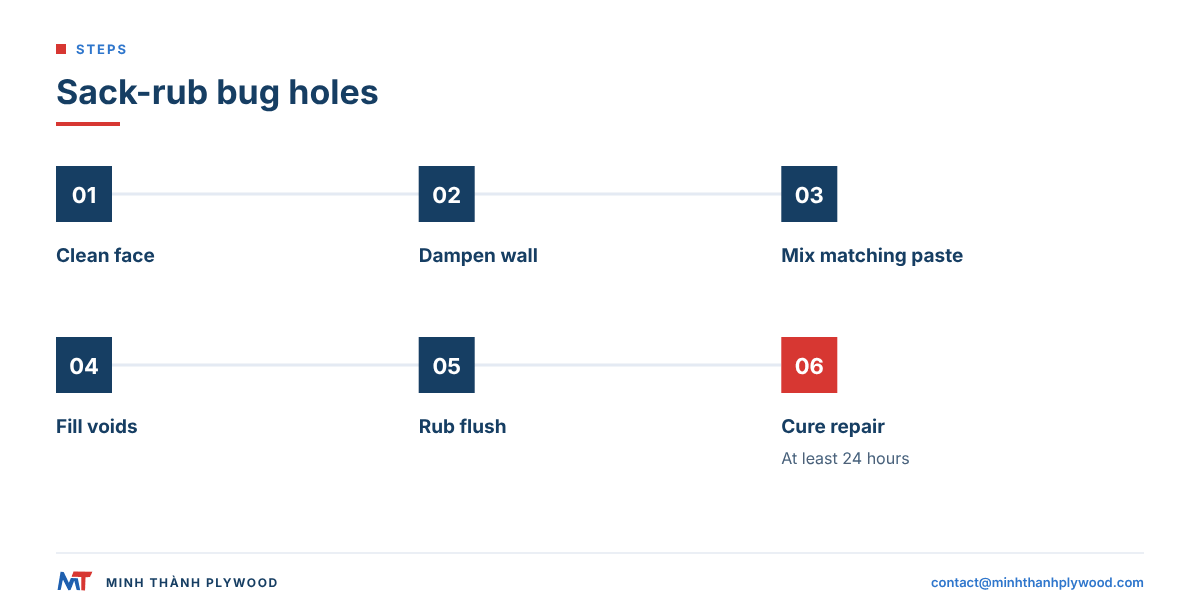
- Bug holes: clean, dampen, fill with paste, rub flush, cure.
- Honeycomb: cut back to sound concrete, prime, repair with bonded mortar, cure; refer deep areas to the engineer.
- Crazing: leave, or seal with a penetrating sealer.
- Staining: clean with water and a mild cleaner; trial any acid or abrasive method first.
- Blisters and pop-outs: grind or chip out and patch.
Steps for repairing bug holes, sack rub method:
- Clean the face of dust, laitance and release agent with a stiff brush and water.
- Wet the wall to saturated surface-dry, so the dry concrete does not suck water from the patch.
- Mix the patch: portland cement and fine sand as a stiff paste, or a polymer-modified repair skim for coated walls. Blend white cement into a grey mix on a trial patch until the colour matches once dry.
- Fill each void by pressing the paste in with a rubber float or a hand pad. A void deeper than a fingertip is packed in two layers, so the paste does not shrink away from the sides.
- Rub the surface flush with a sponge float or a coarse cloth sack, working paste into the remaining pores, then wipe clean before it dries.
- Cure the repair damp for at least 24 hours, out of sun and wind.
Do the work on a trial area first, because a repaired patch usually dries a different shade from the aged face.
Where a coating or waterproofing membrane goes on the wall, fill bug holes first: the coating cannot bridge open voids and will pinhole over them.
What this means for your formwork plywood order
The formwork plywood itself is one part of a good concrete face, and it is the part a buyer specifies in the order. Ask for the face, the glue, the core and the edge treatment, and keep the same specification across a project so every exposed face is cast against the same surface.
Minh Thanh film-faced plywood is pressed from 12 to 21 mm on Eucalyptus or Acacia cores, with melamine-fortified or phenolic WBP glue, in 1220 × 2440 mm and 1250 × 2500 mm sheets, thickness tolerance ±0.5 mm and moisture of 8–12 % at dispatch. Our film-faced plywood page has the full specification, and our guide to fair-faced concrete plywood covers architectural finishes.
Film-faced plywood for exposed walls: 18 mm, premium film 135 g/m² black, phenolic WBP glue, Eucalyptus core, factory-sealed edges, 1250 × 2500 mm, thickness ±0.5 mm; 1×40HC CIF your port.
Minh Thanh sends free samples and replies within hours: contact@minhthanhplywood.com or WhatsApp +84 988 586 601.
Buyer questions, answered
What are bug holes in concrete?
Bug holes are small, rounded surface voids on a formed concrete face, usually under about 15 mm across. They form where air or bleed water was trapped against the form face and could not escape before the concrete stiffened.
Are bug holes a structural problem?
Usually not. Bug holes are a surface feature; they matter on exposed or fair-faced concrete and where a coating or waterproofing must bridge them. Large, deep voids or honeycomb behind them need an engineer's assessment.
What is the difference between bug holes and honeycomb?
Bug holes are small voids in a dense surface. Honeycomb is a rough, stony area where mortar did not fill the gaps between coarse aggregate, usually from poor vibration, congested reinforcement or grout leaking out of form joints.
Does the plywood cause bug holes?
The plywood does not cause them on its own. A smooth, non-absorbent film face with a thin release coat lets air move along the face; worn, porous or over-oiled faces trap it. Mix and vibration remain the main causes.
Is concrete crazing a defect?
Crazing is a network of fine surface cracks that is cosmetic in almost all cases; it does not weaken the concrete. It shows most on dense, smooth faces and on slabs that dried too fast at the surface.
Will concrete crazing get worse over time?
Crazing normally stops developing once the concrete has dried and cured; the cracks may look more visible when they fill with dirt or when the surface is wet.
Can you repair concrete crazing?
Crazing cannot be closed, but it can be hidden. Clean the surface, then apply a penetrating sealer or a breathable coating; prevention through proper curing works better than repair.
What causes crazing on a formed concrete wall?
A paste-rich surface against a very smooth, non-absorbent form face, combined with early stripping and poor curing. Keep the wall moist after stripping and avoid overworking the concrete against the form.
What causes concrete blistering?
Blistering happens on slabs when the surface is sealed by trowelling while air or bleed water is still rising, so bumps form under the finished skin. It is a finishing defect, not a formwork defect.
What are concrete pop-outs?
Pop-outs are small cone-shaped pieces that break out of the surface when a porous or reactive aggregate particle near the face expands. They come from the aggregate and freeze-thaw exposure, not from the form.
How do you prevent bug holes on a wall?
Use a mix that flows and consolidates well, place in shallow layers, vibrate each layer into the one below, apply a thin, even release agent and use a smooth, clean, sealed form face.
Which formwork plywood gives the best concrete finish?
A smooth film-faced plywood with a heavier film, sealed edges and tight joints gives the most uniform finish, and HDO overlay panels go further for architectural concrete. Worn or scratched film transfers its marks to the concrete.