
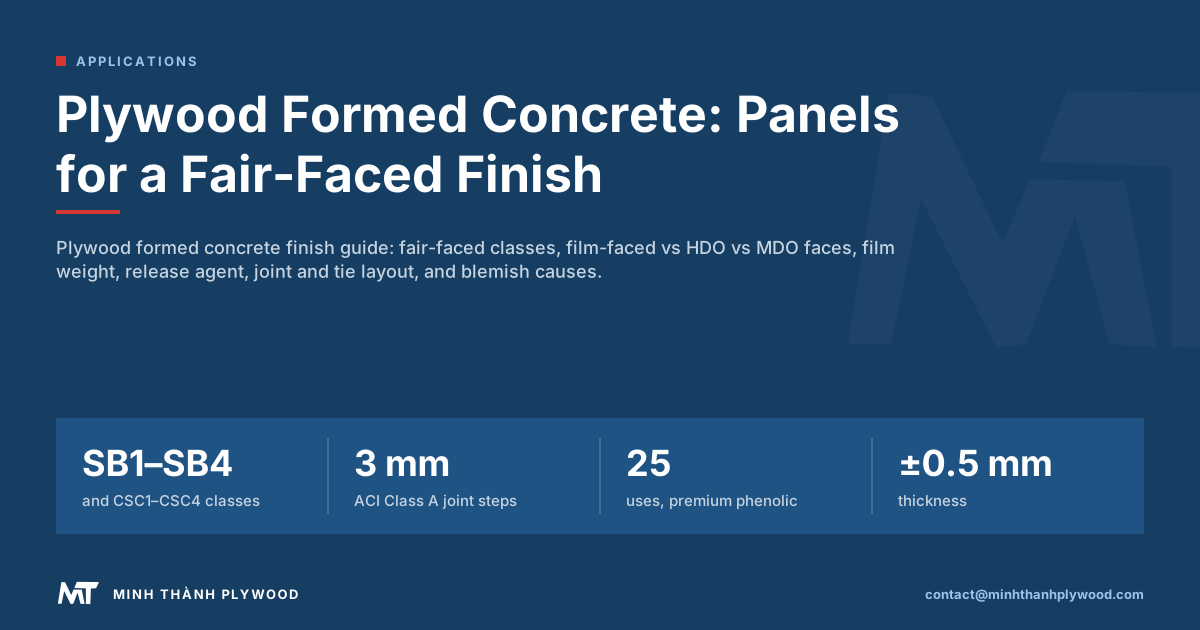
Plywood formed concrete copies its form face: sheen, texture, joints and wear all print into the wall. A fair-faced finish comes from four things working together: a panel face matched to the finish class, a thin even release coat, a planned joint and tie layout, and a mix placed and vibrated well. Minh Thanh Plywood supplies film-faced panels with standard or premium film, sealed edges and ±0.5 mm thickness tolerance.
What is plywood formed concrete, and what does fair-faced mean?
Plywood formed concrete is concrete cast against plywood formwork, and fair-faced concrete is the version left exposed with no render, paint or cladding, so the surface the form leaves is the finished face. The form face works like a mould: whatever is on it ends up in the concrete.
That makes the form panel part of the architecture. Sheen, grain, scratches, joint lines and tie holes all show on the finished wall for decades. A structural wall can hide a worn panel behind plaster; a fair-faced wall cannot.
Fair-faced work is also called exposed, as-cast or architectural concrete. In North America the usual words are architectural concrete or formed concrete. Whatever the name, a specification for it sets a finish class, and the formwork team chooses panels, release agent and layout to meet that class.
What finish classes are used for fair-faced concrete?
Fair-faced concrete is specified by finish class: German-speaking markets use the DBV and VDZ classes SB1 to SB4, North America uses ACI 347.3R Concrete Surface Categories CSC1 to CSC4, and many projects also set abrupt-irregularity limits from ACI 347 surface classes A to D. Each step up tightens blowholes, colour, joints and flatness.
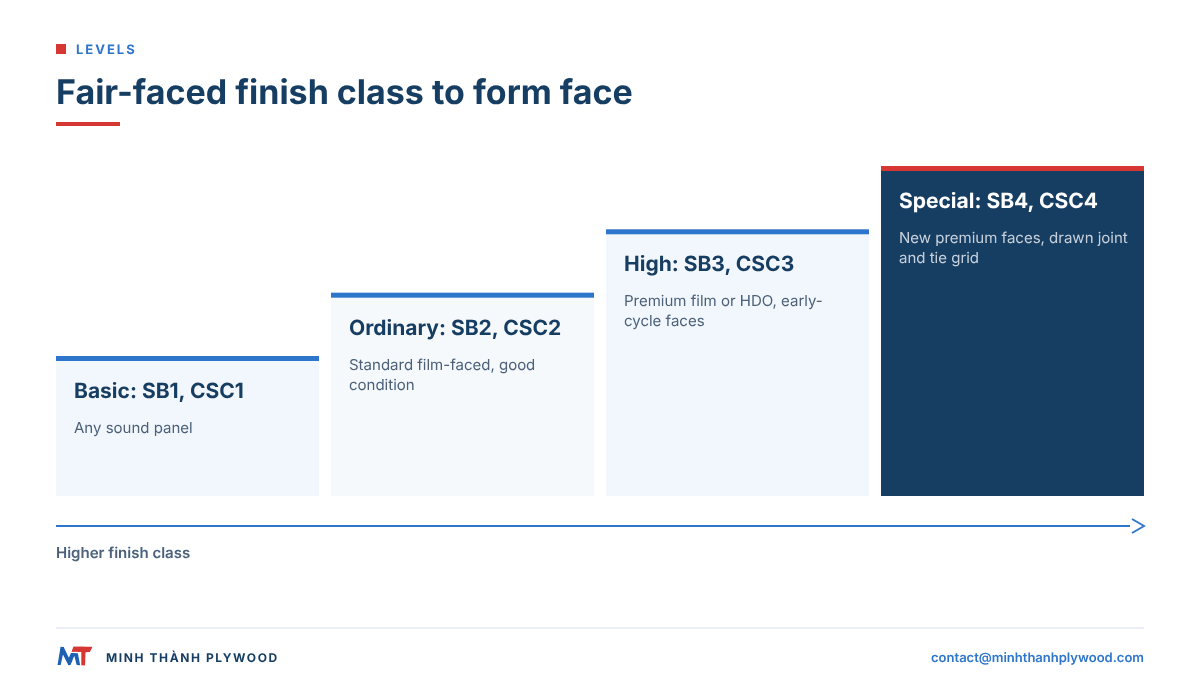
The classes describe the result, not the panel, so a designer translates each class into a form face. The ladder below is a practical reading of that translation:
| Finish level | Example class | What it demands | Typical form face |
|---|---|---|---|
| Hidden or basic | SB1, CSC1 | Sound concrete, few limits on looks | Any sound panel, including reused film-faced |
| Ordinary visible | SB2, CSC2 | Even colour, small blowholes allowed | Standard film-faced, good condition |
| High visual demand | SB3, CSC3 | Tight joints, few blowholes, even sheen | Premium film-faced or HDO, early-cycle faces |
| Special | SB4, CSC4 | Architect’s sample panel governs | Premium film or HDO, new faces, drawn joint and tie grid |
ACI 347 surface classes cap abrupt steps at the joints: about 3 mm for Class A, 6 mm for Class B, 13 mm for Class C and 25 mm for Class D. Class A and B walls need panels that sit flush, which is where thickness tolerance matters.
How does the form face transfer to the concrete finish?
The form face transfers its texture, sheen and absorbency directly to the concrete: a glossy phenolic film casts a smooth, slightly reflective face, a matte overlay casts a calm low-sheen face, and bare wood prints its grain and absorbs water from the surface, leaving a darker, rougher skin. Damage on the face prints too.
Three properties of the face do most of the work:
- Absorbency. A sealed film or overlay absorbs almost nothing, so the surface paste stays even. Bare wood draws water unevenly and darkens the concrete in patches.
- Texture. A smooth film leaves a smooth face; a textured or bare face leaves its pattern.
- Condition. Scratches, dents, stripped film and patched holes on a reused sheet appear as marks on the next pour.
This is why fair-faced work separates panel types by elevation. New faces go on the walls people see, and reused faces move to footings, cores and back-of-house walls.
Concrete finish on plywood: film-faced, HDO or MDO?
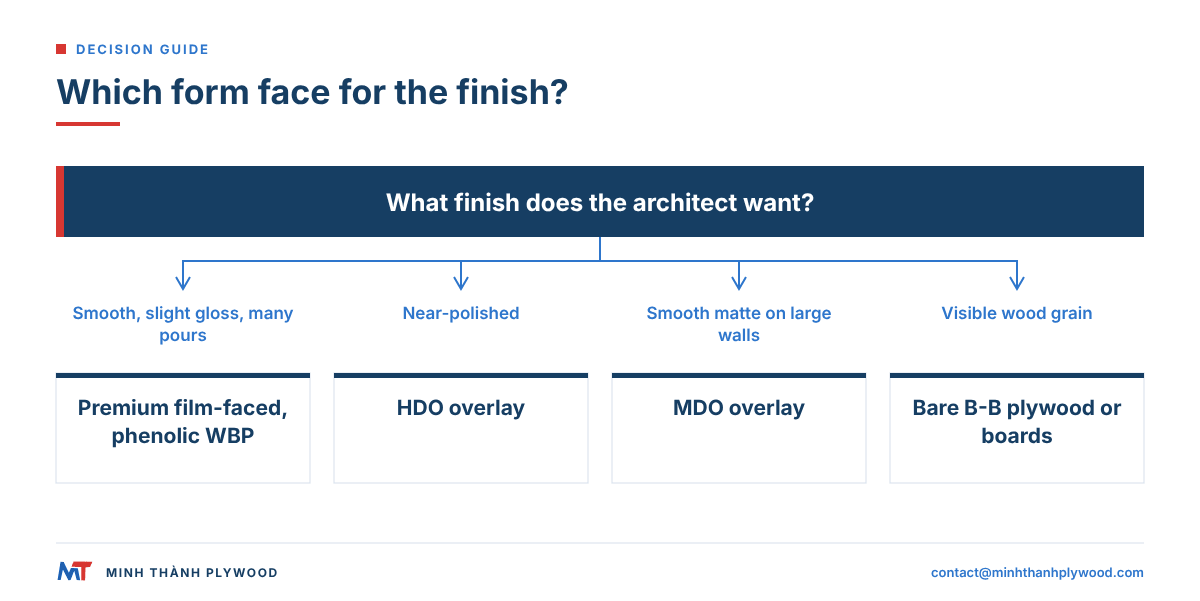
For a concrete finish on plywood, film-faced and HDO panels give the smoothest, most even face and the most pours, and MDO gives a matte face that hides minor variation on large elevations. Bare B-B plywood suits only hidden or board-textured work. Pick the face from the finish the architect wants, then the grade from the pours you need.
| Form face | Concrete finish | Sheen | Pours in good condition |
|---|---|---|---|
| Standard film-faced, 120–135 g/m² | Smooth, even | Slight gloss | About 12–15 with melamine-fortified glue |
| Premium film-faced, from 135 g/m² | Smooth, very even | Gloss | Up to about 25 with phenolic WBP glue |
| HDO overlay | Near-polished | Gloss | 20 to 50 with reasonable care; 200 or more with specialist care (APA) |
| MDO overlay | Smooth, matte | Low | Between bare wood and HDO |
| Bare B-B plywood | Grain shows faintly | None | About 5 to 10 |
The film-faced figures are Minh Thanh’s panels with proper handling, release agent and edge sealing; the HDO, MDO and B-B figures follow APA’s concrete forming guidance (consulted 20 October 2026). The guide to HDO plywood vs MDO plywood compares the two overlays in detail.
US panels for plywood formed concrete
In the United States, form plywood is bought by the inch and by the APA grade. The standard panel is 3/4 in (18 mm) thick and 4 x 8 ft (1,220 x 2,440 mm). APA Plyform is made in two grades: Class I, with Group 1 species on the faces for strength and stiffness, and Structural I, with Group 1 species throughout for the highest load capacity. Either can be ordered with an HDO or MDO overlay (APA, concrete forming). Structural plywood in the US is made to Voluntary Product Standard PS 1-22, which NIST lists as the current standard.
| US panel | Face | Reuse stated by the seller or APA | Price per 3/4 in 4 x 8 ft sheet, October 2026 |
|---|---|---|---|
| Plyform B-B, bare | Sanded, oiled | About 5 to 10 | See local yard |
| Film-faced forming plywood (TigerForm) | Phenolic film | Per maker | US$78.99 at Menards |
| MDO | Matte overlay | Between bare and HDO | US$74.08 at Lowe’s |
| HDO Plyform | Hard phenolic overlay | 20 to 50 with reasonable care, 200 or more with specialist care (APA); up to 20 for a brown-film panel at Toledo Plywood | US$131.73 for HDO 1S at Plywood Company |
Reuse depends on handling more than on the label, which explains the wide range: APA gives 20 to 50 for HDO with reasonable care and 200 or more for specialists. A dealer selling a brown-film overlay lists up to 20 reuses with reasonable care (Toledo Plywood). Retail prices move with the yard; the cost per pour is the number that compares them, so divide the sheet price by the pours you expect.
Slab forms carry both live load (workers and equipment) and dead load (fresh concrete). Normal-weight concrete exerts 12.5 psf per inch of slab thickness, so an 8 in slab loads the deck with 100 psf of concrete before any live load.
Curved forms follow the minimum bending radii in APA’s Concrete Forming Design and Construction Guide, Form V345, and Plyform is made under PS 1, which holds thickness, width, length, squareness and edge straightness to tight tolerances. APA also publishes an advisory, SP-1185, on imported plywood panels from Brazil tested against PS 1, so an importer should ask any mill for PS 1 or equivalent test evidence on the shipment.
Does film weight change the concrete finish?
Film weight changes how long the finish lasts more than how it looks on the first pour: a heavier film holds a closed, even face through more pours before scratches and wear start to show. Minh Thanh’s standard film is 120–135 g/m², and premium film starts from 135 g/m².
On a new sheet, both films cast a smooth face. The difference appears after stripping, cleaning and handling: a thin film wears through at corners and along tie holes sooner, and once wood shows through, the concrete over that spot darkens and roughens.
For fair-faced elevations, premium film with phenolic WBP glue is the safer choice. It keeps the face sound through more pours, so the panels on the visible walls stay in the same condition across the elevation. Choose the colour, black or brown, to match panels already on site; the colour itself does not tint the concrete.
Fair faced ply: which panel build gives the best finish?
The best fair faced ply combines four things: a premium phenolic film from 135 g/m² on both faces, phenolic WBP glue, a dense, even core that keeps the face flat, and sealed edges. Each part protects the finish in a different way, so leaving one out shows on the wall.
- Film. Premium film keeps the face closed through more pours.
- Glue bond. Phenolic WBP holds the veneers together through repeated wetting, so the face does not blister or lift. The bond-quality requirements for plywood are defined in BS EN 314-2.
- Core. An Eucalyptus core at 650–750 kg/m³ gives a stiff, flat base; Acacia, at about 580 kg/m³, is lighter to handle.
- Edges. Sealed perimeters keep water out of the core, so edges do not swell and print a ridge at every joint.
Thickness tolerance matters on a visible wall, because adjoining sheets must sit flush. Our film-faced sheets hold ±0.5 mm on thickness and ±2 mm on length and width, so steps at joints stay well inside the 3 mm Class A limit when the formwork is built true.
Which release agent gives the best fair-faced finish?
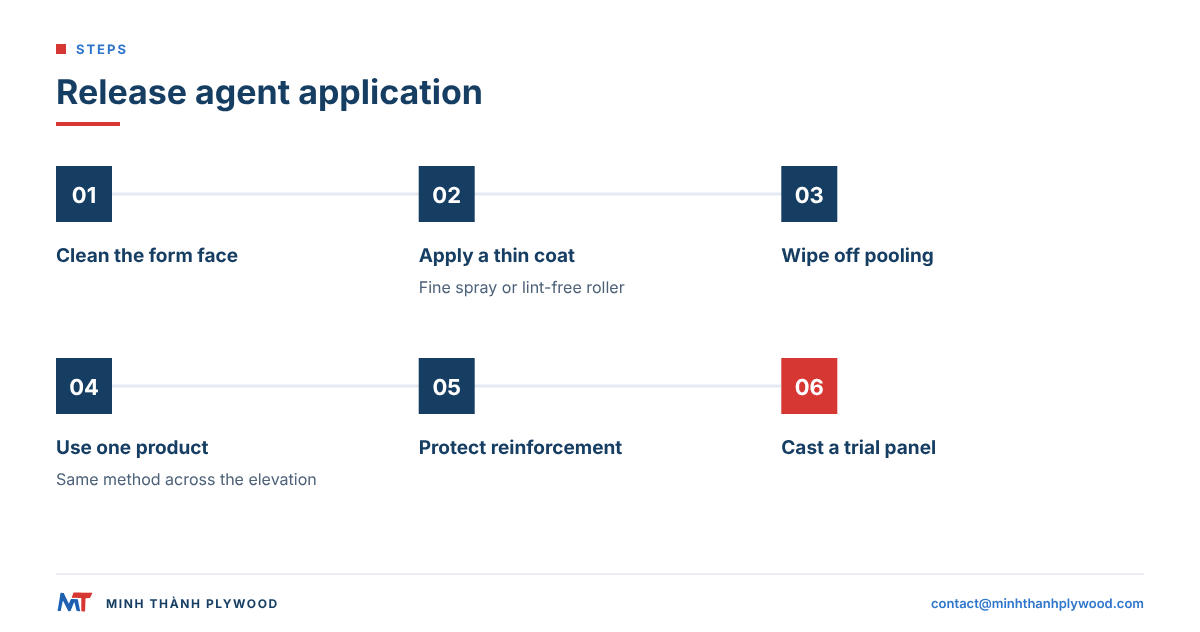
A thin, even coat of a chemically active release agent suited to film-faced or overlaid plywood gives the cleanest fair-faced finish, applied the same way on every panel of an elevation. Too much release agent causes blowholes and staining; too little lets concrete stick and tear the film.
Rules that hold for every product:
- Clean the face first, without scraping tools that gouge the film.
- Apply by fine spray or a lint-free roller, then wipe off any pooling.
- Coat all panels of one elevation with the same product, at the same time before the pour.
- Keep release agent off the reinforcement and construction joints.
- Cast the trial panel with the same product and method as the main pour.
Mixing products or coats across one wall shows as colour bands. The guide to concrete form release agents and form oil covers product types and coverage.
How should joints and ties be laid out on a fair-faced elevation?
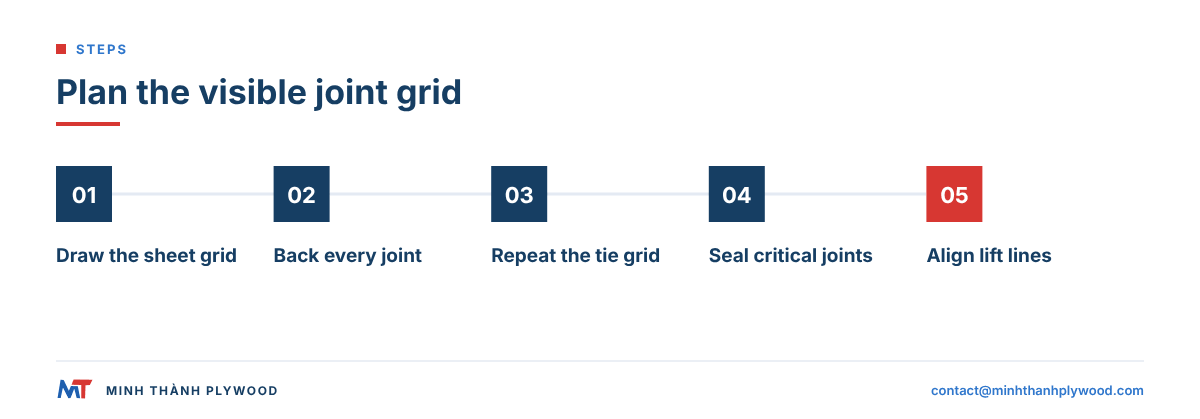
On a fair-faced elevation, sheet joints and tie holes are part of the design: draw them on the elevation, line joints up across the wall and across lifts, and place ties on a regular grid inside the sheet pattern. A neat, repeated pattern reads as intentional; a random one reads as a mistake.
Practical layout steps:
- Set the sheet grid from the architect’s drawing, usually full 1220 × 2440 mm or 1250 × 2500 mm sheets with cut sheets placed symmetrically.
- Back every joint with a joist or batten so both edges deflect together.
- Place ties on a grid that repeats inside each sheet, with cones or plugs specified for the hole finish.
- Seal joints with tape or foam on the highest classes to stop grout loss.
- Plan lift lines to fall on a sheet joint or a rebate.
The tie spacing comes from the concrete pressure. The guide to plywood formwork design shows how pressure turns into tie and joist spacing. For US sites, the requirements for cast-in-place concrete formwork are in OSHA standard 1926.703.
What causes blemishes on fair-faced concrete?
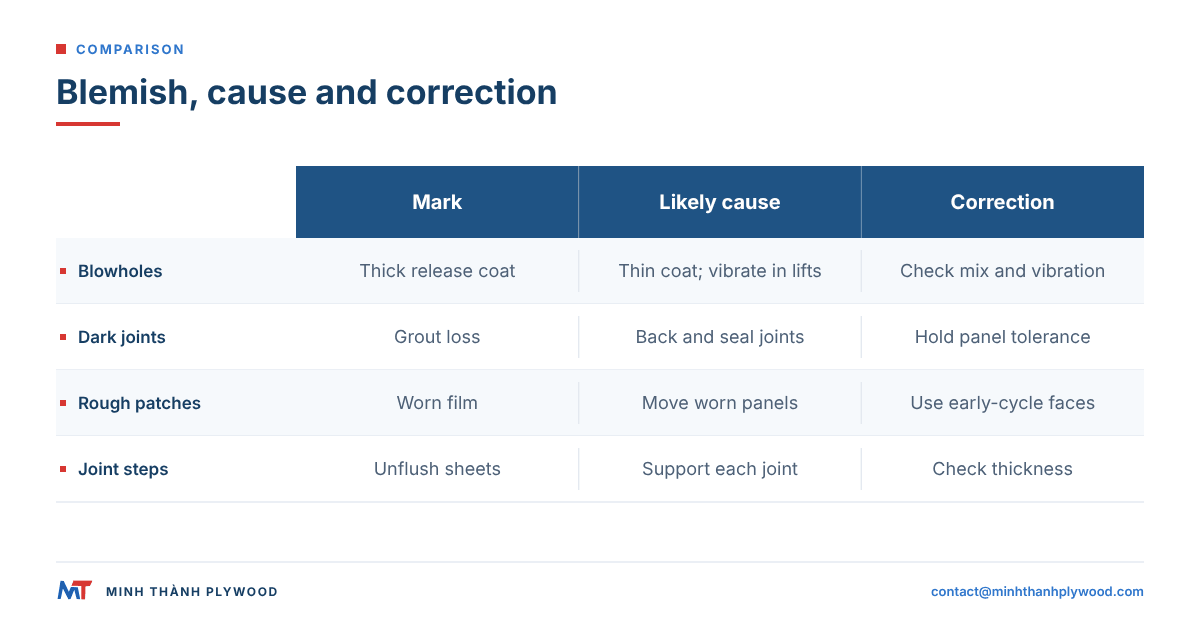
Most blemishes on fair-faced concrete come from release agent, vibration, joints or worn panels rather than from a fresh form face. Each type of mark points to its own cause, so read the mark before changing the panel.
| Blemish | Usual cause | Fix |
|---|---|---|
| Blowholes | Thick release agent, short vibration, sticky mix | Thinner coat, longer vibration in lifts |
| Dark joint lines | Grout loss at open joints | Seal joints, back every joint, hold tolerance |
| Colour blotches | Uneven release agent, curing or mix | One product, one method, steady curing |
| Dull or rough patches | Worn film, scratches, dents | Move worn panels off visible elevations |
| Steps at joints | Sheets not flush, soft supports | Tight tolerance, joints on joists |
| Bow between joists | Joist spacing too wide | Design to span ÷ 360 |
| Tie hole spalling | Poor cones or early stripping | Specified cones, stripping time from the mix |
If the marks sit in the middle of a fresh panel, look at the pour. If they follow the panel’s worn spots, change the panel.
Why does reuse stage belong on the elevation plan?
Reuse stage belongs on the elevation plan because a panel’s face changes with every pour, and panels at different stages cast slightly different concrete side by side. Put new or early-cycle panels on the most visible elevations and move older ones to hidden work as they wear.
A simple rotation works on most projects:
- First pours: new premium panels on the main fair-faced elevations.
- Middle pours: the same panels on secondary visible walls, after inspection.
- Later pours: panels with worn film move to cores, footings and back-of-house walls.
Inspect each panel after stripping under raking light, record its pour count on the edge, and retire it from visible work as soon as the face shows wear. Cost per pour still drives the purchase, but on a fair-faced job the count of visible pours per panel is lower than the total pours it can give.
Why should you cast a trial panel before the main pour?
A trial panel shows the finish the real combination of panel, release agent, mix, vibration and curing produces, before the visible walls are poured. On SB3, SB4 or CSC3 and CSC4 work, the architect approves the trial panel and it becomes the reference for the whole job.
Build the trial panel at full height where possible, with at least one sheet joint and a row of ties, using the panels, release agent and crew of the main pour. Strip it at the planned time and let it cure the same way.
Ask the panel supplier for samples of the exact build you will order. Minh Thanh sends free samples of the quoted film-faced build, so the trial panel uses the same film, glue and core as the container that follows.
Mirror finish shuttering ply: what does the name mean?
Mirror finish shuttering ply is a trade name for film-faced plywood with a heavy, glossy phenolic film that casts a very smooth, reflective concrete face. The name describes a look, not a grade, so specify the film mass, resin and glue behind it.
Gloss on the panel gives gloss on the concrete, and gloss also shows every variation in colour and every repair. On large elevations some architects prefer a matte overlay for that reason. On columns, soffits and feature walls, a glossy finish can be exactly what the design calls for.
When a quotation offers mirror finish, ask for the film mass in g/m², the film colour, the glue bond and the core species. Minh Thanh’s premium build pairs film from 135 g/m² with phenolic WBP glue, and the sample shows the sheen before you order.
What should you send for fair-faced formwork plywood?
Send the finish class, the elevation layout and sheet size, the panel thickness, film grade and colour, glue bond, core, edge sealing, quantity and destination port. A supplier who knows the finish class can quote the right film and pack the panels so the faces arrive unscratched.
Minh Thanh Plywood makes film-faced plywood 12–21 mm thick in 1220 × 2440 and 1250 × 2500 mm sheets, with cut-to-size panels available for repeated formwork modules. Packs travel wrapped, with protected corners, and each pack is photographed and filmed before loading.
The minimum order is one 40HC, with mixed specifications by agreement. Production takes 15–45 days after the 30% deposit. Read the full cluster in the concrete form plywood buying guide, compare US grades in Plyform classes and sizes, or open the film faced plywood product page.
Specification line to send: “Fair-faced walls, class SB3: film-faced plywood 18 mm, 1250 × 2500 mm, Eucalyptus core, phenolic WBP glue, premium film from 135 g/m², brown, sealed edges, face-protected packs, 1 × 40HC to [port].” Send it through the contact form or WhatsApp +84 988 586 601; we reply within hours.
Buyer questions, answered
What is fair-faced concrete?
Fair-faced concrete is concrete left as cast, with no render, paint or cladding, so the surface from the formwork is the finished face. The project specification sets a finish class that limits colour variation, blowholes, joint lines and steps.
How do you achieve a fair-faced concrete finish?
Use a form face matched to the finish class, a thin even release coat, tight sealed joints, a tie layout drawn on the elevation, and a consistent mix placed in steady lifts with careful vibration. A trial panel cast before the main pour settles the combination.
Does the plywood form face affect the concrete finish?
Yes. Glossy phenolic film casts a smooth, slightly reflective face, a matte overlay casts a calmer face, and bare wood prints its grain. Scratches, dents and worn film transfer to the concrete as well.
What causes blemishes on fair-faced concrete?
Blowholes usually come from too much release agent or poor vibration, dark joint lines from grout loss at open joints, colour blotches from uneven release agent or curing, and dull patches from worn or damaged film on reused panels.
Which plywood is best for fair-faced concrete?
For the highest finish classes, use premium film-faced or HDO plywood with phenolic glue, sealed edges and new or early-cycle faces on visible elevations. For a matte look, MDO is the usual choice.
Is black or brown film better for fair-faced concrete?
Film colour does not change the concrete colour; film mass, resin and the condition of the face do. Choose the colour your site already uses so new and reused panels match on the same wall.
How many times can plywood forms be reused for fair-faced concrete?
Fewer than for structural concrete, because a face that is fine for a hidden wall can be too worn for a visible one. Minh Thanh's panels give about 12–15 uses on standard film and up to about 25 on premium phenolic WBP panels with proper care.
What is plywood formed concrete called in North America?
It is usually called architectural concrete or formed concrete, and ACI 347.3R grades it by Concrete Surface Category, CSC1 to CSC4. Plywood forms for it are typically HDO or MDO Plyform or film-faced plywood.
What is a mirror finish shuttering ply?
It is a trade name for film-faced plywood with a heavy, glossy phenolic film that casts a very smooth, reflective concrete face. Specify it by film mass and resin rather than by the name.
How do you stop grout leaks at plywood form joints?
Keep sheet edges sealed and square, back every joint with a joist or batten, add foam or tape to the joint on high finish classes, and hold tolerance so adjoining sheets sit flush.