
Yes, you can paint film faced plywood, but only after the glossy phenolic film is degreased, sanded until the shine is gone and coated with a bonding primer: the film is made to shed concrete, so it sheds untreated paint too. Clean cutting needs a sharp fine-tooth carbide blade, the film supported on the side where the teeth exit, and every cut edge sealed the same day. Minh Thanh Plywood makes film-faced panels in Phu Tho, Vietnam.
Can you paint film faced plywood?
Yes, you can paint film faced plywood, but untreated film rejects paint. The phenolic or melamine film is a hard, glossy resin surface made to release concrete and shed water, and those same properties stop paint from keying in unless the surface is prepared first.
Paint holds when three conditions are met:
- The surface is clean: no release oil, no concrete residue, no grease from handling.
- The gloss is broken: a light sanding gives the primer something to grip without cutting through the film.
- The primer is a bonding primer: a product made for glossy, non-porous surfaces, not a standard wood primer.
Skip any of the three and the paint lifts in sheets the first time the panel gets wet, flexes or is taped over. With all three, film faced plywood takes a durable painted finish for site hoardings, signage, workshop furniture, vehicle linings and display stands.
Why does paint struggle to stick to phenolic film?
Paint struggles on phenolic film because the film is a cured resin layer with almost no pores. Paint bonds by soaking into a surface or by gripping its texture, and a fresh film offers neither.
Three features of the film work against paint:
- Cured resin: the paper in the film is impregnated with phenolic or melamine resin and cured in the hot press, at 130–145 °C for a WBP (water and boil proof) phenolic bond and 110–120 °C for an MR (moisture-resistant) bond. The surface is closed and chemically inert.
- Smooth gloss: the press plate leaves a smooth face so concrete releases cleanly. Smooth means no mechanical key.
- Release oil: panels used on site carry form oil or release agent, which keeps working against paint long after the pour.
Used panels add a fourth problem: cement film and laitance in scratches. Clean those out first, because paint over residue fails with the residue.
How to paint film faced plywood step by step
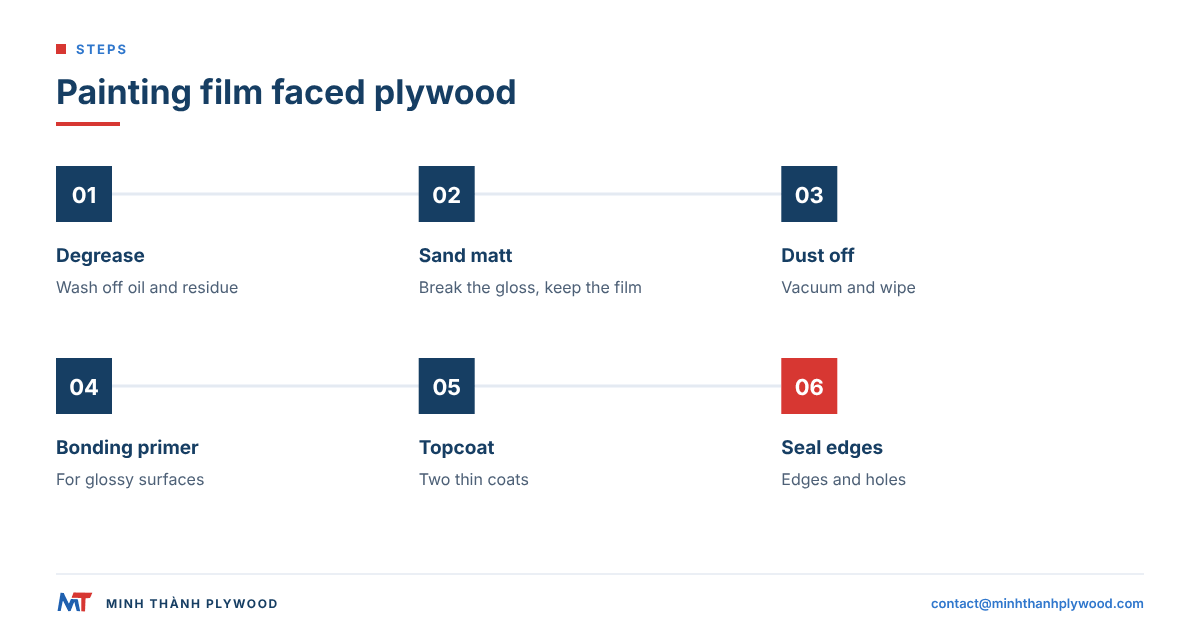
Paint film faced plywood in six steps: clean, sand, dust off, prime, topcoat and seal the edges. Work in a dry space between about 10 and 30 degrees Celsius, on panels that have been stored dry.
- Degrease: wash the film with a strong detergent or sugar soap, rinse and let it dry. On used panels, scrape off concrete residue with a plastic scraper and remove form oil with a degreaser.
- Sand to a matt finish: use medium-fine abrasive paper (around P120 to P180) on a random-orbit sander or by hand until the whole face is evenly dull. Stop when the gloss is gone; do not sand through the film into the veneer.
- Remove the dust: vacuum, then wipe with a damp lint-free cloth or a tack cloth.
- Prime with a bonding primer: one full coat of an adhesion primer for glossy surfaces. Let it cure for the full time on the tin, not just until touch-dry.
- Apply the topcoat: two thin coats of the chosen paint, with a light rub-down between coats if the maker allows it.
- Seal edges and holes: brush the same primer and paint, or an edge sealer, onto every edge and fixing hole.
Before coating a batch, paint a test patch, let it cure for a few days, then cut a cross-hatch into it and pull a strip of strong tape off. If paint comes away on the tape, the cleaning or sanding was not enough or the primer is wrong.
Which primer and paint work on film faced plywood?
The primer decides whether paint stays on film faced plywood; the topcoat decides how it looks and how long it lasts. Use a bonding primer for glossy surfaces under any topcoat.
| Product | Use on film faced plywood | Notes |
|---|---|---|
| Waterborne bonding primer | Yes, first coat | Sold for laminate, tiles and glazed surfaces; low odour, easy cleanup |
| Shellac-based primer | Yes, first coat | Grips gloss well and blocks stains; indoor or under an exterior topcoat |
| Two-pack epoxy primer | Yes, first coat | Strongest bond; for hard-wearing or wet uses such as vehicle floors |
| Standard wood primer | No | Made to soak into bare timber; it sits on the film and peels |
| Exterior acrylic paint | Topcoat | Flexible, good for hoardings and outdoor signs |
| Alkyd or polyurethane enamel | Topcoat | Hard, washable finish for furniture, shelving and displays |
| Floor or deck paint | Topcoat | For stage floors and platforms; check slip resistance |
| Spray paint straight on film | No | Thin, unprimed coats chip at the first knock |
Check the paint maker’s data sheet for “laminate”, “melamine” or “glossy surfaces” in the list of suitable substrates. If the primer maker names those, it suits phenolic film.
Does colour of the film matter for painting?
The film colour matters only for coverage. Dark brown and black films need a tinted primer or an extra topcoat when you paint them white or a pale colour. Film colour, film weight and film brand are order specifications, so a buyer who plans to paint can order a lighter film.
Can formply be painted for hoardings, signage and furniture?
Yes, formply can be painted, and many contractors reuse old formwork panels as painted site hoardings. Can you paint formply for furniture or signs as well? Yes, the method is the same as for any film faced plywood: clean, key, bonding primer, topcoat.
| Use | Why film faced plywood works | What to watch |
|---|---|---|
| Site hoarding | Flat, stiff and water-resistant, large sheets | Exterior topcoat; seal edges and fixings; drain the bottom edge |
| Signage and graphics | Smooth base for paint or vinyl | Vinyl sticks better to primed film than to bare film |
| Workshop benches and shelving | Hard-wearing, easy to wipe | Enamel topcoat; round the edges before painting |
| Vehicle and trailer linings | Hard face, water-resistant glue | Two-pack primer; anti-slip film for floors |
| Stage and display platforms | Stiff, flat, quick to assemble | Floor paint on top; check slip resistance |
| Children’s play or furniture pieces | Hard face | Use paints rated for the use; sand all edges smooth |
A used formwork panel can be painted if the film is still intact. Where the film has worn through to veneer, fill and sand those spots, prime them twice, and accept that the painted face will show the patches.
How to cut phenolic plywood without chipping the film
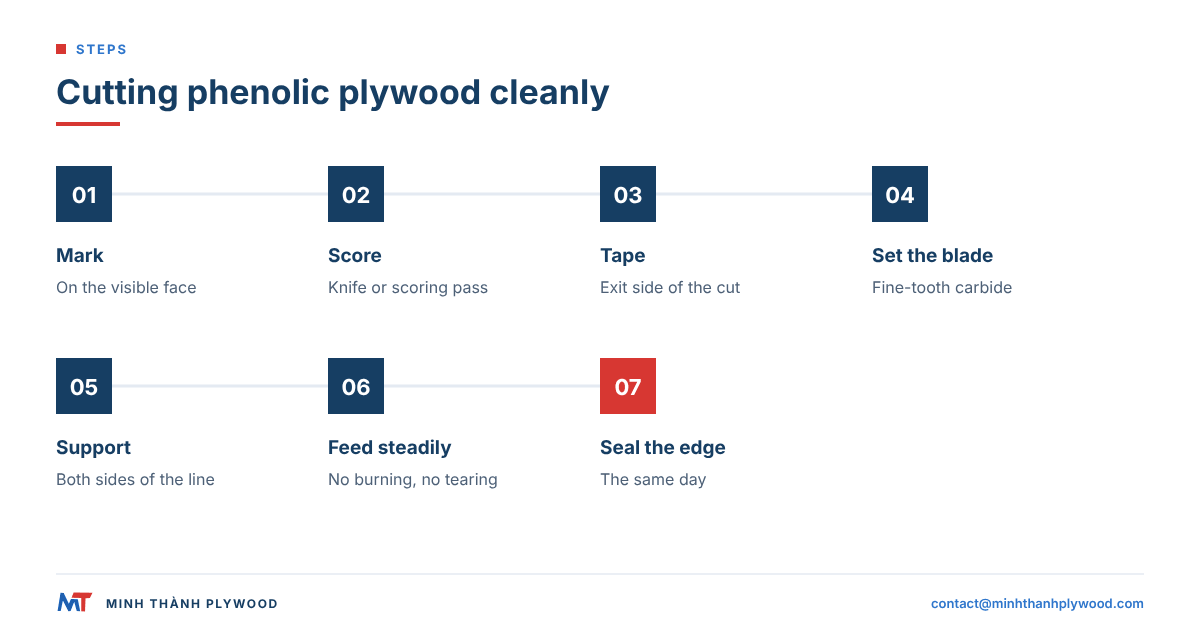
To cut phenolic plywood cleanly, support the film where the saw teeth come out of the sheet, because that is where chipping starts. Use a sharp fine-tooth carbide blade and feed at a steady rate.
- Mark the line on the face that will be visible, with a fine pencil or marker.
- Score the line with a sharp knife against a straightedge, or make a shallow scoring pass with the saw, so the film breaks cleanly along the line.
- Tape the line with masking tape on the exit side if you have no scoring saw.
- Set the blade depth so the teeth project just above the sheet; a low blade chips less on a table saw, while a track saw is set to its full cut depth plus a little.
- Support the sheet on both sides of the cut, so the off-cut does not drop and tear the last few centimetres.
- Feed steadily: too slow burns the film, too fast tears it.
- Seal the edge the same day (see the edge-sealing section).
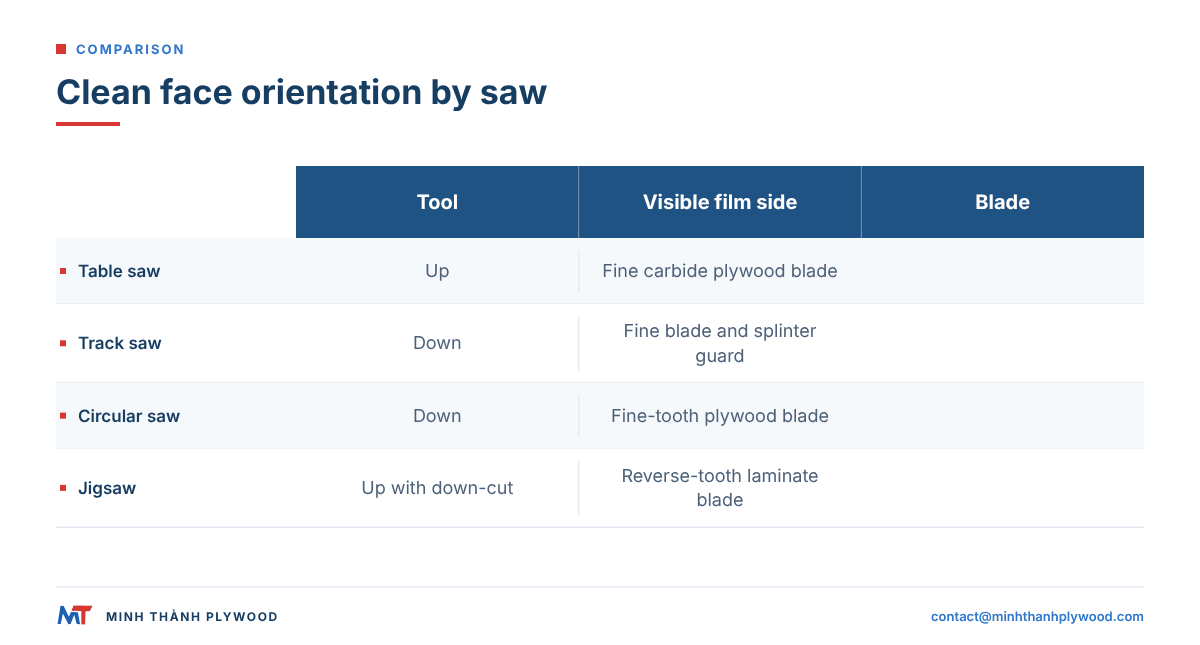
The face you want clean goes up on a table saw or panel saw, where the teeth enter from above. It goes down on a handheld circular saw or track saw, where the teeth exit through the top.
Cutting phenolic plywood: which saw and blade for each job?
Cutting phenolic plywood well comes down to tooth count, tooth shape and support. A sharp carbide-tipped blade with many fine teeth gives a clean film edge on every saw.
| Tool | Blade | Film side | Best for |
|---|---|---|---|
| Panel saw with scoring blade | Fine-tooth carbide main blade plus scoring blade | Up | Factory and depot cutting, chip-free on both faces |
| Table saw | Fine plywood or laminate blade, triple-chip or alternate-bevel teeth | Up | Straight rips and cross-cuts in the workshop |
| Track saw | Fine-tooth blade, splinter guard on the track | Down | Full sheets on site, the cleanest handheld cut |
| Circular saw | Fine-tooth plywood blade, not a framing blade | Down | Rough cuts on site, then plane or sand the edge |
| Jigsaw | Down-cut or reverse-tooth laminate blade | Up with down-cut blade | Openings, curves, cut-outs for pipes |
| CNC router | Compression or down-cut spiral bit | Either | Repeated shapes, signage, furniture parts |
| Hand saw | Fine-tooth panel saw | Up | Only for small trims; tape the line |
Tooth counts that work: a 10 in table saw blade with 60 to 80 teeth in an alternate top bevel or Hi-ATB grind, or triple-chip for laminates (Pro Table Saw Reviews, 2026). A track saw blade of 48 teeth or more, such as the 160 mm Festool 495377 (48 teeth, 2.2 mm kerf) or Makita B-07353 (6-1/2 in, 48 teeth, 0.087 in kerf). Sheets are 4 × 8 ft (1220 × 2440 mm) in 1/2, 5/8 and 3/4 in (12, 15 and 18 mm).
A framing blade with few large teeth is the most common cause of a ragged film edge. Blades dull quickly on the hard resin, so change or sharpen them sooner than on plain plywood.
How to cut phenolic board on site: cutting formply for formwork
Cutting formply on site is mostly straight cuts for wall and slab panels, plus openings for pipes and boxes. How to cut phenolic board on site without a workshop: use a track saw where you can, and a circular saw with a fine blade and a clamped straightedge where you cannot.
- Plan the cuts from full sheets to keep off-cuts large enough for fillers and stop-ends.
- Cut on a flat, supported surface, such as a pair of trestles with timber bearers across them, never on the ground.
- Keep the film clean: lay the sheet on clean bearers or a sheet of cardboard so grit does not scratch the face.
- Cut openings with a jigsaw after drilling a starter hole in each corner.
- Mark panels after cutting on the back or the edge, not on the casting face.
Full sheets come as 1220 × 2440 mm or 1250 × 2500 mm, and a site that cuts many panels to the same size saves time by ordering them cut at the mill. We cut panels to size before packing: one sheet into 4, 6 or 8 pieces.
How to drill tie holes in film faced plywood
Drill tie holes in film faced plywood from the film face, with a sharp bit and a backing board, so the film around the hole stays intact. A torn film ring around a tie hole lets water into the core at every pour.
- Mark the tie positions on the film from the formwork drawing.
- Clamp a scrap board behind the panel at the hole position.
- Drill from the film side with a brad-point or spur bit, slow speed at the start.
- Clear the bore and check the exit side for breakout.
- Seal the inside of the bore with edge sealer or the same paint used on the edges.
- Fit tie cones or sleeves where the formwork design uses them, so the tie does not bear directly on the bore.
Unused holes in a reused panel can be plugged with plastic plugs made for formwork and sealed, so the next pour does not print a ring.
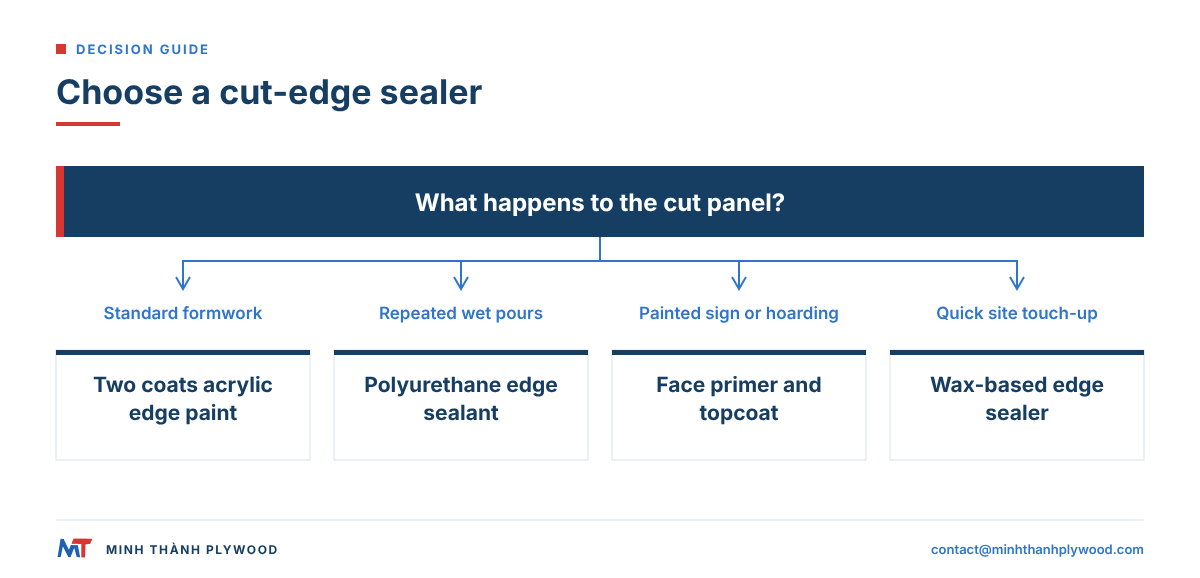
Why seal every cut edge, and with what?
Every cut edge must be sealed because it exposes bare veneer and glue lines, the path water takes into the panel. An unsealed edge takes up water, swells, and the film begins to lift from the corners inward.
| Edge sealer | How to apply | Use |
|---|---|---|
| Water-resistant acrylic edge paint | Two brushed coats | Standard choice for formwork panels |
| Polyurethane edge sealant | One or two coats | Panels that see many pours or long wet periods |
| Paint system used on the face | Primer plus topcoat on the edge | Painted hoardings, signs and furniture |
| Wax-based edge sealer | Brush or dip | Quick site touch-ups between pours |
Seal edges on the day of cutting, before the panel goes into storage or into the form. Re-seal edges that are chipped during stripping, because each chip opens the core again. The guide on how many times film faced plywood can be reused shows how far edge care moves the reuse count.
Which edge colour should you order?
Edge paint colour is an order specification. Many buyers order a colour that differs from the film so their own panels are easy to tell apart on a shared site; others match the film for a neat look on hoardings.
Should you paint film faced plywood or order a different face?
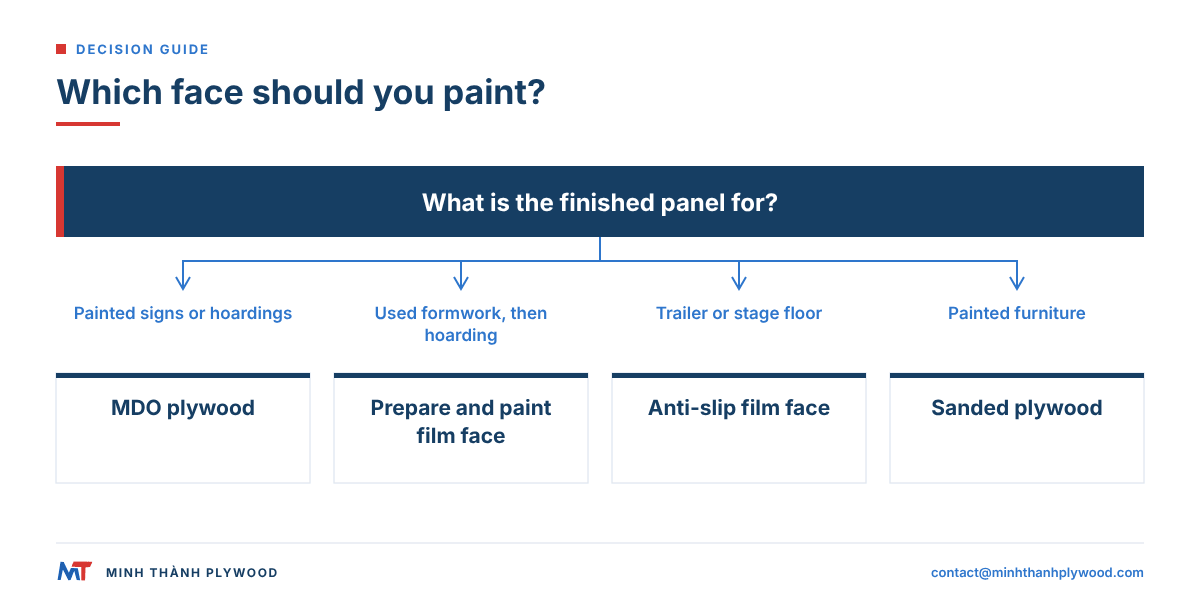
Paint film faced plywood when you already own the panels or need the water-resistant glue and hard face; order a paint-ready face when a painted finish is the main purpose. Paint never bonds to phenolic film as well as it bonds to a surface made for paint.
| Need | Best choice | Why |
|---|---|---|
| Painted signs, hoardings, displays as the main use | MDO (medium density overlay) plywood | Paper overlay made to take paint |
| Concrete forms, later reused as hoardings | Film faced plywood, painted after use | Earns its cost on site first |
| Hard, water-resistant floor in a trailer or stage | Anti-slip film faced plywood | Textured film, no paint needed |
| Painted furniture or interiors | Sanded plywood with a smooth face | Takes primer and paint directly |
| A coloured face without painting | Film faced plywood in a chosen film colour | Colour is an order line |
Our comparison of HDO plywood vs MDO plywood explains the two overlays in detail. Anti-slip film is heavier than formwork film, at about 220 g/m² against about 120–135 g/m² for a standard formwork film, with a raised hexagon, wire-mesh or grain pattern.
Is cutting phenolic plywood dusty or hazardous?
Cutting phenolic plywood produces fine wood and resin dust, and wood dust is a recognised health hazard for anyone who saws timber products regularly. The US Occupational Safety and Health Administration sets out the risks of wood dust exposure.
Control the dust at the saw:
- Extract at the source: connect saws and sanders to a dust extractor or a vacuum rated for fine dust.
- Wear protection: a fitted dust mask or respirator, eye protection, and hearing protection near saws.
- Clean with a vacuum, not a broom or compressed air, which put the dust back into the air.
- Sand outdoors or in a ventilated area when you prepare film for painting.
Phenolic film faced plywood bonded with a WBP glue is cured in the press, and the cured resin in the dust is inert. The hazard is the fine dust itself, so the same precautions apply as for any plywood.
What mistakes ruin cut or painted film faced plywood?
Most failures come from four shortcuts: a coarse blade, no edge sealing, paint on oily film and skipping the primer. Each takes minutes to avoid and costs a panel to ignore.
| Mistake | Result | Fix |
|---|---|---|
| Framing blade with few teeth | Torn, chipped film edge | Fine-tooth carbide blade, scoring cut |
| Wrong face up for the saw | Chipping on the visible face | Clean face up on table saws, down on handheld saws |
| Off-cut left unsupported | Tear-out at the end of the cut | Support both sides of the line |
| Cut edges left bare | Edge swell, lifting film | Seal the same day |
| Paint on oily or dusty film | Paint peels in sheets | Degrease, sand, dust off |
| Standard wood primer | Poor adhesion | Bonding primer for glossy surfaces |
| Sanding through the film | Patchy finish, water entry | Stop when the gloss is gone |
| Painting in cold, damp air | Slow cure, soft paint | Paint in dry conditions, cure fully |
Ordering film faced plywood that you plan to cut or paint
When you plan to cut or paint film faced plywood, put the extra requirements on the order: size or cut list, film colour and weight, glue type, edge paint colour and thickness tolerance. A clear order line saves cutting and sanding time later.
Our film-faced panels are made in thicknesses within 3–40 mm, with a thickness tolerance of ±0.5 mm and ±2 mm on length and width. Glue is MR or phenolic (WBP) to the buyer’s specification, and film colour, film weight and film brand are written on the order.
Proof to ask for on the same order. Film faced plywood that will be cut, painted and reused needs a bond that survives repeated wetting, and a buyer can check it:
- Bond class: ask for the EN 314-2 bond class and the EN 636-3 plywood class for exterior use on the test report. For Class 3, EN 314-2 requires shear tests after three separate EN 314-1 pretreatments: a 24-hour soak at 20 °C, a 6-hour boil with 1 hour cooling in water, and either a cycle of 4 hours boiling, 16-20 hours drying at 60 °C, 4 hours boiling and at least 1 hour cooling in water, or a 72-hour boil (APA Europe, EN 314-2). A phenolic (WBP) bond is made for that cycle; a melamine-fortified bond is rated for humid conditions.
- Boil test on a sample: some buyers also boil a sample for 10-24 hours to see whether the plies and the film hold (Onsun). Test the sample you will cut and paint, not a catalogue piece.
- Third-party testing: we arrange testing to the buyer’s method, for example EN 717-1 through SGS, on request.
- Certificates: the EUDR compliance dossier, with origin records and geolocation files, is supplied with orders. CARB P2 / TSCA Title VI certification is held under ICTT mill no. 23024.
A specification line for panels you will cut and paint might read:
- Application: formwork, then painted hoarding; or signage boards.
- Core and glue: hardwood core, phenolic (WBP) glue.
- Film: a lighter film colour for painting; film weight to the use.
- Size: 1220 × 2440 mm full sheets, or the cut list.
- Thickness: 12, 15, 18 or 21 mm, ±0.5 mm.
- Edges: sealed, edge paint colour.
- Packing and quantity: sheets per pack, number of packs, destination port.
Every shipment is photographed and filmed before loading, and buyers get the photos and video. Send your specification through the film-faced plywood page and we reply within hours; free samples are available so you can test cutting and painting before you order. The wider concrete form plywood buying guide covers grades and cores.
Buyer questions, answered
Can you paint film faced plywood?
Yes. Degrease the film, sand it until the gloss is gone without cutting into the veneer, apply a bonding primer made for glossy non-porous surfaces, then a topcoat. Paint applied straight onto untreated phenolic film peels.
Can formply be painted for hoardings?
Yes. Formply makes a flat, water-resistant hoarding board once the film is keyed and primed. Use an exterior topcoat and seal the cut edges and fixing holes, which is where water enters first.
What primer sticks to phenolic film?
A bonding or adhesion primer sold for glossy surfaces such as laminate, tiles or glazed finishes, either shellac-based, waterborne bonding primer or two-pack epoxy primer. Test a patch with a tape pull before coating a whole batch.
What blade is best for cutting phenolic plywood?
A sharp carbide-tipped blade with many fine teeth, often sold as a laminate or fine plywood blade. Fewer, coarser teeth tear the film; a dull blade burns and chips it.
Which side up should film faced plywood be when cutting?
On a table saw or panel saw, the face you want clean goes up, because the teeth enter from above. On a handheld circular saw or track saw, it goes down, because the teeth exit through the top.
How do you stop film faced plywood from chipping when you cut it?
Score the cut line with a knife or a scoring pass, tape along the line, support the sheet on both sides of the cut, feed steadily and use a sharp fine-tooth blade.
Do you need to seal cut edges of film faced plywood?
Yes. A cut edge exposes bare veneer and glue lines. Seal it the same day with a water-resistant edge paint or sealer, or the edge takes up water, swells and the film starts to lift.
Can you drill through film faced plywood for form ties?
Yes. Drill from the film face with a sharp brad-point or spur bit, back the exit side with scrap to stop breakout, and seal the bore before the panel goes back into service.
Is MDO better than film faced plywood for painting?
For a painted finish, yes. MDO carries a paper overlay made to take paint; phenolic film faced plywood is made to release concrete. Order MDO when paint is the main use.
Is phenolic plywood dust harmful?
Wood dust from sawing any plywood is a health hazard. Cut with dust extraction, wear a fitted dust mask and eye protection, and clean up with a vacuum rather than a broom.