
Decorative hardwood plywood is a panel faced with a hardwood veneer chosen for its look: oak, walnut, hickory, alder, wenge, rosewood or a burl. The species sets colour and price, the cut sets the grain pattern, and the core decides how flat it stays. This A–Z covers each face, its legality note and the engineered alternative, from Minh Thanh Plywood's furniture line.
What is decorative hardwood plywood?
Decorative hardwood plywood is plywood whose face veneer is chosen for appearance: a sliced or figured hardwood such as oak, walnut, cherry or wenge, pressed onto a flat core and sold for surfaces people see. The trade also calls it fancy plywood or hardwood veneered plywood.
Three things decide what a buyer gets:
- The species sets colour, grain and most of the price.
- The cut (rotary, plain sliced, quarter, rift) sets the pattern the face shows.
- The core decides whether the face stays flat, takes a finish evenly and machines cleanly.
Commercial plywood uses a plain rotary face for general work. A decorative panel carries a selected face over a whole-piece core, because any gap under a thin face veneer telegraphs through to the finish. This guide covers the species first, then cuts, figure, matching, legality and the order.
Decorative veneer species A–Z: look, origin and legality
The table lists the decorative faces buyers ask for most, with the look, the usual origin, the trade note and the engineered alternative when the natural face is scarce or controlled.
| Face species | Look | Usual origin | Legality and trade note | Engineered alternative |
|---|---|---|---|---|
| Alder (red alder) | Even light reddish-brown, little figure | North America | Not CITES-listed | Rarely needed |
| Ash | Pale, open bold grain like oak | Europe, North America | Not CITES-listed | EV ash-look |
| Beech | Pale pinkish, fine fleck | Europe | Not CITES-listed | Rarely needed |
| Birch | Pale, quiet rotary figure | Northern Europe | Not CITES-listed | Poplar or EV |
| Cherry (American) | Warm red-brown, darkens with light | North America | Not CITES-listed | EV cherry-look |
| Ebony | Near-black, very fine grain | Africa, Madagascar, Asia | Madagascar Diospyros in CITES Appendix II | Dyed or EV ebony-look |
| Hickory | Strong cream and brown contrast | North America | Not CITES-listed | Rarely made |
| Mahogany (genuine) | Red-brown, ribbon when quartered | Central and South America | Swietenia macrophylla in CITES Appendix II | Sapele, EV |
| Maple | Creamy white, sometimes curly or bird’s-eye | North America, Europe | Not CITES-listed | Poplar, EV |
| Oak, red | Pinkish tone, open cathedral grain | North America | Not CITES-listed | EV oak |
| Oak, white | Grey-brown, ray fleck when quartered | North America, Europe | Not CITES-listed | EV oak |
| Rosewood | Dark purple-brown streaks | Asia, Africa, Latin America | Dalbergia in CITES Appendix II; Brazilian rosewood Appendix I | EV rosewood-look |
| Sapele | Red-brown, ribbon stripe | West and Central Africa | Not CITES-listed | EV, okoume |
| Teak | Golden brown, oily | Plantations in Asia, Africa, Latin America | Plantation origin papers | EV teak |
| Walnut (black) | Chocolate brown, purple and grey tones | North America | Not CITES-listed | EV walnut |
| Wenge | Dark brown with fine black stripes | Central Africa | Not CITES-listed; limited supply | EV wenge |
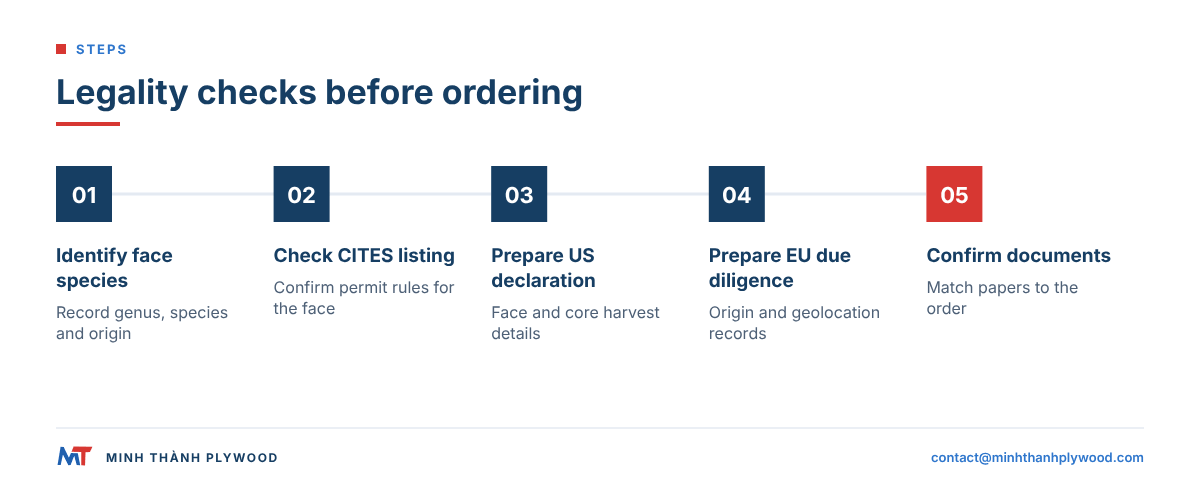
CITES (the Convention on International Trade in Endangered Species of Wild Fauna and Flora) controls trade in listed species; check the current listing for any face in the CITES species checklist before you order. Sapele has its own sapele plywood guide, and walnut faces are covered in walnut plywood.
Hickory plywood and alder plywood: the North American faces
Hickory plywood and alder plywood are both North American decorative faces, at opposite ends of the look scale. Hickory is loud, alder is quiet.
Hickory plywood shows creamy sapwood and brown heartwood in one face, with bold, wandering grain and occasional mineral streaks. Buyers choose it for rustic kitchens, lodges and furniture where variation is the point. Hickory veneer is hard and dense, so sanding and finishing need a sharp, consistent process to avoid swirl marks.
Alder plywood has an even, light reddish-brown face with little figure. Red alder takes stain evenly, which is why cabinet makers often stain it to look like cherry at a lower cost. A “knotty alder” face with small sound knots is also sold for rustic doors.
Both faces are made to order on hardwood plywood lines, laid over a sanded core. For either, specify the face grade, whether character marks (knots, streaks, colour change) are accepted, and whether panels must be sequence-matched for a run of doors.
Exotic hardwood plywood: wenge, rosewood and ebony
Exotic hardwood plywood uses tropical faces such as wenge, rosewood, ebony, zebrano or padauk, chosen for dark colour or strong stripes. Supply is limited, prices are high and two of the three best-known faces are CITES-listed.
- Wenge plywood: dark coffee brown with fine black stripes, usually quarter-sliced for a straight-line look. Natural wenge is from Central Africa and is not CITES-listed, but good logs are scarce. Engineered wenge gives the same stripe evenly across a run.
- Rosewood plywood: purple-brown to near-black streaks. All Dalbergia species are in CITES Appendix II, and Brazilian rosewood (Dalbergia nigra) is in Appendix I. Natural rosewood veneer and plywood move only with a CITES export permit from the country of origin.
- Ebony plywood: the darkest face available. Ebony from Madagascar (Diospyros) is in CITES Appendix II; other ebony faces come in very short, narrow leaves. Most “ebony” panels on the market are dyed or engineered veneer.
For a project that needs these looks on many panels, engineered veneer is usually the practical choice: same colour on every sheet, no permit, and a lower price. Natural exotic faces suit a one-off piece where the grain itself is the feature.
Veneer cuts: rotary, plain sliced, quarter, rift and half-round
The cut is how the veneer is taken from the log, and it sets the pattern a face shows. The same species looks different in each cut.
| Cut | How it is made | Pattern on the face | Yield and cost |
|---|---|---|---|
| Rotary | Log turned against a knife, one continuous sheet | Wide, wild figure | Highest yield, lowest cost |
| Plain sliced (flat cut) | Half-log sliced parallel to its centre | Cathedral arches with straight edges | Good yield, the standard decorative face |
| Quarter sliced | Quarter-log sliced at right angles to the growth rings | Straight stripes; ray fleck in oak | Lower yield, higher cost |
| Rift cut | Sliced at about 15° off the quarter | Straight, even grain with little fleck | Lowest yield of the sliced cuts |
| Half-round | Log mounted off-centre on a lathe | Cathedral with a softer, wider look | Between rotary and plain sliced |
Rotary cut faces are common on birch, maple and commercial faces. Plain sliced and quarter sliced faces dominate oak, walnut and cherry decorative panels. White oak buyers ask for rift and quarter faces most; the white oak plywood guide shows those cuts side by side.
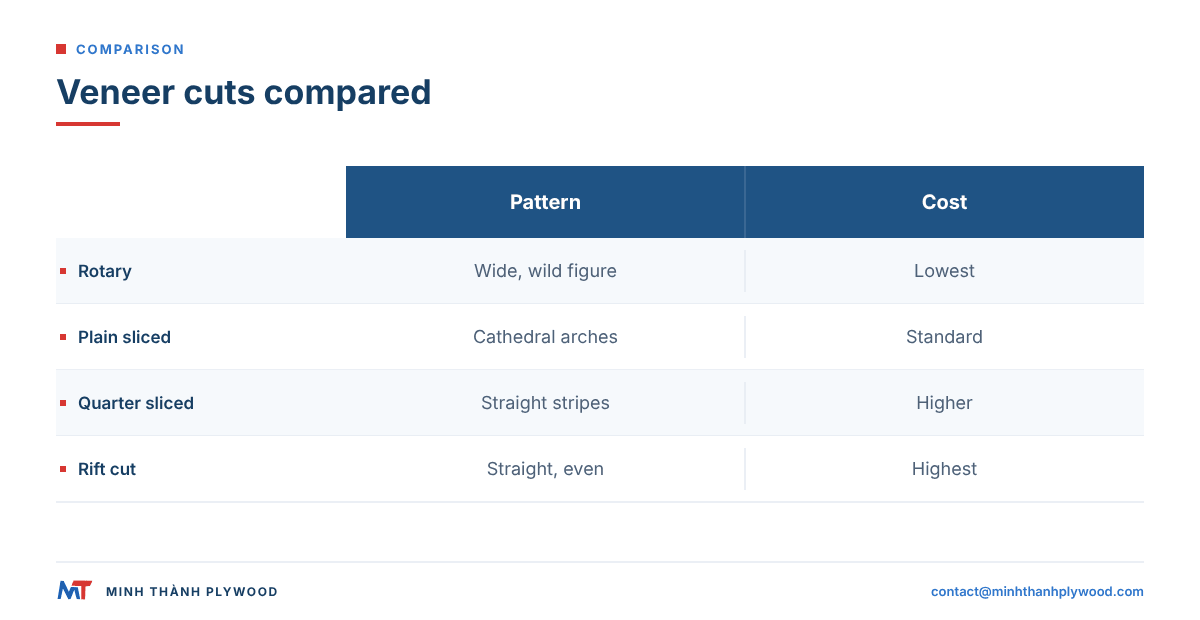
Figure: crown, ribbon, curl, burl and bird’s-eye
Figure is the pattern inside the grain that makes a face special. It comes from how the tree grew and how the veneer was cut, and it drives the top of the price range.
- Crown or cathedral: arches from plain slicing. The everyday decorative look in oak, walnut and cherry.
- Ribbon or stripe: alternating light and dark bands from interlocked grain cut on the quarter. Sapele and genuine mahogany are the classic ribbon faces.
- Curl or fiddleback: bands across the grain that shimmer as the light moves. Found in maple, cherry and some sapele.
- Quilted and bird’s-eye: rare maple figures, quilts like ripples and bird’s-eye as small dots.
- Burl: swirls and eyes from growths on the trunk. Walnut, elm and maple burls are sold in small leaves and pieced together.
- Ray fleck: the silvery flakes of quarter-sawn white oak.
Figured faces vary leaf by leaf. Order them from an approved sample of the same flitch (the bundle of leaves from one log section), and agree how many panels that flitch must cover.
Matching: book match, slip match and panel layout
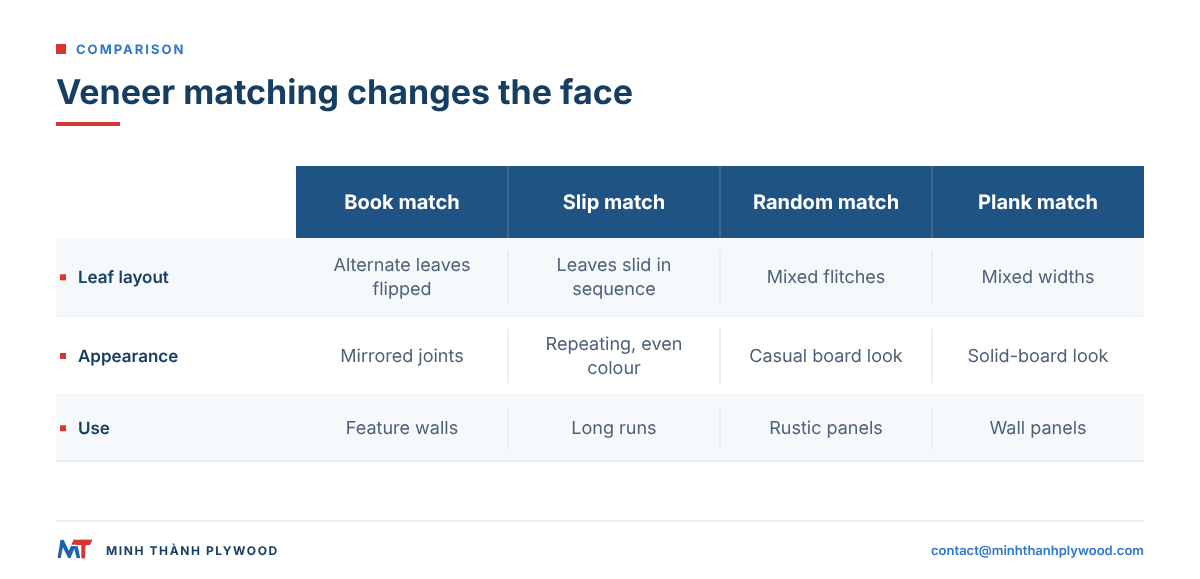
Matching is how leaves of veneer are laid side by side to make a face wider than one leaf. The pattern changes the look as much as the species.
| Match | How the leaves are laid | Effect | Best for |
|---|---|---|---|
| Book match | Every second leaf turned over like a book page | Mirror image at each joint | Walnut, figured faces, feature walls |
| Slip match | Leaves slid out in sequence, not turned | Repeating pattern, even colour | Quarter and rift faces, long runs |
| Random match | Leaves from different flitches mixed | Board-like, casual look | Rustic and budget decorative faces |
| Plank match | Mixed leaves of differing widths | Looks like solid boards | Wall panels, ceilings |
Panel layout matters too. A “balance match” uses leaves of equal width; a “centre match” puts a joint at the panel centre. For rooms where panels sit side by side, ask for sequence-matched panels: consecutive sheets from the same flitch, numbered in order, so the grain flows across the wall.
Natural or engineered veneer: which should you choose?
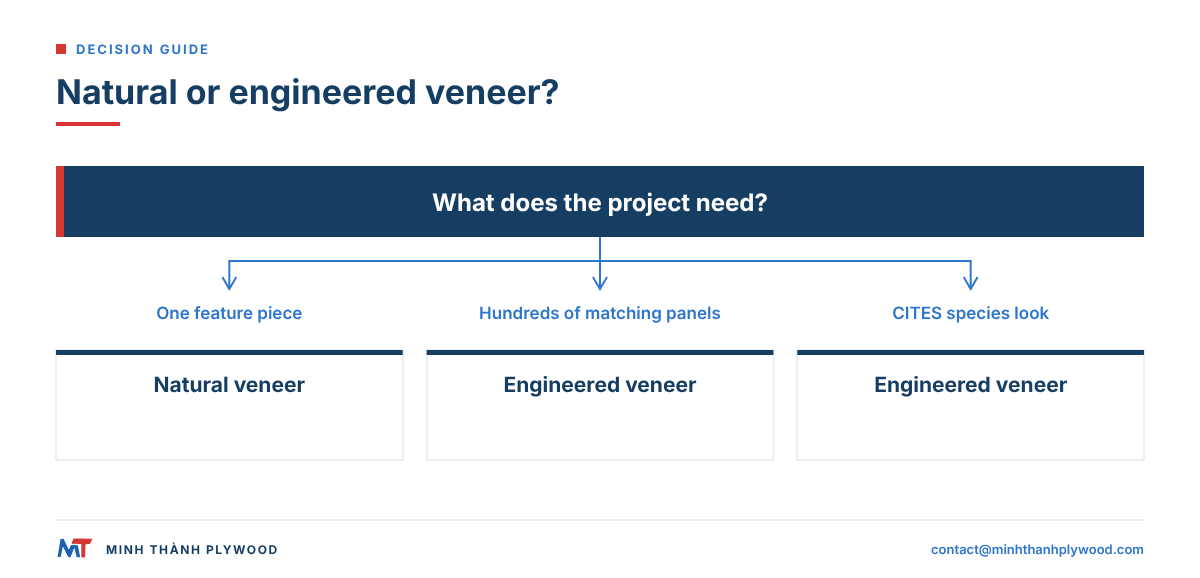
Choose natural veneer when the grain of a real log is the feature; choose engineered veneer (EV) when you need the same look on hundreds of panels, a controlled species or a lower price. Both are pressed onto the same kind of core.
Engineered veneer is made by peeling fast-growing plantation logs, dyeing the leaves, gluing them into a block in a mould and slicing the block again. The result copies walnut, oak, teak, wenge or a rosewood look with a grain that repeats exactly. EV is one of Minh Thanh’s most-produced faces; see EV plywood for the build.
| Need | Natural decorative veneer | Engineered veneer (EV) |
|---|---|---|
| One-off feature piece | Best: unique grain | Looks uniform |
| Hundreds of matching panels | Varies leaf by leaf | Same colour and grain |
| Species under CITES | Permit needed | No permit for the EV face |
| Price | Follows species and figure | Lower and stable |
| Repair and touch-up | Match by eye | Easy to match |
Many projects mix both: natural walnut on a reception desk, EV walnut on the run of wall panels behind it.
Legality: CITES, the Lacey Act and EUDR
Decorative faces cross more borders than cores, so the documents matter as much as the look. Three rules cover most orders.
- CITES: a face from a listed species needs a CITES export permit from its origin country, and an import permit for Appendix I. Dalbergia rosewoods, Madagascar ebony, genuine mahogany (Swietenia macrophylla) and Spanish cedar (Cedrela) are the listed decorative species buyers meet most. Check the CITES checklist for the species and population.
- US Lacey Act: importers declare the genus, species and country of harvest for every wood in the panel, face and core. Minh Thanh supplies the face and core species and the Vietnamese harvest origin of its cores for that declaration; the USDA APHIS Lacey Act page explains the declaration.
- EU Deforestation Regulation (EUDR): plywood placed on the EU market under Regulation (EU) 2023/1115 needs due diligence with origin and geolocation data. Minh Thanh supplies the EUDR compliance dossier (origin records and geolocation files) with orders.
A face from a separate origin (North American walnut, African sapele) carries its own origin papers from the veneer supplier, which travel with the panel documents.
The core under a decorative face
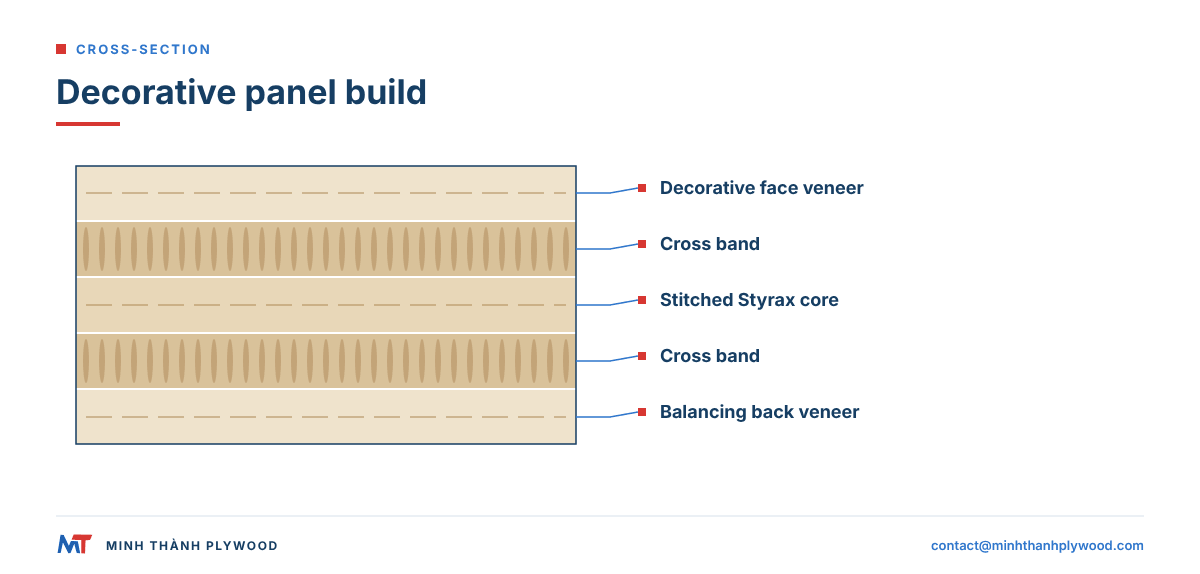
A decorative face is often well under a millimetre thick, so every flaw in the core shows through. The core decides whether the finished surface is flat, even and free of telegraphing.
What a good decorative core needs:
- Closed, even plies: no gaps or overlaps. Minh Thanh stitches core layers both horizontally and vertically before pressing.
- Calibration before facing: furniture-grade panels are pressed twice as standard; the core board is pressed and calibrated, then face and back are pressed on.
- Tight thickness: sanded furniture panels hold ±0.2–0.3 mm, down to ±0.2 mm, so CNC parts and edge banding fit.
- Light, stable species: white Styrax or Eucalyptus cores as standard; Styrax gives a lighter panel, Eucalyptus a stiffer one.
- Dry: veneers and panels at 8–12 % moisture content at dispatch.
The US standard ANSI/HPVA HP-1-2020 names five core types for hardwood and decorative plywood:
| Core type (HP-1-2020) | What it is | Made by Minh Thanh |
|---|---|---|
| Veneer core | Three or more veneer layers glued at 90 degrees | Yes: every panel is veneer-core plywood |
| MDF core | Medium density fibreboard under the face | No |
| Particleboard core | Particleboard under the face | No |
| Combination core | Veneer core with MDF crossbands | No |
| Lumber core | Edge-glued lumber strips | No |
A veneer core holds screws better along the edge and is lighter than MDF; that is why cabinet and furniture plants that run CNC and edge banding ask for it.
Glue and emission for decorative panels
Decorative plywood goes indoors, close to people, so emission matters as much as bond strength. Furniture and interior panels at Minh Thanh use UF glue at E0 emission as standard; MR (melamine-fortified) and phenolic bonds are made to the customer’s specification.
The proof is on file. Minh Thanh holds CARB P2 / TSCA Title VI certification as ICTT mill no. 23024. Six ASTM D6007 chamber tests between April 2025 and June 2026 on 9, 15 and 18 mm panels averaged 0.014–0.032 ppm, against the 0.05 ppm CARB Phase 2 / TSCA Title VI limit for veneer-core hardwood plywood; three were run by Shanghai Hongjun and three by ICTT Vietnam. Third-party testing to a buyer’s method, for example EN 717-1, is arranged through SGS on request.
US specifiers working to LEED v4.1 look for two things in a decorative panel: low-emitting material and responsible sourcing of raw materials. The CARB P2 / TSCA Title VI certificate and the six chamber reports above are the emission evidence for the first; the species names and Vietnamese harvest origin Minh Thanh supplies with every order support the second. Confirm the credit with your project’s LEED assessor, because credits are awarded to the building, not to a panel.
How decorative plywood is graded and priced
Decorative plywood is graded on its face first and its back second, and the price follows the face. A natural decorative face is the most expensive layer in the panel.
| Price driver | Lower cost | Higher cost |
|---|---|---|
| Species | Birch, maple, red oak, EV | Walnut, white oak rift, exotics, burls |
| Cut | Rotary, plain sliced | Quarter, rift, figured |
| Matching | Random, slip | Book match, sequence-matched sets |
| Face grade | Character marks accepted | Clear face, close colour match |
| Back | Plain balancing back | Same species both sides |
| Core | Standard furniture core | Lighter or thinner calibrated builds |
In the US, face and back grades follow ANSI/HPVA HP-1-2020. Faces are graded AA, A, B, C, D and E, with AA the best (virtually no defects) and E the lowest (knots and defects allowed). Backs are graded 1 (best) to 4 (lowest). A cabinet-grade panel is often sold as A-1 or A-2: a clean A face on a sound 1 or 2 back.
| HP-1 face grade | What the face looks like | Typical use |
|---|---|---|
| AA | Virtually no defect characteristics, close colour match | Visible cabinet doors, fine furniture |
| A | Few, small defects | Cabinet fronts, wall panels |
| B | Small knots and colour variation allowed | Cabinet sides, painted or stained work |
| C, D | Larger knots and defects allowed | Shop and utility panels |
| E | Knots and defects, lowest face | Concealed parts |
Our natural and engineered veneer (EV) faces are quoted against these letters: a clear walnut or oak face to AA or A, a character face to B. The approved sample still fixes the match. Panels are 4 x 8 ft, made in Vietnam as 1220 × 2440 mm, in thicknesses from 1/4 to 3/4 inch (6 to 18 mm).
To save cost, many buyers order the decorative face on one side and a cheaper balancing back on the other. Face and back grades are quoted as pairs and fixed by the approved sample. As a starting point, furniture and interior plywood starts from US$350/m³ (October 2026); a natural decorative face is added to that base, and the final price depends on face, core, glue, thickness, size, quantity and delivery term.
Two other decorative types appear in the same US catalogues. Bending or flexible plywood has a grain pattern that lets it curve around a radius for curved counters, columns and wall features. Beaded decorative plywood has a V-groove or bead machined into the face to look like board panelling. Both are specialty products; ask for them by name when the design needs a curve or a boarded look.
Where decorative hardwood plywood is used
Decorative hardwood plywood goes wherever wood is seen up close and must stay flat: furniture, kitchens, doors and interiors.
- Cabinets and kitchens: doors, end panels and visible boxes, often in oak, walnut, maple or alder.
- Furniture: tables, sideboards, wardrobes and shelving, cut by CNC and edge-banded.
- Wall panels and ceilings: hotels, offices, retail and homes, often sequence-matched in walnut or oak; buyers in Ireland and the UK ask for this for interior wall panelling.
- Doors: flush door skins and panel inserts.
- Shopfitting and exhibition stands: displays where finish quality is visible.
For wall panels and ceilings, specify E0 emission, sequence-matching for adjacent panels and a fire-performance treatment if the building code asks for it.
What this means for your order
Order decorative hardwood plywood by writing the face as precisely as the core. A specification line looks like this:
18 mm, 1220 × 2440 mm, face: walnut plain sliced, book-matched, clear grade; back: balancing veneer; core: white Styrax, stitched, pressed twice; UF glue at E0; sanded, ±0.2 mm; quantity per run; destination port.
- Name the species, cut and match, and whether natural or engineered veneer.
- Approve a sample cut from the actual flitch or EV batch.
- State legality papers for CITES species, the Lacey Act or EUDR.
- Fix the back: decorative both sides, or a balancing back.
Minh Thanh lays up 10+ face veneers on its furniture line, including EV, and other faces on request, in sizes 1220 × 2440 and 1250 × 2500 mm and thicknesses from 3 to 40 mm. The minimum order is one 40HC with mixed specifications by agreement, and free samples go out with the quotation. Send your face and build to [email protected].
Buyer questions, answered
What is decorative hardwood plywood?
Plywood with a hardwood face veneer selected for appearance, such as oak, walnut, cherry or wenge, pressed onto a stable core. It is made for surfaces people see: cabinets, doors, furniture and wall panels.
What is the difference between decorative plywood and commercial plywood?
Decorative plywood carries a selected face veneer, often sliced and matched, over a whole-piece core; commercial plywood uses a plain rotary face for general work. The face veneer is the main price difference.
Is rosewood plywood legal to import?
Yes, with CITES papers. Dalbergia rosewoods are listed in CITES Appendix II, so veneer and plywood need an export permit from the country of origin; Brazilian rosewood is in Appendix I and is effectively out of trade.
Is ebony plywood available?
Natural ebony faces are rare and costly, and Madagascar ebony is CITES-listed. Most ebony-look panels use engineered or dyed veneer, which gives an even black-brown face at a fraction of the cost.
What does hickory plywood look like?
Hickory plywood shows strong contrast between creamy sapwood and brown heartwood in the same face, with bold, irregular grain. It suits rustic cabinets and furniture where variation is wanted.
Is alder plywood a hardwood?
Yes. Red alder is a North American hardwood with a soft, even reddish-brown face and little figure, often stained to look like cherry. It is popular for cabinet doors and interior panels.
What is the most expensive decorative veneer?
Burls, figured exotics and CITES-listed species such as rosewood and ebony cost the most, followed by quarter-sliced and rift faces of walnut and white oak. Plain-sliced oak, maple and birch are the economical decorative faces.
What is the difference between plain sliced and quarter sliced veneer?
Plain sliced veneer is cut parallel to the log centre and shows a cathedral pattern; quarter sliced veneer is cut at right angles to the growth rings and shows straight stripes. Quarter slicing yields less face per log, so it costs more.
Can decorative plywood be used for wall panels?
Yes. Decorative hardwood plywood is a standard material for interior wall panelling and ceilings; specify sequence-matched faces when panels sit side by side and E0 emission for interior air.
What is engineered veneer plywood?
Engineered veneer (EV) is made by dyeing and re-laminating plantation veneers into blocks that are sliced again, giving a repeatable grain and colour. It copies walnut, oak, teak or wenge without the variation or the legality questions of rare logs.
Does decorative plywood need both faces in the same species?
No. Many buyers order the decorative face on one side and a cheaper balancing back on the other. The back must still be a veneer of similar behaviour so the panel stays flat.