
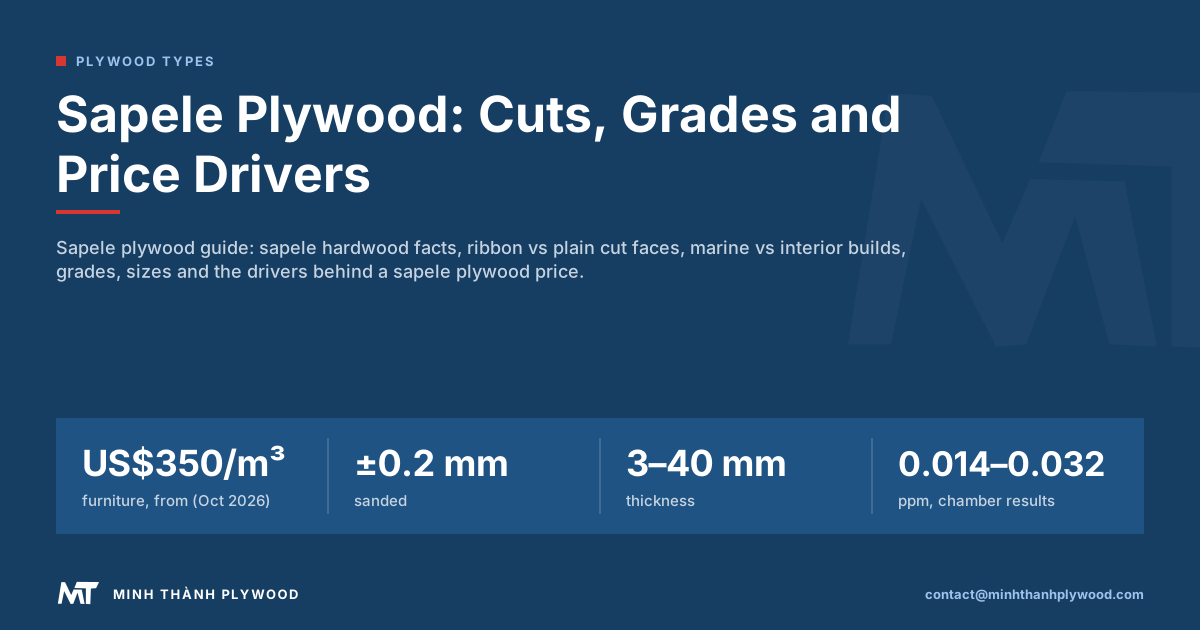
Sapele plywood is hardwood plywood faced with sapele, an African hardwood with a red-brown colour and a ribbon stripe that looks like mahogany. The cut sets the look, the core sets flatness, and the face drives most of the price. Minh Thanh Plywood makes sapele-faced panels on request; this guide covers the wood, the cuts, the builds and what to specify for a quote.
What is sapele plywood?
Sapele plywood is hardwood plywood with a face veneer of sapele, an African hardwood with a red-brown colour and a ribbon-stripe grain that resembles mahogany. The face is pressed onto a hardwood core and the panel is sold for furniture, doors, cabinets and interior panelling.
The trade uses several names for the same product: sapele veneered plywood, sapele veneer plywood, sapele faced plywood and, in some markets, sapele mahogany plywood or sapeli plywood. All mean a sapele face on a plywood core; only “sapele marine plywood” means a different build, covered below.
Three choices decide a sapele panel: the cut of the face (ribbon or plain), the core under it and the glue bond. This guide takes them in order and ends with the price drivers and a specification line.
Sapele hardwood in brief
Sapele (Entandrophragma cylindricum) is a large tropical hardwood of West and Central Africa, in the same family (Meliaceae) as genuine mahogany. As a timber it is known for four things:
- Colour: pinkish when freshly cut, darkening to a deep red-brown with light and age.
- Interlocked grain: the fibres change direction in alternating bands, which gives the ribbon stripe on quartered faces.
- Hardness: harder and denser than genuine mahogany, with a smooth, hard-wearing surface.
- Finishing: takes clear coats, oils and stains well, and polishes to a high lustre.
Sapele hardwood is sold as lumber (sapele boards), as sliced veneer and as plywood faces. It is not listed in CITES, but it is harvested from natural forest, so origin papers matter; see the legality section below. For other African and American mahogany faces, see mahogany plywood.
Ribbon vs plain cut sapele faces
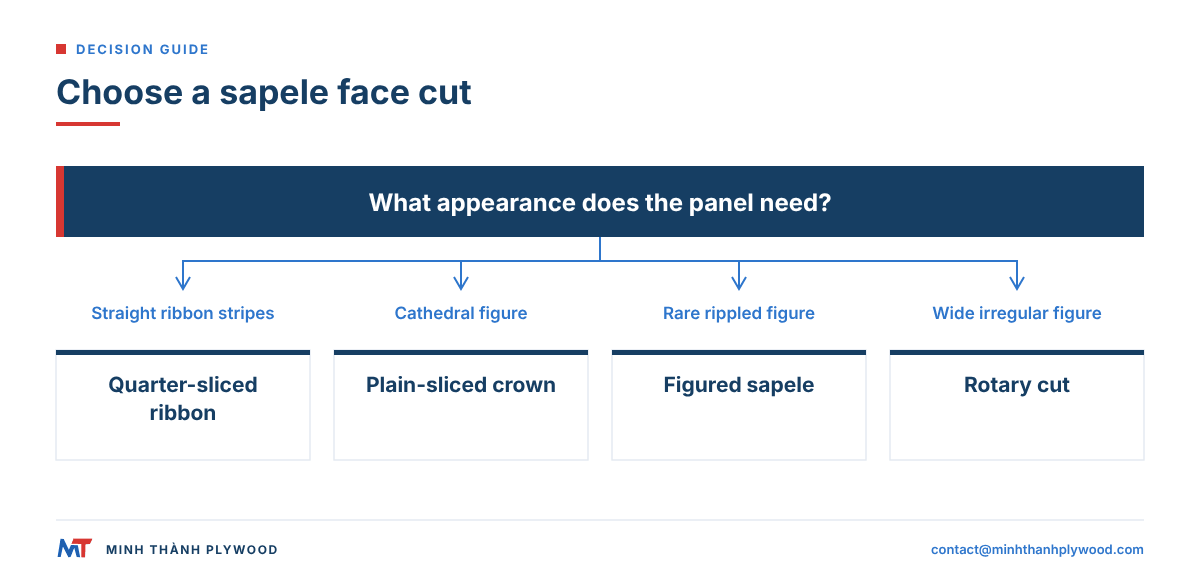
The cut decides what a sapele face looks like. Quarter slicing shows the ribbon stripe; plain slicing shows a cathedral figure; rotary cutting gives a wide, wild figure for commercial faces.
| Cut | Pattern | Look | Typical use | Cost |
|---|---|---|---|---|
| Quarter sliced (ribbon) | Straight alternating light and dark stripes | Classic, formal, shimmers in light | Doors, cabinet fronts, wall panels | Higher |
| Plain sliced (crown) | Cathedral arches | Warm, decorative | Furniture tops, panels | Standard |
| Figured (pommele, fiddleback) | Blistered or rippled figure | Rare, striking | Feature pieces, instruments | Highest |
| Rotary cut | Wide, irregular figure | Plain, uneven stripe | Commercial and painted panels | Lowest |
Ribbon cut sapele is the face most buyers mean by “sapele plywood”. Because the stripe moves with the light, specify the grain direction (along the length is standard) and ask for sequence-matched panels where several sit side by side.
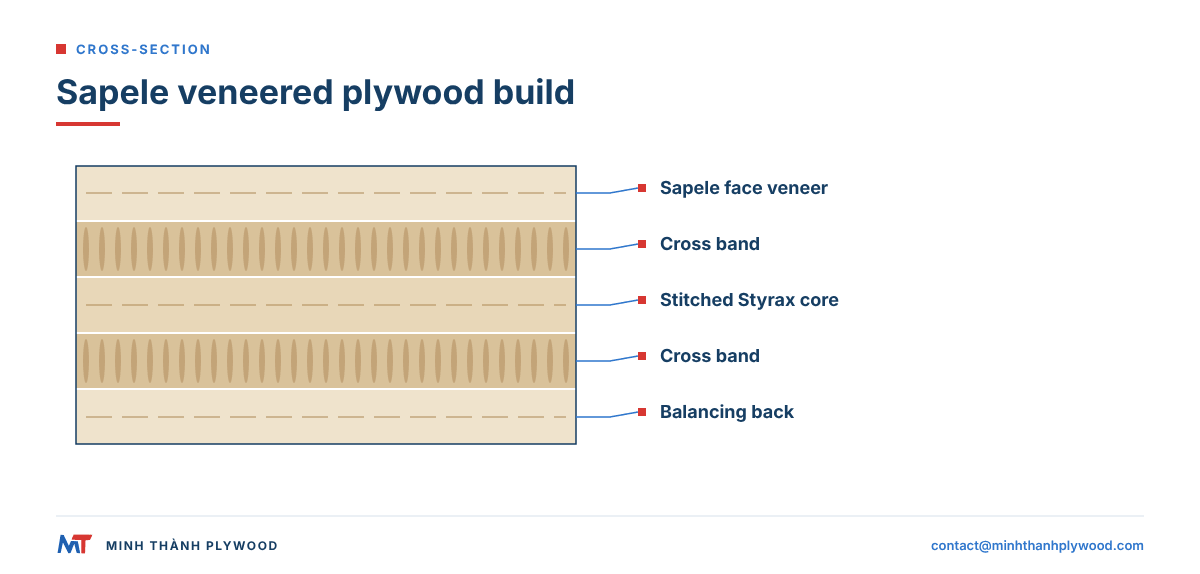
The sapele veneered plywood build: face on a Vietnamese core
A sapele veneered plywood panel from Vietnam is a sapele face and a balancing back pressed over a plantation hardwood core. The face brings the look; the core decides flatness, weight and how the panel machines.
At Minh Thanh, sapele faces are made on request on the same furniture line as the 10+ standard faces:
- Core: white Styrax or Eucalyptus as standard; Styrax for a lighter panel, Eucalyptus for a stiffer one.
- Stitched layers: core layers stitched both horizontally and vertically, so no gap shows through the thin face.
- Pressing twice: the core board is pressed and calibrated, then face and back are pressed on.
- Sanded tolerance: ±0.2–0.3 mm, down to ±0.2 mm, for CNC work and edge banding.
- Moisture: veneers and panels at 8–12 % moisture content at dispatch.
Glue, emission and the documents that come with the panel
Sapele plywood for furniture and interiors uses UF glue at E0 emission as standard at Minh Thanh; MR (melamine-fortified) and phenolic (WBP) bonds are made to the customer’s specification.
Emission evidence is on file: CARB P2 / TSCA Title VI certification as ICTT mill no. 23024, ISO 9001:2015 (KAC25/0185) and TCVN 11902:2017 certification for veneer-faced plywood (VietCert 141.1-VNC-HC). Six ASTM D6007 chamber tests from April 2025 to June 2026 on 9, 15 and 18 mm panels averaged 0.014–0.032 ppm against the 0.05 ppm CARB Phase 2 / TSCA Title VI limit, three by Shanghai Hongjun and three by ICTT Vietnam. Third-party testing to a buyer’s method, such as EN 717-1, is arranged through SGS on request.
Sapele vs mahogany vs okoume plywood
Sapele, genuine mahogany and okoume are the three reddish faces buyers compare most. Sapele sits between them: darker and more striped than okoume, more available than genuine mahogany.
| Point | Sapele | Genuine mahogany | Okoume |
|---|---|---|---|
| Species | Entandrophragma cylindricum | Swietenia macrophylla | Aucoumea klaineana |
| Origin | West and Central Africa | Central and South America | Central Africa |
| Colour | Red-brown, darkens | Reddish-brown, golden | Pinkish-brown |
| Figure | Strong ribbon stripe | Soft ribbon, lustrous | Mild, even |
| CITES | Not listed | Appendix II | Not listed |
| Typical plywood use | Doors, furniture, panels | Fine furniture, boats | Furniture, interiors, marine builds |
Okoume-faced plywood is a standard face at Minh Thanh; see okoume plywood. For the full species list, see decorative veneer species A–Z.
Sapele marine plywood vs sapele faced plywood
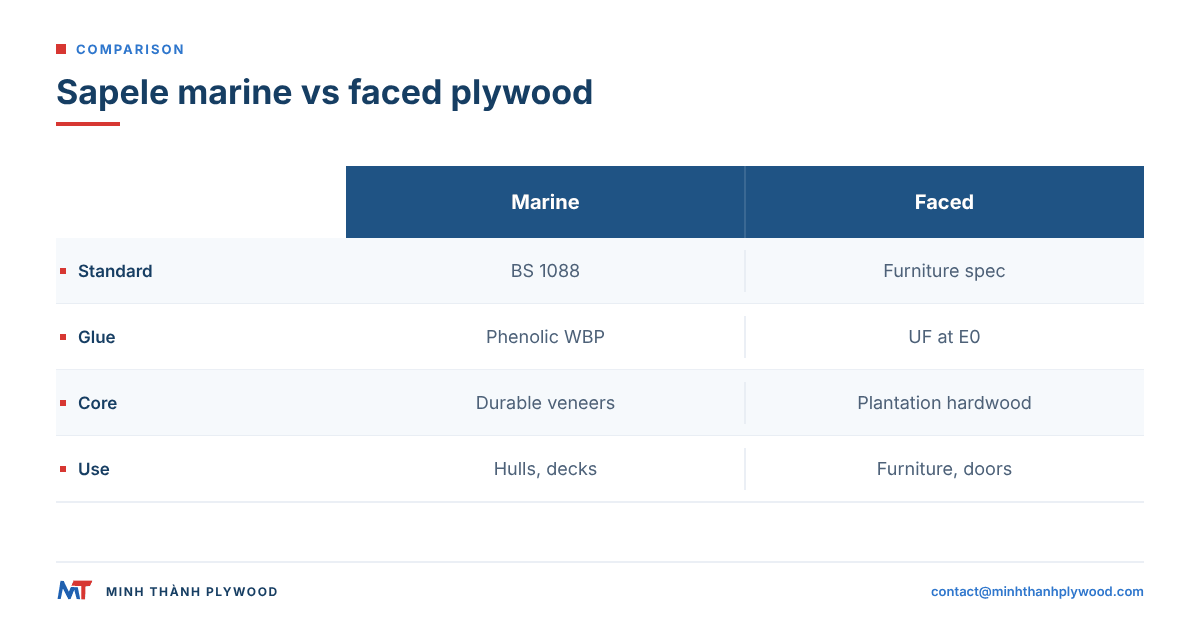
Sapele marine plywood and sapele faced plywood are two different products. Marine plywood is a complete build to a marine standard, usually BS 1088; sapele faced plywood is an interior or furniture panel with a sapele face on a hardwood core.
| Point | Sapele marine plywood | Sapele faced plywood |
|---|---|---|
| Standard | BS 1088 (or Lloyd’s-approved) | Furniture and interior specifications |
| Glue | Phenolic (WBP), boil-resistant | UF at E0 for interiors; MR or WBP on order |
| Core veneers | Durable species throughout, gap limits | Plantation hardwood core |
| Use | Boat hulls, decks, wet exposure | Furniture, doors, cabinets, panels |
Minh Thanh’s sapele-faced panels are furniture and interior panels. For a boat build, buy plywood certified to BS 1088 for marine use; for interiors of boats, sapele faced plywood with a phenolic bond is a common choice.
Sapele plywood grades
Sapele plywood is graded on its face and back as a pair, fixed by an approved sample. The face grade sets how clear and even the sapele surface is; the back can be a lower grade or a different veneer.
- Clear face: no open defects, close colour match across leaves; for doors and visible furniture.
- Good face: small sound marks and some colour variation; for furniture parts and panels.
- Back: sapele for two-sided panels, or a balancing veneer when one side is hidden.
In the US, stock sapele is labelled with the ANSI/HPVA HP-1 notation. “A-1” is an A face (a clean, well-matched face) on a 1 back (the best back). “Q/S” means quarter-sliced, the cut that gives the ribbon stripe, and “P/S” means plain sliced. So “Sapele, A Q/S-1 P/S” on a US price list reads: A-grade quarter-sliced face, 1 back, plain-sliced back. Our clear face corresponds to A, our good face to B, and the back follows the approved sample. A US buyer sends the HP-1 line and gets the same panel specified in the quotation.
Agree three more points with the sample: ribbon or plain cut, how leaves are matched (book or slip match), and the colour range accepted. Sapele darkens with light, so compare samples that have aged the same way.
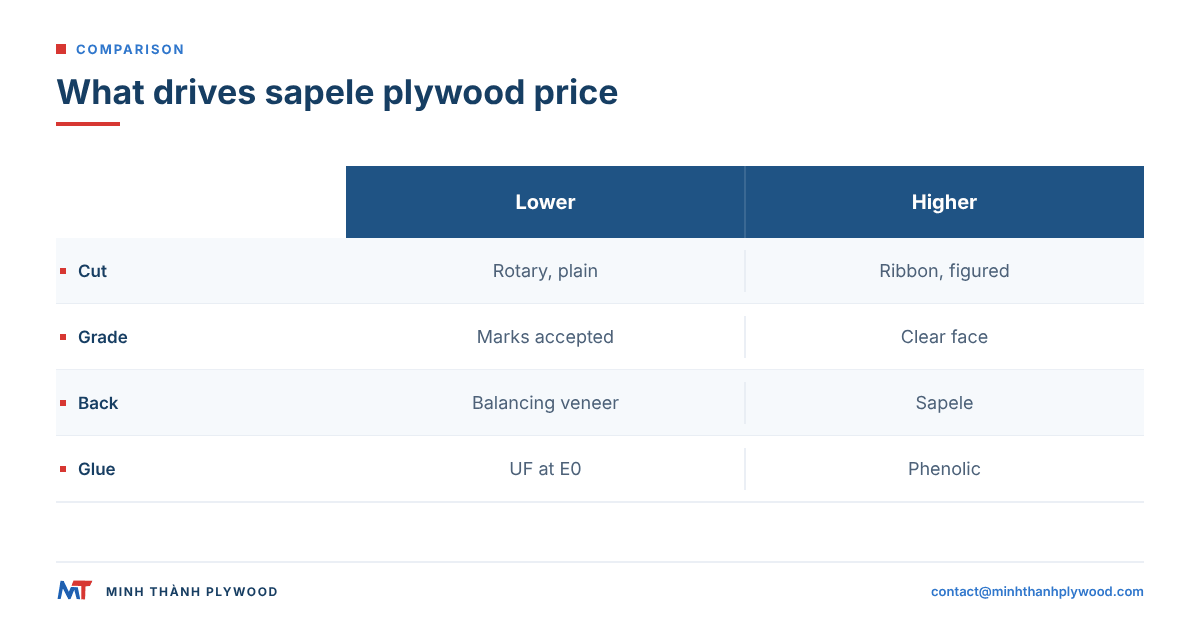
Sapele wood price and sapele plywood price drivers
Sapele plywood costs more than a commercial-faced panel because its face is a sliced African hardwood. As a starting point, furniture and interior plywood from Vietnam starts from US$350/m³ (October 2026); the sapele face, its cut and grade, and the build add to that base.
| Price driver | Pushes the price down | Pushes the price up |
|---|---|---|
| Cut | Rotary, plain sliced | Quarter-sliced ribbon, figured |
| Face grade | Small marks accepted | Clear face, close colour match |
| Back | Balancing veneer | Sapele both sides |
| Matching | Random or slip | Book-matched, sequence-matched sets |
| Thickness | Thin panels | Thick panels (more core per sheet) |
| Glue | UF at E0 | Phenolic (WBP) |
| Order size | Full 40HC of one build | Many small specifications |
The final price depends on face, core, glue, thickness, size, quantity and delivery term. Sapele wood price for lumber follows a different logic: solid sapele boards are priced by volume and grade, and a square metre of sapele surface costs far more in solid wood than as a veneer face.
Sapele boards vs sapele plywood
Choose sapele boards for solid parts and edges, sapele plywood for wide flat panels. Solid sapele moves across the grain with humidity and its interlocked grain can tear out when planed; a sapele veneer on a cross-laminated core stays flat across a full sheet.
- Sapele boards: legs, frames, edge lipping, mouldings, stair parts and anything shaped in three dimensions.
- Sapele plywood: cabinet sides, door panels, table tops, wall panelling and any wide surface.
Most sapele furniture combines both: plywood panels with solid sapele lipping on the visible edges.
Sizes and thickness of sapele plywood
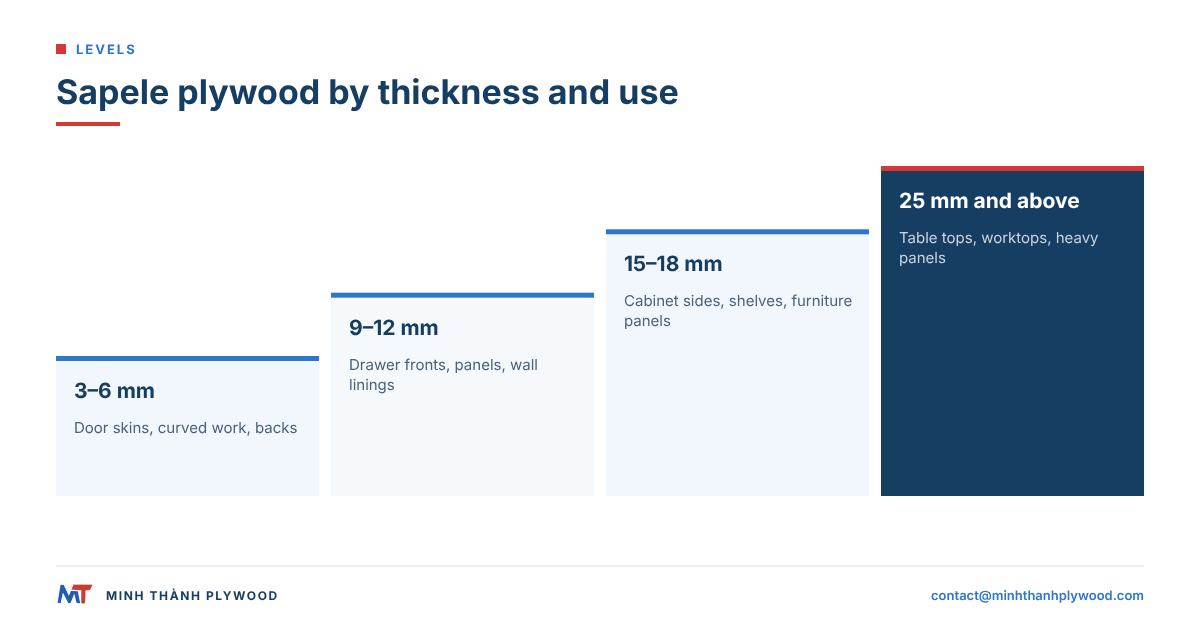
Sapele plywood is made in the standard sheet sizes 1220 × 2440 mm (4 × 8 ft) and 1250 × 2500 mm, with custom sizes such as 1220 × 2500 and 1220 × 2280 mm. Minh Thanh makes thicknesses from 3 to 40 mm.
| Thickness | Typical use |
|---|---|
| 3 to 6 mm | Door skins, curved work, backs |
| 9 to 12 mm | Drawer fronts, panels, wall linings |
| 15 to 18 mm | Cabinet sides, shelves, furniture panels |
| 25 mm and above | Table tops, worktops, heavy panels |
Sapele plywood sizes US buyers see on stock
US distributors list sapele plywood in inches, and the sheet is slightly oversize so it trims to a true 4 x 8 ft. Edensaw in Washington, for example, stocks sapele at 1/4 x 48-1/2 x 96-1/2 in, 3/4 x 48-1/2 x 96-1/2 in and 3/4 x 48-1/2 x 120-1/2 in (a 10 ft sheet), and the 1/2 in sapele on a marine-type VCHXB build.
| US stock size | Metric equivalent | Core options on US stock | Made by Minh Thanh |
|---|---|---|---|
| 1/4 in | 6.35 mm, made as 6 mm | MDF core or veneer core | Veneer core; ply count confirmed with the order |
| 1/2 in | 12.7 mm, made as 12 mm | Veneer core | Veneer core |
| 3/4 in | 19.05 mm, made as 18 mm | Veneer core, MDF core, Europly or combination core | Veneer core |
| 48-1/2 x 96-1/2 in | Oversize 4 x 8 | Trimmed by the buyer | 1220 × 2440 mm, 1250 × 2500 mm and 1220 × 2500 mm |
| Marine sapele, 5/32 and 3/16 in | 4 mm and 5 mm | Marine build to BS 1088 | Not our product; boat builders buy it by the sheet |
Single sheets in the US are costly to move. A full 4 x 8 ft sheet of sapele ships on a pallet by freight carrier, which is costly for a single sheet. A container changes the arithmetic: the freight is shared across the load and the price is quoted per cubic metre, which suits importers, distributors and cabinet plants buying volume.
Thin panels from 3 to 5 mm are always 5-ply at Minh Thanh. Cut-to-size panels, one sheet cut into 4, 6 or 8 pieces, are also available for furniture plants that want parts ready for the line.
How to finish and machine sapele plywood
Sapele plywood finishes well with clear coats, oils and stains, and it machines cleanly when cutting tools are sharp. Its interlocked grain is the one thing to plan for.
- Sanding: sand along the grain with 150 then 180 grit; the hard face sands to a smooth surface but shows cross-grain scratches clearly.
- Clear finish: a sanding sealer and two to three top coats of lacquer or waterborne polyurethane bring out the ribbon stripe.
- Stain: sapele takes stain evenly, but the ribbon looks best under a clear or lightly tinted coat.
- Colour change: sapele darkens with light; a UV-filtering top coat slows the change, and panels for one room should be finished and installed together.
- Cutting: use sharp carbide blades with a scoring unit to avoid chipping the thin face across the grain.
- Edges: band with sapele veneer or a solid sapele lipping, cut from the same colour range as the face.
Where sapele plywood is used
Sapele plywood is used where a warm red-brown, striped wood surface is the design: high-end furniture, doors and interiors.
- Doors: flush door faces and panel inserts, often ribbon cut.
- Cabinets and kitchens: fronts, end panels and visible boxes.
- Furniture: tables, sideboards, desks and wardrobes.
- Wall panelling: offices, hotels, ships’ interiors and boardrooms.
- Musical instruments and speakers: guitar bodies and cabinets use sapele for its tone and look.
- Boat interiors: bulkheads and joinery, with a phenolic bond.
Buyers in Northern Europe and the Baltics ask for sapeli plywood for doors and furniture; the build and documents are the same as for any EU order.
Legality and documents for sapele plywood
Sapele is not CITES-listed, but it is harvested from natural forests in Africa, so every order needs origin papers that name the species and country of harvest for the face.
- EU Deforestation Regulation (EUDR): wood products placed on the EU market need due diligence under Regulation (EU) 2023/1115, with origin and geolocation data. Minh Thanh supplies the EUDR compliance dossier (origin records and geolocation files) with orders, and the sapele face carries its veneer supplier’s origin papers.
- US Lacey Act: importers declare the genus, species and country of harvest for every wood in the panel; Minh Thanh supplies face and core species and the Vietnamese harvest origin of its cores. See the USDA APHIS Lacey Act page.
- Certificates: FSC and CE are available* where a project asks for them. FSC sapele is an orderable option: US distributors list it as “FSC Sapele”, and the FSC claim sits on the invoice beside the Lacey Act species and country-of-harvest data.
*Supplied directly or through qualified partner mills.
What this means for your order
Order sapele plywood by naming the cut, the grade and the build, then approve a sample of exactly that combination before production starts. Put the bond, the back veneer and the origin papers on the same order line, so the quotation, the sample and the shipment all describe one panel. A specification line looks like this:
18 mm, 1220 × 2440 mm, face: sapele quarter-sliced ribbon, clear grade, slip-matched; back: balancing veneer; core: white Styrax, stitched, pressed twice; UF glue at E0; sanded, ±0.2 mm; quantity; destination port.
- Choose the cut: ribbon for doors and formal panels, plain for furniture tops.
- Choose the bond: UF at E0 indoors, phenolic for boat interiors.
- Set the back: sapele both sides or a balancing veneer.
- Ask for the papers: species, origin and EUDR or Lacey data.
Minh Thanh makes sapele faced plywood on request as a Vietnam exporter, with the minimum order one 40HC with mixed specifications by agreement, production in 15–45 days after the 30% deposit, and 70% against the scanned B/L. Free samples go out with the quotation. Send your sapele specification to [email protected].
Buyer questions, answered
What is sapele plywood?
Sapele plywood is hardwood plywood with a face veneer of sapele (Entandrophragma cylindricum), an African hardwood with a red-brown colour and ribbon-stripe grain. It is used for furniture, doors, cabinets and wall panels.
Is sapele the same as mahogany?
No. Sapele belongs to the same family (Meliaceae) as genuine mahogany and looks similar, which is why it is sold as sapele mahogany, but it is a different genus with a more pronounced stripe and a harder surface.
Is sapele plywood waterproof?
The sapele face is moderately durable, but waterproofing comes from the glue. Interior sapele plywood uses UF glue; marine sapele plywood uses a phenolic bond and a marine build to BS 1088.
Is sapele marine plywood the same as sapele faced plywood?
No. Sapele marine plywood is built to a marine standard such as BS 1088, with a phenolic bond and durable veneers throughout. Sapele-faced furniture plywood is an interior panel with a sapele face on a hardwood core.
What is ribbon cut sapele?
Ribbon cut sapele is quarter-sliced veneer that shows alternating light and dark stripes along the grain, caused by sapele's interlocked grain. It is the classic sapele look for doors and furniture.
How much does sapele plywood cost?
Sapele plywood costs more than a commercial-faced panel because the face is a sliced African hardwood. Furniture and interior plywood starts from US$350/m³ (October 2026), and the sapele face, cut, grade and thickness add to that base.
Is sapele legal to import?
Yes. Sapele is not CITES-listed, but it is harvested from natural forests in Africa, so buy it with origin papers. EU buyers need EUDR due diligence data and US buyers a Lacey Act declaration naming the species and country of harvest.
Does Minh Thanh make sapele plywood?
Yes, on request. Minh Thanh lays sapele faces on its stitched, twice-pressed Styrax or Eucalyptus cores, in 1220 × 2440 or 1250 × 2500 mm and 3 to 40 mm thick.
Is sapele plywood good for furniture?
Yes. Sapele's warm colour, ribbon figure and hard surface make it a classic face for cabinets, tables, doors and wall panels, and it takes clear finishes and stains well.
What is the difference between sapele boards and sapele plywood?
Sapele boards are solid lumber, priced by volume and prone to movement across the grain. Sapele plywood puts a thin sapele face on a cross-laminated core, so it stays flat in wide panels and costs far less per square metre of sapele surface.
What can I use instead of sapele plywood?
Engineered veneer (EV) in a sapele or mahogany look gives an even ribbon stripe at a lower price; okoume-faced plywood gives a lighter pinkish-brown face. Both are standard faces at Minh Thanh.