
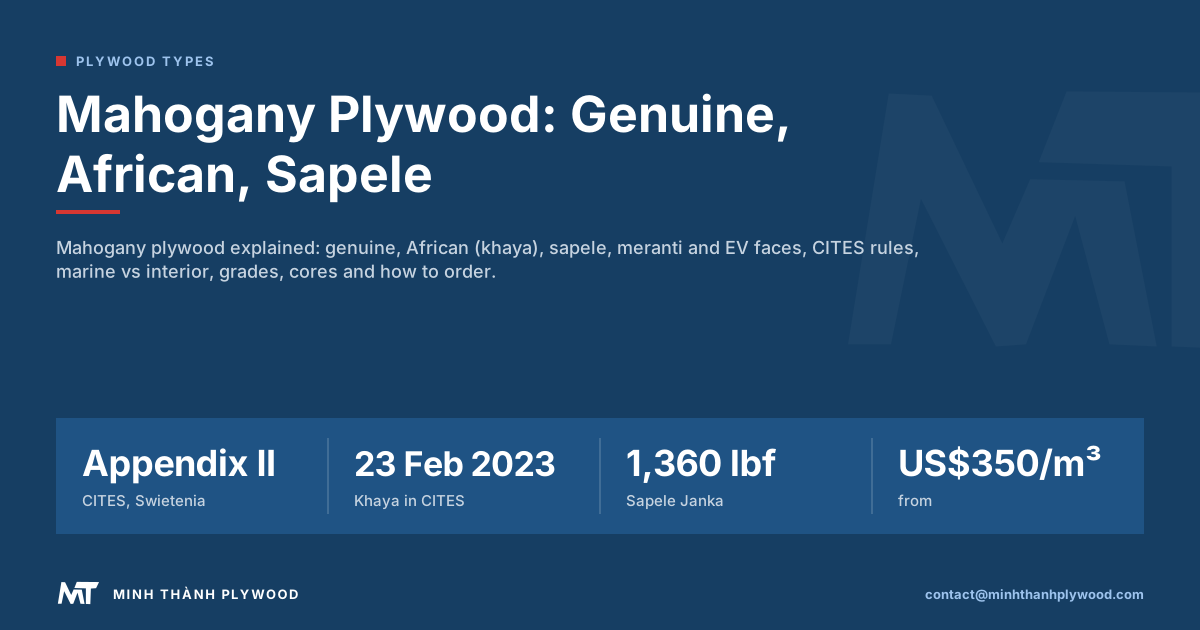
Mahogany plywood is plywood with a mahogany-type face veneer, and the species behind the name varies: genuine mahogany (Swietenia), African mahogany (Khaya), sapele, meranti sold as Philippine mahogany, or an engineered veneer in a mahogany colour. Ask which species is on the face, then fix grade, core and glue. Minh Thanh Plywood supplies sapele and EV faces on furniture cores.
What is mahogany plywood?
Mahogany plywood is plywood with a mahogany-type face veneer pressed onto a core of other species. The face gives the warm reddish-brown look; the core gives strength, flatness and price. The name covers several woods, so the face species on the order decides what you receive.
Three facts decide what a buyer receives:
- The face species: “mahogany” in the trade covers at least five woods, from genuine Swietenia to meranti.
- The core: most mahogany veneer plywood has a core of a cheaper hardwood, such as Styrax, Eucalyptus, poplar or okoume.
- The bond: interior UF glue, melamine-fortified, or phenolic (WBP) for marine and exterior use.
Mahogny plywood and other trade names
The names on quotes vary: mahogany veneer plywood, mahogany veneered plywood, mahogany faced plywood, and in Sweden or Norway “mahogny plywood”. All mean the same build: a thin mahogany-type face on a plywood core.
Which “mahogany” is on the face?
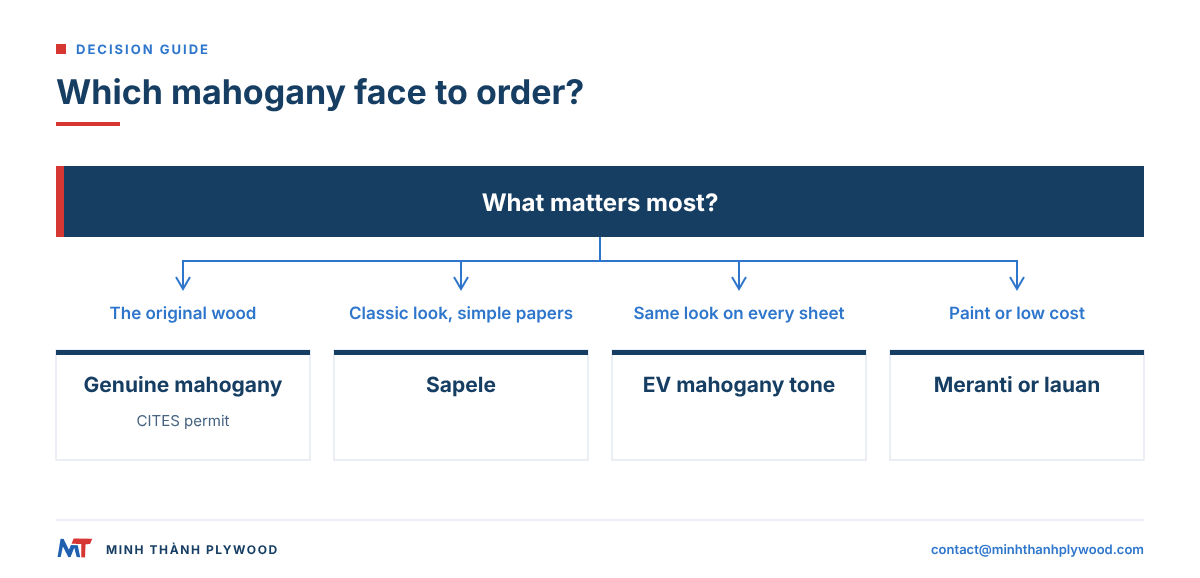
Five woods are sold under the mahogany name, and they differ in colour, hardness, CITES status and price. Name the species before you compare quotes.
| Face species | Botanical name | Dried density | Janka hardness | CITES status | Look |
|---|---|---|---|---|---|
| Genuine mahogany | Swietenia macrophylla | 590 kg/m³ | 900 lbf | Appendix II | Pinkish to deep reddish brown |
| African mahogany | Khaya spp. | 545 kg/m³ | 850 lbf | Appendix II, African populations | Pale pink to reddish brown |
| Sapele | Entandrophragma cylindricum | 665 kg/m³ | 1,360 lbf | Not listed | Golden to dark reddish brown, ribbon stripe |
| Meranti / lauan (“Philippine mahogany”) | Shorea spp. | Varies by group | Varies by group | Not listed as a group | Pinkish to dark red-brown, coarse |
| Okoume (“gaboon mahogany”) | Aucoumea klaineana | 430 kg/m³ | 400 lbf | Not listed | Pale pink to light brown |
Density and hardness are Wood Database averages for solid wood (accessed October 2026). An engineered veneer (EV) in a mahogany colour adds a sixth option; see the EV section.
What is genuine mahogany plywood?
Genuine mahogany plywood carries a face of big-leaf mahogany, Swietenia macrophylla, from Central and South America. It is the wood the name originally meant, and the scarcest and most expensive face of the group.
What a buyer must know:
- CITES Appendix II: Swietenia macrophylla is listed, and the listing covers logs, sawn wood, veneer sheets and plywood. Every export needs a CITES permit from the country of origin.
- Supply: limited, mostly from managed forests in a few countries, so lead times and prices move with permit quotas.
- Look: fine, even texture, colour from pinkish brown to deep reddish brown that darkens with age.
The current CITES lists are on the CITES Appendices page. For most furniture and interior work, buyers now choose sapele or an engineered veneer instead, at a lower price and with simpler documents. In the EU, CITES is applied through Council Regulation (EC) No 338/97, and an EU import permit may be needed on top of the export permit.
African mahogany plywood (khaya)
African mahogany plywood has a face of Khaya, mostly Khaya ivorensis and Khaya anthotheca from West and Central Africa. It looks close to genuine mahogany and is slightly lighter, at about 545 kg/m³.
Since 23 February 2023, African populations of Khaya are listed in CITES Appendix II. The listing covers logs, sawn wood, veneer sheets, plywood and transformed wood, so khaya-faced plywood needs an export permit, and EU imports follow the EU wildlife trade rules.
What that means for an order:
- Documents first: confirm the CITES permit chain before the price, because a shipment without it cannot clear.
- Species names: four Khaya species are sold as African mahogany, and they cannot be told apart reliably by eye.
- Colour: pale pink to reddish brown, sometimes streaky; ask for a sample from the actual veneer lot.
Sapele plywood: the common mahogany-type face
Sapele plywood is the most practical mahogany-type face today: rich reddish-brown colour, a striking ribbon stripe on quarter-cut veneer, and no CITES listing. Sapele belongs to the mahogany family (Meliaceae) without being Swietenia.
Why buyers choose it:
- Hard face: 1,360 lbf Janka, much harder than genuine or African mahogany, so it takes wear on doors and furniture fronts.
- Ribbon figure: quarter-cut sapele shows even light and dark stripes that read as classic mahogany.
- Simpler documents: no CITES permit; standard origin and EUDR records apply.
Sapele is listed as vulnerable on the IUCN Red List, so buyers usually ask for legal-origin documents with each order. Minh Thanh supplies sapele faces on request, on its furniture cores. The full profile is in sapele plywood.
Lauan and meranti: “Philippine mahogany”
Philippine mahogany is a trade name for lauan and meranti, species of Shorea and related genera from South-East Asia. They are not related to true mahogany, and the face is coarser and more variable in colour.
Where lauan and meranti faces fit:
- Utility and underlayment panels: thin lauan or luan plywood for floor underlayment, door skins and backs.
- Painted work: the coarse grain fills and paints well.
- Budget interiors: where a reddish face is wanted at a low cost.
They are a poor choice where buyers expect the fine grain of genuine mahogany. Many Shorea species are on the IUCN Red List, so ask for legal-origin documents. Other decorative faces are compared in decorative veneer plywood species.
EV plywood with a mahogany look
Engineered veneer (EV) gives a mahogany colour and grain without a scarce species on the face. EV is made from fast-growing plantation veneer, dyed, laminated into a block and re-sliced, so every sheet in an order matches.
Why EV is often the best “mahogany” for furniture production:
- Repeatable colour: the same pattern from the first container to the tenth.
- Wide sheets without defects: no knots, splits or colour bands to grade out.
- No CITES permit: the face species is a plantation wood.
- Choice of pattern: crown-cut or quarter-cut stripe looks, in mahogany, sapele or other tones.
EV is one of Minh Thanh’s most produced faces. The panel build is the same as for natural faces: Styrax or Eucalyptus core, UF glue at E0 emission, pressed twice. See EV plywood.
Mahogany marine plywood vs interior mahogany plywood
A mahogany face does not make plywood marine. Marine plywood is defined by the build and the bond: durable face and core species, no core gaps, and a weather and boil proof phenolic glue line, as set out in standards such as BS 1088:2018, which specifies standard and lightweight marine plywood classes.
How the two compare:
| Interior mahogany plywood | Marine-grade mahogany plywood | |
|---|---|---|
| Bond | UF glue at E0 emission (MR on order) | Phenolic (WBP), weather and boil proof |
| Core | Styrax, Eucalyptus or mixed hardwood | Durable species, no gaps or overlaps |
| Standard | Furniture panel specification | BS 1088 or similar marine standard |
| Uses | Furniture, doors, panelling, cabinets | Boat hulls, decks, exterior joinery |
Mahogany-faced marine panels are historically khaya or sapele-faced. Minh Thanh’s mahogany-type faces go on furniture and interior builds; for boats, read the marine plywood buying guide before writing the order.
What grades does mahogany-faced plywood come in?
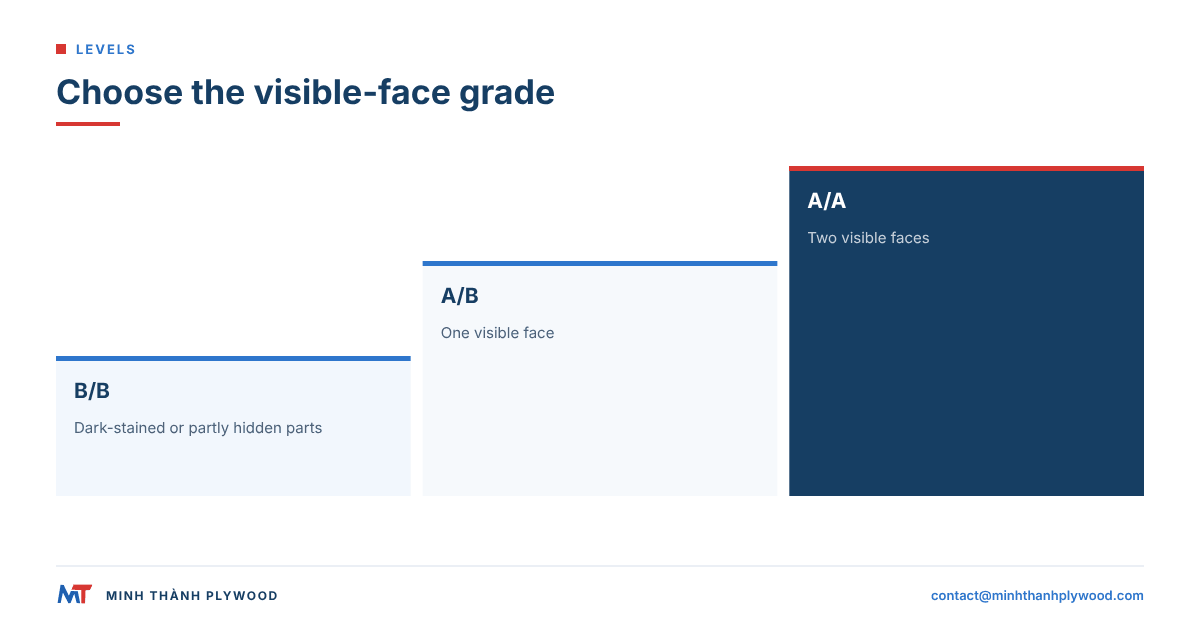
Mahogany-type faces are quoted as face/back grade pairs, such as A/A, A/B and B/B, and the approved sample fixes the look. A/A suits two visible faces, A/B one visible face, B/B parts that are stained dark or partly hidden.
What changes between grades:
- Colour match: A faces are matched for an even tone across the sheet; B faces allow more variation.
- Joints: the number and width of veneer leaves, and how well they are book- or slip-matched.
- Small features: pin knots, mineral streaks and repairs, few on A, more on B.
Hardwood plywood sold in the US and Canada also carries a back-grade number under the HPVA standard (HP-1), and Nordic importers meet it on supplier lists. Write the face letter and the back number together.
| Back grade | What the back may contain | Use |
|---|---|---|
| 1 | The cleanest back: small sound knots and natural colour variation | Visible back |
| 2 | Larger sound knots and neat repairs | Semi-visible back |
| 3 | Utility back: larger knots and limited open defects, sound | Concealed back |
| 4 | Reject back, appearance not a concern | Concealed back, common on 1/4 in panels |
The cut matters as much as the grade. Rotary-cut faces show a wide, wild grain; crown-cut (flat-sliced) faces show cathedrals; quarter-cut faces show the straight ribbon stripe buyers associate with sapele and mahogany. Put the cut on the order next to the grade.
How is mahogany veneer plywood built?
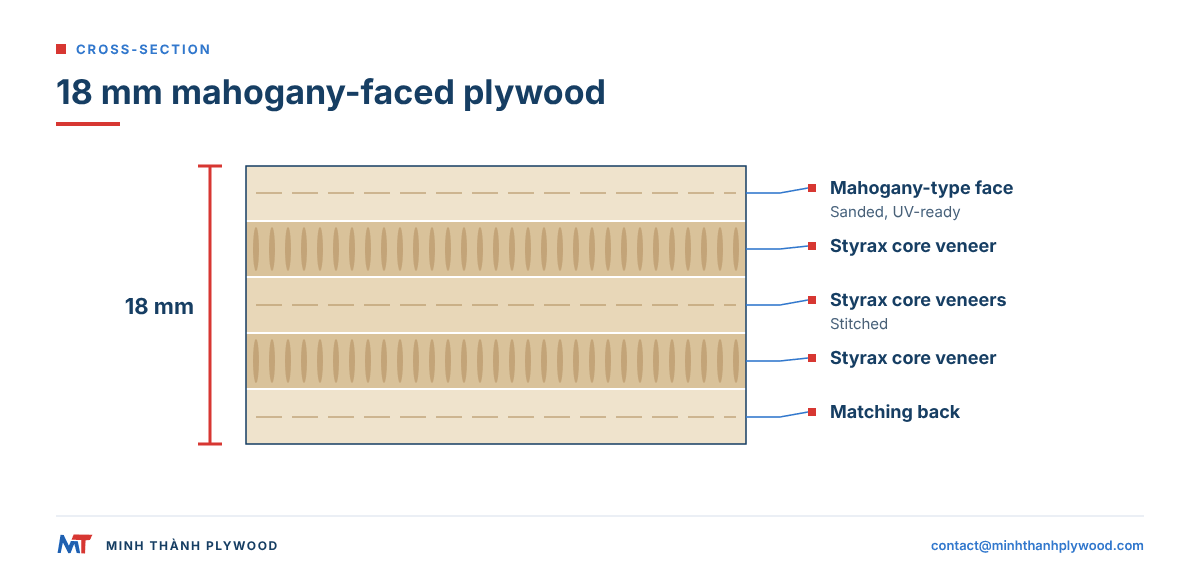
At Minh Thanh, mahogany veneer plywood is built like every furniture panel: a light Vietnamese core, a balanced face and back, and two pressings. The core decides weight and flatness; the face decides the look.
- Core: white Styrax as standard for light furniture panels, Eucalyptus where stiffness matters; core layers stitched horizontally and vertically.
- Glue and emission: UF glue at E0 emission; MR, melamine-fortified or phenolic bonds to the customer’s specification.
- Pressing: twice. The core board is pressed and calibrated, then face and back are pressed on.
- Sanding: sanded and polished faces, both UV-ready for the buyer’s own coating line.
- Tolerance: sanded furniture panels ±0.2–0.3 mm, down to ±0.2 mm; length and width ±2 mm.
- Moisture: veneers and finished panels dried to 8–12% at dispatch.
Six ASTM D6007 chamber tests between April 2025 and June 2026 averaged 0.014–0.032 ppm against the 0.05 ppm CARB Phase 2 / TSCA Title VI limit. The limit for veneer-core hardwood plywood is 0.05 ppm under 40 CFR 770.10.
Which thicknesses and sizes are available?
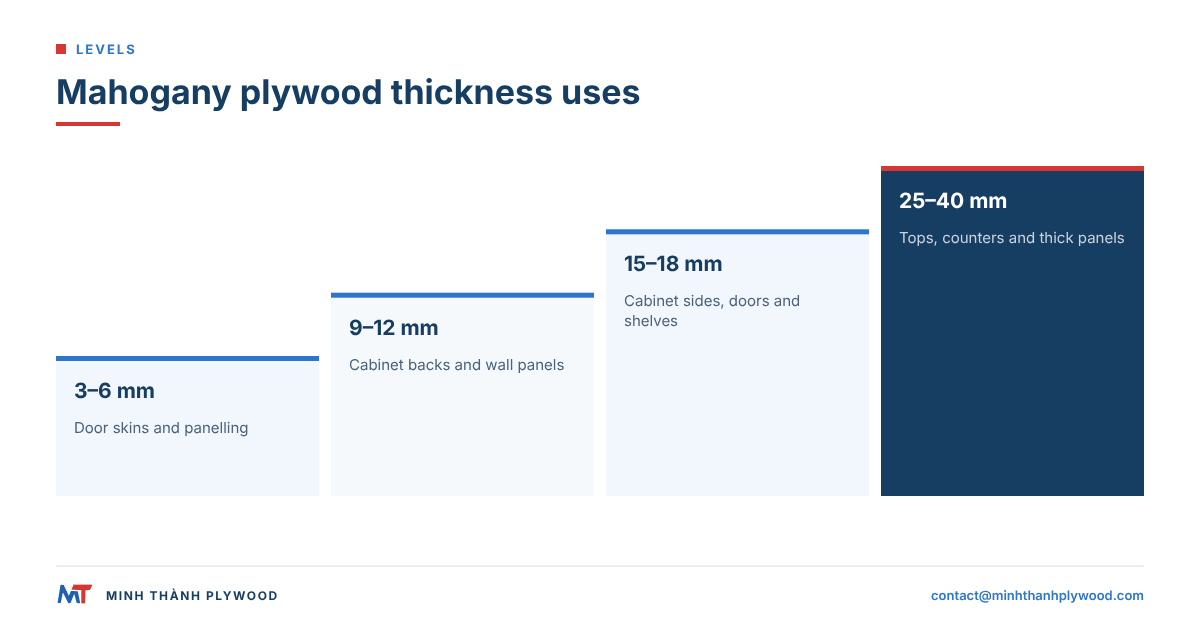
Minh Thanh makes faced plywood from 3 to 40 mm, in 1220 × 2440 and 1250 × 2500 mm, plus custom sizes such as 1220 × 2500 and 1220 × 2280 mm.
| Thickness | Typical use | Build note |
|---|---|---|
| 3–6 mm | Door skins, panelling, curved work | Always 5-ply (3–5 mm) |
| 9–12 mm | Cabinet backs, drawer bottoms, wall panels | Balanced face and back |
| 15–18 mm | Cabinet sides, doors, shelves, furniture | 18 mm usually 11–13 plies |
| 25–40 mm | Table tops, counters, thick panels | Thick cores, two pressings |
Panels can also be cut to size, one sheet into 4, 6 or 8 pieces, a service shipped regularly to Italy and other European markets.
Formats, face thickness and price of mahogany plywood
Mahogany plywood in Sweden is sold as khaya (African mahogany) A/B in 4.5, 6, 9, 12 and 15 mm on the full 2440 × 1220 mm sheet, with 1210 × 605 mm and 840 × 1220 mm cut sheets for boat and hobby work. The face veneer is thin: one Swedish shop lists 1.5 mm veneer on both sides, a chandler’s khaya-core marine ply has 0.6 mm khaya faces in 6.5, 9 and 12 mm.
| Format | Typical stock | Face veneer | Raw FOB at US$350/m³ |
|---|---|---|---|
| 2440 × 1220 mm, 4.5 mm | Swedish shops, khaya A/B | 1.5 mm (shop listing) | about US$4.7 |
| 2440 × 1220 mm, 6 mm | khaya A/B | 1.5 mm | about US$6.3 |
| 2440 × 1220 mm, 9 mm | khaya A/B | 1.5 mm | about US$9.4 |
| 2440 × 1220 mm, 12 mm | khaya A/B | 1.5 mm | about US$12.5 |
| 2440 × 1220 mm, 15 mm | khaya A/B | 1.5 mm | about US$15.6 |
| 1210 × 605 mm and 840 × 1220 mm | cut sheets for boat and hobby buyers | as the parent sheet | cut from the parent sheet |
| Khaya-core marine build, 6.5, 9, 12 mm | chandlers, khaya core | 0.6 mm | marine grades quoted per order |
A US shelf price is the reference an importer will hear: African mahogany plywood in 4 × 8 ft sheets runs US$91.50 to US$199 in 1/4 and 3/4 in at an American hardwood dealer. The FOB column is a raw example at the furniture plywood starting price of US$350/m³ (October 2026) for one sheet, not a sheet price: the face species, face thickness and grade change the quote, and sea freight, duty and VAT come on top.
From Hai Phong to Northern Europe the days at sea are 30 to 40, so a Swedish or Norwegian importer plans the order with that lead time plus 15 to 45 days of production. The EUDR dossier travels with the shipment. Face veneer thickness is agreed per order; a thicker face survives sanding and refinishing, a thin face is for flat-panel work.
What is mahogany plywood used for?
Mahogany plywood is used where a warm, reddish wood face is part of the design: furniture, doors, wall panelling, cabinet fronts, shop fittings and boat interiors.
| Use | Recommended face | Recommended build |
|---|---|---|
| Classic furniture and cabinet fronts | Sapele quarter-cut or EV | A/B, Styrax core, UF glue at E0 emission |
| Interior doors and door skins | Sapele or EV | 3–6 mm skins, A grade face |
| Wall panelling in hotels and offices | EV in mahogany tone | A/B, matched sheets across the order |
| Boat interiors (cabins, furniture) | Sapele or khaya | Phenolic bond, buyer’s marine spec |
| Painted or dark-stained parts | Meranti or lauan | B/B, cost first |
For large hotel and office projects, the colour match across hundreds of sheets often decides between natural sapele and EV.
Which documents come with mahogany plywood?
The documents depend on the face species and the market. Genuine and African mahogany need CITES permits; every species needs origin records for the EU and the US.
- CITES export permit: for Swietenia and African Khaya faces, issued by the country of origin of the veneer.
- EUDR: Minh Thanh supplies the EUDR compliance dossier (origin records and geolocation files) with EU orders.
- US orders: TSCA Title VI label on the panels, CARB P2 / TSCA Title VI certification (ICTT mill no. 23024), and face and core species with harvest origin for the importer’s Lacey Act declaration.
- Quality: ISO 9001:2015 and the TCVN 11902:2017 certificate for veneer-faced plywood (VietCert 141.1-VNC-HC).
Shipping documents add the commercial invoice, packing list, B/L, certificate of origin (EUR.1 for the EU) and phytosanitary and fumigation certificates.
How do you order mahogany plywood?
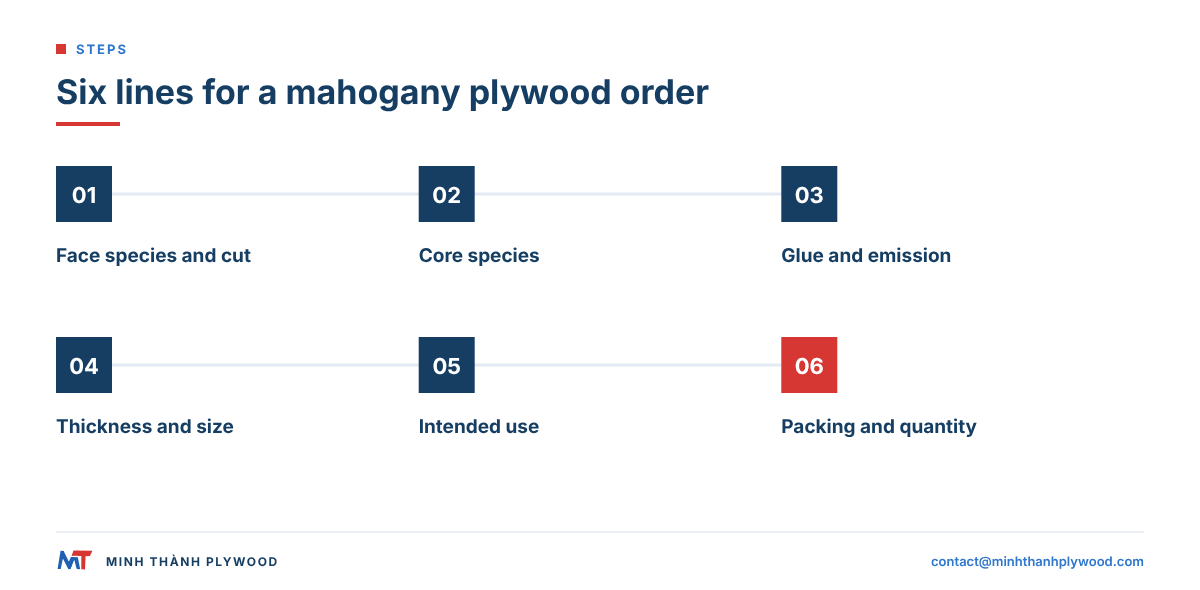
Write the face species first, then the cut and grade, then the panel. Six lines make a complete order:
- Face: species (sapele, khaya, genuine mahogany, meranti or EV mahogany tone), cut (rotary, crown or quarter) and grade pair, for example A/B.
- Core: white Styrax or Eucalyptus, stitched.
- Glue and emission: UF glue at E0 emission for interiors; phenolic for damp or marine use.
- Sheet: thickness, size, tolerance, sanded or polished.
- Use: furniture, doors, panelling or boat interior, so the mill can advise.
- Packing and quantity: packs, marks, sheets or m³, destination port.
Furniture plywood from Minh Thanh starts from US$350/m³ (October 2026), with a minimum of one 40HC and production 15–45 days after the deposit. Free samples go out with the quotation. Send the six lines to [email protected].
Buyer questions, answered
Is there mahogany plywood?
Yes. Mahogany plywood is made by pressing a thin mahogany-type face veneer onto a plywood core. The face can be genuine mahogany, African mahogany, sapele, meranti or an engineered veneer, so the species should be named on the order.
What is mahogany plywood used for?
Furniture, doors, wall panelling, cabinet fronts, shop fittings, boat interiors and musical-instrument cases. Exterior and boat-hull work needs a marine-grade build, not only a mahogany face.
Is mahogany plywood the same as marine plywood?
No. Marine plywood is defined by its build and bond, for example to BS 1088. A mahogany face on an interior core with UF glue is interior plywood, however it looks.
Is sapele plywood real mahogany?
Sapele (Entandrophragma cylindricum) belongs to the mahogany family, Meliaceae, but not to the genus Swietenia. It is the most common mahogany-type face in plywood today.
What is African mahogany plywood?
Plywood faced with Khaya veneer. Since 23 February 2023 African Khaya is listed in CITES Appendix II, and the listing covers veneer sheets and plywood, so exports need a CITES permit.
Is Philippine mahogany plywood real mahogany?
No. Philippine mahogany is a trade name for lauan and meranti (Shorea and related genera), which are not related to true mahogany. It is a utility face, often called lauan or luan plywood.
Can genuine mahogany plywood be imported?
Yes, with CITES paperwork. Swietenia macrophylla is in CITES Appendix II, and veneer and plywood need an export permit from the country of origin.
Is okoume plywood mahogany?
No. Okoume (Aucoumea klaineana) is sometimes sold as gaboon mahogany, but it is a different, lighter wood. It is widely used as a face for interior and marine plywood.
What grades does mahogany plywood come in?
Mahogany-type faces are quoted as face/back grade pairs such as A/A, A/B and B/B, matched to an approved sample. A/A suits two visible faces, A/B one visible face.
How thick is mahogany plywood?
Minh Thanh makes faced plywood from 3 to 40 mm, in 1220 × 2440 and 1250 × 2500 mm and custom sizes such as 1220 × 2500 mm.
What is mahogny plywood?
Mahogny is the Swedish and Norwegian spelling of mahogany. Mahogny plywood in Scandinavia is usually sapele, khaya or meranti-faced plywood.