
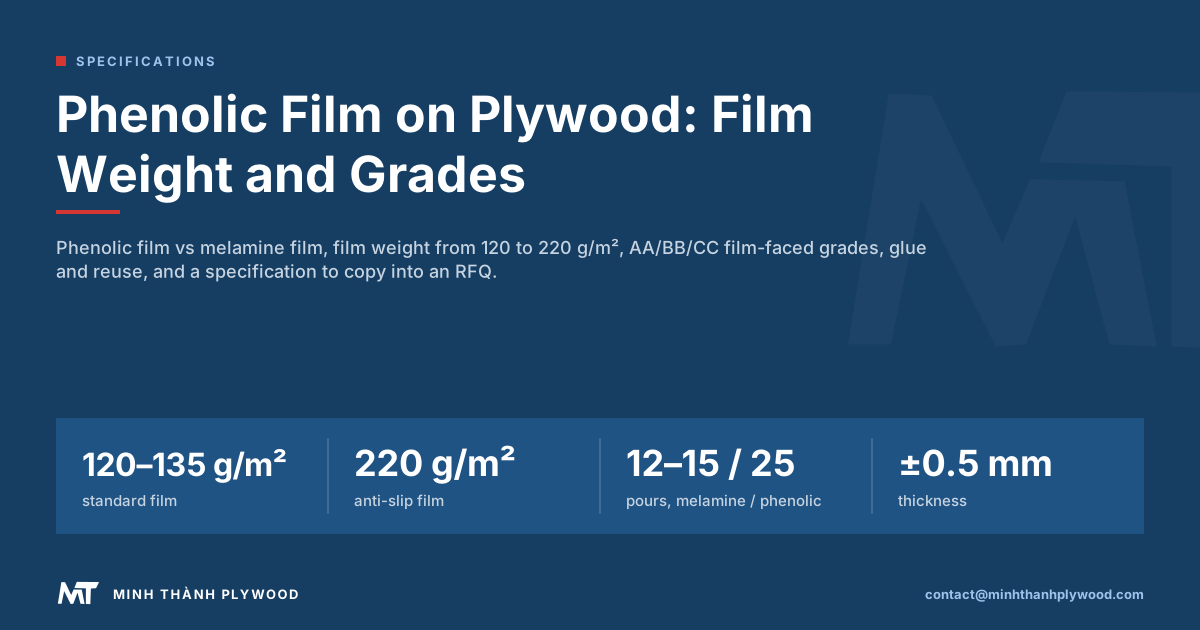
Phenolic film is kraft paper soaked in phenol-formaldehyde resin and hot-pressed onto plywood to give a hard, water-resistant face for concrete formwork, floors and vehicles. Film weight is its resin-paper weight per square metre: about 120–135 g/m² for standard formwork film and about 220 g/m² for anti-slip film. Minh Thanh Plywood, a Vietnamese manufacturer, sets out how film, glue and core decide the grade.
Phenolic film: what it is and why it goes on plywood
Phenolic film is a resin-impregnated paper overlay that turns a plywood face into a hard, smooth, water-resistant surface. Kraft paper is soaked in phenol-formaldehyde resin, dried, then pressed onto the plywood under heat and pressure, where the resin cures and bonds to the face veneer.
The result does three jobs:
- Releases from concrete. Wet concrete does not stick to the cured resin, so the form strips cleanly and the concrete surface comes out smooth.
- Keeps water out of the face. The film seals the face veneer against rain, curing water and wet concrete.
- Takes wear. The hard resin surface resists abrasion from vibrators, rebar and boots, and from wheels on floors.
Phenolic film plywood is the standard panel for concrete formwork, and it is also used for trailer and van floors, stage floors, walkways and packaging that sees rain. With an embossed anti-slip pattern, the same film becomes a floor panel.
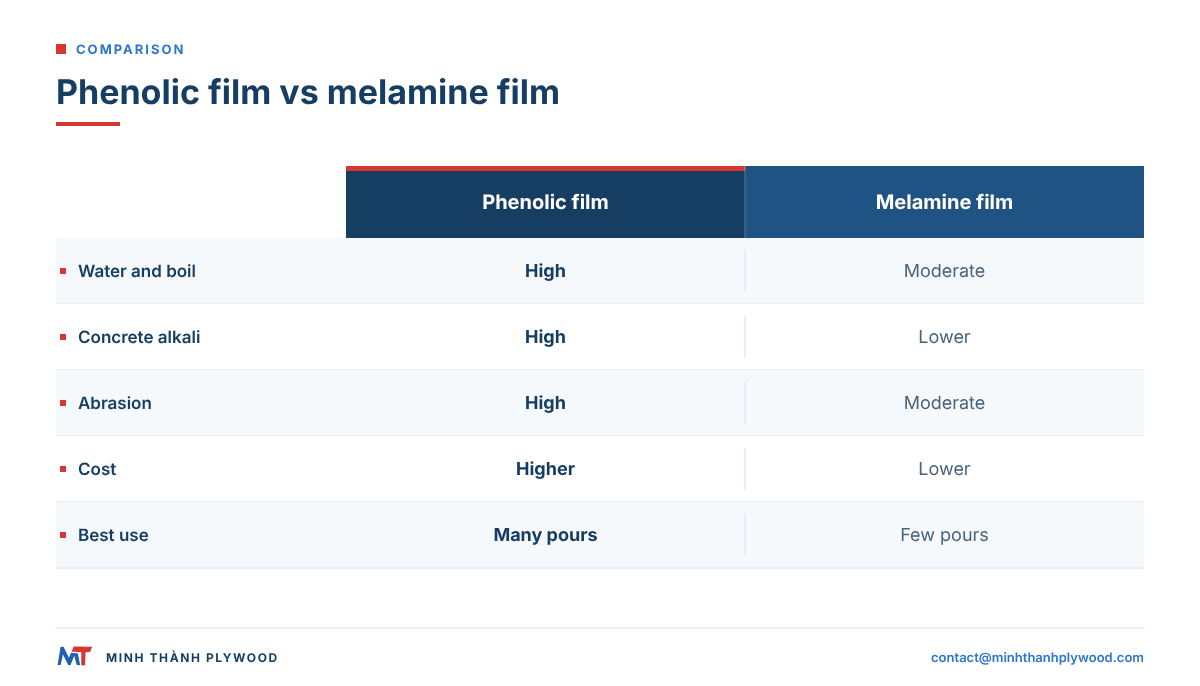
Phenolic film vs melamine film: which is better?
Phenolic film is better for formwork that will be reused many times; melamine film is the lower-cost choice for short jobs and light reuse. The two look alike when new, but behave differently on site.
| Property | Phenolic film | Melamine film |
|---|---|---|
| Resin | Phenol-formaldehyde | Melamine-formaldehyde, often with urea |
| Typical colour | Brown, dark brown, black | Brown, black, other colours |
| Water and boil resistance | High | Moderate |
| Resistance to alkali from concrete | High | Lower |
| Abrasion resistance | High | Moderate |
| Surface after many pours | Stays smooth longer | Dulls and roughens sooner |
| Cost | Higher | Lower |
| Best use | Repeated formwork, floors, vehicle decks | Short jobs, few pours, packaging |
A dark brown colour does not tell you the film is phenolic. Ask for the resin type and film weight in writing, and check on a sample: phenolic film is harder and keeps its gloss after a boil test, while melamine film softens sooner.
Film weight: what g/m² means on film faced plywood
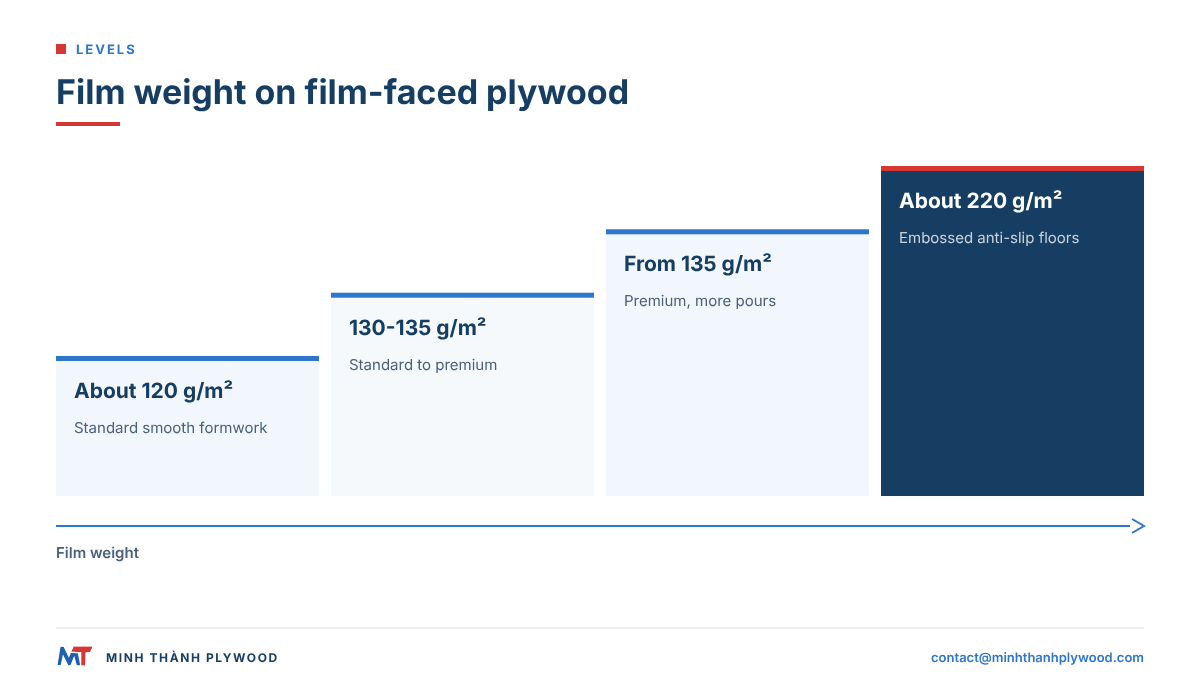
Film weight is the mass of the resin-impregnated paper per square metre, written as g/m² or gsm. A heavier film carries more resin and paper, so it gives a thicker, harder, longer-lasting surface.
| Film weight | Surface | Typical use | Relative cost |
|---|---|---|---|
| About 120 g/m² | Smooth | Standard formwork, few to medium pours | Base |
| About 130–135 g/m² | Smooth | Standard to premium formwork | Higher |
| From 135 g/m² | Smooth | Premium formwork, more pours | Higher still |
| About 220 g/m² | Embossed anti-slip | Floors, trailers, walkways, stages | Highest |
You will also see heavier smooth films, such as 165 or 167 g/m², offered for long-life formwork. The film weight applies per face: a panel with the same film on both faces carries it twice. Film weight, film brand and colour are order specifications, so write all three on the quote rather than accepting “standard film”. A buyer who asks for Dynea film faced plywood, for example, is naming the film maker; ask for the film maker’s label or delivery note with the order if the brand matters to you.
Film faced plywood 120 gsm vs 220 gsm: which one for your job?
Choose 120 gsm for smooth concrete formwork and 220 gsm for surfaces people walk on or load with wheels. The two films answer different questions: release and smooth finish on one side, grip and wear on the other, so the right weight follows the surface the panel will face.
| Question | 120 gsm smooth film | 220 gsm anti-slip film |
|---|---|---|
| Surface | Smooth, glossy | Embossed: wire-mesh, hexagon or rice grain |
| Main job | Release from concrete, smooth finish | Grip under feet and wheels |
| Wear resistance | Good | Higher |
| Concrete finish | Smooth, fair-faced | Not used against concrete |
| Common uses | Walls, slabs, columns, beams | Trailer and van floors, scaffold and stage decks, walkways |
| Typical faces | Smooth both sides | Anti-slip top, smooth bottom |
Most anti-slip panels carry the 220 g/m² embossed film on the top face and a smooth film on the bottom face. Our anti-slip plywood is made on order with the pattern and film weight you choose.
What do AA, BB and CC grades mean on film-faced plywood?
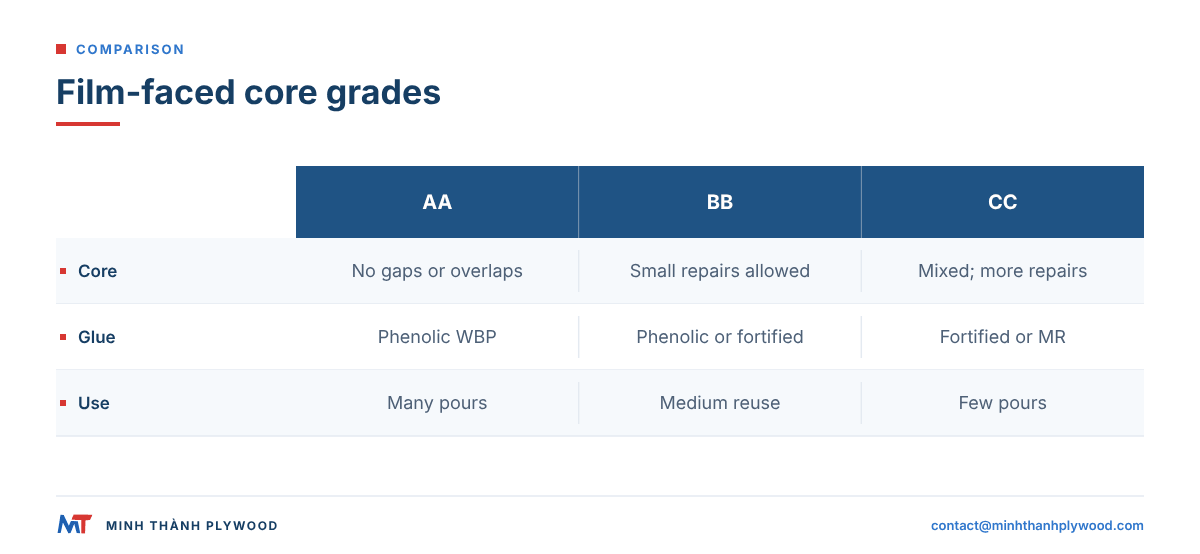
AA, BB and CC on film-faced plywood are market labels for the core quality under the film, not a formal standard. Because the film hides the face, the grade describes what the film covers: core species, gaps, repairs and glue.
| Label | Core under the film | Typical glue | Typical use |
|---|---|---|---|
| AA | Best core veneers, no gaps or overlaps, often hardwood throughout | Phenolic (WBP) | Fair-faced concrete, many pours |
| BB | Good core, small repairs allowed | Phenolic or melamine-fortified | General formwork, medium reuse |
| CC | Mixed core, more repairs | Melamine-fortified or MR | Short jobs, few pours |
Two mills can sell “BB” panels with different cores, glues and film weights. Compare film-faced grades by the build, not the label: core species and grade, glue, film weight, ply count and thickness tolerance. Our guide to film-faced plywood types and selection compares the core species in more detail.
Which glue: melamine-fortified or phenolic (WBP)?
Phenolic (WBP) glue gives the most pours and the best resistance to boiling and wet curing; melamine-fortified glue costs less and suits medium reuse. The glue holds the veneers together; the film only protects the faces.
| Property | Melamine-fortified (MR or WBP melamine) | Phenolic (WBP) |
|---|---|---|
| Glue line colour | Light | Dark brown |
| Boil resistance | Moderate to good | High |
| Typical reuse in formwork | About 12–15 pours | Up to about 25 pours |
| Cost | Lower | Higher |
| Best use | General formwork, medium reuse | Repeated formwork, wet climates, long jobs |
Those reuse figures assume proper handling, release agent and edge sealing. A good film on a weak glue line delaminates at the edges long before the film wears out, which is why glue comes before film weight on a specification. For bond testing, see our guide on boiling and bond tests.
How many pours? What really decides reuse
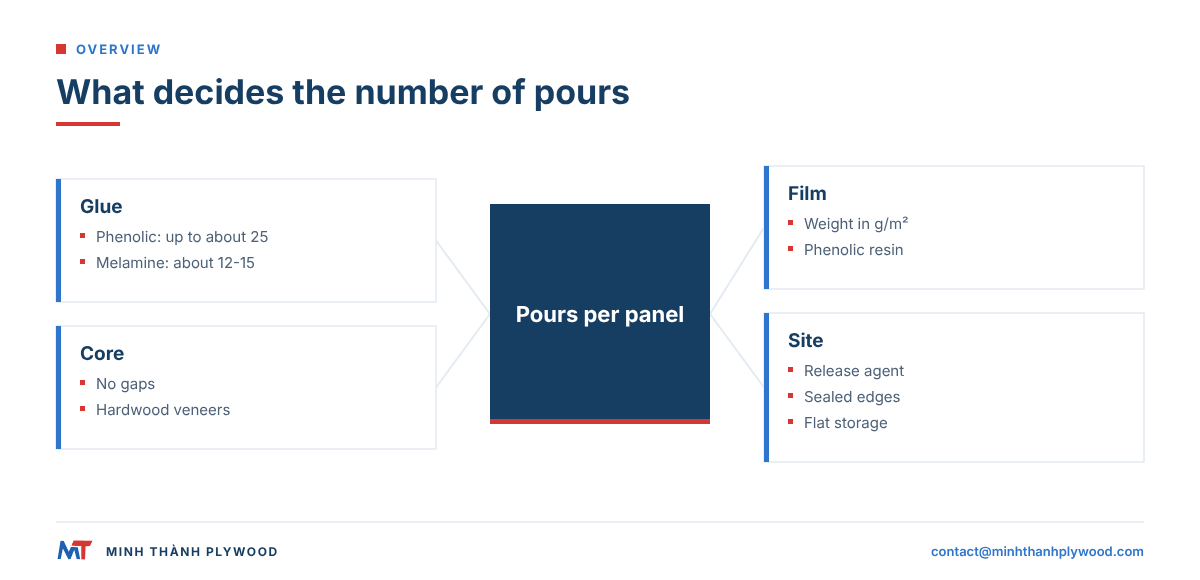
Reuse is decided by glue, core, film weight and site practice together; no film weight alone gives a pour count. The same panel lasts longer on a well-run site than on a careless one.
- Glue. Phenolic glue reaches up to about 25 pours; melamine-fortified about 12–15.
- Core. A solid core without gaps holds its shape; gaps under the film crush and print into the concrete.
- Film weight. Heavier film wears through later.
- Edge sealing. Sealed edges keep water out of the veneers.
- Release agent. A thin, even coat before every pour protects the film.
- Handling and storage. Panels stored flat, covered and off the ground, and stripped without levering on the face, last longer.
Ask any supplier for the reuse target of the exact build quoted, with the conditions it assumes.
Film faced plywood specifications: thickness, size, plies and tolerance
Film faced plywood specifications cover thickness, size, core and plies, glue, film weight and colour, edge sealing and tolerance. The table shows a typical formwork specification and the range each line can take.
| Specification line | Typical formwork panel | Range |
|---|---|---|
| Thickness | 18 mm | 9 to 21 mm, others on order |
| Size | 1220 × 2440 mm | 1250 × 2500 mm and custom sizes |
| Core | Eucalyptus or acacia, grade A | Eucalyptus or acacia, grade A or AB |
| Plies (18 mm) | 11–13 plies | By thickness |
| Glue | Phenolic (WBP) | Melamine-fortified (MR or WBP melamine) or phenolic |
| Film | Phenolic, about 130 g/m², brown, both faces | 120 to 220 g/m², other colours |
| Edges | Sealed with acrylic paint | Colour on order |
| Thickness tolerance | ±0.5 mm | — |
| Length and width tolerance | ±2 mm | — |
The thickness tolerance matters on site: panels that differ in thickness leave steps in the concrete at every joint. Our film-faced panels are made to ±0.5 mm on thickness and ±2 mm on length and width. More on this in our guide to film-faced plywood thickness and tolerances.
Film faced shuttering plywood specification: a block to copy into an RFQ
A film faced shuttering plywood specification for an RFQ should state every line a mill could change. Copy the block below and fill in the blanks.
| Line | Your entry |
|---|---|
| Use | Concrete formwork: walls / slabs / columns |
| Thickness and tolerance | 18 mm, ±0.5 mm |
| Size | 1220 × 2440 mm |
| Core species and grade | Eucalyptus, grade A, no core gaps |
| Glue | Phenolic (WBP) |
| Film | Phenolic film, ___ g/m², colour ___, both faces |
| Edges | Sealed, colour ___ |
| Reuse target | ___ pours with release agent and sealed edges |
| Packing | Export pallet, plywood covers, steel straps |
| Quantity and term | ___ × 40HC, FOB Hai Phong / CIF ___ |
Send the same block to every mill and the quotes become comparable line by line. A quote that leaves the film weight or the glue blank is a quote for whatever the mill had in stock.
How does film weight change the price?
Film weight changes the price, but less than the glue and core do. The film is a thin overlay on both faces; the core is most of the panel’s volume.
| Cost line | Effect on price |
|---|---|
| Core species and grade | Largest; a gap-free hardwood core costs most |
| Glue | Phenolic costs more than melamine-fortified |
| Film weight | Heavier film costs more per face |
| Anti-slip embossing | Adds cost over a smooth film |
| Thickness | More veneers and glue lines |
| Edge sealing and packing | Small, but adds reuse and protects the load |
A cheaper quote often saves on the core or glue and keeps a heavy film to look premium. Our film faced plywood price guide breaks down the cost lines in more detail.
How to check film-faced plywood on arrival
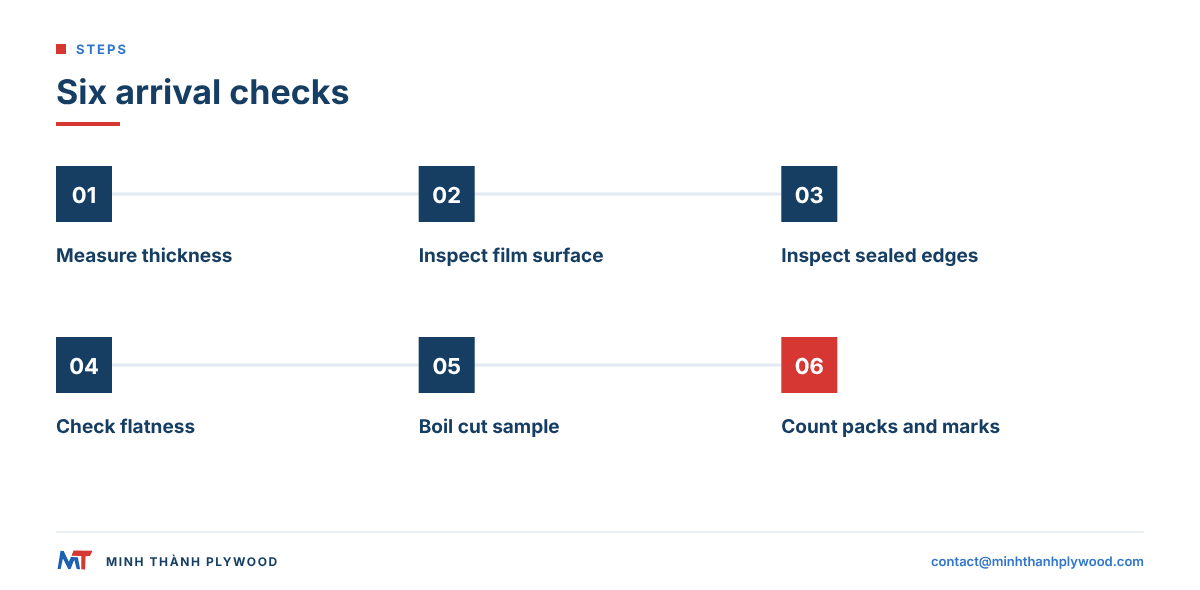
Check film-faced plywood on arrival by measuring, looking and testing a sample from several packs. Six checks catch most problems before the panels reach the site.
- Thickness. Measure with a caliper at corners and mid-edges against the ±0.5 mm tolerance.
- Film surface. Look for bubbles, dry spots, scratches or uneven gloss under raking light.
- Edges. Check that edge paint covers every edge and that no core gaps show.
- Flatness. Lay panels on a flat floor; warped panels make uneven joints.
- Boil test. Boil a cut sample and check for delamination of the film and the glue lines.
- Count and marks. Sheets per pack and pack marks against the packing list.
We photograph and film every shipment before loading, and buyers receive the photos and video before the panels sail.
Weight and container loading of film-faced plywood
Film-faced plywood is heavier than furniture plywood of the same size, because its cores are usually eucalyptus or acacia and the film adds resin. That limits how much fits in a container by weight.
| Core | Volume per 40HC, premium film-faced |
|---|---|
| Eucalyptus | About 43 m³ |
| Acacia | About 47 m³ |
These are typical loads for premium film-faced plywood; a lower weight limit on the booking lowers them. A mixed load of film-faced and other plywood is possible by agreement, usually 1–2 specifications per container.
Film-faced plywood for Europe: formaldehyde, bond and documents
Film-faced plywood shipped to the EU is judged on three documents besides the panel itself: the formaldehyde rule, the bond class and the origin dossier. Ask for each on the quote, not after loading.
- Formaldehyde. Since 6 August 2026, Regulation (EU) 2023/1464 restricts the formaldehyde that wood-based articles may release when placed on the EU market. Phenolic glue lines and phenolic films cure into a low-emitting resin; third-party testing to the buyer’s method is arranged through SGS on request.
- Bond class. Formwork panels are bought for exterior or wet service, so the glue line should be tested for boiling. Write the glue (phenolic WBP or melamine-fortified) and the test you expect on the order. The BSI catalogue lists BS EN 314-2 for plywood bonding quality requirements and BS EN 636:2012+A1:2015 for plywood specifications.
- Origin. We supply the EUDR compliance dossier (origin records and geolocation files) with orders, plus the certificate of origin (EUR.1 for the EU), phytosanitary and fumigation certificates.
For contractors and distributors, these papers decide whether the panels clear customs and reach site on time. A low price on panels that wait at the port for missing papers is not a low price.
What this means for a Minh Thanh Plywood film-faced order
We make film-faced plywood in Ha Hoa, Phu Tho, to the film, glue and core you specify, and our quote states each of them. Film brand, film weight and colour are order specifications.
- Film: smooth film from about 120 g/m², premium from 135 g/m², anti-slip film about 220 g/m² with wire-mesh, hexagon or rice-grain pattern.
- Glue: melamine-fortified or phenolic (WBP), to your use and reuse target.
- Core: eucalyptus or acacia, to your order.
- Sizes and tolerance: 1220 × 2440 mm and 1250 × 2500 mm, plus custom sizes; ±0.5 mm on thickness.
- Terms: minimum one 40HC, production 15–45 days after the 30% deposit, FOB Hai Phong, CFR or CIF.
Send the RFQ block above through the film-faced plywood page, and ask for free samples to test the film and glue before you order. Related reading: the film-faced plywood buyer guide and the anti-slip plywood buyer guide.
Buyer questions, answered
What is phenolic film on plywood?
Phenolic film is a kraft paper impregnated with phenol-formaldehyde resin, pressed onto plywood under heat. It cures into a hard, smooth, water-resistant face that releases from concrete and protects the wood beneath.
What is the difference between 120 gsm and 220 gsm film faced plywood?
120 g/m² is a standard smooth formwork film; 220 g/m² is a heavier film, usually embossed with a wire-mesh, hexagon or rice-grain anti-slip pattern for floors, trailers and walkways. The heavier film resists wear better but costs more.
Is phenolic film better than melamine film?
For formwork, yes: phenolic film resists water, alkali from concrete and abrasion better, so it lasts more pours. Melamine film is lower in cost and suits short jobs and light reuse.
How many times can film faced plywood be reused?
As a guide, panels with melamine-fortified glue reach about 12–15 pours and panels with phenolic glue up to about 25, with proper handling, release agent and edge sealing. The glue and core matter as much as the film.
What do AA, BB and CC grades mean on film-faced plywood?
They are market labels for the quality of the core under the film: AA has the best core with no gaps, BB allows small repairs, CC allows more. The labels are not a formal standard, so ask for core species, glue and film weight.
What glue is used in film faced plywood?
Formwork panels use melamine-fortified (MR or WBP melamine) or phenolic (WBP) glue. Phenolic glue gives the most pours and the best boil resistance; melamine-fortified glue costs less.
What thickness of film faced plywood is used for formwork?
18 mm is the most common formwork thickness, with 12, 15 and 21 mm for lighter or heavier forms. Thickness tolerance for film-faced panels is about ±0.5 mm.
Does film colour matter?
Colour shows the film type and maker more than its quality: brown and black are most common for phenolic film, and red, yellow or other colours are sold for site identification. Specify film weight and resin, not colour alone.
Why do film faced plywood edges need sealing?
The film protects the faces but not the cut edges, where water enters the veneers. A sealed edge with acrylic or similar paint slows swelling and delamination and adds pours.
Where is film faced plywood with phenolic film made in Vietnam?
Minh Thanh Plywood makes phenolic film-faced plywood in Ha Hoa, Phu Tho, in northern Vietnam, alongside furniture and commercial plywood. Cores come from locally grown plantation timber.