
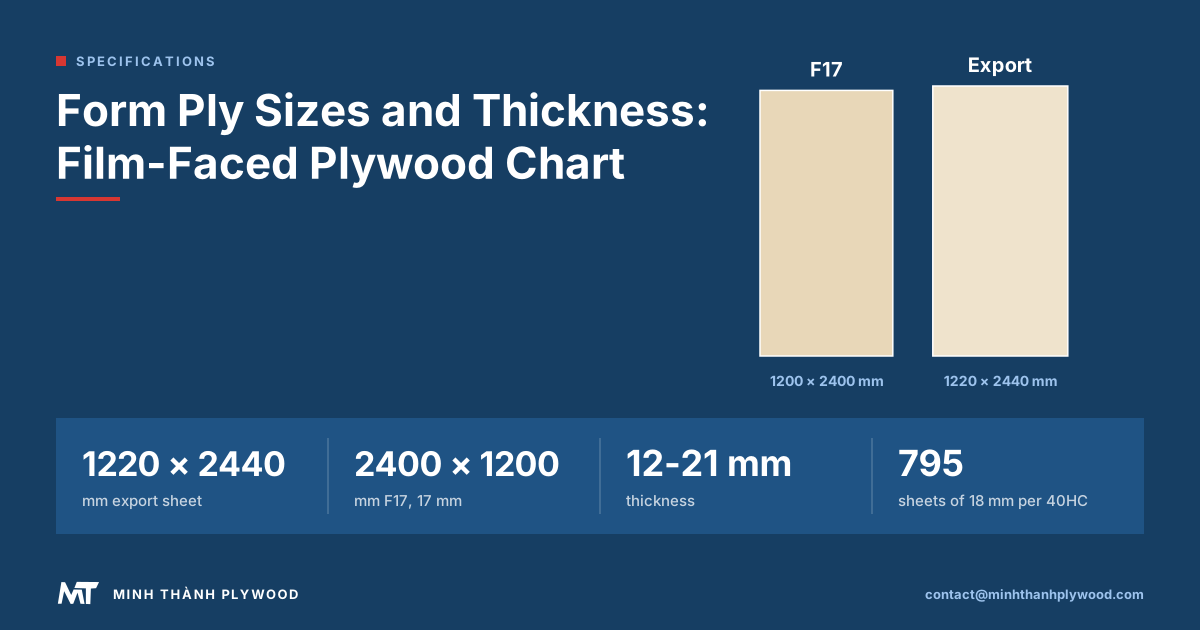
The standard form ply sizes are 1220 × 2440 mm (4 × 8 ft) and 1250 × 2500 mm, with 1200 × 2400 and 1200 × 1800 mm in Australia, and the common thicknesses run from 12 to 21 mm, with 18 mm the workhorse. Minh Thanh Plywood makes film-faced plywood in 12–21 mm on Eucalyptus or Acacia cores, held to ±0.5 mm.
Form ply sizes: the short answer
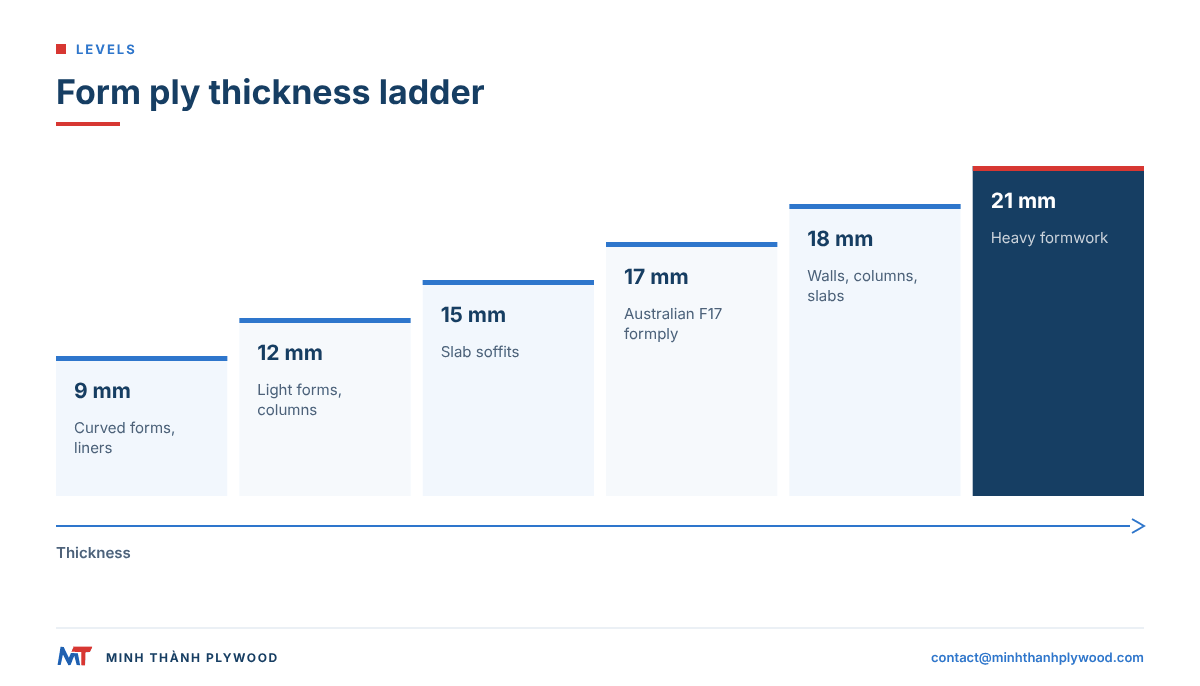
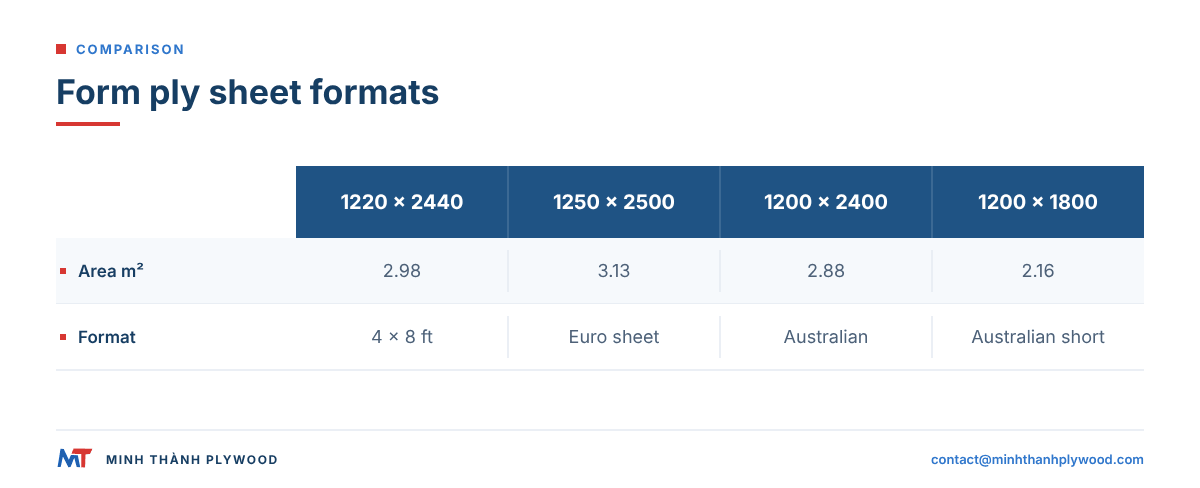
Form ply sizes come in a few standard sheet formats and a thickness ladder from 9 to 21 mm. The sheet you need is set by your formwork system and your market; the thickness by the support spacing and the pour.
| Format | Size (mm) | Size (m) | Where it is standard |
|---|---|---|---|
| 4 × 8 ft | 1220 × 2440 | 1.22 × 2.44 | Asia, Middle East, Africa, the Americas |
| Euro sheet | 1250 × 2500 | 1.25 × 2.5 | Continental Europe |
| Australian formply | 1200 × 2400 | 1.2 × 2.4 | Australia, New Zealand |
| Australian short sheet | 1200 × 1800 | 1.2 × 1.8 | Australia, slab tables and walls |
| Custom | 1220 × 2500 and others | 1.22 × 2.5 | Formwork systems drawn around a panel |
| Thickness | Typical formwork use |
|---|---|
| 9 mm | Curved forms, liners on a backing |
| 12 mm | Light forms, liners, columns with close bearers |
| 15 mm | Slab soffits on close supports |
| 17 mm | Australian F17 formply |
| 18 mm | Walls, columns, slabs: the general workhorse |
| 21 mm | Heavy formwork, wide support spacing |
At Minh Thanh Plywood the film-faced range is 12–21 mm in 1220 × 2440 and 1250 × 2500 mm, held to ±0.5 mm on thickness, on Eucalyptus or Acacia cores with melamine-fortified or phenolic (WBP) glue.
Australian formply: F17, AS 6669, 17 and 25 mm
F17 is a stress grade under Australian standards that rates a panel’s strength and stiffness, and F17 formply is the rated panel for load-bearing formwork. AS 6669 sets the formwork plywood requirements. In practice 17 mm is the common thickness for residential slabs, footings and walls, and 25 mm is chosen for deeper pours, higher concrete pressure or wider spans between supports.
| Australian formply | Sheet | Typical use |
|---|---|---|
| F17, 17 mm | 1800 × 1200 mm or 2400 × 1200 mm | Slabs, footings, walls, columns |
| F17, 25 mm | 2400 × 1200 mm | Deeper pours, wide spans |
| Structural film-faced (F-rated) | As above | Load-bearing formwork |
| Non-structural film-faced | 1220 × 2440 mm and others | Lighter shuttering where no stress grade is required |
Australian shelf prices give the market context (October 2026): Just Plywood lists F17 at A$59 for 17 mm × 1800 × 1200 mm, A$69 for 17 mm × 2400 × 1200 mm and A$115 for 25 mm × 2400 × 1200 mm, and A$65 per sheet in a 40-sheet pack. The glue line is A-bond phenolic.
Our film-faced panels are non-structural shuttering plywood sold by container, so use them where the design does not name an F-grade, and read the F17 formply and AS 6669 grades guide for the structural route. For prices by country see film-faced plywood price.
United States: APA Plyform, HDO and MDO
US contractors order APA Plyform, an exterior B-B plywood in Class I (Group 1 species, the stiffer class) and Class II, in 4 × 8 ft sheets. APA says the common Plyform Class I thicknesses are 19/32, 5/8, 23/32 and 3/4 in., and it can be ordered with an HDO or MDO overlay. HDO (high-density overlay) is specified for the smoothest concrete finish; MDO (medium-density overlay) gives a flat, matte one.
| US term | What it is | Metric match |
|---|---|---|
| Plyform Class I or II, B-B | Sanded exterior plywood, mill oiled | 5/8 in. is about 16 mm, 3/4 in. about 19 mm |
| HDO | Plyform with a hard resin-impregnated overlay | Closest to phenolic film-faced panels |
| MDO | Plyform with a medium-density overlay | Matte face, fewer pours |
A phenolic film-faced 18 mm sheet is the metric counterpart of 3/4 in. Plyform. For the US panel, read the Plyform plywood guide.
Formply thickness: 9, 12, 15, 18 and 21 mm compared
Formply thickness decides how far the panel spans between bearers before it bends under wet concrete. Thicker panels span further, take more reuse and weigh more. The table compares the steps on a 1220 × 2440 mm sheet.
| Thickness | Eucalyptus core, 650 kg/m³ | Acacia core, 580 kg/m³ | Where it fits | Trade-off |
|---|---|---|---|---|
| 9 mm | 17.4 kg | — | Curved forms, liners | Bends easily; needs a backing |
| 12 mm | 23.2 kg | 20.7 kg | Light forms, columns | Light to handle; close supports |
| 15 mm | 29.0 kg | 25.9 kg | Slab soffits | Good stiffness for weight |
| 18 mm | 34.8 kg | 31.1 kg | Walls, columns, slabs | The standard choice |
| 21 mm | 40.6 kg | 36.3 kg | Heavy formwork | Stiffest; heaviest to lift |
Weights are calculated as 1.22 m × 2.44 m × thickness × density. A Eucalyptus core can reach 750 kg/m³, which takes an 18 mm sheet to about 40.2 kg; the order states the core and the sample shows its weight.
Two rules of thumb from formwork practice: on the same bearer spacing, going from 15 to 18 mm reduces the deflection of the face noticeably, and on a slab system drawn for 18 mm panels, swapping in 15 mm needs the bearers moved closer. The formwork designer’s drawing decides; the thickness on the order follows it.
Stud spacing by thickness. A 3/4 in. (about 19 mm) panel is normally backed by studs or joists at 12 to 16 in. centres (300 to 400 mm) for standard wall pours. A 12 mm panel needs closer supports, and 25 mm or thicker panels are chosen for high pours and wide spacing.
Glue sets the European class under EN 636. Melamine-fortified (MUF) glue gives EN 636-2 and phenolic (WBP) glue gives EN 636-3 Class 3, the grade for exterior exposure. Bond quality is tested under EN 314-2, the bonding-quality standard for plywood. In the US, formwork for cast-in-place concrete falls under OSHA standard 1926.703.
Formply sizes by market: what each country calls the panel
Formply sizes follow the market’s own names and habits. The same 18 mm film-faced panel is ordered as formply, shuttering plywood, phenolic board or Siebdruckplatte, in different sheet sizes. Most markets buy the 1220 × 2440 mm sheet; Australia uses 2400 × 1200 mm and Germany and Central Europe use 1250 × 2500 mm, as the table below shows.
| Market | Name buyers use | Common sheet | Common thickness |
|---|---|---|---|
| Australia | Formply, F17 formply | 2400 × 1200 and 1800 × 1200 mm | 17 mm (F17, AS 6669) |
| India, Pakistan, Bangladesh | Shuttering plywood, centering ply | 8 × 4 ft (1220 × 2440 mm) | 12 and 18 mm, also sold by sheet weight |
| Philippines | Phenolic board, marine form | 4 × 8 ft (1.22 × 2.44 m) | 1/2 and 3/4 inch (12 and 18 mm) |
| Middle East | Film-faced plywood, shuttering ply | 1220 × 2440 mm | 18 mm |
| South Africa | Shutterply | 1220 × 2440 mm | 18 and 21 mm |
| Germany, Central Europe | Siebdruckplatte, Schalungsplatte | 1250 × 2500 mm and long sheets | 12–21 mm, thicker to order |
| United Kingdom | Shuttering ply, phenolic film-faced | 1220 × 2440 and 1250 × 2500 mm | 18 mm |
Australian formply is a structural product made to AS 6669:2016, Plywood – Formwork (consulted 20 October 2026). F17 formply is 17 mm thick, the standard covers panels up to 3100 × 1500 mm, and the panel is sold in 2400 × 1200 and 1800 × 1200 mm sheets. A 1220 × 2440 mm sheet is trimmed to 1200 × 2400 mm in Australia when the system needs it; say on the order whether we cut it before loading.
In Germany, Siebdruckplatte strictly means a film-faced board with a wire-mesh (anti-slip) pattern on one face, used for floors and trailer decks, while the smooth board is Schalungsplatte. Buyers searching “Siebdruckplatte Stärke” usually choose 12 to 21 mm. Minh Thanh’s smooth film-faced range covers formwork; anti-slip plywood is made on order.
Phenolic board size in meters and feet
The standard phenolic board size in meters is 1.22 m × 2.44 m, which is 4 × 8 ft and covers about 2.98 m² per sheet. Most of Asia, the Middle East and Africa order this format.
| Size in feet | Size in meters | Size in mm | Area per sheet |
|---|---|---|---|
| 4 × 8 ft | 1.22 × 2.44 m | 1220 × 2440 | 2.98 m² |
| 4.1 × 8.2 ft | 1.25 × 2.5 m | 1250 × 2500 | 3.13 m² |
| about 3.9 × 7.9 ft | 1.2 × 2.4 m | 1200 × 2400 | 2.88 m² |
| about 3.9 × 5.9 ft | 1.2 × 1.8 m | 1200 × 1800 | 2.16 m² |
Area matters for cost per pour. A formwork contractor pricing per square metre of contact face divides the sheet price by these areas, and a 1250 × 2500 mm sheet covers about 5 % more than a 1220 × 2440 mm sheet.
Phenolic board thickness in the Philippines is sold in inches, but the panel behind 3/4 inch is an 18 mm sheet and behind 1/2 inch a 12 mm sheet. Order in millimetres.
What does shuttering plywood 34 kg mean?
Shuttering plywood 34 kg is a weight per 8 × 4 ft sheet, used in India and nearby markets as shorthand for how thick and dense the panel is. A heavier sheet at the same nominal thickness has a denser core or more glue; a heavier sheet at the same density is thicker.
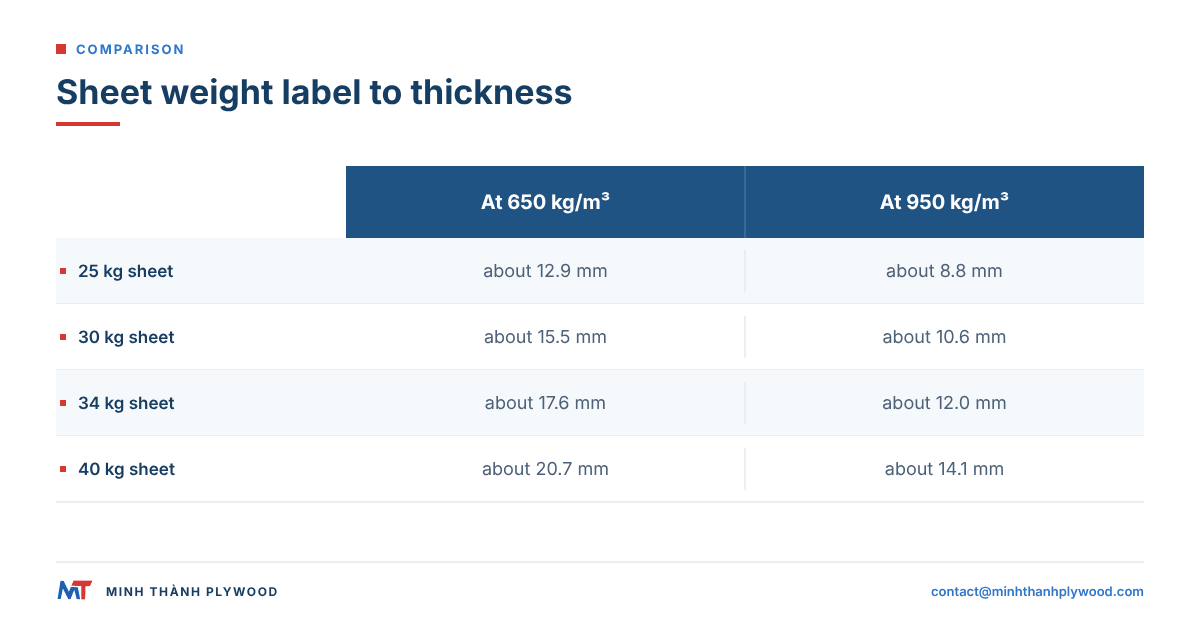
The arithmetic: weight = 1.22 m × 2.44 m × thickness × density. At a core density of 650 kg/m³, a 34 kg sheet is about 17.6 mm thick, so it is an 18 mm class panel. The same 34 kg at a denser 950 kg/m³ hardwood core is only about 12 mm thick.
| Sheet weight label (8 × 4 ft) | Thickness at 650 kg/m³ | Thickness at 950 kg/m³ |
|---|---|---|
| 25 kg | about 12.9 mm | about 8.8 mm |
| 30 kg | about 15.5 mm | about 10.6 mm |
| 34 kg | about 17.6 mm | about 12.0 mm |
| 40 kg | about 20.7 mm | about 14.1 mm |
So a weight label alone does not tell you the thickness. Write both on the order: “18 mm, 1220 × 2440 mm, Eucalyptus core, about 34.8 kg per sheet” leaves no room for doubt. Our 18 mm Eucalyptus-core sheet at 650 kg/m³ weighs 34.8 kg, close to the 34 kg class Indian buyers ask for.
12 mm film-faced plywood: light forms and liners
12 mm film-faced plywood is the light end of the formwork range, used for liners, column boxes, curved and small forms where bearers are close together. It is light to handle: about 23.2 kg per 1220 × 2440 mm sheet on a Eucalyptus core, 20.7 kg on Acacia.
Where 12 mm works:
- Liners over an existing form for a fine concrete finish.
- Column boxes with close yokes.
- Curved work, where a thinner panel follows the radius.
- Small precast moulds, where weight per lift matters.
Where it does not: walls and slabs on normal bearer spacing, where 12 mm deflects under fresh concrete. Shuttering plywood 12mm is also the panel most often sold by weight in South Asia; a 12 mm sheet that weighs 30 kg or more has a very dense core.
15 mm phenolic plywood: slab soffits
15 mm phenolic plywood is the slab panel for systems with close supports. It is stiffer than 12 mm, lighter than 18 mm, and many table and drop-head slab systems are drawn around it.
On a 1220 × 2440 mm sheet, 15 mm weighs about 29.0 kg on Eucalyptus and 25.9 kg on Acacia, and a 40HC carries 960 sheets on a Eucalyptus core. For overhead slab work, the lower weight matters: crews lift and place soffit panels above their heads all day.
Choose phenolic (WBP) glue for 15 mm slab panels that will be reused many times; melamine-fortified glue suits shorter jobs.
18 mm film-faced plywood: the standard formwork panel
18 mm film-faced plywood is the standard formwork panel worldwide. It spans normal bearer spacing on walls, columns and slabs, takes repeated pours with good handling, and fits most proprietary systems.
| 18 mm, 1220 × 2440 mm | Eucalyptus core | Acacia core |
|---|---|---|
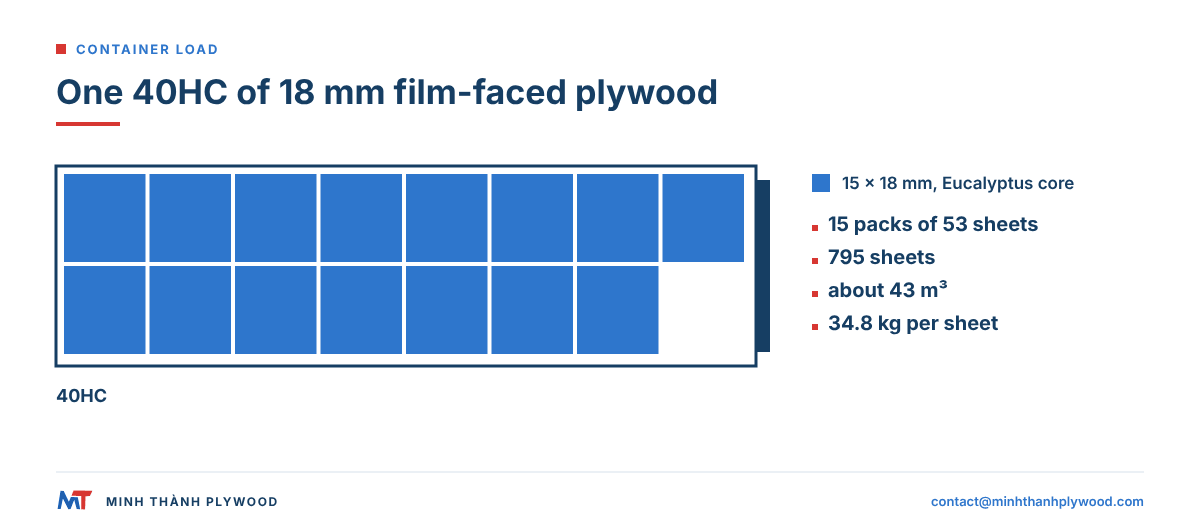
| Sheet weight | 34.8 kg (650 kg/m³) | 31.1 kg (580 kg/m³) |
| Sheets per pack | 53 sheets | 55 sheets |
| Packs per 40HC | 15 | 16 |
| Sheets per 40HC | 795 sheets | 880 sheets |
| Volume per 40HC | about 43 m³ | about 47 m³ |
Most buyers who start with one thickness start here. The 18 mm panel is also the one most often asked for in brown or black film; the colour is a choice of the site, while the film weight, core and glue decide the panel’s life.
21 mm film-faced plywood: heavy formwork
21 mm film-faced plywood is for heavy formwork: tall walls, thick slabs, wide bearer spacing and high-reuse systems. It is the stiffest panel in the standard range and the heaviest to lift, about 40.6 kg per 1220 × 2440 mm sheet on Eucalyptus.
Choose 21 mm when the formwork design calls for it or when you want to widen bearer spacing on a repeating system. Choose phenolic (WBP) glue and premium film with it: a heavy panel that is reused many times earns its weight back over the pours.
Film weight vs thickness: two different specifications
Film weight and thickness are two separate lines on a film-faced order. Thickness is the plywood panel in millimetres; film weight is the resin-impregnated paper on its faces, in grams per square metre.
| Line | Unit | Minh Thanh standard | Premium |
|---|---|---|---|
| Panel thickness | mm | 12–21 mm, ±0.5 mm | — |
| Film weight | g/m² | 120–135 g/m² | From 135 g/m² |
| Glue | — | Melamine-fortified (EN 636-2) | Phenolic (WBP, EN 636-3) |
| Core | — | Eucalyptus or Acacia | Eucalyptus or Acacia |
A heavier film protects the face over more pours, but it does not make the panel stiffer: stiffness comes from thickness and core. A panel with a heavy film over a weak core still bends between bearers. Write all four lines, and the quotation compares like with like.
Which thickness for which formwork element?
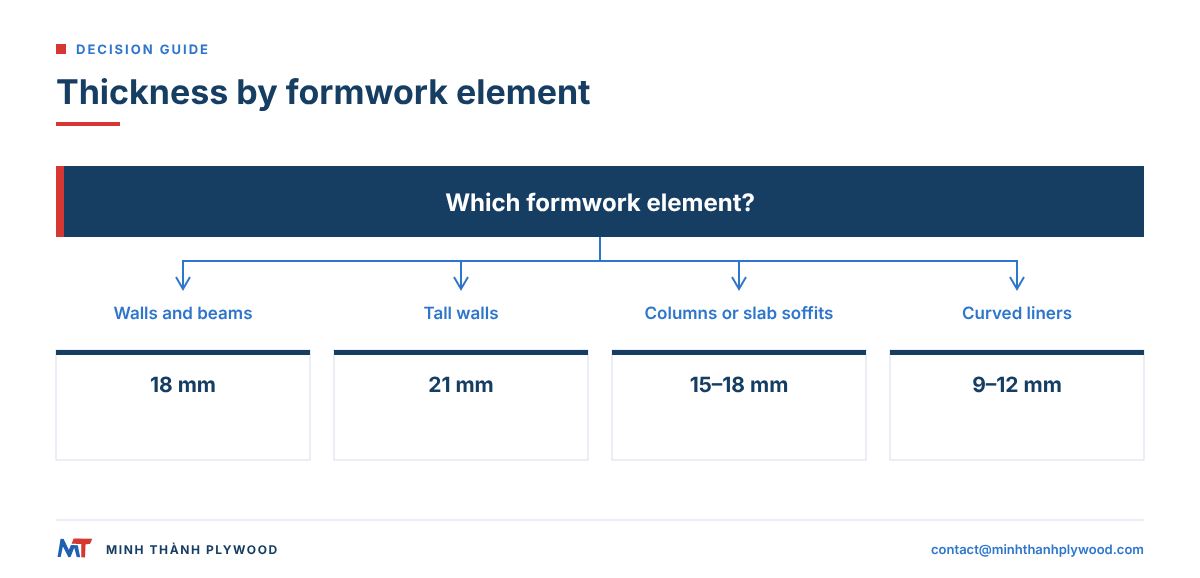
Choose formwork plywood thickness by the element, the pour height and the bearer spacing in the formwork design. The table is the starting point most site engineers use before the design fixes the panel.
| Element | Usual thickness | Glue for repeated use | Note |
|---|---|---|---|
| Wall forms, normal height | 18 mm | Phenolic (WBP) | Standard panel for proprietary wall systems |
| Tall walls, high pour rate | 21 mm | Phenolic (WBP) | Stiffer face, wider bearer spacing |
| Columns, square and rectangular | 15–18 mm | Phenolic (WBP) | Close yokes allow 15 mm |
| Slab soffits on tables or drop heads | 15–18 mm | Phenolic (WBP) | Lighter 15 mm for overhead handling |
| Beams and beam sides | 18 mm | Phenolic (WBP) | Cut panels; seal every cut edge |
| Footings and pile caps | 12–18 mm | Melamine-fortified | Short reuse, rough finish accepted |
| Curved walls and liners | 9–12 mm | Melamine-fortified or phenolic | Thin panel bends to the radius |
Whatever the element, cut edges and drilled holes take water first. Seal every cut edge and tie hole with edge paint before the first pour, store panels flat and off the ground, and clean the face with a soft scraper after stripping. A well-kept panel keeps its film and its thickness longer than a heavier panel left in the rain.
Custom form ply sizes and cut panels
Custom form ply sizes are made when a formwork system is drawn around a panel that is not 1220 × 2440 or 1250 × 2500 mm. Minh Thanh presses custom sizes such as 1220 × 2500 mm and cuts full sheets to the sizes on your drawing before packing.
Send the cutting list with the panel thickness, the film side, and who seals the cut edges. Cut panels are packed and labelled by part, so the site receives a pack per element instead of full sheets to cut in the yard. For Australian buyers, the 1220 × 2440 mm sheet can be trimmed to 1200 × 2400 mm at the mill.
Tolerances and checks on arrival
Film-faced plywood from Minh Thanh is held to ±0.5 mm on thickness and ±2 mm on length and width. On arrival, check those lines on sheets from several packs before the panels go to site.
- Thickness: caliper readings at four points along the long edges on five sheets per pack.
- Length, width and squareness: steel tape on both ends and both diagonals.
- Edges: sealed, with paint on all four edges and no open core gaps.
- Film: smooth, no bubbles, no lifted corners, colour even across the pack.
- Weight: weigh five sheets; compare with the declared core density.
- Pack labels: product, thickness, size and sheet count against the packing list.
Every shipment is photographed and filmed before loading, and buyers receive the photos and video to compare pack by pack.
How many film-faced sheets fit in a 40HC?
A 40HC carries 795 sheets of 18 mm film-faced plywood on a Eucalyptus core, in 15 packs of 53 sheets, planned to a 28,000 kg payload. Lighter Acacia cores fit 16 packs and 880 sheets of 18 mm.
| Thickness, 1220 × 2440 mm | Eucalyptus core: sheets per 40HC | Per pack | Acacia core: sheets per 40HC | Per pack |
|---|---|---|---|---|
| 12 mm | 1,200 sheets | 80 sheets | 1,328 sheets | 83 sheets |
| 15 mm | 960 sheets | 64 sheets | 1,056 sheets | 66 sheets |
| 18 mm | 795 sheets | 53 sheets | 880 sheets | 55 sheets |
| 21 mm | 675 sheets | 45 sheets | 752 sheets | 47 sheets |
The plan: packs about one metre high, sheets per pack = 1,000 ÷ thickness rounded down, then reduced so the load stays inside 28,000 kg. If your booking carries a lower payload, the counts fall with it, and the quotation shows the recalculated plan.
How to order film-faced plywood sizes and thickness
Write one order line per panel, with size, thickness, film, glue and core. A complete line reads:
“Film-faced plywood, 18 mm ±0.5 mm, 1220 × 2440 mm, brown film 120–135 g/m², phenolic (WBP) glue, Eucalyptus core, edges sealed, 795 sheets in 15 packs, CIF your port.”
What comes with the order:
- Minimum and mix: one 40HC, with mixed specifications by agreement, for example 18 mm wall panels with 12 mm liners.
- Production: 15–45 days after the 30% deposit; balance 70% against the scanned B/L, or irrevocable L/C at sight.
- Terms: FOB Hai Phong, CFR or CIF.
- Samples: free samples in your thickness and film.
- Transit: typical days at sea from Hai Phong are 5–12 to South-East Asia, 15–25 to the Middle East and 35–50 to West Africa, by carrier and route.
Send the line to contact@minhthanhplywood.com or WhatsApp +84 988 586 601; Lisa replies within hours. Certificates and test reports are on the quality page. See film-faced plywood for the build and how to select a film-faced plywood supplier for the questions to ask. Further guides as they are published: what is film-faced plywood, phenolic coated plywood and F17 formply and AS 6669 grades.
Buyer questions, answered
What are the standard form ply sizes?
1220 × 2440 mm (4 × 8 ft) is the world standard, 1250 × 2500 mm is common in Europe, and Australian formply comes in 2400 × 1200 and 1800 × 1200 mm.
What does F17 mean on formply?
F17 is an Australian stress grade for strength and stiffness. F17 formply is made for load-bearing formwork to AS 6669: 17 mm for residential slabs, footings and walls, 25 mm for deeper pours and wider spans. Australian prices in October 2026 run from A$59 to A$115 per sheet.
What thickness is form ply?
Film-faced form ply is made from 9 to 21 mm, sometimes thicker. 12 mm suits light forms and liners, 15 mm slab soffits, 18 mm walls and columns, and 21 mm heavy formwork. Australian F17 formply is 17 mm.
What is the most common shuttering plywood thickness?
18 mm. It balances stiffness between supports, reuse and weight, and fits most wall, column and slab systems.
What does shuttering plywood 34 kg mean?
It is a weight per 8 × 4 ft sheet, used in South Asian trade as shorthand for thickness and density. At 650 kg/m³ a 1220 × 2440 mm sheet weighs 34 kg at about 17.6 mm, so it is an 18 mm class panel.
What is the phenolic board size in meters?
The standard phenolic board is 1.22 m × 2.44 m, about 2.98 m². European boards are 1.25 m × 2.5 m, and Australian formply is 1.2 m × 2.4 m or 1.2 m × 1.8 m.
How much does an 18 mm film-faced plywood sheet weigh?
A 1220 × 2440 × 18 mm sheet weighs about 31.1 kg on an Acacia core and 34.8–40.2 kg on a Eucalyptus core, depending on core density.
What is the thickness tolerance of film-faced plywood?
Minh Thanh holds film-faced plywood to ±0.5 mm on thickness and ±2 mm on length and width.
How many film-faced plywood sheets fit in a 40HC container?
On a Eucalyptus core, a 40HC carries 1,200 sheets of 12 mm, 960 of 15 mm, 795 of 18 mm or 675 of 21 mm at 1220 × 2440 mm, planned to a 28,000 kg payload.
Is 12 mm film-faced plywood strong enough for formwork?
For light forms, curved work and liners on close supports, yes. For walls, columns and slabs, 15–18 mm panels on the support spacing of the formwork design are the usual choice.
What is the difference between film weight and thickness?
Thickness is the panel, in millimetres. Film weight is the coating, in grams per square metre, for example 120–135 g/m² standard and from 135 g/m² premium. They are two separate lines on the order.