
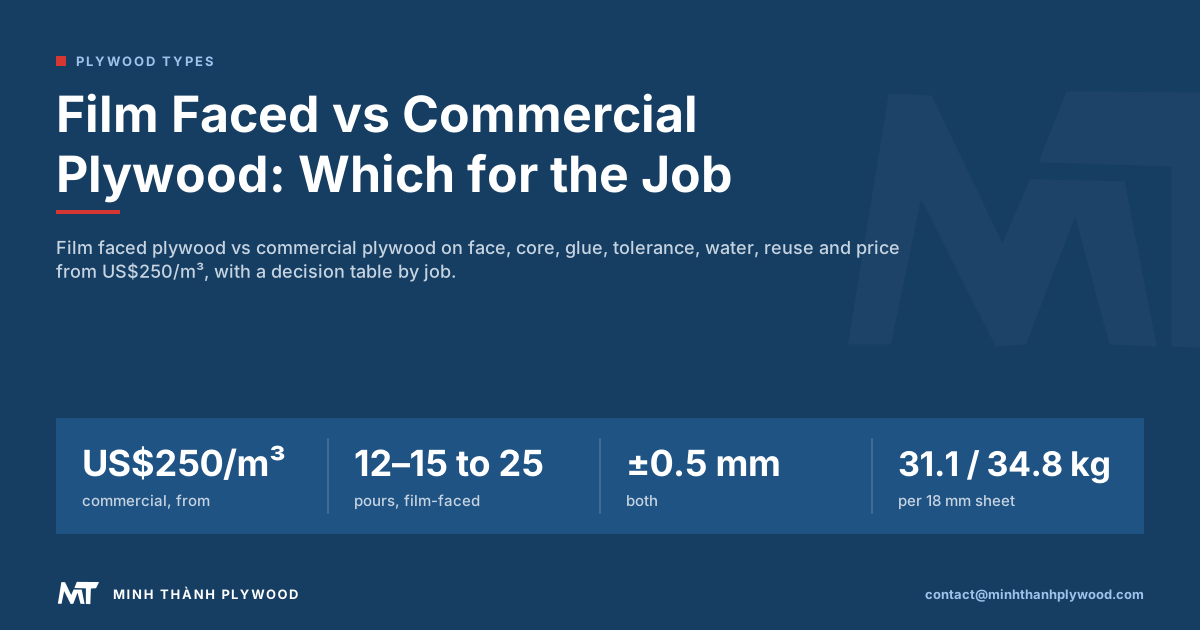
Film faced plywood vs commercial plywood is a choice between a coated formwork panel and an unfaced general-purpose one. Film-faced plywood has phenolic film and water-resistant glue for pouring concrete and wet site work; commercial plywood has bare veneer faces for furniture bases, backs, partitions and packing. Minh Thanh Plywood makes both in Vietnam, so the verdict below follows the job.
Film faced plywood vs commercial plywood: the short answer
Choose film faced plywood when the panel meets wet concrete or stays on a wet site, and commercial plywood when it goes into dry interiors, furniture bases, backs or packing. Film-faced plywood pays back over many pours; commercial plywood wins where a bare, low-cost face is all the job needs.
- Film-faced plywood: phenolic film on both faces, Acacia or Eucalyptus core, melamine-fortified or phenolic (WBP) glue, sealed edges.
- Commercial plywood: bare veneer faces such as bintangor, okoume, poplar or pine, Acacia or Eucalyptus core, UF or melamine-fortified glue.
We make both panels, so the advice in this guide follows the job, not a product we prefer to sell.
Film faced plywood overview
Film faced plywood is plywood with a resin-impregnated paper film pressed onto both faces and a water-resistant glue between the plies; it is built for concrete formwork and shuttering.
| Point | Film-faced plywood |
|---|---|
| Faces | Phenolic film, about 120–135 g/m²; premium from 135 g/m² |
| Core | Acacia or Eucalyptus |
| Glue | Melamine-fortified (MR) or phenolic (WBP) |
| Edges | Sealed with water-resistant paint |
| Thickness tolerance | ±0.5 mm |
| Reuse (industry guide) | About 12–15 uses with melamine glue; up to about 25 with phenolic, with proper handling, release agent and edge sealing |
Our sibling guide what is film-faced plywood? explains the build and film types.
Non film faced plywood: what commercial plywood is
Non film faced plywood is any plywood without a film overlay; in trade it usually means commercial plywood, a general-purpose panel with bare wood veneer faces over a hardwood core. It is sold unsanded or lightly sanded for interior and utility work.
- Faces: bintangor, okoume, poplar, pine or EV, in utility to good grades.
- Core: Acacia or Eucalyptus, in a lower grade than furniture cores, laid loose or jointed.
- Glue: UF glue for dry interiors; melamine-fortified for humid ones.
- Tolerance: ±0.5 mm.
- Uses: furniture bases and backs, drawer bottoms, partitions, ceilings, flooring underlay, crates and packing.
Commercial plywood is the panel most buyers mean when they ask for “plywood” with no other word. See our commercial plywood page for faces and sizes.
Side-by-side comparison table
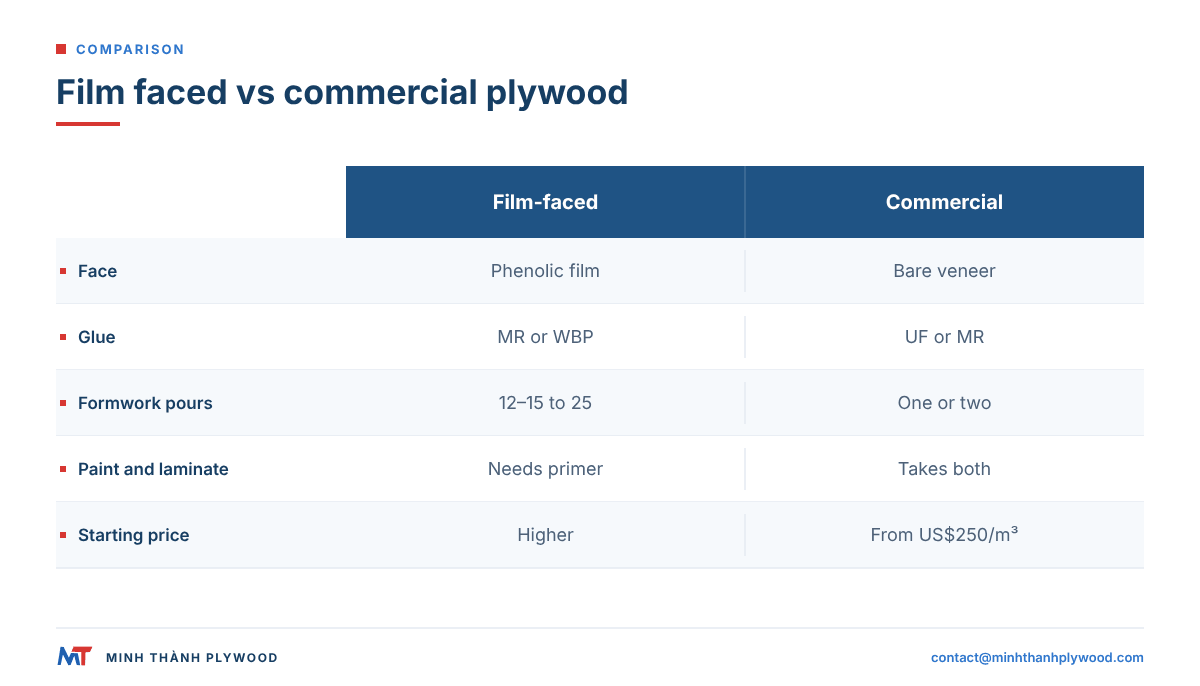
The table compares the two panels on one metric per row, as made in our mill.
| Metric | Film-faced plywood | Commercial plywood |
|---|---|---|
| Face | Phenolic film | Bare wood veneer |
| Core | Acacia or Eucalyptus | Acacia or Eucalyptus, lower grade |
| Glue | Melamine-fortified or phenolic (WBP) | UF or melamine-fortified |
| Thickness tolerance | ±0.5 mm | ±0.5 mm |
| Water on faces | Film sheds water | Veneer absorbs water |
| Concrete release | With suitable release agent | Depends on the specified panel and release treatment |
| Formwork pours | About 12–15 to 25 by glue | One or two, rough work only |
| Paint and laminate | Needs abrading and a bonding primer | Takes paint, laminate and veneer |
| Typical colour | Brown or black film | Natural veneer colour |
| Price per sheet | Higher | Lower; from US$250/m³ (October 2026) |
The face row decides most jobs: film for concrete and wet sites, bare veneer for anything that will be finished, glued or hidden.
How each panel is built
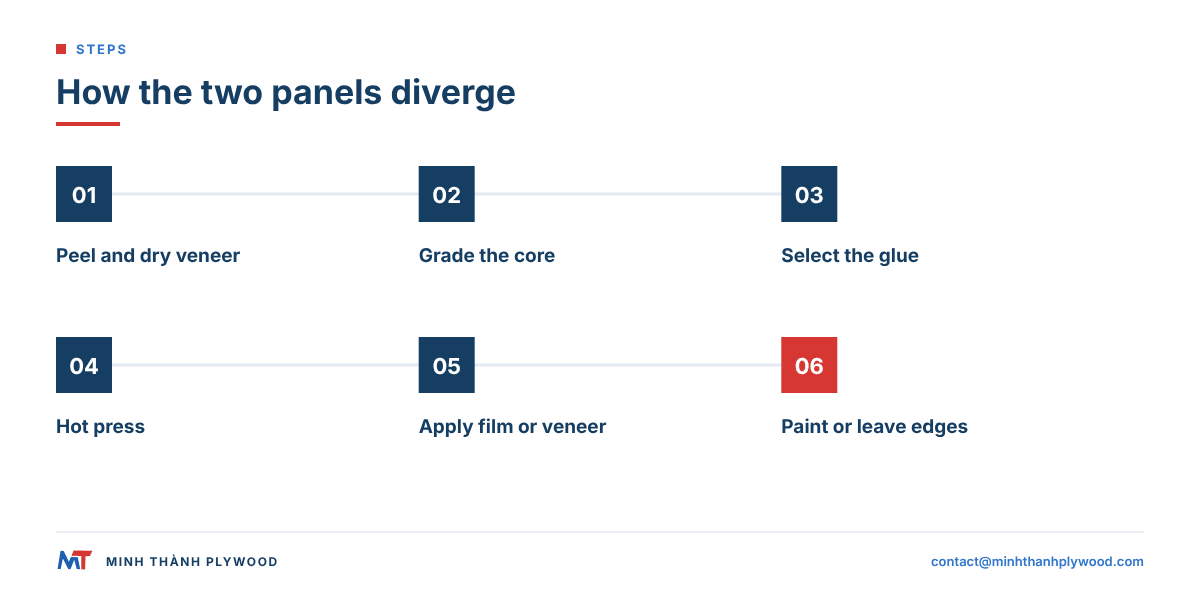
Both panels start from the same steps: peeled veneer, dried and graded, glued in crossed plies and hot-pressed. They part at the glue, the core grade and the faces.
- Core grade: film-faced cores are graded so the film lies flat; commercial cores use lower grades, laid loose or jointed.
- Glue: film-faced uses melamine-fortified or phenolic glue; commercial uses UF or melamine-fortified.
- Pressing: melamine glue presses at about 110–120 °C, phenolic at about 130–145 °C.
- Faces: film-faced gets film pressed onto both faces; commercial gets veneer faces, unsanded or lightly sanded.
- Edges: film-faced edges are painted; commercial edges are left bare.
Furniture plywood sits above both: graded core stitched both horizontally and vertically, pressed twice as standard, and sanded to ±0.2–0.3 mm.
Which projects need which?
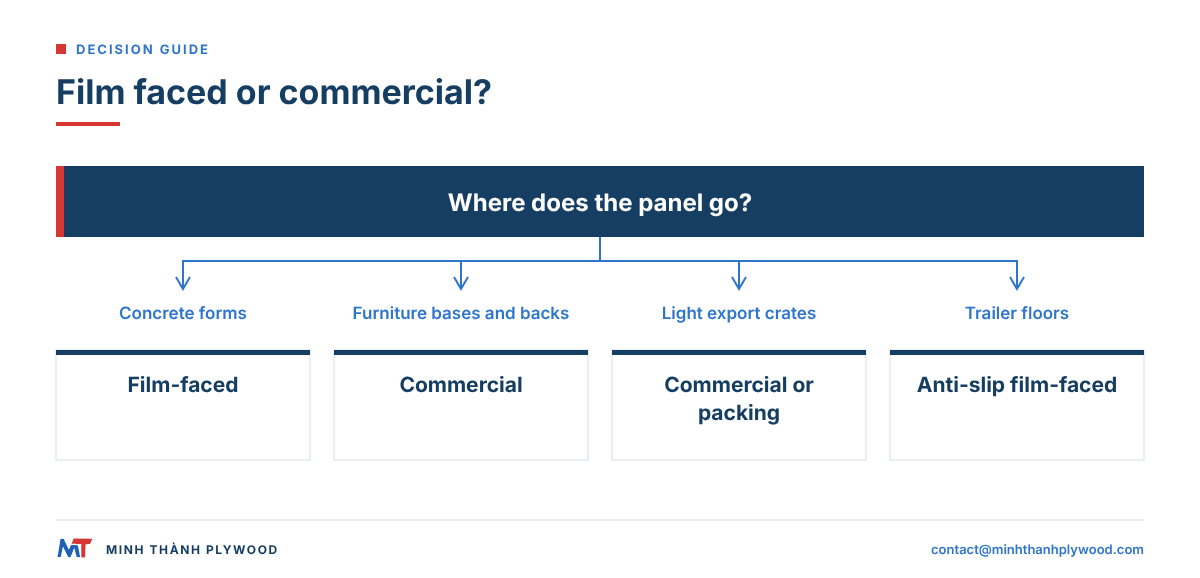
The decision table gives the panel for each common application, with the reason.
| Application | Choose | Why |
|---|---|---|
| Wall and column formwork | Film-faced, phenolic | Smooth finish, many pours |
| Slab soffits, standard cycles | Film-faced, melamine | Water-resistant, reusable |
| Rough foundations below ground | Commercial or low-grade film-faced | Finish does not matter |
| Furniture bases and carcass backs | Commercial | Low cost, takes glue and laminate |
| Drawer bottoms and partitions | Commercial | Light, easy to cut |
| Laminated or painted interior panels | Commercial | Bare face bonds to laminate and paint |
| Export crates, light goods | Commercial or packing | Lowest cost per crate |
| Heavy or wet packing cases | Film-faced | Hard face, water-resistant glue |
| Trailer and truck floors | Anti-slip film-faced | Wear and grip |
| Site hoardings | Film-faced | Weather-resistant faces |
For finished furniture, neither panel is the best choice: order sanded furniture plywood instead.
Cost per use: sheet price is not the whole cost
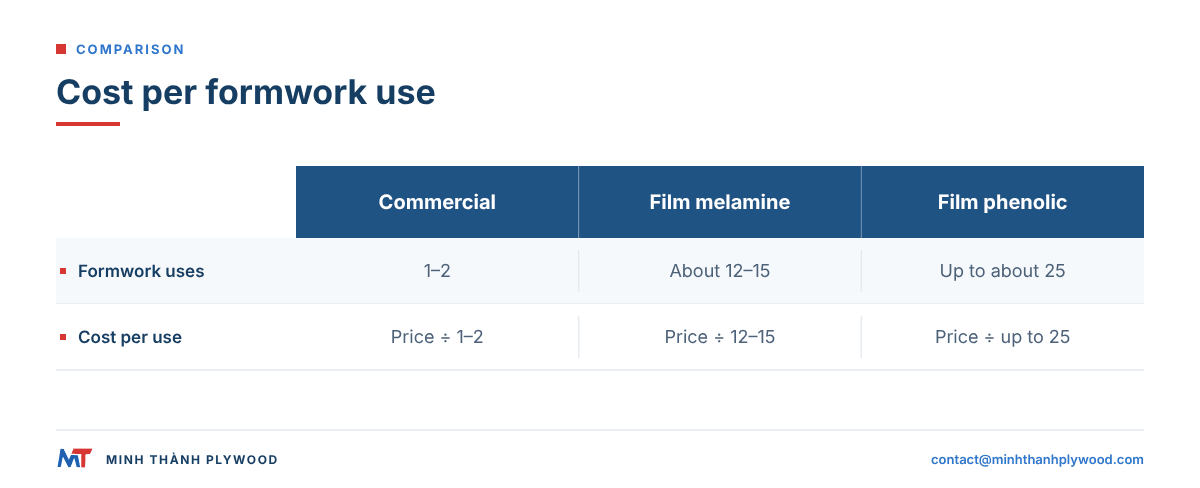
Commercial plywood is cheaper per sheet, but film-faced plywood is cheaper per pour in formwork, because one film-faced sheet replaces many commercial sheets over a job. Compare cost per use, not per sheet.
Cost per use = sheet price ÷ number of uses on your site.
| Panel in formwork | Uses (guide) | Cost per use |
|---|---|---|
| Commercial plywood | One or two | Full sheet price, or half |
| Film-faced, melamine-fortified | About 12–15 | Sheet price ÷ 12–15 |
| Film-faced, phenolic (WBP) | Up to about 25 | Sheet price ÷ up to 25 |
Film-faced reuse figures are industry guides, with proper handling, release agent and edge sealing. Off the formwork, the sum turns round: a furniture base or a crate is used once, so the cheaper commercial sheet wins. Our film faced plywood price guide explains what moves the sheet price.
Water resistance and outdoor use
Film-faced plywood is the water-resistant panel of the two: its film sheds water and its melamine-fortified or phenolic glue holds the plies when wet. Commercial plywood with UF glue is for dry interiors. With melamine-fortified glue, specify the required bond class and confirm whether the complete panel is suitable for humid or exterior exposure.
- Wet site, rain, concrete: film-faced plywood.
- Humid interiors: commercial with melamine-fortified glue.
- Dry interiors: commercial with UF glue.
- Permanent outdoor building: exterior plywood with a water-resistant bond; see our exterior plywood page.
In Europe, EN 636 classes plywood by its service condition: dry, humid or exterior. The BSI catalogue lists BS EN 636:2012+A1:2015 for plywood in dry, humid or exterior conditions (BSI, checked on 20 October 2026). Commercial plywood with UF glue fits the dry class; film-faced plywood with phenolic glue is built for exterior site conditions.
In every case, seal the cut edges. Our guide is plywood waterproof? explains what each glue survives.
Using film-faced plywood for non-formwork projects
Film-faced plywood works well outside formwork where a hard, wipe-clean, water-resistant face is wanted and the panel will not be veneered or laminated. Its limits are weight, the dark film and poor paint adhesion without preparation.
| Non-formwork use | Fit | Note |
|---|---|---|
| Trailer and van floors | Very good | Anti-slip film for grip |
| Workshop benches | Good | Hard, wipe-clean face |
| Site cabins and hoardings | Good | Paint after abrading and priming |
| Heavy packing cases | Good | Reusable cases pay back |
| Shelving in stores and garages | Fair | Heavier than needed |
| Finished furniture | Poor | Film cannot be veneered or laminated |
To paint film-faced plywood: degrease, abrade the film lightly, apply a bonding primer for glossy surfaces, then two topcoats.
Using commercial plywood where water is present
Commercial plywood can work in damp places only when it is made with melamine-fortified glue and sealed on faces and edges. It should not be used for concrete forms beyond rough, one-off work, because bare veneer absorbs water and grips concrete.
- Order melamine-fortified glue for kitchens, bathrooms and humid stores.
- Seal every face and edge with paint, laminate or a sealer.
- Keep it off wet floors with a plinth or feet.
- Use film-faced or exterior plywood wherever rain or concrete reach the panel.
Grades, tolerance and what to inspect
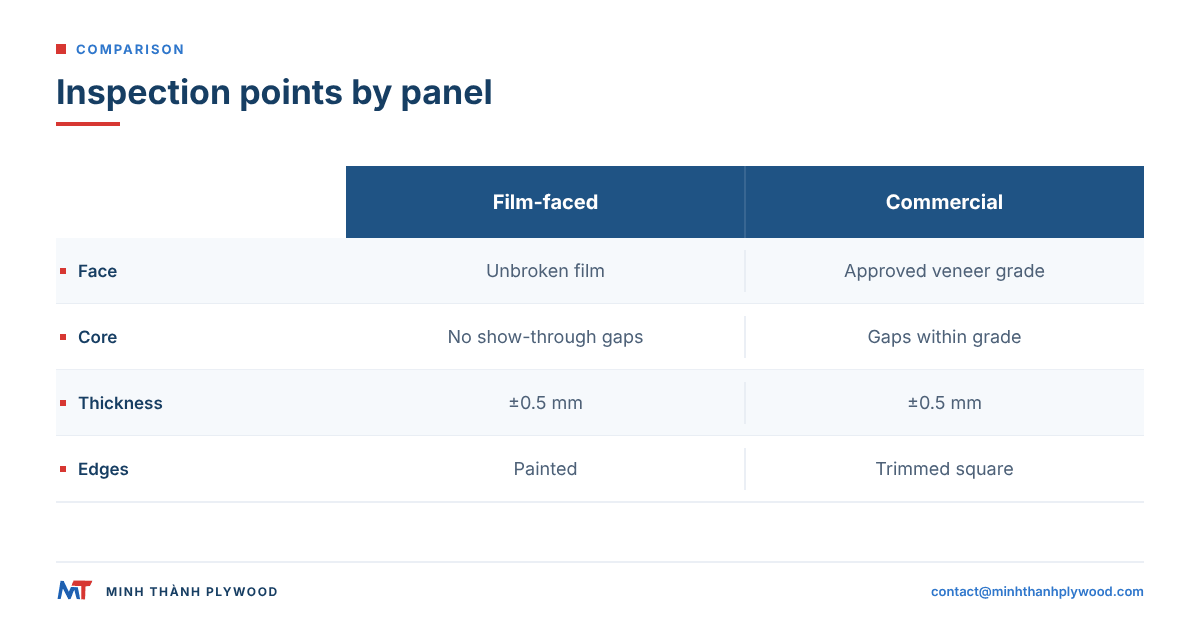
Inspect film-faced plywood for film coverage, edge sealing and flatness; inspect commercial plywood for face grade, core gaps and thickness. Both are made to ±0.5 mm in our mill.
| Inspection point | Film-faced plywood | Commercial plywood |
|---|---|---|
| Face | Film unbroken, no bubbles or wrinkles | Face grade to the approved sample |
| Core | No gaps that show through the film | Gaps within the agreed grade |
| Thickness | ±0.5 mm | ±0.5 mm |
| Length and width | ±2 mm | ±2 mm |
| Edges | Painted all round | Trimmed square |
| Bond | Boil or bond test for the agreed glue | Bond test for the agreed glue |
Face grades for commercial plywood follow the face species: poplar faces are quoted as A/A, A/B and B/B, and also by the Chinese codes B/BB, BB/CC and CP; pine faces as A/A, A/B and B/B, with B/C for utility parts.
Price and loading
Our indicative starting price for commercial plywood is from US$250/m³ (October 2026); film-faced plywood costs more per cubic metre because of its film, graded core and water-resistant glue. Face, core, glue, thickness, size and quantity set the final price of either panel.
Market context: Vietnamese film-faced plywood is quoted at about US$380–520/m³ FOB Hai Phong in early 2026, from standard melamine-glue panels to phenolic-film, phenolic-glue panels, according to the Vinawood plywood statistics page (checked on 21 October 2026). Commercial plywood from US$250/m³ sits below that range, so film-faced costs more per cubic metre and less per pour. Our film-faced quote depends on film weight, glue and core, so send the build line and we price that exact panel.
Loading differs by core weight. A 40HC of premium film-faced plywood carries about 43 m³ on Eucalyptus core or 47 m³ on Acacia. The same core densities set commercial plywood loads: Acacia about 580 kg/m³ and Eucalyptus about 650 kg/m³ on our planning figures, capped by the container payload.
At 18 mm, a 40HC of 1220 × 2440 mm sheets carries 880 on Acacia core and 795 on Eucalyptus core on our packing plan.
| Core | Planning density | 18 mm sheet, 1220 × 2440 mm |
|---|---|---|
| Acacia | 580 kg/m³ | 31.1 kg |
| Eucalyptus | 650 kg/m³ | 34.8 kg |
US buyers: matching the names
US formwork buyers order by APA names, not by “film faced”. APA’s concrete-forming page lists Plyform Class I and Structural I, each available with HDO or MDO overlay, made to PS 1 and sold in 4 × 8 ft sheets (APA concrete forming, checked on 21 October 2026). APA describes HDO as a hard phenolic overlay capable of up to 200 or more reuses with proper care; its nonoverlaid, mill-treated Plyform panels typically give 5 to 10.
Our film-faced panels have phenolic film on both faces over a hardwood core, in the nominal 4 × 8 ft format of 1220 × 2440 mm. Check the complete panel against your engineer’s specification. If PS 1 compliance or an APA grade mark is required, obtain evidence for that product; a bond test and film weight do not establish that qualification. NIST lists PS 1-22 as the current structural plywood standard (NIST, checked on 20 October 2026).
Common mistakes when choosing between them
The most common mistake is comparing a film-faced quote with a commercial quote on sheet price alone, when the two panels do different jobs. Five mistakes cost buyers most:
- Using commercial plywood for repeated pours: it swells and grips concrete, so the saving is lost after the first pour.
- Buying film-faced plywood for finished furniture: the film cannot be veneered or laminated, and the panel is heavier than needed.
- Comparing two film-faced quotes without the build line: core grade, glue and film weight set reuse; two offers with the same name are often not the same construction.
- Leaving cut edges bare: both panels take water through the edges, and film-faced reuse figures assume sealed edges.
- Ordering UF glue for damp rooms: commercial plywood for kitchens, bathrooms and humid stores needs melamine-fortified glue.
Each mistake is avoided by naming the application first on the request, so that the mill quotes the right face, glue and core for the job.
Proof and documents we supply
A buyer can ask for four documents with either panel:
- Emission: six ASTM D6007 chamber tests, April 2025 to June 2026, on 9, 15 and 18 mm panels averaged 0.014–0.032 ppm against the 0.05 ppm CARB Phase 2 and TSCA Title VI limit; ICTT mill no. 23024. These cover our veneer-core hardwood plywood, the commercial and furniture side of the range.
- EUDR: the compliance dossier, with origin records and geolocation files, goes with orders. The Commission’s EUDR page gives 30 December 2026 as the start date for large and medium operators (European Commission, checked on 8 October 2026).
- Moisture: veneers and finished panels are dried to 8–12 % moisture content at dispatch.
- Bond: third-party testing to your method, for example EN 314-1 bond testing assessed against EN 314-2 Class 3 requirements, is arranged through SGS on request.
What this means for your order
Name the job first, and the right panel follows; a mixed container can carry both by agreement. Send these lines with your request:
- Application: formwork, furniture base, packing, flooring or site work.
- Core: Acacia or Eucalyptus.
- Glue: phenolic (WBP) or melamine-fortified for film-faced; UF or melamine-fortified for commercial.
- Face: film weight and colour, or face species and grade such as poplar B/BB or bintangor.
- Size and thickness: 1220 × 2440 mm or 1250 × 2500 mm, to ±0.5 mm.
- Packing and quantity: from one 40HC, mixed specifications by agreement; FOB Hai Phong, CFR or CIF.
Production takes 15–45 days after the deposit, and free samples are available. Request a quote on our film-faced plywood or commercial plywood pages, or compare film-faced vs marine plywood and read how to select a film faced plywood supplier.
Buyer questions, answered
What is the difference between film faced plywood and commercial plywood?
Film faced plywood has phenolic film on both faces and water-resistant glue, made for concrete formwork. Commercial plywood has bare wood veneer faces and usually UF or melamine-fortified glue, made for furniture bases, interiors and packing.
What is commercial plywood?
Commercial plywood is general-purpose plywood with wood veneer faces such as bintangor, okoume, poplar or pine over a hardwood core, sold unsanded or lightly sanded for interior work, furniture backs and packing.
What is non film faced plywood?
Non film faced plywood is any plywood without a film overlay, most often commercial plywood. Its faces are bare veneer, so it can be painted, laminated or veneered. Concrete-form suitability depends on the panel grade, bond and release treatment.
Can commercial plywood be used for concrete formwork?
Only for rough, one-off work such as foundations below ground. Concrete sticks to bare veneer and water swells it, so commercial plywood gives one or two pours at most, against many for film-faced plywood.
Can film faced plywood be used for furniture?
Rarely. The film cannot be veneered, laminated or painted without special preparation, and the panel is heavier than a furniture core. It suits workshop benches and utility units, not finished furniture.
Which is cheaper, film faced or commercial plywood?
Commercial plywood is cheaper per sheet; our commercial plywood starts from US$250/m³ (October 2026). For formwork, film-faced plywood is cheaper per pour because it is reused many times.
Is commercial plywood waterproof?
No. Commercial plywood with UF glue is for dry interiors; with melamine-fortified glue it resists humidity. For wet sites and formwork, film-faced plywood with phenolic glue is the water-resistant choice.
What thickness tolerance do the two panels have?
Both are made to ±0.5 mm in our mill. Sanded furniture panels are tighter, at ±0.2–0.3 mm.
Which plywood is used for packing crates?
Commercial or packing plywood for most crates; film-faced plywood for heavy, wet or reusable cases where the hard face and water-resistant glue pay back.
What cores do film-faced and commercial plywood use in Vietnam?
Film-faced panels use Acacia or Eucalyptus cores. Commercial plywood uses Acacia and Eucalyptus cores, in lower core grades than furniture plywood.