
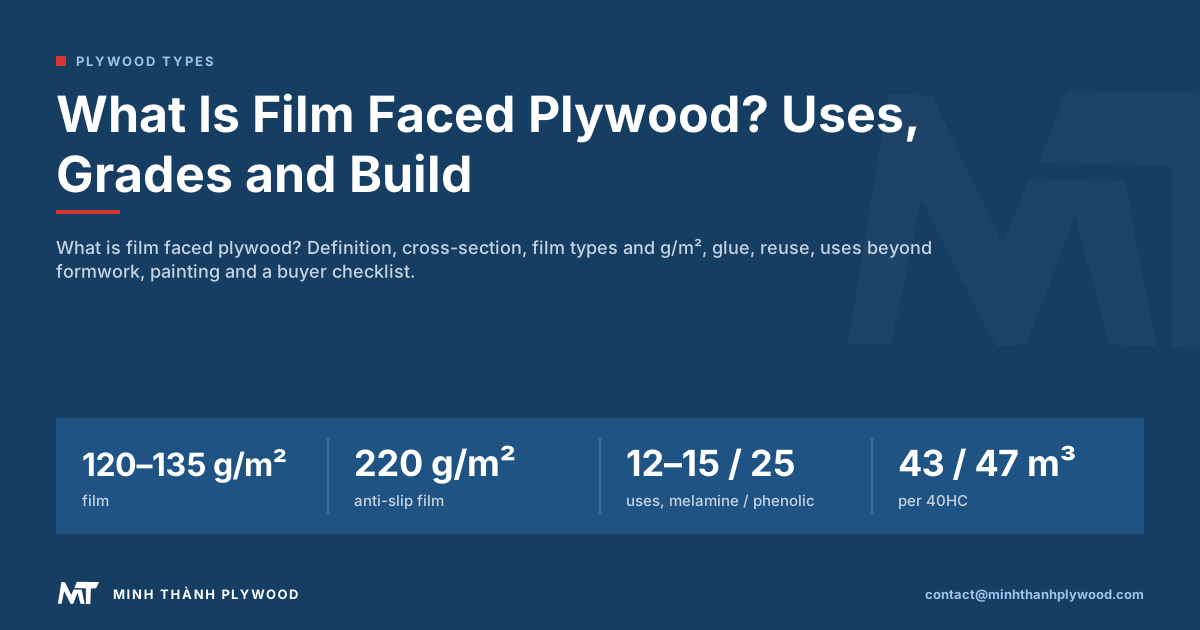
Film faced plywood is plywood covered on both faces with a resin-impregnated paper film, usually phenolic, and bonded with water-resistant glue. The film gives a smooth, hard, water-shedding surface that releases from concrete, so the panel is used mainly as formwork and shuttering. Minh Thanh Plywood makes film-faced panels in Vietnam alongside its furniture plywood; this guide covers the build, film, glue, reuse and uses.
What is film faced plywood? A definition
Film faced plywood is plywood whose face and back are covered with a resin-impregnated paper film, bonded to a core of crossed veneers with water-resistant glue. The film is usually phenolic resin; it gives a smooth, hard surface that sheds water and releases from set concrete.
It is also called film face ply, film plywood, formply, shuttering plywood and phenolic board. In every case the buyer means the same build: veneer core, waterproof-type glue, film on both faces, and painted edges.
- Main use: concrete formwork and shuttering.
- Why the film: a smooth concrete finish, easy stripping and more pours per panel.
- Why the glue: the plies must stay bonded through wet concrete, rain and cleaning.
Film faced plywood wiki: the key facts in one table
The table gives the film faced plywood facts a buyer looks up first: build, film, glue, sizes, tolerance and reuse.
| Point | Typical film-faced plywood |
|---|---|
| Core | Hardwood veneers; Acacia or Eucalyptus in Vietnam |
| Film | Phenolic paper film on both faces |
| Film weight | About 120–135 g/m²; premium from 135 g/m² |
| Anti-slip film | About 220 g/m², wire-mesh or hexagon pattern |
| Glue | Melamine-fortified (MR) or phenolic (WBP) |
| Sizes | 1220 × 2440 mm (4 × 8 ft in the US), 1250 × 2500 mm; other sizes can be quoted |
| Common thicknesses | 12, 15, 18 and 21 mm; the market range runs from 4 mm to 50 mm |
| Thickness tolerance | ±0.5 mm (our film-faced line) |
| Edges | Sealed with water-resistant edge paint |
| Reuse (industry guide) | About 12–15 uses with melamine glue; up to about 25 with phenolic, with proper handling, release agent and edge sealing |
Film weight, glue and core grade decide performance. Colour and brand stamps do not.
Makers list wider ranges than the common four thicknesses: one Chinese maker offers 4 mm to 50 mm and sheets up to 2000 mm wide and 6000 mm long (plywood.cc, checked on 21 October 2026). Those are special orders. For formwork, 12 to 21 mm in 1220 × 2440 mm is the standard that stripping crews and form designs assume, and we quote other thicknesses and sizes on request.
US equivalents. A US buyer searching this term will meet different names. APA lists Plyform Class I and Structural I, each available with an HDO (high-density overlay) or MDO (medium-density overlay) face, made to PS 1 in 4 × 8 ft sheets (APA concrete forming, checked on 21 October 2026). Imported film-faced plywood is the same kind of product, a resin-overlaid form panel, but it carries a mill build line (core, glue, film weight) instead of an APA grade stamp, so specify the bond and the film.
Film face: what the film is and what it does
A film face is a sheet of kraft paper impregnated with phenolic or melamine resin, pressed onto the plywood under heat until the resin cures into a hard, sealed skin. The cured film protects the veneer below from water, abrasion and alkaline concrete.
What the film does on site:
- Release: set concrete lets go of the smooth film, helped by release agent.
- Finish: the concrete takes the film’s smooth surface, so less patching and rendering is needed.
- Protection: the film keeps water and cement paste out of the face veneer.
- Reuse: a heavier film lasts more pours before it wears through.
Film is sold by weight per square metre. Standard film is about 120–135 g/m²; premium film starts from 135 g/m². The film maker, weight and colour are order specifications.
Film faced plywood cross-section: how the panel is built
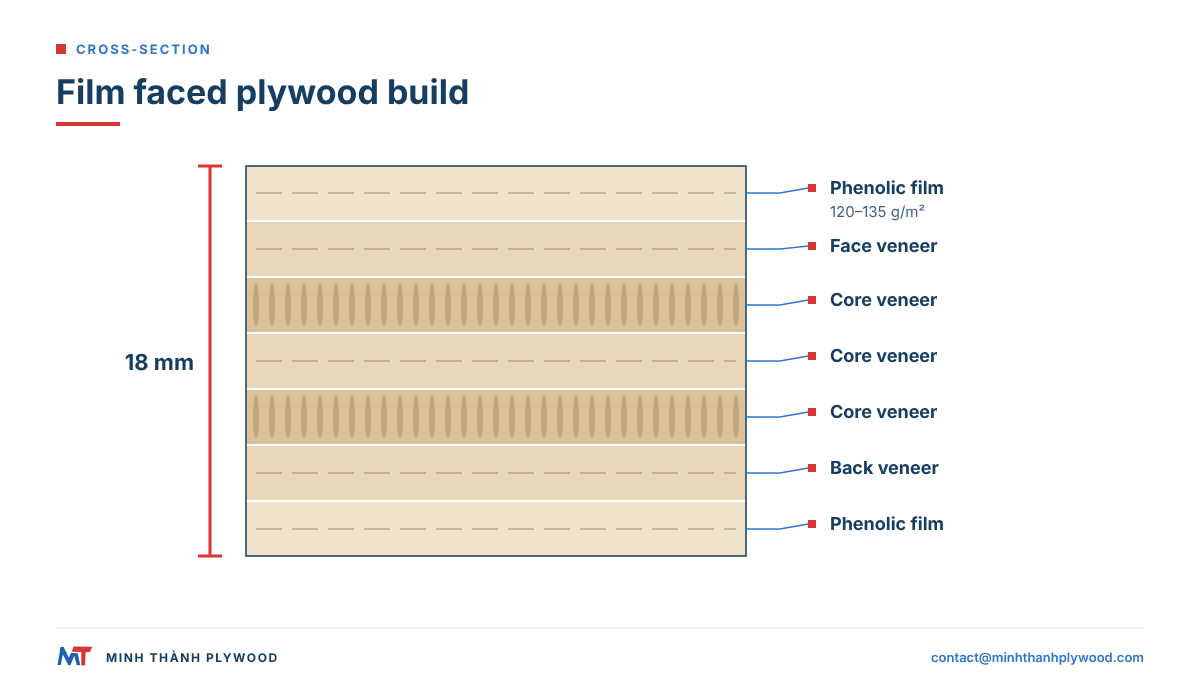
A film faced plywood panel is, from top to bottom: film, face veneer, crossed core veneers, back veneer, film, with sealed edges all round. Each veneer is turned across the one below, so the panel is stiff in both directions.
| Layer | What it is | Its job |
|---|---|---|
| Top film | Phenolic paper, about 120–135 g/m² | Release, finish, protection |
| Face veneer | Hardwood veneer | Base for the film |
| Core veneers | Crossed Acacia or Eucalyptus veneers | Strength and stiffness |
| Back veneer | Hardwood veneer | Balance |
| Bottom film | Same as the top | Reuse on both faces |
| Edge seal | Water-resistant paint | Keeps water out of the edges |
An 18 mm panel typically has 11–13 plies. A closed core, with no gaps or overlaps, keeps the face flat under concrete pressure and stops the film from cracking over voids.
How film faced plywood is made
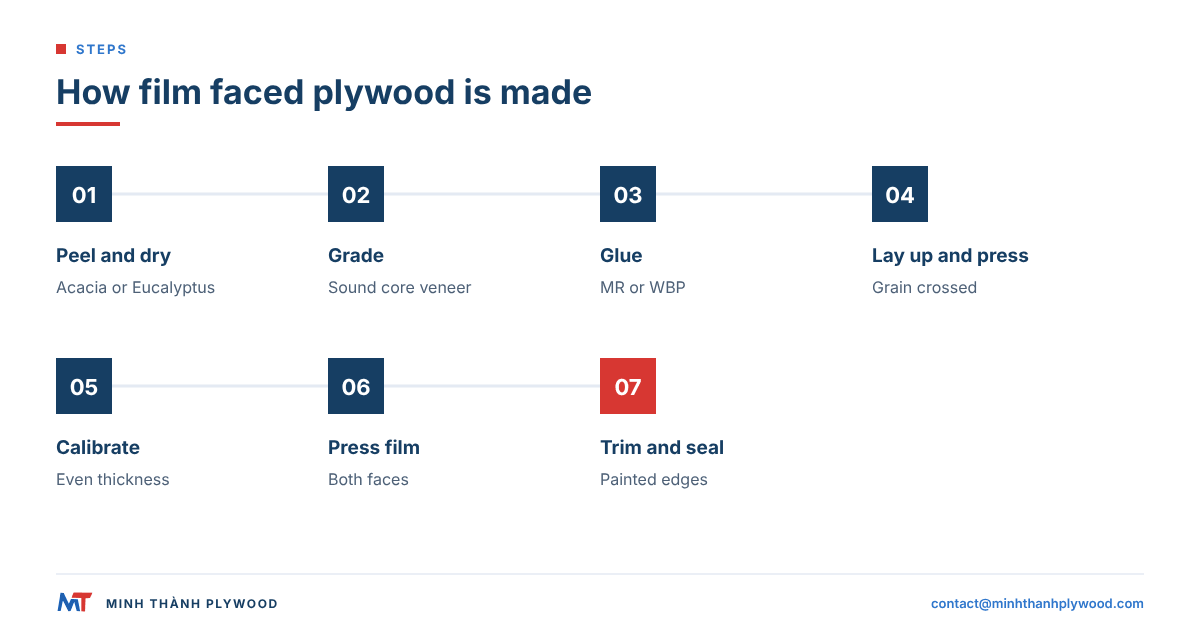
Film faced plywood is made in eight steps from veneer to painted edge (the diagram below combines lay-up and pressing into one step), with the core pressed first and the film pressed on after.
- Veneer: Acacia or Eucalyptus logs are peeled into veneer and dried.
- Grading: veneers are sorted by grade; better panels use graded, sound core veneer.
- Glue spreading: melamine-fortified or phenolic (WBP) glue is spread on each core veneer.
- Lay-up: plies are laid with grain crossed.
- Cold and hot pressing: the core is pre-pressed, then hot-pressed; melamine glue presses at about 110–120 °C and phenolic at about 130–145 °C.
- Calibration: the core board is sanded to an even thickness so the film lies flat.
- Film pressing: film is laid on both faces and hot-pressed until the resin cures.
- Trim and edge seal: panels are trimmed to size and the edges painted with water-resistant paint.
Our film-faced plywood is made to a ±0.5 mm thickness tolerance, so that adjoining panels meet flush in the form.
Film types: phenolic, melamine and anti-slip
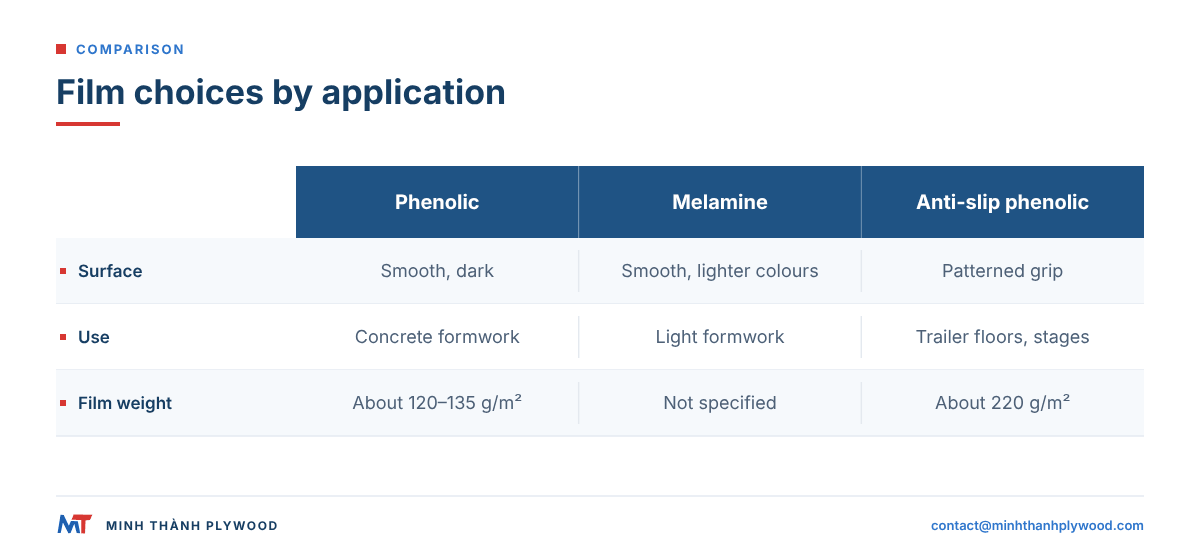
Three film types cover most orders: phenolic film for formwork, melamine film for lighter and coloured faces, and anti-slip film for floors and platforms.
| Film type | Surface | Typical use |
|---|---|---|
| Phenolic, brown or black | Smooth, hard, dark | Concrete formwork and shuttering |
| Melamine | Smooth, lighter colours | Light formwork, hoardings, furniture backs |
| Anti-slip phenolic | Wire-mesh, hexagon or rice-grain pattern, about 220 g/m² | Trailer floors, stages, platforms, walkways |
Anti-slip plywood is a separate product built on the same core; we make it on order. See our anti-slip plywood page for its patterns and uses.
Glue types and what they mean for reuse
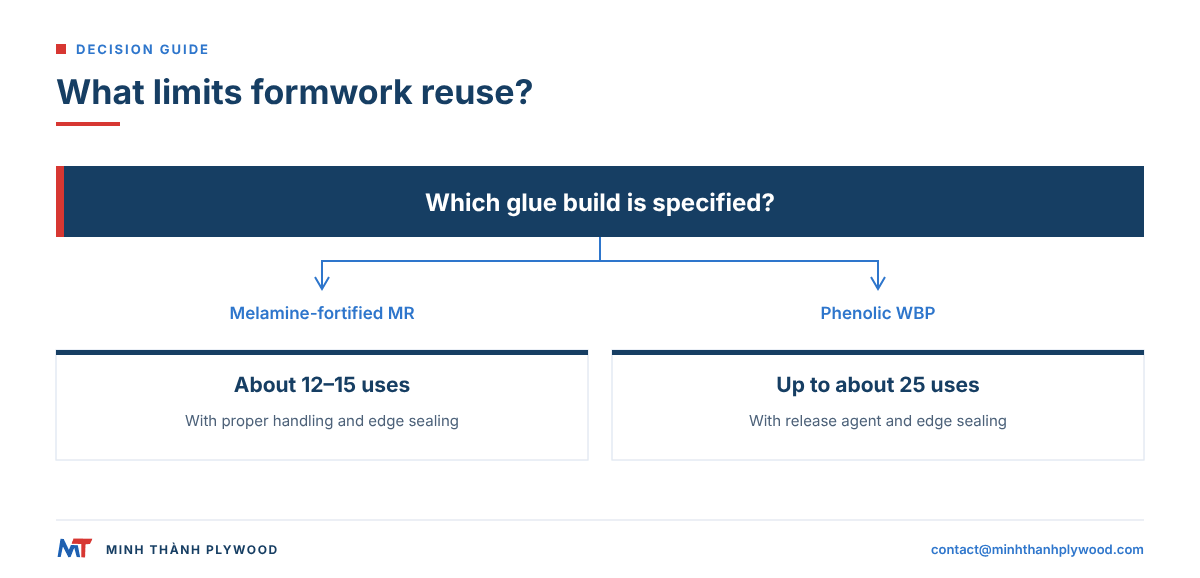
The glue sets how long the plies stay bonded through wet pours: melamine-fortified glue suits standard formwork, and phenolic (WBP) glue suits panels that must last the most pours. As an industry guide, melamine glue gives about 12–15 uses and phenolic up to about 25, with proper handling, release agent and edge sealing.
| Glue | Bond | Industry guide reuse | Fits |
|---|---|---|---|
| Melamine-fortified (MR) | Water-resistant | About 12–15 uses | Residential and standard formwork |
| Phenolic (WBP) | Weather- and boil-resistant | Up to about 25 uses | High-rise, repeated cycles, harsh sites |
Glue type and emission class are two separate specifications. A formwork panel is specified by its bond; furniture panels are specified by both bond and emission. In the US, the emission limit for veneer-core hardwood plywood is 0.05 ppm under 40 CFR 770.10.
In Europe, plywood bond quality is classed under EN 314-2 and plywood for dry, humid and exterior conditions under EN 636, both published by the European Committee for Standardization (CEN). A buyer who orders to a European class should name it on the order next to the glue type.
How many times can film faced plywood be reused?
Film faced plywood can be reused about 12–15 times with melamine-fortified glue and up to about 25 times with phenolic (WBP) glue, as an industry guide, with proper handling, release agent and edge sealing. Reuse is a target for a given build and site practice, not a fixed property of the sheet.
What decides the real number of pours:
- Film weight: heavier film wears through later.
- Glue: phenolic holds the plies longest.
- Core grade: a closed, graded core keeps the face flat.
- Release agent: applied before every pour.
- Edge sealing: reseal every cut edge on site.
- Handling and storage: no dropping on corners; store flat, covered and off the ground.
- Cleaning: clean with a soft scraper, never a steel blade that cuts the film.
What is film faced plywood used for?
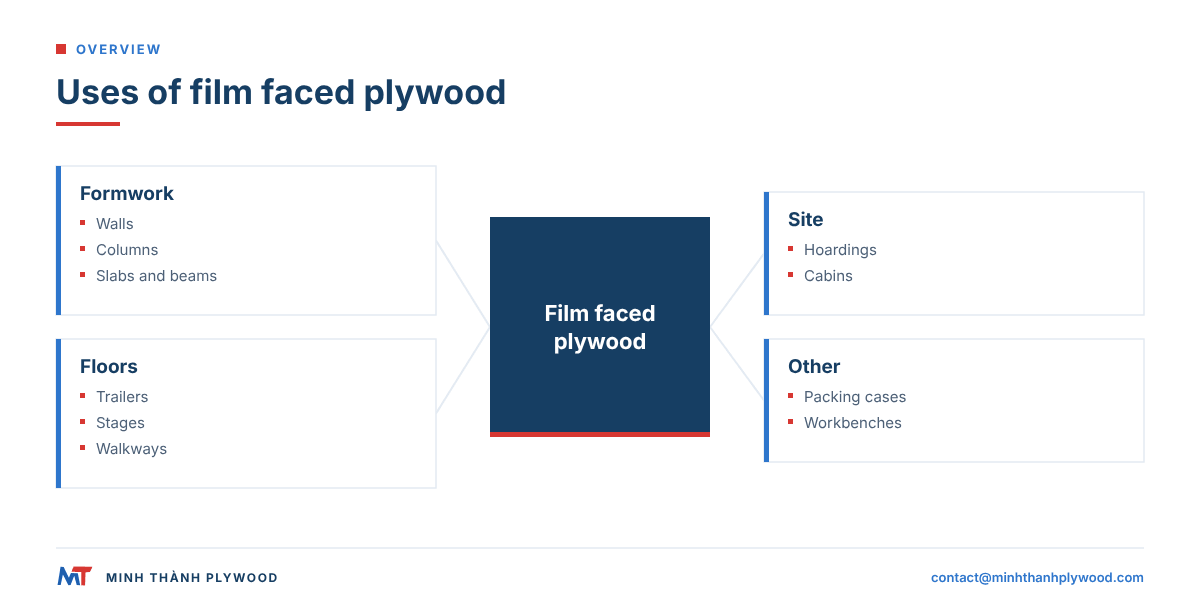
Film faced plywood is used mainly for concrete formwork and shuttering: wall forms, column forms, slab soffits, beams, stairs and foundations. Its water-resistant build also suits several uses beyond formwork.
| Use | Why film-faced plywood fits |
|---|---|
| Wall and column formwork | Smooth finish, stiff, reusable |
| Slab and beam soffits | Flat face under wet concrete load |
| Film faced shuttering for foundations | Water-resistant, easy to strip |
| Trailer and truck floors | Anti-slip film, hard-wearing |
| Site hoardings and fences | Weather-resistant, paintable with the right primer |
| Site cabins and temporary works | Fast to fix, easy to clean |
| Packing cases for heavy goods | Strong and water-resistant |
| Workshop benches and surfaces | Hard, wipe-clean face |
For panel sizes and thicknesses by job, see our sibling guide to film-faced plywood sizes and thickness.
Film faced shuttering plywood on site
Film faced shuttering plywood gives the best results when it is cut, sealed, oiled and stored correctly. Most early failures come from site handling, not from the panel.
- Cut with a fine-tooth blade to avoid chipping the film.
- Seal every cut edge and drilled hole with water-resistant edge paint the same day.
- Apply release agent evenly before each pour.
- Support the panel at the spacing the formwork design gives for its thickness.
- Strip carefully: use wedges or a soft bar, never a claw hammer on the film.
- Clean and stack flat after each pour, film to film, under cover.
On US sites the formwork itself falls under OSHA standard 1926.703, which covers requirements for cast-in-place concrete.
Is film faced plywood waterproof?
Film faced plywood is highly water-resistant but not fully waterproof: the film faces shed water and the phenolic (WBP) or melamine-fortified glue keeps the plies bonded, but water enters through bare edges, holes and damaged film. Sealed edges keep the panel water-resistant for its service life.
- Faces: the cured film resists water and concrete.
- Glue: water-resistant bonds do not delaminate in rain or wet concrete.
- Edges: the weak point; edge paint must be renewed after cutting.
- Damage: scratches and dents through the film let water into the veneer.
Our guide is plywood waterproof? explains what each glue type survives.
Can you paint film faced plywood? How to paint it
Yes, you can paint film faced plywood, but paint does not grip the smooth, cured film on its own; the face must be cleaned, abraded and primed first.
- Clean: wash off release agent, oil and dust with a degreaser; rinse and dry.
- Abrade: sand the film lightly with fine abrasive to dull the shine.
- Prime: apply a bonding primer made for plastics, laminates or glossy surfaces.
- Paint: apply two coats of exterior acrylic or a polyurethane paint.
- Edges: seal and paint the edges as well as the faces.
For hoardings and signs, many buyers order a lighter melamine film or plain exterior plywood and paint that instead.
Film faced plywood vs marine and commercial plywood
Film faced plywood is a formwork panel; marine plywood is a high-grade panel for boats; commercial plywood is an unfaced general-purpose panel. They are built for different jobs.
| Point | Film-faced | Marine | Commercial |
|---|---|---|---|
| Faces | Phenolic film | Durable hardwood veneer, no film | Hardwood veneer, no film |
| Glue | MR or WBP | WBP, to a marine standard | UF or MR |
| Main use | Formwork | Boats and marine work | Furniture backs, packing, interiors |
| Concrete release | Yes | No, unless oiled | No |
Our guides compare film-faced vs marine plywood and film-faced vs commercial plywood point by point.
Film faced plywood vs steel and aluminium formwork
Film faced plywood is the cheapest formwork face to buy and the lightest to carry by hand; steel and aluminium systems win only where the same layout repeats for hundreds of pours. A published guide puts plywood at 7 to 50 uses, aluminium at 150 to 300 and steel at 200 to 500 (Rapid Scaffold, checked on 21 October 2026).
| Point | Film-faced plywood | Aluminium | Steel |
|---|---|---|---|
| Uses (published guide) | 7 to 50; 12–15 to about 25 on our industry guide | 150 to 300 | 200 to 500 |
| Weight | About 10.4–11.7 kg/m² at 18 mm (computed from 580–650 kg/m³) | About a third of steel | Heaviest |
| Upfront cost | Lowest | High | Medium to high |
| Cutting on site | Saw and nails | Not cut | Not cut |
| Concrete finish | Smooth, fair-faced when new | Smooth | Smooth, shows panel joints |
| Best fit | Varied shapes, small and mid-size jobs | Repeated floors | Repeated large walls |
Plywood suits irregular shapes because carpenters cut it to fit. A fair-faced finish from film panels lets a crew skip a plastering coat, and one maker credits that with a 30 % shorter finishing period (Teconform, checked on 21 October 2026). Treat that as the maker’s figure, not a guarantee.
How to choose a film faced plywood manufacturer in Vietnam
Choose a film faced plywood manufacturer in Vietnam by the build it quotes and proves, not by the name on the stamp. Vietnamese mills serve different segments, from premium film-faced with graded cores and heavy film to budget panels with lower-grade cores.
Buyer checklist before you order:
- Core species and grade: Acacia or Eucalyptus; graded, closed core.
- Glue: melamine-fortified or phenolic (WBP), named on the quote.
- Film: maker, weight in g/m² and colour.
- Thickness tolerance: ±0.5 mm for film-faced.
- Reuse target: stated with the conditions of use.
- Edge sealing: colour and paint type.
- Documents: certificate of origin, phytosanitary and fumigation certificates, and test reports for the agreed build.
- Proof: loading photos and video of your shipment before it leaves.
- Quality system and testing: we work under ISO 9001:2015 for plywood manufacturing, and third-party testing to your method, such as a boil or bond test to EN 314-2, is arranged through SGS on request.
For EU buyers, plywood under heading 4412 is a relevant product of the EU Deforestation Regulation, Regulation (EU) 2023/1115, so ask the mill for origin records with the order.
Our guide to selecting a film faced plywood supplier expands each point, and our film faced plywood price guide explains what moves the price.
What this means for your order
To order film-faced plywood, specify core, glue, film and thickness first, then size, packing and destination. Send these lines with your request:
- Application: wall, column or slab formwork; floors in anti-slip film; or other uses.
- Core: Acacia or Eucalyptus.
- Glue: melamine-fortified or phenolic (WBP).
- Film: weight from about 120 g/m², colour, and anti-slip pattern if needed.
- Size and thickness: 1220 × 2440 mm or 1250 × 2500 mm; 12, 15, 18 or 21 mm, to ±0.5 mm.
- Packing and quantity: from one 40HC; a 40HC of premium film-faced plywood carries about 43 m³ on Eucalyptus core or 47 m³ on Acacia.
Every shipment is photographed and filmed before loading, production takes 15–45 days after the deposit, and free samples are available. Request a quote on our film-faced plywood page, or read about phenolic coated plywood and F17 formply grades.
Buyer questions, answered
What is film faced plywood?
Film faced plywood is plywood with a resin-impregnated paper film pressed onto both faces and water-resistant glue between the plies. It is made for concrete formwork, where the film gives a smooth concrete surface and lets the panel be reused.
What is film faced plywood used for?
Mainly concrete formwork and shuttering for walls, columns, slabs and beams. It is also used for trailer and truck floors (in anti-slip film), hoardings, site cabins, packing cases and workshop surfaces.
Is film faced plywood waterproof?
The film faces shed water and the phenolic (WBP) or melamine-fortified glue keeps the plies bonded when wet, so it is highly water-resistant. The cut edges are the weak point and must be sealed with edge paint.
How many times can film faced plywood be reused?
As an industry guide, about 12–15 uses with melamine-fortified glue and up to about 25 with phenolic (WBP) glue, with proper handling, release agent and edge sealing.
Can you paint film faced plywood?
Yes, but the film is smooth and non-porous, so paint does not key to it on its own. Clean and degrease the face, abrade it lightly, apply a bonding primer for plastics or laminates, then the topcoat.
What is the difference between film faced plywood and shuttering plywood?
Usually none. Shuttering plywood is the name for plywood used in concrete formwork, and film faced plywood is the most common type of it. Unfaced plywood is also sometimes used as shuttering for rough work.
What colour is film faced plywood?
Brown and black are the most common film colours, with red and other colours on order. Colour does not set quality; film weight, glue and core do.
What thickness does film faced plywood come in?
Formwork panels are most often 12, 15, 18 and 21 mm, in 1220 × 2440 mm or 1250 × 2500 mm sheets. Our film-faced plywood is made to a ±0.5 mm thickness tolerance.
What is the film weight on film faced plywood?
Standard film is about 120–135 g/m², with premium film from 135 g/m². Anti-slip film for floors is about 220 g/m² with a wire-mesh or hexagon pattern.
Is film faced plywood the same as marine plywood?
No. Film faced plywood is a formwork panel with film faces; marine plywood is a high-grade panel made to a marine standard for boats, with durable veneers and no core gaps.
What core is used in film faced plywood?
In Vietnam, film-faced panels use Acacia or Eucalyptus cores. Higher grades use a graded, closed core; budget grades use lower-grade core veneers.