
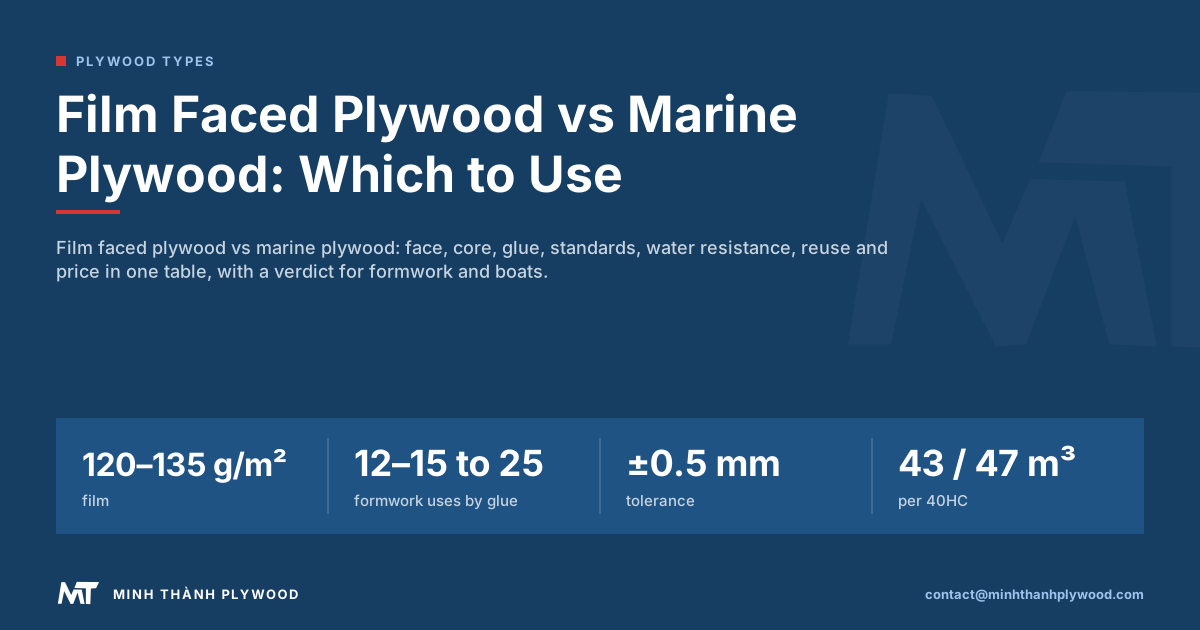
In film faced plywood vs marine plywood, the job decides: film-faced plywood is a formwork panel with phenolic film on both faces, made to be poured against, stripped and reused; marine plywood is a high-grade veneer panel made to a marine standard for boats and constant wet exposure. Minh Thanh Plywood makes film-faced plywood in Vietnam. This guide compares the two point by point and gives a verdict by job.
Film faced plywood vs marine plywood: the quick verdict
Choose film faced plywood for concrete formwork and wet site work, and marine plywood for boats and parts that stay wet for years. The two share a water-resistant glue, but their faces, cores and standards serve different jobs.
- Film faced plywood: phenolic film on both faces, Acacia or Eucalyptus core in Vietnam, melamine-fortified or phenolic (WBP) glue. Built to be poured against, stripped and reused.
- Marine plywood: no film, durable hardwood veneers, void-free core, boil-proof glue, made to a marine standard such as BS 1088. Built for boats and constant wet exposure.
If the job is concrete, film-faced is the panel. If the job floats, marine is.
Film faced plywood in one screen
Film faced plywood is plywood with a resin-impregnated paper film, usually phenolic, pressed onto both faces and bonded with water-resistant glue. The film gives a smooth, hard face that releases from concrete and sheds water.
| Point | Film-faced plywood |
|---|---|
| Faces | Phenolic film, about 120–135 g/m²; premium from 135 g/m² |
| Core | Acacia or Eucalyptus veneers |
| Glue | Melamine-fortified (MR) or phenolic (WBP) |
| Edges | Sealed with water-resistant paint |
| Thickness tolerance | ±0.5 mm (our film-faced line) |
| Reuse (industry guide) | About 12–15 uses with melamine glue; up to about 25 with phenolic, with proper handling, release agent and edge sealing |
Our sibling guide what is film-faced plywood? covers the build, film types and uses in full.
Marine plywood in one screen
Marine plywood is high-grade plywood made from durable hardwood veneers with boil-proof glue and a core free of gaps, to a marine standard such as BS 1088. It has no film; its faces are sanded veneer that can be varnished, painted or epoxy-coated.
- Veneers: durable species such as okoume or meranti, with limited defects on face and back.
- Core: no gaps or overlaps, so water cannot collect inside and the panel does not soften over voids.
- Glue: a weather- and boil-proof bond.
- Standard: BS 1088 is the common British marine plywood standard; buyers ask for test or inspection papers that show the panel meets it. It sets face and back veneer thickness at 1.3–3.8 mm on multi-ply panels and about 0.5 mm on three-ply (plywood.cc, BS 1088 comparison, checked on 21 October 2026). Australia sells marine plywood to AS/NZS 2272.
- Classes: the BSI listing for BS 1088:2018 describes two classes, standard and lightweight, made from untreated tropical hardwood veneers (BSI, checked on 20 October 2026).
- Uses: boat hulls, decks, transoms, docks and permanently wet parts.
Our marine plywood buying guide explains how to check a marine claim before you order.
Key differences at a glance
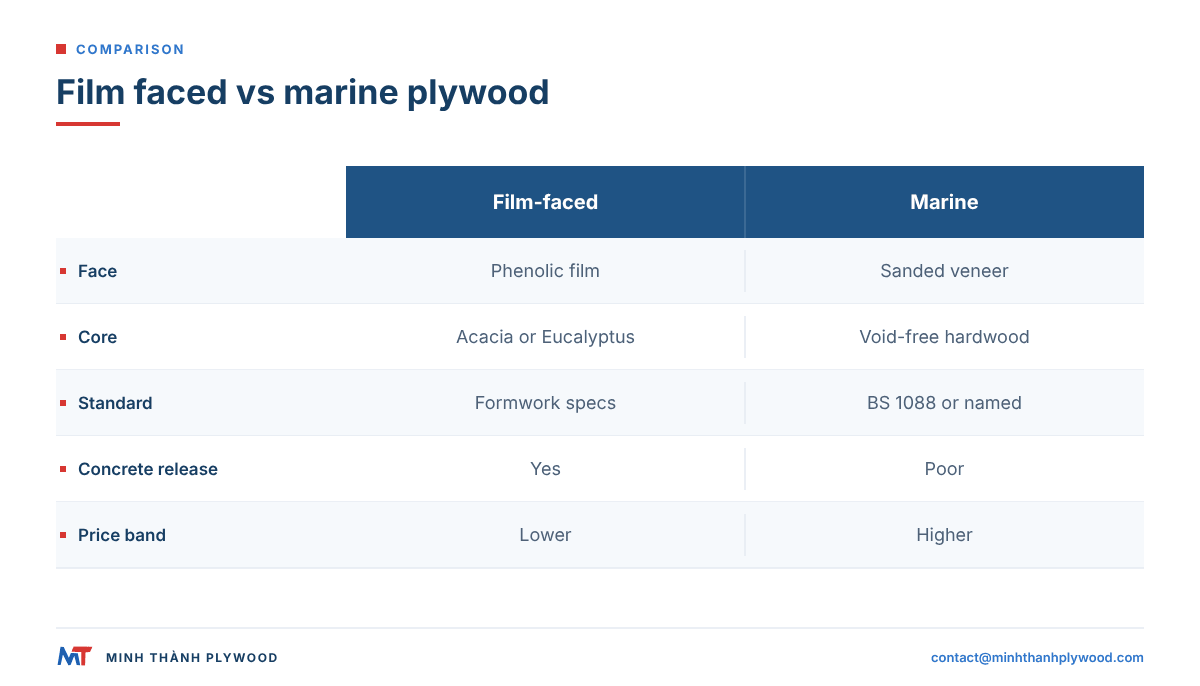
The table compares film faced and marine plywood on one metric per row: face, core, glue, standard, water behaviour, reuse, finish and price band.
| Metric | Film-faced plywood | Marine plywood |
|---|---|---|
| Face | Phenolic film on both faces | Sanded durable veneer, no film |
| Core | Acacia or Eucalyptus veneers | Durable hardwood, void-free |
| Glue | Melamine-fortified or phenolic (WBP) | Boil-proof, to the marine standard |
| Standard | Formwork specifications by market | Marine standard such as BS 1088 |
| Water on faces | Film sheds water | Veneer needs a coating |
| Edges | Must be sealed | Must be sealed |
| Concrete release | Yes, with release agent | Poor; concrete grips veneer |
| Reuse in formwork | About 12–15 to 25 uses by glue; plan 60–80 % of that on a mixed crew | Few uses; not made for it |
| Boats | Not suitable | Made for it |
| Price (UAE, 18 mm) | Vietnam FOB about US$380–520/m³ before freight and duty | Shelf listings about AED 119–163 per 4 × 8 ft sheet |
The decisive rows are the face and the standard. Film is the reason formwork lasts many pours; the marine standard is the reason a boat lasts years in water.
Water resistance is not one property
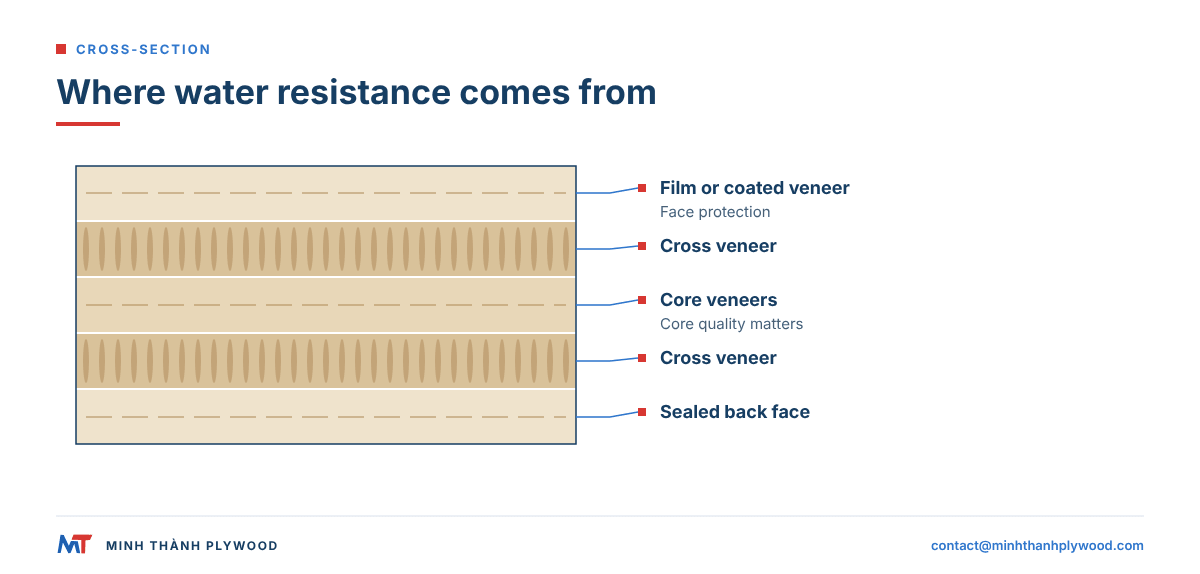
Water resistance in plywood comes from three separate parts: the glue bond, the faces and the core. Film faced and marine plywood are both water-resistant, but in different parts: film faced panels rely on sealed film faces and a water-resistant bond for repeated site wetting, marine plywood on durable veneers, a void-free core and boil-proof glue for constant exposure.
| Part | Film-faced plywood | Marine plywood |
|---|---|---|
| Glue bond | Water-resistant; phenolic is boil-proof | Boil-proof |
| Faces | Film seals the faces | Veneer needs varnish, paint or epoxy |
| Core | Hardwood veneers; quality by grade | Void-free, durable species |
| Long wet exposure | Site cycles, not permanent immersion | Built for permanent exposure |
So “is film faced plywood waterproof?” has a precise answer: the faces and glue resist water through repeated pours and rain, but the panel is not built for years in water, and its edges must stay sealed. Our guide is plywood waterproof? explains each glue class.
Adhesive and bond class
Both panels can use a phenolic (WBP-type) bond, so the glue alone does not make a panel marine. Film faced plywood is also made with melamine-fortified glue for standard formwork.
- Melamine-fortified (MR): water-resistant; about 12–15 formwork uses as an industry guide.
- Phenolic (WBP): weather- and boil-proof; up to about 25 formwork uses as an industry guide.
- Marine bond: boil-proof, with bond tests set by the marine standard.
European specifications put a number on the bond. A melamine-fortified (MUF) panel is EN 314-2 Class 2, sold as EN 636-2 for humid conditions; a phenolic (WBP) panel is Class 3, sold as EN 636-3 for exterior conditions. An engineer who writes EN 636-3 is excluding the melamine panel, so ask the mill for the EN 636 line on the data sheet. Film colour is not bond class: a dark film can sit on either glue.
Hot pressing differs by glue: melamine glue presses at about 110–120 °C and phenolic at about 130–145 °C. Glue type and emission class are two separate specifications; formwork is bought on bond.
Standards and documents to request
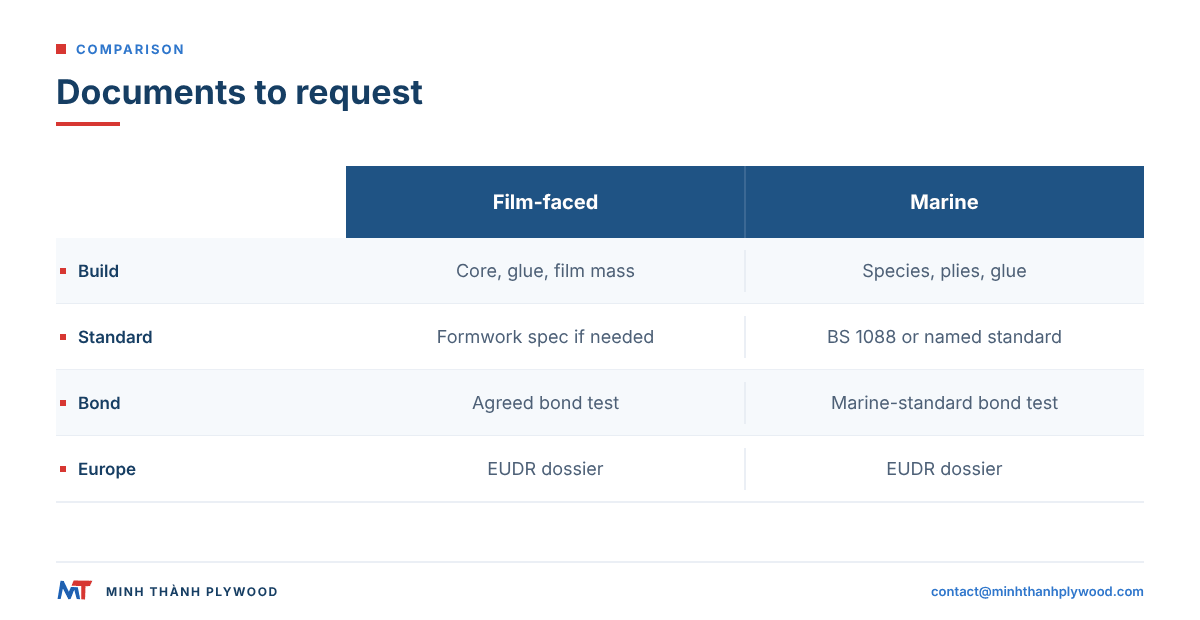
For marine plywood, ask for proof that the panel meets the marine standard it is sold under, such as BS 1088; for film faced plywood, ask for the build: core, glue, film weight, tolerance and reuse target.
| Document | Film-faced plywood | Marine plywood |
|---|---|---|
| Build sheet | Core, glue, film g/m², thickness, tolerance | Species, ply count, glue |
| Standard | Market formwork specification if required | BS 1088 or the named marine standard |
| Bond test | Boil or bond test for the agreed glue | Bond test to the marine standard |
| Shipping papers | Certificate of origin, phytosanitary, fumigation | Same |
| European orders | EUDR compliance dossier (origin records and geolocation files) | Same |
EN 636-3 is the European specification for plywood in exterior conditions, a wider class than marine. The BSI catalogue lists BS EN 636:2012+A1:2015 for plywood in dry, humid or exterior conditions (BSI, checked on 20 October 2026). A panel can meet an exterior class without meeting a marine standard.
For European orders, the Commission’s EUDR page gives 30 December 2026 as the start date for large and medium operators (European Commission, checked on 8 October 2026).
When to choose film faced plywood
Choose film faced plywood when the panel will be poured against, stripped, cleaned and reused, or when it needs a hard, wipe-clean face on site.
- Wall and column formwork: smooth finish, easy stripping.
- Slab and beam soffits: flat face under wet concrete.
- Foundations and shuttering: water-resistant, reusable.
- Trailer and truck floors: anti-slip film, about 220 g/m².
- Site hoardings and cabins: weather-resistant faces.
- Packing cases for heavy goods: strong and water-resistant.
Our film-faced plywood is made in 1220 × 2440 mm and 1250 × 2500 mm sheets, to ±0.5 mm.
When to choose marine plywood
Choose marine plywood when the panel stays wet for long periods, carries a structural load in water, or must meet a marine standard by contract.
- Boat hulls, decks and transoms.
- Docks, pontoons and jetty parts.
- Boat interiors and lockers where a varnished veneer face is wanted.
- Outdoor parts with permanent exposure, coated and edge-sealed.
For these jobs, a formwork panel is the wrong choice, however good its glue. Buy marine plywood from a supplier that can show it meets the marine standard named on the order.
Can marine plywood be used for concrete formwork?
Marine plywood can be used for concrete formwork, but it is rarely the right choice: it has no release film, so concrete grips the veneer, the finish is rougher and the face wears after few pours, and it costs more than film-faced plywood.
| Point | Marine plywood as formwork | Film-faced plywood as formwork |
|---|---|---|
| Release | Needs heavy oiling | Film plus release agent |
| Concrete finish | Shows grain | Smooth |
| Pours | Few | About 12–15 to 25 by glue, with proper handling |
| Cost per pour | High | Low |
If a specification calls for “marine plywood” for formwork, it usually means a water-resistant formwork panel. Ask the engineer whether film-faced plywood with phenolic glue meets the intent.
Can film faced plywood be used for boats?
No, film faced plywood should not be used for boats. It is not made to a marine standard: its core is graded for formwork, not guaranteed void-free, and its veneers are not chosen for durability in constant wet exposure.
- Core gaps can hold water and rot from inside.
- Film is hard to bond to with epoxy and paint without careful preparation.
- Weight: Eucalyptus and Acacia cores are heavier than the okoume used in many marine panels.
For a boat, buy marine plywood. For a boat trailer floor, anti-slip film-faced plywood fits well.
Is there film faced marine plywood?
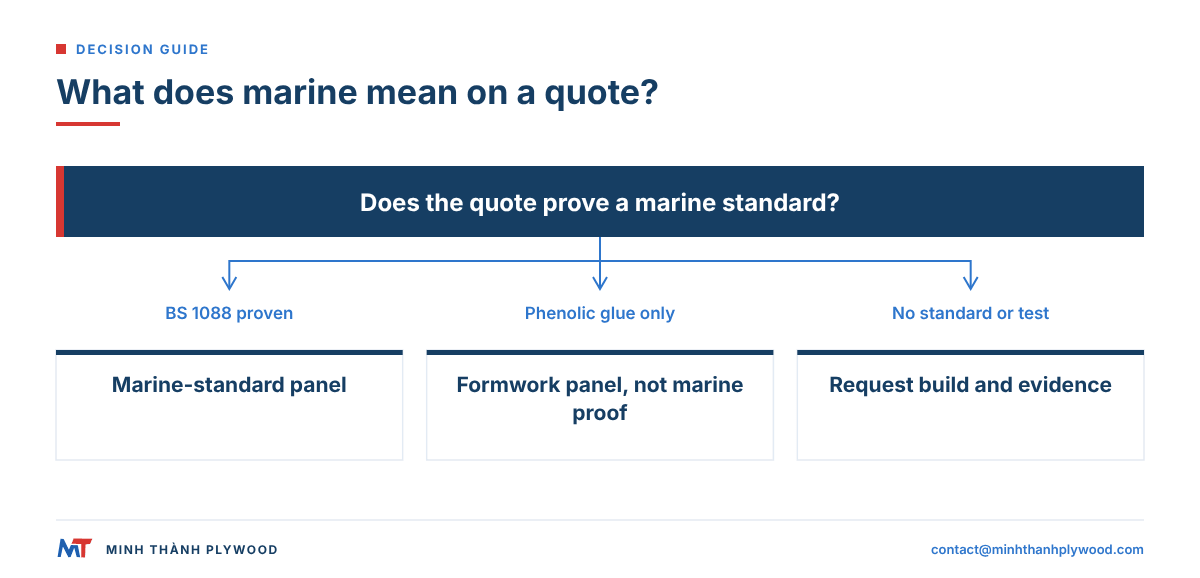
“Film faced marine plywood” is a trade name used in some markets, including the Gulf and parts of Africa and Asia, for film-faced plywood with phenolic (WBP) glue. It is a formwork panel with a water-resistant bond, not marine plywood made to BS 1088.
When a quote says “film faced marine plywood”, read the build line:
- Glue: phenolic (WBP) or melamine-fortified.
- Core: species and grade.
- Film: weight in g/m² and colour.
- Standard: whether any marine standard is actually named and proven.
Buying by build line rather than by name avoids paying for a word the panel does not meet, or getting a melamine panel where a phenolic one was expected.
Price band and cost per use
Film faced plywood is usually cheaper per sheet than marine plywood made to BS 1088, and far cheaper per pour in formwork. Marine plywood’s price pays for durable veneers, a void-free core and inspection that formwork does not need.
For a UAE buyer the two numbers sit on different rungs. Vietnamese film-faced plywood is quoted at about US$380–520/m³ FOB Hai Phong in early 2026 (Vinawood statistics, checked on 21 October 2026). An 18 mm sheet of 1220 × 2440 mm is 0.0536 m³, so that is about US$20–28 per sheet as a raw FOB example before freight, duty and margin.
UAE shelf listings for 18 mm BS 1088 marine plywood run from AED 118.75 before VAT (FEPY) to AED 162.75 with VAT (Blue Rhine), checked on 21 October 2026.
Listings differ on VAT and brand, so treat them as a band, not a quote. At the 3.6725 dirham peg the band is about US$32–44.
| Cost point | Film-faced plywood | Marine plywood |
|---|---|---|
| Sheet price, 18 mm, 4 × 8 ft | About US$20–28 raw FOB from Vietnam (computed) | About AED 119–163 on UAE shelves |
| Formwork pours | Many | Few |
| Cost per pour | Low | High |
| Boat service life | Not suitable | Years with coating |
For formwork, compare cost per pour: sheet price divided by the pours your site achieves. Our film faced plywood price guide explains what moves the sheet price.
Can both be used outdoors?
Yes, both can be used outdoors with sealed edges, but for different exposure. Film faced plywood suits site work and hoardings that face rain for months; marine plywood suits parts exposed for years or kept wet.
- Film faced outdoors: hoardings, site cabins, temporary floors, ramps; seal cut edges and holes.
- Marine outdoors: docks, boat parts, permanently wet structures; coat faces and seal edges.
- Both: store flat and covered before use.
For general outdoor building such as sheathing and stair treads, exterior plywood with a water-resistant bond is often the cost-effective middle choice; see our exterior plywood page.
How to specify the right panel
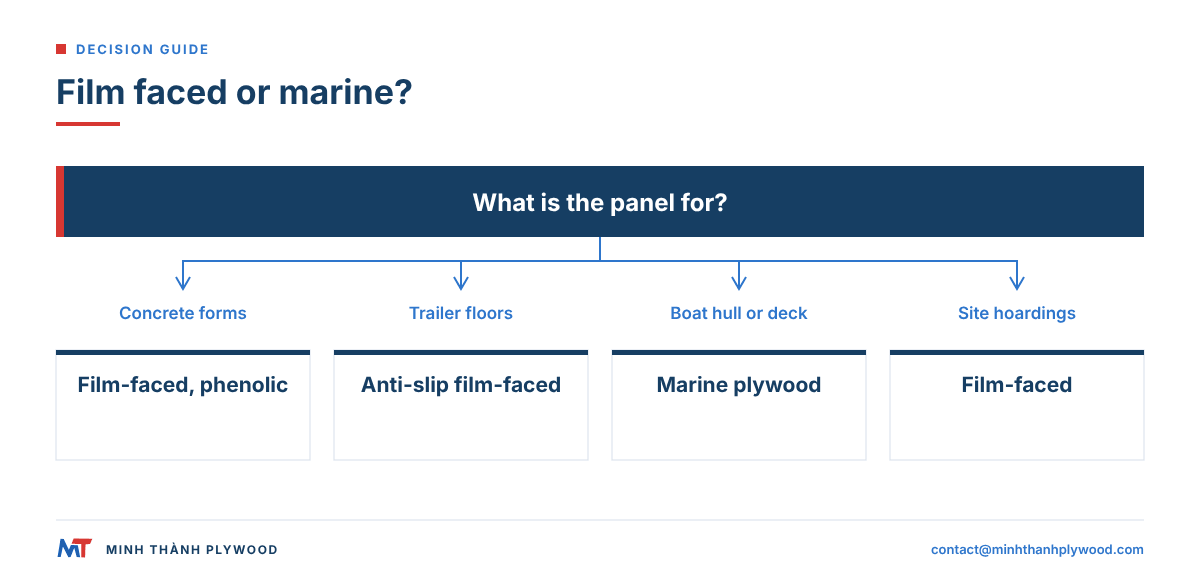
Specify by the job first, then the build: a formwork order names glue, film and tolerance; a marine order names the standard and the species.
| Job | Panel | Specification line |
|---|---|---|
| Wall and column forms | Film-faced | Phenolic (WBP), 18 mm, film from 135 g/m², ±0.5 mm |
| Slab forms, standard cycles | Film-faced | Melamine-fortified, 15 or 18 mm, film about 120–135 g/m² |
| Trailer floors | Anti-slip film-faced | Phenolic, anti-slip film about 220 g/m² |
| Boat hull or deck | Marine | BS 1088 or the named standard, species and thickness |
| Dock or pontoon | Marine | Marine standard, coated faces, sealed edges |
What this means for your order
For formwork and site work, order film-faced plywood by its build line. Send these lines with your request:
- Application: wall, column or slab forms, trailer floors or site work.
- Core: Acacia or Eucalyptus.
- Glue: melamine-fortified or phenolic (WBP).
- Film: weight from about 120 g/m², colour, and anti-slip pattern if needed.
- Size and thickness: 1220 × 2440 mm or 1250 × 2500 mm, to ±0.5 mm.
- Packing and quantity: from one 40HC; a 40HC of premium film-faced plywood carries about 43 m³ on Eucalyptus core or 47 m³ on Acacia.
Production takes 15–45 days after the deposit, every shipment is photographed and filmed before loading, and free samples are available. Request a quote on our film-faced plywood page, or compare film-faced vs commercial plywood for unfaced alternatives.
Buyer questions, answered
What is the difference between film faced plywood and marine plywood?
Film faced plywood has phenolic film on both faces and is made for concrete formwork. Marine plywood has no film; it is made from durable veneers with no core gaps and boil-proof glue to a marine standard such as BS 1088, for boats and constant wet exposure.
Is film faced plywood waterproof?
Film faced plywood is highly water-resistant: the film sheds water and the phenolic (WBP) or melamine-fortified glue holds the plies when wet. Its cut edges must be sealed, because water enters there.
Can marine plywood be used for concrete forms?
It can, but it is rarely worth it. Marine plywood has no release film, so concrete grips the veneer, the finish is rougher and the panel wears faster unless it is oiled, and it costs more than film-faced plywood.
Which is cheaper, film faced or marine plywood?
Film faced plywood is usually cheaper than marine plywood made to BS 1088, because marine plywood needs higher-grade, durable veneers, a void-free core and tighter inspection.
When should I choose film faced instead of marine?
Choose film faced plywood for concrete formwork, shuttering, site hoardings, trailer floors in anti-slip film and other wet site work where a hard, reusable face matters more than marine certification.
Do film faced panels still need edge sealing?
Yes. Film covers the faces only, so every cut edge and drilled hole must be sealed with water-resistant edge paint to stop water entering the core.
Can film faced plywood be used for boats?
No. Film faced plywood is not made to a marine standard; its core may contain gaps, and its veneers are not chosen for durability in constant wet exposure. Boats need marine plywood.
What is film faced marine plywood?
It is a trade name used in some markets for film-faced plywood with phenolic (WBP) glue. It is a formwork panel with a water-resistant bond, not marine plywood made to BS 1088.
Is WBP the same as marine plywood?
No. WBP describes the glue bond, weather- and boil-proof. Marine plywood uses a WBP-type bond but also needs durable veneers, a void-free core and face rules set by its marine standard.
Can both be used outdoors?
Yes, with sealing. Film faced plywood suits outdoor site work and hoardings; marine plywood suits permanent exposure such as docks and boat parts. Both need sealed edges and fixings.